Home › Past questions › JAMB › Literature in English › 1983 45 questions. Try each one, then open the answer to check yourself and read the explanation.
Sign up free to answer these questions on a CBT screen with a timer, then see your score and every answer explained.
Start practising free
Question 1 Set Text: Julius Caesar Marcus Antonius roused the public to mutiny in his funeral speech in Julius Caesar partly because he succeeded in discrediting Brutus and Cassius by calling them 'honourable men', when in fact he consciously organized his speech to prove that they were dishonourable. This device is known as
A. allegory B. hyperbole C. irony D. contrast E. parallelism. Show the answer and explanation Answer: C (irony )
Explanation Antony says "honourable" while meaning the opposite: that is irony.
Open this question
Question 2 Set Text: Julius Caesar From Julius Caesar (Shakespeare) These lines were spoken by
A. Cassius before the corpse of Brutus B. Cassius before the corpse of Caesar C. Brutus before the corpse of Cassius D. Titinius before the corpse of Cato E. Brutus before the corpse of Portia. Show the answer and explanation Answer: C (Brutus before the corpse of Cassius )
Explanation At Philippi Brutus finds Cassius dead by his own sword and feels Caesar's spirit is still turning their swords against them.
Open this question
Question 3 Set Text: Julius Caesar Caesar's ghost appears to Brutus
A. just as he is about to surrender to Antony B. as he is about to leave the forum after the assassination of Caesar C. just as he is about to address his fellow citizens D. after Cassius and Brutus have resolved their differences E. before Brutus receives the news of his wife's death. Show the answer and explanation Answer: D (after Cassius and Brutus have resolved their differences )
Explanation The ghost visits Brutus in his tent after the quarrel with Cassius has been settled (and after he learns of Portia's death).
Open this question
Question 4 Set Text: Julius Caesar 'Night hangs upon mine eyes; my bones would rest, that have but laboured to attain this hour'. Brutus' words in the above lines come
A. after the conclusion of the plan to kill Caesar B. soon after his wife's insistent demand to know the object of his unusual brooding C. as part of his famous address to his fellow Romans D. during a brief meeting between him and Cassius on how to counter the forces of Octavius and Antony E. after his defeat by the forces of Octavius and Antony. Show the answer and explanation Answer: E (after his defeat by the forces of Octavius and Antony. )
Explanation Brutus speaks these tired words at Philippi, after his army is beaten and just before he kills himself.
Open this question
Question 5 Set Text: Julius Caesar From Julius Caesar (Shakespeare) This is a statement made by
A. Antony, urging Caesar to take the crown B. Cassius, urging Brutus to join in the struggle to remove Caesar before he grows into a tyrant C. Brutus, urging that Cassius and himself lead out their forces to meet those of Antony and Octavius at Philippi D. Casca, urging that the conspirators explain their cause to the populace before their motives are misunderstood E. Messala, urging Titinius to search for Pindarus. Show the answer and explanation Answer: C (Brutus, urging that Cassius and himself lead out their forces to meet those of Antony and Octavius at Philippi )
Explanation Brutus argues that they must seize the moment ("the tide") and march to Philippi.
Open this question
Question 6 Other Set Texts: African Drama Most of the information in the Trials of Brother Jero is conveyed when Brother Jero speaks to himself in dramatic monologues otherwise known as a
A. stream of consciousness technique B. personal conversation C. dialogue D. narration E. soliloquy. Show the answer and explanation Answer: E (soliloquy. )
Explanation Speaking one's thoughts aloud alone on stage is a soliloquy.
Open this question
Question 8 Other Set Texts: African Drama The hero of The Trials of Brother Jero is
A. Amope B. the Old Prophet C. the Politician D. Brother Chume E. Brother Jero. Show the answer and explanation Answer: E (Brother Jero. )
Explanation The play centres on the beach prophet Brother Jero.
Open this question
Question 9 Other Set Texts: African Drama Soyinka's main concern in The Trials of Brother Jero is to
A. expose the corrupt politicians in the society B. expose the religious charlatans in the society C. expose women's power to seduction D. condemn men who beat their wives E. show the significance of religion in our lives. Show the answer and explanation Answer: B (expose the religious charlatans in the society )
Explanation Jero is a fake prophet who cheats his followers; the play satirises such religious frauds.
Open this question
Question 10 Other Set Texts: African Drama Brother Jero himself identifies ONE of the following as his main weakness
A. Avarice B. Treachery C. Lustfulness D. Self-doubt E. Hypocrisy. Show the answer and explanation Answer: C (Lustfulness )
Explanation Jero admits his weakness is the "daughters of Eve": women.
Open this question
Question 12 African Poetry The poem 'When a Strainer Takes in Water' is
A. a dirge B. an incantation C. an ode D. a lullaby E. a ballad. Show the answer and explanation Answer: B (an incantation )
Explanation It is a Yoruba magical chant meant to make something happen: an incantation.
Open this question
Question 13 African Poetry In addition to describing scenes of an African village night, Senghor's poem, 'Nuit de Sine' makes a definite statement about
A. black soldiers killed in Europe B. fishermen diving in the sea C. technological development in Africa D. population movement from rural to urban centres E. communicating with dead ancestors. Show the answer and explanation Answer: E (communicating with dead ancestors. )
Explanation The poet asks to listen to the ancestors and speak with the dead in the village night.
Open this question
Question 14 African Poetry From Awoonor's 'More Message' A poetic device consciously used by Awoonor in these lines (from More Message) is
A. apostrophe B. alliteration C. simile D. onomatopoeia E. personification. Show the answer and explanation Answer: B (alliteration )
Explanation "Full fish following our fathers' footprints" repeats the "f" sound.
Open this question
Question 16 African Poetry The 'run on' lines in J.P. Clark's poem, 'Night Rain', suggest the
A. poet's ignorance of punctuation rules B. long duration of that night C. intensity of the darkness of that night D. deep, soothing sleep of the poet under the night rain E. continuous pouring down of the night rain. Show the answer and explanation Answer: E (continuous pouring down of the night rain. )
Explanation Lines that flow on without stopping copy the steady, unbroken fall of the rain.
Open this question
Question 17 African Poetry In 'Fulani Cattle', the poet expresses
A. his belief that cattle are meant to be slaughtered by men B. regret that there will soon not be enough cattle to go round C. the idea that cattle are created strong to enable them endure the long journey from the North to the South D. sympathy for the cattle that are driven from the North to the South of Nigeria to be slaughtered E. admiration for the sharp knife with which the cattle are slaughtered. Show the answer and explanation Answer: D (sympathy for the cattle that are driven from the North to the South of Nigeria to be slaughtered )
Explanation The poet is moved by the cattle walking patiently all the way south to be killed.
Open this question
Question 18 African Poetry In the poem, 'The Cathedral', Kofi Awoonor expresses
A. sorrow at the disappearance of his village B. his feeling about traditional religion C. disapproval of the change from Africa's past life to the present and the modern D. anger at slavery and colonialism E. his approval for the building of a cathedral in his village. Show the answer and explanation Answer: C (disapproval of the change from Africa's past life to the present and the modern )
Explanation The old tree that sheltered the village is cut down and a huge cathedral put in its place: Awoonor regrets the change.
Open this question
Question 19 African Poetry 'The Fence' (Lenrie Peters) is a
A. lyrical poem which celebrates the beauty of fences B. dramatic poem in which the poet demonstrates how to overcome problems C. moral poem which deals with the poet's dilemma D. free verse which teaches us how to sit on the fence E. free verse which says sitting on the fence is admirable. Show the answer and explanation Answer: C (moral poem which deals with the poet's dilemma )
Explanation The speaker is caught on the fence between choices: a moral dilemma.
Open this question
Question 20 African Poetry The overall mood conveyed in Wole Soyinka's poem, 'Night', can be accurately described as
A. calm B. agitated C. cheerful D. aggressive E. uneasy. Show the answer and explanation Answer: B (agitated )
Explanation The speaker is disturbed and anxious, begging night to hide him.
Open this question
Question 21 Set Text: Animal Farm In Animal Farm, Boxer represents the dedicated worker who serves the revolutionary cause to the best of his ability and is
A. gently consigned to obscurity in the end B. justly rewarded in the end C. unfairly, ruthlessly treated in the end D. given national honours in the end E. allowed a graceful retirement in old age. Show the answer and explanation Answer: C (unfairly, ruthlessly treated in the end )
Explanation When Boxer collapses, Napoleon sells him to the horse slaughterer.
Open this question
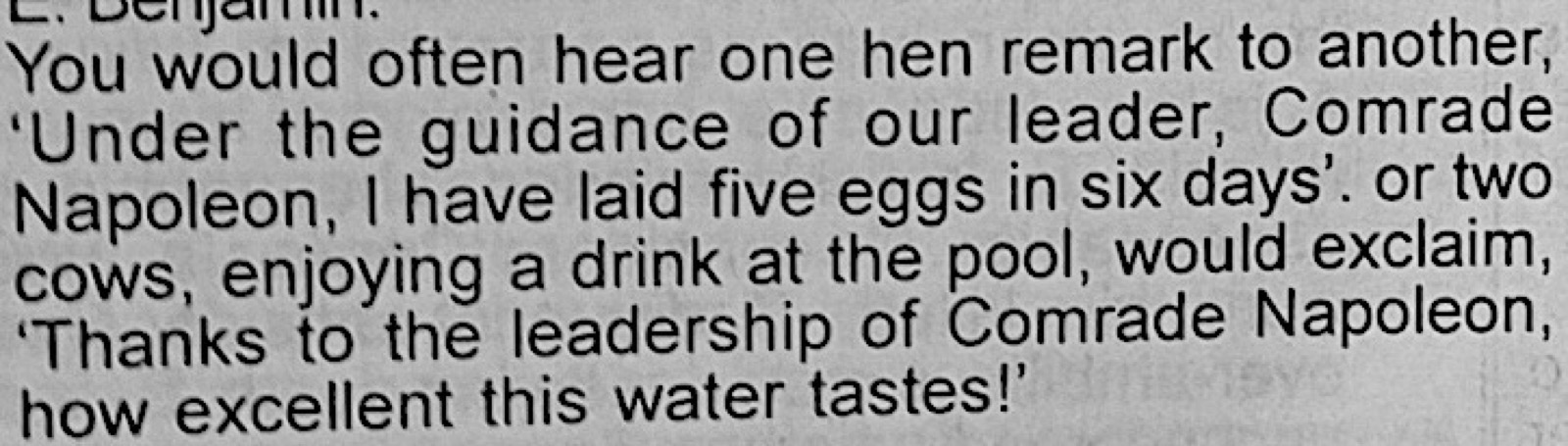
Question 22 Set Text: Animal Farm From Animal Farm (George Orwell) In this passage taken from Animal Farm, the truth is that the
A. cause of the hens' death is unknown B. official explanation given is unacceptable C. issue is not worth considering D. official explanation is acceptable E. hens died of old-age. Show the answer and explanation Answer: B (official explanation given is unacceptable )
Explanation The hens died because Napoleon stopped their food when they rebelled; "coccidiosis" is a cover story.
Open this question
Question 23 Set Text: Animal Farm Animal Farm is a fable illustrating the inevitable degeneration of revolutionary ideals. According to the novel, this degeneration occurs because
A. social equality, the goal of such idealism, is actually undesirable B. revolutionary ideals are dreamed by blood-thirsty individuals C. man's greedy individualistic nature always subverts the realization of ideals D. revolutionary ideals are inimical to progress E. animals are the wrong characters to illustrate man's weaknesses. Show the answer and explanation Answer: C (man's greedy individualistic nature always subverts the realization of ideals )
Explanation The pigs' greed for power and comfort destroys the equality the animals fought for.
Open this question
Question 24 Set Text: Animal Farm 'No sentimentality, comrade! War is war. The only good human being is a dead one'. This statement in Animal Farm was made by
A. Squealer B. Boxer C. Major D. Snowball E. Benjamin. Show the answer and explanation Answer: D (Snowball )
Explanation Snowball says this after the Battle of the Cowshed when Boxer is upset at thinking he has killed a boy.
Open this question
Question 25 Set Text: Animal Farm From Animal Farm (George Orwell) It is obvious from this passage that the narrator
A. agrees with the animals' good opinion of Napoleon B. thinks the hens are correct while the cows are wrong C. agrees with the cows and disagrees with the hens D. feels it is not possible to know the truth E. is being ironic since neither the cows nor the hens are correct. Show the answer and explanation Answer: E (is being ironic since neither the cows nor the hens are correct. )
Explanation Napoleon had nothing to do with the eggs or the water; the narrator mocks the animals' blind praise.
Open this question
Question 26 Other Set Texts: African Prose Which of the following adjectives best describes the character of Okonkwo in Things Fall Apart?
A. Gentle B. Quick-tempered C. Considerate D. Meek E. Wicked. Show the answer and explanation Answer: B (Quick-tempered )
Explanation Okonkwo is quick to anger and to use his fists.
Open this question
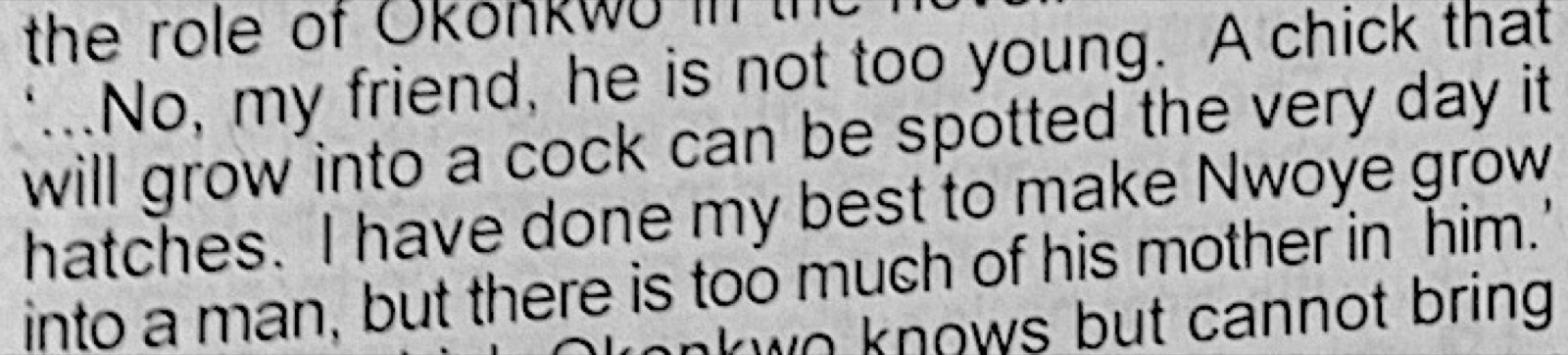
Question 28 Other Set Texts: African Prose From Things Fall Apart (Chinua Achebe) The truth, which Okonkwo knows but cannot bring himself to state, is that Nwoye is what he is because there is in him too much of
A. his father B. his grandfather C. Ikemefuna D. his grandmother E. Ezinma. Show the answer and explanation Answer: B (his grandfather )
Explanation Nwoye is gentle like Unoka, his grandfather, whom Okonkwo despised.
Open this question
Question 29 Other Set Texts: African Prose The title of Achebe's Things Fall Apart is taken from poem written by
A. T.S. Eliot B. William Shakespeare C. William Wordsworth D. Wole Soyinka E. W.B. Yeats. Show the answer and explanation Answer: E (W.B. Yeats. )
Explanation The title comes from Yeats' 'The Second Coming': "Things fall apart; the centre cannot hold".
Open this question
Question 30 Other Set Texts: African Prose The novel Things Fall Apart by Chinua Achebe was first published in
A. 1948 B. 1952 C. 1958 D. 1960 E. 1962. Show the answer and explanation Answer: C (1958 )
Explanation Things Fall Apart came out in 1958.
Open this question
Question 31 Poetry: General A Sonnet is a poem of
A. seven lines B. three lines C. four lines D. fourteen lines E. twelve lines. Show the answer and explanation Answer: D (fourteen lines )
Explanation A sonnet has fourteen lines.
Open this question
Question 32 Literary Terms and Devices Point out the odd term
A. Enjambment B. Rhyme C. Alliteration D. Assonance E. Plot. Show the answer and explanation Answer: E (Plot. )
Explanation The others are features of poetry; plot belongs to the story of a novel or play.
Open this question
Question 33 Drama: General The antagonist in a tragedy is
A. any character in the tragedy B. the wife of the protagonist C. the character who provides comic relief D. the character set in opposition to the main character E. the leading chorus. Show the answer and explanation Answer: D (the character set in opposition to the main character )
Explanation The antagonist works against the protagonist.
Open this question
Question 34 Figures of Speech In 'In Memoriam' Senghor writes 'That from the dangerous safety of the tower, I may go down into the street...' 'Dangerous safety' used in this poem is an example of
A. oxymoron B. metaphor C. simile D. personification E. apostrophe. Show the answer and explanation Answer: A (oxymoron )
Explanation Two opposite words, "dangerous" and "safety", placed side by side make an oxymoron.
Open this question
Question 35 Figures of Speech A statement that appears to say something opposite to common sense or the truth, but which may contain a truth is
A. an oxymoron B. a parable C. an irony D. an inversion E. a paradox. Show the answer and explanation Answer: E (a paradox. )
Explanation That is the definition of a paradox.
Open this question
Question 36 Drama: General Dialogue is important in drama because it
A. helps the audience to improve their English B. is usually funny and lively C. helps the audience to relax D. prolongs the action of the play E. reveals the minds of the characters. Show the answer and explanation Answer: E (reveals the minds of the characters. )
Explanation Through what characters say we learn their thoughts and motives.
Open this question
Question 37 Prose: General A novel is
A. a long prose narrative fiction B. an interesting story about a hero C. a prose writing that deals with various people D. a long story in which human characters represent abstract qualities E. a prose writing about the lives of great or interesting people. Show the answer and explanation Answer: A (a long prose narrative fiction )
Explanation A novel is a long, invented story in prose.
Open this question
Question 38 Literary Terms and Devices Identify the odd item in the following list
A. Prose B. Poetry C. Melodrama D. Catastrophe E. Drama. Show the answer and explanation Answer: D (Catastrophe )
Explanation The others are kinds of literature; catastrophe is a stage in the plot of a tragedy.
Open this question
Question 39 Literary History Verse extract (Question 39) Which of the following authors chose the title of one of his novels from the above lines?
A. Eddie Iroh B. Onuora Nzekwu C. Cyprian Ekwensi D. Elechi Amadi E. Chinua Achebe. Show the answer and explanation Answer: E (Chinua Achebe. )
Explanation "But no longer at ease here, in the old dispensation" gave Achebe the title of his novel No Longer at Ease.
Open this question
Question 40 Literary Appreciation: Prose and Drama It is obvious from this passage that Simi is
A. famous for her love of children B. a goddess worshipped by children, women and men C. a woman other women like to befriend D. an alluring, irresistible man-snatcher E. disliked for teaching sex-education. Show the answer and explanation Answer: D (an alluring, irresistible man-snatcher )
Explanation Wives pray their husbands never meet Simi, because she "broke men": she is irresistible to men.
Open this question
Question 41 Figures of Speech The tendency in words to echo the meaning by the actual sound is called
A. onomatopoeia B. assonance C. alliteration D. rhyme E. phonetics. Show the answer and explanation Answer: A (onomatopoeia )
Explanation Words like "buzz" and "hiss" sound like what they mean: onomatopoeia.
Open this question
Question 42 Figures of Speech The expression 'All the world is a stage' is a good example of the figure of speech known as
A. personification B. paradox C. onomatopoeia D. simile E. metaphor. Show the answer and explanation Answer: E (metaphor. )
Explanation The world is said to be a stage without "like" or "as": a metaphor.
Open this question
Question 43 Prose: General The 'Setting' in a novel refers to
A. the point in the story where we first encounter the main character B. the overall social and physical background of the main events in the novel C. the home country of the hero or heroine D. the location where the main event in the novel takes place E. all the various places mentioned in the novel. Show the answer and explanation Answer: B (the overall social and physical background of the main events in the novel )
Explanation Setting is when and where the story happens, including its social background.
Open this question
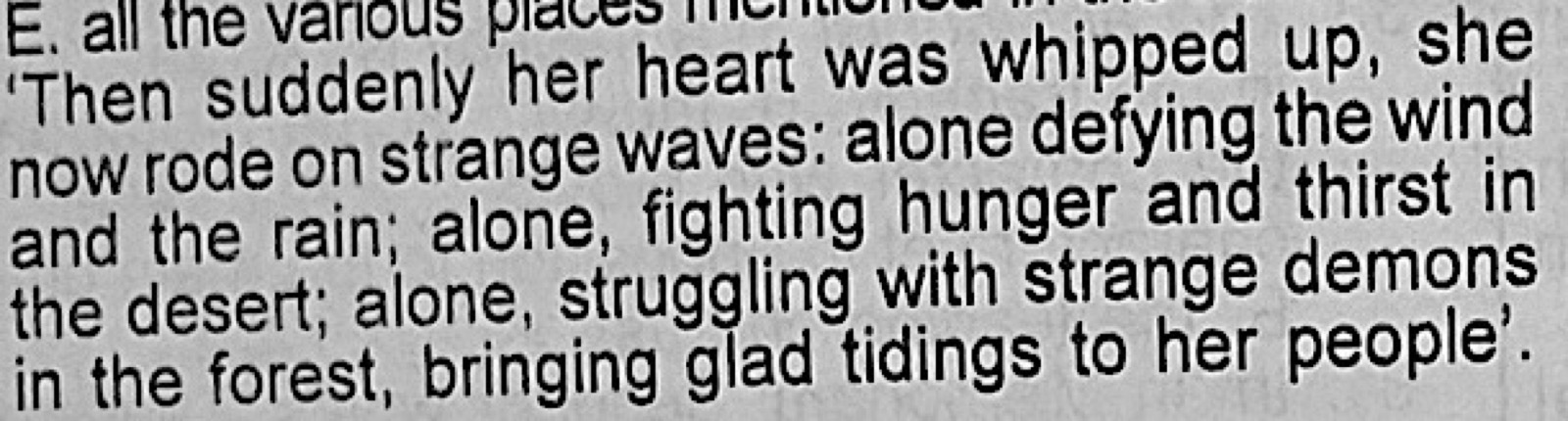
Question 44 Literary Appreciation: Prose and Drama Prose extract (Question 44) The mood of the lady in this passage is one of
A. defeat B. depression C. triumphant defiance D. simple elation E. sorrow. Show the answer and explanation Answer: C (triumphant defiance )
Explanation She pictures herself alone defying wind, rain, hunger and demons: bold and triumphant.
Open this question
Question 45 Literary Appreciation: Prose and Drama The quality which this passage displays is
A. inaccessibility B. seriousness C. humour D. gloom E. nervousness. Show the answer and explanation Answer: C (humour )
Explanation The writer pokes fun at himself: the steps meant to improve his life ruined it.
Open this question
Question 46 Literary Appreciation: Poetry There is in line 2 ('like a gasping messenger...') an example of
A. oxymoron B. metonymy C. alliteration D. simile E. personification. Show the answer and explanation Answer: D (simile )
Explanation The wind is compared to a messenger using "like": a simile.
Open this question
Question 47 Literary Appreciation: Poetry For the writer of these lines, living is an experience to be described as
A. pleasant B. difficult C. rewarding D. exciting E. bracing. Show the answer and explanation Answer: B (difficult )
Explanation Life is a wilderness where rain beats him and stumps cut like knives: it is hard.
Open this question
Question 48 Literary Appreciation: Prose and Drama This passage achieves its beautiful effect partly because of its repeated appeal to the sense of
A. taste B. touch C. sight D. smell E. hearing. Show the answer and explanation Answer: C (sight )
Explanation Brilliance, visible things, shadows and dark figures all appeal to sight.
Open this question
Question 49 Literary Appreciation: Prose and Drama This passage achieves vividness through the use of
A. details B. simple words C. short sentences D. the past tense E. punctuation. Show the answer and explanation Answer: A (details )
Explanation Details of eyebrows, nose and loud breathing make the man vivid.
Open this question Sign up free for every JAMB Literature in English year, practice by topic and timed mocks.
Start practising free