43 questions. Try each one, then open the answer to check yourself and read the explanation.
Question 1
Non-African PoetryWordsworth's 'The World is Too Much With Us' is a
- A.sonnet
- B.epic
- C.couplet
- D.quartrain
- E.tercet.
Show the answer and explanation
Answer: A (sonnet)
ExplanationIt is a fourteen-line poem with an octave and a sestet: a sonnet.
Question 2
Other Set Texts: Non-African Drama'The Thane of Cawdor lives: why do you dress me in borrowed robes? Macbeth is putting this question to
- A.Banquo
- B.the witches
- C.his servant
- D.Ross and Angus
- E.Lady Macbeth.
Show the answer and explanation
Answer: D (Ross and Angus)
ExplanationRoss and Angus bring the king's message that Macbeth is now Thane of Cawdor, and he asks them why, since Cawdor still lives.
Question 4
African PoetryThe grave procession in Soyinka's 'Procession I–Hanging Day' is meant to suggest in the entire poem
- A.the people are walking in the shadow of the walls
- B.the people are moving slowly in order to avoid the sunny spots
- C.the people in the procession are solemn
- D.the people in the procession are solemn and are going to the grave
- E.the people walk soundlessly.
Show the answer and explanation
Answer: D (the people in the procession are solemn and are going to the grave)
ExplanationThe slow, silent procession is that of men led out to be hanged, walking solemnly towards death.
Question 6
Non-African PoetryGray's 'Elegy Written in a Country Churchyard' can be seen as
- A.a total condemnation of human life
- B.lament for the death of the great and powerful
- C.an attack on social inequality
- D.a criticism of the poor and unambitious
- E.a recognition of the worth of a simple and poor life.
Show the answer and explanation
Answer: E (a recognition of the worth of a simple and poor life.)
ExplanationThe poem praises the quiet, useful lives of poor country people.
Question 7
Other Set Texts: Non-African DramaIn Shakespeare's Macbeth, the central character–Macbeth–is
- A.a Russian general
- B.a Scottish general
- C.a Finnish general
- D.an English general
- E.a German general.
Show the answer and explanation
Answer: B (a Scottish general)
ExplanationMacbeth is a Scottish nobleman and general in King Duncan's army.
Question 8
African PoetryThe 'Myth of the Bagre' is recited at the
- A.funeral of young men
- B.funeral of young women
- C.funeral of old men and women
- D.coming of age of young men and women
- E.return of the ancestors.
Show the answer and explanation
Answer: D (coming of age of young men and women)
ExplanationThe Bagre is recited during the initiation of young people into the Bagre society.
Question 9
Drama: GeneralDramatic irony entails
- A.a statement that means more than is evident to its maker
- B.a hilarious statement
- C.satirical comment
- D.a sarcastic announcement
- E.praise of the audience.
Show the answer and explanation
Answer: A (a statement that means more than is evident to its maker)
ExplanationIn dramatic irony the audience knows more than the speaker, so his words carry a meaning he does not see.
Question 10
African PoetryIn 'Salute to the Elephant' the line 'The elephant's head is his burden which he balances' suggests that
- A.the elephant's head is so big that it does not allow the animal to move elegantly
- B.the elephant has a big head yet it moves elegantly
- C.the elephant's head is so big that it makes the animal look clumsy
- D.the elephant's head is so big that it prevents the animal from moving from one part of the forest to the other
- E.the elephant's head is like a big instrument for weighing.
Show the answer and explanation
Answer: B (the elephant has a big head yet it moves elegantly)
Explanation"Balances" shows the elephant carries its huge head with grace.
Question 11
African PoetryWhat is the subject of Kalu Uka's 'Earth to Earth?
- A.The size of the universe
- B.The immensity of Nature
- C.Death
- D.Growth
- E.A long journey.
Show the answer and explanation
Answer: C (Death)
ExplanationThe title echoes the burial words "earth to earth"; the poem is about death.
Question 12
Other Set Texts: Non-African DramaFrom Macbeth (Shakespeare)
Which character made the following statement in Macbeth?:
- A.Macbeth
- B.Duncan
- C.Lady Macbeth
- D.Macduff
- E.Lennox.
Show the answer and explanation
Answer: B (Duncan)
ExplanationKing Duncan praises Macbeth's castle as he arrives, not knowing he will be murdered there.
Question 13
Other Set Texts: Non-African DramaWhich character does NOT fit into the group?
- A.Corin
- B.Silvius
- C.William
- D.Young Siward
- E.Audrey.
Show the answer and explanation
Answer: D (Young Siward)
ExplanationThe others are country people in As You Like It; Young Siward is a soldier in Macbeth.
Question 15
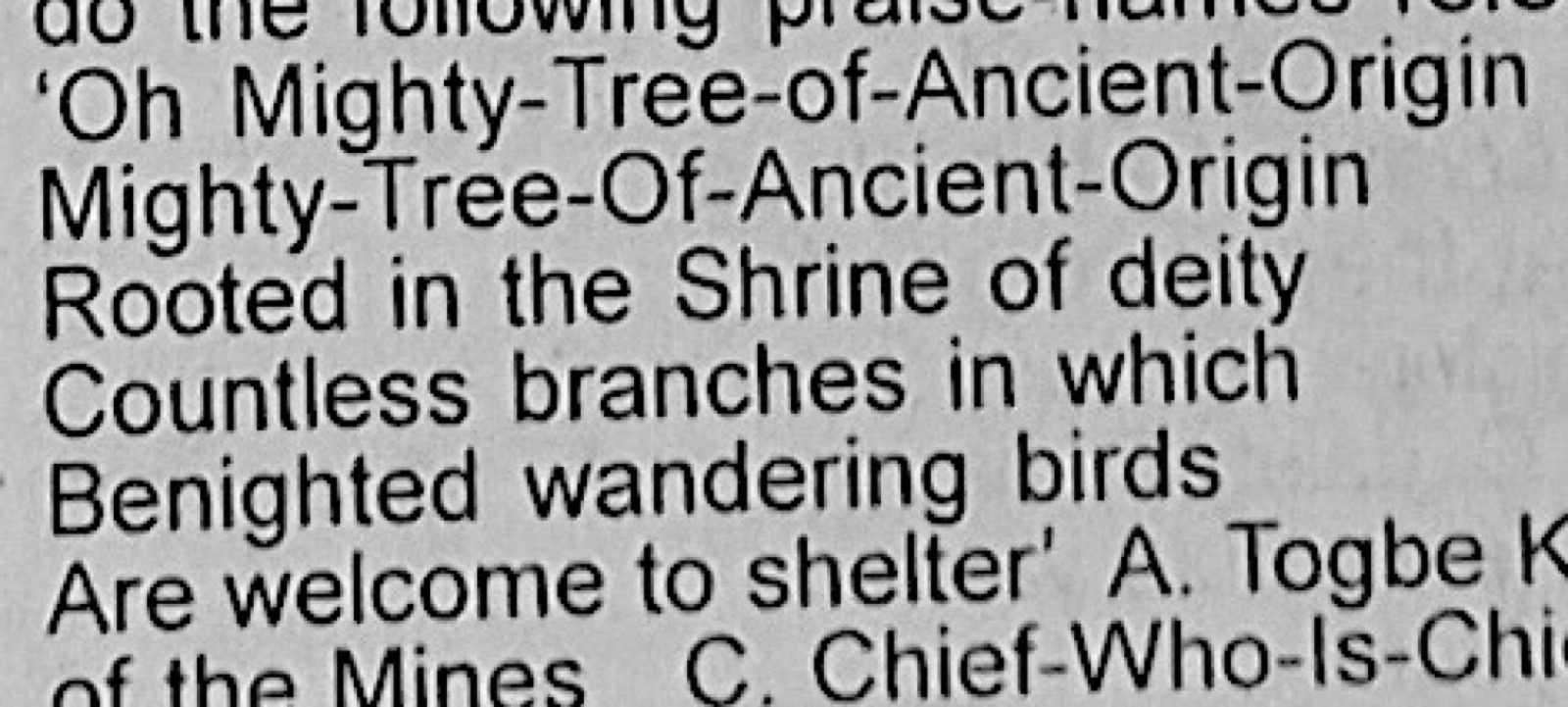
Set Text: The Marriage of AnansewaPraise-names from The Marriage of Anansewa
In The Marriage of Anansewa, to which character do the following praise-names refer?
- A.Togbe Klu IV
- B.Chief of the Mines
- C.Chief-Who-Is-Chief
- D.Chief of Sapa
- E.Property Man.
Show the answer and explanation
Answer: C (Chief-Who-Is-Chief)
ExplanationThe grand praise-names (Mighty Tree sheltering birds) belong to Chief-Who-Is-Chief, the greatest of the suitors.
Question 16
Set Text: The Marriage of AnansewaThe role of the Storyteller in The Marriage of Anansewa is that of a
- A.bearer of false rumours
- B.trickster
- C.commentator
- D.suitor
- E.Chief's messenger.
Show the answer and explanation
Answer: C (commentator)
ExplanationThe Storyteller introduces scenes and comments on the action, linking the play to the audience.
Question 17
African PoetryIn Oswald Mtshali's 'Nightfall in Soweto', night represents
- A.the oppression of the whites by the Africans
- B.white people's fear of the Africans
- C.the black victimization of white people
- D.the oppression of the Africans by the white people
- E.the rebellion of the white people.
Show the answer and explanation
Answer: D (the oppression of the Africans by the white people)
ExplanationNight in Soweto brings terror to black people under white rule.
Question 18
Non-African PoetryKeats' 'Ode to a Nightingale' is a romantic poem because
- A.it depends a great deal on the poet's spontaneous response to beauty
- B.it is a poem about love
- C.nightingale symbolizes love
- D.it was addressed to one of Keats' friends called Nightingale
- E.Keats first described the poem as a romantic poem.
Show the answer and explanation
Answer: A (it depends a great deal on the poet's spontaneous response to beauty)
ExplanationRomantic poetry expresses the poet's personal feelings stirred by beauty and nature, as Keats does on hearing the bird.
Question 19
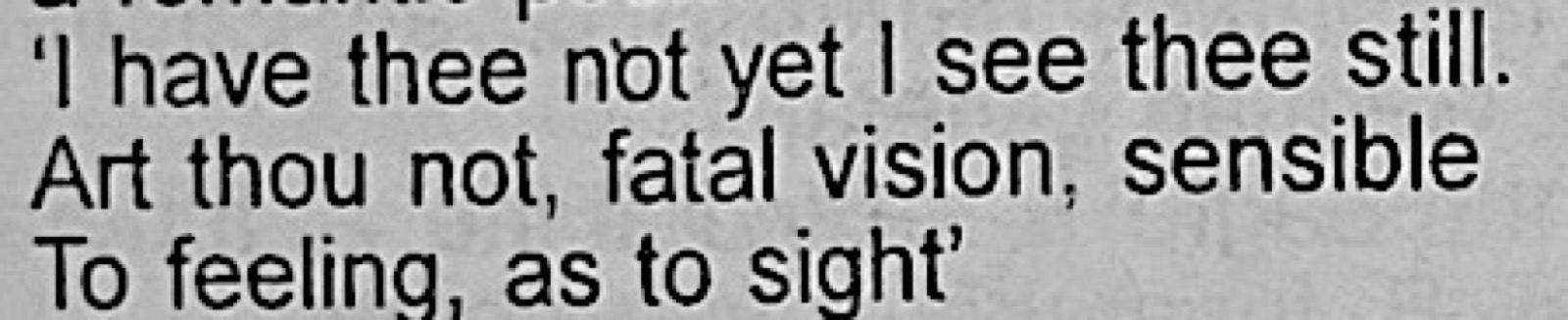
Other Set Texts: Non-African DramaFrom Macbeth (Shakespeare)
'fatal vision' in the second line is a reference to
- A.the ghost of Banquo
- B.the ghost of Duncan
- C.one of the three witches
- D.an imaginary dagger
- E.King Duncan's crown.
Show the answer and explanation
Answer: D (an imaginary dagger)
ExplanationBefore killing Duncan, Macbeth sees a dagger in the air that he cannot grasp.
Question 20
Other Set Texts: Non-African DramaWhich of the following is a major source of interest in As You Like It?
- A.The effective use of disguise
- B.The disappointment of lovers
- C.The fidelity of Shakspeare's characters
- D.The author's irreverent use of language
- E.The consistency of roles.
Show the answer and explanation
Answer: A (The effective use of disguise)
ExplanationRosalind's disguise as the boy Ganymede creates the play's comedy and drives its love plot.
Question 21
Other Set Texts: African ProseIn Mine Boy Peter Abrahams is of the view that in South Africa
- A.black and white should live and develop separately
- B.racial harmony is desirable and possible
- C.black should never cooperate with white
- D.racial harmony is mere wishful thinking
- E.the conflict between black and white can never end.
Show the answer and explanation
Answer: B (racial harmony is desirable and possible)
ExplanationThe novel shows black and white working and suffering together and hopes for people to be seen as "men first".
Question 22
Literary Appreciation: Prose and DramaProse extract (Question 22)
What makes this scene taken from a novel very real to the reader is the writer's use of
- A.imagery
- B.simile
- C.details
- D.uncommon words
- E.metaphor.
Show the answer and explanation
Answer: C (details)
ExplanationSmall exact actions (the box, the letter, the single tear, washing his face) make the scene feel real.
Question 23
Literary Appreciation: PoetryIn these lines, 'the clammy and numbing night fog' (line 3) refers to
- A.a night in the poet's life
- B.unpleasant weather conditions
- C.life's problems and misfortunes
- D.the state before birth and after death
- E.darkness after sunset.
Show the answer and explanation
Answer: D (the state before birth and after death)
ExplanationPeople come "whence they entered hither" and go "thither": the fog is the unknown before birth and after death.
Question 24
Literary Appreciation: PoetryThe mood registered in these lines is
- A.excitement
- B.depression
- C.gaiety
- D.happiness
- E.pessimism.
Show the answer and explanation
Answer: B (depression)
ExplanationDead leaves, gloom and a tree's sorrow create a low, sad mood.
Question 25
Figures of Speech'So fair fancy few would weave In these years!' The poetic device consciously used here is
- A.personification
- B.apostrophe
- C.alliteration
- D.oxymoron
- E.simile.
Show the answer and explanation
Answer: C (alliteration)
ExplanationThe "f" sound repeats in fair, fancy, few.
Question 26
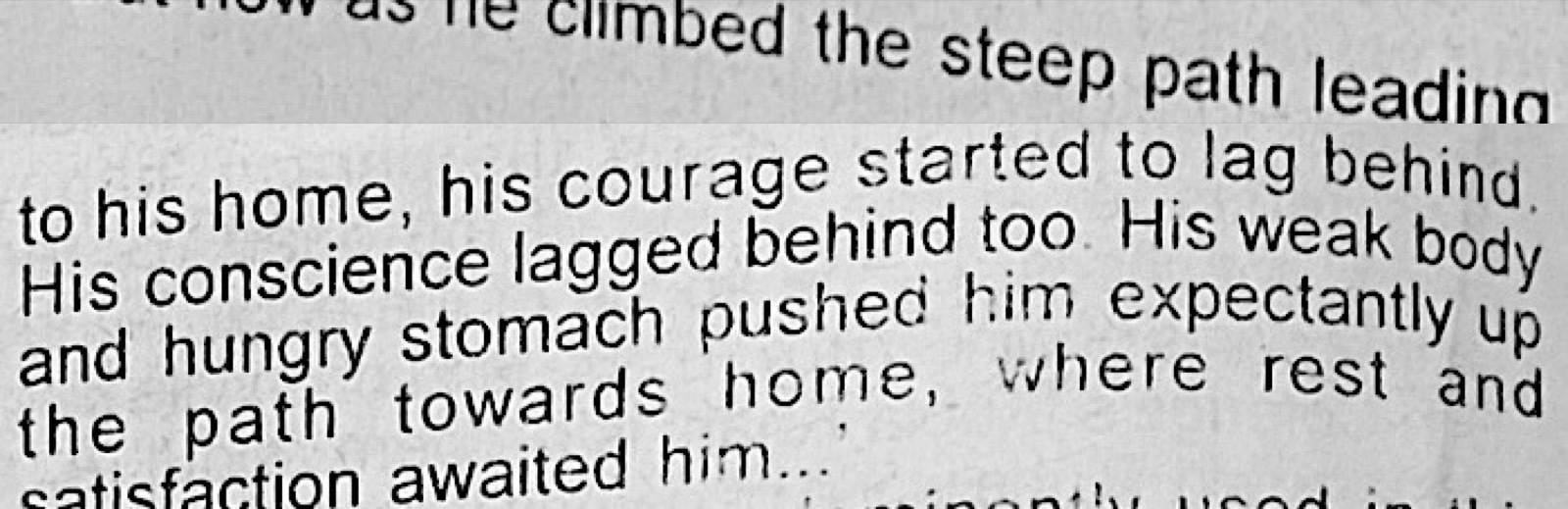
Literary Appreciation: Prose and DramaProse extract (Question 26)
The literary device predominantly used in this passage is
- A.hendiadys
- B.onomatopoeia
- C.metonymy
- D.simile
- E.personification.
Show the answer and explanation
Answer: E (personification.)
ExplanationHis courage and conscience "lag behind" and his stomach "pushes" him, as if they were people.
Question 27
Literary Appreciation: Prose and DramaFrom what he says, the kid in this passage
- A.loves his father
- B.dislikes his father
- C.disowns his father
- D.feels sorry for his father
- E.is proud of his father.
Show the answer and explanation
Answer: B (dislikes his father)
ExplanationHe calls his father the man who made his mother's life hell and gave him only the belt.
Question 29
Literary Appreciation: Prose and DramaWhat the writer feels for or toward the woman in this passage is
- A.love
- B.sympathetic understanding
- C.contempt
- D.respect
- E.difference.
Show the answer and explanation
Answer: C (contempt)
ExplanationHer shrill voice "cut the air to pieces" and her showy claim about her "constitution" are mocked.
Question 30
Literary Appreciation: Prose and DramaThe sentiment expressed here about the curse on women is
- A.that of the writer of the passage
- B.that of the lady in the passage
- C.that of the lady's parents
- D.that of everybody everywhere
- E.that of an unnamed person.
Show the answer and explanation
Answer: B (that of the lady in the passage)
ExplanationThe narrator reports the woman's own thoughts as she looks at her husband's face.
Question 31
Literary Appreciation: Prose and DramaThe man in this passage is obviously
- A.a rich man
- B.a poor man
- C.an ignorant man
- D.a rich ignorant man
- E.a poor unthinking man.
Show the answer and explanation
Answer: B (a poor man)
ExplanationHe cannot afford meat with his fufu, so he is poor.
Question 32
Literary Appreciation: PoetryTo whom does 'her' (line 5) refer?
- A.Majesty
- B.World
- C.Letter
- D.Nature
- E.The poet's sister.
Show the answer and explanation
Answer: D (Nature)
ExplanationThe message that "Nature told" is the one committed to unseen hands, so "her" is Nature.
Question 33
Literary Appreciation: PoetryThe writer of these words is in a state of
- A.exuberance
- B.dejection
- C.despair
- D.joyful hope
- E.dismal sorrow.
Show the answer and explanation
Answer: D (joyful hope)
ExplanationThe bells chime for a new year and his heart rings "in a dawn": he is hopeful.
Question 34
Literary Appreciation: PoetryThe dominant rhetorical device used in the poem is
- A.apostrophe
- B.personification
- C.metonymy
- D.synecdoche
- E.simile.
Show the answer and explanation
Answer: B (personification)
ExplanationScience is called "she", a "simple saint" with devotions who knows and counts: personification.
Question 35
Literary Appreciation: PoetryThe poet suggests that Science
- A.teaches us everything about life
- B.deals with the causes of natural phenomena
- C.does not deal with the causes of natural phenomena
- D.teaches us how to contemplate
- E.does not teach us how to contemplate.
Show the answer and explanation
Answer: B (deals with the causes of natural phenomena)
ExplanationScience explains how things came about and measures them, but not what they are for.
Question 36
Literary Appreciation: Prose and DramaTo whom does 'they' refer?
- A.Men
- B.Girls
- C.Men and Girls
- D.The walls
- E.John and the girls.
Show the answer and explanation
Answer: D (The walls)
Explanation"The walls sing and press inward. They press the men and girls": "they" are the walls.
Question 37
Other Set Texts: African ProseIn Zambia Shall Be Free Kaunda's 'wandering days' resulted from his
- A.desire to visit other territories
- B.need to assert himself by being on his own
- C.disagreement with the members of his family
- D.need to join other political parties
- E.disagreement with his employers.
Show the answer and explanation
Answer: B (need to assert himself by being on his own)
ExplanationKaunda left his settled post to find his own way and stand on his own feet.
Question 38
Other Set Texts: African ProseIn The Narrow Path, Nani is transferred very frequently because he is
- A.a trained teacher
- B.an untrained teacher
- C.a lazy worker
- D.a devoted and hardworking teacher
- E.a poor man's son.
Show the answer and explanation
Answer: D (a devoted and hardworking teacher)
ExplanationThe mission sends Nani, a dedicated teacher, wherever a school needs to be set right.
Question 39
Other Set Texts: African ProseIn Mine Boy, the dominant Shebeen queen who is described as 'tall and big, with the smooth yellowness of the Basuto women...' is
- A.Ma Plank
- B.Leah
- C.Eliza
- D.Lena
- E.Maisy.
Show the answer and explanation
Answer: B (Leah)
ExplanationLeah runs the shebeen and dominates Malay Camp.
Question 40
Literary Terms and Devices'Local colour' in a novel or play is that feature which
- A.defines the nature of the vegetation of the setting
- B.explains the differences in patterns of behaviour of the characters
- C.refers to the racial backgrounds of the major characters in the novel or play
- D.emphazises the customs, norms, values and setting of the novel or play
- E.hightlights the ethnic origins of the various characters in the novel or play.
Show the answer and explanation
Answer: D (emphazises the customs, norms, values and setting of the novel or play)
ExplanationLocal colour is the special flavour of a place: its customs, speech, values and scenery.
Question 41
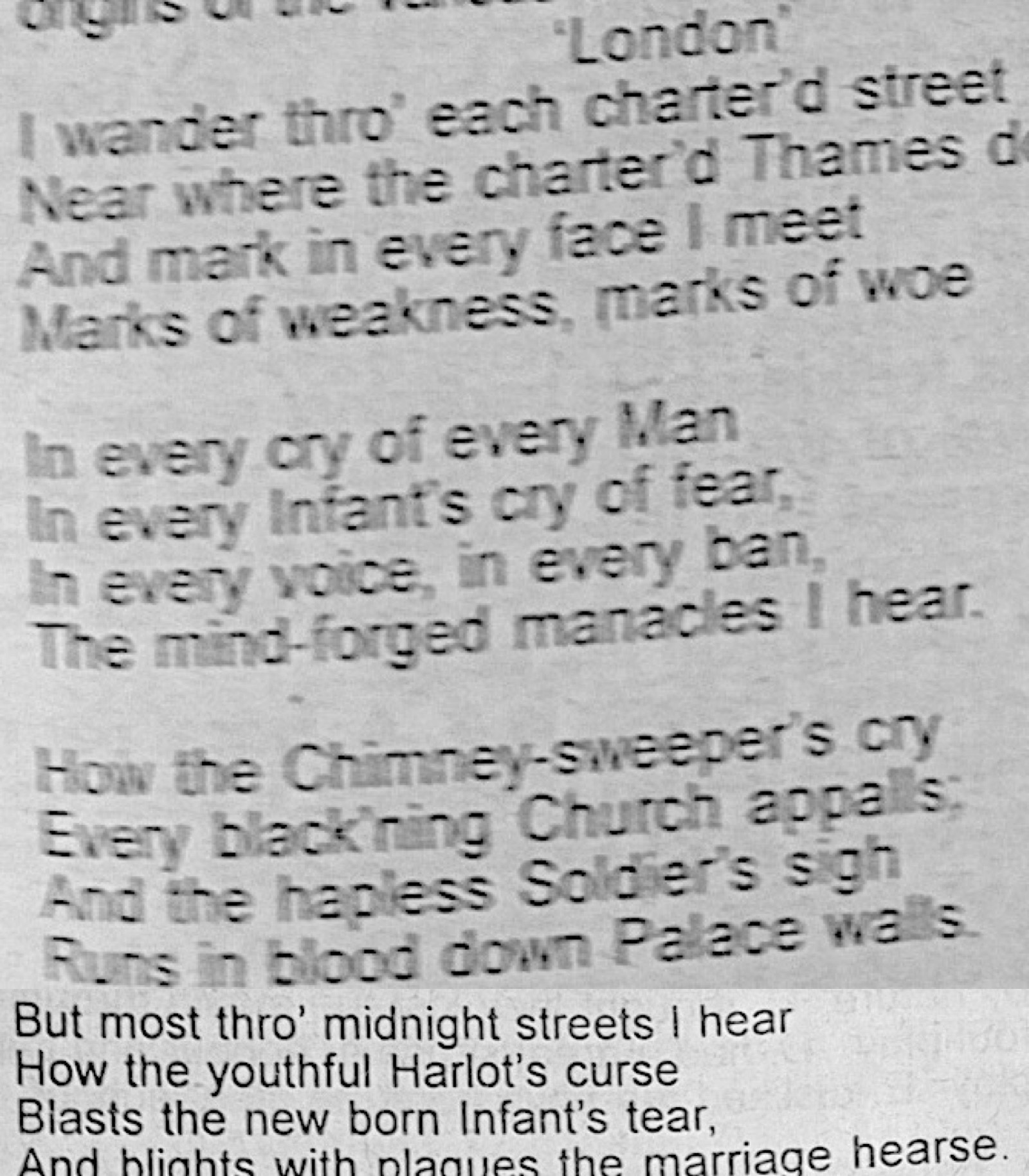
Non-African Poetry'London'
The stanza form in 'London' is referred to as
- A.a quartet
- B.a quatrain
- C.a quadruple
- D.quintet
- E.a sestet.
Show the answer and explanation
Answer: B (a quatrain)
ExplanationEach stanza has four lines: a quatrain.
Question 43
Literary Appreciation: PoetryThe most important figure of speech in the above passage is
- A.paradox
- B.personification
- C.metaphor
- D.simile
- E.onomatopoeia.
Show the answer and explanation
Answer: B (personification)
ExplanationAutumn is a "bosom-friend" of the sun "conspiring" with him: personification.
Question 45
Literary Appreciation: PoetryThe dominant images in the above passage are
- A.cosmic
- B.metallic
- C.harsh
- D.sensuous
- E.domestic.
Show the answer and explanation
Answer: D (sensuous)
ExplanationRipe apples, swelling gourds, sweet kernels and clammy honey cells appeal to taste, touch and sight.
Question 46
Other Set Texts: Non-African ProseAs non-fiction, V.S. Naipaul's The Middle Passage belongs more properly to the genre of
- A.autobiography
- B.sermon
- C.travelogue
- D.epistle
- E.biography.
Show the answer and explanation
Answer: C (travelogue)
ExplanationThe book records Naipaul's journey through the Caribbean: a travel book.
Question 47
Other Set Texts: African ProseWhich of the following comes closest to a correct interpretation of the symbol of the mine dumps in Mine Boy?
- A.The hope of all workers
- B.Acknowledgement of the efforts of black South African workers
- C.The enduring courage of black workers
- D.The dignity of labour under an oppressive regime
- E.The exploitation of black labour by an oppressive regime.
Show the answer and explanation
Answer: E (The exploitation of black labour by an oppressive regime.)
ExplanationThe great mine dumps are built by black workers' sweat for white owners' profit.
Question 48
Other Set Texts: African ProseWhen Di says of Eliza, 'That girl is tragedy already' she means
- A.Eliza faces the threat of premature death
- B.Eliza is a pathetic victim of culture conflict
- C.Eliza is the tragic heroine of the novel
- D.Eliza will not survive her illness
- E.Eliza is suffering from an undiagnosed disease.
Show the answer and explanation
Answer: B (Eliza is a pathetic victim of culture conflict)
ExplanationEliza is torn between African life and the white way of life she longs for.
Question 49
Other Set Texts: African ProseFrom Kenneth Kaunda's Zambia Shall Be Free (Question 49)
In this passage Kenneth Kaunda makes his account of the fight more vivid through the use of
- A.repetitious statements
- B.symbolic reference
- C.biblical allusion
- D.deliberate distortion
- E.hyperbolic comment.
Show the answer and explanation
Answer: C (biblical allusion)
ExplanationComparing the big boy to Goliath of the Philistines is a reference to the Bible.