43 questions. Try each one, then open the answer to check yourself and read the explanation.
Question 2
Set Text: The Marriage of AnansewaChief-Who-Is-Chief won Anansewa for his wife because he
- A.paid the largest dowry
- B.showed the greatest love for her
- C.bribed Property Man
- D.was a friend of Anansewa's father
- E.paid her school fees.
Show the answer and explanation
Answer: B (showed the greatest love for her)
ExplanationWhen Ananse announced Anansewa's "death", only Chief-Who-Is-Chief responded with real love and offered to bury her as his wife.
Question 3
Set Text: The Marriage of AnansewaGeorge Kweku Ananse in the Marriage of Anansewa was
- A.a tricker
- B.an exploiter
- C.a Christian
- D.an orator
- E.a politician.
Show the answer and explanation
Answer: A (a tricker)
ExplanationLike the spider of the folktales, Ananse lives by clever tricks, promising his daughter to four chiefs at once.
Question 4
Set Text: The Marriage of AnansewaThe Marriage of Anansewa is a play based on Ghanaian
- A.politics
- B.traditional marriage ceremonies
- C.folktales
- D.Lady Macbeth could not sleep
- E.oral poetry.
Show the answer and explanation
Answer: C (folktales)
ExplanationSutherland built the play from Ghanaian Ananse folktales (the "Anansegoro" storytelling form).
Question 5
Other Set Texts: Non-African DramaAfter the murder of Duncan, Macbeth was still dissatisfied because
- A.he wanted to see the witches again
- B.he had only paved the way for Banquo's son
- C.he felt remorse
- D.Lady Macbeth could not sleep
- E.there was knocking at the gate.
Show the answer and explanation
Answer: B (he had only paved the way for Banquo's son)
ExplanationThe witches said Banquo's descendants would be kings, so Macbeth fears he has murdered only to make Banquo's sons kings.
Question 6
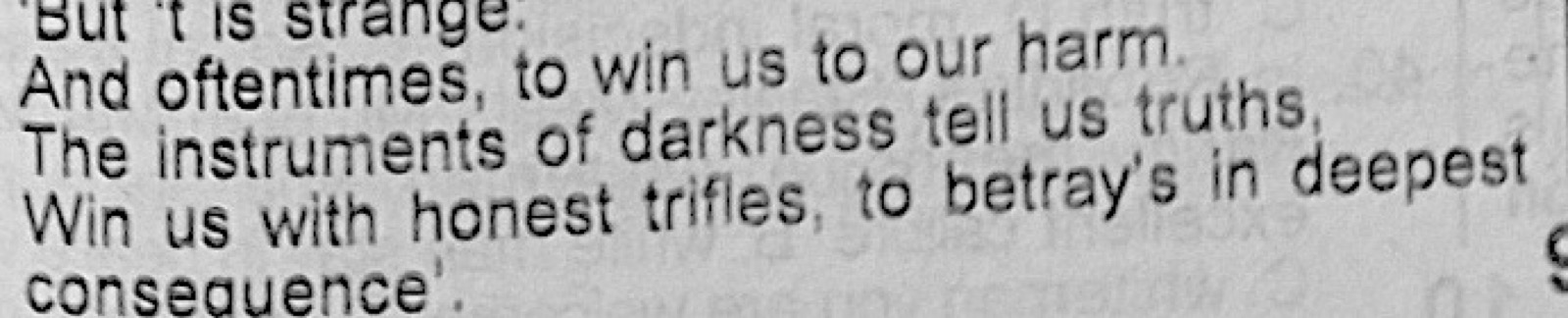
Other Set Texts: Non-African DramaFrom Macbeth (Shakespeare)
These words were spoken by
- A.Banquo
- B.Macbeth
- C.Malcolm
- D.Lady Macbeth
- E.Macduff.
Show the answer and explanation
Answer: A (Banquo)
ExplanationBanquo warns Macbeth that the witches may tell small truths to lead people into deep harm.
Question 7
Other Set Texts: Non-African DramaMacbeth is confident that he will not be defeated in battle because
- A.all his enemies had gone into exile
- B.he is a better fighter than Macduff
- C.he had already killed Banquo
- D.Lady Macbeth gives him courage
- E.the witches gave him an assurance.
Show the answer and explanation
Answer: E (the witches gave him an assurance.)
ExplanationThe apparitions promised that no man born of woman could harm him and he would not fall until Birnam Wood came to Dunsinane.
Question 8
Other Set Texts: Non-African Drama'They have tied me to a stake: I cannot fly, But bear like I must fight the course'. Macbeth here is represented as
- A.confident and arrogant
- B.pitiable and evil
- C.pitiable but courageous
- D.pitiable and fearful
- E.merry and confident.
Show the answer and explanation
Answer: C (pitiable but courageous)
ExplanationTrapped like a bear at a stake, Macbeth is a sad figure, yet he still chooses to fight on.
Question 9
Other Set Texts: Non-African DramaWhich group of characters appears in Macbeth?
- A.Audrey, Phebe, Silvius
- B.Charles, Malcolm, Banquo
- C.Lennox, Donalbain, Seyton
- D.Duncan, Frederick, Banquo
- E.Oliver, Ross, Adam.
Show the answer and explanation
Answer: C (Lennox, Donalbain, Seyton)
ExplanationLennox, Donalbain and Seyton are all in Macbeth; the other lists mix in characters from As You Like It.
Question 10
Other Set Texts: Non-African DramaThe banished Duke regained his kingdom when his brother Frederick
- A.was defeated in battle
- B.was rejected by his people
- C.died on his way to the woods
- D.was converted by a religious man
- E.became too old to rule.
Show the answer and explanation
Answer: D (was converted by a religious man)
ExplanationFrederick marched to the forest to kill his brother but met an old religious man, was converted and gave back the dukedom.
Question 11
Other Set Texts: Non-African DramaOlivia hated Orlando because Orlando
- A.defeated Charles in the wrestling contest
- B.was in love with Rosalind
- C.was preferred by the people to himself
- D.was more educated than himself
- E.ran away from home.
Show the answer and explanation
Answer: C (was preferred by the people to himself)
ExplanationOliver admits that Orlando is so loved by everyone that he himself is "altogether misprised".
Question 12
Other Set Texts: Non-African DramaFrom As You Like It (Shakespeare)
The speaker of the above lines from As You Like It is
- A.Jacques
- B.Orlando
- C.Adams
- D.Duke Senior
- E.Le Bosu.
Show the answer and explanation
Answer: D (Duke Senior)
ExplanationDuke Senior praises life in the forest, saying hardship has its good uses.
Question 13
Other Set Texts: Non-African DramaIn As You Like It, the Forest of Arden could symbolize
- A.passion
- B.anxiety
- C.goodness
- D.wealth
- E.power.
Show the answer and explanation
Answer: C (goodness)
ExplanationIn the forest people are healed, forgiven and reformed, so it stands for goodness compared with the corrupt court.
Question 14
Other Set Texts: African DramaIn Kongi's Harvest, there is a struggle for power between Kongi and
- A.Daodu
- B.Oba Danlola
- C.Segi's father
- D.the Aweri fraternity
- E.the people.
Show the answer and explanation
Answer: B (Oba Danlola)
ExplanationKongi wants the old king Danlola to hand him the New Yam and so his traditional authority.
Question 15
Other Set Texts: African DramaPart of the meaning of Kongi's Harvest lies in the fact that Kongi's final harvest is
- A.a big yam
- B.respect
- C.disaster
- D.honour
- E.fame.
Show the answer and explanation
Answer: C (disaster)
ExplanationInstead of the yam, Kongi is presented with the head of Segi's father, and the festival ends in chaos.
Question 16
Other Set Texts: African DramaIn Kongi's Harvest, Wole Soyinka dramatizes
- A.the fall of a great man
- B.the rise of the carpenter's brigade
- C.the tragedy of Segi
- D.the growth and development of political tyranny
- E.the destruction of a great African country.
Show the answer and explanation
Answer: D (the growth and development of political tyranny)
ExplanationThe play shows a dictator tightening his grip on power.
Question 18
Drama: GeneralDrama is essentially different from poetry because it
- A.always involves many characters
- B.exists mainly in action
- C.uses elevated language
- D.uses localized imagery
- E.deals with tragic experiences.
Show the answer and explanation
Answer: B (exists mainly in action)
ExplanationDrama is written to be performed; its essence is action on stage.
Question 20
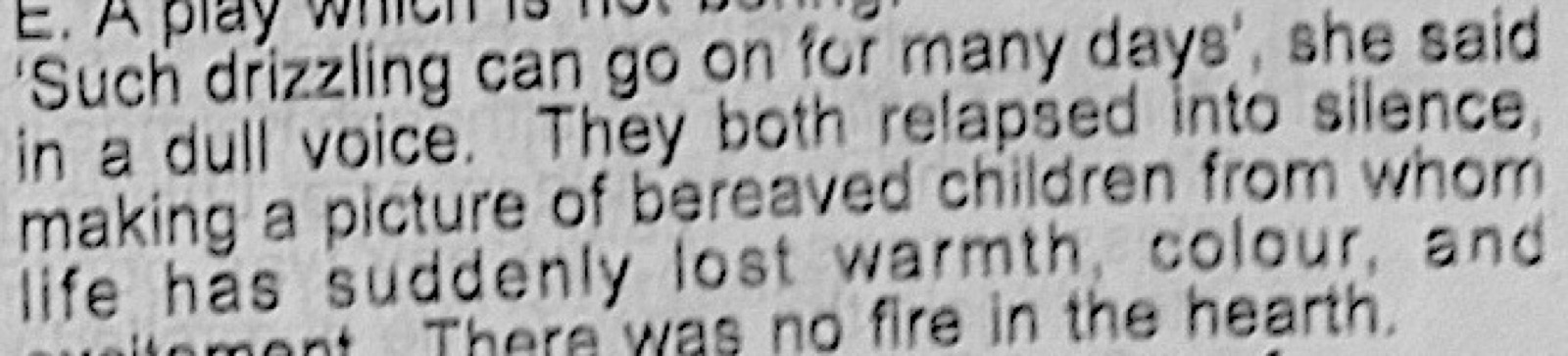
Literary Appreciation: Prose and DramaProse extract (Question 20)
The mood caught in this scene is one of
- A.excitement
- B.warmth
- C.hopefulness
- D.high spirits
- E.sadness.
Show the answer and explanation
Answer: E (sadness.)
ExplanationA dull voice, silence, "bereaved children" and a fireless hearth all create sadness.
Question 21
Literary Appreciation: PoetryThe poet of these lines
- A.shows cheap love
- B.is incapable of seriousness
- C.considers heaven's cloths worthless
- D.is a sensitive, serious lover
- E.is an unrealistic, wishful man.
Show the answer and explanation
Answer: D (is a sensitive, serious lover)
ExplanationThe poor speaker offers his dreams and asks his beloved to tread softly: he is tender and sincere.
Question 22
Literary Appreciation: Prose and DramaIn this passage the elders are presented as
- A.very admirable people
- B.decent and honest
- C.impressed by the Secretary
- D.impressively learned
- E.distinctly progressive.
Show the answer and explanation
Answer: C (impressed by the Secretary)
ExplanationThe elders understand nothing of the speech but nod and praise the Secretary as a learned man.
Question 24
Literary Appreciation: PoetryFor this poet, the passing year has
- A.been one of satisfaction and fulfilment
- B.had nothing to do with his personal life
- C.brought death to relatives
- D.meant unrealized hopes
- E.brought changes.
Show the answer and explanation
Answer: D (meant unrealized hopes)
ExplanationHis heart beats a farewell "to all my hopes and mute yearnings of a year": hopes that came to nothing.
Question 25
Literary Appreciation: PoetryIn this passage describing the end of a school day, children's movements are made memorable through the use, in lines 4-5 of
- A.simile
- B.metaphor
- C.alliteration
- D.cadence
- E.inversions.
Show the answer and explanation
Answer: B (metaphor)
ExplanationThe school is a "dam" that bursts and the children are "floods": a metaphor without "like" or "as".
Question 26
Other Set Texts: African ProseZambia Shall Be Free is a
- A.biography
- B.autobiography
- C.novel
- D.novella
- E.short story.
Show the answer and explanation
Answer: B (autobiography)
ExplanationKenneth Kaunda tells the story of his own life.
Question 28
Other Set Texts: Non-African ProseWhat Gerry liked most about Theodore Shephanides in My Family and Other Animals was his
- A.smart appearance
- B.difference
- C.gift of a microscope
- D.lovely tea parties
- E.inexhaustible knowledge.
Show the answer and explanation
Answer: E (inexhaustible knowledge.)
ExplanationTheodore seemed to know everything about nature, and Gerry loved learning from him.
Question 29
Other Set Texts: Non-African ProseIn the early days of the Durrell's sojourn on the Island of Corfu, Gerry's most constant companion was
- A.Christaki
- B.Roger
- C.Spiro
- D.Yani
- E.Larry.
Show the answer and explanation
Answer: B (Roger)
ExplanationRoger the dog followed Gerry on all his early wanderings round the island.
Question 30
Other Set Texts: Non-African ProseNaipaul's The Middle Passage is best described as
- A.a novel
- B.a tragic play
- C.an autobiography
- D.a satire.
Show the answer and explanation
Answer: C (an autobiography)
ExplanationThe Middle Passage is a non-fiction account of Naipaul's own travels in the Caribbean, so of these it is closest to autobiography.
Question 31
Non-African PoetryFrom Gray's 'Elegy Written in a Country Churchyard'
In these lines from Gray's 'Elegy Written in a Country Churchyard' the poet is referring to
- A.the plowman and the herd
- B.the rich people of the village
- C.the congregation in the church
- D.the politicians
- E.all those buried in the graveyard.
Show the answer and explanation
Answer: E (all those buried in the graveyard.)
Explanation"For them" means the dead in the churchyard, who will never again enjoy home and family.
Question 32
Non-African PoetryAs the magi journey towards their destination, voices singing in their ears said their undertaking was
- A.worthwhile
- B.uncertain
- C.foolish
- D.wise
- E.commendable.
Show the answer and explanation
Answer: C (foolish)
ExplanationThe voices sing "that this was all folly".
Question 33
African PoetryFrom Kwesi Brew's 'The Sea Eats Our Land'
The figure of speech used in these lines from Kwesi Brew's. 'The Sea Eats Our Land's is
- A.oxymoron
- B.personification
- C.metaphor
- D.simile
- E.synecdoche.
Show the answer and explanation
Answer: B (personification)
ExplanationNight is given a human action: it "charmed" a power into the waves.
Question 34
African PoetryIn 'Salute to the Elephant', the poet
- A.warns about the danger of elephants
- B.tells the story of elephants
- C.describes the attributes of the elephants
- D.shows where to find elephants
- E.wants the destruction of elephants.
Show the answer and explanation
Answer: C (describes the attributes of the elephants)
ExplanationThe praise poem lists the elephant's qualities: its size, strength and ways.
Question 35
Non-African PoetryFrom Keats' 'Ode to a Nightingale'
In these lines from Keats 'Ode to a Nightingale' the poet uses
- A.alternate rhymes
- B.heroic couplet
- C.blank verse
- D.octosyllabic metre
- E.terza rima.
Show the answer and explanation
Answer: A (alternate rhymes)
ExplanationLines 1 and 3 (pains/drains) and lines 2 and 4 (drunk/sunk) rhyme: alternate rhymes.
Question 36
African PoetryThe main idea suggests in Kalu Uka's poem 'Earth to Earth'
- A.death and burial
- B.man's mortality
- C.the changes in seasons
- D.the propitiation of ancestors
- E.the falling of dew-drops.
Show the answer and explanation
Answer: B (man's mortality)
ExplanationBeneath the images of burial, the poem's idea is that every person must die.
Question 37
African PoetryFrom Brutus' 'A Troubadour I Traverse'
The above lines from Brutus' poem 'A Troubadour I Traverse' indicate that the poet
- A.is a traveller
- B.is an explorer who collects things
- C.enjoys amorous adventures
- D.loves a woman
- E.has a deep-rooted love for his country.
Show the answer and explanation
Answer: E (has a deep-rooted love for his country.)
ExplanationThe "land" he explores like a lover is South Africa: he speaks of his country as a beloved woman.
Question 38
African PoetryThe night is significant in 'Nightfall in Soweto' because E night brings a lot of enjoyment.
- A.people stay in their houses
- B.crimes are committed at night
- C.the people can rest their tired bones at night
- D.black peoples are persecuted even in their own homes at night
Show the answer and explanation
Answer: D (black peoples are persecuted even in their own homes at night)
ExplanationAt night violent men and police break into homes, so black people are not safe even indoors.
Question 39
African PoetryThe word 'fence' in Peter's poem 'The Fence' symbolizes
- A.racial prejudice
- B.falsehood
- C.truth
- D.moral indecision
- E.social classes.
Show the answer and explanation
Answer: D (moral indecision)
ExplanationTo sit on the fence is to refuse to choose sides.
Question 40
African PoetryIn Rubadiri's 'Stanley Meets Mutesa' Mtu Mweupe Karibu means
- A.whiteman, you are a man of excellent calibre
- B.white man stay in peace with us
- C.whiteman you are welcome
- D.whiteman go back to your country
- E.whiteman here are cables for you.
Show the answer and explanation
Answer: C (whiteman you are welcome)
ExplanationIn Swahili "mtu mweupe" is "white man" and "karibu" is "welcome".
Question 41
Non-African PoetryIn Lord Tennyson's 'Ulysses' the phrase 'happy Isles' refers to
- A.the abode of the dead
- B.the palace of Achilles
- C.the abode of the gods
- D.the ringing plants of windy Troy
- E.the land of an idle king.
Show the answer and explanation
Answer: A (the abode of the dead)
ExplanationUlysses hopes they may reach the Happy Isles, the place of dead heroes, "and see the great Achilles".
Question 42
Non-African PoetryS.T. Colerige's 'Kubla Khan' is a poem about
- A.a dream world
- B.the world of demon lovers
- C.the river Alph
- D.a sunless sea
- E.sunny spots of greenery.
Show the answer and explanation
Answer: A (a dream world)
ExplanationKubla Khan describes a fantastic pleasure-dome and landscape seen in a vision: a dream world.
Question 43
African Poetry'The Myth of the Bagre' is an example of
- A.a dream world
- B.a narrative poem of initiation
- C.a poem in praise of manly prowess
- D.a poem recited at marriage festivals
- E.a poem sacred to the memory of ancestors.
Show the answer and explanation
Answer: B (a narrative poem of initiation)
ExplanationThe Bagre myth is recited during the initiation of new members of the Bagre society.
Question 45
Other Set Texts: African ProseAt the mines where Xuma worked, the workers were
- A.satisfied
- B.confused
- C.rebellious
- D.overworked
- E.respected.
Show the answer and explanation
Answer: D (overworked)
ExplanationThe black mine workers did heavy, dangerous work for long hours and little pay.
Question 47
Other Set Texts: African ProsePeter Abraham's Mine Boy can be described as a
- A.regional novel
- B.detective novel
- C.romantic novel
- D.novel of social criticism
- E.historical novel.
Show the answer and explanation
Answer: D (novel of social criticism)
ExplanationThe novel exposes the harsh conditions and racism faced by black workers: social criticism.
Question 48
Other Set Texts: African ProseLeah was finally arrested by the police because she
- A.was betrayed by an enemy
- B.was outwitted by the Fox
- C.did not offer a big enough bribe to the police
- D.bribed the wrong person
- E.became too militant.
Show the answer and explanation
Answer: B (was outwitted by the Fox)
ExplanationThe policeman nicknamed the Fox finally tricks Leah and catches her selling illegal beer.
Question 49
Other Set Texts: African ProseWhen Kofi's grandparents in The Narrow Path learnt that Nani wanted to marry Edzi, they
- A.did not approve
- B.made her change her religion
- C.congratulated him
- D.welcomed Edzi with open arms
- E.disowned him.
Show the answer and explanation
Answer: A (did not approve)
ExplanationNani's parents opposed his marriage to Edzi.
Question 50
Other Set Texts: African ProseBecause he was transferred often, Kofi's father in The Narrow Path
- A.made a lot of money
- B.became a very famous headmaster
- C.loved travelling a great deal
- D.could not train his children properly
- E.could save no money to build himself a house at home.
Show the answer and explanation
Answer: E (could save no money to build himself a house at home.)
ExplanationMoving from station to station cost so much that he could never save enough to build a house.