Home › Past questions › JAMB › Literature in English › 1980 43 questions. Try each one, then open the answer to check yourself and read the explanation.
Sign up free to answer these questions on a CBT screen with a timer, then see your score and every answer explained.
Start practising free
Question 1 Other Set Texts: African Drama Kongi's Harvest .
A. Kongi is a democratic ruler B. Kongi is a socialist C. Kongi is a dictator D. Kongi is a respecter of tradition E. none of the above. Show the answer and explanation Answer: C (Kongi is a dictator )
Explanation Kongi has imprisoned the old king Danlola and rules by force and propaganda: he is a dictator.
Open this question
Question 2 Other Set Texts: Non-African Drama Which one of the following statements is true of Lady Macheth?
A. She is wicked and hates her husband B. She tells lies against Duncan C. She does not receive Duncan warmly D. She conspires with those guarding Duncan E. She is a loving wife to her husband. Show the answer and explanation Answer: E (She is a loving wife to her husband. )
Explanation For all her wickedness, Lady Macbeth is devoted to her husband and wants him to be great; she drugs the guards rather than conspiring with them.
Open this question
Question 3 Other Set Texts: Non-African Drama One of the themes of Macbeth is
A. how to become a thane B. the prophecy of the weird sisters C. the fight with Macduff D. the defeat of evil by good E. the death of Duncan. Show the answer and explanation Answer: D (the defeat of evil by good )
Explanation The tyrant Macbeth is finally overthrown by Malcolm and Macduff: good defeats evil. The other options are events, not themes.
Open this question
Question 4 Other Set Texts: Non-African Drama One of the themes of As You Like It is
A. life in the forest B. wrestling matches C. disguise D. the meaning of true love E. banishment. Show the answer and explanation Answer: D (the meaning of true love )
Explanation The play keeps asking what true love is through its several pairs of lovers.
Open this question
Question 5 Drama: General One of the differences between tragedy and comedy is
A. there is humour in comedy but not in tragedy B. there is suffering in tragedy but not in comedy C. there is feasting in comedy but not in tragedy D. there is a happy ending in comedy but not in tragedy E. none of the above. Show the answer and explanation Answer: D (there is a happy ending in comedy but not in tragedy )
Explanation Comedy ends happily, often in marriages; tragedy ends in suffering and death.
Open this question
Question 6 Drama: General The main purpose of drama is to
A. tell the story of dead people B. teach us how to write C. educate us D. entertain us E. both educate and entertain us. Show the answer and explanation Answer: E (both educate and entertain us. )
Explanation Drama entertains its audience and at the same time teaches lessons about life.
Open this question
Question 7 Other Set Texts: African Prose 'There is a devil in me that wants things I cannot get' The speaker in the novel Mine Boy' is
A. Lena B. Drunk Liz C. Malsey D. Paddy E. Eliza. Show the answer and explanation Answer: E (Eliza. )
Explanation Eliza loves Xuma but is torn by her longing for the white people's way of life, which she cannot have.
Open this question
Question 8 Other Set Texts: African Prose The difficulties of his early life taught Kaunda the value of
A. self interest B. economy C. changing jobs D. self help E. political protest. Show the answer and explanation Answer: D (self help )
Explanation Poor and struggling as a young man, Kaunda learnt to rely on his own efforts.
Open this question
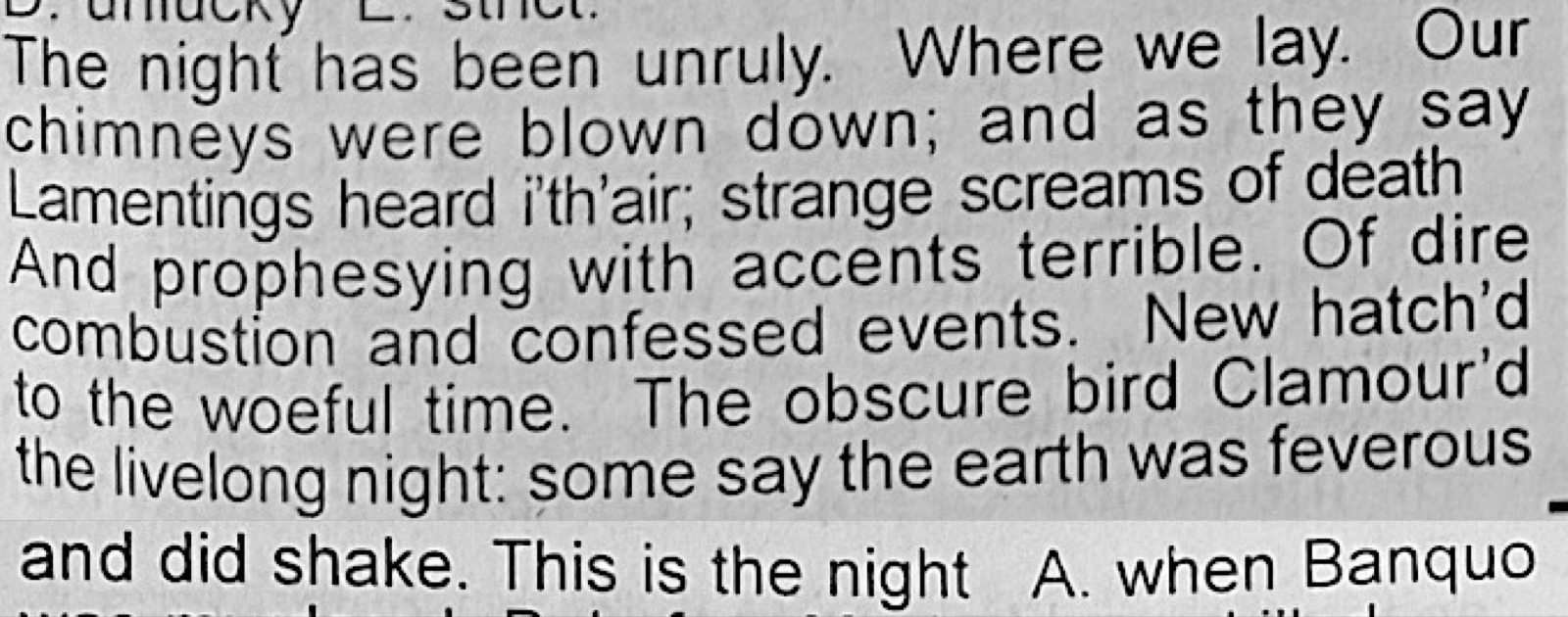
Question 10 Other Set Texts: Non-African Drama From Macbeth (Shakespeare) This is the night
A. when Banquo was murdered B. before Macbeth was killed C. when Duncan and his men were fighting the enemy D. when Macbeth went to see the witches E. when Duncan was murdered. Show the answer and explanation Answer: E (when Duncan was murdered. )
Explanation Lennox describes the strange storms of the night Duncan was killed in Macbeth's castle.
Open this question
Question 11 Other Set Texts: African Prose Kofi had to live under a master and go to school in Keta because
A. his mother lived in Keta B. his father was transferred to Abor C. he lost his school fees to gamblers D. his father's school was a junior school E. his father wanted to punish him. Show the answer and explanation Answer: D (his father's school was a junior school )
Explanation His father's school only went up to the junior classes, so Kofi had to go to Keta for higher classes.
Open this question
Question 13 Set Text: The Marriage of Anansewa Ananse knew who loved his daughter most through
A. the quality of gifts they sent to him B. the eagerness which each showed to marry her C. their reactions to the news of Anansewa's death D. the words of their messengers E. the letters the chiefs wrote to him. Show the answer and explanation Answer: C (their reactions to the news of Anansewa's death )
Explanation Ananse pretends Anansewa is dead and watches how each chief responds; Chief-Who-Is-Chief shows true love.
Open this question
Question 14 Other Set Texts: Non-African Drama Orlando addressed the banished duke and his men roughly because
A. he was hungry B. he was greedy C. he was afraid D. he thought they were wild E. they refused to give him food. Show the answer and explanation Answer: D (he thought they were wild )
Explanation Orlando says he thought "all things had been savage here", so he drew his sword to demand food.
Open this question
Question 15 Other Set Texts: Non-African Drama In As You Like It Orland's defeat of Charles, the Duke's wrestler made his brother Oliver
A. decide to reconcile with him B. plan to kill him C. hate him more D. ask the servant, Adam to drive him away E. give him his deserved inheritance. Show the answer and explanation Answer: B (plan to kill him )
Explanation Adam warns Orlando that Oliver plans to burn his lodging and kill him after his victory.
Open this question
Question 17 Other Set Texts: Non-African Drama 'To be thus is nothing But to be safely thus Our fear in Banquo stick deep'. Soon after these words, Macbeth is dramatically 'attended' by
A. Banquo and his son B. two murderers C. Lady Macbeth D. Lady Macbeth and a servant E. Banquo. Show the answer and explanation Answer: B (two murderers )
Explanation Macbeth fears Banquo, and right after this speech he meets the two murderers he will send to kill Banquo and his son.
Open this question
Question 18 Other Set Texts: Non-African Drama 'Thou losest labour As easy mayst thou the interenchant air with thy keen sword impress as make me bleed'. Macbeth's contempt from Macduff's efforts in this battle scene arises from
A. the quality of his military uniform B. the fact that he cannot be hurt by mortals C. the fact that the witches have given him charms D. the fact that the witches have made him think no mortal can hurt him E. the fact that he is as light as air. Show the answer and explanation Answer: D (the fact that the witches have made him think no mortal can hurt him )
Explanation The apparition said no man born of woman could harm him, so Macbeth believes he is safe.
Open this question
Question 19 Other Set Texts: African Prose Eliza in Mine Boy is representative of
A. European female sophistication B. the disaster of an African wishing to be European C. moral decadence in South Africa where women smoke D. the hardships of a black female teacher E. the loneliness of a female teacher in Malay Camp. Show the answer and explanation Answer: B (the disaster of an African wishing to be European )
Explanation Eliza wants the white people's things and life, and this longing leaves her unhappy and she goes away.
Open this question
Question 20 Other Set Texts: African Prose Which of these characters in Abraham's Mine Boy is notorious for playing with a knife?
A. Xuma B. Leah C. Ma Plank D. Dladla E. Joseph. Show the answer and explanation Answer: D (Dladla )
Explanation Dladla is the man who carries and threatens with a knife in Malay Camp.
Open this question
Question 21 Other Set Texts: African Prose 'The doctors looked at Chris and Johannes. They were both dead. 'They kept the place up with their bodies so that we could get out!' a mine boy cried and began to sob (Mine Boy ). The death of Chris and Johannes is symbolic because
A. it shows how black and white can and ought to make sacrifices for mutual benefit B. it leads to the arrest of the miners by the police C. it shows the bad conditions of the mines D. it is the result of panic E. it keeps Xuma out of trouble. Show the answer and explanation Answer: A (it shows how black and white can and ought to make sacrifices for mutual benefit )
Explanation Chris is white and Johannes black; they die together saving the miners, showing what the races can do together.
Open this question
Question 22 Other Set Texts: African Prose In Mine Boy Peter Abrahams is of the view that apartheid would cease to exist in South Africa if
A. the blacks forced out the whites B. the whites packed their bags and went away peacefully C. the whites became more generous and gentle to the blacks D. black and white stopped regarding people primarily by the colour of the skin E. unequal treatment of black and white at the mines was discontinued. Show the answer and explanation Answer: D (black and white stopped regarding people primarily by the colour of the skin )
Explanation Paddy teaches Xuma to be "a man first" and not to see people by colour.
Open this question
Question 23 Other Set Texts: African Drama Kongi wants to eat the New Yam during the Harvest Festival because
A. he was very hungry after his period of fasting B. the Yam won the agriculture contest C. it belonged to the Royal House D. it symbolized the acquisition of power E. he wanted to reconcile with Oba Danlola. Show the answer and explanation Answer: D (it symbolized the acquisition of power )
Explanation Receiving the New Yam from Danlola would show that Kongi has taken the old king's spiritual authority.
Open this question
Question 25 Other Set Texts: Non-African Drama In As You Like It , the verse which begins. 'Blow blow thou winter wind' is about
A. a storm in winter B. man's ingratitude C. Duk Senior's cave D. Le Beau's love for Snowballs E. Orlando's love for Rosalind. Show the answer and explanation Answer: B (man's ingratitude )
Explanation Amiens sings that the cold wind hurts less than human ingratitude.
Open this question
Question 26 Other Set Texts: African Drama Kongi's Harvest is
A. a political drama B. a social comedy C. a play about natural rulers D. a historical tragedy E. a domestic comedy. Show the answer and explanation Answer: A (a political drama )
Explanation The play satirises a dictator's struggle for power, so it is political drama.
Open this question
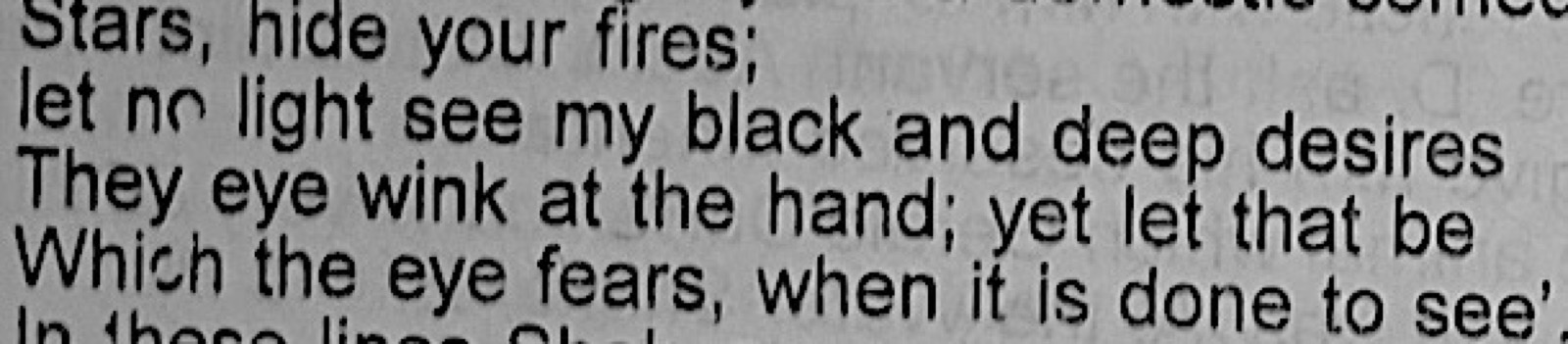
Question 27 Other Set Texts: Non-African Drama From Macbeth (Shakespeare) In these lines Shakespeare uses
A. hyperbole B. metonymy C. onomatopoeia D. simile E. apostrophe. Show the answer and explanation Answer: E (apostrophe. )
Explanation Macbeth speaks directly to the stars as if they could hear him: apostrophe.
Open this question
Question 28 Non-African Poetry These lines fairly represent the attitude of Ulysses' life. This attitude may be described as
A. complaining continually about life B. unwillingness to agree and work with others. C. ceaseless labour and search for challenges D. dislike of one's country or home E. roaming and idling. Show the answer and explanation Answer: C (ceaseless labour and search for challenges )
Explanation Ulysses is always "roaming with a hungry heart" for new experience: a restless search for challenge.
Open this question
Question 29 Non-African Poetry The poetic beauty of the last line owes to the use of
A. simile B. onomatopoeia C. metaphor D. archaism E. metonymy. Show the answer and explanation Answer: B (onomatopoeia )
Explanation The soft "m", "s" and "z" sounds copy the buzzing of the flies.
Open this question
Question 30 Non-African Poetry In 'Ode to a Nightingale' Keats celebrates the beauty of
A. a particular 'immortal Bird' B. all nightingales C. artistic expression D. philosophical statement E. the nightingale Ruth heard. Show the answer and explanation Answer: A (a particular 'immortal Bird' )
Explanation Keats addresses the bird he hears as an "immortal Bird" whose song has lasted through the ages.
Open this question
Question 31 African Poetry In 'Procession I–Hanging Day', Soyinka writes about
A. what he actually witnessed B. an imaginary event C. what he read about in the papers D. what the prison warder told him E. what everyone knows. Show the answer and explanation Answer: A (what he actually witnessed )
Explanation The poem comes from Soyinka's prison years, when he heard and saw condemned men led to hanging.
Open this question
Question 32 Non-African Poetry When the Franklin declares in the prologue to his tale that he has 'not slept on Mount Parnassus' he meant that
A. his bed has always been uncomfortable B. he has sleepless nights C. he has no literary pretensions D. he is well-versed in rhetorics E. he is a poor sleeper. Show the answer and explanation Answer: C (he has no literary pretensions )
Explanation Parnassus is the mountain of the Muses; the Franklin is saying he is no learned poet.
Open this question
Question 33 African Poetry The dominant images in Kalu Uka's 'Earth to Earth' are those of
A. love and beauty B. youth and joy C. death and burial D. the sweetness of wooing E. the richness of a man's memory. Show the answer and explanation Answer: C (death and burial )
Explanation The poem is about death and return to the earth, and its images are of burial.
Open this question
Question 34 Non-African Poetry 'The Tiger' of William Blake is made up of a series of
A. analogies B. rhetorical questions C. apostrophes D. exaggerations E. similes. Show the answer and explanation Answer: B (rhetorical questions )
Explanation The poem keeps asking who could have made the tiger, without expecting an answer.
Open this question
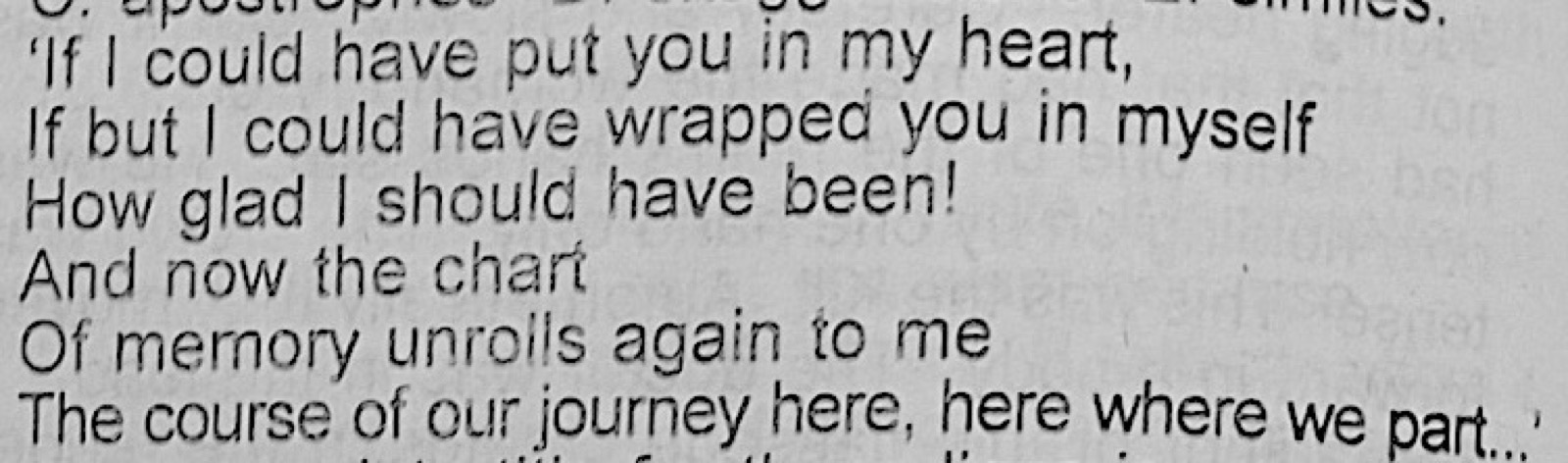
Question 35 Literary Appreciation: Poetry Verse extract (Question 35) An appropriate title for these lines is...
A. The end B. A Lover's Hopes C. Joys of Being in Love D. The Journey of Life E. Glad Lover. Show the answer and explanation Answer: A (The end )
Explanation The speaker remembers the journey together at the moment "where we part": the lines are about an ending.
Open this question
Question 36 Literary Appreciation: Prose and Drama This passage achieves realism through the use of
A. details B. simple words C. the long sentence D. the past tense E. punctuation. Show the answer and explanation Answer: A (details )
Explanation Exact details of the eyes, mouth, blood and wound make the scene vivid and real.
Open this question
Question 37 Non-African Poetry In 'The World is Too Much With Us', Wordsworth wishes that people could
A. become pagans B. appreciate the beauty of Nature more C. go to see Proteus and Triton D. become part of Nature E. give their 'hearts away'. Show the answer and explanation Answer: B (appreciate the beauty of Nature more )
Explanation Wordsworth complains that people are so busy "getting and spending" that they no longer feel nature's beauty.
Open this question
Question 38 Literary Appreciation: Poetry Verse extract (Question 38) The images in the passage mostly draw attention to
A. fun B. ill health C. carelessness D. sacrifice E. dicting. Show the answer and explanation Answer: B (ill health )
Explanation Disease, fever and bleeding are pictures of illness.
Open this question
Question 39 Literary Appreciation: Poetry It is suggested in these lines that
A. the beauty of the morning gains from the beauty of the city B. the beauty of the city gains from the beauty of the morning C. the beauty of the city and the beauty of the morning are unrelated D. the beauty of the same has nothing to do with either the city or the morning E. there is no beauty on earth. Show the answer and explanation Answer: B (the beauty of the city gains from the beauty of the morning )
Explanation The city "wears" the morning's beauty like a garment: the morning makes the city beautiful.
Open this question
Question 41 Literary Appreciation: Poetry Line 3 is made memorable by the use of
A. simile B. metaphor C. polysyndeton D. monosyndeton E. alliteration. Show the answer and explanation Answer: E (alliteration. )
Explanation "Meandering with a mazy motion" repeats the "m" sound: alliteration.
Open this question
Question 42 African Poetry The feeling in the poem 'Nightfall in Soweto' is one of
A. gratitude B. love C. hate D. joy E. safety. Show the answer and explanation Answer: C (hate )
Explanation The speaker hates the night that brings violence and terror to Soweto.
Open this question
Question 45 African Poetry The subject matter of 'A Troubadour I Traverse' is
A. suffering and oppression B. laughter and happiness C. singing and merry making D. love for a woman E. long journey. Show the answer and explanation Answer: A (suffering and oppression )
Explanation Brutus writes about living under apartheid's restrictions and persecution.
Open this question
Question 46 Poetry: General Poetry deals with one of the following
A. emotion only B. death only C. ideas only D. emotion and ideas E. beauty only. Show the answer and explanation Answer: D (emotion and ideas )
Explanation Poems express feelings and thoughts together.
Open this question
Question 47 African Poetry From Kalu Uka's 'Earth to Earth' The rhyme scheme in this passage from Kalu Uka's 'Earth to Earth' is
A. alternate rhymes B. triplets C. Couplets D. free verse E. blank verse. Show the answer and explanation Answer: C (Couplets )
Explanation The first two lines rhyme together (flower/bower) as a pair: couplet rhyme.
Open this question
Question 48 African Poetry All the images used to describe where the poet always stops in Lenrie Peter's 'The Fence' are suggestive of the character's
A. cleverness B. versatility C. moral weakness D. romantic disposition E. evil nature. Show the answer and explanation Answer: C (moral weakness )
Explanation Always stopping "on the fence" shows a person who will not take a firm moral stand.
Open this question
Question 49 Non-African Poetry In Gray's 'Elegy' the poor are
A. abused B. accursed C. romanticized D. praised E. admonished. Show the answer and explanation Answer: C (romanticized )
Explanation Gray paints an idealised, gentle picture of the humble country poor and their simple lives.
Open this question
Question 50 Non-African Poetry Chaucer presents The Franklin as
A. a great noble man B. a devout Christian C. an epicurian in taste D. a jovial character E. an ambitious man. Show the answer and explanation Answer: C (an epicurian in taste )
Explanation Chaucer calls the Franklin "Epicurus' own son": he loves good food and drink.
Open this question Sign up free for every JAMB Literature in English year, practice by topic and timed mocks.
Start practising free