Home › Past questions › JAMB › Literature in English › 1979 43 questions. Try each one, then open the answer to check yourself and read the explanation.
Sign up free to answer these questions on a CBT screen with a timer, then see your score and every answer explained.
Start practising free
Question 4 African Poetry The dominant feeling in Leopold Sedar Senghor's 'In Memoriam' is
A. happiness B. nostalgia C. sadness D. despair E. hatred. Show the answer and explanation Answer: B (nostalgia )
Explanation Alone in Paris on All Saints' Day, the poet longs for his dead ancestors and his African home: nostalgia.
Open this question
Question 5 Drama: General 'Exposition' in a play means
A. the initial unfolding of the necessary background of the play B. its climax C. the marriage of the hero and heroine D. the untangling of the plot E. the private speech of a character. Show the answer and explanation Answer: A (the initial unfolding of the necessary background of the play )
Explanation The exposition comes at the start and tells the audience who the characters are and what has happened before.
Open this question
Question 6 Prose: General A novel can be described as
A. a narration of facts B. a story C. a brief description of a concept or point of view D. an extended prose narrative covering a wide range of characters and experience E. a narration of an incident. Show the answer and explanation Answer: D (an extended prose narrative covering a wide range of characters and experience )
Explanation A novel is long fiction in prose with many characters and events.
Open this question
Question 7 Literary Terms and Devices A good plot must possess
A. many exciting events B. good, interesting characters C. a pleasant setting D. intrigue E. a single, complete, and ordered action. Show the answer and explanation Answer: E (a single, complete, and ordered action. )
Explanation Aristotle's rule is that a plot should be one complete action with a beginning, middle and end, linked in order.
Open this question
Question 8 Figures of Speech Pick out the odd one
A. Metaphor B. Characterization C. Personification D. Rhythm E. Simile. Show the answer and explanation Answer: B (Characterization )
Explanation Characterization is about how people in a story are presented; the others are features of poetic language.
Open this question
Question 9 Other Set Texts: African Prose Events in The Concubine are dominated by
A. Ihuoma B. Emenike C. the Sea God D. supernatural elements E. Ekwueme. Show the answer and explanation Answer: D (supernatural elements )
Explanation Deaths and misfortunes in the novel are driven by the gods, spirits and the Sea-King, i.e. the supernatural.
Open this question
Question 11 African Poetry In 'Come Away, My Love' Kariuki deals with the problems of
A. love in the abstract B. reflections on shop windows C. the music of the piano D. love between people of different races E. the light from the candle. Show the answer and explanation Answer: D (love between people of different races )
Explanation The poem shows a black man and a white woman who cannot love freely because of racial barriers.
Open this question
Question 12 Other Set Texts: African Prose Although the following statement is not a direct quotation from any of the books, it serves as an aid to identifying characters that appear in the works. Read it carefully and say which character is likely to make it. How could I have succumbed to the pressures of the corrupt society? I thought I would be a successful social reformer but now I am as bad as those I criticize
A. Ihuoma B. Tom C. Clara D. Emenike E. Obi Okonkwo. Show the answer and explanation Answer: E (Obi Okonkwo. )
Explanation Obi Okonkwo returns from England condemning bribery but ends up taking bribes himself in No Longer at Ease.
Open this question
Question 13 Drama: General The difference between tragedy and comedy is
A. that tragedy contains soliloquies, but comedy does not B. that comedy contains disguise, but tragedy does not C. that tragedy is imaginative, but comedy is not D. that comedy deals with love, but tragedy does not E. none of the above. Show the answer and explanation Answer: E (none of the above. )
Explanation Both kinds can have soliloquies, disguise, imagination and love; the real difference is the ending and the mood.
Open this question
Question 14 Drama: General A play is drama because
A. it contains characters B. it does not contain any story C. it cannot be read silently D. it can be acted on the stage E. it is written in verse. Show the answer and explanation Answer: D (it can be acted on the stage )
Explanation Drama is written to be performed by actors.
Open this question
Question 15 Other Set Texts: Non-African Drama The central theme of Shakespeare's As You Like It is
A. wrestling B. disguise C. forest life D. disagreement between brothers E. the nature of true love. Show the answer and explanation Answer: E (the nature of true love. )
Explanation The play explores many kinds of love (Rosalind and Orlando, Silvius and Phebe, Touchstone and Audrey).
Open this question
Question 16 Other Set Texts: Non-African Drama Which of the following statements is true of Shakespeare's Macbeth ?
A. Macbeth is a wicked woman who does not love her husband B. The Birnam wood actually moved C. The tragedy of Macbeth is caused by Macbeth's ambition and some other factors D. Macbeth is the only cause of his own tragedy E. The witches have only good news for Macbeth. Show the answer and explanation Answer: C (The tragedy of Macbeth is caused by Macbeth's ambition and some other factors )
Explanation Macbeth's ambition is the main cause, helped by the witches' prophecies and Lady Macbeth's urging.
Open this question
Question 17 Poetry: General One of the following is a mark of good poetry
A. An interesting story B. Imaginative use of language C. Realistic characterization D. Flashback E. Audience participation. Show the answer and explanation Answer: B (Imaginative use of language )
Explanation Poetry is valued for fresh, imaginative use of words and images.
Open this question
Question 18 African Poetry In Night of Seine , the word 'dark' in 'listen to our dark blood beat' is used
A. biologically B. scientifically C. figuratively D. literally E. sociologically. Show the answer and explanation Answer: C (figuratively )
Explanation Blood is not literally dark; "dark blood" stands for African identity and the deep life of the race.
Open this question
Question 19 African Poetry 'Streamside Exchange' primarily shows J.P. Clark's interest in
A. birds B. children C. trade D. rivers E. destiny. Show the answer and explanation Answer: E (destiny. )
Explanation The child asks the bird when his mother will return, and the bird answers that he cannot know: the poem is about fate.
Open this question
Question 21 African Poetry Kalu Uka's 'Earth to Earth' is about one of the following:
A. death B. urine C. flowers D. Goddess of Earth E. love. Show the answer and explanation Answer: A (death )
Explanation "Earth to earth" comes from the burial service; the poem is about death and burial.
Open this question
Question 22 African Poetry Dennis Brutus' 'A Troubadour I Traverse' is on the following:
A. a poem of resistance against oppression B. a poem about a lost lover C. a poem about a journey of exploration D. a poem of satisfaction with one's society E. none of the above. Show the answer and explanation Answer: A (a poem of resistance against oppression )
Explanation Brutus, a political prisoner in South Africa, pictures himself as a free troubadour defying apartheid's restrictions.
Open this question
Question 23 African Poetry In 'The Vultures', the 'vultures's are
A. birds of prey B. African hunters C. colonial masters D. vampires E. sacrificial animals. Show the answer and explanation Answer: C (colonial masters )
Explanation Diop uses vultures to stand for the colonisers who fed on Africa.
Open this question
Question 24 Non-African Poetry In 'The Duel', the line 'And the swords clicked and scrapped, and the onsets sped' indicates
A. the depth of their fatigue B. the loftiness of their hopes C. the abjectness of their fears D. the fervour of their prayers E. the fierceness of the fight. Show the answer and explanation Answer: E (the fierceness of the fight. )
Explanation The sounds of clashing swords and quick attacks show how fierce the fight is.
Open this question
Question 26 Non-African Poetry 'The Choirmaster's Burial' shows man's
A. gratitude B. ingratitude C. devotion D. spinelessness E. courage. Show the answer and explanation Answer: B (ingratitude )
Explanation The choir-master's simple last wish for music at his grave is ignored by the vicar: people fail to repay his service.
Open this question
Question 27 Non-African Poetry In 'Wild Grapes', the narrator says 'You see me celebrate two birthdays, And give myself out as two different age's because
A. she is reincarnated B. she has first declared a false age C. the incident of the poem begins a new chapter in her life D. the grapes are wilder than herself E. the grapes are older than herself. Show the answer and explanation Answer: C (the incident of the poem begins a new chapter in her life )
Explanation The day she was carried up by the bent birch tree was like a second birth, so she counts two birthdays.
Open this question
Question 28 Non-African Poetry 'Strange Meeting' reveals the absurdity of
A. cowardice B. love C. hatred D. war E. friendship. Show the answer and explanation Answer: D (war )
Explanation Owen's dead soldier meets the enemy he killed and finds they were like brothers: war is pointless.
Open this question
Question 29 Set Text: Romeo and Juliet Romeo and Juliet 'O Romeo, Romeo! Wherefore art thou Romeo? Deny thy father and refuse thy name' Juliet makes this statement because
A. she hates Romeo B. she hates Romeo's father C. she is anxious to marry Romeo D. she finds the name Romeo unromantic E. she wants Romeo to bear a particular name. Show the answer and explanation Answer: C (she is anxious to marry Romeo )
Explanation Juliet loves Romeo and wishes his family name were no barrier, so that she could be his.
Open this question
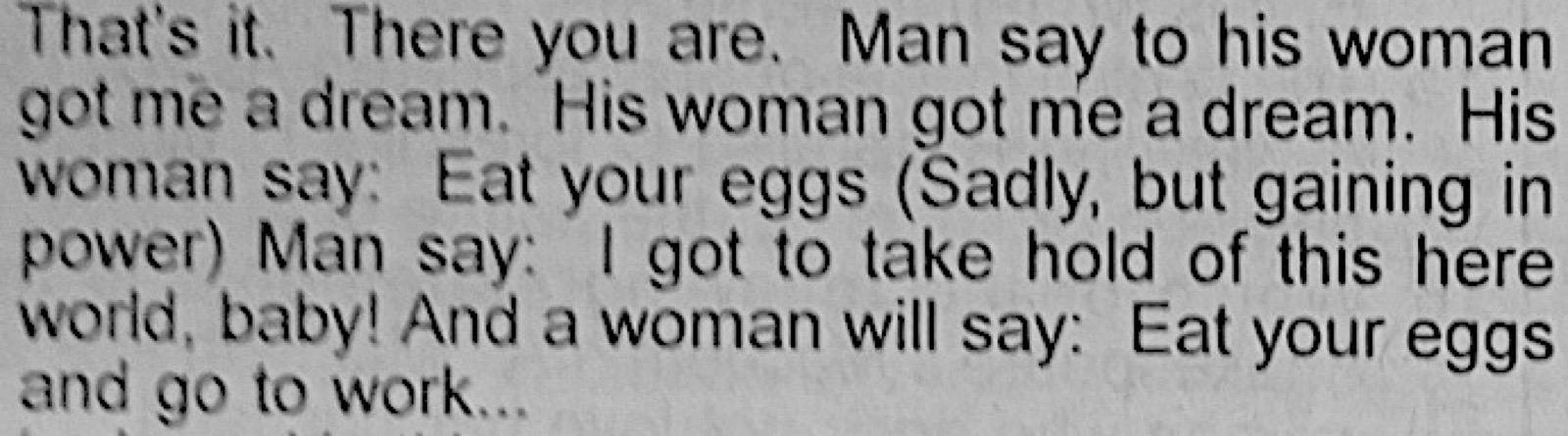
Question 30 Other Set Texts: Non-African Drama From A Raisin' in the Sun 'a dream' in this speech refers to
A. a liquor store B. a prosperous academic career C. a political career D. a family estate in Clybourne Park E. a film industry. Show the answer and explanation Answer: A (a liquor store )
Explanation Walter Lee keeps talking about his dream of getting rich through a liquor store, while his wife tells him to eat his eggs.
Open this question
Question 31 African Poetry In 'The Mesh', the poet 'lingered over the choice' because
A. he had quarrelled with the lady B. he is not yet sure of the lady's love C. he is not yet sure of his love for the lady D. the lady is not beautiful E. the lady is too possessive. Show the answer and explanation Answer: C (he is not yet sure of his love for the lady )
Explanation He hesitated in "the darkness of my doubts" until her love lit the way: he was not yet sure of his own feelings.
Open this question
Question 32 Other Set Texts: African Prose Wigwe has come to Ihuoma in order to
A. marry her clandestinely B. gain her consent before informing the relations C. persuade her to marry his own son D. dissuade her from marrying his own son E. inquire about her health. Show the answer and explanation Answer: C (persuade her to marry his own son )
Explanation Wigwe, Ekwueme's father, visits Ihuoma to ask her to marry his son.
Open this question
Question 33 African Poetry In 'The Executioner's Dream', the first line 'I dream I saw an eye, a pretty eye' is
A. ironical B. complimentary C. exclamatory D. rhetorical E. interrogatory. Show the answer and explanation Answer: A (ironical )
Explanation The executioner sees a "pretty eye" in a dream about killing: the gentle words clash with the grim reality.
Open this question
Question 34 African Poetry In Birago Diop's 'Vanity', these two lines 'Sad complaining voices of beggars Who indeed will hear them without laughter?' contain
A. an exaggeration B. a hyperbole C. a paradox D. an understatement E. an illogicality. Show the answer and explanation Answer: C (a paradox )
Explanation Sad voices that make people laugh is a paradox: it seems contradictory but makes a point about our indifference.
Open this question
Question 35 African Poetry In 'Telephone Conversation', the tone of the question 'You mean–like plain or milk chocolate?' is
A. sarcastic B. complimentary C. admissive D. pleading E. commanding. Show the answer and explanation Answer: A (sarcastic )
Explanation The speaker mocks the landlady's question about his colour by asking it back about chocolate.
Open this question
Question 36 African Poetry In 'Night', Soyinka describes night as
A. horrifying B. terrifying C. protective D. soothing E. both protective and terrifying. Show the answer and explanation Answer: B (terrifying )
Explanation The speaker begs night to hide him and fears what "night children" may do: night is frightening.
Open this question
Question 37 Other Set Texts: African Prose Modern African Stories In Alex la Guma's A Matter of Taste , it is a matter of taste to eat exactly what you want because
A. that is your own favourite choice B. you can afford it C. friends can always get it for you D. you can always have it as bonus at work E. your taste is always available. Show the answer and explanation Answer: B (you can afford it )
Explanation In the story the poor men drink cheap "coffee" and joke that taste is something only those with money can choose.
Open this question
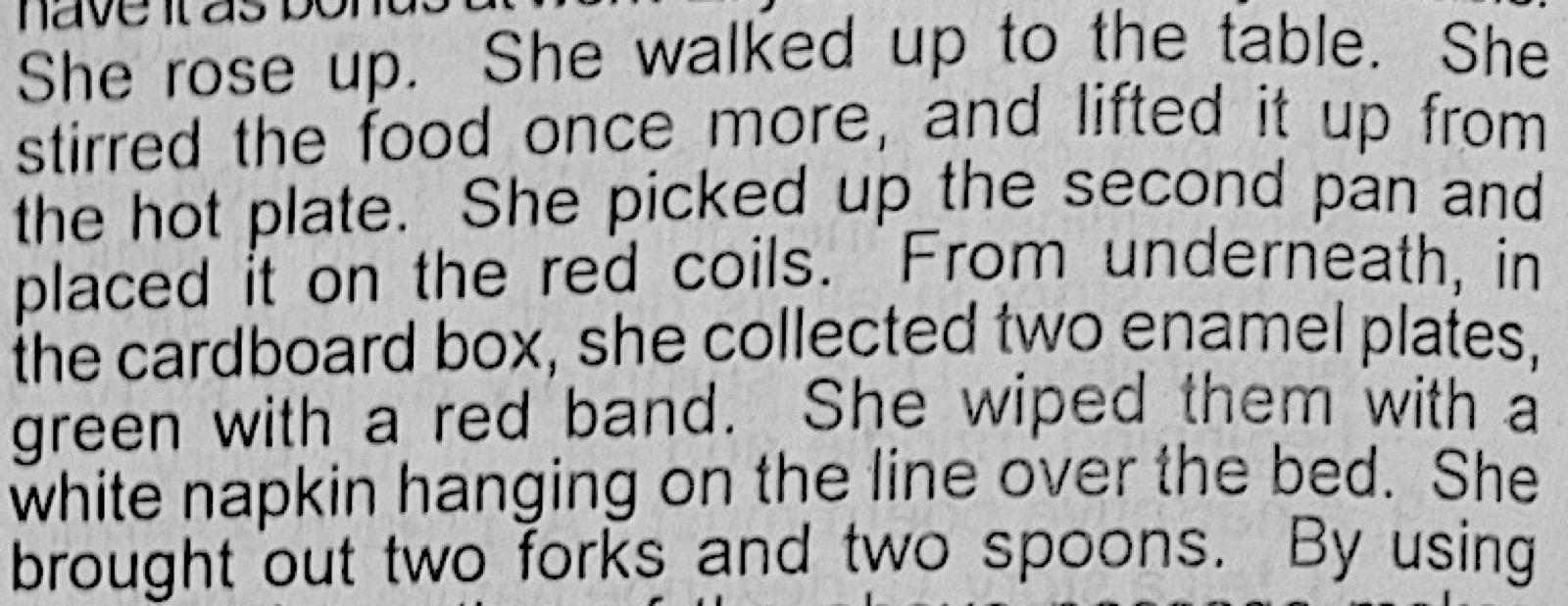
Question 38 Literary Appreciation: Prose and Drama Prose extract (Question 38) By using details, the author of the above passage makes the scene
A. monotonous B. unattractive C. realistic D. bewildering E. strange. Show the answer and explanation Answer: C (realistic )
Explanation Small exact details (the red coils, green plates with a red band, the napkin) make the scene feel real.
Open this question
Question 40 Other Set Texts: African Prose In Kossoh Town Boy , the hero presents his father as
A. tyrannical B. despotic C. strict D. weak E. selfish. Show the answer and explanation Answer: C (strict )
Explanation The narrator's father is a firm disciplinarian but not cruel.
Open this question
Question 41 Other Set Texts: Non-African Prose Kontiki Expedition demonstrates human
A. rashness B. wastefulness C. tactlessness D. courage E. recklessness. Show the answer and explanation Answer: D (courage )
Explanation Crossing the Pacific on a balsa raft shows great courage and endurance.
Open this question
Question 42 African Poetry Mtchali's 'Nightfall in Soweto' is about one of the following:
A. moonlight play at night B. disease that attacks the body C. a man fighting against a dangerous animal D. an animal attacking a helpless man E. a wicked man oppressing a helpless man. Show the answer and explanation Answer: E (a wicked man oppressing a helpless man. )
Explanation In Soweto, nightfall brings terror from violent men, both criminals and the apartheid police, to helpless people.
Open this question
Question 43 Literary History Point out the odd item in this list
A. Romeo and Juliet B. Ozidi C. Tom Sawyer D. A Raisin in the Sun E. Kongi's Harvest .Show the answer and explanation Answer: C (Tom Sawyer
Explanation Four of the titles are plays; The Adventures of Tom Sawyer is a novel by Mark Twain.
Open this question
Question 44 Literary Appreciation: Poetry Verse extract (Question 44) The author of these lines is
A. W.B. Yeats B. Chinua Achebe C. Thomas Hardy D. T.S. Eliot E. G. Okara. Show the answer and explanation Answer: D (T.S. Eliot )
Explanation These are the closing lines of T.S. Eliot's 'Journey of the Magi'.
Open this question
Question 45 Other Set Texts: African Prose Peter Abraham's Mine Boy is about one of the following:
A. oppression through labour B. the dignity of labour C. happy childhood D. conflict of culture E. none of the above. Show the answer and explanation Answer: D (conflict of culture )
Explanation Xuma, a man from the country, struggles with city ways and a racially divided society: a clash of ways of life.
Open this question
Question 46 Literary Appreciation: Poetry From 'Portrait' The tone of this passage may be described as
A. solemn B. self-mocking C. dead earnest D. serious E. angry. Show the answer and explanation Answer: B (self-mocking )
Explanation The speaker laughs at his own show of holiness while he greedily "defiles the dinner plate".
Open this question
Question 47 Other Set Texts: Non-African Prose Our attitude to the hero of George Eliot's Sill Marner is one of
A. contempt B. fear C. sympathy D. hatred E. none of the above. Show the answer and explanation Answer: C (sympathy )
Explanation Silas is wrongly accused, robbed and lonely, so readers pity him.
Open this question
Question 48 Other Set Texts: African Prose Kenneth Kaunda's Zambia Shall Be Free is a non-fictional work because
A. it is about politics B. it has no characters C. it evokes no feelings D. it is not written by a novelist E. it deals with real life events. Show the answer and explanation Answer: E (it deals with real life events. )
Explanation Non-fiction tells of things that really happened; Kaunda writes about his own life and real events.
Open this question
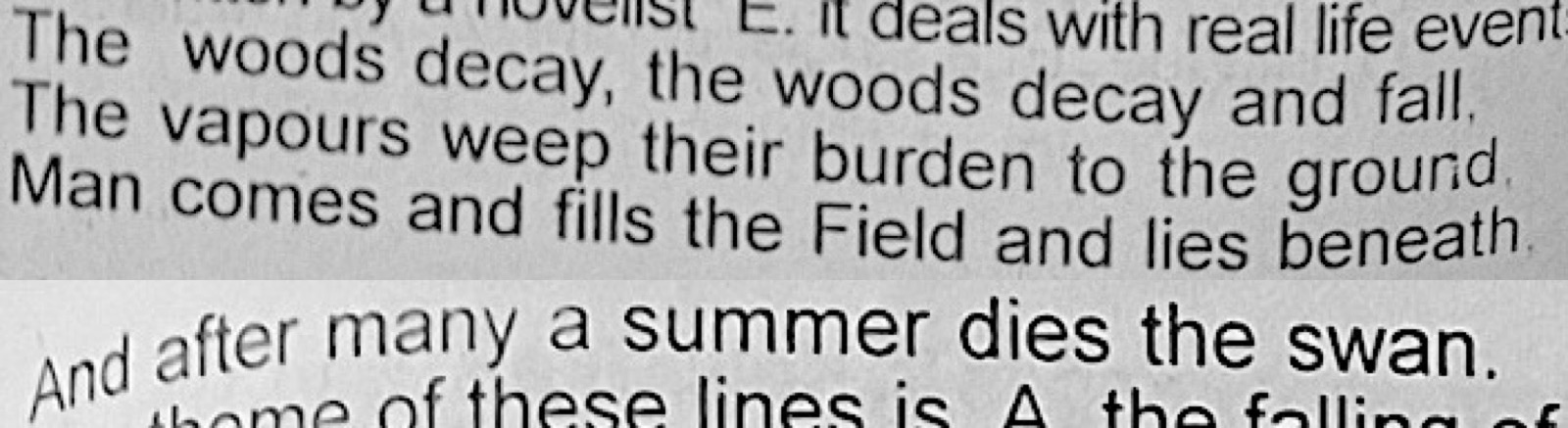
Question 49 Literary Appreciation: Poetry Verse extract (Question 49) The theme of these lines is
A. the falling of leaves B. the ground on which leaves fall C. man as a farmer D. the power of death over every life E. the flight of birds in certain seasons. Show the answer and explanation Answer: D (the power of death over every life )
Explanation Woods, man and even the swan all die in time: death comes to every living thing.
Open this question
Question 50 Literary Appreciation: Prose and Drama The author of this passage creates in the reader
A. disbelief B. a feeling of nostalgia C. a feeling of lighthearted relaxation D. suspense E. unconcern. Show the answer and explanation Answer: D (suspense )
Explanation The slow creeping policemen, the slipping hand and the tense crowd keep us anxious about what will happen.
Open this question Sign up free for every JAMB Literature in English year, practice by topic and timed mocks.
Start practising free