Home › Past questions › JAMB › Literature in English › 1978 46 questions. Try each one, then open the answer to check yourself and read the explanation.
Sign up free to answer these questions on a CBT screen with a timer, then see your score and every answer explained.
Start practising free
Question 1 Set Text: Romeo and Juliet Romeo and Juliet is a tragedy because
A. it is full of noblemen and ladies B. it is set in Verona C. it ends unhappily D. Juliet is only fourteen years old E. it has five acts. Show the answer and explanation Answer: C (it ends unhappily )
Explanation A tragedy is a serious play that ends in suffering and death; Romeo and Juliet both die at the end.
Open this question
Question 2 Drama: General Essentially, plays are meant
A. to be read for sheer pleasure B. to make us laugh C. to be presented on stage through words and action D. to keep people out of trouble E. to change the whole world. Show the answer and explanation Answer: C (to be presented on stage through words and action )
Explanation Drama is written for performance: actors bring it to life on stage through speech and action.
Open this question
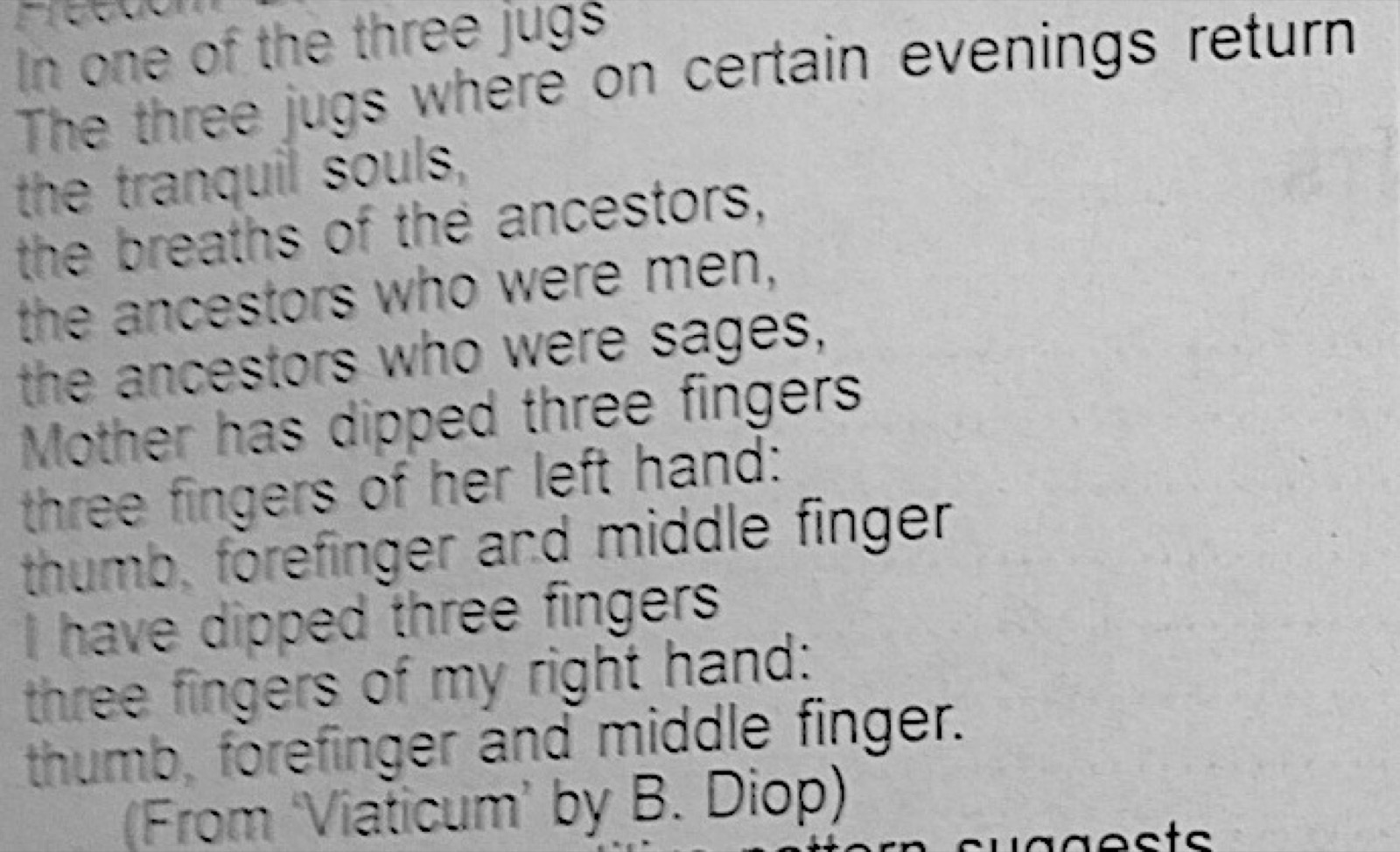
Question 5 African Poetry From 'Viaticum' by B. Diop In this poem, the repetitive pattern suggests
A. pain, agony and misery B. ritual or established form of worship C. the love of a mother for her child D. the beauty of the full moon E. the glorious lives of our ancestors. Show the answer and explanation Answer: B (ritual or established form of worship )
Explanation The repeated "three jugs" and "three fingers" sound like the fixed words and actions of a ritual of initiation.
Open this question
Question 6 African Poetry The language of David Diop's 'Africa' suggests
A. the beauty of the African countryside B. that black is beautiful C. that the poet is sad because Africa has been exploited and laid waste for too long D. that the poet remembers the great empire of Africa E. that the poet sees Africa as a colonial power. Show the answer and explanation Answer: C (that the poet is sad because Africa has been exploited and laid waste for too long )
Explanation Diop's 'Africa' mourns the "blood of your sweat" and the whip of slavery, lamenting Africa's long exploitation.
Open this question
Question 7 African Poetry In 'I Will Pronounce Your Name' Senghor writes: 'Naëtt, that is the dry tornado, the hard clap of lightning'. The figure of speech used in the above line is:
A. metaphor B. simile C. hyperbole D. irony E. synecdoche. Show the answer and explanation Answer: A (metaphor )
Explanation The name is said to BE the tornado and the lightning, a direct comparison without "like" or "as", which is a metaphor.
Open this question
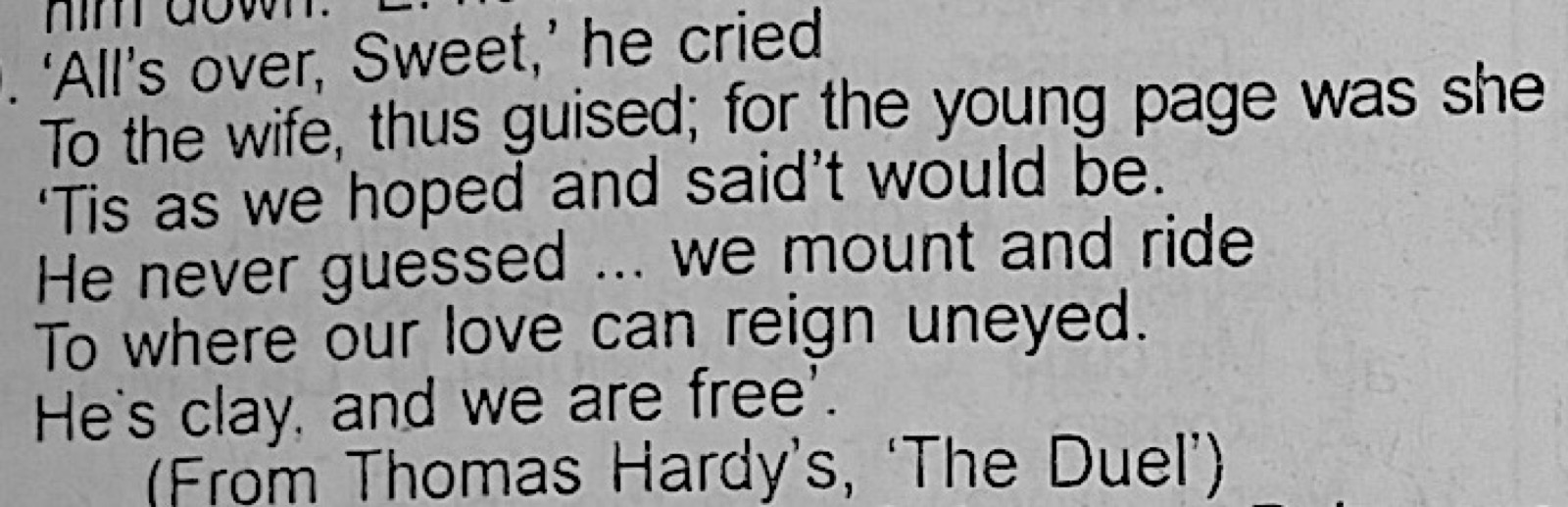
Question 8 Non-African Poetry In 'The Duel' Thomas ends his narrative
A. with a wish to see more duels fought B. in celebration of female fidelity C. in hopeless despair and anger D. with an unexpected turn of events E. in praise of matrimonial bliss. Show the answer and explanation Answer: D (with an unexpected turn of events )
Explanation At the end of the duel the winner calls the "page" his sweet, and we learn the page is the dead man's disguised wife: a surprise ending.
Open this question
Question 10 Non-African Poetry In 'The Castle' Muir writes: 'Our only enemy was gold'. This is true because
A. the castle was made of gold B. all the men swallowed gold C. there was no gold to pay for arms D. the captain stole all available gold E. gold was the cause of their betrayal. Show the answer and explanation Answer: E (gold was the cause of their betrayal. )
Explanation The defenders were strong, but a warder was bribed with gold to let the enemy in through a little gate; gold betrayed them.
Open this question
Question 11 Non-African Poetry In 'The Flight to Australia', the following line occurs: 'Tier upon tier it towered, the terrible Appennines'. The figure of speech used in this line is known as
A. alliteration B. litotes C. exaggeration D. parody E. metonymy. Show the answer and explanation Answer: A (alliteration )
Explanation The repeated "t" sound in "tier", "tier", "towered", "terrible" is alliteration.
Open this question
Question 12 Other Set Texts: African Prose If we describe Kossoh Town Boy as an autobiography, we mean that it is
A. a historical novel B. a piece of writing telling us about the life of its author C. a short story D. a narrative tale E. a book well written. Show the answer and explanation Answer: B (a piece of writing telling us about the life of its author )
Explanation An autobiography is the story of a person's life written by that person.
Open this question
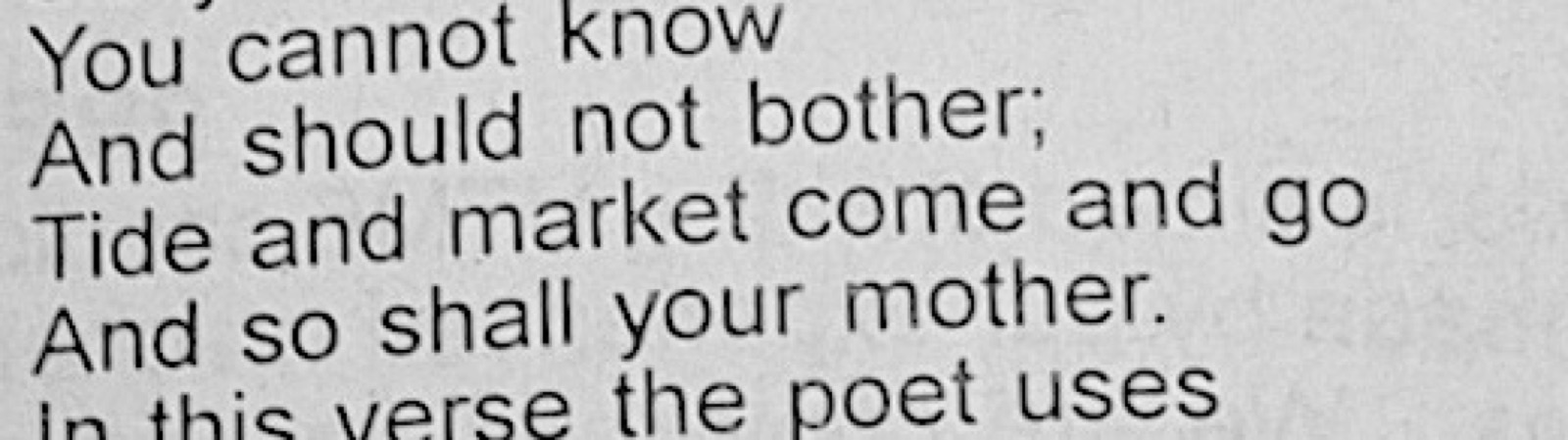
Question 13 Literary Appreciation: Poetry Verse extract (Question 13) In this verse the poet uses
A. alternate rhymes B. monorhyme C. couplets D. triplets E. blank verse. Show the answer and explanation Answer: A (alternate rhymes )
Explanation Lines 1 and 3 rhyme (know/go) and lines 2 and 4 rhyme (bother/mother): an abab pattern of alternate rhymes.
Open this question
Question 14 Literary Appreciation: Prose and Drama This writer's tone is
A. melancholic B. matter-of-fact C. bitterly humorous D. sympathetic E. sad. Show the answer and explanation Answer: C (bitterly humorous )
Explanation Orwell mocks the Comstocks' genteel poverty: 'the snobbish consolation of regarding themselves as an old family' is said with a sneer, so the tone is bitterly humorous.
Open this question
Question 15 Literary Appreciation: Prose and Drama In the first sentence, cars are described in terms of
A. birds B. ants C. fish D. lamp-posts E. pretty girls. Show the answer and explanation Answer: C (fish )
Explanation A "shoal" is a group of fish, and the cars "swam" past: the image is of fish.
Open this question
Question 16 Literary History Point out the odd item:
A. A Raisin' in the sun B. Twelfth Night C. Ozidi D. The Concubine E. Romeo and Juliet. Show the answer and explanation Answer: D (The Concubine )
Explanation All the others are plays; The Concubine is a novel.
Open this question
Question 17 Poetry: General An image in poetry usually gives a clue to one of the following:
A. rhyme B. assonance C. paradox D. theme E. refrain. Show the answer and explanation Answer: D (theme )
Explanation Images carry the poem's meaning, so they point the reader to its theme.
Open this question
Question 18 Literary Appreciation: Prose and Drama Prose extract (Question 18) The mood conveyed here is one of
A. excitement B. sadness C. joy D. triumph E. elation. Show the answer and explanation Answer: B (sadness )
Explanation A harvest "like a funeral", weeping farmers and a man hanging himself create a mood of sadness.
Open this question
Question 19 Drama: General One of the following terms applies to the discussion of both tragedy and comedy:
A. climax B. happy ending C. tragic hero D. alliteration E. stanza. Show the answer and explanation Answer: A (climax )
Explanation Every play, tragic or comic, builds up to a climax; the other terms belong to only one kind or to poetry.
Open this question
Question 20 Drama: General One of the peculiar features of drama in general is
A. humour B. satire C. sarcasm D. action E. exposition. Show the answer and explanation Answer: D (action )
Explanation Drama is the literature of action: the story is acted out rather than narrated.
Open this question
Question 21 Drama: General Dialogue is important in drama because
A. it always makes the audience laugh B. it is like conversation C. it reveals the minds of the characters D. it makes the play last longer on the stage E. it makes the characters honest. Show the answer and explanation Answer: C (it reveals the minds of the characters )
Explanation With no narrator in a play, we learn what characters think and feel through what they say.
Open this question
Question 22 Poetry: General A good poem must
A. be about love B. have a regular rhythm C. rhyme D. be difficult to understand E. none of the above. Show the answer and explanation Answer: E (none of the above. )
Explanation Good poems can be about anything and can be in free verse without rhyme, so none of these is required.
Open this question
Question 23 Prose: General One of the following is a narrative technique in the novel:
A. character B. interesting story C. flashback D. logical conclusion E. social relevance. Show the answer and explanation Answer: C (flashback )
Explanation Flashback, going back to earlier events, is a way of telling the story, i.e. a narrative technique.
Open this question
Question 24 Prose: General One of these statements is true of the novel:
A. it is an exact reproduction of historical events B. characters are unimportant in it C. it is always the story of the author's life D. it deals with human experience E. it does not make use of imagery. Show the answer and explanation Answer: D (it deals with human experience )
Explanation A novel is imagined prose fiction about human life and experience.
Open this question
Question 25 Other Set Texts: African Drama As a character, Ozidi, in J.P. Clark's play of that name, is ruined by
A. too great interest in women B. too much love of peace C. excessive belief in his own powers D. too great dependence on his grand-mother E. the wickedness of his enemies. Show the answer and explanation Answer: C (excessive belief in his own powers )
Explanation Ozidi grows so confident in his strength and charms that he kills without limit, and this excess brings his downfall.
Open this question
Question 26 Set Text: Twelfth Night Twelfth Night (Shakespeare) In Twelfth Night , the lines above were spoken by
A. Curio B. Valentine C. Orsino D. Antonio E. Sir Andrew. Show the answer and explanation Answer: C (Orsino )
Explanation The play opens with Duke Orsino, sick with love for Olivia, asking for more music.
Open this question
Question 27 Other Set Texts: African Prose Ihuoma cannot be a successful wife in The Concubine because
A. she is troublesome and cruel B. the sea god, her spirit husband, has put a curse on her C. nobody wishes to marry her in the village D. she is too old to bear children E. she is a widow. Show the answer and explanation Answer: B (the sea god, her spirit husband, has put a curse on her )
Explanation Ihuoma is the wife of the jealous Sea-King, who destroys any man who tries to marry her.
Open this question
Question 28 Other Set Texts: African Prose The old and new values in No Longer at Ease are represented by
A. The European Club and Joseph B. Obi and Clara C. The Umuofia Progressive Union and Obi D. Mr. Green and Miss Williamson E. none of the above. Show the answer and explanation Answer: C (The Umuofia Progressive Union and Obi )
Explanation The Umuofia Progressive Union stands for traditional village expectations, while Obi brings Western-educated ideas.
Open this question
Question 29 Other Set Texts: African Prose Achebe's language and style in No Longer at Ease is remarkable
A. for its short and simple sentences B. for its day-to-day expression C. for its reflection of the speech of the ordinary man D. for using the speech style of most African communities E. for reflecting the speech patterns of the different segments of the Nigerian society. Show the answer and explanation Answer: E (for reflecting the speech patterns of the different segments of the Nigerian society. )
Explanation Achebe gives each group its own voice: proverbs for the village elders, pidgin for clerks, formal English for officials.
Open this question
Question 30 African Poetry In Wole Soyinka's poem, 'I Think It Rains', rain symbolizes
A. the rise of sudden cloud from ashes B. loosening of parched tongues from the mouth C. inconveniences D. relief, and a feeling of goodness E. none of these. Show the answer and explanation Answer: D (relief, and a feeling of goodness )
Explanation Rain in the poem loosens dry tongues and minds; it stands for relief and renewal.
Open this question
Question 32 African Poetry The casualties referred to in 'Casualties' are
A. people killed during the civil war B. those who were wounded and had to endure a lot of pain C. those who lost their properties and relations D. victims of the Nigerian Civil War, both the living and the dead E. none of these. Show the answer and explanation Answer: D (victims of the Nigerian Civil War, both the living and the dead )
Explanation Clark says the casualties are not only the dead and wounded but all of us, living and dead, touched by the war.
Open this question
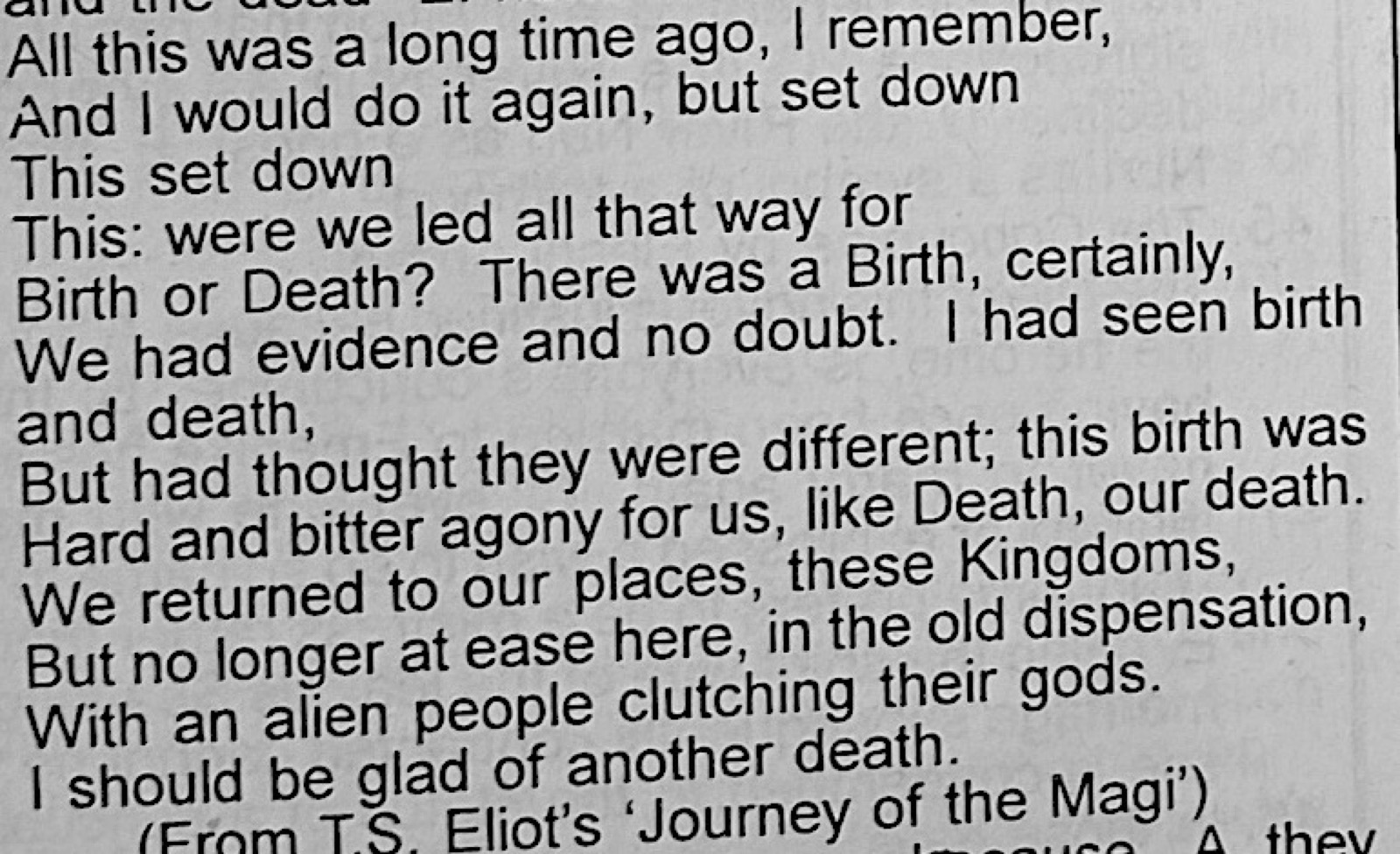
Question 33 Other Set Texts: African Prose From T.S. Eliot's 'Journey of the Magi' The Magi are no longer at ease because
A. they suffered a lot on their way to Bethlehem B. they found greater spiritual satisfaction from their journey C. death and birth are one and the same thing D. their Kingdoms can no longer offer them satisfaction E. the world has changed for the worse. Show the answer and explanation Answer: D (their Kingdoms can no longer offer them satisfaction )
Explanation Having seen the birth of Christ, the Magi feel like strangers among their own people and old gods.
Open this question
Question 34 Other Set Texts: Non-African Prose Mr. Johnson , by Joyce Cary, is an interesting novel for the reason that
A. Mr. Johnson the chief character, is a typical African B. Mr. Rudbeck is a British colonial officer C. it is a great love story between Mr. Johnson and his wife, Bamu D. Mr. Johnson is an active character full of drama, song and poetry E. all the characters are nice and considerate people. Show the answer and explanation Answer: D (Mr. Johnson is an active character full of drama, song and poetry )
Explanation Mr. Johnson is lively and imaginative, always singing and making up poems, and this drives the novel.
Open this question
Question 35 African Poetry Wole Soyinka's 'Telephone Conversation' is
A. an attack on the British telephone system B. a complaint about the difficulty of getting telephones installed in private houses C. about the colour of Soyinka's passport D. a humorous but satirical comment on colour prejudice in Britain E. about the game of hide and seek. Show the answer and explanation Answer: D (a humorous but satirical comment on colour prejudice in Britain )
Explanation An African man phoning a landlady is questioned about how dark his skin is; the poem mocks racism with humour.
Open this question
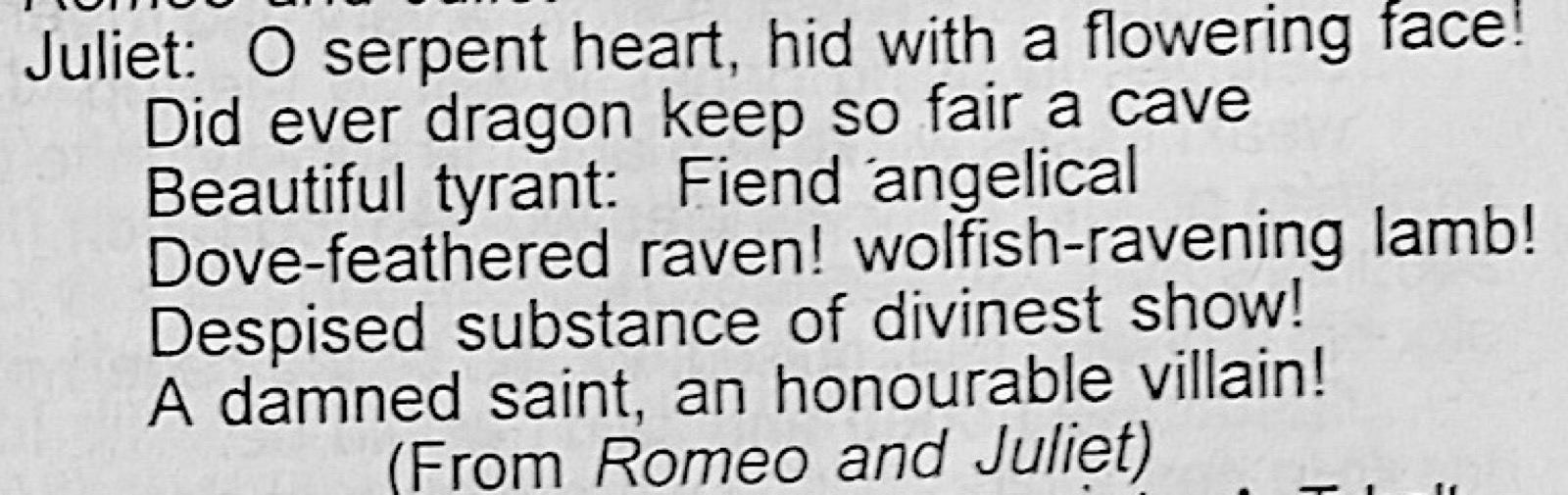
Question 36 Set Text: Romeo and Juliet From Romeo and Juliet (Shakespeare) Juliet is referring in the above passage to
A. Tybalt B. Mercutio C. Old Capulet D. Lady Montague E. Romeo. Show the answer and explanation Answer: E (Romeo. )
Explanation Juliet has just heard that Romeo killed Tybalt, and her contradictions ("beautiful tyrant") are aimed at Romeo.
Open this question
Question 37 Set Text: Twelfth Night Which of the following statements reflects best the situation revealed above
A. Malvolio is greatly admired by Maria and Sir Toby B. Malvolio's dress and bearing will please Lady Olivia very much C. Malvolio is deceived into doing things hated by Olivia D. Malvolio is a heathen and pedant E. the author of Twelfth Night pokes fun at foolishly misguided people, liked Malvolio here. Show the answer and explanation Answer: C (Malvolio is deceived into doing things hated by Olivia )
Explanation Maria's forged letter tricks Malvolio into yellow stockings and cross-garters, which Olivia actually hates.
Open this question
Question 38 Non-African Poetry The mood of the above poem is
A. optimism B. pessimism C. optimism mixed with pessimism D. much optimism qualified by a little pessimism E. much pessimism lightened by a little optimism. Show the answer and explanation Answer: B (pessimism )
Explanation The dying year tolls the end of "all my hopes", and even the new year brings only "shrouded things" seen dimly.
Open this question
Question 39 Other Set Texts: African Prose In the fiction No Longer at Ease , by Chinua Achebe, Obiajulu Okonkwo's fall can be traced to the fact that
A. the Nigerian society is often wicked to the individual B. he is at bottom a very bad man C. he believes in using bribes to get to the top D. the weaknesses within him and the society unite to pull him down E. he fancies women too much. Show the answer and explanation Answer: D (the weaknesses within him and the society unite to pull him down )
Explanation Obi falls because his own weakness meets the pressures of his society: money demands, the Union, and his family.
Open this question
Question 40 Non-African Poetry From Thomas Hardy's 'The Duel' The theme of this poem is
A. bravery B. honour C. betrayal D. death of a fool E. the evil of duelling Show the answer and explanation Answer: C (betrayal )
Explanation The "page" is the dead man's wife, who has plotted with her lover so that they can be free: a story of betrayal.
Open this question
Question 41 African Poetry In the above poem, Soyinka,
A. describes nightfall and its effect on him B. does not wish to surrender to night C. rejects the night's presence D. says that night has no progress E. does not need protection from the dangers of night. Show the answer and explanation Answer: A (describes nightfall and its effect on him )
Explanation The poem pictures night falling and the strong feelings it stirs in the speaker.
Open this question
Question 42 African Poetry In this poem,
A. the gods are being abused for their causing a natural disaster B. the poet's father is being 'cursed' for stopping the children's play C. a natural disaster is linked to the moral and religious life of a people D. the 'golden girls' are being praised for leaving home to go to the city E. nature is seen as an enemy. Show the answer and explanation Answer: C (a natural disaster is linked to the moral and religious life of a people )
Explanation The sea's destruction is linked to sacrifices to the gods and to faults that "blossomed into crimes".
Open this question
Question 43 African Poetry The poet varies the lengths of the lines skilfully
A. to show the speed, power and destructiveness of the storm B. to create pleasant sounds C. to conform to normal poetic practice D. to create a mood of fear E. to show his cleverness. Show the answer and explanation Answer: A (to show the speed, power and destructiveness of the storm )
Explanation Short, sharp lines like "Turning / Sharply" copy the sudden, whirling movement of the storm wind.
Open this question
Question 44 African Poetry Gabriel Okara's 'The Call of the River Nun', treats
A. a personal problem that is of no significance to humanity in general B. a situation that has universal significance C. the River Nun as symbolizing decline D. the River Nun as a ghost E. the River Nun as a symbol of adulthood. Show the answer and explanation Answer: B (a situation that has universal significance )
Explanation The river's call becomes a picture of every person's journey of life towards death, a universal theme.
Open this question
Question 45 Other Set Texts: African Prose The Concubine by Elechi Amadi. The title of this novel is justified because
A. Ihuoma, the heroine, is everyone's concubine B. Ihuoma having once been married to Emenike has vowed never to marry again C. everyone who married Ihuoma or expressed a wish to do so came to harm D. Ihuoma prefers to be a mistress rather than wife E. being the spirit-wife of the jealous Sea-king, any marriage subsequently contracted cannot be valid; she is condemned to the status of a concubine. Show the answer and explanation Answer: E (being the spirit-wife of the jealous Sea-king, any marriage subsequently contracted cannot be valid; she is condemned to the status of a concubine. )
Explanation As wife of the Sea-King, Ihuoma can only be a concubine to any human husband.
Open this question
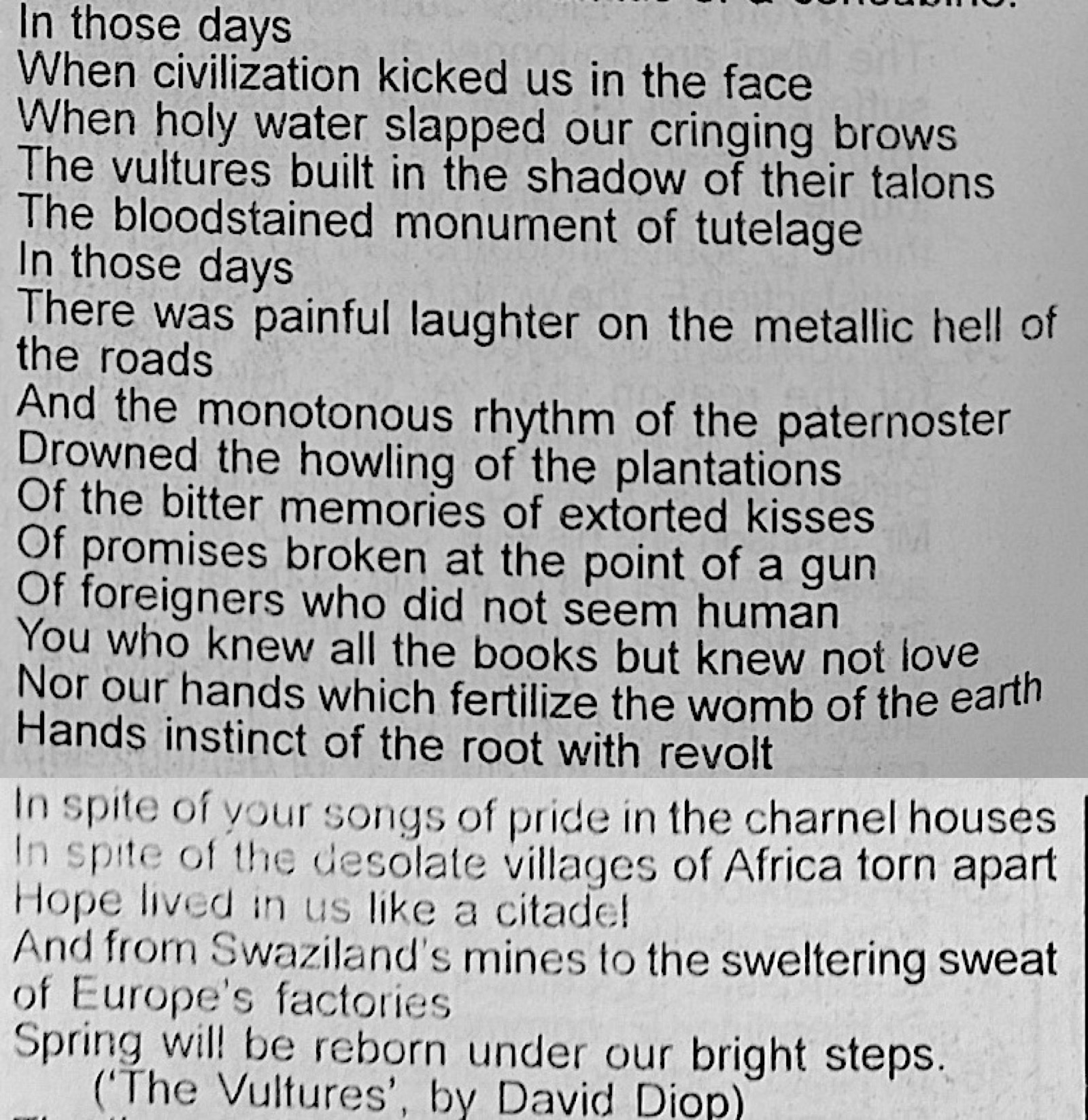
Question 46 African Poetry 'The Vultures', by David Diop The theme of this poem is
A. Vultures B. Oppression of Africans by European colonialists and the African's hope for independence C. Swaziland's mines and Europe's factories D. Bloodstained monuments E. Books without love. Show the answer and explanation Answer: B (Oppression of Africans by European colonialists and the African's hope for independence )
Explanation Diop attacks the cruelty of the colonisers ("vultures") but ends with hope that "spring will be reborn".
Open this question
Question 47 Literary History One of the following writers is better known as a playwright than as a novelist
A. C. Achebe B. C. Ekwensi C. W. Soyinka D. J.P. Clark E. E.G. Okara. Show the answer and explanation Answer: C (W. Soyinka )
Explanation Soyinka is mainly a dramatist (The Lion and the Jewel, Kongi's Harvest); Achebe and Ekwensi are novelists.
Open this question
Question 48 Prose: General The plot of a novel is best described as
A. the bare outline of the story arranged in logical order B. the story in all its details C. the story grossly elaborated D. a summary of the story E. the beginning, middle and end of the story. Show the answer and explanation Answer: A (the bare outline of the story arranged in logical order )
Explanation Plot is the chain of events of a story and the order in which the writer arranges them.
Open this question
Question 49 Poetry: General A narrative poem must
A. preach a sermon B. tell a story C. describe natural scenery D. argue a question E. propound a philosophy. Show the answer and explanation Answer: B (tell a story )
Explanation "Narrative" means story-telling, so a narrative poem tells a story.
Open this question
Question 50 Literary Terms and Devices Literature is studied as a subject at school because
A. it exposes students to the realities of life B. it provides entertainment C. it merely gives additional work to students D. it teaches the use of words E. it provides a means to kill time. Show the answer and explanation Answer: A (it exposes students to the realities of life )
Explanation Literature mirrors life, so studying it helps students understand people and society.
Open this question Sign up free for every JAMB Literature in English year, practice by topic and timed mocks.
Start practising free