Home › Past questions › JAMB › Economics › 2014 46 questions. Try each one, then open the answer to check yourself and read the explanation.
Sign up free to answer these questions on a CBT screen with a timer, then see your score and every answer explained.
Start practising free
Question 2 Economic Systems The choice of how to produce in a command economy is determined by
A. industrialists. B. labour unions. C. government. D. consumers. Show the answer and explanation Answer: C (government. )
Explanation In a command economy the government (central planners) decides what, how and for whom to produce.
Open this question
Question 3 Economic Systems In capitalist economies, questions about what to produce are ultimately answered by
A. output decisions of firms. B. spending decisions of households. C. income level of households. D. available technical skills in the economy. Show the answer and explanation Answer: B (spending decisions of households. )
Explanation Under capitalism firms produce what sells. Households' spending ('voting' with naira) tells firms what to produce.
Open this question
Question 4 Tools of Economic Analysis The best measure of dispersion to determine the tallest tree in a forest is
A. standard deviation. B. mean deviation. C. range. D. variance. Show the answer and explanation Answer: C (range. )
Explanation The range is found from the highest and lowest values, so it works directly with the tallest tree.
Open this question
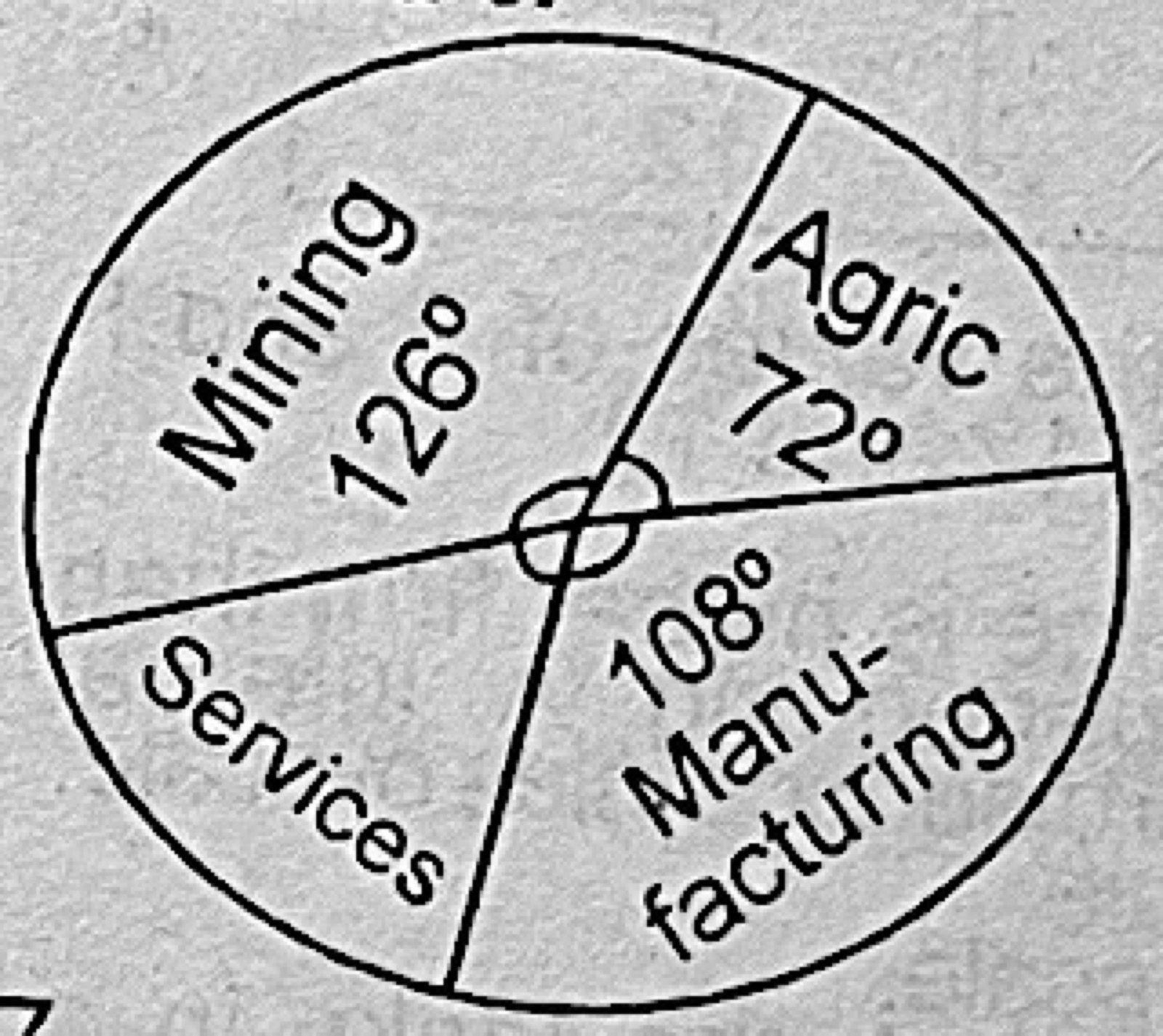
Question 5 Tools of Economic Analysis Use the pie chart below to answer the question.
A. 54%. B. 24%. C. 15%. D. 10%. Show the answer and explanation Answer: C (15%. )
Explanation Services = 360° − (126° + 72° + 108°) = 54°. 54/360 × 100 = 15%.
Open this question
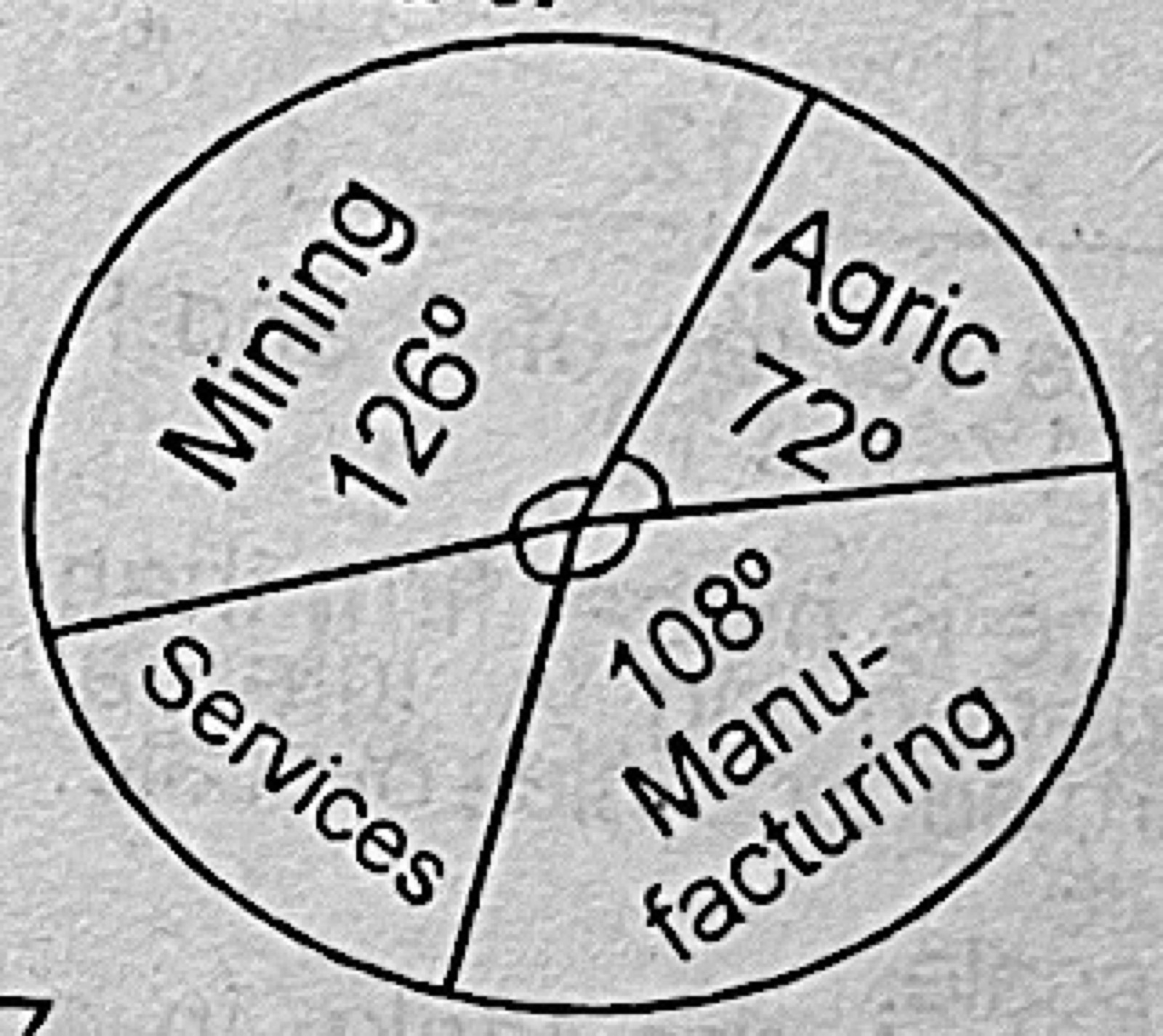
Question 6 Tools of Economic Analysis Use the pie chart below to answer the question.
A. ₦18m. B. ₦17m. C. ₦12m. D. ₦9m. Show the answer and explanation Answer: A (₦18m. )
Explanation Manufacturing = 108/360 × ₦60m = ₦18m.
Open this question
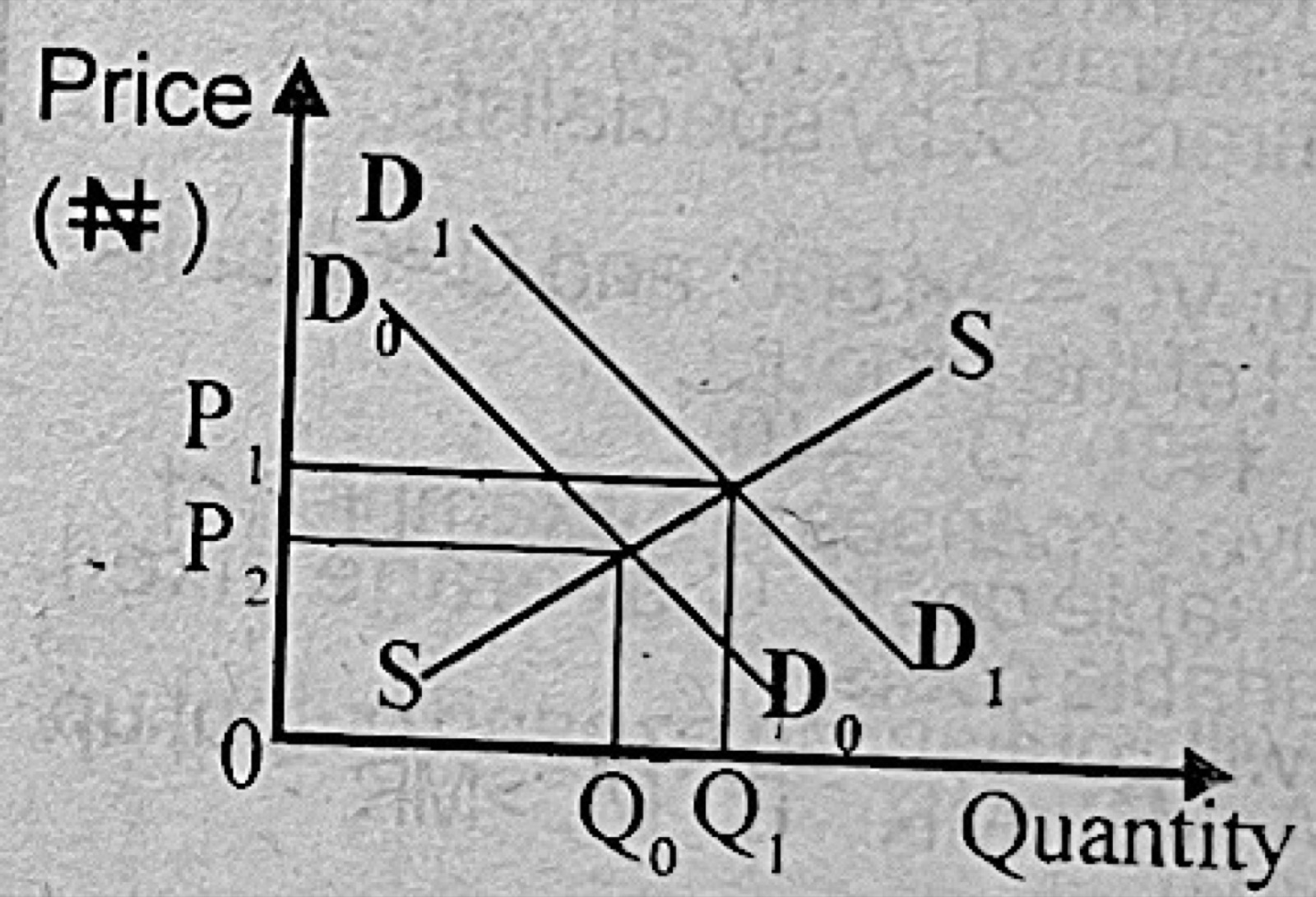
Question 7 Theory of Demand Use the graph below to answer the question.0 D0 to D1 D1 are
A. consumers income and population size. B. consumers taste and change in price. C. consumers income and change in technology. D. price of the commodity and weather conditions. Show the answer and explanation Answer: A (consumers income and population size. )
Explanation The demand curve shifts right because of a change in a condition of demand, such as higher income or a larger population. Price changes and technology do not shift demand.
Open this question
Question 8 Price Determination Given that Qd = 40 − 2P and Qs = 6P + 24, calculate the equilibrium price.
A. ₦36 B. ₦16 C. ₦4 D. ₦2. Show the answer and explanation Answer: D (₦2. )
Explanation At equilibrium Qd = Qs: 40 − 2P = 6P + 24, so 8P = 16 and P = ₦2.
Open this question
Question 9 Theory of Demand A change in demand for a normal good implies that, there is a
A. movement along a given demand curve. B. change in the price elasticity of demand. C. change in the quantity demanded as price charges. D. shift in the demand curve. Show the answer and explanation Answer: D (shift in the demand curve. )
Explanation Economists use 'change in demand' for a shift of the whole demand curve, and 'change in quantity demanded' for a movement along it caused by price.
Open this question
Question 10 Elasticity If a 10% rise in price causes a 5% decrease in the quantity demanded of a commodity, the elasticity of demand is
A. elastic. B. inelastic. C. unitary elastic. D. zero elastic. Show the answer and explanation Answer: B (inelastic. )
Explanation Elasticity = 5%/10% = 0.5, which is less than 1, so demand is inelastic.
Open this question
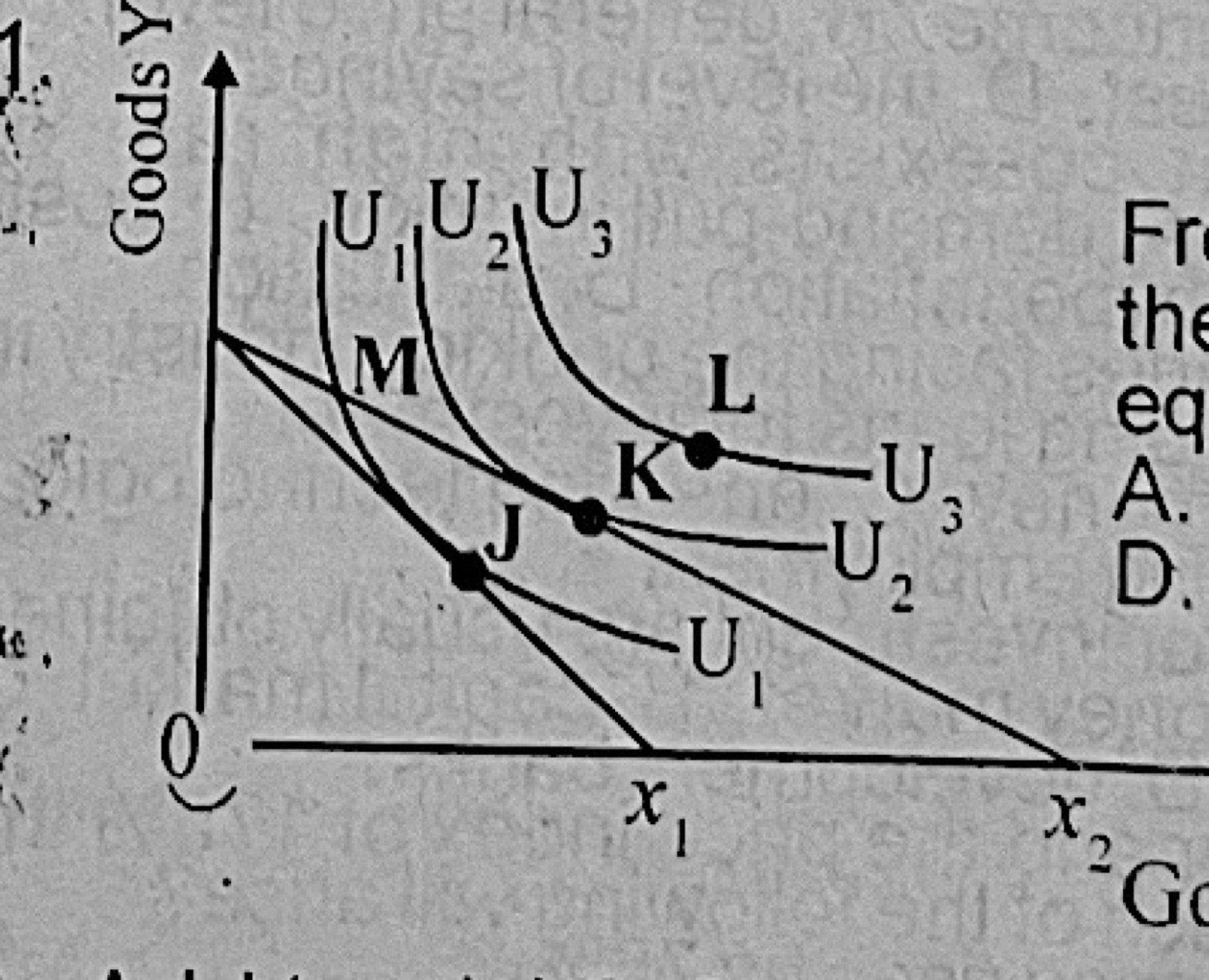
Question 11 Theory of Consumer Behaviour Use the graph below to answer the question.
A. L. B. M. C. J. D. K. Show the answer and explanation Answer: D (K. )
Explanation Equilibrium is where a budget line just touches an indifference curve. The outer budget line touches U2 at K; L is out of reach and M is not a point of tangency.
Open this question
Question 12 Theory of Consumer Behaviour A rightward shift of the budget line is caused by a
A. fall in the commodity relative price. B. rise in the commodity relative price. C. fall in consumer income. D. change in consumer taste. Show the answer and explanation Answer: A (fall in the commodity relative price. )
Explanation When a good becomes cheaper, the same income buys more of it, so the budget line moves outward to the right.
Open this question
Question 13 Theory of Supply Given the supply function p = ¼(Qs + 10) when P = ₦10, what is Qs?
A. 50 B. 30 C. 20 D. 15. Show the answer and explanation Answer: B (30 )
Explanation 10 = ¼(Qs + 10), so Qs + 10 = 40 and Qs = 30.
Open this question
Question 14 Elasticity Use the table below to answer the question.
A. 2.00 B. 1.25 C. 0.50 D. 0.80. Show the answer and explanation Answer: D (0.80. )
Explanation % change in quantity = 4/20 × 100 = 20%. % change in price = 2/8 × 100 = 25%. Elasticity = 20/25 = 0.80.
Open this question
Question 15 Price Determination When price is set below equilibrium, this will lead to
A. a decrease in the quantity supplied. B. a fall in price. C. an increase in the quantity supplied. D. a new equilibrium. Show the answer and explanation Answer: A (a decrease in the quantity supplied. )
Explanation At a lower price producers are less willing to sell, so the quantity supplied falls.
Open this question
Question 16 Economic Systems Price mechanism determines the prices of commodities through
A. the sales of treasury bills. B. government legislation. C. auctioning. D. market forces. Show the answer and explanation Answer: D (market forces. )
Explanation Under the price mechanism, prices are set by the free interaction of demand and supply (market forces).
Open this question
Question 17 Theory of Production Use the table below to answer the question.
A. 28 and 5 B. 12 and 19 C. 27 and 1 D. 68 and 12. Show the answer and explanation Answer: C (27 and 1 )
Explanation E = AP × units = 9 × 3 = 27. F = 28 − 27 = 1 (the extra output from the 4th unit).
Open this question
Question 18 Theory of Costs and Revenue If the production cost of a large is higher firm than that of a small firm, it is experiencing
A. internal economies of scale. B. internal diseconomies of scale. C. external economies of scale. D. external diseconomies of scale. Show the answer and explanation Answer: B (internal diseconomies of scale. )
Explanation When a firm grows so big that its own costs rise (management problems, waste), it suffers internal diseconomies of scale.
Open this question
Question 20 Theory of Costs and Revenue Given that FC = ₦500, VC = ₦1500, and Q = 50 units. Find the average cost of the product.
A. ₦10 B. ₦20 C. ₦30 D. ₦40. Show the answer and explanation Answer: D (₦40. )
Explanation Total cost = 500 + 1500 = ₦2000. Average cost = 2000 ÷ 50 = ₦40.
Open this question
Question 21 Theory of Costs and Revenue Rent and administrative expenses are examples of
A. fixed costs. B. variable costs. C. average fixed costs. D. average variable costs. Show the answer and explanation Answer: A (fixed costs. )
Explanation Fixed costs stay the same whatever the output, like rent and office expenses.
Open this question
Question 22 Market Structures A perfect competitor will continue to expand output up to the point where
A. MC<MR B. MC>MR C. TC>TR D. MR=AR. Show the answer and explanation Answer: A (MC<MR )
Explanation As long as an extra unit adds more to revenue than to cost (MC < MR), producing it raises profit, so the firm keeps expanding.
Open this question
Question 23 Market Structures One of the characteristics of a monopolist is that he can influence
A. both price and quanity. B. price or quantity. C. quantity produced by other producers. D. prices charged by other producers. Show the answer and explanation Answer: B (price or quantity. )
Explanation If the monopolist fixes the price, buyers decide how much to buy; if he fixes output, buyers decide the price. He cannot set both.
Open this question
Question 24 Market Structures A monopolist can boost his revenue by
A. increasing price. B. reducing price. C. adjusting both price and output upward. D. reducing total output to match the price. Show the answer and explanation Answer: A (increasing price. )
Explanation A monopolist, as the only seller, raises his price; because buyers have no close substitutes, revenue rises.
Open this question
Question 25 National Income Which of the following can be used to measure the Gross National Product in an open economy?
A. C+I+G B. C+I+G+(X−M) C. C−I−G−(X+M) D. C+I+G+X. Show the answer and explanation Answer: B (C+I+G+(X−M) )
Explanation In an open economy total spending = consumption + investment + government spending + net exports (X − M).
Open this question
Question 26 National Income If MPC = ⅔ and investment is ₦100 million, the level of national income is
A. ₦303 million. B. ₦300 million. C. ₦100 million. D. ₦10 million. Show the answer and explanation Answer: B (₦300 million. )
Explanation Multiplier = 1/(1 − ⅔) = 3. Income = 3 × ₦100m = ₦300m.
Open this question
Question 27 Money and Inflation The precautionary demand for money is determined by
A. the level of income. B. general price level. C. the rate of interest. D. the level of savings. Show the answer and explanation Answer: A (the level of income. )
Explanation People keep money for emergencies in proportion to their income: the higher the income, the more they hold.
Open this question
Question 28 Money and Inflation An inflation that co-exists with high rate of unemployment is
A. demand-pull inflation. B. cost-push inflation. C. hyperinflation. D. stagflation. Show the answer and explanation Answer: D (stagflation. )
Explanation Stagflation is stagnation (high unemployment, low growth) plus inflation at the same time.
Open this question
Question 29 Financial Institutions One of the challenges facing the banking industry in Nigeria is
A. providing loans for investment. B. creating more money. C. ensuring technological security. D. providing employment. Show the answer and explanation Answer: C (ensuring technological security. )
Explanation Banks face fraud and cyber attacks, so keeping their electronic systems secure is a major challenge.
Open this question
Question 30 Financial Institutions Short-term loans for investment are usually obtained through the
A. money market. B. capital market. C. stock market. D. development banks. Show the answer and explanation Answer: A (money market. )
Explanation The money market deals in short-term funds; the capital market supplies long-term funds.
Open this question
Question 32 Money and Inflation Wage freeze is a policy measure aimed at
A. regulating standard of living. B. curbing deflation. C. encouraging investors. D. curbing inflation. Show the answer and explanation Answer: D (curbing inflation. )
Explanation A wage freeze stops wages from rising, which limits spending and production costs, so it helps curb inflation.
Open this question
Question 33 Economic Growth and Development A major obstacle to the development of Nigerian economy is
A. over-dependence on oil. B. poor development policies. C. low capital formation. D. rural-urban migration. Show the answer and explanation Answer: B (poor development policies. )
Explanation Poorly designed and badly carried out development policies have held back Nigeria's development.
Open this question
Question 34 Economic Growth and Development A major feature of an underdeveloped economy is
A. low level of standard of living. B. low level of unemployment. C. excess capacity utilization. D. low rate of population growth. Show the answer and explanation Answer: A (low level of standard of living. )
Explanation Underdeveloped economies have low incomes per head, so most people have a low standard of living.
Open this question
Question 35 Agriculture An important role of agriculture in Nigeria's economic development is the
A. provision of infrastructure. B. provision of employment. C. processing of raw materials for industries. D. regulation of price system. Show the answer and explanation Answer: C (processing of raw materials for industries. )
Explanation Agriculture supplies raw materials such as cotton, cocoa and palm produce that industries process.
Open this question
Question 36 Agriculture An advantage of large-scale farming over peasant farming is in the area of
A. encouraging the use of traditional implements. B. encouraging urban-rural migration. C. providing research and massive employment of labour. D. redistributing national income to various regions of the country. Show the answer and explanation Answer: C (providing research and massive employment of labour. )
Explanation Large farms can afford research and employ many workers, which small peasant farms cannot.
Open this question
Question 37 Industrialisation A major disadvantage of localization of industry is
A. the risk of seasonal unemployment. B. under-utilization of installed industrial capacity. C. the risk of structural unemployment. D. over-utilization of installed industrial capacity. Show the answer and explanation Answer: C (the risk of structural unemployment. )
Explanation If the one industry a town depends on declines, many workers lose their jobs at once, causing structural unemployment.
Open this question
Question 38 Industrialisation One major factor that determines the location of an industry is
A. the capital base. B. the social responsibility of the firm. C. tax exemption grant. D. its proximity to the market. Show the answer and explanation Answer: D (its proximity to the market. )
Explanation Being close to the market lowers the cost of transporting finished goods to buyers.
Open this question
Question 39 International Economic Organisations The major contribution of OPEC to the Nigerian economy is the
A. stabilization of oil prices. B. building of refineries. C. provision of social infrastructures. D. granting of subsidies on petroleum products. Show the answer and explanation Answer: A (stabilization of oil prices. )
Explanation OPEC sets production quotas to keep oil prices stable, which steadies Nigeria's oil revenue.
Open this question
Question 41 Theory of Costs and Revenue The short-run average variable cost of a firm will rise owing to
A. an increase in the cost of labour. B. an increase in the salaries of directors. C. the expansion of factory space. D. the building of new warehouses. Show the answer and explanation Answer: A (an increase in the cost of labour. )
Explanation Labour is a variable cost, so higher wages raise average variable cost. Directors' salaries and buildings are fixed costs.
Open this question
Question 42 Business Organisations Firms embark on vertical integration in order to
A. reduce advertisement and marketing cost. B. enjoy economies of large-scale production. C. take over markets formally controlled by other firms. D. prevent other firms from entering the market. Show the answer and explanation Answer: B (enjoy economies of large-scale production. )
Explanation Joining firms at different stages of production makes one larger firm that enjoys economies of scale, e.g. cheaper supplies.
Open this question
Question 43 Business Organisations The voting power in co-operative societies is vested on
A. the shareholders. B. members with the highest contribution. C. the management. D. members without loan. Show the answer and explanation Answer: A (the shareholders. )
Explanation In a co-operative each member has one vote no matter how many shares he holds, so voting power belongs to the member-shareholders.
Open this question
Question 44 Population An accurate census figure is an important tool for planners in
A. providing social amenities. B. allocating resources. C. providing employment. D. siting industries. Show the answer and explanation Answer: B (allocating resources. )
Explanation Knowing how many people live where helps planners share out resources correctly.
Open this question
Question 45 Population An accurate population census is important in order to
A. estimate a country's per capita income. B. fast track industrial development. C. produce more food for the growing population. D. provide employment opportunities for the people. Show the answer and explanation Answer: A (estimate a country's per capita income. )
Explanation Per capita income = national income ÷ population, so it needs an accurate population figure.
Open this question
Question 46 Balance of Payments and Exchange Rates A major determinant of a floating exchange rate is
A. the system of government. B. the forces of demand and supply. C. the highest denomination of the currency. D. an Act of the parliament. Show the answer and explanation Answer: B (the forces of demand and supply. )
Explanation Under a floating system the value of a currency is left to the market: demand for and supply of the currency.
Open this question
Question 47 International Trade If the importation of a commodity is limited to a definite quantity, the trade control measure imposed is
A. quotas. B. tariff. C. excise duties. D. import duties. Show the answer and explanation Answer: A (quotas. )
Explanation A quota sets a maximum quantity of a good that may be imported.
Open this question
Question 48 International Economic Organisations The main objective of WTO is to
A. assist countries with chronic balance of payments problem. B. assist developing countries to execute developmental projects. C. ensure adequate protection for infant industries. D. provide a mechanism for tariff reduction. Show the answer and explanation Answer: D (provide a mechanism for tariff reduction. )
Explanation The World Trade Organization provides rules and negotiations through which countries cut tariffs and settle trade disputes.
Open this question
Question 49 National Income The major determinant of the total volume of output in an economy is the
A. number of farmers. B. size of the labour force. C. level of total expenditure. D. composition of consumer spending. Show the answer and explanation Answer: C (level of total expenditure. )
Explanation Firms produce what they expect to sell, so the total volume of output in an economy is set by the level of total spending (consumption, investment, government and net exports).
Open this question
Question 50 Labour Market The labour force of a country is determined by the
A. sex distribution of the population. B. number of people available for work. C. age structure of the population. D. geographical distribution of the population. Show the answer and explanation Answer: B (number of people available for work. )
Explanation The labour force is the number of people able and willing to work.
Open this question Sign up free for every JAMB Economics year, practice by topic and timed mocks.
Start practising free