Home › Past questions › JAMB › Economics › 2013 45 questions. Try each one, then open the answer to check yourself and read the explanation.
Sign up free to answer these questions on a CBT screen with a timer, then see your score and every answer explained.
Start practising free
Question 2 Economic Systems An economy in which both the public and private sectors contribute to economic growth is a
A. feudal economy. B. capitalist economy. C. socialist economy. D. mixed economy. Show the answer and explanation Answer: D (mixed economy. )
Explanation A mixed economy combines private enterprise and government enterprise.
Open this question
Question 3 Tools of Economic Analysis If the standard deviation of a given data is 53, what is the variance?
A. 2082 B. 2809 C. 2808 D. 2209. Show the answer and explanation Answer: B (2809 )
Explanation Variance is the square of the standard deviation: 53² = 2809.
Open this question
Question 4 Tools of Economic Analysis Which of the following set of statistical tools is used for further economic analysis?
A. The median and standard deviation. B. The mean and mode. C. The mean and standard deviation. D. The mode and median. Show the answer and explanation Answer: C (The mean and standard deviation. )
Explanation The mean and standard deviation use every value and can be handled algebraically, so they are used in further statistical work.
Open this question
Question 6 Tools of Economic Analysis Find the median of the following set of data 35, 10, 14, 38, 15, 18, 22, 30 and 28.
A. 10 B. 38 C. 35 D. 22. Show the answer and explanation Answer: D (22. )
Explanation In order: 10, 14, 15, 18, 22, 28, 30, 35, 38. The middle (5th) of the 9 values is 22.
Open this question
Question 8 Theory of Demand An increase in the price of a commodity will result in
A. a decrease in quantity demanded. B. an increase in demand. C. an increase in quantity demanded. D. a decrease in demand. Show the answer and explanation Answer: A (a decrease in quantity demanded. )
Explanation By the law of demand, a higher price reduces the quantity demanded (a movement along the curve).
Open this question
Question 9 Elasticity If the price of a bicycle changes from N120 to N80 and the quantity bought changes from 300 to 500 units, the elasticity of demand for bicycle is
A. 66.7 B. 0.5 C. 1.5 D. 2.0 Show the answer and explanation Answer: D (2.0 )
Explanation % change in quantity = 200/300 × 100 = 66.7%. % change in price = 40/120 × 100 = 33.3%. Elasticity = 66.7/33.3 = 2.
Open this question
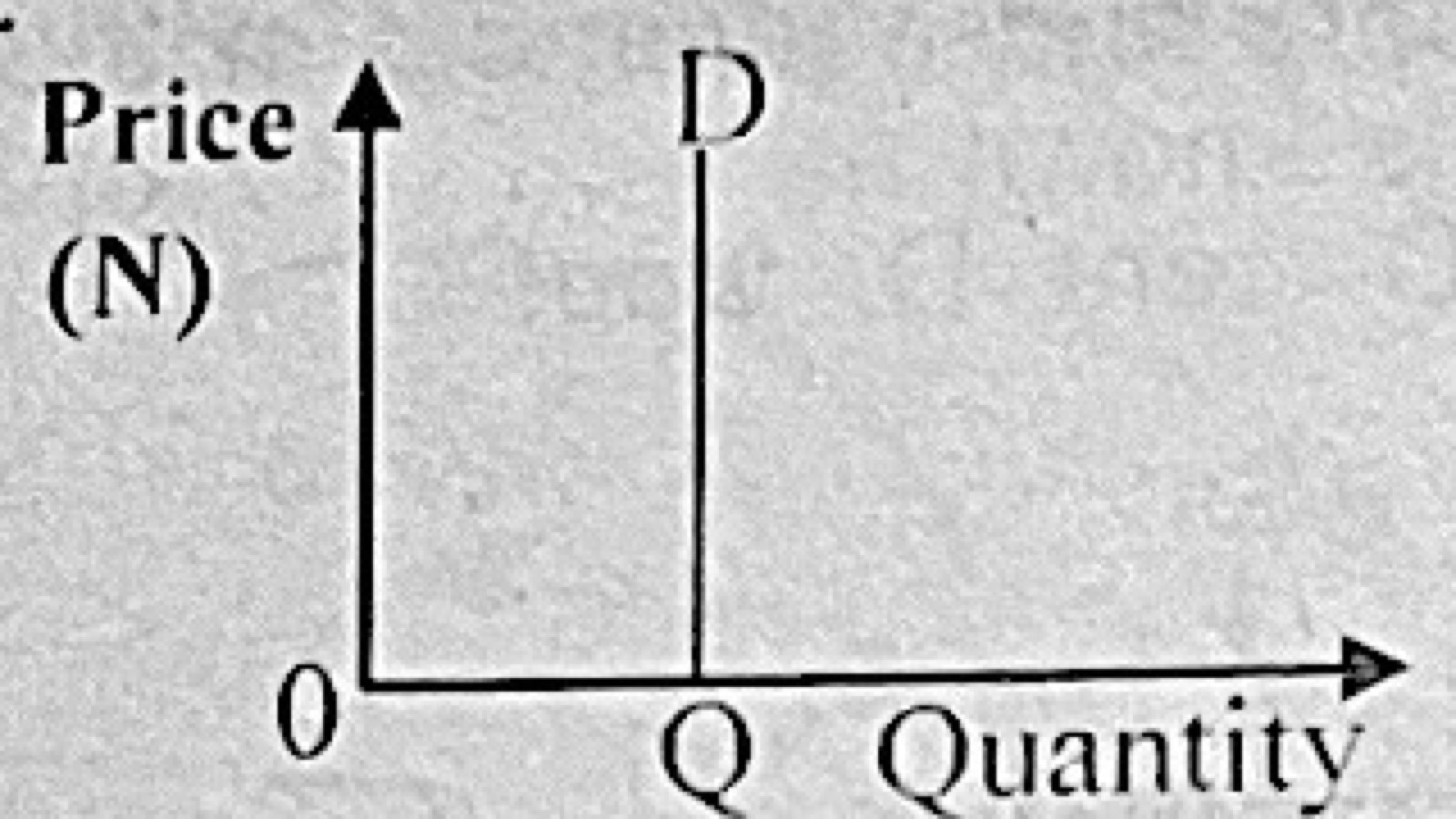
Question 10 Elasticity Use the graph below to answer the question.
A. unitarily elastic. B. perfectly elastic. C. perfectly inelastic. D. fairly inelastic. Show the answer and explanation Answer: C (perfectly inelastic. )
Explanation The demand curve is vertical: the same quantity Q is bought at every price, so demand is perfectly inelastic.
Open this question
Question 11 Theory of Consumer Behaviour One of the assumptions of the cardinalist approach is
A. diminishing marginal rate of substitution. B. the consistency and transitivity of choice. C. that total utility depends on the quantity of the commodities consumed. D. unstable marginal utility of money. Show the answer and explanation Answer: C (that total utility depends on the quantity of the commodities consumed. )
Explanation The cardinal approach measures utility in units and assumes total utility depends on the quantities consumed. A and B belong to the ordinal approach, and it assumes the marginal utility of money is constant.
Open this question
Question 12 Theory of Consumer Behaviour Utility is the satisfaction derived from the
A. distribution of goods and services. B. use of goods and services. C. demand of goods and services. D. production of goods and services. Show the answer and explanation Answer: B (use of goods and services. )
Explanation Utility is the satisfaction a person gets from consuming (using) goods and services.
Open this question
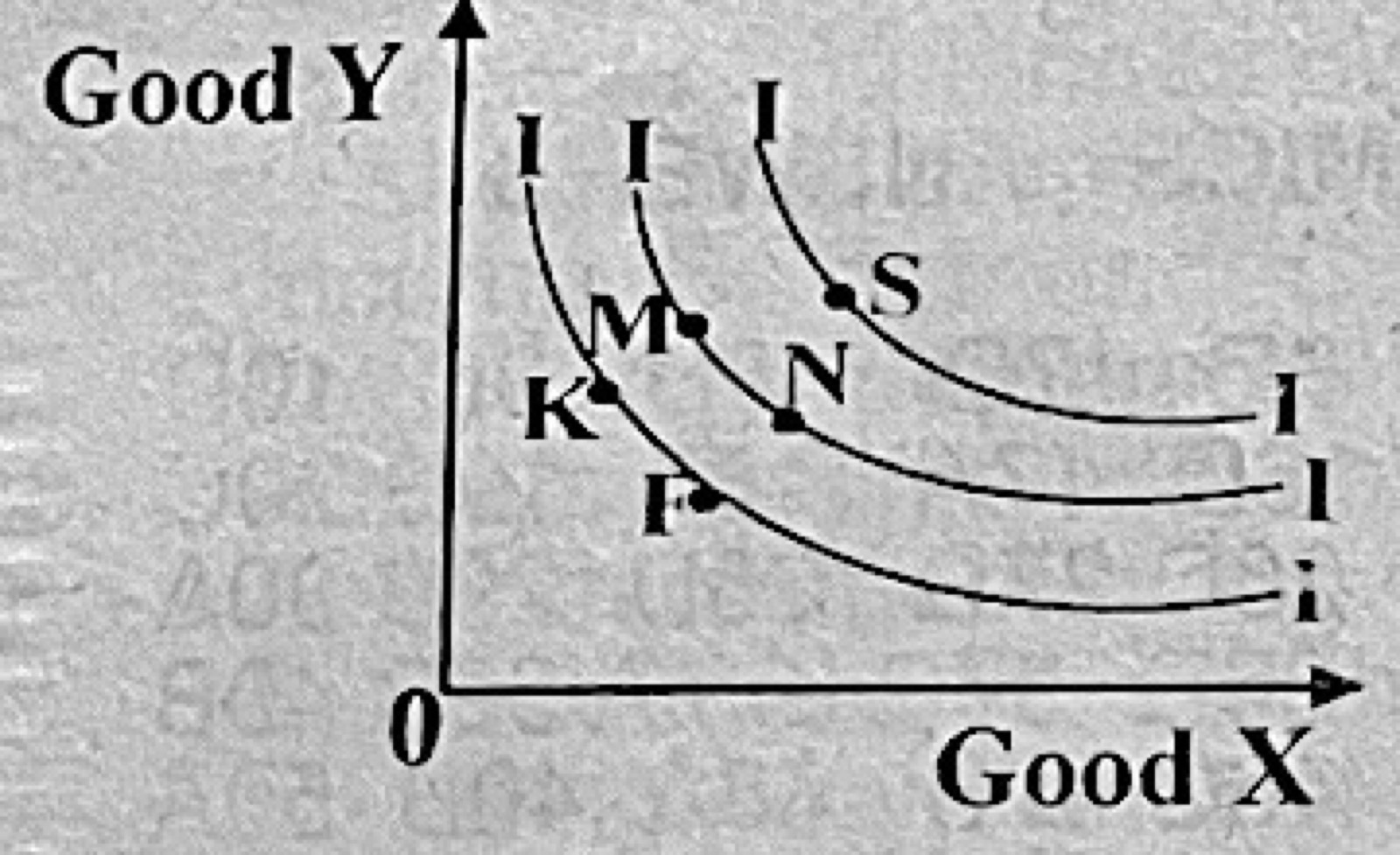
Question 13 Theory of Consumer Behaviour Use the graph below to answer the question.
A. F B. S C. M D. K. Show the answer and explanation Answer: B (S )
Explanation A higher indifference curve gives more satisfaction. S lies on the highest curve, so it is preferred.
Open this question
Question 14 Theory of Supply One of the major factors that brings about changes in supply is
A. market discrimination. B. availability of storage facilities. C. the cost of storage. D. incentives granted to workers. Show the answer and explanation Answer: B (availability of storage facilities. )
Explanation Where storage facilities exist, producers can hold back or release goods, so the quantity they offer for sale changes.
Open this question
Question 15 Theory of Supply If P = ¼(Qs + 10), what is the quantity supplied at N14?
A. 14 B. 60 C. 46 D. 32. Show the answer and explanation Answer: C (46 )
Explanation 14 = ¼(Qs + 10), so Qs + 10 = 56 and Qs = 46.
Open this question
Question 16 Elasticity If the supply of a product is elastic, a small reduction in price will
A. reduce the cost of production. B. reduce the quantity supplied. C. increase the quantity supplied. D. lead to no change in the quantity supplied. Show the answer and explanation Answer: B (reduce the quantity supplied. )
Explanation With elastic supply, producers respond strongly to price, so even a small price fall cuts the quantity supplied a lot.
Open this question
Question 17 Theory of Supply The supply of beverages by firms in a monopolistic market is an example of
A. derived demand. B. competitive supply. C. composite supply. D. joint demand. Show the answer and explanation Answer: B (competitive supply. )
Explanation Firms selling similar beverages compete for the same buyers, so their supply is competitive supply.
Open this question
Question 18 Price Determination If the price of a commodity is fixed below equilibrium, this will lead to
A. excess demand. B. a decrease in price. C. an increase in price. D. excess supply. Show the answer and explanation Answer: A (excess demand. )
Explanation Below equilibrium, buyers want more than sellers offer, so there is excess demand (shortage).
Open this question
Question 19 Economic Systems One of the criticisms of the price mechanism is that
A. producers are sovereign. B. it provides low degree of freedom. C. it widens the inequitable gap. D. consumers are sovereign. Show the answer and explanation Answer: C (it widens the inequitable gap. )
Explanation Under the price mechanism goods go to those who can pay, so the rich get richer and income inequality widens.
Open this question
Question 20 Price Determination In Nigeria, government can reduce the cost of accommodation by fixing rent
A. at the prevailing rate. B. at the equilibrium price. C. above the equilibrium price. D. below the equilibrium price. Show the answer and explanation Answer: D (below the equilibrium price. )
Explanation A rent control lowers the cost of housing only if the maximum rent is set below the market (equilibrium) rent.
Open this question
Question 21 Theory of Costs and Revenue If a refinery achieves a reduction in cost by purchasing and transporting crude oil in large quantities, it enjoys
A. economies of scale. B. specialization. C. division of labour. D. diseconomies of scale. Show the answer and explanation Answer: A (economies of scale. )
Explanation Buying and transporting in bulk lowers average cost as the firm grows: an economy of scale.
Open this question
Question 22 Theory of Production An isoquant lying above to the right of another represents
A. a higher output level. B. constant returns to scale. C. over-capacity utilization. D. a lower output level. Show the answer and explanation Answer: A (a higher output level. )
Explanation Isoquants further from the origin use more inputs and show higher output levels.
Open this question
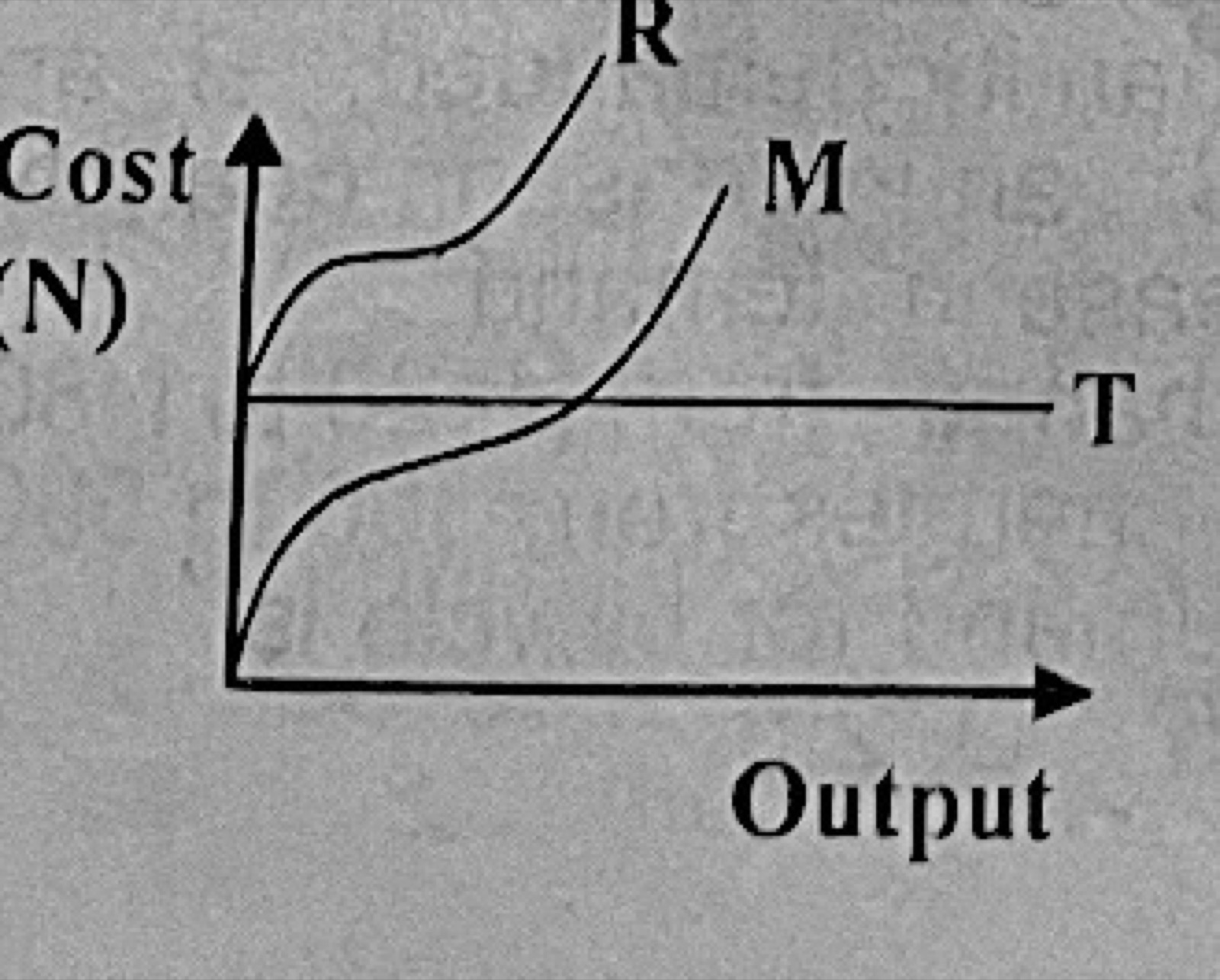
Question 23 Theory of Costs and Revenue Use the graph below to answer the question.
A. marginal cost. B. total cost. C. variable cost. D. fixed cost. Show the answer and explanation Answer: B (total cost. )
Explanation T is flat (fixed cost) and M starts at zero (variable cost). R has the same shape as M but starts at the fixed-cost level, so it is total cost = fixed + variable.
Open this question
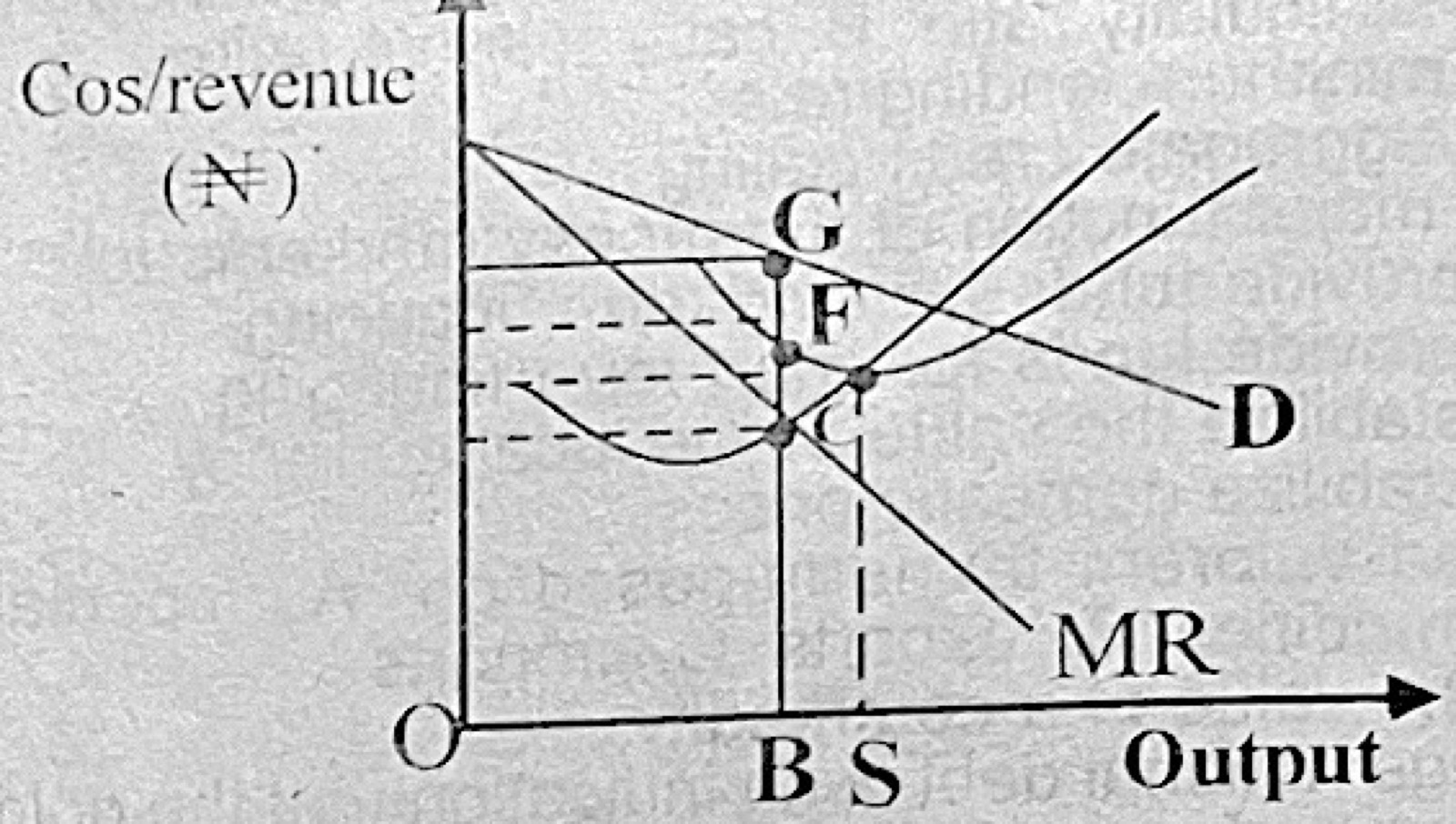
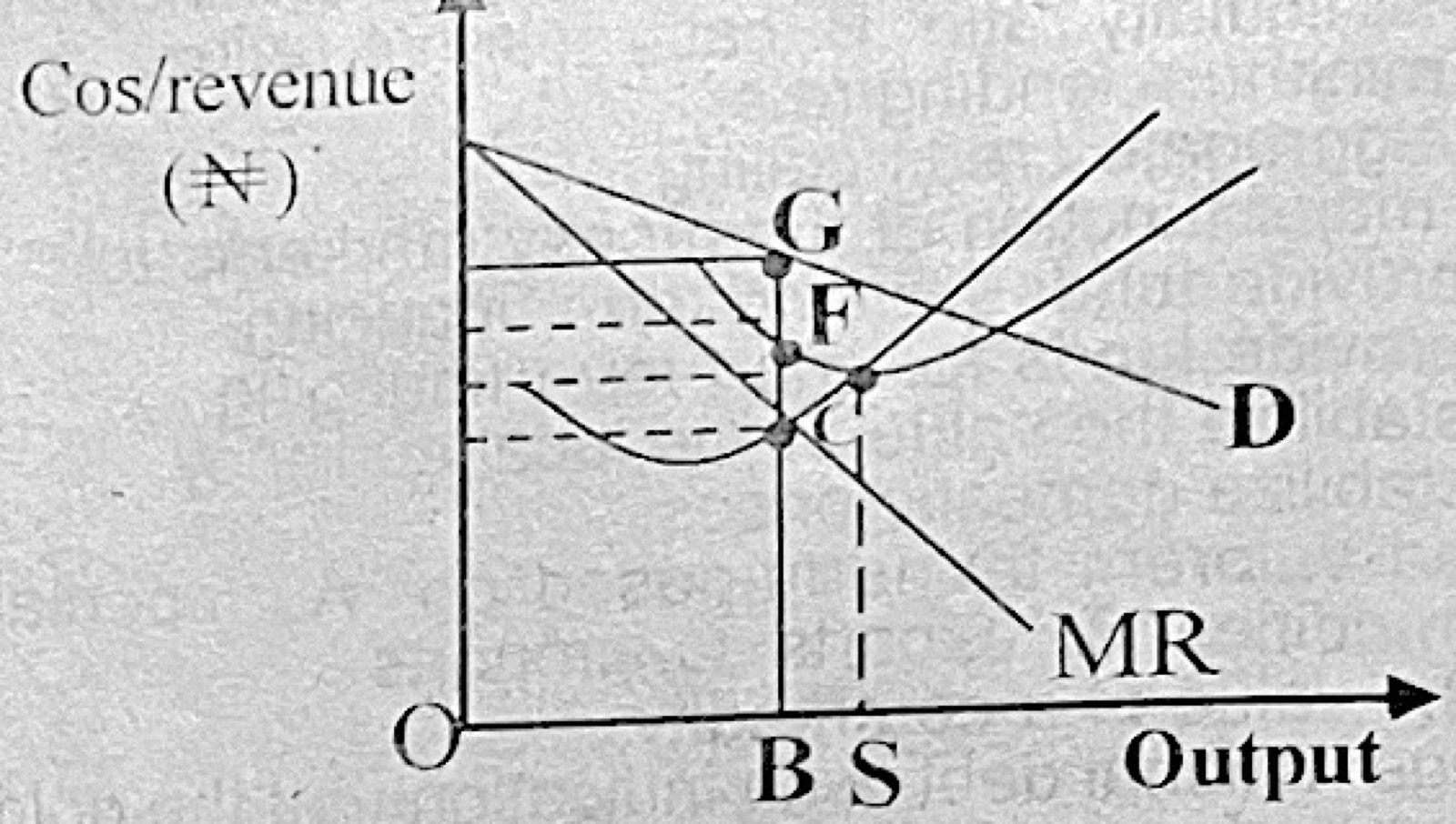
Question 24 Market Structures Use the graph below to answer the question.
A. BC. B. OB. C. OS. D. BS. Show the answer and explanation Answer: B (OB. )
Explanation A firm maximises profit where marginal cost equals marginal revenue. MC cuts MR at C, directly above B, so the best output is OB.
Open this question
Question 25 Market Structures Use the graph below to answer the question.
A. GHEF. B. GHJC. C. EFJC. D. GHOB. Show the answer and explanation Answer: D (GHOB. )
Explanation Total revenue = price × quantity. The price is read at G on the demand curve and the output is OB, so TR is the rectangle GHOB.
Open this question
Question 26 National Income A measure of national income used as a comparison of standard of living among nations is
A. net national product. B. gross domestic product. C. gross national product. D. per capita income. Show the answer and explanation Answer: D (per capita income. )
Explanation Per capita income divides national income by population, so it allows fair comparison between countries of different sizes.
Open this question
Question 27 Money and Inflation The speculative demand for money is inversely related to the
A. interest rate. B. level of income. C. exchange rate. D. inflation rate. Show the answer and explanation Answer: A (interest rate. )
Explanation When interest rates are high, people hold bonds rather than idle cash, so speculative demand for money falls.
Open this question
Question 28 Money and Inflation If Mr. K obtains a N50,000 loan from a bank for the purpose of providing household needs, the demand for money is said to be
A. transactionary and speculative. B. transactionary. C. speculative. D. precautionary and speculative. Show the answer and explanation Answer: B (transactionary. )
Explanation Money wanted for everyday spending on household needs is held for the transactions motive.
Open this question
Question 29 Money and Inflation Which of the following is used by the Central Bank of Nigeria to control inflation?
A. Tariffs on imports. B. Tax rate. C. Exchange rate. D. Discount rate. Show the answer and explanation Answer: D (Discount rate. )
Explanation Raising the discount (bank) rate makes borrowing dearer and reduces money supply; tariffs and taxes are fiscal tools.
Open this question
Question 30 Money and Inflation If CBN reduces money supply, the interest rate will
A. fluctuate. B. rise. C. fall. D. remain unchanged. Show the answer and explanation Answer: B (rise. )
Explanation Less money available for lending makes money scarcer, so its price (the interest rate) rises.
Open this question
Question 31 Public Finance An example of an expansionary fiscal policy action is
A. decrease in the corporate profit tax rates. B. decrease in welfare payments. C. purchase of government securities. D. decrease in the bank rate. Show the answer and explanation Answer: A (decrease in the corporate profit tax rates. )
Explanation Fiscal policy uses taxes and government spending. Cutting company tax leaves firms more to spend and invest, which expands the economy.
Open this question
Question 32 Public Finance A tax on land will ultimately fall
A. partly on agents and users. B. entirely on users. C. entirely on owners. D. partly on users and owners. Show the answer and explanation Answer: C (entirely on owners. )
Explanation The quantity of land cannot change, so owners cannot shift the tax to users by reducing supply; they bear all of it.
Open this question
Question 35 Agriculture In order to add value to Nigeria agricultural produce, there is need to
A. cultivate high. breed crops. B. process them into finished goods. C. adopt modern storage methods. D. advertize them in European markets. Show the answer and explanation Answer: B (process them into finished goods. )
Explanation Processing raw produce into finished goods (e.g. cocoa into chocolate) raises its value.
Open this question
Question 36 Agriculture The main reason for low agricultural produce in West Africa is
A. the presence of large-scale agro-allied industries. B. high dependency ratio. C. over dependence on agriculture for subsistence. D. the use of crude implements in farming process. Show the answer and explanation Answer: D (the use of crude implements in farming process. )
Explanation Most farmers still use hoes and cutlasses, which limit the size of farms and output.
Open this question
Question 37 Industrialisation The most important determinant for the location of a brick industry is the availability of
A. market. B. power supply. C. water. D. raw materials. Show the answer and explanation Answer: A (market. )
Explanation Clay is found almost everywhere, while bricks are heavy and costly to transport, so brick works are sited near their market.
Open this question
Question 38 Business Organisations In Nigeria, efficiency in public corporations can be achieved through
A. public offer. B. indigenization. C. privatization. D. nationalization. Show the answer and explanation Answer: C (privatization. )
Explanation Privatisation puts corporations under private owners who are driven by profit to run them efficiently.
Open this question
Question 39 Natural Resources and Petroleum Government participation in the oil industry was necessitated by the
A. annual increase in production. B. formation of OPEC. C. high demand for crude oil. D. huge investment outlay. Show the answer and explanation Answer: B (formation of OPEC. )
Explanation OPEC urged its members to take ownership shares in the foreign oil companies operating in their countries. After joining OPEC in 1971, Nigeria set up the NNOC (later NNPC) and acquired equity in the oil companies.
Open this question
Question 40 Natural Resources and Petroleum The deregulation of the petroleum sector in Nigeria will bring about
A. efficiency in pricing and distribution of the products. B. an end to the importation of fuel. C. an end to foreign firms' dominance. D. fixing appropriate production quotas. Show the answer and explanation Answer: A (efficiency in pricing and distribution of the products. )
Explanation Deregulation lets market forces and competition set prices and run distribution, which improves efficiency.
Open this question
Question 41 Business Organisations A distinguishing characteristic of consumer co-operative society is that, the
A. maximum number of shareholders is 20. B. members are the owners. C. members are the workers. D. the minimum number of shareholder is 5. Show the answer and explanation Answer: B (members are the owners. )
Explanation A consumer co-operative is owned by its members, who are also its customers.
Open this question
Question 42 Business Organisations A major disadvantage of partnership business is
A. difficulty in the transfer of shares. B. distrust among members. C. limited liability. D. large capital outlay. Show the answer and explanation Answer: B (distrust among members. )
Explanation Partners often disagree or lose trust in each other, which can break up the business.
Open this question
Question 43 Labour Market The quality of labour force in Nigeria can be improved by
A. establishing more tertiary institutions. B. creating sufficient job opportunities. C. encouraging the study of science and technology. D. establishing more skills acquisition centres. Show the answer and explanation Answer: D (establishing more skills acquisition centres. )
Explanation Skills acquisition centres train workers in practical skills, raising the quality of labour.
Open this question
Question 44 Population The effect of emigration on a country's population is
A. decrease in the population. B. decrease in job opportunities. C. increase in population. D. increase in dependency ratio. Show the answer and explanation Answer: A (decrease in the population. )
Explanation Emigration means people leaving the country, so the population falls.
Open this question
Question 45 International Trade A measure for preventing the external value of the naira from falling is for the government to
A. increase its spending with foreign reserve. B. sell its own currency. C. reduce interest rate. D. buy its own currency with foreign reserve. Show the answer and explanation Answer: D (buy its own currency with foreign reserve. )
Explanation Buying naira with foreign reserves raises the demand for naira, which supports its value.
Open this question
Question 46 Public Finance A fiscal policy instrument that can influence the demand pattern in an economy is
A. government spending. B. interest rate. C. income tax. D. tariff. Show the answer and explanation Answer: C (income tax. )
Explanation Income tax changes people's disposable income, and so changes how much and what they demand.
Open this question
Question 47 International Economic Organisations One of the main achievements of the Economic commission for Africa is
A. eliminating trade restrictions among states. B. encouraging transport and communication development. C. guaranteeing a steady flow of foreign investment into Africa. D. providing the machinery for collaboration on monetary issues. Show the answer and explanation Answer: B (encouraging transport and communication development. )
Explanation The ECA, a UN body, has sponsored regional projects such as the Trans-African Highway and the Pan-African telecommunications network, encouraging transport and communication development across Africa.
Open this question
Question 48 Financial Institutions The rate of interest charged on loans depends largely on
A. the prevailing exchange rate. B. marginal efficiency of capital. C. the risk associated with the loan. D. the prevailing tax rate. Show the answer and explanation Answer: C (the risk associated with the loan. )
Explanation The riskier a loan (the more likely it is not repaid), the higher the interest the lender charges.
Open this question
Question 49 Labour Market A valid explanation for real wage growth is
A. an increase in the rate of productivity. B. the rising cost of capital accumulation. C. a contraction of employment in service industries. D. an increase in the quantity of labour. Show the answer and explanation Answer: A (an increase in the rate of productivity. )
Explanation When workers produce more per hour, firms can afford to pay them more in real terms.
Open this question
Question 50 Labour Market If Mr. X lost his clerical job at a store and searched for a similar job for ten months before finding one, this implies that Mr. X was
A. structurally unemployed. B. frictionally unemployed. C. seasonally unemployed. D. cyclically unemployed. Show the answer and explanation Answer: B (frictionally unemployed. )
Explanation Frictional unemployment is the time spent between jobs while searching for a new one.
Open this question Sign up free for every JAMB Economics year, practice by topic and timed mocks.
Start practising free