Home › Past questions › JAMB › Economics › 2011 44 questions. Try each one, then open the answer to check yourself and read the explanation.
Sign up free to answer these questions on a CBT screen with a timer, then see your score and every answer explained.
Start practising free
Question 2 Money and Inflation An effective way of controlling inflation in a mixed economy is to
A. increase productivity B. reduce income tax C. ration available output D. increase imports. Show the answer and explanation Answer: A (increase productivity )
Explanation Inflation means too much money chasing too few goods. Producing more goods raises supply and brings prices down.
Open this question
Question 3 Basic Concepts One of the limitations of PPC assumption is that there is
A. no indication of technological development B. no recognition of preferred goods for countries C. technical inefficiency D. abundant resources Show the answer and explanation Answer: B (no recognition of preferred goods for countries )
Explanation A production possibility curve shows all the combinations an economy can produce, but it does not show which combination the country actually prefers.
Open this question
Question 4 Tools of Economic Analysis A major disadvantage of the arithmetic mean is that it is
A. not useful for large data B. not suitable for further statistical analysis C. cumbersome to determine the actual value D. affected by extreme values. Show the answer and explanation Answer: D (affected by extreme values. )
Explanation Because the mean uses every value, one very large or very small value can pull it far from the typical value.
Open this question
Question 6 Theory of Consumer Behaviour A consumer surplus measures the
A. benefits derived from consuming a cheap commodity B. excess of total expenditure over total utility C. difference between marginal utility and marginal cost D. excess of marginal utility over price. Show the answer and explanation Answer: D (excess of marginal utility over price. )
Explanation Consumer surplus is the extra satisfaction a buyer gets above what he pays, i.e. what the good is worth to him minus its price.
Open this question
Question 7 Theory of Demand If the demand for one commodity excludes another, it is said to be
A. complementary demand B. competitive demand C. composite demand D. derived demand. Show the answer and explanation Answer: B (competitive demand )
Explanation Goods in competitive demand are substitutes: buying one means you do not buy the other.
Open this question
Question 8 Theory of Demand Use the table below to answer the question.
A. a kinked demand curve B. a normal demand curve C. an abnormal demand curve D. a diminishing marginal utility curve. Show the answer and explanation Answer: C (an abnormal demand curve )
Explanation As the price rises from ₦1 to ₦5, the quantity rises from 100 kg to 200 kg. A demand curve that slopes upwards like this is abnormal.
Open this question
Question 9 Tools of Economic Analysis The median of an odd-numbered set of scores is the
A. middle value in the set B. highest value in the set C. arithmetic mean of the set D. most frequently occurring score. Show the answer and explanation Answer: A (middle value in the set )
Explanation When scores are arranged in order, the median is the one in the middle; with an odd number there is exactly one middle value.
Open this question
Question 10 Price Determination If demand increases without a change in supply, equilibrium price and quantity will
A. remain unchanged B. shift inward C. fall D. rise. Show the answer and explanation Answer: D (rise. )
Explanation The demand curve shifts right along an unchanged supply curve, so both price and quantity rise.
Open this question
Question 11 Theory of Production In the process of production, total output is at maximum when
A. MP = 0 B. MP > 0 C. AP = 0 D. AP > 0. Show the answer and explanation Answer: A (MP = 0 )
Explanation Total product keeps rising while marginal product is positive and starts to fall once MP is negative, so it peaks where MP = 0.
Open this question
Question 12 Elasticity Use the table below to answer the question.
A. 4 B. 25 C. 1 D. 2. Show the answer and explanation Answer: C (1 )
Explanation % change in quantity = 60/60 × 100 = 100%; % change in price = 1/1 × 100 = 100%. Elasticity = 100/100 = 1.
Open this question
Question 13 Theory of Consumer Behaviour When a consumer is at equilibrium, the MRSxy is equal to the
A. sum of the two prices B. product of the two prices C. ratio of the two prices D. difference of the two prices. Show the answer and explanation Answer: C (ratio of the two prices )
Explanation At equilibrium the indifference curve touches the budget line, so their slopes are equal: MRSxy = Px/Py.
Open this question
Question 14 Price Determination Minimum price legislation by government will
A. reduce supply B. increase supply C. reduce demand and create surplus D. increase demand and create scarcity. Show the answer and explanation Answer: C (reduce demand and create surplus )
Explanation A minimum price is fixed above equilibrium, so quantity demanded falls while quantity supplied rises, leaving a surplus.
Open this question
Question 15 Theory of Consumer Behaviour Ranking is the method used in measuring
A. marginal utility B. ordinal utility C. cardinal utility D. total utility. Show the answer and explanation Answer: B (ordinal utility )
Explanation Ordinal utility theory says satisfaction cannot be measured in numbers but can be ranked in order of preference.
Open this question
Question 16 Elasticity If a firm is faced with an elastic supply curve, its revenue will
A. be supplied at a higher price B. double at a higher price C. increase by more than the percentage increase in price D. equal percentage change in price. Show the answer and explanation Answer: C (increase by more than the percentage increase in price )
Explanation With elastic supply, quantity sold rises by a bigger percentage than price, so revenue rises by more than the percentage rise in price.
Open this question
Question 17 Market Structures The optimal range of output for a perfectly competitive firm is where
A. AC is lowest B. AVC is lowest C. MC is rising D. MC is falling. Show the answer and explanation Answer: A (AC is lowest )
Explanation The optimum (most efficient) output is where average cost is lowest, because each unit is then produced as cheaply as possible. The lowest point of AVC is only the point below which the firm shuts down.
Open this question
Question 18 Theory of Costs and Revenue A firm will experience diseconomies of scale when
A. there are difficulties in coordinating production B. there is shortage in labour supply C. the size of market is small D. there is an increase in the price of raw materials. Show the answer and explanation Answer: A (there are difficulties in coordinating production )
Explanation When a firm grows too large, management and coordination become difficult, so average cost rises: diseconomies of scale.
Open this question
Question 19 Theory of Production The law of variable proportions is applicable only
A. in the long-run period B. to large-scale enterprises C. to small-scale enterprises D. in the short-run period. Show the answer and explanation Answer: D (in the short-run period. )
Explanation The law describes what happens when more of a variable factor is added to a fixed factor. Some factors are fixed only in the short run.
Open this question
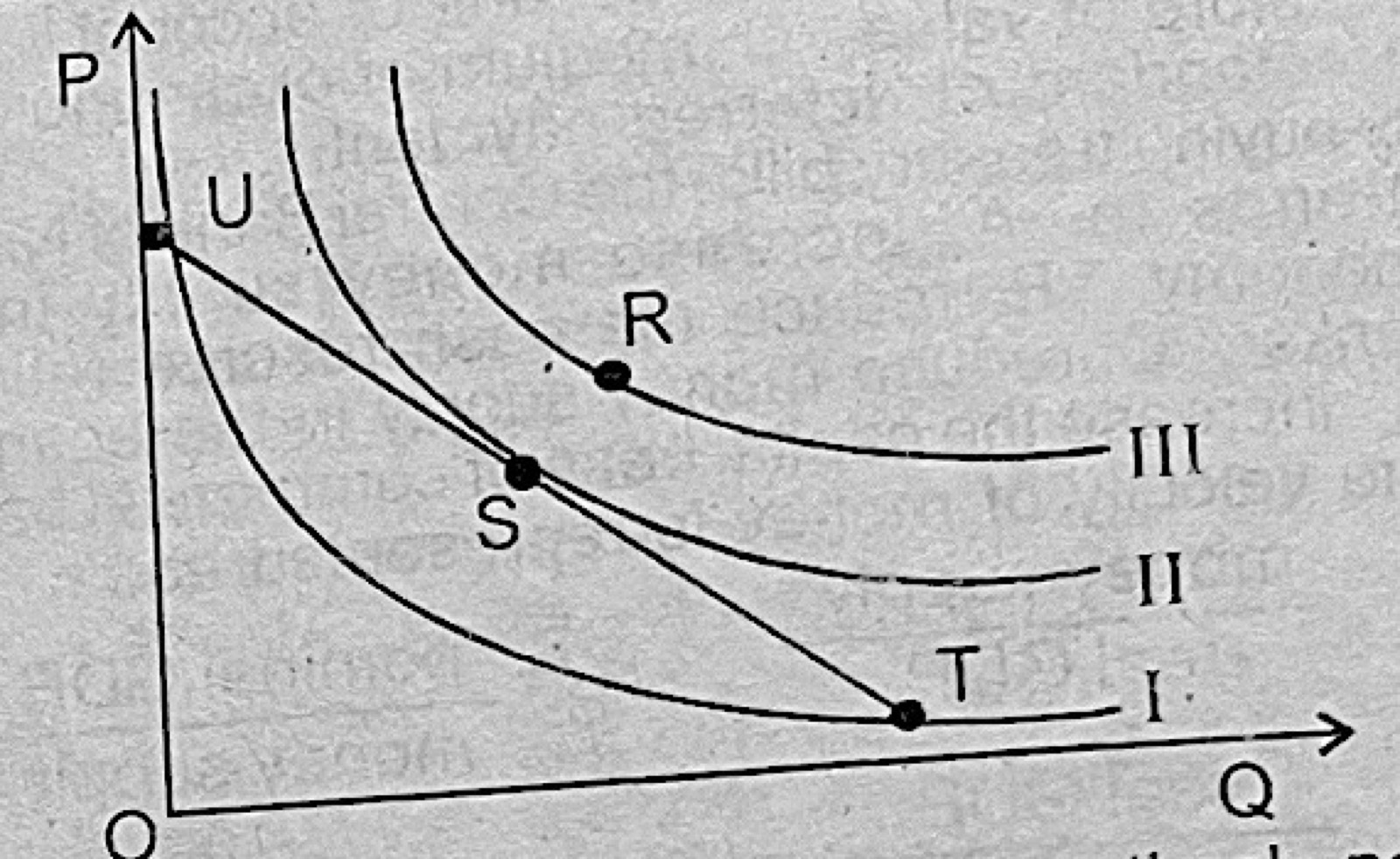
Question 20 Theory of Consumer Behaviour Use the diagram below to answer the question.
A. R B. T C. U D. S. Show the answer and explanation Answer: D (S. )
Explanation The best point is where the budget line just touches the highest indifference curve it can reach. That is S on curve II; R is unaffordable and U and T are on a lower curve.
Open this question
Question 21 Money and Inflation If real income increases while nominal income remains the same, it can be inferred that
A. unemployment rate has decreased B. general prices have fallen C. employment rate has risen D. general prices have risen. Show the answer and explanation Answer: B (general prices have fallen )
Explanation Real income is money income adjusted for prices. If money income is unchanged but it buys more, prices must have fallen.
Open this question
Question 22 Market Structures One of the characteristics of oligopoly is the availability of
A. few sellers B. few buyers C. many sellers D. a single seller. Show the answer and explanation Answer: A (few sellers )
Explanation An oligopoly is a market dominated by a few sellers.
Open this question
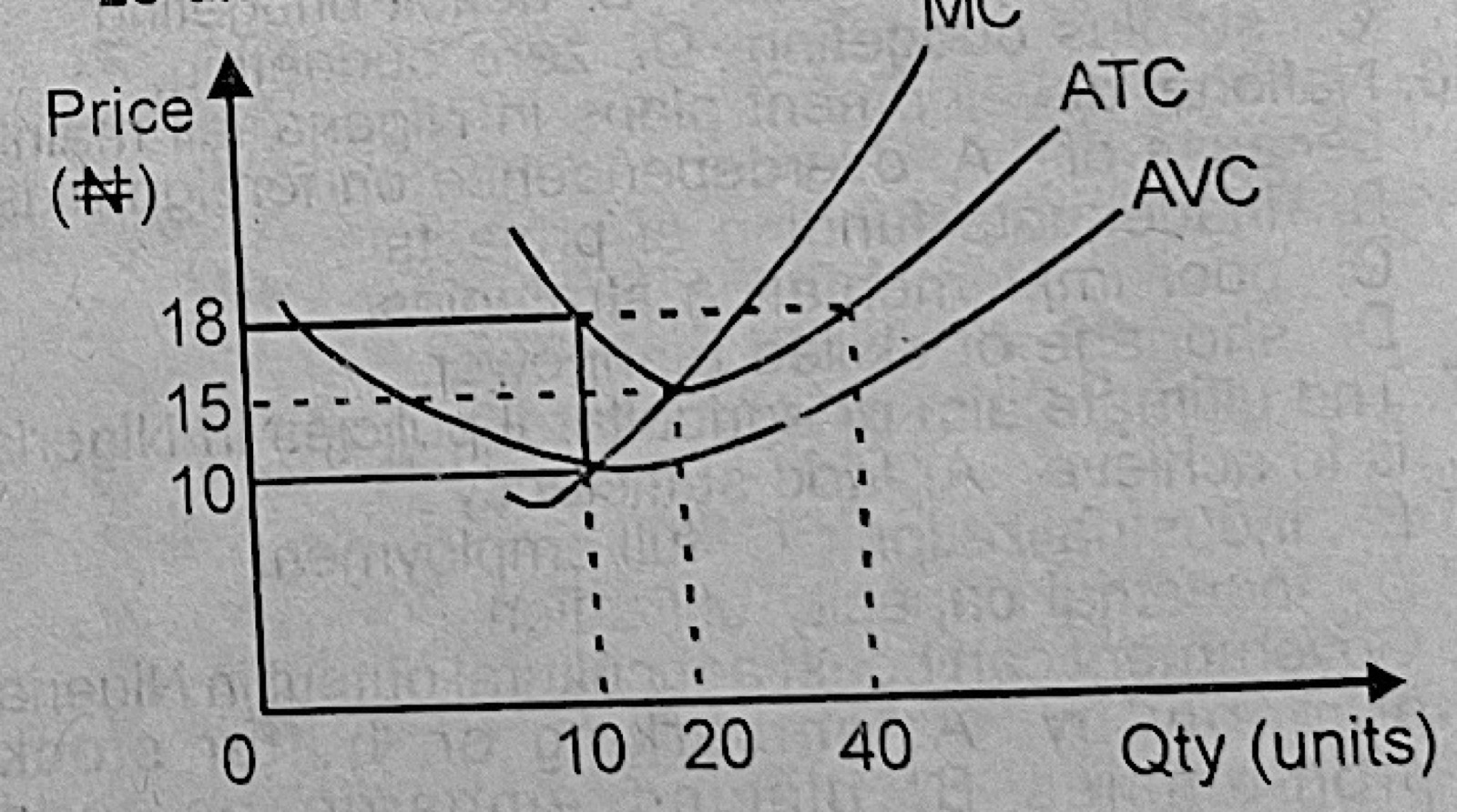
Question 23 Theory of Costs and Revenue Use the diagram below to answer the question.
A. ₦20.00 B. ₦23.00 C. ₦13.00 D. ₦15.00. Show the answer and explanation Answer: D (₦15.00. )
Explanation At 20 units the ATC curve is at its lowest point, which reads ₦15 on the price axis.
Open this question
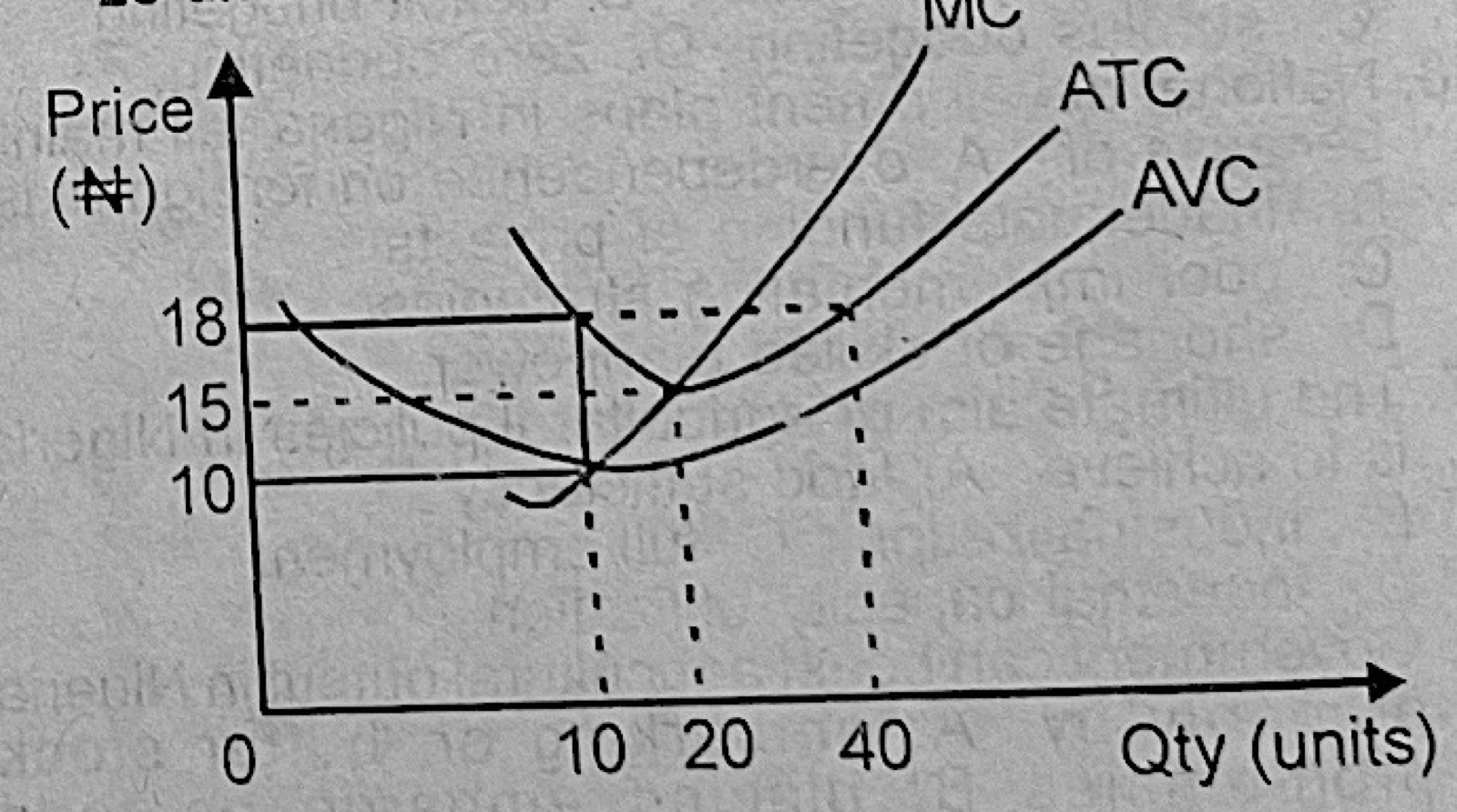
Question 24 Theory of Costs and Revenue Use the diagram below to answer the question.
A. ₦360 B. ₦300 C. ₦460 D. ₦400. Show the answer and explanation Answer: B (₦300 )
Explanation TC = ATC × quantity = ₦15 × 20 = ₦300.
Open this question
Question 25 Market Structures The profit of a monopolist can be eliminated where price equals
A. AFC B. MC C. AC D. AVC. Show the answer and explanation Answer: C (AC )
Explanation Profit per unit = price − average cost. If price is set equal to AC, the monopolist earns no abnormal profit.
Open this question
Question 26 Financial Institutions Bank consolidation policy in Nigeria is a measure to increase
A. the capital base of banks B. employment opportunities in banks C. the number of shareholders D. the number of branches. Show the answer and explanation Answer: A (the capital base of banks )
Explanation The 2004/2005 consolidation raised banks' minimum capital (to ₦25 billion) to make them stronger.
Open this question
Question 27 Money and Inflation An increase in the circulation of money without a corresponding increase in output will lead to
A. a rise in income levels B. stagflation C. deflation D. inflation. Show the answer and explanation Answer: D (inflation. )
Explanation More money chasing the same quantity of goods pushes the general price level up: inflation.
Open this question
Question 28 National Income In national income accounts, an item counted as part of government spending is
A. salaries and wages B. pension C. scholarship D. social welfare. Show the answer and explanation Answer: A (salaries and wages )
Explanation Government spending in national income counts only payments for goods and services, like salaries and wages. Pensions, scholarships and welfare are transfer payments and are left out.
Open this question
Question 29 National Income If aggregate demand is lower than total output in an economy, national income will
A. be constant B. be at equilibrium C. increase D. fall. Show the answer and explanation Answer: D (fall. )
Explanation When spending is less than output, unsold goods pile up, firms cut production and national income falls.
Open this question
Question 30 Money and Inflation During the era of barter, money was generally in the form of
A. notes B. precious metals C. coins D. commodities. Show the answer and explanation Answer: D (commodities. )
Explanation Before coins and notes, goods such as cowries, salt and cattle were used as money (commodity money).
Open this question
Question 31 Economic Growth and Development A country achieves economic development when there is
A. an increase in military expenditure B. an increase in capacity utilization C. a sustained increase in per capita income D. an even distribution of goods and services. Show the answer and explanation Answer: C (a sustained increase in per capita income )
Explanation Development needs a lasting rise in income per head, which raises the standard of living of the people.
Open this question
Question 32 National Income An indicator of growth in an economy over a period of time is the
A. GDP gap B. GDP at factor cost C. GDP at market price D. GDP deflator. Show the answer and explanation Answer: C (GDP at market price )
Explanation Economic growth is measured by the rise in the value of total output, GDP at market price, over time.
Open this question
Question 33 Public Finance A country embarks on deficit financing in order to
A. increase revenue B. reduce aggregate demand C. curb inflation D. stimulate investment. Show the answer and explanation Answer: D (stimulate investment. )
Explanation Spending more than revenue injects money into the economy, raising demand and encouraging investment and output.
Open this question
Question 36 Industrialisation The import-substitution strategy of industrialization is to encourage
A. domestic production B. large-scale production C. importation D. exportation. Show the answer and explanation Answer: A (domestic production )
Explanation Import substitution means setting up local factories to make goods the country used to import, so it encourages domestic production.
Open this question
Question 38 Agriculture Agricultural production in Nigeria is constrained by
A. ineffective use of stabilization measures B. inadequate demand C. poor implementation of policies D. balance of payments deficits Show the answer and explanation Answer: C (poor implementation of policies )
Explanation Many agricultural policies in Nigeria were well designed but poorly carried out, so poor implementation of policies has held back farm production.
Open this question
Question 39 Natural Resources and Petroleum The main function of NNPC is to
A. oversee the development of the oil sector B. develop the oil producing areas C. fix the prices of petroleum products D. ensure regular supply of products. Show the answer and explanation Answer: A (oversee the development of the oil sector )
Explanation NNPC is the government corporation that manages and oversees Nigeria's oil and gas industry.
Open this question
Question 40 Agriculture Investing heavily in the agricultural sector will lead to
A. sufficient food production B. a vibrant commodity market C. capital inflow D. stable export prices. Show the answer and explanation Answer: A (sufficient food production )
Explanation More investment in farming raises farm output, so the country produces enough food.
Open this question
Question 42 Balance of Payments and Exchange Rates The record of a country's transactions in international trade is her
A. capital account B. balance of payments C. current account D. balance of trade. Show the answer and explanation Answer: B (balance of payments )
Explanation The balance of payments records all of a country's transactions with the rest of the world in a period.
Open this question
Question 43 Business Organisations The transfer of public shareholding in corporations to private enterprises is
A. concession B. incorporation C. commercialization D. privatization. Show the answer and explanation Answer: D (privatization. )
Explanation Selling government shares in public corporations to private owners is privatisation.
Open this question
Question 44 Balance of Payments and Exchange Rates A condition in which official and autonomous exchange rates coexist is
A. dual exchange rate system B. managed floating rate system C. market determined exchange rate system D. multiple exchange rate system. Show the answer and explanation Answer: A (dual exchange rate system )
Explanation When an official rate and a separate market (autonomous) rate operate at the same time, there are two rates: a dual exchange rate system.
Open this question
Question 45 Population In modern economies, the Malthusian theory of population is ineffective because of
A. birth control measures B. technical progress C. government policies D. natural disasters. Show the answer and explanation Answer: B (technical progress )
Explanation Malthus said food would grow slower than population, but improved technology has made food output grow fast enough.
Open this question
Question 46 Population Optimum population enables an economy to attain the highest level of
A. industrial development B. income per head C. revenue generation D. economic development. Show the answer and explanation Answer: B (income per head )
Explanation Optimum population is the size at which, with the available resources, income per head is highest.
Open this question
Question 47 Labour Market A change from one industry to another by a worker is an example of
A. geographical mobility B. horizontal mobility C. professional advancement D. vertical mobility. Show the answer and explanation Answer: B (horizontal mobility )
Explanation Horizontal mobility is moving to another job or industry at about the same level. Vertical mobility is a promotion or demotion.
Open this question
Question 48 Labour Market The money paid per hour for work done is
A. salary B. wage rate C. cost D. bonus Show the answer and explanation Answer: B (wage rate )
Explanation Payment per hour or per day of work is a wage rate; a salary is a fixed monthly or yearly payment.
Open this question
Question 49 International Trade Trade takes place because of
A. marginal utility B. inefficiency in production C. opportunity cost D. comparative advantage. Show the answer and explanation Answer: D (comparative advantage. )
Explanation Countries trade because each can produce some goods at a lower opportunity cost than others: comparative advantage.
Open this question
Question 50 International Economic Organisations The World Trade Organization is responsible for
A. stabilizing and harmonizing oil prices B. ensuring equal participation of countries in trade C. modernising world economies D. minimizing obstacles to international trade and investment. Show the answer and explanation Answer: D (minimizing obstacles to international trade and investment. )
Explanation The WTO works to reduce tariffs and other barriers to trade among its members.
Open this question Sign up free for every JAMB Economics year, practice by topic and timed mocks.
Start practising free