Home › Past questions › JAMB › Economics › 2008 50 questions. Try each one, then open the answer to check yourself and read the explanation.
Sign up free to answer these questions on a CBT screen with a timer, then see your score and every answer explained.
Start practising free
Question 1 Basic Concepts The production possibility curve can be used to explain the underlying concepts of
A. scale of preference and choice B. opportunity cost and choice C. wants and means D. opportunity cost and scale of preference Show the answer and explanation Answer: B (opportunity cost and choice )
Explanation The PPC shows the choices open to a society with scarce resources, and the amount of one good given up to get more of the other is the opportunity cost.
Open this question
Question 2 Economic Systems The deregulation of telecommunication services in Nigeria is a characteristic of
A. command economy B. traditional economy C. market economy D. feudal economy Show the answer and explanation Answer: C (market economy )
Explanation Deregulation removes government controls and lets private firms compete, which is a feature of a market economy.
Open this question
Question 3 Basic Concepts If the increase in the price of yams is used to estimate the inflation rate, this is an example of
A. deductive reasoning B. inductive reasoning C. normative reasoning D. positive reasoning Show the answer and explanation Answer: B (inductive reasoning )
Explanation Inductive reasoning moves from a particular observation, here yam prices, to a general conclusion about prices as a whole.
Open this question
Question 4 Tools of Economic Analysis If the standard deviation of a given data is 8.2, find its variance
A. 4.1 B. 67.2 C. 82.0 D. 91.8 Show the answer and explanation Answer: B (67.2 )
Explanation Variance = (standard deviation)² = 8.2² = 67.24 ≈ 67.2.
Open this question
Question 5 Tools of Economic Analysis Use the data below to answer questions 5 and 6.
A. 45.5 B. 55.6 C. 55.8 D. 65.8 Show the answer and explanation Answer: C (55.8 )
Explanation The ten scores add up to 558, so the mean = 558 ÷ 10 = 55.8.
Open this question
Question 6 Tools of Economic Analysis Use the data below to answer questions 5 and 6.
A. 36 B. 42 C. 54 D. 62 Show the answer and explanation Answer: D (62 )
Explanation 62 appears three times, more often than any other score, so it is the mode.
Open this question
Question 7 Theory of Demand A major determinant of the demand for a luxury good is
A. the price of the good B. the price of other goods C. the income of consumers D. tastes and fashion Show the answer and explanation Answer: C (the income of consumers )
Explanation People buy luxuries only when their income allows, so demand for a luxury rises and falls strongly with income.
Open this question
Question 8 Theory of Supply If 100 units and 120 units of commodity X are supplied at ₦80 at different times, it means that there is
A. a change in supply B. a change in the quantity supplied C. an increase in the quantity supplied D. a decrease in the quantity supplied Show the answer and explanation Answer: A (a change in supply )
Explanation The price stayed at ₦80 but the quantity offered changed, so something other than price shifted the supply curve; that is a change in supply.
Open this question
Question 9 Elasticity If income rises from ₦2 000 to ₦4 000 and quantity demanded increases from 80 units to 120 units, find the income elasticity of demand.
A. 0.5 B. 1.2 C. 2.5 D. 4.0 Show the answer and explanation Answer: A (0.5 )
Explanation % change in quantity = 40/80 = 50%; % change in income = 2 000/2 000 = 100%; income elasticity = 50 ÷ 100 = 0.5.
Open this question
Question 10 Elasticity If the demand elasticity coefficient of cars is 0.5, it implies that the demand for petrol is
A. elastic B. perfectly inelastic C. inelastic D. perfectly elastic Show the answer and explanation Answer: C (inelastic )
Explanation A coefficient between 0 and 1 means quantity changes proportionately less than price, which is inelastic demand.
Open this question
Question 11 Theory of Consumer Behaviour As long as marginal utility is positive, total utility must be
A. negative B. increasing C. zero D. decreasing Show the answer and explanation Answer: B (increasing )
Explanation Each extra unit adds something to satisfaction while MU is positive, so total utility keeps rising.
Open this question
Question 12 Theory of Consumer Behaviour Diminishing marginal utility implies that
A. total utility decreases as consumption increases B. marginal utility increases as consumption increases C. marginal utility deceases as consumption increases D. marginal utility decreases as consumption decreases Show the answer and explanation Answer: C (marginal utility deceases as consumption increases )
Explanation The law says each additional unit consumed gives less extra satisfaction than the one before.
Open this question
Question 13 Theory of Consumer Behaviour The excess benefit derived from the purchase of goods over the amount paid for them is referred to as consumer
A. rationality B. surplus C. sovereignty D. credit Show the answer and explanation Answer: B (surplus )
Explanation Consumer surplus is the difference between what a buyer is willing to pay and what he actually pays.
Open this question
Question 14 Theory of Supply An upward movement along the same supply curve results in
A. an increase in supply B. a decrease in price C. a decrease in quantity supplied D. an increase in quantity supplied Show the answer and explanation Answer: D (an increase in quantity supplied )
Explanation Moving up a supply curve means a higher price, at which producers offer a larger quantity.
Open this question
Question 15 Price Determination Use the information below to answer questions 15 and 16. Given that Qd = 20 − 4P and Qs = 6P + 12.
A. 14.2 B. 16.8 C. 20.8 D. 30.2 Show the answer and explanation Answer: B (16.8 )
Explanation Set 20 − 4P = 6P + 12, so 10P = 8 and P = 0.8. Then Q = 20 − 4(0.8) = 16.8.
Open this question
Question 16 Price Determination Use the information below to answer questions 15 and 16. Given that Qd = 20 − 4P and Qs = 6P + 12.
A. 30 B. 22 C. 12 D. 8 Show the answer and explanation Answer: B (22 )
Explanation At P = 3: Qd = 20 − 12 = 8 and Qs = 18 + 12 = 30, so excess supply = 30 − 8 = 22.
Open this question
Question 17 Theory of Supply One of the factors affecting the supply of manufactured goods is
A. weather B. technology C. consumer tastes D. availability of inputs Show the answer and explanation Answer: B (technology )
Explanation Better technology lowers production costs, so firms can supply more manufactured goods at each price.
Open this question
Question 18 Market Structures Individual markets differ from each other according to
A. the degree of competition B. the volume of trade C. the number of buyers D. its composition Show the answer and explanation Answer: A (the degree of competition )
Explanation Markets are classified (perfect competition, monopoly, oligopoly…) by how much competition there is among sellers.
Open this question
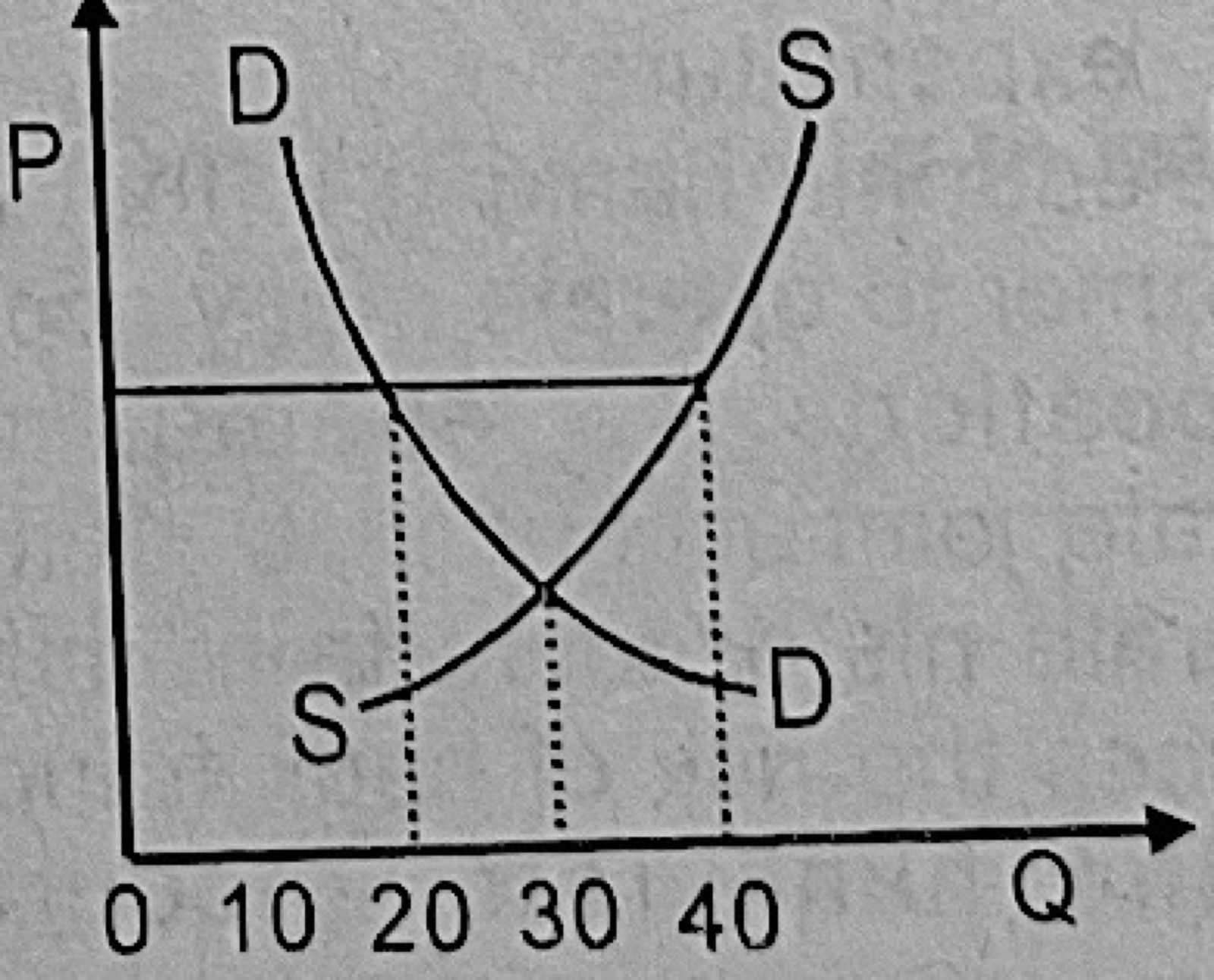
Question 19 Price Determination In the diagram above, there is an excess
A. demand for 30 units B. supply of 40 units C. demand for 20 units D. supply of 20 units Show the answer and explanation Answer: D (supply of 20 units )
Explanation At the price shown, which is above equilibrium, buyers take 20 units but sellers offer 40, giving an excess supply of 40 − 20 = 20 units.
Open this question
Question 20 Agriculture To protect farmers during a bumper harvest, the government usually
A. set a maximum price B. release products from the buffer stock C. sell the excess to consumers D. set a minimum price Show the answer and explanation Answer: D (set a minimum price )
Explanation A bumper harvest pushes prices down; a guaranteed minimum price stops farmers' incomes from collapsing.
Open this question
Question 21 Labour Market The use of modern weaving machines in the production of local fabric will result in
A. an increase in the demand for labour B. a decrease in the demand for labour C. an increase in wages D. a decrease in wages Show the answer and explanation Answer: B (a decrease in the demand for labour )
Explanation Machines take over work done by hand, so fewer workers are needed.
Open this question
Question 22 Labour Market In a perfectly competitive condition, a firm uses 10 units of labour at ₦25 and 11 units at ₦36, what is the marginal cost of labour?
A. ₦396 B. ₦323 C. ₦250 D. ₦146 Show the answer and explanation Answer: D (₦146 )
Explanation Total cost rises from 10 × 25 = ₦250 to 11 × 36 = ₦396, so the marginal cost of labour = 396 − 250 = ₦146.
Open this question
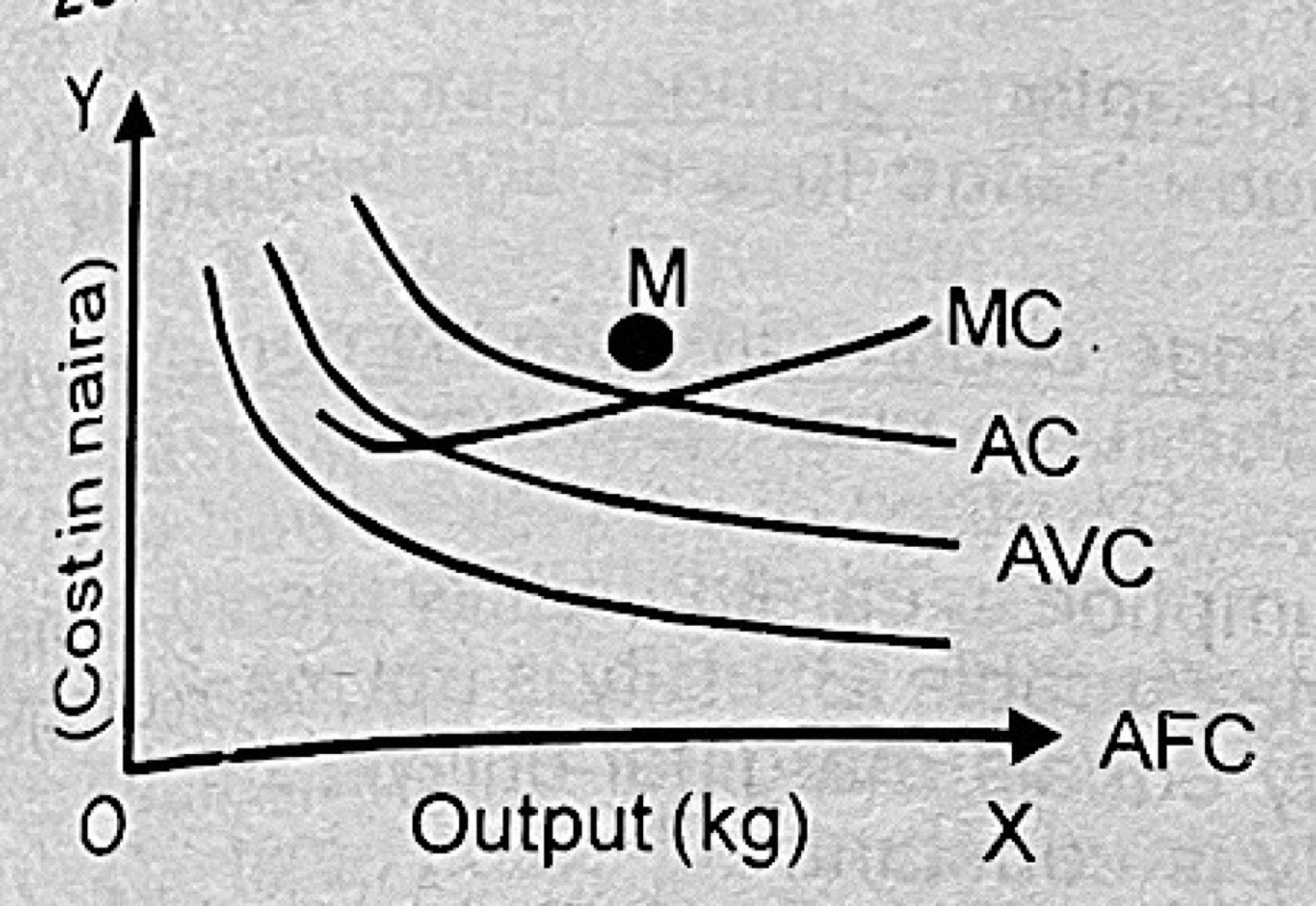
Question 23 Theory of Costs and Revenue From the graph above, point M shows that MC
A. cuts AC at its minimum point B. and AC rise simultaneously C. cuts AC at its maximum point D. is falling Show the answer and explanation Answer: A (cuts AC at its minimum point )
Explanation M marks where the rising MC curve crosses the U-shaped AC curve, which happens at AC's minimum point.
Open this question
Question 24 Market Structures The characteristic of entry and exit ensures that firms
A. earn excess profit B. earn normal profit C. break-even D. expand their operations Show the answer and explanation Answer: B (earn normal profit )
Explanation Free entry competes away supernormal profit and free exit removes losses, so in the long run firms earn only normal profit.
Open this question
Question 25 Market Structures Which of the following producers is closest to being a monopolist?
A. A baker B. A wheat farmer C. A large chain store D. An automobile plant Show the answer and explanation Answer: D (An automobile plant )
Explanation Making cars needs huge capital, which keeps rivals out, so a car plant faces the fewest competitors; bakers, farmers and shops face many.
Open this question
Question 26 National Income The output approach to measuring national income is based on the computation of
A. final output B. factor cost C. value added D. profits earned Show the answer and explanation Answer: C (value added )
Explanation The output method adds the value added by each sector, which avoids counting intermediate goods twice.
Open this question
Question 27 National Income An example of injection into the circular flow of income is
A. taxes B. pensions C. imports D. exports Show the answer and explanation Answer: D (exports )
Explanation Exports bring foreign spending into the economy, so they are an injection; taxes and imports are leakages.
Open this question
Question 28 Money and Inflation The theoretical relationship between money supply and prices is weakened by changes in the
A. money supply B. general price level C. velocity of money D. interest rate Show the answer and explanation Answer: C (velocity of money )
Explanation The quantity theory links money and prices only if the velocity of circulation stays constant, so changes in velocity weaken the link.
Open this question
Question 29 Money and Inflation The high rate of inflation in Nigeria can be attributed to
A. increasing cost of production B. the appreciation of the naira C. decreasing cost of production D. high capacity utilization Show the answer and explanation Answer: A (increasing cost of production )
Explanation Rising costs of fuel, power, transport and imported inputs push producers to raise prices (cost-push inflation).
Open this question
Question 30 Financial Institutions If the required reserves of a bank is 20% and ₦10 000 is paid into its demand deposit account, what is the excess reserves?
A. ₦2 000 B. ₦8 000 C. ₦12 000 D. ₦18 000 Show the answer and explanation Answer: B (₦8 000 )
Explanation Required reserve = 20% of ₦10 000 = ₦2 000, so excess reserves = ₦10 000 − ₦2 000 = ₦8 000.
Open this question
Question 31 Financial Institutions Contractionary monetary policy is used to
A. control inflation B. bridge the deflationary gap C. expand the output level D. deregulate the economy Show the answer and explanation Answer: A (control inflation )
Explanation Contractionary policy reduces money supply and spending, which brings down inflation.
Open this question
Question 32 Public Finance The use of government revenue and expenditure to achieve set objectives is known as
A. budget B. fiscal policy C. revenue allocation D. monetary policy Show the answer and explanation Answer: B (fiscal policy )
Explanation Fiscal policy is government's use of taxation and spending to influence the economy.
Open this question
Question 33 Public Finance An example of an indirect tax is
A. profit tax B. sales tax C. capital gain tax D. poll tax Show the answer and explanation Answer: B (sales tax )
Explanation Sales tax is charged on goods and passed on to buyers in the price, so it is indirect; the others are paid directly by the taxpayer.
Open this question
Question 34 Economic Growth and Development A good indicator of economic development is an increase in
A. gross national product B. per capita income C. real national income D. real per capita income Show the answer and explanation Answer: D (real per capita income )
Explanation Real per capita income adjusts income for price changes and for population, showing whether the average person is actually better off.
Open this question
Question 35 Economic Growth and Development Economic growth takes place when there is an increase in
A. savings over time B. investment over time C. population over time D. output over time Show the answer and explanation Answer: D (output over time )
Explanation Economic growth is a sustained rise in the real output of goods and services over time.
Open this question
Question 36 Agriculture One of the effects of instability in farmer's income in Nigeria is
A. lack of infrastructural facilities B. rural-urban migration C. inadequate supply of fertilizer D. low level of technology Show the answer and explanation Answer: B (rural-urban migration )
Explanation When farmers' incomes rise and fall unpredictably, farming becomes unattractive, so many young people leave the villages for towns in search of steady wage jobs: rural-urban migration.
Open this question
Question 37 Agriculture A major impediment to the development of agriculture in Nigeria is
A. land use system B. inadequate supply of farm inputs C. low income of farmers D. limited research on seedlings Show the answer and explanation Answer: B (inadequate supply of farm inputs )
Explanation Many Nigerian farmers cannot get enough fertilizer, improved seeds and tools, which keeps output low.
Open this question
Question 38 Industrialisation A major consideration in locating a cement factory is the availability of
A. skilled labour B. power C. infrastructural facilities D. limestone Show the answer and explanation Answer: D (limestone )
Explanation Limestone is bulky and is the main raw material for cement, so cement factories are sited near limestone deposits.
Open this question
Question 39 International Trade The export-promotion strategy is aimed at producing
A. consumer goods originally imported B. machinery for industries C. more goods for exports D. more goods for domestic consumption Show the answer and explanation Answer: C (more goods for exports )
Explanation Export promotion encourages firms to produce more goods for sale abroad to earn foreign exchange.
Open this question
Question 40 Natural Resources and Petroleum The activities in the oil and gas industry are classified into
A. exploration and transportation B. upstream and downstream C. discovery and extraction D. onshore and offshore Show the answer and explanation Answer: B (upstream and downstream )
Explanation The oil industry is divided into upstream (exploration and production) and downstream (refining, distribution and marketing).
Open this question
Question 41 Business Organisations The economic policy of privatization came up as a result of the poor performance of
A. commercial banks B. small-scale businesses C. public enterprises D. private enterprises Show the answer and explanation Answer: C (public enterprises )
Explanation Government-owned enterprises were inefficient and loss-making, so they were sold to private owners.
Open this question
Question 42 Business Organisations Joint-stock companies can raise funds from
A. the money market B. the capital market C. various sources D. government Show the answer and explanation Answer: B (the capital market )
Explanation Joint-stock companies raise long-term funds by selling shares and bonds on the capital market.
Open this question
Question 43 Population The active population of a country determines the size of its
A. economic resources B. national income C. labour force D. gross domestic product Show the answer and explanation Answer: C (labour force )
Explanation The active population is the people of working age who are able to work, which is the labour force.
Open this question
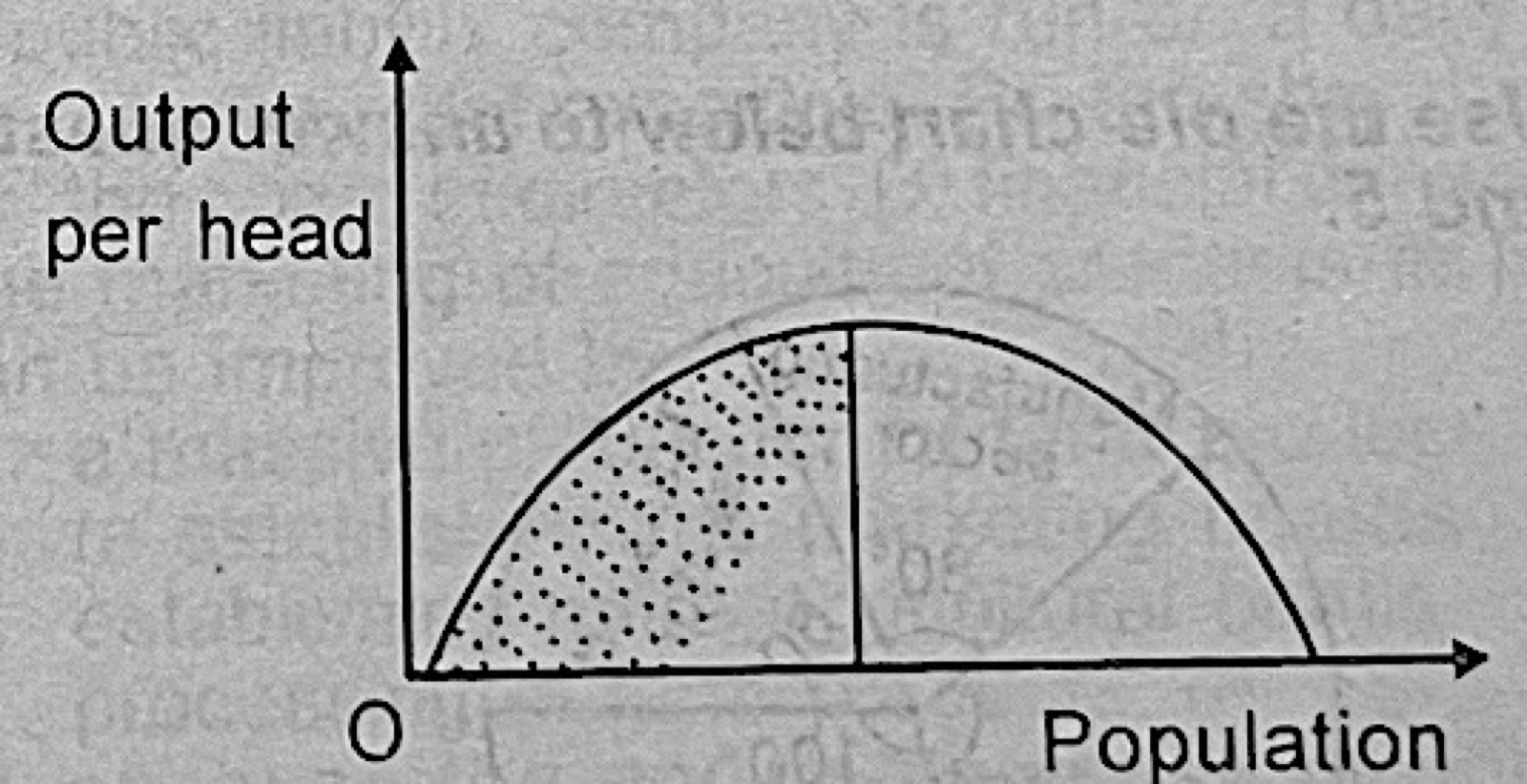
Question 44 Population From the shaded area of the diagram above, an appropriate population policy will be to
A. encourage early marriages B. discourage immigration C. discourage polygamy D. encourage the use of contraceptives Show the answer and explanation Answer: A (encourage early marriages )
Explanation The shaded area lies before output per head peaks, so the country is underpopulated; more people would raise output per head, so early marriage should be encouraged.
Open this question
Question 45 Population The population of a country will decrease if
A. the death rate exceeds the birth rate B. immigration is equal to emigration C. the birth rate exceeds the death rate D. there is rapid economic growth Show the answer and explanation Answer: A (the death rate exceeds the birth rate )
Explanation If more people die than are born (with no net migration), the population falls.
Open this question
Question 46 International Economic Organisations The OPEC marketing policy of fixing minimum price allows members to
A. sell above minimum price B. sell below minimum price C. determine the price and quantity to sell D. negotiate price with customers Show the answer and explanation Answer: A (sell above minimum price )
Explanation A minimum price is a floor: members may not sell below it but can sell above it.
Open this question
Question 47 International Economic Organisations A major trading problem facing ECOWAS is
A. the absence of common currency B. political instability C. high poverty level D. non implementation of decisions Show the answer and explanation Answer: A (the absence of common currency )
Explanation Each ECOWAS country has its own currency, so traders must keep changing money, which makes trade within the region harder.
Open this question
Question 48 Theory of Production A high rent on land will affect the cost of producing maize
A. positively B. negatively C. at the early stage of production D. at the later stage of production Show the answer and explanation Answer: B (negatively )
Explanation Rent is a cost of production, so a high rent makes producing maize more expensive, which harms (negatively affects) the farmer.
Open this question
Question 49 Labour Market If the active population is 50 million and unemployed is 5 million, what is the unemployment rate?
A. 10% B. 45% C. 55% D. 90% Show the answer and explanation Answer: A (10% )
Explanation Unemployment rate = unemployed ÷ active population × 100 = 5 ÷ 50 × 100 = 10%.
Open this question
Question 50 Labour Market A classroom teacher is promoted to the rank of a principal. This is an example of
A. vertical mobility B. lateral mobility C. social mobility D. horizontal mobility Show the answer and explanation Answer: A (vertical mobility )
Explanation Promotion moves a worker up to a higher grade in the same occupation, which is vertical mobility.
Open this question Sign up free for every JAMB Economics year, practice by topic and timed mocks.
Start practising free