Home › Past questions › JAMB › Economics › 2007 49 questions. Try each one, then open the answer to check yourself and read the explanation.
Sign up free to answer these questions on a CBT screen with a timer, then see your score and every answer explained.
Start practising free
Question 2 Basic Concepts The logical sequence of basic concepts in economics is
A. wants, choice, scarcity and opportunity cost B. scarcity, choice, scale of preference and opportunity cost C. wants, scarcity, choice and opportunity cost D. scarcity, wants, choice and scale of preference Show the answer and explanation Answer: C (wants, scarcity, choice and opportunity cost )
Explanation Human wants come first; resources to meet them are scarce, so we must choose, and every choice has an opportunity cost.
Open this question
Question 3 Economic Systems An economic system in which the producer and the consumer are the same is referred to as a
A. mixed economy B. subsistence economy C. capitalist economy D. socialist economy Show the answer and explanation Answer: B (subsistence economy )
Explanation In a subsistence economy people produce mainly for their own use, so the producer is also the consumer.
Open this question
Question 4 Economic Systems The choice of what to produce in a command economy is determined by
A. industrial establishments B. labour unions C. the government and labour unions D. the central government Show the answer and explanation Answer: D (the central government )
Explanation In a command (planned) economy the central government owns the resources and decides what, how and for whom to produce.
Open this question
Question 5 Tools of Economic Analysis The range is used to
A. estimate the mean from grouped data B. determine the spread of a set of data C. calculate the standard deviation D. measure the difference between the mean and the mode Show the answer and explanation Answer: B (determine the spread of a set of data )
Explanation The range is the difference between the highest and lowest values, so it shows how spread out the data are.
Open this question
Question 6 Tools of Economic Analysis Use the table below to answer questions 6 and 7. The table shows the wage distribution of workers.
A. ₦14.80 B. ₦10.00 C. ₦7.40 D. ₦4.00 Show the answer and explanation Answer: C (₦7.40 )
Explanation Σfx = 4 + 15 + 8 + 33 + 14 = 74 and Σf = 10, so mean = 74 ÷ 10 = ₦7.40.
Open this question
Question 7 Tools of Economic Analysis Use the table below to answer questions 6 and 7. The table shows the wage distribution of workers.
A. ₦11.00 B. ₦8.00 C. ₦6.50 D. ₦5.00 Show the answer and explanation Answer: C (₦6.50 )
Explanation Listing the 10 wages in order (2, 2, 5, 5, 5, 8, 11, 11, 11, 14), the middle two are 5 and 8, so the median = (5 + 8) ÷ 2 = ₦6.50.
Open this question
Question 8 Theory of Demand When the demand for a good increases owing to an increase in income, it means that
A. there is an increase in quantity demanded B. inflation has taken place C. demand has exceeded supply D. there is an increase in demand Show the answer and explanation Answer: D (there is an increase in demand )
Explanation A rise in income shifts the demand curve to the right; this is called an increase in demand (a change in quantity demanded is caused only by the good's own price).
Open this question
Question 9 Elasticity The major determinant of cross elasticity of demand is the
A. price of the good B. degree of necessity of the good C. level of income of consumers D. closeness of the substitutes Show the answer and explanation Answer: D (closeness of the substitutes )
Explanation Cross elasticity measures how demand for one good responds to another good's price; the closer the substitutes, the bigger the response.
Open this question
Question 10 Theory of Demand A commodity is described as inferior when the
A. income effect is negative B. income effect is positive C. substitution effect is negative D. substitution effect is positive Show the answer and explanation Answer: A (income effect is negative )
Explanation For an inferior good, people buy less of it as their income rises, so its income effect is negative.
Open this question
Question 11 Theory of Supply If P = ½(Qs + 15), what is the quantity supplied at ₦9.00?
A. 1.5 B. 3.0 C. 12.0 D. 33.0 Show the answer and explanation Answer: B (3.0 )
Explanation Substitute P = 9: 9 = ½(Qs + 15), so Qs + 15 = 18 and Qs = 3.
Open this question
Question 12 Elasticity A firm operating at full capacity will have a
A. perfectly inelastic supply curve B. perfectly elastic supply curve C. fairly elastic supply curve D. fairly inelastic supply curve Show the answer and explanation Answer: A (perfectly inelastic supply curve )
Explanation At full capacity the firm cannot produce more even if price rises, so its supply curve is vertical (perfectly inelastic).
Open this question
Question 13 Elasticity The coefficient of the price elasticity of supply is always
A. positive B. negative C. constant D. zero Show the answer and explanation Answer: A (positive )
Explanation Price and quantity supplied normally move in the same direction, so the elasticity of supply is positive.
Open this question
Question 14 Natural Resources and Petroleum The world market for crude oil refers to the
A. total supply by OPEC members B. total demand for and supply of crude oil C. excess crude oil produced in the world D. difference between the supply of and demand for oil Show the answer and explanation Answer: B (total demand for and supply of crude oil )
Explanation A market is made up of all the buyers and sellers, so the world oil market is the total demand for and supply of crude oil.
Open this question
Question 15 Theory of Production The division of labour requires that the task to be performed
A. must be done in stages B. requires no special knowledge C. is simple but strenuous D. must be undertaken by experts Show the answer and explanation Answer: A (must be done in stages )
Explanation Division of labour breaks a job into stages or processes, with different workers doing each stage.
Open this question
Question 16 Theory of Production Use the table below to answer questions 16 and 17.
A. 180 kg B. 60 kg C. 20 kg D. 8 kg Show the answer and explanation Answer: D (8 kg )
Explanation Marginal product = change in total output = 60 − 52 = 8 kg.
Open this question
Question 17 Theory of Production Use the table below to answer questions 16 and 17.
A. 5 B. 4 C. 3 D. 2 Show the answer and explanation Answer: B (4 )
Explanation Total output peaks at 66 kg with 4 workers; a 5th worker adds nothing (MP = 0), and a 6th reduces output.
Open this question
Question 18 Theory of Production A characteristic of the linear production function is that
A. the percentage change in inputs exceeds output B. output and all inputs change by the same percentage C. the percentage change in output is greater than one D. the percentage change in output is less than one Show the answer and explanation Answer: B (output and all inputs change by the same percentage )
Explanation A linear (homogeneous) production function shows constant returns to scale: increasing all inputs by a given percentage raises output by the same percentage.
Open this question
Question 19 Theory of Costs and Revenue If the total fixed cost is the same regardless of output, the average fixed cost will be
A. increasing B. maximum C. minimum D. decreasing Show the answer and explanation Answer: D (decreasing )
Explanation Average fixed cost = fixed cost ÷ output; the same fixed cost spread over more units gets smaller.
Open this question
Question 20 Theory of Costs and Revenue A firm incurs short-run costs when
A. operation is at its early stages B. it cannot increase prices C. some inputs cannot be varied D. operation is at its later stages Show the answer and explanation Answer: C (some inputs cannot be varied )
Explanation The short run is the period in which at least one input is fixed and cannot be changed.
Open this question
Question 21 Theory of Supply An increase in the marginal cost of production causes
A. an upward movement along the supply curve B. a downward movement along the supply curve C. a leftward shift of the supply curve D. a rightward shift of the supply curve Show the answer and explanation Answer: C (a leftward shift of the supply curve )
Explanation Higher costs mean less is offered at every price, so the supply curve shifts to the left.
Open this question
Question 22 Elasticity When a firm's average revenue curve is downward-sloping, its price elasticity of demand will be
A. one B. between zero and infinity C. greater than one D. zero Show the answer and explanation Answer: B (between zero and infinity )
Explanation Along a downward-sloping straight demand (AR) curve, elasticity changes from very large at the top to zero at the bottom, so it lies between zero and infinity.
Open this question
Question 23 Market Structures The price per unit of a commodity to a buyer is the same as the
A. average revenue of the seller B. marginal revenue of the seller C. normal profit of the seller D. marginal cost of the commodity Show the answer and explanation Answer: A (average revenue of the seller )
Explanation Average revenue = total revenue ÷ quantity sold = price, so what the buyer pays per unit is the seller's average revenue.
Open this question
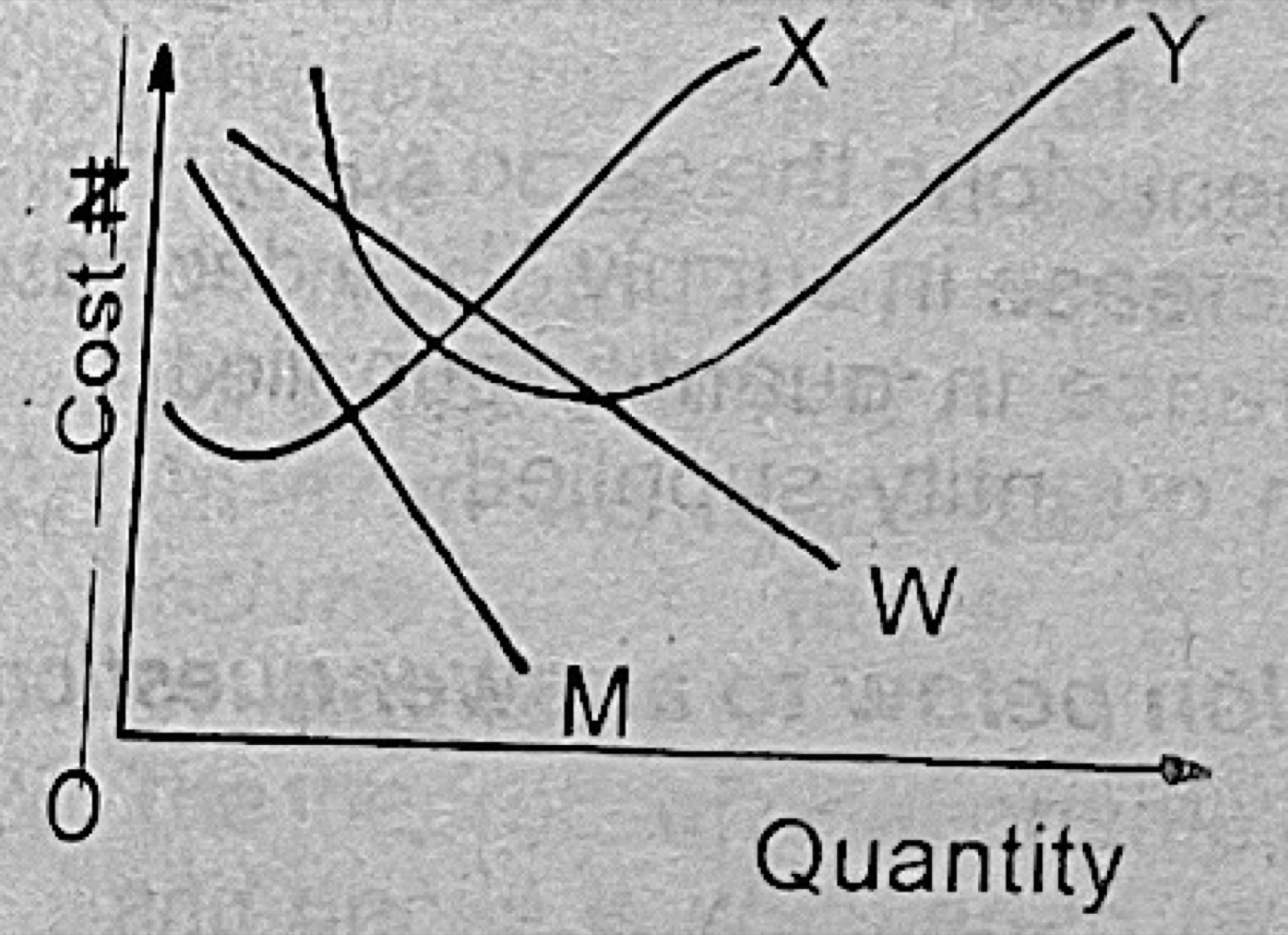
Question 24 Market Structures The diagram above shows a firm operating under conditions of monopolistic competition. The curve W represents its
A. marginal revenue B. marginal cost C. average cost D. average revenue Show the answer and explanation Answer: D (average revenue )
Explanation Under monopolistic competition the AR (demand) curve slopes down less steeply than the MR curve; W is the flatter downward curve and M is MR.
Open this question
Question 25 National Income Corrections in the GNP figures for price changes require the use of a
A. price deflator B. price index C. retail price index D. producer price index Show the answer and explanation Answer: A (price deflator )
Explanation To remove the effect of price changes, nominal GNP is divided by the GNP price deflator to give real GNP.
Open this question
Question 26 National Income One way of solving the problem of double counting is by computing national income using the
A. income method B. expenditure method C. value-added method D. output method Show the answer and explanation Answer: C (value-added method )
Explanation The value-added method counts only the extra value created at each stage of production, so intermediate goods are not counted twice.
Open this question
Question 27 National Income In the circular flow of income model, the outflow variables represent
A. injections B. income C. leakages D. expenditure Show the answer and explanation Answer: C (leakages )
Explanation Savings, taxes and imports flow out of the circular flow; these are called leakages (withdrawals).
Open this question
Question 28 Financial Institutions An advantage of electronic banking is that it
A. enables a customer to operate many accounts from different locations B. enables many customers to operate joint accounts C. enables a customer to operate his account from different locations D. reduces the risk of bank fraud Show the answer and explanation Answer: C (enables a customer to operate his account from different locations )
Explanation With electronic banking (ATMs, online and mobile banking) a customer can use his account from anywhere.
Open this question
Question 29 Financial Institutions A reduction in the bank rate encourages commercial banks to create money by
A. raising the interest rate B. decreasing the interest rate C. maintaining the interest rate D. doubling the interest rate Show the answer and explanation Answer: B (decreasing the interest rate )
Explanation Cheaper central bank funds let commercial banks lower their own lending rates, so more people borrow and more money is created.
Open this question
Question 30 Financial Institutions Life insurance companies contribute to economic development by holding a part of their assets in
A. cash and near money B. money-market instruments C. equipment D. long-term financial instruments Show the answer and explanation Answer: D (long-term financial instruments )
Explanation Life insurers have long-term liabilities, so they invest in long-term securities such as stocks and bonds, providing long-term funds for development.
Open this question
Question 31 Financial Institutions The non-bank financial institutions that are entrusted with workers' contributions towards retirement are
A. investment companies B. pension funds custodians C. pension funds administrators D. mortgage institutions Show the answer and explanation Answer: C (pension funds administrators )
Explanation Under Nigeria's pension scheme, Pension Fund Administrators manage and invest workers' retirement contributions.
Open this question
Question 32 Money and Inflation A persistent rise in the prices of inputs will lead to
A. hyperinflation B. stagflation C. cost-push inflation D. demand-pull inflation Show the answer and explanation Answer: C (cost-push inflation )
Explanation When inputs cost more, producers raise prices to cover their costs; this is cost-push inflation.
Open this question
Question 33 Public Finance The monetization policy is an offshoot of
A. NEEDS B. SAP C. PAYE D. MDGs Show the answer and explanation Answer: A (NEEDS )
Explanation The monetisation of public servants' fringe benefits was part of the public service reforms under NEEDS (the National Economic Empowerment and Development Strategy).
Open this question
Question 34 Economic Growth and Development A continuous increase in national income accompanied by the structural transformation of all indices is called
A. economic planning B. economic growth C. economic reforms D. economic development Show the answer and explanation Answer: D (economic development )
Explanation Growth is only a rise in output; development is growth plus improvements in the structure of the economy and people's welfare.
Open this question
Question 35 Theory of Production In a developing economy, productivity is measured by the
A. capital-output ratio B. output per capita C. output-labour ratio D. output growth rate Show the answer and explanation Answer: C (output-labour ratio )
Explanation Labour productivity is output per worker, i.e. the output-labour ratio.
Open this question
Question 36 International Trade The gains from international trade are shared on the basis of the
A. quantity produced of each of the traded goods B. cost of production of each of the traded goods C. terms of trade D. bilateral trade agreements Show the answer and explanation Answer: C (terms of trade )
Explanation The terms of trade (the rate at which exports exchange for imports) decide how much of the gain from trade each country gets.
Open this question
Question 37 Balance of Payments and Exchange Rates One of the ways of correcting a deficit balance of payments is to
A. revalue a country's currency B. devalue a country's currency C. increase imports D. reduce exports Show the answer and explanation Answer: B (devalue a country's currency )
Explanation Devaluation makes exports cheaper abroad and imports dearer at home, which helps reduce a deficit.
Open this question
Question 38 International Economic Organisations The main objective of WTO is to
A. help countries with chronic balance of payments problems B. help debtor nations solve their problems C. ensure adequate tariff protection for infant industries D. provide a mechanism for tariff reductions Show the answer and explanation Answer: D (provide a mechanism for tariff reductions )
Explanation The World Trade Organization promotes freer trade by providing rules and negotiations for reducing tariffs.
Open this question
Question 39 Business Organisations The minimum number of shareholders for a joint-stock company is
A. 2 B. 3 C. 4 D. 7 Show the answer and explanation Answer: D (7 )
Explanation A public joint-stock company needed at least seven members (a private company needs only two).
Open this question
Question 40 Business Organisations The survival of a partnership depends on
A. the managerial ability of the partners B. access to finance C. the goodwill of the partners D. political stability Show the answer and explanation Answer: A (the managerial ability of the partners )
Explanation A partnership is run by the partners themselves, so its success depends on how well they manage it.
Open this question
Question 41 Agriculture A major objective of the Federal Government's initiative on cassava production in Nigeria is to
A. diversify the export base of the economy B. ensure the availability of cassava C. make cassava a staple food in the country D. provide raw materials for industries Show the answer and explanation Answer: A (diversify the export base of the economy )
Explanation The Presidential Initiative on Cassava aimed to make cassava an export product so that Nigeria depends less on oil.
Open this question
Question 42 Agriculture A country would develop its agricultural sector first so as to
A. stabilize the prices of agricultural products B. stabilize the prices of industrial products C. create a market for the agricultural sector D. create a market for the industrial sector Show the answer and explanation Answer: D (create a market for the industrial sector )
Explanation Higher farm incomes give farmers money to buy manufactured goods, creating a market for the industrial sector.
Open this question
Question 43 Industrialisation Environmental degradation is more associated with
A. localization of industries B. location of industries C. decreased urbanization D. urban-rural migration Show the answer and explanation Answer: A (localization of industries )
Explanation When many industries concentrate in one area (localisation), their waste and emissions pile up and damage the environment.
Open this question
Question 44 International Trade Foreign investment can be attracted to Nigeria through
A. a review of the tax policy B. a review of interest rates C. the revaluation of the naira D. a review of the naturalization policy Show the answer and explanation Answer: A (a review of the tax policy )
Explanation Tax incentives such as tax holidays make it more profitable for foreigners to invest in Nigeria.
Open this question
Question 45 Industrialisation Industrialization is a prerequisite for balanced economic growth because it
A. encourages trade liberalization B. stimulates the development of all sectors C. enhances productivity in the manufacturing sector D. expands employment opportunities in urban areas Show the answer and explanation Answer: B (stimulates the development of all sectors )
Explanation Industries buy from agriculture, mining and services and supply them in turn, so industrial growth stimulates every sector.
Open this question
Question 46 Natural Resources and Petroleum Upstream oil activities involve the
A. exploration of crude oil B. refining of crude oil C. marketing of finished products D. management of pollution Show the answer and explanation Answer: A (exploration of crude oil )
Explanation The upstream sector covers finding and producing crude oil; refining and marketing are downstream.
Open this question
Question 47 Population The Malthusian theory of population has been rendered ineffective by
A. government policies B. natural disasters C. birth control measures D. technical progress Show the answer and explanation Answer: D (technical progress )
Explanation Malthus said food would not keep up with population, but improved farming technology has raised food output faster than he expected.
Open this question
Question 48 Population The movement of people from rural to urban areas affects the
A. occupational distribution of population B. sex distribution of population C. geographical distribution of population D. age distribution of population Show the answer and explanation Answer: C (geographical distribution of population )
Explanation Rural-urban migration changes where people live, which is the geographical distribution of the population.
Open this question
Question 49 Labour Market An upward review of the retirement age will affect the
A. demand for labour B. supply of labour C. wage rate D. tax rate Show the answer and explanation Answer: B (supply of labour )
Explanation If people retire later, more people remain available for work, so the supply of labour increases.
Open this question
Question 50 Labour Market The labour force of a country best describes
A. the number of people in paid employment B. the number of people receiving pension C. people within the retirement age D. people within the working age Show the answer and explanation Answer: D (people within the working age )
Explanation The labour force is the people of working age who are able and willing to work.
Open this question Sign up free for every JAMB Economics year, practice by topic and timed mocks.
Start practising free