Home › Past questions › JAMB › Economics › 2006 48 questions. Try each one, then open the answer to check yourself and read the explanation.
Sign up free to answer these questions on a CBT screen with a timer, then see your score and every answer explained.
Start practising free
Question 1 National Income If the marginal propensity to consume is 0.6 and consumption expenditure changes by ₦10 million, the equilibrium level of income will change by
A. ₦4.0 million B. ₦25.0 million C. ₦2.5 million D. ₦15.0 million Show the answer and explanation Answer: B (₦25.0 million )
Explanation The multiplier is 1/(1 − MPC) = 1/0.4 = 2.5. So income changes by 2.5 × ₦10 million = ₦25 million.
Open this question
Question 2 Money and Inflation The price index is calculated as
A. (base year price)/(current price) × 100/1 B. (current price)/(base year price) × 100/1 C. (weighted price)/(current price) × 100/1 D. (current price)/(weighted price) × 100/1 Show the answer and explanation Answer: B ((current price)/(base year price) × 100/1 )
Explanation A price index compares current prices with base-year prices: current price divided by base year price, times 100.
Open this question
Question 3 Public Finance Personal income tax as a source of government revenue is increased when the
A. tax rate is raised B. tax system is proportional C. retirement age is reduced D. tax base is contracted Show the answer and explanation Answer: A (tax rate is raised )
Explanation Raising the tax rate means each taxpayer pays more on the same income, so revenue from personal income tax rises.
Open this question
Question 4 National Income In computing national income, transfers are excluded because
A. they are received only by the poor B. the figures reduce the size of national income C. it is difficult to get the exact figures D. they are not payments for productive activities Show the answer and explanation Answer: D (they are not payments for productive activities )
Explanation Transfer payments such as pensions and gifts are not earned by producing goods or services, so counting them would overstate national output.
Open this question
Question 5 Financial Institutions The major role of NDIC is to
A. insure bank deposits B. regulate the activities of insurance companies C. ensure adequate capitalization of insurance companies D. accept customers' deposits Show the answer and explanation Answer: A (insure bank deposits )
Explanation The Nigeria Deposit Insurance Corporation insures bank deposits so that depositors are paid if a bank fails.
Open this question
Question 6 Public Finance When the federal government guarantees a loan for a state government, such a loan constitutes
A. a public debt B. a transferred debt C. a private debt D. an inter-governmental debt Show the answer and explanation Answer: A (a public debt )
Explanation A loan taken by a state government and guaranteed by the federal government is owed by the public sector, so it is a public debt.
Open this question
Question 7 Money and Inflation One way of controlling deflation is by
A. contractionary monetary policy B. decreasing wages C. deficit financing D. rigid fiscal policy Show the answer and explanation Answer: C (deficit financing )
Explanation Deflation comes from too little spending. Deficit financing means government spends more than it collects, which raises demand and prices.
Open this question
Question 8 Financial Institutions If the Central Bank of Nigeria reduces the bank rate, this will cause
A. money supply to increase B. commercial banks to reduce lending C. commercial banks to merge D. money supply to reduce Show the answer and explanation Answer: A (money supply to increase )
Explanation A lower bank rate makes borrowing from the central bank cheaper, so commercial banks lend more and money supply increases.
Open this question
Question 9 Public Finance The main source of government revenue in Nigeria is
A. import duties B. rents and royalties C. company income tax D. capital gains tax Show the answer and explanation Answer: B (rents and royalties )
Explanation Nigeria's government earns most of its revenue from crude oil, collected as rents and royalties from oil companies.
Open this question
Question 10 Public Finance The Revenue Mobilization, Allocation and Fiscal Commission in Nigeria has the primary responsibility for
A. maintaining the fiscal supremacy of the central government B. evolving an acceptable wage for public servants C. evolving an acceptable revenue-sharing formula D. ensuring equity in the sharing of fiscal responsibilities Show the answer and explanation Answer: C (evolving an acceptable revenue-sharing formula )
Explanation The RMAFC's main job is to work out the formula for sharing federal revenue among the federal, state and local governments.
Open this question
Question 11 Elasticity The burden of a government tax on a commodity whose demand is inelastic will
A. be borne only by the government B. fall more heavily on consumers C. be shared equally between consumers and producers D. fall more heavily on producers Show the answer and explanation Answer: B (fall more heavily on consumers )
Explanation When demand is inelastic, buyers keep buying even at a higher price, so sellers can pass most of the tax on to consumers.
Open this question
Question 12 Elasticity An important determinant of price elasticity of demand is
A. the state of technology B. the prices of other commodities C. the ease of substitution D. government policy Show the answer and explanation Answer: C (the ease of substitution )
Explanation If a good has close substitutes, buyers switch easily when its price rises, so demand is more elastic.
Open this question
Question 13 Tools of Economic Analysis The range of the data 14, 13, 15, 18, 20, 35 and 13 is
A. 20 B. 22 C. 13 D. 18 Show the answer and explanation Answer: B (22 )
Explanation Range = highest − lowest = 35 − 13 = 22.
Open this question
Question 14 Theory of Consumer Behaviour If the marginal utility of good X exceeds that of good Y, this implies that
A. a rational consumer will buy less of X B. consuming more of X will increase total utility C. Y is an inferior good D. X will be cheaper than Y Show the answer and explanation Answer: B (consuming more of X will increase total utility )
Explanation As long as marginal utility of X is positive, consuming more of X adds to total utility; here X's extra unit gives more satisfaction than Y's.
Open this question
Question 15 Theory of Demand A commodity will be demanded only if
A. consumers' income increases B. it has no close substitutes C. the price is low D. it has utility Show the answer and explanation Answer: D (it has utility )
Explanation People only want a good if it gives satisfaction (utility); without utility there is no demand at any price.
Open this question
Question 16 Theory of Demand Derived demand is normally used with reference to
A. superior goods B. inferior goods C. the cost of production D. the factors of production Show the answer and explanation Answer: D (the factors of production )
Explanation Factors of production are demanded not for themselves but for the goods they help produce, so their demand is derived.
Open this question
Question 17 Theory of Consumer Behaviour A straight line indifference curve indicates that the two products are
A. normal goods B. inferior goods C. perfect substitutes D. close substitutes Show the answer and explanation Answer: C (perfect substitutes )
Explanation A straight-line indifference curve has a constant marginal rate of substitution, which happens when the goods are perfect substitutes.
Open this question
Question 18 Price Determination Given that demand and price remain unchanged, an outward shift of the supply curve will lead to
A. hoarding B. excess supply C. excess demand D. a black market Show the answer and explanation Answer: B (excess supply )
Explanation More is offered for sale at the same price while demand stays the same, so quantity supplied exceeds quantity demanded.
Open this question
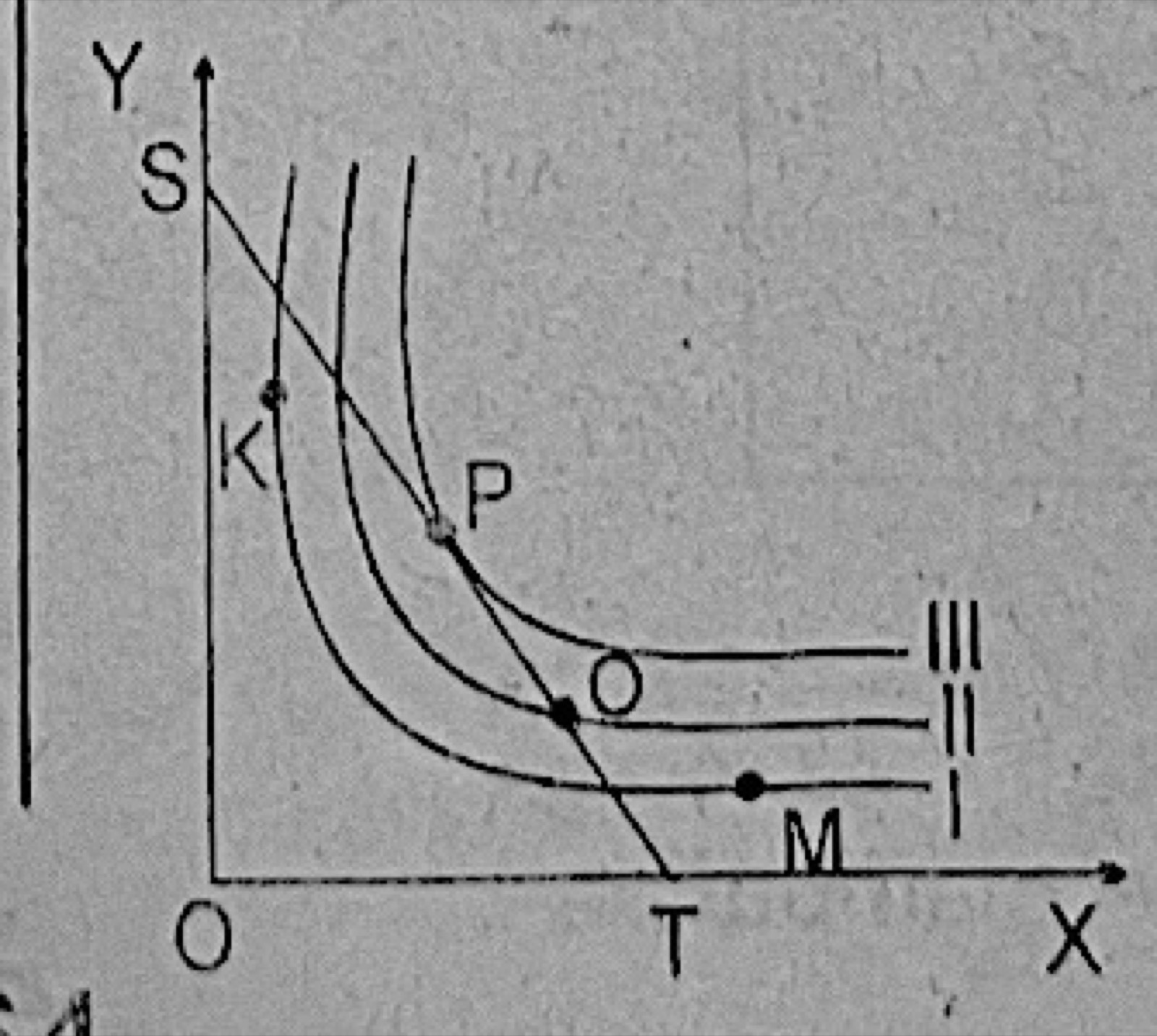
Question 19 Theory of Consumer Behaviour Use the diagram below to answer questions 19 and 20. A movement from K to M will
A. increase the price of the commodity B. leave the consumer's utility unchanged C. decrease the consumer's utility D. increase the consumer's utility Show the answer and explanation Answer: B (leave the consumer's utility unchanged )
Explanation K and M lie on the same indifference curve (I), and every point on one indifference curve gives the same satisfaction.
Open this question
Question 21 Tools of Economic Analysis A distribution is said to be positively skewed if it
A. has a long tail to the left B. has a long tail to the right C. is bimodal D. is bell-shaped Show the answer and explanation Answer: B (has a long tail to the right )
Explanation A positively skewed distribution has most values bunched on the left and a long tail stretching to the right.
Open this question
Question 22 Basic Concepts A decision on input combination solves the economic problem of
A. how to produce B. for whom to produce C. when to produce D. what to produce Show the answer and explanation Answer: A (how to produce )
Explanation Deciding which mix of labour, capital and other inputs to use is the question of how to produce (the production method).
Open this question
Question 23 Basic Concepts Choice involves opportunity cost because
A. goods give different utilities B. available resources are inadequate C. there are many goods to select from D. not all goods have the same price Show the answer and explanation Answer: B (available resources are inadequate )
Explanation Resources are scarce, so choosing one thing means giving up the next best alternative, which is the opportunity cost.
Open this question
Question 24 Theory of Demand The law of demand can be expressed as
A. Qd = f(P) B. Qd = f(1/P) C. P = f(1/Qd) D. P = f(Qd) Show the answer and explanation Answer: A (Qd = f(P) )
Explanation Quantity demanded depends on price, written as the demand function Qd = f(P).
Open this question
Question 25 International Trade Nigeria's exports usually comprise
A. primary goods B. intermediate goods C. capital goods D. consumer goods Show the answer and explanation Answer: A (primary goods )
Explanation Nigeria mainly exports raw materials such as crude oil, cocoa and groundnuts, which are primary products.
Open this question
Question 26 Business Organisations A characteristic common to partnership and sole proprietorship is
A. limited liability B. accessibility to loans C. transferability of shares D. unlimited liability Show the answer and explanation Answer: D (unlimited liability )
Explanation In both a sole proprietorship and an ordinary partnership the owners' personal property can be taken to pay business debts: unlimited liability.
Open this question
Question 27 Economic Growth and Development Economic growth can be accelerated through
A. excess current consumption B. excess consumption over investment C. increased current consumption D. increased current investment Show the answer and explanation Answer: D (increased current investment )
Explanation Investing now adds to the stock of capital, which raises the economy's future output.
Open this question
Question 28 Balance of Payments and Exchange Rates The exchange rate determined by market forces is known as
A. pegged exchange rate B. floating exchange rate C. fixed exchange rate D. dual exchange rate Show the answer and explanation Answer: B (floating exchange rate )
Explanation A floating exchange rate is set by the demand for and supply of the currency, not by government.
Open this question
Question 29 Business Organisations An association formed by a group of individuals solely for the marketing of their product is a
A. credit and thrift society B. consumer cooperative society C. producer cooperative society D. voluntary organization Show the answer and explanation Answer: C (producer cooperative society )
Explanation Producers who join together to market what they produce form a producer (marketing) cooperative society.
Open this question
Question 30 International Trade Import substitution policy is used to
A. protect local industries B. check government expenditure C. correct the balance of payments problem D. encourage increased volume of trade Show the answer and explanation Answer: C (correct the balance of payments problem )
Explanation Producing at home what was once imported cuts the import bill, which helps correct a balance of payments deficit.
Open this question
Question 31 International Economic Organisations The organization whose aim is to solve the trade problems of less developed nations is
A. UNCTAD B. OECD C. UNECA D. WTO Show the answer and explanation Answer: A (UNCTAD )
Explanation The United Nations Conference on Trade and Development (UNCTAD) was set up to deal with the trade and development problems of poorer countries.
Open this question
Question 32 Labour Market Mobility of labour is higher when there
A. is a monopoly of jobs in one location B. is intense competition for jobs in the same location C. are alternative jobs in the same location D. are no alternative jobs in the same location Show the answer and explanation Answer: C (are alternative jobs in the same location )
Explanation When several jobs are available in one place, workers can easily move from one job to another.
Open this question
Question 33 Industrialisation A major advantage of industrialization is that it
A. leads to self-reliance B. curbs inflation C. leads to growth and development D. improves the terms of trade Show the answer and explanation Answer: C (leads to growth and development )
Explanation Industrialisation raises output, creates jobs and widens the economy, leading to growth and development.
Open this question
Question 34 Natural Resources and Petroleum The oil-producing areas in Nigeria are agitating for special compensation owing mainly to
A. the high level of poverty B. the high level of unemployment C. constant flooding D. environmental pollution Show the answer and explanation Answer: D (environmental pollution )
Explanation Oil spills and gas flaring pollute the land, water and air of the Niger Delta, so the communities demand compensation.
Open this question
Question 35 Population If children and the aged dominate the population of a country, this results in
A. a reduction in the importation of capital goods B. a fall in the standard of living C. an increase in the national income D. an improvement in the standard of living Show the answer and explanation Answer: B (a fall in the standard of living )
Explanation Children and old people mostly consume without producing, so a small working population must support many dependants and living standards fall.
Open this question
Question 36 Industrialisation A major factor militating against rapid industrialization in Nigeria is
A. inadequate skilled manpower B. poor market facilities C. poor transport facilities D. epileptic power supply Show the answer and explanation Answer: D (epileptic power supply )
Explanation Factories need steady electricity; frequent power cuts raise costs and hold back industrial growth in Nigeria.
Open this question
Question 37 Labour Market Minimum wage legislation will result in
A. reduced income B. greater supply of labour C. reduced labour productivity D. greater demand for labour Show the answer and explanation Answer: B (greater supply of labour )
Explanation A minimum wage above the market rate attracts more people to offer their labour, so the supply of labour increases.
Open this question
Question 39 Population The major problem of conducting a census in Nigeria is
A. inadequate skilled personnel B. financial constraint C. urban congestion D. lack of political will Show the answer and explanation Answer: D (lack of political will )
Explanation Census figures in Nigeria are tied to political power and revenue sharing, so political interference is the main obstacle to an accurate count.
Open this question
Question 40 Labour Market The marginal productivity theory applies in a
A. unionized labour market B. perfectly competitive market C. monopsonistic market only D. monopolistic market only Show the answer and explanation Answer: B (perfectly competitive market )
Explanation The theory says workers are paid the value of their marginal product, which holds under perfect competition.
Open this question
Question 41 Theory of Costs and Revenue A rising short-run average cost is a result of
A. economies of scale B. falling marginal costs C. diminishing returns D. rising fixed costs Show the answer and explanation Answer: C (diminishing returns )
Explanation In the short run, adding more variable inputs to fixed inputs brings diminishing returns, so cost per unit rises.
Open this question
Question 42 Theory of Production The only factor of production that plays an active role in the production process is
A. land B. capital C. entrepreneur D. labour Show the answer and explanation Answer: C (entrepreneur )
Explanation The entrepreneur actively organises the other factors and takes the risks of the business.
Open this question
Question 43 Market Structures The market structure in which there is interdependence of price-output policies is
A. a pure monopoly B. an oligopoly C. a pure competition D. a monopolistic competition Show the answer and explanation Answer: B (an oligopoly )
Explanation In an oligopoly a few firms dominate, so each must consider how rivals will react to its price and output decisions.
Open this question
Question 44 Theory of Costs and Revenue If the short-run cost curve of a firm is U-shaped, the marginal and average costs are equal where the
A. average variable cost is minimum B. marginal cost is falling C. average cost is minimum D. average fixed cost is falling Show the answer and explanation Answer: C (average cost is minimum )
Explanation The marginal cost curve cuts the average cost curve at its lowest point.
Open this question
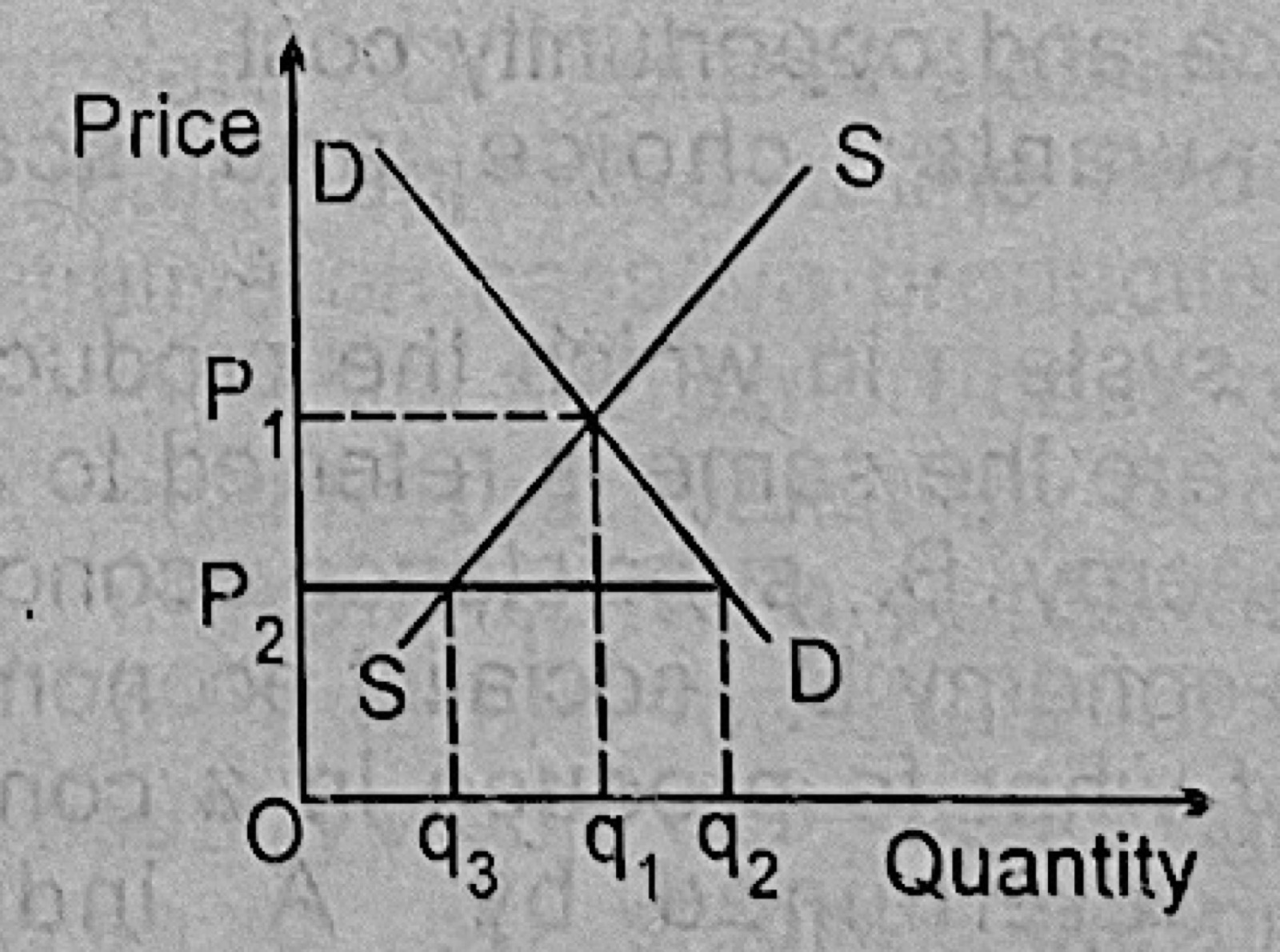
Question 45 Price Determination The diagram above shows the effect of
A. maximum price legislation at P2 B. minimum price legislation at P2 C. excess supply over demand at q2 D. excess demand over supply at q2 Show the answer and explanation Answer: A (maximum price legislation at P2 )
Explanation P2 is a price ceiling set below the equilibrium price P1 , which is maximum price legislation; it causes a shortage of q2 − q3 .
Open this question
Question 46 Market Structures A perfectly competitive firm is advised to close down when the
A. price is below the marginal cost B. price is equal to the marginal revenue C. marginal revenue is equal to the marginal cost D. price is below the average variable cost Show the answer and explanation Answer: D (price is below the average variable cost )
Explanation If price cannot even cover average variable cost, the firm loses less by shutting down and paying only its fixed costs.
Open this question
Question 47 Theory of Production Use the table below to answer questions 47 and 48.
A. 180 units B. 100 units C. 540 units D. 120 units Show the answer and explanation Answer: A (180 units )
Explanation Average product = total product ÷ number of men = 540 ÷ 3 = 180 units.
Open this question
Question 48 Theory of Production Use the table below to answer questions 47 and 48.
A. ₦110 B. ₦120 C. ₦220 D. ₦330 Show the answer and explanation Answer: C (₦220 )
Explanation Total revenue = 660 × ₦2 = ₦1,320; spread over 6 men this is ₦1,320 ÷ 6 = ₦220 per man.
Open this question
Question 49 Market Structures Product differentiation in monopolistic competition implies that
A. different products are sold to the same buyer B. different buyers pay different prices for the same product C. sellers determine whom to sell their products to D. the same product is available in different forms Show the answer and explanation Answer: D (the same product is available in different forms )
Explanation Firms in monopolistic competition sell basically the same product but make it look different through brand, packaging or design.
Open this question
Question 50 Theory of Production A constraint on the expansion of a firm is the
A. rate of advertisement B. size of the market C. level of the producers' income D. tastes of the consumers Show the answer and explanation Answer: B (size of the market )
Explanation A firm cannot grow beyond what its market can buy; a small market limits expansion.
Open this question Sign up free for every JAMB Economics year, practice by topic and timed mocks.
Start practising free