Home › Past questions › JAMB › Economics › 2005 46 questions. Try each one, then open the answer to check yourself and read the explanation.
Sign up free to answer these questions on a CBT screen with a timer, then see your score and every answer explained.
Start practising free
Question 1 Market Structures A profit maximizing monopolist should produce within the range where his demand is
A. inelastic B. elastic C. infinitely elastic D. unitarily elastic Show the answer and explanation Answer: B (elastic )
Explanation A monopolist sets MR = MC, and MC is positive, so MR must be positive. MR is positive only where demand is elastic.
Open this question
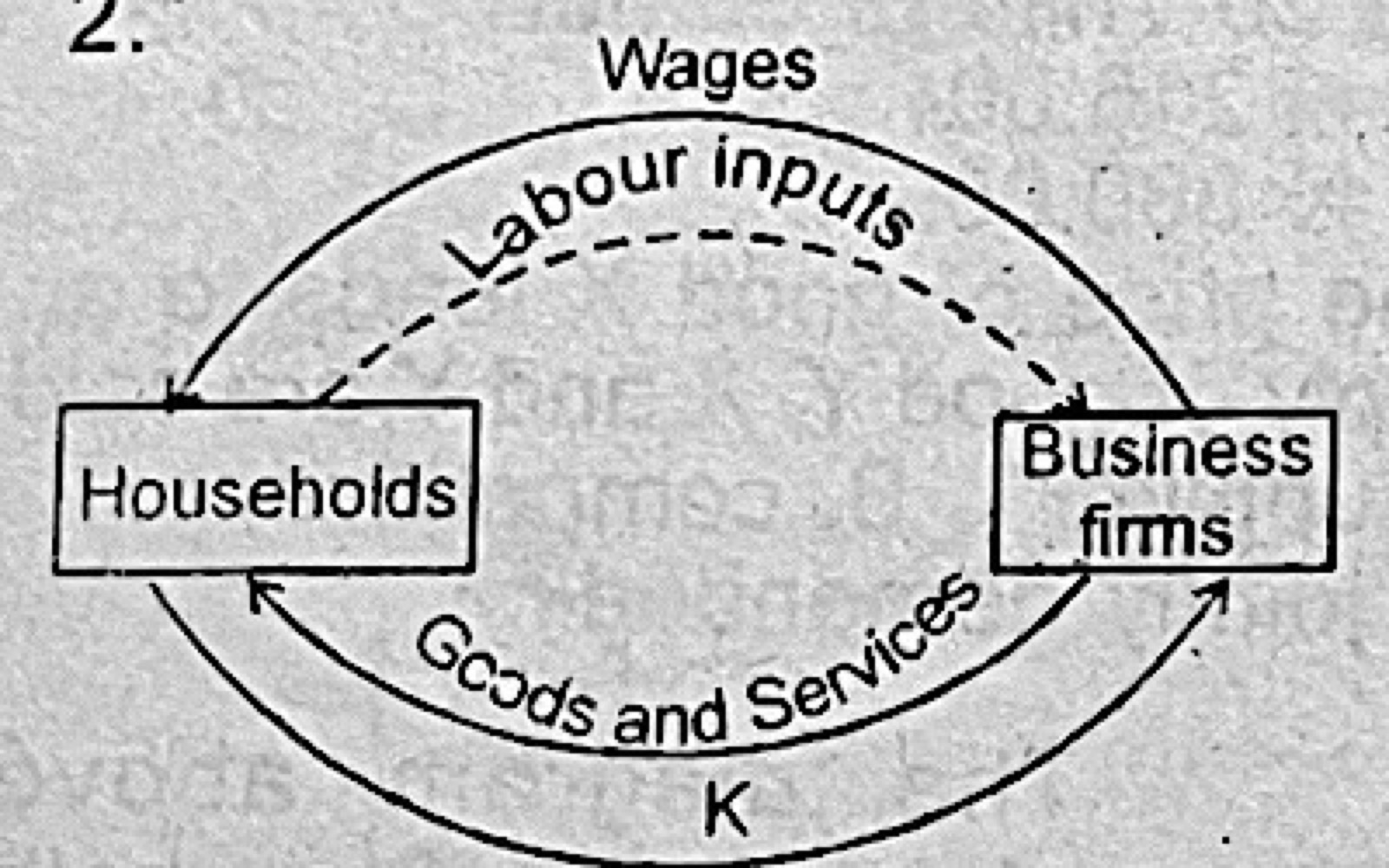
Question 2 National Income In the circular flow diagram above, the arrow marked K indicates
A. the flow of capital goods B. payments to factors of production C. payments for goods and services D. the flow of economic rent Show the answer and explanation Answer: C (payments for goods and services )
Explanation Use the diagram. Goods and services flow from firms to households, and K is the money flowing the other way, from households to firms, to pay for them.
Open this question
Question 3 Financial Institutions The savings deposit in a commercial bank is called
A. capital B. fund C. near money D. call money Show the answer and explanation Answer: C (near money )
Explanation A savings deposit is not spent directly like cash but can quickly be turned into cash, so it is near money (quasi-money).
Open this question
Question 4 Market Structures Output(kg) | 240 | 450 | 580 | 630
A. 450g B. 630 kg C. 240 kg D. 580 kg Show the answer and explanation Answer: A (450g )
Explanation Profit is greatest where marginal revenue equals marginal cost. MR = MC = ₦48 at an output of 450 kg.
Open this question
Question 5 Financial Institutions The regulatory authority of the capital market in Nigeria is the
A. Central Bank B. Securities and Exchange Commission C. Nigerian Deposit Insurance Corporation D. Stock Exchange Market Show the answer and explanation Answer: B (Securities and Exchange Commission )
Explanation The Securities and Exchange Commission (SEC) regulates and supervises Nigeria's capital market.
Open this question
Question 6 Market Structures In the long run, the equilibrium point of a monopolistic firm is a point where the
A. marginal cost cruve is tangential to the average fixed cost curve B. demand curve is tangential to the average variable cost curve C. supply curve is tangential to the marginal cost curve D. demand curve is tangential to the average cost curve Show the answer and explanation Answer: D (demand curve is tangential to the average cost curve )
Explanation In the long run new firms enter until only normal profit is left, so the firm's demand (AR) curve just touches its average cost curve.
Open this question
Question 7 National Income Given that Y = C + I, where C = 50 + 0.75 and I = N45m, what is the equilibrium level of income?
A. N380 m B. N 20 m C. N180 m D. N200 m Show the answer and explanation Answer: A (N380 m )
Explanation Taking C = 50 + 0.75Y: Y = 50 + 0.75Y + 45, so 0.25Y = 95 and Y = 380 (₦380 million).
Open this question
Question 8 Financial Institutions Above full employment level, an expansionary monetary policy will lead to a
A. fall in aggregate demand B. decrease in aggregate supply C. fall in the inflation rate D. rise in the inflation rate Show the answer and explanation Answer: D (rise in the inflation rate )
Explanation At full employment output cannot rise further, so extra money only raises spending and pushes prices up.
Open this question
Question 9 Market Structures A major assumption in a perfectly competitive market is that
A. the number of buyers and sellers is small B. individuals cannot influence prices C. the quality of products remains the same D. prices will always remain constant Show the answer and explanation Answer: B (individuals cannot influence prices )
Explanation There are so many buyers and sellers that no single one can affect the market price; each is a price taker.
Open this question
Question 10 Financial Institutions A discount house is a market where
A. various bills are exchanged B. short-term and medium-term loans are obtained C. shares are bought and sold D. short-term loans are obtained Show the answer and explanation Answer: A (various bills are exchanged )
Explanation A discount house buys and sells (discounts) bills such as treasury bills and bills of exchange.
Open this question
Question 11 Money and Inflation Idle cash balances are held for
A. planned purchases B. the purchase of bonds C. the purchase of shares D. unplanned purchases Show the answer and explanation Answer: B (the purchase of bonds )
Explanation Idle balances are money held for the speculative motive: waiting to buy bonds when their prices fall (interest rates rise).
Open this question
Question 12 National Income In a particular year, the sum of the value added in each sector of the economy was N4550 million. The amount represents the GNP measured by the
A. factor-price approach B. output approach C. income approach D. expenditure approach Show the answer and explanation Answer: B (output approach )
Explanation Adding up the value added by every sector of the economy is the output (product) method of measuring national income.
Open this question
Question 13 Population Population density is described as the
A. average number of people per square kilometre B. average number of people in a country C. total population excluding migration D. total population including net migration Show the answer and explanation Answer: A (average number of people per square kilometre )
Explanation Population density = population ÷ land area, i.e. the average number of people per square kilometre.
Open this question
Question 14 Agriculture The short-run inelasticity of supply of agricultural produce causes
A. stability in prices B. a steady rise in prices C. a steady decline in prices D. instability in prices Show the answer and explanation Answer: D (instability in prices )
Explanation Farm supply cannot adjust quickly, so changes in demand or harvests cause big swings in price: prices are unstable.
Open this question
Question 15 Natural Resources and Petroleum The major contribution of the petroleum industry to the Nigerian economy is the
A. generation of revenue for the oil companies B. provision of employment opportunities for communities C. generation of revenue for government D. promotion of industrial harmony Show the answer and explanation Answer: C (generation of revenue for government )
Explanation Oil provides most of the Nigerian government's revenue and foreign exchange.
Open this question
Question 16 Labour Market During a conflict between management and workers, the union's bargaining power is based on
A. work-to-rule B. negotiation C. picketing D. management decision Show the answer and explanation Answer: B (negotiation )
Explanation A union's strength comes from collective bargaining, negotiating with employers on behalf of all its members.
Open this question
Question 18 Population If the death rate of a country is 52% and the growth rate is 12%, what is the birth rate of the country
A. 48% B. 64% C. 40% D. 52% Show the answer and explanation Answer: B (64% )
Explanation Growth rate = birth rate − death rate, so birth rate = growth rate + death rate = 12% + 52% = 64%.
Open this question
Question 19 Agriculture Agricultural backward-linkage effect means the establishment of
A. subsidiary industries to increase the number of industries B. main industries to increase output C. industries to reduce imports D. subsidiary industries to feed the main industry Show the answer and explanation Answer: D (subsidiary industries to feed the main industry )
Explanation Backward linkage means setting up suppliers (such as farms) that provide raw materials to the main industry.
Open this question
Question 20 Natural Resources and Petroleum The distinction between onshore and offshore operations in oil exploration lies in the
A. location of sites B. output generated C. size of production D. techniques of production Show the answer and explanation Answer: A (location of sites )
Explanation Onshore operations are on land and offshore operations are at sea; the difference is where the sites are located.
Open this question
Question 21 Theory of Production Long-run production is called
A. diminishing returns to scale B. returns to scale C. external economies of scale D. economies of scale Show the answer and explanation Answer: B (returns to scale )
Explanation In the long run all inputs change together, and the effect on output is called returns to scale.
Open this question
Question 22 Market Structures For a firm to break even in the long run, the marginal cost curve must cut the
A. average variable cost curve at its highest point B. average cost curve at any two lowest point C. total cost cure at its lowest point D. average cost curve at its lowest point Show the answer and explanation Answer: D (average cost curve at its lowest point )
Explanation The MC curve always cuts the average cost curve at its lowest point; when price equals this minimum average cost the firm just breaks even.
Open this question
Question 23 Theory of Supply An increase in the quantity supplied of a commodity suggests
A. a leftward shift of the supply curve B. a rightward shift of the supply curve C. a movement along the supply curve D. an increase in elasticity of supply Show the answer and explanation Answer: C (a movement along the supply curve )
Explanation A change in quantity supplied is caused by a change in the good's own price and is a movement along the supply curve.
Open this question
Question 24 Theory of Costs and Revenue An example of a long-run cost of a firm is
A. fuel and maintenance cost B. the planned size of plant and equipment C. the existing size of plant and equipment D. rent on buildings Show the answer and explanation Answer: B (the planned size of plant and equipment )
Explanation In the long run a firm can choose any size of plant, so long-run costs relate to the planned plant and equipment. Rent on buildings is a fixed cost of the short run.
Open this question
Question 25 Theory of Production In a car assembly plant, division of labour is demonstrated by
A. assigning each worker to a specific activity B. assigning each worker a given number to produce C. increasing the daily output D. producing a specific model Show the answer and explanation Answer: A (assigning each worker to a specific activity )
Explanation Division of labour means splitting production into tasks and giving each worker one specific task.
Open this question
Question 26 Market Structures Under perfect competition, the short-run supply curve of a firm is determined by its
A. total cost curve B. marginal cost curve C. average fixed cost curve D. average cost curve Show the answer and explanation Answer: B (marginal cost curve )
Explanation A competitive firm produces where price = marginal cost, so its supply curve is its MC curve above average variable cost.
Open this question
Question 27 Price Determination The hoarding of goods is usually experienced when
A. supply is greater than demand B. the market price is above the equilibrium price C. demand is greater than supply D. excess demand is greater than excess supply Show the answer and explanation Answer: C (demand is greater than supply )
Explanation When goods are scarce (demand exceeds supply), traders hold them back expecting higher prices: hoarding.
Open this question
Question 28 Theory of Production The technical relationship between input combination and maximum attainable output is called
A. a production function B. an indifference curve C. an isocost D. an isoquant Show the answer and explanation Answer: A (a production function )
Explanation A production function shows the maximum output that can be produced from each combination of inputs.
Open this question
Question 29 Theory of Consumer Behaviour If the marginal utility of the last unit of commodity X at N2 is 16 and that of commodity Y at N4 is 24, the consumer will be at equilibrium when
A. the price-quantity ratios are equal B. equal amounts of X and Y are consumed C. less of Y and more of X are consumed D. less of X and more of Y are consumed Show the answer and explanation Answer: C (less of Y and more of X are consumed )
Explanation X gives 16 ÷ 2 = 8 utils per naira and Y gives 24 ÷ 4 = 6. To equalise MU per naira, the consumer buys more X (lowering its MU) and less Y (raising its MU).
Open this question
Question 30 Price Determination A buyer who haggles in the market is applying the principle of
A. choice B. price mechanism C. opportunity cost D. utility maximization Show the answer and explanation Answer: B (price mechanism )
Explanation Haggling is bargaining between buyer and seller until a price is agreed, which is the price mechanism at work.
Open this question
Question 31 Theory of Demand An inverse relationship between price and quantity demanded implies that
A. the two variables change in opposite directions B. the two variables change in the same direction C. only one variable changes D. the two variables remain unchanged Show the answer and explanation Answer: A (the two variables change in opposite directions )
Explanation Inverse means when one rises the other falls, i.e. they move in opposite directions.
Open this question
Question 32 Theory of Consumer Behaviour When the marginal utility of a commodity is zero, the total utility is
A. at its minimum B. upward-sloping C. downward-sloping D. at its maximum Show the answer and explanation Answer: D (at its maximum )
Explanation Total utility rises while marginal utility is positive and stops rising when marginal utility reaches zero, so it is at its maximum.
Open this question
Question 33 Economic Systems Economic freedom is a basic feature of
A. a market economy B. an industrialized economy C. a planned economy D. a developed economy Show the answer and explanation Answer: A (a market economy )
Explanation In a market (capitalist) economy individuals are free to own property, choose jobs and run businesses.
Open this question
Question 34 Tools of Economic Analysis Use the table below to answer the question.
A. 5 kg B. 6 kg C. 3 kg D. 4 kg Show the answer and explanation Answer: D (4 kg )
Explanation Arranged in order the quantities are 2, 3, 4, 5, 6; the middle value is 4 kg.
Open this question
Question 35 Tools of Economic Analysis Use the table below to answer the question.
A. N54 B. N51 C. N56 D. N59 Show the answer and explanation Answer: B (N51 )
Explanation Weight each price by its quantity: (40×6 + 48×5 + 55×4 + 60×3 + 70×2) ÷ (6+5+4+3+2) = 1020 ÷ 20 = ₦51.
Open this question
Question 36 Elasticity If elasticity of demand is greater than 1 and less than infinity, demand is said to be
A. elastic B. perfectly inelastic C. inelastic D. perfectly elastic Show the answer and explanation Answer: A (elastic )
Explanation Elasticity above 1 means demand is elastic; it is perfectly elastic only when elasticity is infinite.
Open this question
Question 37 Theory of Production In economics, production takes place only when
A. producers sell to retailers B. value has been added to a commodity C. modern equipment is used D. consumption has taken place Show the answer and explanation Answer: B (value has been added to a commodity )
Explanation In economics, production means creating or adding value (utility) to goods and services.
Open this question
Question 38 Public Finance The monetization policy of the Nigerian government is aimed at
A. encouraging public servants toretire early and become self-employed B. transferring government's properties to retired public servants C. reducing government's burden on the provision of fringe benefits to public servants D. helping government recover properties held by public servants Show the answer and explanation Answer: C (reducing government's burden on the provision of fringe benefits to public servants )
Explanation Monetisation pays public servants cash allowances in place of free houses, cars and other fringe benefits, cutting government's cost of providing them.
Open this question
Question 40 Economic Growth and Development The problem of planning in Nigeria is mainly in the
A. implementation of the plans B. appraisal of the plans C. allocation of scarce resources D. articulation of the plans Show the answer and explanation Answer: A (implementation of the plans )
Explanation Nigeria's plans were usually well drawn up but poorly carried out, so the main problem is implementation.
Open this question
Question 42 International Trade Use the table below to answer the question.
A. 7, 000 units B. 16,000 units C. 9,000 units D. 8,000 units Show the answer and explanation Answer: B (16,000 units )
Explanation Nigeria is far better at groundnuts, so it moves all its resources into them. Resources that gave 8,000 groundnuts plus 1,000 cocoa now give 2 × 8,000 = 16,000 groundnuts.
Open this question
Question 43 International Trade Use the table below to answer the question.
A. 16,000 units B. 9,000 units C. 8,000 units D. 7,000 units Show the answer and explanation Answer: D (7,000 units )
Explanation With specialisation Nigeria makes 16,000 groundnuts (and Ghana 16,000 cocoa), against 9,000 of each before: a gain of 16,000 − 9,000 = 7,000 units.
Open this question
Question 45 Economic Growth and Development Economic growth is different from economic development because economic growth
A. describes expansion and change B. is measurable but not objective C. describes expansion and not change D. is not measurable but objective Show the answer and explanation Answer: C (describes expansion and not change )
Explanation Growth is just a rise in output (expansion); development also involves structural and social change such as better health and education.
Open this question
Question 46 Balance of Payments and Exchange Rates A long-term capital outflow is recorded in the balance of payment as a
A. credit on the capital account B. credit on the current account C. debit on the current account D. debit on the capital account Show the answer and explanation Answer: D (debit on the capital account )
Explanation Long-term investment flowing out of the country is a payment abroad on the capital account, so it is a debit there.
Open this question
Question 47 Business Organisations Business organizations in which the owners' personal property may be forfeited in the event of bankruptcy are
A. partnerships and limited liability companies B. partnerships and sole proprietorships C. cooperatives and limited liability companies D. corporations and sole proprietorships Show the answer and explanation Answer: B (partnerships and sole proprietorships )
Explanation Sole proprietors and (ordinary) partners have unlimited liability, so their personal property can be taken to pay business debts.
Open this question
Question 48 Money and Inflation The factor responsible for the current inflationary pressures in Nigeria is the
A. exchange rate depreciation B. increase in exports C. low per capita income D. budget surplus Show the answer and explanation Answer: A (exchange rate depreciation )
Explanation When the naira loses value, imported goods and inputs cost more, pushing up prices.
Open this question
Question 49 Public Finance If government increases its expenditure on public works, the desired effect is
A. a reduction in the use of capital equipment B. an increase in the level of emploment C. an increase in the level of inflation D. an increase in the use of capital equipment Show the answer and explanation Answer: B (an increase in the level of emploment )
Explanation Public works such as roads and buildings create jobs, so the aim is to raise employment.
Open this question
Question 50 International Economic Organisations An institution that regulates trade relations among members is the
A. ADB B. OPEC C. EU D. IMF Show the answer and explanation Answer: C (EU )
Explanation The European Union is a common market that sets the rules of trade among its member countries. OPEC regulates oil output and prices, not trade relations.
Open this question Sign up free for every JAMB Economics year, practice by topic and timed mocks.
Start practising free