Home › Past questions › JAMB › Economics › 2001 50 questions. Try each one, then open the answer to check yourself and read the explanation.
Sign up free to answer these questions on a CBT screen with a timer, then see your score and every answer explained.
Start practising free
Question 1 Elasticity If the price elasticity of demand for a good is 0.43, an increase in the price of the good will result in
A. an increase in profit by 43% B. a net gain C. a decrease in profit by 43% D. a net loss Show the answer and explanation Answer: B (a net gain )
Explanation An elasticity of 0.43 is less than 1, so demand is inelastic. Raising the price cuts quantity by a smaller proportion, so total revenue rises: a net gain.
Open this question
Question 2 Economic Systems In a free market economy, the price system allocates resources
A. under government's directives B. to ensure general welfare C. to their best alternative uses D. to reduce poverty Show the answer and explanation Answer: C (to their best alternative uses )
Explanation In a free market, prices guide resources to the uses where they earn the most, that is, their best alternative uses.
Open this question
Question 3 Theory of Consumer Behaviour At consumer equilibrium, the slope of the indifference curve is
A. half the slope of the budget constraint line B. equal to the slope of the budget constraint line C. greater than the slope of the budget constraint line D. less than the slope of the budget constraint line Show the answer and explanation Answer: B (equal to the slope of the budget constraint line )
Explanation The consumer is in equilibrium where the budget line just touches (is tangent to) the highest indifference curve, so their slopes are equal.
Open this question
Question 4 Theory of Supply For a supply curve, an increase in the price of a commodity will result in
A. a decrease in supply B. a decrease in the quantity supplied C. an increase in supply D. an increase in the quantity supplied Show the answer and explanation Answer: D (an increase in the quantity supplied )
Explanation A change in the good's own price causes a movement along the supply curve, so a higher price raises the quantity supplied (not supply itself).
Open this question
Question 5 Elasticity A normal good with close substitutes is likely to have its price elasticity of demand
A. between zero and one B. equal to unity C. less than unity D. greater than unity Show the answer and explanation Answer: D (greater than unity )
Explanation When close substitutes exist, buyers switch easily if the price rises, so demand is elastic: elasticity greater than 1.
Open this question
Question 6 Basic Concepts Economics is regarded as a social science because it
A. adopts the scientific method in production B. is an agent of socialization C. adopts the scientific method in the study of human behaviour D. deals with social problems Show the answer and explanation Answer: C (adopts the scientific method in the study of human behaviour )
Explanation Economics studies how people behave when making choices, and it does so using scientific methods of observation, hypothesis and testing.
Open this question
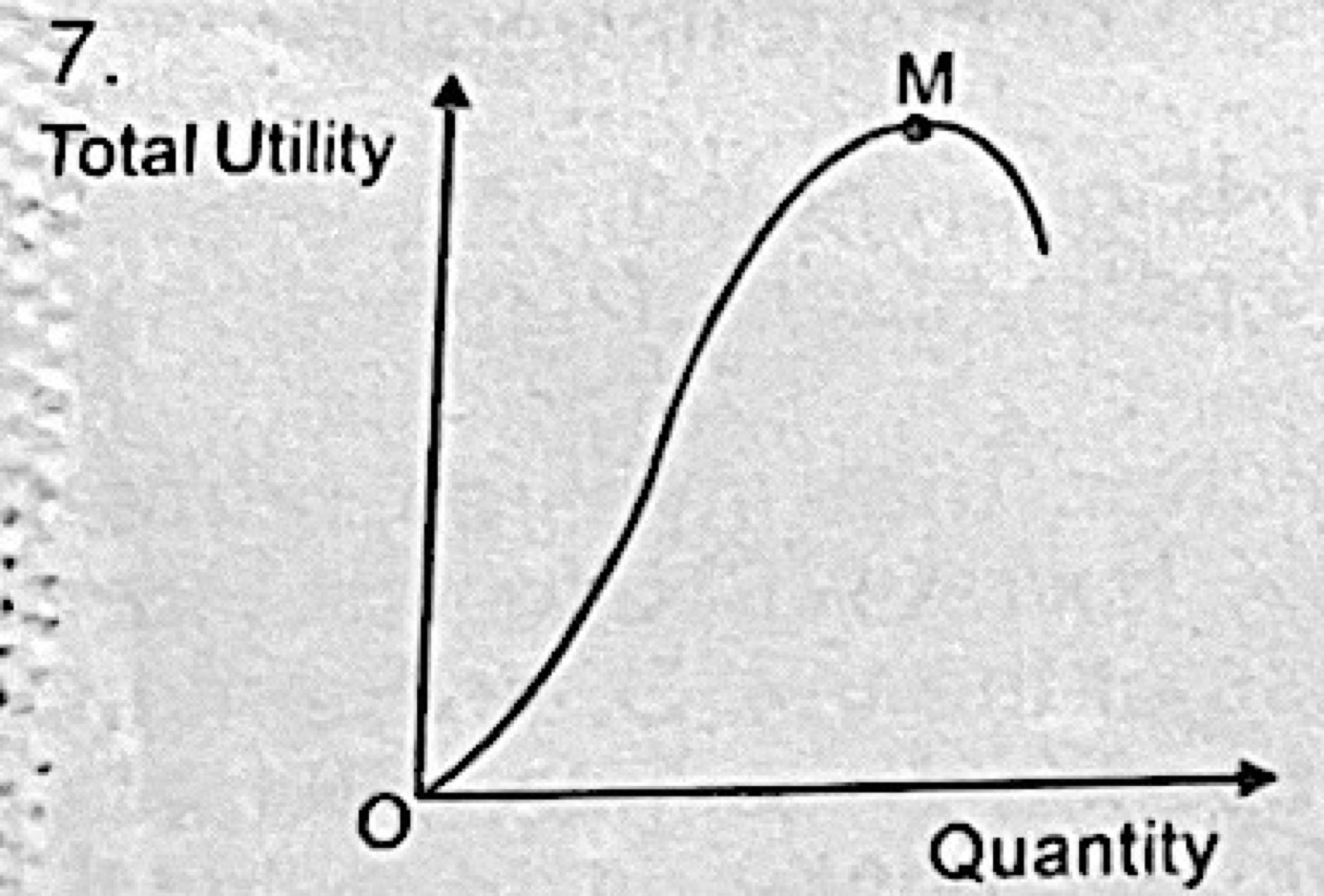
Question 7 Theory of Consumer Behaviour The diagram above shows the total utility curve. At the point M, marginal utility
A. increases B. is unity C. diminishes D. is zero Show the answer and explanation Answer: D (is zero )
Explanation Use the diagram to answer the question. Point M is the top of the total utility curve, where total utility stops rising, so marginal utility there is zero.
Open this question
Question 8 Theory of Supply A change in supply is best described as a
A. movement along the supply curve B. shift of the supply curve to the left or to the right C. shift of the supply curve to the left D. shift of the supply curve to the right Show the answer and explanation Answer: B (shift of the supply curve to the left or to the right )
Explanation A change in supply is caused by factors other than the good's own price and shows as a shift of the whole curve, either left (decrease) or right (increase).
Open this question
Question 9 Tools of Economic Analysis When a generalization is made based on observed facts, it is known as
A. deductive reasoning B. inductive reasoning C. theoretical reasoning D. normative reasoning Show the answer and explanation Answer: B (inductive reasoning )
Explanation Inductive reasoning moves from observed facts to a general rule; deductive reasoning starts from a general assumption and reasons down to particular cases.
Open this question
Question 10 Basic Concepts A major problem facing all economies is how to
A. increase consumption of imported goods B. improve trade among nations C. transform from a developing to a developed economy D. allocate scarce resources Show the answer and explanation Answer: D (allocate scarce resources )
Explanation Every economy has limited resources and unlimited wants, so all must decide how to allocate scarce resources.
Open this question
Question 11 Elasticity A vertical supply curve indicates that
A. the quantity supplied is responsive to price B. the same fixed quantity will be supplied no matter the price C. an increase in price will result in an increase in the quantity supplied D. there is a fixed price for the commodity below which no supply will be made Show the answer and explanation Answer: B (the same fixed quantity will be supplied no matter the price )
Explanation A vertical supply curve means perfectly inelastic supply: the same quantity is supplied at every price.
Open this question
Question 12 Theory of Demand In a demand curve, the relationship between price and quantity is
A. indeterminate B. direct C. nil D. inverse Show the answer and explanation Answer: D (inverse )
Explanation By the law of demand, as price rises quantity demanded falls, so the relationship is inverse.
Open this question
Question 13 Tools of Economic Analysis If the arithmetic mean of 1, 2, 5, 6, x, 16 and 18 is 8.0, find the value of x.
A. 7.0 B. 6.0 C. 8.5 D. 8.0 Show the answer and explanation Answer: D (8.0 )
Explanation Seven numbers with mean 8 add up to 56. The known numbers add up to 48, so x = 56 − 48 = 8.
Open this question
Question 14 Economic Systems The fixing of the price of an item above or below the equilibrium price is most likely to take place in a
A. centrally planned economy B. free market economy C. developed economy D. mixed economy Show the answer and explanation Answer: A (centrally planned economy )
Explanation In a centrally planned economy the government, not the market, sets prices, so prices are often fixed above or below equilibrium.
Open this question
Question 15 Basic Concepts A consumer's scale of preference is an arrangement of his
A. scarce resources in order of importance B. needs in order of importance C. sources of income and their importance D. requirements and how to satisfy them Show the answer and explanation Answer: B (needs in order of importance )
Explanation A scale of preference is a list of a person's needs/wants arranged in order of importance, so the most pressing are satisfied first.
Open this question
Question 16 Market Structures A firm's shut-down point is reached when the average revenue fails to cover the
A. average variable cost B. marginal cost C. average total cost D. average fixed cost Show the answer and explanation Answer: A (average variable cost )
Explanation In the short run a firm keeps producing as long as price (average revenue) covers average variable cost; below that it shuts down.
Open this question
Question 17 Theory of Costs and Revenue Internal economies of scale are expected to bring about
A. an increase in short-run average cost B. an increase in long-run average cost C. a decrease in long-run average cost D. a decrease in short-run average cost Show the answer and explanation Answer: C (a decrease in long-run average cost )
Explanation Internal economies of scale are the savings a firm gets as it grows larger, which lower its long-run average cost.
Open this question
Question 18 Market Structures In the long-run, a monopolist maximizes his profit when the marginal cost equals
A. total revenue B. marginal revenue C. average cost D. price Show the answer and explanation Answer: B (marginal revenue )
Explanation Every profit-maximising firm, including a monopolist, produces where marginal cost equals marginal revenue.
Open this question
Question 19 Theory of Production The long run is a period during which a firm
A. sells inputs to purchase fixed assets B. varies all its inputs C. sources all its inputs from within D. replaces all its inputs Show the answer and explanation Answer: B (varies all its inputs )
Explanation In the long run there are no fixed factors: the firm can change the quantity of all its inputs.
Open this question
Question 20 Market Structures An important feature of perfect competition is that
A. the movement of goods and services is restricted B. there is adequate knowledge of existing prices C. prices are centrally administered D. individual economic units can influence prices Show the answer and explanation Answer: B (there is adequate knowledge of existing prices )
Explanation Perfect competition assumes buyers and sellers have perfect knowledge of market prices.
Open this question
Question 21 Price Determination If government fixes price below the equilibrium price, what effect will it have on demand?
A. Quantity demanded and supplied will be equal B. Quantity supplied will be greater than quantity demanded C. Quantity demanded will increase D. Quantity demanded will decrease Show the answer and explanation Answer: C (Quantity demanded will increase )
Explanation A lower price makes buyers want more, so quantity demanded rises (and exceeds quantity supplied, causing a shortage).
Open this question
Question 22 Market Structures An imperfect market exists where
A. the product is homogenous B. there is perfect information among the few buyers and sellers C. both buyers and sellers have free entry into and free exit from the market D. the location of some sellers gives them an advantage over others Show the answer and explanation Answer: D (the location of some sellers gives them an advantage over others )
Explanation A seller's location advantage means the market is not perfect; the other options are features of perfect competition.
Open this question
Question 23 Theory of Production A production function relates
A. cost to output B. wage to profit C. cost to input D. output to input Show the answer and explanation Answer: D (output to input )
Explanation A production function shows the relationship between the quantity of inputs used and the output produced.
Open this question
Question 24 Price Determination The table below shows a demand schedule for eggs.
A. ₦100 B. ₦110 C. ₦60 D. ₦80 Show the answer and explanation Answer: D (₦80 )
Explanation Equilibrium is where quantity demanded equals quantity supplied. At ₦80 both are 490 dozen.
Open this question
Question 25 Theory of Production A major advantage of specialization and division of labour is that
A. time wastage will be minimized B. trade unions will be encouraged C. there will be a ready market for labour D. workers will be adequately rewarded Show the answer and explanation Answer: A (time wastage will be minimized )
Explanation With division of labour each worker stays on one task and does not move between jobs, so time is saved.
Open this question
Question 26 Theory of Costs and Revenue Which of the following is an example of a fixed cost?
A. Fuel cost B. Electricity bill C. Rent on building D. Transportation cost Show the answer and explanation Answer: C (Rent on building )
Explanation Rent must be paid whatever the level of output, so it is a fixed cost; fuel, electricity and transport vary with output.
Open this question
Question 27 Agriculture In the agricultural sector, improved extension services facilitate
A. acquisition of techniques B. arable crop production C. mobility of labour D. livestock production Show the answer and explanation Answer: A (acquisition of techniques )
Explanation Extension workers teach farmers new methods, so extension services help farmers acquire improved techniques.
Open this question
Question 28 Industrialisation A disadvantage of concentrating industries in an area is that it could
A. lead to collusion among the firms B. result in environmental pollution C. bring about diseconomies of scale D. increase the cost of production Show the answer and explanation Answer: C (bring about diseconomies of scale )
Explanation When too many firms crowd into one area they suffer external diseconomies of scale such as congestion, pollution and higher land and labour costs.
Open this question
Question 29 Business Organisations The losses suffered by a sole proprietor are
A. usually equal to the amount invested B. usually less than the amount invested C. limited to the amount invested D. not limited to the amount invested Show the answer and explanation Answer: D (not limited to the amount invested )
Explanation A sole proprietor has unlimited liability, so his personal property can be taken to pay the business's debts.
Open this question
Question 30 Natural Resources and Petroleum To facilitate the exportation of crude oil from Nigeria, special
A. airstrips were constructed for jets to evacuate the oil B. roads were built to connect the major oil wells to the ports C. pipelines were laid to connect the major oil wells to the ports D. railway lines were constructed to connect the major oil wells to the ports Show the answer and explanation Answer: C (pipelines were laid to connect the major oil wells to the ports )
Explanation Crude oil is moved from the oil fields to the export terminals mainly through pipelines.
Open this question
Question 31 Business Organisations An industry is a
A. company producing unrelated commodities B. group of firms producing related commodities C. group of firms producing distinct commodities D. firm producing differentiated commodities Show the answer and explanation Answer: B (group of firms producing related commodities )
Explanation An industry is a group of firms producing similar or related goods, e.g. the textile industry.
Open this question
Question 32 Financial Institutions The raising of funds by selling stocks to the public is called
A. equity financing B. stock financing C. debt financing D. loan financing Show the answer and explanation Answer: A (equity financing )
Explanation Selling shares gives buyers ownership (equity) in the company, so raising money this way is equity financing.
Open this question
Question 33 Public Finance A tax that increases at a higher percentage as income increases is called
A. a proportional tax B. a regressive tax C. a progressive tax D. an income tax Show the answer and explanation Answer: C (a progressive tax )
Explanation Under a progressive tax the rate rises as income rises, so higher earners pay a larger percentage.
Open this question
Question 34 Labour Market The price paid for labour services is the
A. commission rate B. wage rate C. income rate D. salary rate Show the answer and explanation Answer: B (wage rate )
Explanation The reward for labour is wages, so the price of labour services is the wage rate.
Open this question
Question 35 Financial Institutions The capital market is a market for trading of financial assets such as
A. bankers' acceptances B. treasury bills C. long-term securities D. commercial papers Show the answer and explanation Answer: C (long-term securities )
Explanation The capital market deals in long-term funds such as shares and bonds; treasury bills, commercial papers and bankers' acceptances are short-term money-market instruments.
Open this question
Question 36 National Income In national income accounting, NNP is derived by subtracting from the GNP
A. transfer payments B. indirect taxes C. allowance for wastage D. capital consumption Show the answer and explanation Answer: D (capital consumption )
Explanation Net National Product = GNP − capital consumption (depreciation), the value of capital worn out in producing the output.
Open this question
Question 37 Economic Growth and Development Economic growth can be accelerated through
A. balancing of savings and consumption B. postponement of current consumption C. planned current consumption D. increased current consumption Show the answer and explanation Answer: B (postponement of current consumption )
Explanation Postponing consumption means more saving, which provides funds for investment in capital goods, and investment speeds up growth.
Open this question
Question 38 Financial Institutions An increase in the discount rate is an indication of a central bank's intention to pursue
A. an expansionary monetary policy B. a disciplined monetary policy C. a dynamic monetary policy D. a contractionary monetary policy Show the answer and explanation Answer: D (a contractionary monetary policy )
Explanation Raising the discount (bank) rate makes borrowing dearer, reducing the money supply: a contractionary (tight) monetary policy.
Open this question
Question 39 Labour Market The efficiency of labour can be increased by
A. constant training of workers B. retirement of workers on a regular basis C. engaging expatriates only D. placing an embargo on recruitment Show the answer and explanation Answer: A (constant training of workers )
Explanation Regular training improves workers' skills, so they produce more and better output.
Open this question
Question 40 Public Finance In Nigeria, revenue sharing from the Federation Account is between the
A. executive, the judiciary and the legislature B. federal and state governments and the parastatals C. federal and state governments and the senate D. federal, state and local governments Show the answer and explanation Answer: D (federal, state and local governments )
Explanation Money in the Federation Account is shared among the three tiers of government: federal, state and local governments.
Open this question
Question 41 Population The reduction of high fertility rate is a measure in population control designed to make the
A. female population higher than the male B. female and male population equal C. male population higher than the female D. growth in population more sustainable Show the answer and explanation Answer: D (growth in population more sustainable )
Explanation Lowering the fertility rate slows population growth so that it can be supported by the country's resources.
Open this question
Question 42 Public Finance National debt is an expected outcome of a
A. deficit budget B. consolidated budget C. balanced budget D. surplus budget Show the answer and explanation Answer: A (deficit budget )
Explanation When a government spends more than its revenue (a deficit budget), it borrows to cover the gap, creating national debt.
Open this question
Question 43 Distributive Trade The distribution channel that contributes most to the cost of production is
A. producer–wholesaler–consumer B. producer–retailer–consumer C. producer–retailer–wholesaler–consumer D. producer–wholesaler–retailer–consumer Show the answer and explanation Answer: D (producer–wholesaler–retailer–consumer )
Explanation The longest chain of middlemen (producer–wholesaler–retailer–consumer) adds the most handling costs and profit margins.
Open this question
Question 44 Money and Inflation Money may not be accepted as a store of value if
A. its value is unstable B. it is easily transferable C. its value is stable D. it is easily divisible Show the answer and explanation Answer: A (its value is unstable )
Explanation People only store wealth in money if it keeps its value; if its value is unstable (e.g. high inflation), they prefer other assets.
Open this question
Question 45 Population In order to accelerate economic development, a country must
A. stimulate her population growth rate B. pursue a high population growth rate C. pursue a rational population policy D. pursue an incremental population policy Show the answer and explanation Answer: C (pursue a rational population policy )
Explanation A sensible (rational) population policy keeps population growth in line with resources, which helps development.
Open this question
Question 46 Labour Market If the labour force in a given community is 2,000,000, in the wage employment 200,000 and the unemployed are 80,000, what is the unemployment rate in the community?
A. 0.4% B. 40.0% C. 10.0% D. 4.0% Show the answer and explanation Answer: D (4.0% )
Explanation Unemployment rate = unemployed ÷ labour force × 100 = 80,000 ÷ 2,000,000 × 100 = 4%.
Open this question
Question 47 National Income GNP is not a good measure of social welfare because there are unrecorded
A. indirect taxes B. social costs C. government subsidies D. transfer payments Show the answer and explanation Answer: B (social costs )
Explanation GNP does not deduct social costs such as pollution and congestion, which reduce welfare but are not recorded.
Open this question
Question 48 International Economic Organisations The loans from the World Bank to developing countries are mainly to support
A. the establishment of more universities B. capital-intensive technology C. infrastructural investments D. their low level of consumption Show the answer and explanation Answer: C (infrastructural investments )
Explanation The World Bank lends mainly for long-term development projects such as roads, power and water: infrastructure.
Open this question
Question 49 International Trade The major reason why nations engage in international trade is that
A. it allows free movement of factors of production B. it makes possible the use of capital-intensive method of production C. nations are substantially different in their endowments of economic resources D. it affords the trading nations the opportunity to earn high profit Show the answer and explanation Answer: C (nations are substantially different in their endowments of economic resources )
Explanation Countries have different resources, so each can specialise in what it produces best and trade for the rest.
Open this question
Question 50 Balance of Payments and Exchange Rates A country with over-valued currency will
A. expect balance of payments surplus B. have increased demand for her exports C. increase her foreign reserve D. decrease her foreign reserve Show the answer and explanation Answer: D (decrease her foreign reserve )
Explanation An over-valued currency makes exports dear and imports cheap, so the country tends to run deficits and loses foreign reserves.
Open this question Sign up free for every JAMB Economics year, practice by topic and timed mocks.
Start practising free