JAMB Economics 1998 past questions and answers

49 questions. Try each one, then open the answer to check yourself and read the explanation.

Question 1

Basic Concepts

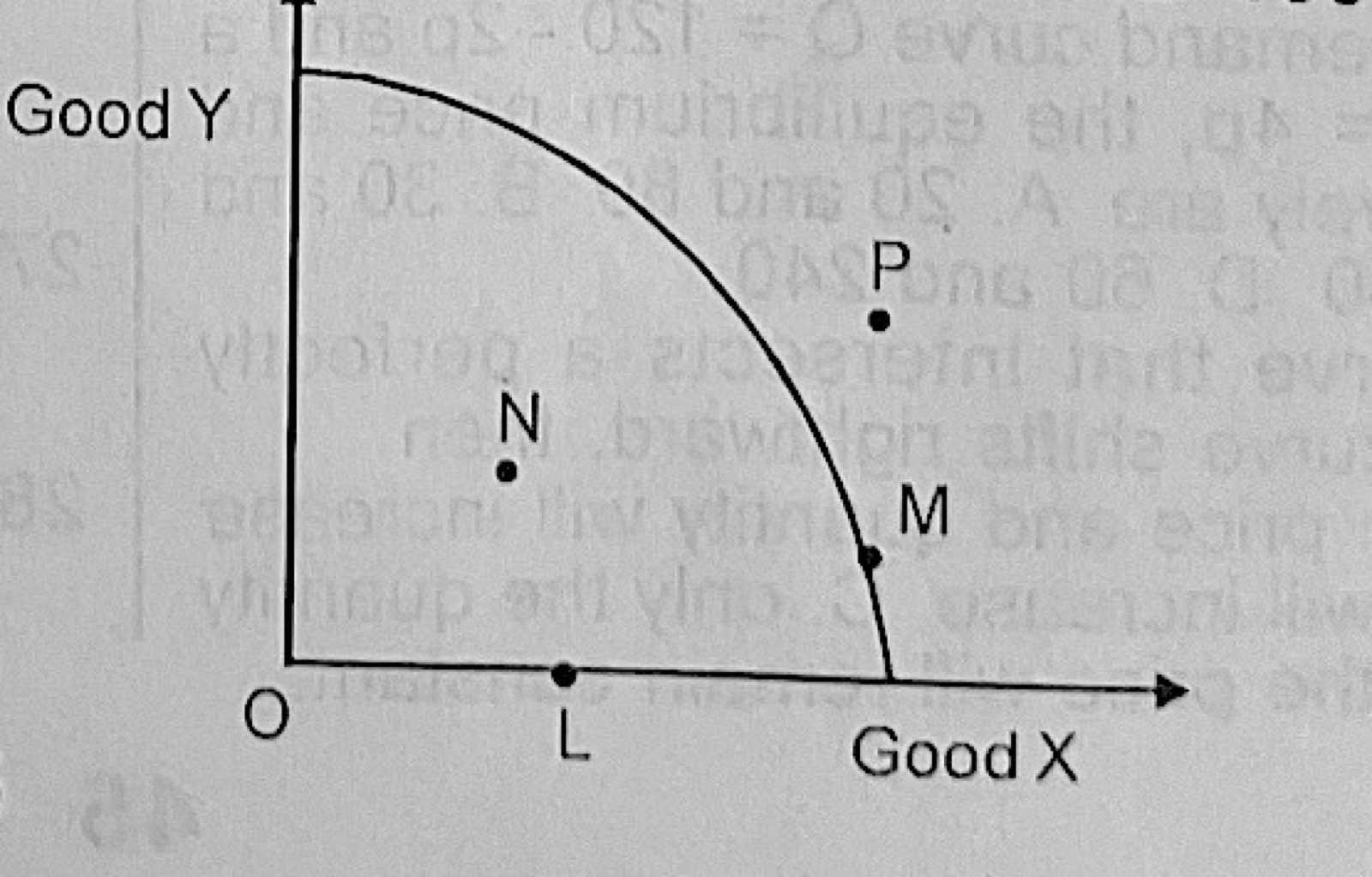
In the diagram above, full employment is indicated by

Diagram for this question
  1. A.L
  2. B.M
  3. C.N
  4. D.P
Show the answer and explanation

Answer: B (M)

Explanation

Full employment of resources is shown by a point on the production possibility curve. M lies on the curve; N and L are inside it and P is outside it (unattainable).

Open this question

Question 2

Theory of Consumer Behaviour

Units of consumption of commodity X | Marginal utility (Utils)
1 | 100
2 | 80
3 | 50
4 | 20
From the table above, the total utility for the individual who consumes 3 units of commodity X is

  1. A.50 utils
  2. B.150 utils
  3. C.230 utils
  4. D.250 utils.
Show the answer and explanation

Answer: C (230 utils)

Explanation

Total utility is the sum of the marginal utilities: 100 + 80 + 50 = 230 utils.

Open this question

Question 3

Economic Growth and Development

One of the economic problems of Nigeria today arises from

  1. A.the overutilization of human and natural resources
  2. B.unavailability of mineral resources
  3. C.inadequate manpower resources
  4. D.the under-utilization of human and natural resources.
Show the answer and explanation

Answer: D (the under-utilization of human and natural resources.)

Explanation

Nigeria has plenty of people and natural resources, but many workers are unemployed and many resources lie idle, so they are under-utilized.

Open this question

Question 4

Economic Systems

In certain circumstances, a centrally planned economy adopts the rationing system because of

  1. A.the scarcity of goods and services in the market
  2. B.low real and money wages
  3. C.the need for equitable distribution of goods and services
  4. D.transportation and distribution problems.
Show the answer and explanation

Answer: C (the need for equitable distribution of goods and services)

Explanation

Rationing gives each person a fixed share, so a planned economy uses it to share goods fairly among everyone.

Open this question

Question 5

Population

Given that
B = Births
D = Deaths
X = Emigrants
M = Immigrants
The population of a country over a period of time will rise if

  1. A.B = D and X > M
  2. B.B − D = O and M > X
  3. C.D − B = O and M = X
  4. D.X > M and D > B.
Show the answer and explanation

Answer: B (B − D = O and M > X)

Explanation

If births equal deaths, natural increase is zero, so the population rises only if more people come in (M) than leave (X).

Open this question

Question 6

Population

Population Statistics of a Country
AGE RANGE IN YEARS | % OF POPULATION 1960 | % OF POPULATION 1990
60 and above | 35 | 38
18 - 59 | 40 | 42
1 - 17 | 25 | 20
The dependency ratio between 1960 and 1990 is

  1. A.increased by 5%
  2. B.increased by 2%
  3. C.decreased by 2%
  4. D.decreased by 5%.
Show the answer and explanation

Answer: C (decreased by 2%)

Explanation

Dependants (under 18 and 60+) were 25 + 35 = 60% in 1960 and 20 + 38 = 58% in 1990, so the dependent share fell by 2%.

Open this question

Question 7

Population

Population Statistics of a Country
AGE RANGE IN YEARS | % OF POPULATION 1960 | % OF POPULATION 1990
60 and above | 35 | 38
18 - 59 | 40 | 42
1 - 17 | 25 | 20
In 1990, the difference between the dependent population and the active population ratio is

  1. A.22%
  2. B.20%
  3. C.16%
  4. D.4%.
Show the answer and explanation

Answer: C (16%)

Explanation

In 1990 the dependent population is 38 + 20 = 58% and the active population is 42%. The difference is 58 − 42 = 16%.

Open this question

Question 8

Theory of Production

The short-run period in production is defined as a period when

  1. A.there is at least one fixed factor
  2. B.all costs of production must be covered
  3. C.the output cannot be varied
  4. D.current output is not profitable.
Show the answer and explanation

Answer: A (there is at least one fixed factor)

Explanation

The short run is a period too short to change every input, so at least one factor (such as land or machinery) stays fixed.

Open this question

Question 9

Theory of Production

Specialization often improves economic performance because it

  1. A.permits exploitation of economies of scale
  2. B.incorporates external economies
  3. C.is based on the law of variable proportions
  4. D.allocates resources according to absolute advantage.
Show the answer and explanation

Answer: A (permits exploitation of economies of scale)

Explanation

When firms and workers specialise, output can be produced on a large scale with special machines and skills, which lowers cost per unit. These economies of scale are why specialization improves economic performance.

Open this question

Question 10

Theory of Production

Which of the following statements best describes the relationship between average product and marginal product?

  1. A.Marginal product and average product curves rise and fall together.
  2. B.Marginal product equals average product at the minimum point of the latter.
  3. C.Average product curve will rise as long as marginal product is greater than average product.
  4. D.Marginal product equals average product at the maximum point of the former.
Show the answer and explanation

Answer: C (Average product curve will rise as long as marginal product is greater than average product.)

Explanation

When the extra output of a new worker (MP) is above the average, it pulls the average up, so AP rises while MP > AP. MP cuts AP at AP's highest point.

Open this question

Question 12

Theory of Costs and Revenue

When a firm is reaping economies of large-scale production, it experiences a fall in its

  1. A.long-run marginal cost
  2. B.long-run average cost
  3. C.long-run total cost
  4. D.short-run marginal cost.
Show the answer and explanation

Answer: B (long-run average cost)

Explanation

Economies of scale mean that as the firm grows, its cost per unit (long-run average cost) falls.

Open this question

Question 13

Price Determination

In the diagram above, the price P2 in price control situation, is referred to as

Diagram for this question
  1. A.minimum price
  2. B.mark-up price
  3. C.maximum price
  4. D.mark-down price.
Show the answer and explanation

Answer: A (minimum price)

Explanation

Demand and supply meet at P1. P2 is fixed above this equilibrium, and a legal price set above equilibrium, below which sales may not take place, is a minimum price.

Open this question

Question 14

Theory of Consumer Behaviour

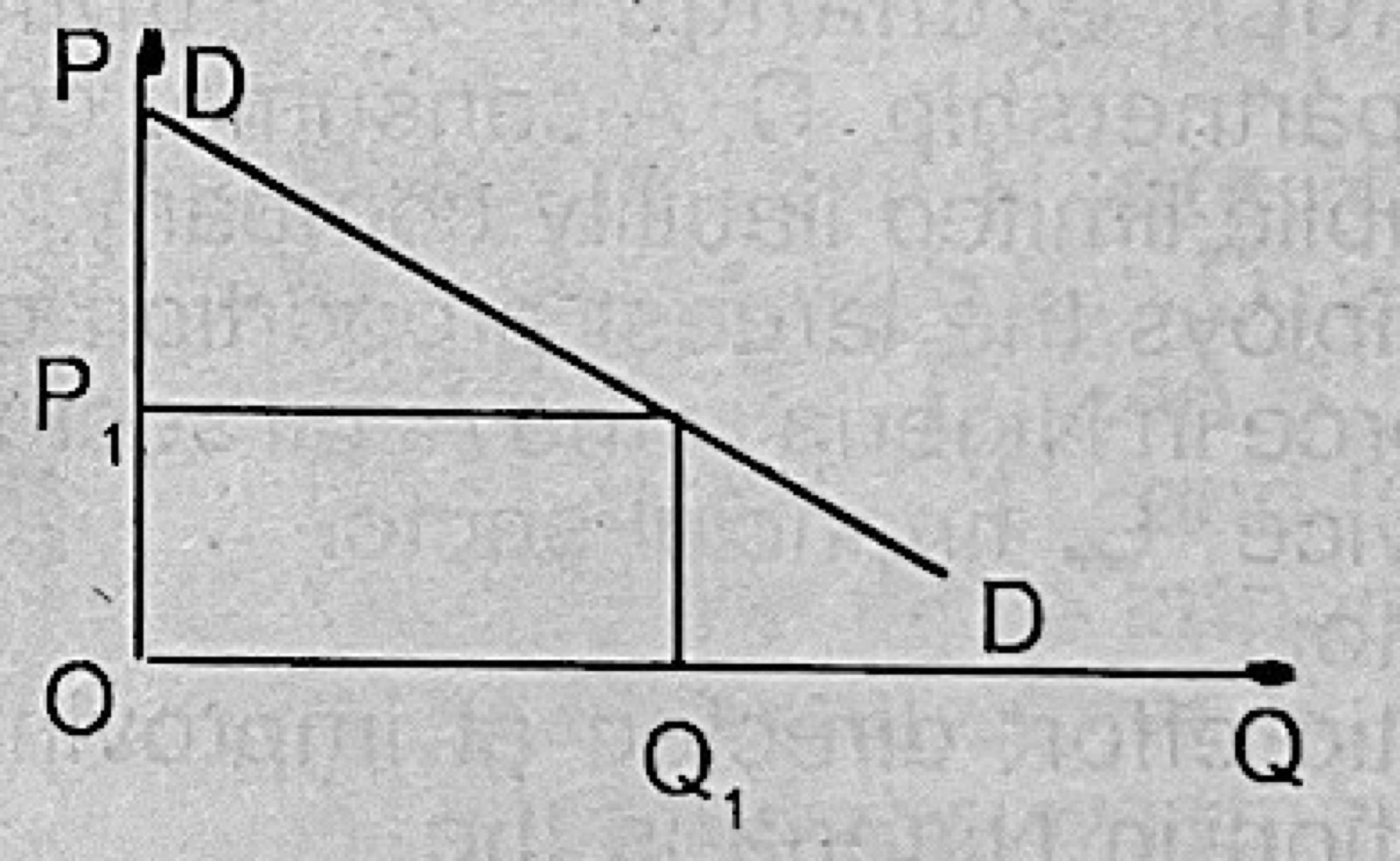
The shaded triangle in the diagram above is known as

Diagram for this question
  1. A.excess supply
  2. B.consumer surplus
  3. C.excess consumption
  4. D.producer surplus.
Show the answer and explanation

Answer: B (consumer surplus)

Explanation

The triangle below the demand curve and above the price P1 shows what buyers were willing to pay above what they actually paid: consumer surplus.

Open this question

Question 15

Price Determination

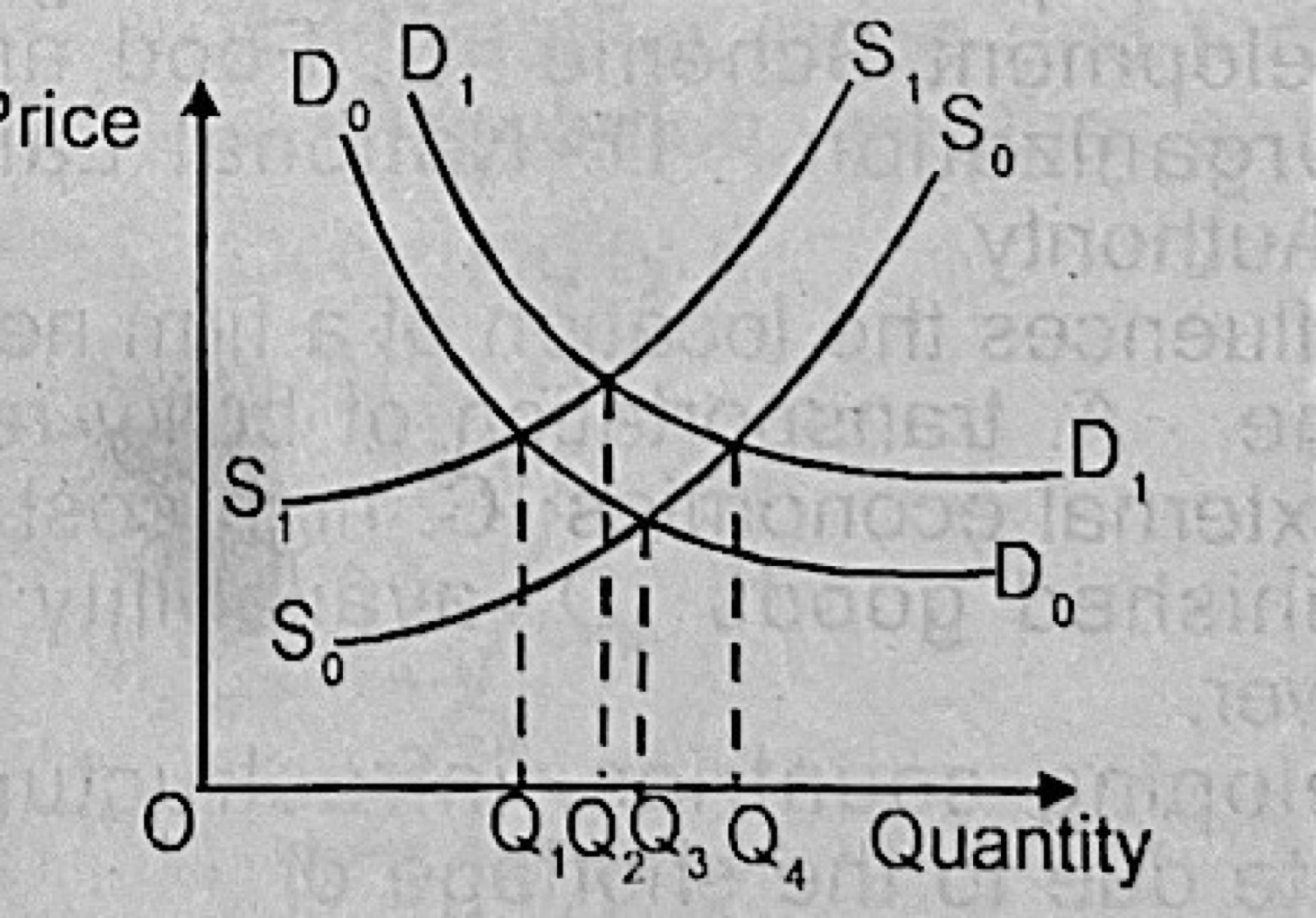
In the diagram above, D0D0 is the original demand curve, S0S0 is the original supply curve, D1D1 is the new demand curve and S1S1 is the new supply curve. What is the new equilibrium quantity?

Diagram for this question
  1. A.Q1
  2. B.Q2
  3. C.Q3
  4. D.Q4.
Show the answer and explanation

Answer: B (Q2)

Explanation

The new equilibrium is where the new demand curve D1D1 crosses the new supply curve S1S1, which is above Q2.

Open this question

Question 16

Elasticity

If an increase in the price of a commodity leads to increase in total revenue, then it means that the demand for this commodity is

  1. A.normal
  2. B.elastic
  3. C.inelastic
  4. D.abnormal.
Show the answer and explanation

Answer: C (inelastic)

Explanation

If raising the price raises total revenue, quantity fell by a smaller percentage than price rose, so demand is inelastic.

Open this question

Question 17

Elasticity

Given that the elasticity of demand for a commodity is 2.5, the percentage change in the quantity demanded as a result of a 10 per cent change in its price is

  1. A.0.25
  2. B.0.40
  3. C.4.00
  4. D.25.00.
Show the answer and explanation

Answer: D (25.00.)

Explanation

% change in quantity = elasticity × % change in price = 2.5 × 10 = 25%.

Open this question

Question 18

Market Structures

The producer in a perfectly competitive market is faced with a demand curve whose elasticity is

  1. A.unitary
  2. B.greater than one
  3. C.infinite
  4. D.less than one.
Show the answer and explanation

Answer: C (infinite)

Explanation

A perfect competitor can sell any amount at the market price but nothing above it, so its demand curve is horizontal: perfectly (infinitely) elastic.

Open this question

Question 19

Market Structures

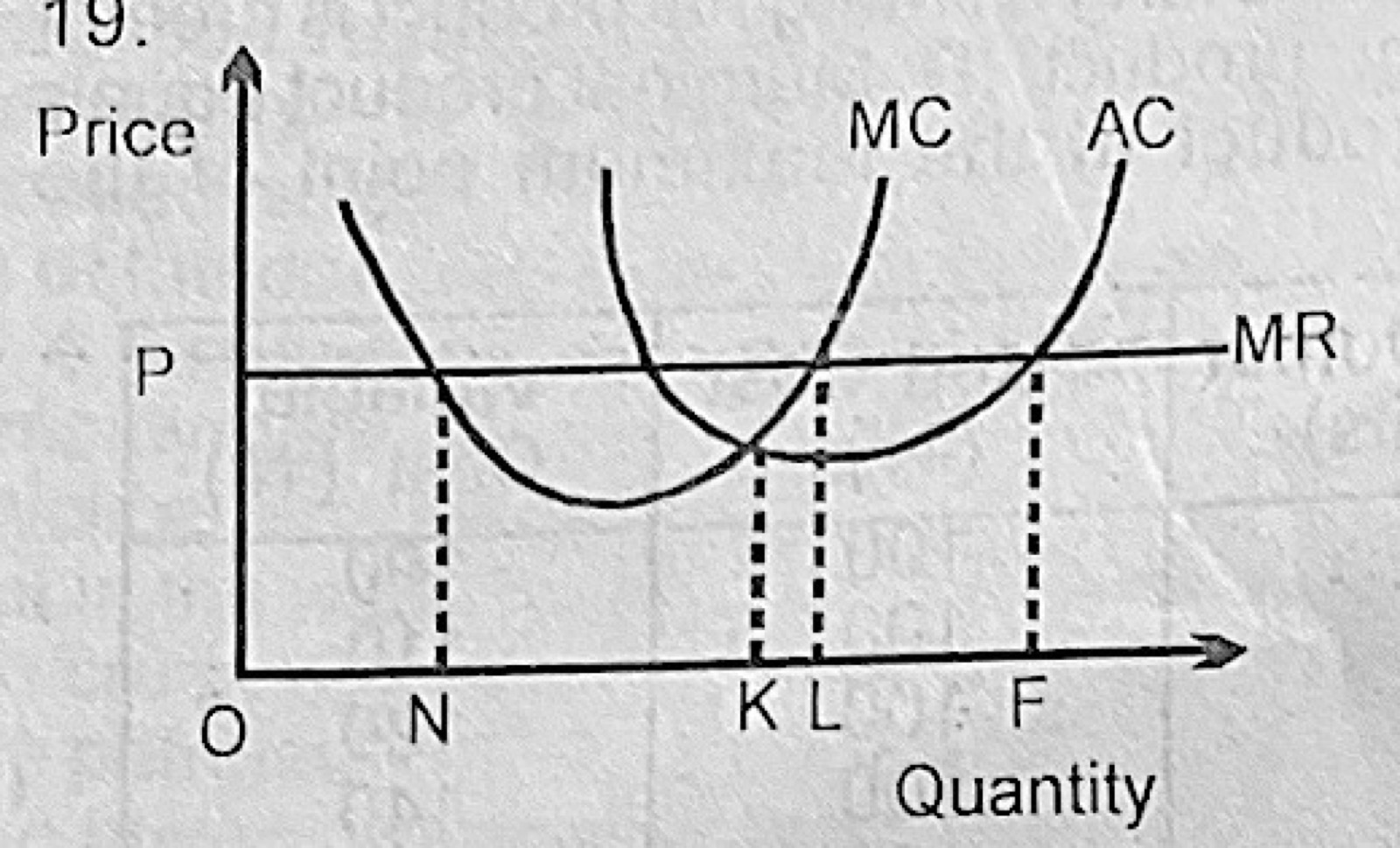
In the diagram above, profit is maximized at the output level

Diagram for this question
  1. A.ON
  2. B.OK
  3. C.OL
  4. D.OF.
Show the answer and explanation

Answer: C (OL)

Explanation

Profit is maximized where MC = MR and MC is rising. MC cuts MR twice; at N it is falling, but at L it is rising, so the best output is OL.

Open this question

Question 20

Distributive Trade

Unlike the retailer, the wholesaler provides

  1. A.useful information to the manufacturer about consumers' tastes
  2. B.after-sales service to the consumer
  3. C.useful information to the customers on the benefits and uses of the product
  4. D.useful information about market trends and finance to the manufacturer.
Show the answer and explanation

Answer: D (useful information about market trends and finance to the manufacturer.)

Explanation

The wholesaler stands between manufacturer and retailer: he advises the manufacturer on market trends and helps finance production by buying in bulk and paying early.

Open this question

Question 21

Business Organisations

Liquidation of limited liability company implies that the

  1. A.company may not pay its debts
  2. B.debts of the company can only be paid from its own assets
  3. C.debts of the company are paid from both business and private funds of the owners
  4. D.debts of the company must be paid from public funds only.
Show the answer and explanation

Answer: B (debts of the company can only be paid from its own assets)

Explanation

With limited liability, shareholders' private property is safe; the company's debts are paid only from the company's own assets.

Open this question

Question 22

Business Organisations

One form of business organization which is not motivated solely by the profit objective is the

  1. A.joint stock company
  2. B.private limited company
  3. C.co-operative society
  4. D.ordinary partnership.
Show the answer and explanation

Answer: C (co-operative society)

Explanation

A co-operative society is formed mainly to serve and help its members, not just to make profit.

Open this question

Question 23

Financial Institutions

Which of the following can have their shares quoted on the stock exchange?

  1. A.Public corporations
  2. B.A partnership
  3. C.A consumer co-operative
  4. D.A public limited liability company.
Show the answer and explanation

Answer: D (A public limited liability company.)

Explanation

Only public limited companies can offer their shares to the public and have them listed on the stock exchange.

Open this question

Question 24

Agriculture

The sector that employs the largest proportion of the active labour force in Nigeria is the

  1. A.oil sector
  2. B.federal civil service
  3. C.financial sector
  4. D.agricultural sector.
Show the answer and explanation

Answer: D (agricultural sector.)

Explanation

Most working Nigerians are farmers, so agriculture employs the largest share of the labour force.

Open this question

Question 25

Agriculture

An entirely domestic effort directed at improving agricultural production in Nigeria is the

  1. A.Agricultural Development Programme
  2. B.Agro-industrial Development Scheme
  3. C.Food and Agricultural Organization
  4. D.National Land Development Authority.
Show the answer and explanation

Answer: D (National Land Development Authority.)

Explanation

The National (Agricultural) Land Development Authority was created and funded by the Nigerian government alone; the ADPs were World Bank assisted and FAO is a UN body.

Open this question

Question 26

Industrialisation

A factor that influences the location of a firm near its market is the

  1. A.transportation of bulky raw materials
  2. B.external economies
  3. C.high cost of transporting finished goods
  4. D.availability of skilled manpower.
Show the answer and explanation

Answer: C (high cost of transporting finished goods)

Explanation

When finished goods are bulky, fragile or perishable and costly to carry, firms locate near the market to save transport costs.

Open this question

Question 27

Economic Growth and Development

In many developing countries, infrastructural problem is acute due to the shortage of

  1. A.industries and industrial equipment
  2. B.savings, investment and consumption
  3. C.natural resources for development
  4. D.supporting services that encourage economic activities.
Show the answer and explanation

Answer: D (supporting services that encourage economic activities.)

Explanation

Infrastructure means the supporting services, such as roads, power, water and telephones, that make other economic activities possible; these are in short supply.

Open this question

Question 28

International Trade

Export-promotion policy is primarily concerned with the

  1. A.processing of raw materials to increase their value
  2. B.making of international routes safe for export commodities
  3. C.reduction in the number of imported items
  4. D.encouragement of the production of export commodities.
Show the answer and explanation

Answer: D (encouragement of the production of export commodities.)

Explanation

Export promotion means encouraging the production and sale of goods for export.

Open this question

Question 29

Natural Resources and Petroleum

The petroleum industry in Nigeria is

  1. A.the sole source of the nation's revenue
  2. B.the oldest industry in the country
  3. C.the mainstay of the economy
  4. D.a factor in the decline in the nation's foreign reserves.
Show the answer and explanation

Answer: C (the mainstay of the economy)

Explanation

Oil earns most of Nigeria's foreign exchange and government revenue, so it is the mainstay of the economy (but not the sole source of revenue).

Open this question

Question 30

Natural Resources and Petroleum

Crude petroleum is a good example of a

  1. A.lasting asset
  2. B.wasting asset
  3. C.synthetic product
  4. D.costless resource.
Show the answer and explanation

Answer: B (wasting asset)

Explanation

Crude oil is used up as it is extracted and cannot be replaced, so it is a wasting asset.

Open this question

Question 31

Financial Institutions

One of the techniques of monetary control used by the Central Bank of Nigeria is

  1. A.selective credit control
  2. B.budget deficit
  3. C.foreign exchange control
  4. D.monitoring the general price level.
Show the answer and explanation

Answer: A (selective credit control)

Explanation

Selective credit control, where the Central Bank tells banks which sectors to lend more or less to, is one of its tools for controlling money and credit.

Open this question

Question 32

Money and Inflation

Which of the following is true about the value of money?

  1. A.It varies inversely with the price level
  2. B.It varies directly with the price level
  3. C.It depreciates in the period of deflation
  4. D.It is not affected by the price level.
Show the answer and explanation

Answer: A (It varies inversely with the price level)

Explanation

When prices rise, each naira buys less, so the value of money moves in the opposite direction to the price level.

Open this question

Question 33

Financial Institutions

If the reserve requirement for commercial banking in Nigeria were 30%, a commercial bank which receives an initial cash deposit of ₦ 3000 is in a position to lend out

  1. A.₦ 9,000
  2. B.₦3,330
  3. C.₦2,770
  4. D.₦2,100.
Show the answer and explanation

Answer: D (₦2,100.)

Explanation

The bank must keep 30% of ₦3000 = ₦900 as reserve, so it can lend ₦3000 − ₦900 = ₦2,100.

Open this question

Question 34

Money and Inflation

An issue of bank-notes not backed by gold but by government securities is known as

  1. A.fiduciary issue
  2. B.guaranteed money
  3. C.seigniorage
  4. D.legal tender.
Show the answer and explanation

Answer: A (fiduciary issue)

Explanation

A fiduciary issue is currency backed by trust and government securities, not by gold.

Open this question

Question 35

Financial Institutions

A rise in the market price of fixed interest securities is an indication that the

  1. A.supply of money has decreased
  2. B.liquidity preference has increased
  3. C.market rate of interest has risen
  4. D.market rate of interest has fallen.
Show the answer and explanation

Answer: D (market rate of interest has fallen.)

Explanation

A bond pays a fixed amount each year. When market interest rates fall, that fixed payment becomes more attractive, so the bond's price rises.

Open this question

Question 36

Public Finance

An increase in government expenditure will lead to

  1. A.investment opportunities for foreign investors
  2. B.an increase in the level of aggregate demand
  3. C.an increase in total tax revenue
  4. D.reduction in total tax revenue.
Show the answer and explanation

Answer: B (an increase in the level of aggregate demand)

Explanation

Government spending is part of aggregate demand (C + I + G + X − M), so more spending raises it.

Open this question

Question 37

Public Finance

When an indirect tax is levied on the producer of a good, the burden on the consumer will depend largely on the

  1. A.elasticity of demand for the good
  2. B.proportion of the consumer's income spent on the good
  3. C.elasticities of demand and supply of the commodity
  4. D.availability of substitutes for the commodity.
Show the answer and explanation

Answer: C (elasticities of demand and supply of the commodity)

Explanation

How much of a tax the producer can pass on depends on how buyers and sellers react to price: the more inelastic demand is relative to supply, the more the consumer pays. So both elasticities matter.

Open this question

Question 38

Public Finance

If a government wants to reduce the level of inflation, it will

  1. A.run a budget surplus
  2. B.run a budget deficit
  3. C.run a balanced budget
  4. D.borrow more money.
Show the answer and explanation

Answer: A (run a budget surplus)

Explanation

A budget surplus takes more money from the economy in taxes than the government spends, reducing total demand and so inflation.

Open this question

Question 39

National Income

If a country's national income increased from ₦1000 billion to ₦1100 billion over a period of 2 years, what was the average annual rate of growth of national income over the period?

  1. A.5%
  2. B.15%
  3. C.20%
  4. D.100%
Show the answer and explanation

Answer: A (5%)

Explanation

Total growth = (1100 − 1000)/1000 × 100 = 10% over 2 years, so the average is 10 ÷ 2 = 5% a year.

Open this question

Question 40

National Income

A fall in the marginal propensity to save will lead to

  1. A.a decrease in national income
  2. B.an increase in national income
  3. C.no change in national income
  4. D.an increase in disposable income.
Show the answer and explanation

Answer: B (an increase in national income)

Explanation

If people save less of each extra naira, they spend more, so the multiplier (1 ÷ MPS) gets bigger and national income rises.

Open this question

Question 41

Public Finance

Which of the following is a transfer payment?

  1. A.Dividend to a shareholder
  2. B.Gift to a Motherless Babies' Home
  3. C.Salary to a worker
  4. D.Rent to a landlord
Show the answer and explanation

Answer: B (Gift to a Motherless Babies' Home)

Explanation

A transfer payment is money received without giving any good or service in return, like a gift to a charity home.

Open this question

Question 42

Economic Growth and Development

The major objective of economic growth is to

  1. A.redistribute income and other benefits of growth
  2. B.equalize opportunities for education and employment
  3. C.increase the aggregate expenditure on goods and services
  4. D.increase the real per capita income.
Show the answer and explanation

Answer: D (increase the real per capita income.)

Explanation

Economic growth aims to raise the real output, and so real income, per person.

Open this question

Question 43

Economic Growth and Development

The Family Support Programme in Nigeria essentially focuses on

  1. A.the generation of employment
  2. B.the alleviation of poverty
  3. C.agricultural and industrial development
  4. D.economic emancipation of women.
Show the answer and explanation

Answer: D (economic emancipation of women.)

Explanation

The Family Support Programme (1994) aimed mainly at improving the economic position of women and families.

Open this question

Question 44

Economic Growth and Development

Economically, underdeveloped countries are characterized by

  1. A.high rate of population growth and low rate of economic growth
  2. B.high rate of economic growth and low rate of population growth
  3. C.high rate of population growth and high rate of economic growth
  4. D.low rate of population growth and low rate of economic growth.
Show the answer and explanation

Answer: A (high rate of population growth and low rate of economic growth)

Explanation

Underdeveloped countries usually have populations growing fast while output grows slowly, so income per head stays low.

Open this question

Question 45

Economic Growth and Development

One of the major consequences of urban-biased development programmes in Nigeria is that they

  1. A.led to rapid rural-urban migration
  2. B.led to unprecedented urban wealth
  3. C.transformed rural areas into urban centres
  4. D.increased the level of specialized manpower in the cities.
Show the answer and explanation

Answer: A (led to rapid rural-urban migration)

Explanation

When jobs and amenities are concentrated in towns, young people leave rural areas for the cities.

Open this question

Question 46

Economic Growth and Development

Development plans have not been successful in some developing countries largely because of

  1. A.very large working population
  2. B.increasing level of consumption
  3. C.scarcity of industrial raw materials
  4. D.shortage of skilled labour and experts.
Show the answer and explanation

Answer: D (shortage of skilled labour and experts.)

Explanation

Plans need trained people to prepare and carry them out; developing countries often lack these skilled workers and experts.

Open this question

Question 47

Balance of Payments and Exchange Rates

The balance of visible trade is the difference between the values of

  1. A.imported and exported goods
  2. B.imported and exported services
  3. C.current account and capital account
  4. D.exchange rate of local and foreign currencies.
Show the answer and explanation

Answer: A (imported and exported goods)

Explanation

Visible trade is trade in physical goods, so its balance is exports of goods minus imports of goods.

Open this question

Question 48

Balance of Payments and Exchange Rates

If a country has a balance of payments surplus on current account this means that

  1. A.total invisible export is greater than invisible import
  2. B.the value of goods exported must be greater than the value of goods imported
  3. C.there must be a positive balance on capital account
  4. D.the aggregate of the balance of trade and the invisible balance must be positive.
Show the answer and explanation

Answer: D (the aggregate of the balance of trade and the invisible balance must be positive.)

Explanation

The current account is the balance of trade (goods) plus the invisible balance (services, income, transfers); a surplus means their total is positive, even if one of them is negative.
Open this question

Question 49

Balance of Payments and Exchange Rates

If a country operates a freely floating exchange rate system, and suffers a balance of payments deficit, the deficit can be eliminated through

  1. A.a rise in the external value of its currency
  2. B.a fall in the external value of its currency
  3. C.an increase in the volume of imports
  4. D.the consumption of more foreign goods.
Show the answer and explanation

Answer: B (a fall in the external value of its currency)

Explanation

A fall in the currency's value makes exports cheaper abroad and imports dearer at home, so exports rise, imports fall and the deficit closes.

Open this question

Question 50

International Economic Organisations

The Economic Commission for Africa was set up by the

  1. A.UNO
  2. B.ECOWAS
  3. C.OAU
  4. D.IMF.
Show the answer and explanation

Answer: A (UNO)

Explanation

The Economic Commission for Africa (1958) is one of the regional commissions of the United Nations.

Open this question