Home › Past questions › JAMB › Economics › 1980 50 questions. Try each one, then open the answer to check yourself and read the explanation.
Sign up free to answer these questions on a CBT screen with a timer, then see your score and every answer explained.
Start practising free
Question 1 Public Finance If the government is interested in raising the highest revenue from a tax system, then for any two commodities
A. it is better to tax one whose demand is more elastic B. it is better to tax one whose demand is more inelastic C. revenue will be the same from both commodities D. it is not possible to say which will yield higher revenue E. government cannot make much revenue from taxing commodities. Show the answer and explanation Answer: B (it is better to tax one whose demand is more inelastic )
Explanation When demand is inelastic, people keep buying almost the same amount after the tax raises the price, so the tax brings in more revenue.
Open this question
Question 2 Theory of Production Production in Economics occurs when
A. a commodity or service is sold B. utility is created or added C. a commodity is manufactured D. raw materials are produced or extracted from mines E. all of these. Show the answer and explanation Answer: E (all of these. )
Explanation Production is any activity that creates or adds utility, which includes extracting, manufacturing and selling (distribution), so all the options describe production.
Open this question
Question 3 Basic Concepts From an economic point of view, an activity does not have a cost when
A. someone else pays for it B. the returns are greater than costs C. the choice involves giving up nothing D. the government pays for it E. it is paid for from a gift. Show the answer and explanation Answer: C (the choice involves giving up nothing )
Explanation Economic cost is opportunity cost; if nothing has to be given up, the opportunity cost is zero.
Open this question
Question 4 Industrialisation Which would you NOT consider an agro-based industry in Nigeria?
A. A dairy enterprise producing milk B. A yam flour mill C. A poultry industry D. A fertilizer plant E. None of the above. Show the answer and explanation Answer: D (A fertilizer plant )
Explanation Agro-based industries process farm products such as milk, yams and poultry. A fertilizer plant makes an input for farmers from chemicals, so it is not agro-based.
Open this question
Question 5 Price Determination Price control indicates the following
A. price is fixed at equilibrium level B. price is fixed above equilibrium level C. price is not fixed but is determined by supply and demand D. price is fixed below equilibrium level E. none of the above. Show the answer and explanation Answer: D (price is fixed below equilibrium level )
Explanation Price control usually means government sets a maximum price below the equilibrium price to protect consumers.
Open this question
Question 6 International Trade The terms of trade are said to be favourable only if
A. value of total exports equals value of total imports B. value of merchandise exports is greater than value of merchandise imports C. there are no balance of payments problems D. there is an increase in the value of a unit of export in terms of imports E. foreign exchange reserves do not change. Show the answer and explanation Answer: D (there is an increase in the value of a unit of export in terms of imports )
Explanation Terms of trade improve when each unit of exports can buy more imports, i.e. export prices rise relative to import prices.
Open this question
Question 7 Public Finance Which is the dominant form of tax in Nigeria?
A. Direct tax B. Indirect tax C. Inheritance tax D. Personal income tax E. Value added tax. Show the answer and explanation Answer: A (Direct tax )
Explanation Petroleum profit tax and company income tax, both direct taxes, provided most of Nigeria's tax revenue at the time.
Open this question
Question 8 Financial Institutions Which is NOT a function of central banks in West Africa?
A. Dealing in foreign exchange B. Issuing of currencies C. Accepting deposits from private customers D. Acting as government bank E. Acting as bankers' bank. Show the answer and explanation Answer: C (Accepting deposits from private customers )
Explanation Central banks serve the government and commercial banks; they do not take deposits from private individuals.
Open this question
Question 9 Population Which is NOT a cause of high population growth in Nigeria?
A. Family Planning Unit of Nigeria B. Improved medical facilities C. Reduction in death rate D. Improved hygiene E. Increased birth rate. Show the answer and explanation Answer: A (Family Planning Unit of Nigeria )
Explanation Family planning helps people have fewer children, so it slows population growth rather than causing it.
Open this question
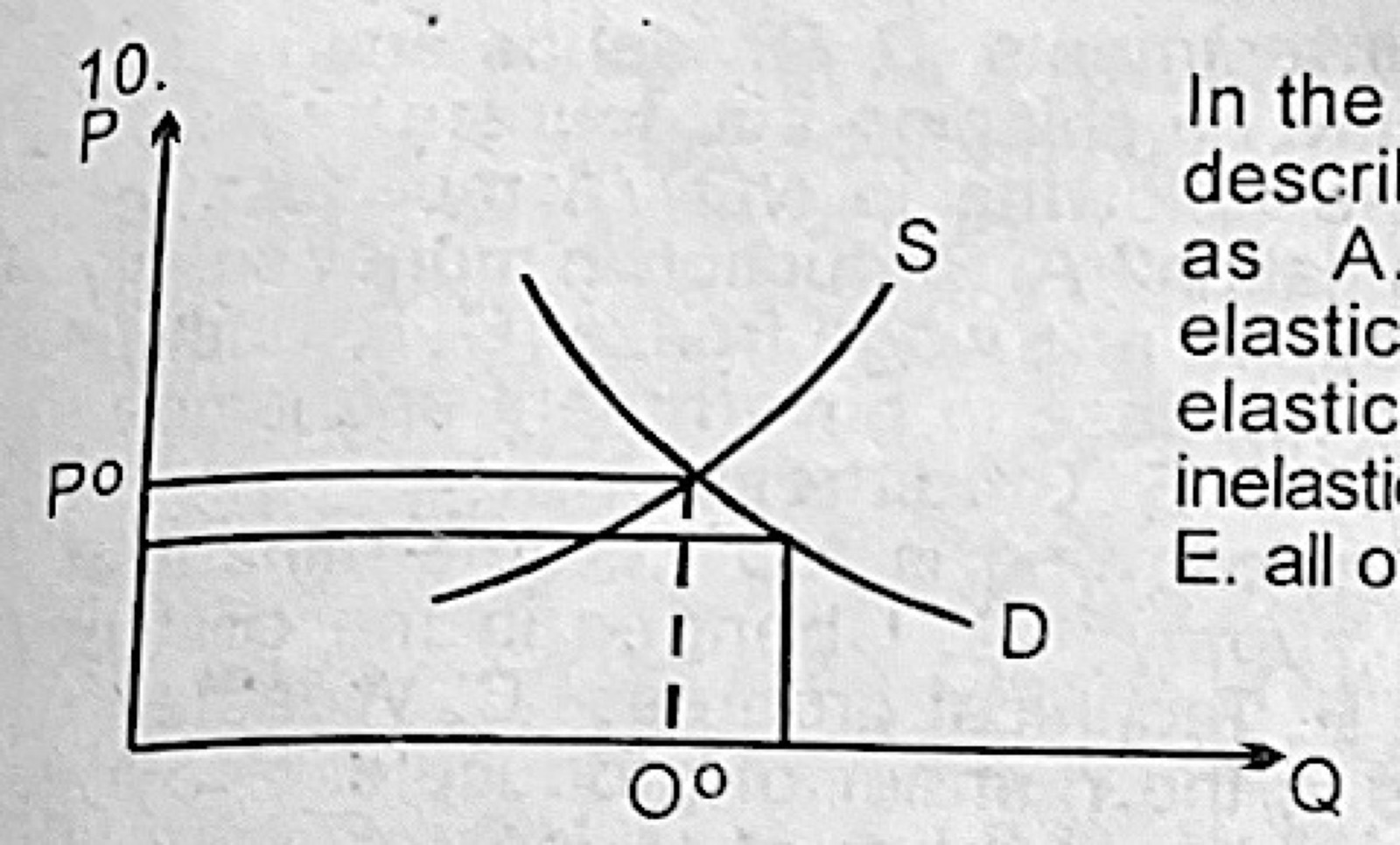
Question 10 Elasticity In the figure, we can describe the demand as
A. perfectly elastic B. having unit elasticity C. perfectly inelastic D. fairly elastic E. all of the above. Show the answer and explanation Answer: D (fairly elastic )
Explanation The demand curve slopes gently downward, so quantity responds quite strongly to price: demand is fairly elastic, neither perfectly elastic (flat) nor perfectly inelastic (vertical).
Open this question
Question 11 Financial Institutions Commercial banks can create money in the following ways
A. by issuing coins and paper money B. by borrowing money from banks abroad C. by receiving deposits from individuals D. by printing money on the instructions of the Central Bank E. none of the above. Show the answer and explanation Answer: E (none of the above. )
Explanation Commercial banks create money by granting loans that become new deposits, which none of options A to D describes.
Open this question
Question 12 Theory of Consumer Behaviour Utility of a commodity means
A. its usefulness B. power to satisfy a want C. price of the commodity D. satisfaction derived from the production of commodity E. its adaptability. Show the answer and explanation Answer: B (power to satisfy a want )
Explanation Utility is the want-satisfying power of a good or service.
Open this question
Question 13 International Trade International trade arises because
A. one country has more abundant resources than the other country B. one country has the technology to produce the commodity whilst the other has not C. one country has the maximum comparative advantage or minimum comparative disadvantage in the production of a commodity over the other country D. one country has more manpower to produce the commodity than the other country E. all of the above. Show the answer and explanation Answer: E (all of the above. )
Explanation Countries trade because they differ in resources, skills and technology, which gives each a comparative advantage in some goods.
Open this question
Question 14 Balance of Payments and Exchange Rates By balance of visible trade we mean
A. import and export of goods B. import and export of services C. balance of current account in the balance of payments D. balance of capital account in the balance of payments E. all of these. Show the answer and explanation Answer: A (import and export of goods )
Explanation Visible trade is trade in physical goods that can be seen and counted at the ports.
Open this question
Question 15 Natural Resources and Petroleum Nigeria earns the major part of her foreign exchange from the export of
A. manpower to other countries B. crude oil C. petroleum products D. groundnuts and cotton E. palm oil and cocoa. Show the answer and explanation Answer: B (crude oil )
Explanation Crude oil exports provide by far the largest part of Nigeria's foreign exchange earnings.
Open this question
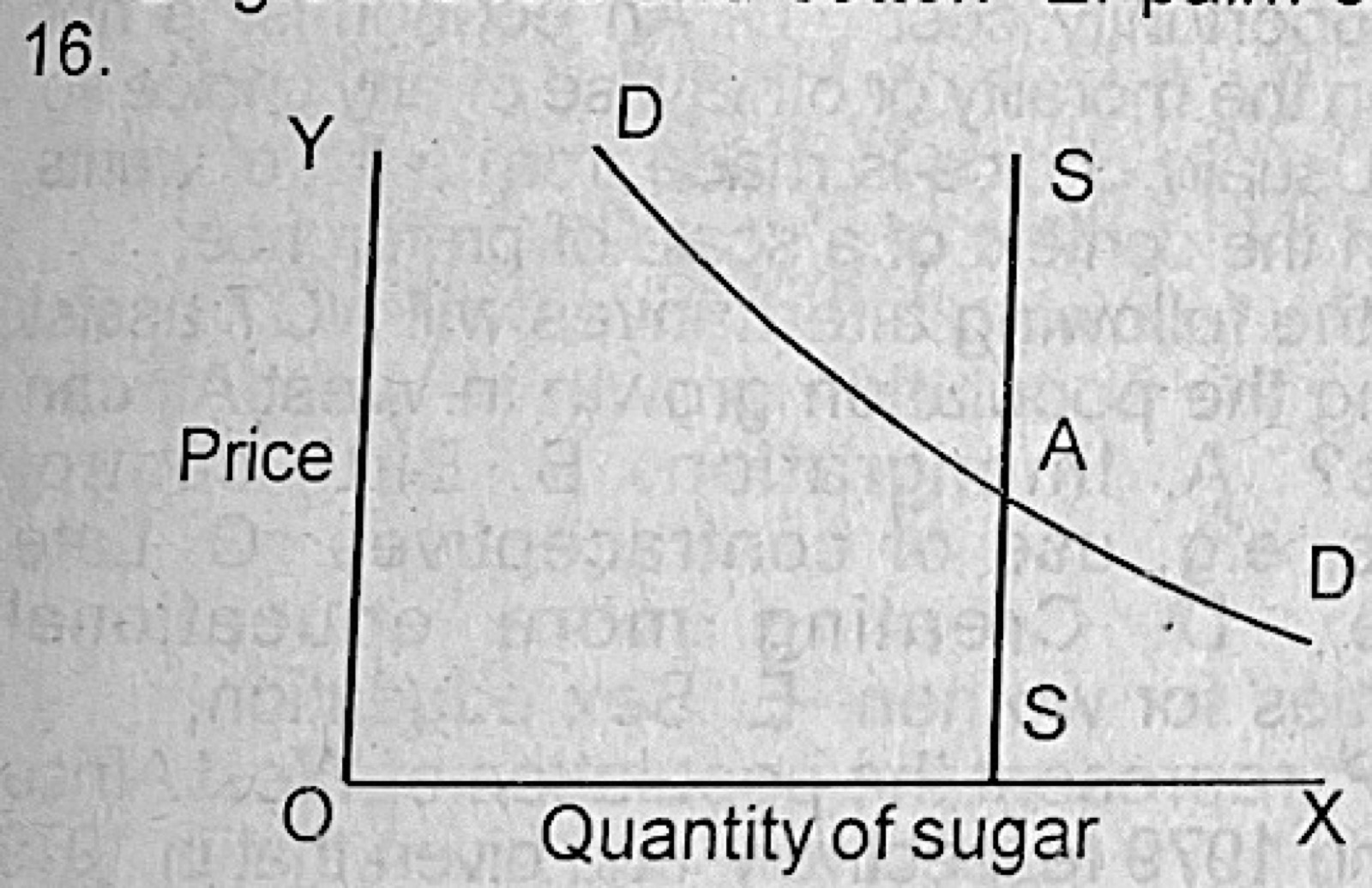
Question 16 Public Finance In the above diagram, supply and demand conditions of sugar in a Nigerian market are given. An indirect tax of 10 kobo per kg is imposed. It will be paid
A. wholly by the supplier B. wholly by the consumer C. partly by the supplier and partly by the consumer D. wholly by the middlemen E. partly by stockholder and partly by consumer. Show the answer and explanation Answer: A (wholly by the supplier )
Explanation The supply curve in the diagram is vertical: the same quantity is supplied at any price. Sellers cannot pass the tax on without being left with unsold sugar, so they pay all of it.
Open this question
Question 17 Business Organisations Which would you NOT consider an advantage of a one-man business?
A. Freedom of action B. Limited liability C. Quick decision-making D. Personal contact with customers E. None of the above. Show the answer and explanation Answer: B (Limited liability )
Explanation A sole trader has unlimited liability, so limited liability is not one of its advantages.
Open this question
Question 18 Public Finance The budget of Nigeria will be in deficit if
A. revenue expenditure exceeds the revenue receipts B. capital expenditure exceeds the capital receipts C. revenue and capital expenditure exceeds revenue and capital receipts D. the government is spending more than its income E. all of the above. Show the answer and explanation Answer: D (the government is spending more than its income )
Explanation A budget is in deficit when total government spending is greater than total government income.
Open this question
Question 19 Basic Concepts An economic problem arises when
A. manufactured goods are in short supply B. money is in short supply C. buyers are many D. sellers are few E. scarcity and choice are involved. Show the answer and explanation Answer: E (scarcity and choice are involved. )
Explanation The economic problem exists because resources are scarce relative to wants, forcing people to choose.
Open this question
Question 20 Agriculture By subsistence production we mean
A. goods and services are produced for consumption only B. goods and services are sold to others C. raw materials are produced in the country D. goods and services are produced for the market E. none of these. Show the answer and explanation Answer: A (goods and services are produced for consumption only )
Explanation Subsistence producers make goods mainly for their own and their family's use, not for sale.
Open this question
Question 21 Theory of Production Division of labour means that
A. the labour is divided into different sections B. the work is divided into different parts to be completed by each labourer C. production is completed by the different departments of a factory D. commodities are produced at different times by a single labourer E. the labour force in the country is not united. Show the answer and explanation Answer: B (the work is divided into different parts to be completed by each labourer )
Explanation Division of labour splits a job into separate tasks, with each worker doing one part.
Open this question
Question 22 Business Organisations A limited liability company is owned by
A. an individual B. two or more partners C. shareholders D. government E. a bank. Show the answer and explanation Answer: C (shareholders )
Explanation The owners of a limited liability company are the people who buy its shares.
Open this question
Question 23 Theory of Demand If the price of a commodity falls and the quantity purchased of it does not rise, the commodity can be described as
A. normal B. abnormal C. inferior D. superior E. scarce. Show the answer and explanation Answer: C (inferior )
Explanation For an inferior good (such as a Giffen good) a fall in price may not lead people to buy more, because the income effect works against the substitution effect.
Open this question
Question 24 Public Finance Mr. A earns N300 and pays N15 in tax. Mr. B earns N100 and pays N6 in tax. This tax system can be described as
A. proportional tax B. progressive tax C. competitive tax D. excise tax E. regressive tax. Show the answer and explanation Answer: E (regressive tax. )
Explanation Mr A pays 15/300 = 5% while Mr B pays 6/100 = 6%; the poorer man pays a higher rate, so the tax is regressive.
Open this question
Question 25 Economic Growth and Development Which sector can you say is growing the fastest in the Nigerian economy?
A. Agriculture B. Industry C. Education D. Transport E. Labour. Show the answer and explanation Answer: C (Education )
Explanation Around 1980 the Universal Primary Education scheme and new universities made education the fastest-expanding sector, according to the book.
Open this question
Question 26 Public Finance Which is NOT a method of raising capital funds in Nigeria?
A. Borrowing from abroad B. Internal borrowing C. Nigerianization of foreign companies D. Gifts from abroad E. Selling government bonds. Show the answer and explanation Answer: C (Nigerianization of foreign companies )
Explanation Nigerianization transfers ownership of existing firms to Nigerians; it does not bring in new capital funds like borrowing, gifts or bond sales.
Open this question
Question 27 Theory of Costs and Revenue If a firm doubles its output and its costs increase by 60%, the firm is experiencing
A. increasing costs B. economies of scale C. decreasing returns D. decreasing costs E. none of the above. Show the answer and explanation Answer: B (economies of scale )
Explanation Output rises by 100% while costs rise by only 60%, so cost per unit falls as the firm grows: economies of scale.
Open this question
Question 28 Basic Concepts The fundamental problem of Economics is
A. money B. poverty C. unemployment D. the scarcity of resources relative to wants E. inflation. Show the answer and explanation Answer: D (the scarcity of resources relative to wants )
Explanation Economics exists because resources are scarce compared with people's unlimited wants.
Open this question
Question 29 Basic Concepts If you do not have to give up anything in order to get a particular thing, then its opportunity cost is
A. zero B. not measurable C. its price in money D. infinite E. equal to one. Show the answer and explanation Answer: A (zero )
Explanation Opportunity cost is the alternative given up; if nothing is given up, it is zero.
Open this question
Question 30 Population Which of the following is the standard concept for measuring and analyzing population growth?
A. The rate of natural increase B. The net migration rate C. The rate of population increase D. The fertility rate E. All of the above. Show the answer and explanation Answer: E (All of the above. )
Explanation Population growth is studied using births (fertility), natural increase, migration and the overall rate of increase together.
Open this question
Question 31 Theory of Demand When we draw a market demand curve, we
A. ignore tastes, incomes and other prices B. assume that tastes, incomes and other prices do not matter C. assume that tastes, incomes and all other prices change in the same direction as prices D. assume that tastes, incomes and all other prices remain constant E. both A and B above. Show the answer and explanation Answer: D (assume that tastes, incomes and all other prices remain constant )
Explanation A demand curve shows quantity against the good's own price, holding tastes, income and other prices constant (ceteris paribus).
Open this question
Question 32 Theory of Production Capital earns income because
A. it is productive B. it is expensive C. it is always cheaper to substitute capital for labour D. it is technically more efficient than labour E. both A and B above. Show the answer and explanation Answer: A (it is productive )
Explanation Capital helps produce more output, and its reward (interest) is paid because of this productivity.
Open this question
Question 33 Economic Systems In a free-market economy, the rationing of scarce goods is done principally by
A. the government B. business organizations C. the price mechanism D. consumers E. both A and B above. Show the answer and explanation Answer: C (the price mechanism )
Explanation In a free market, prices decide who gets scarce goods: those willing and able to pay the price.
Open this question
Question 34 Business Organisations A disadvantage of the corporate form of business is the
A. risk of the owners of loss of personal effects if the business should fail B. ability of the corporation to raise financial resources C. limited life span of the corporation D. problems presented by separation of ownership from control E. none of the above. Show the answer and explanation Answer: D (problems presented by separation of ownership from control )
Explanation In a company the shareholders own it but managers run it, and their interests may differ.
Open this question
Question 35 Money and Inflation The value of money depends primarily on
A. the gold backing of the currency B. the gold backing of both currency and deposits C. the general price level D. government decree that it is legal tender E. none of the above. Show the answer and explanation Answer: C (the general price level )
Explanation Money is worth what it can buy, so its value depends on the general price level.
Open this question
Question 36 Financial Institutions A commercial bank is able to create money
A. by printing it B. by maintaining reserves C. by creating a demand deposit as it gives a new loan D. by issuing cheques to depositors E. by borrowing from the Central Bank. Show the answer and explanation Answer: C (by creating a demand deposit as it gives a new loan )
Explanation When a bank grants a loan it credits the borrower's account, creating a new deposit that is money.
Open this question
Question 37 Balance of Payments and Exchange Rates Which one of the following is NOT one of the balance of payments entries?
A. The current account B. Foreign reserves C. Import and export duties D. Short-term capital E. Long-term capital. Show the answer and explanation Answer: C (Import and export duties )
Explanation The balance of payments has current, capital and reserve (official financing) entries. Customs duties are taxes collected by government, not transactions with foreigners.
Open this question
Question 38 Public Finance Which of the following taxes appear generally progressive in nature?
A. Sales taxes B. The personal income tax C. Property taxes D. Corporation taxes E. None of the above. Show the answer and explanation Answer: B (The personal income tax )
Explanation Personal income tax rates rise as income rises, so it is progressive.
Open this question
Question 39 Economic Systems In a subsistence economy
A. there is no shortage of goods and services B. the State is the sole owner of resources C. production is largely oriented towards consumption in the rural sector D. there is no exchange of goods and services E. women predominate in all economic activities. Show the answer and explanation Answer: C (production is largely oriented towards consumption in the rural sector )
Explanation In a subsistence economy people produce mainly to consume what they produce, mostly in rural areas.
Open this question
Question 40 Price Determination Which of the following is a correct definition of equilibrium price ?
A. A price which covers production cost B. A price which maximizes entrepreneur's profits C. A price at which the quantity demanded equals the quantity supplied D. A price at which competitive firm is at equilibrium E. A price which stabilizes farmers' income. Show the answer and explanation Answer: C (A price at which the quantity demanded equals the quantity supplied )
Explanation Equilibrium price is where quantity demanded equals quantity supplied, so there is no shortage or surplus.
Open this question
Question 41 Theory of Demand In a normal (typical) demand schedule, the quantity demanded is
A. directly related to price B. inversely related to price C. independent of price D. proportionally related to supply E. solely dependent on haggling skill. Show the answer and explanation Answer: B (inversely related to price )
Explanation By the law of demand, quantity demanded rises when price falls and falls when price rises.
Open this question
Question 42 Theory of Production Division of labour is limited by the
A. availability of raw materials B. size of the labour force C. size of the firm D. absolute size of a country's population E. per capita income and number of potential buyers. Show the answer and explanation Answer: E (per capita income and number of potential buyers. )
Explanation Division of labour is limited by the size of the market, which depends on the number of buyers and their incomes.
Open this question
Question 43 Business Organisations In a limited liability company, the greatest risk is borne by
A. debenture holders B. company executives C. ordinary shareholders D. preference shareholders E. board of directors. Show the answer and explanation Answer: C (ordinary shareholders )
Explanation Ordinary shareholders are paid last, after creditors and preference shareholders, so they carry the greatest risk.
Open this question
Question 44 Financial Institutions Which of the following is NOT a function of Nigerian commercial banks?
A. Acceptance of deposits B. Lending of money C. Investment in securities and businesses D. Issue of currency E. Selling and buying of travellers cheques. Show the answer and explanation Answer: D (Issue of currency )
Explanation Only the Central Bank issues Nigeria's currency.
Open this question
Question 45 Money and Inflation In Nigeria, cheques are not money because
A. their use is confined to business houses B. there are no banks in rural areas C. they are no legal tender D. they are not generally acceptable as a medium of exchange E. most Nigerians cannot identify them. Show the answer and explanation Answer: C (they are no legal tender )
Explanation A cheque is only an order to a bank to pay; it is not legal tender, which nobody can refuse in payment.
Open this question
Question 46 Balance of Payments and Exchange Rates Indicate which of the following are invisible trade items in a country's balance of payments
A. Oil exports and imports B. Gold and foreign reserves C. Foreign investments D. Dividends and profits E. Expenditure on shipping and tourism. Show the answer and explanation Answer: E (Expenditure on shipping and tourism. )
Explanation Shipping and tourism are services, which are invisible items in the current account.
Open this question
Question 47 Money and Inflation Which of the following is NOT a measure for controlling inflation?
A. Reduction in money supply B. Wage restraint and wage freeze C. Reduction in taxes and increase in government spending D. Price control E. Credit restriction. Show the answer and explanation Answer: C (Reduction in taxes and increase in government spending )
Explanation Cutting taxes and raising government spending increase demand, which would make inflation worse.
Open this question
Question 48 Theory of Supply Which of the following is NOT a determinant of changes in supply?
A. Changes in the cost of production B. Technical progress C. Weather D. Changes in the number of producers E. Changes in the number of buyers. Show the answer and explanation Answer: E (Changes in the number of buyers. )
Explanation The number of buyers affects demand, not supply.
Open this question
Question 49 Theory of Production The marginal physical product of labour is
A. the output of labour unaided by machinery B. the extra revenue from the output of one additional worker C. the difference in the output of two workers D. additional output achieved when one extra worker is added to fixed account of other factors E. none of the above. Show the answer and explanation Answer: D (additional output achieved when one extra worker is added to fixed account of other factors )
Explanation Marginal product is the extra output from adding one more worker while other inputs stay fixed.
Open this question
Question 50 Theory of Production One of the disadvantages of division of labour is that
A. there is a saving of time B. it results in workers acquiring greater skill at their jobs C. there is a greater risk of unemployment D. it makes possible the use of machinery E. it makes the worker less fatigued by his work. Show the answer and explanation Answer: C (there is a greater risk of unemployment )
Explanation Workers trained in one narrow task may lose their jobs if that task is mechanised or the industry declines.
Open this question Sign up free for every JAMB Economics year, practice by topic and timed mocks.
Start practising free