Home › Past questions › JAMB › Economics › 1979 50 questions. Try each one, then open the answer to check yourself and read the explanation.
Sign up free to answer these questions on a CBT screen with a timer, then see your score and every answer explained.
Start practising free
Question 1 Labour Market Which of the following is not true of the occupational distribution of the labour force in West Africa?
A. A large percentage of the labour force is engaged in agriculture B. Agriculture is the most important occupation in West Africa C. The manufacturing sector employs a large percentage of the population D. Agriculture does not constitute an important source of paid employment E. The public sector forms an important source of paid employment. Show the answer and explanation Answer: C (The manufacturing sector employs a large percentage of the population )
Explanation In West Africa most workers are in farming; manufacturing employs only a small share of the population.
Open this question
Question 2 Population Which of the following is not true of the theory of optimum population?
A. It is possible for a densely populated country to be underpopulated if it has insufficient labour to make the most effective use of its other factors B. The quantity of labour, which combined with the other factors gives the minimum output, is known as optimum population C. The quantity of labour, which combined with the other factors, gives the maximum output, is known as optimum population D. The test of over-population is whether it exceeds the optimum E. It is possible for a thinly populated country to be over-populated if it has a poor supply of other factors. Show the answer and explanation Answer: B (The quantity of labour, which combined with the other factors gives the minimum output, is known as optimum population )
Explanation Optimum population gives the maximum output per head, not the minimum, so statement B is false.
Open this question
Question 3 Theory of Production Production covers all but one of the following activities:
A. changing the position of a good in time as, for example, holding stocks of goods until they are required B. the provision of some kind of service, e.g. retailing C. changing the form of a good from the raw material to the finished product D. changing the situation of a good as, for example, from a factory in Lagos to a retail shop in Port Harcourt E. the use of goods and services to satisfy individual wants. Show the answer and explanation Answer: E (the use of goods and services to satisfy individual wants. )
Explanation Using goods and services to satisfy wants is consumption, not production; storing, retailing, processing and transporting all add utility.
Open this question
Question 4 Theory of Demand If two commodities are good substitutes for one another, e.g. butter and margarine, an increase in the demand for one will reduce the demand for the other. This type of demand is called
A. composite demand B. elastic demand C. derived demand D. competitive demand E. inelastic demand. Show the answer and explanation Answer: D (competitive demand )
Explanation Substitutes compete with each other for buyers, so their demand is called competitive (rival) demand.
Open this question
Question 5 Theory of Supply One of the reasons why the conditions of supply of a commodity may change is
A. a change in real income B. changes in the technique of production C. a change of fashion or taste D. changes in the price of the commodity itself E. changes in population. Show the answer and explanation Answer: B (changes in the technique of production )
Explanation A new production technique changes costs and so shifts the supply curve; income, taste and population affect demand, and the good's own price only moves along the curve.
Open this question
Question 6 Theory of Demand When the demand curve shifts to the right, it indicates that a larger quantity is demanded at each price. This is caused by one of the following:
A. a fall in income B. a rise in the price of a complement C. a fall in the price of a substitute D. a change in tastes against this commodity E. none of the above. Show the answer and explanation Answer: E (none of the above. )
Explanation Each of A to D would reduce demand (shift it to the left) for a normal good, so none of them causes a rightward shift.
Open this question
Question 7 Price Determination When the price of a commodity is below the equilibrium price the quantity demanded will exceed the quantity supplied. Such a situation is referred to as
A. elastic supply B. joint demand C. excess supply D. derived demand E. none of the above. Show the answer and explanation Answer: E (none of the above. )
Explanation When demand exceeds supply the situation is excess demand (a shortage), which is not among options A to D.
Open this question
Question 8 Financial Institutions The Central Bank controls the activities of other banks by all but one of the following. Which one?
A. The use of bank rate B. The purchase or sale of government bonds on the open market C. Special deposit D. The use of directives E. Taxation. Show the answer and explanation Answer: E (Taxation. )
Explanation Bank rate, open market operations, special deposits and directives are monetary tools; taxation is a fiscal tool of government.
Open this question
Question 9 Financial Institutions Which of these alternatives is wrong? Central banks are
A. bankers to the government B. bankers to commercial banks C. merchant banks D. controllers and regulators of the money supply E. issuers of bank notes. Show the answer and explanation Answer: C (merchant banks )
Explanation A central bank serves the government and the banks and controls money; it is not a merchant bank.
Open this question
Question 10 International Trade The principle of comparative advantage or comparative cost is not based on one of the following assumptions:
A. there are restrictions in trade B. there are no costs of transportation C. there is perfect competition D. there are no tariffs or import and export quota E. there are only two countries and only two commodities entering into international trade. Show the answer and explanation Answer: A (there are restrictions in trade )
Explanation The theory assumes free trade, so 'there are restrictions in trade' is not one of its assumptions.
Open this question
Question 11 Public Finance Which of the following is not a direct tax?
A. Company income tax B. Capital tax C. Purchase tax D. Personal income tax E. Capital gains tax. Show the answer and explanation Answer: C (Purchase tax )
Explanation Purchase tax is charged on goods bought and can be passed on to buyers, so it is an indirect tax.
Open this question
Question 12 Theory of Production Division of labour means
A. dividing the labour into different categories B. splitting the process of production into different parts to be completed by each person C. dividing the goods and services into different sections D. assigning different duties to labourers E. group of labourers working in a factory or shop. Show the answer and explanation Answer: B (splitting the process of production into different parts to be completed by each person )
Explanation Division of labour breaks production into separate stages, with each worker specialising in one stage.
Open this question
Question 13 Theory of Consumer Behaviour By utility we mean
A. usefulness B. power of satisfying a want C. beneficial D. advantageous E. consumable. Show the answer and explanation Answer: B (power of satisfying a want )
Explanation In economics utility is the ability of a good or service to satisfy a want, whether or not it is 'useful'.
Open this question
Question 14 Public Finance Which of the following is not an indirect tax?
A. Excise duty B. Company tax C. Import duty D. Export duty E. Sales tax. Show the answer and explanation Answer: B (Company tax )
Explanation Company tax is paid directly on company profits, so it is a direct tax; the others are taxes on goods.
Open this question
Question 15 Theory of Costs and Revenue Average Cost is
A. the total cost of production B. the extra cost of producing one additional unit of output C. the cost of producing a unit of output D. variable cost E. overhead cost. Show the answer and explanation Answer: C (the cost of producing a unit of output )
Explanation Average cost is total cost divided by output, i.e. the cost per unit produced.
Open this question
Question 16 Basic Concepts Opportunity Cost is the
A. price of scarce goods B. resources required for making a commodity C. cost of luxury goods D. accrual of financial losses by chance E. alternative that is forgone in order to satisfy a want. Show the answer and explanation Answer: E (alternative that is forgone in order to satisfy a want. )
Explanation Opportunity cost is the next best alternative given up when a choice is made.
Open this question
Question 17 Theory of Supply The quantity supplied of a commodity increases when
A. production increases B. demand increases C. price of the commodity increases D. population of the country increases E. more commodities are imported. Show the answer and explanation Answer: C (price of the commodity increases )
Explanation By the law of supply, sellers offer more of a commodity when its price rises.
Open this question
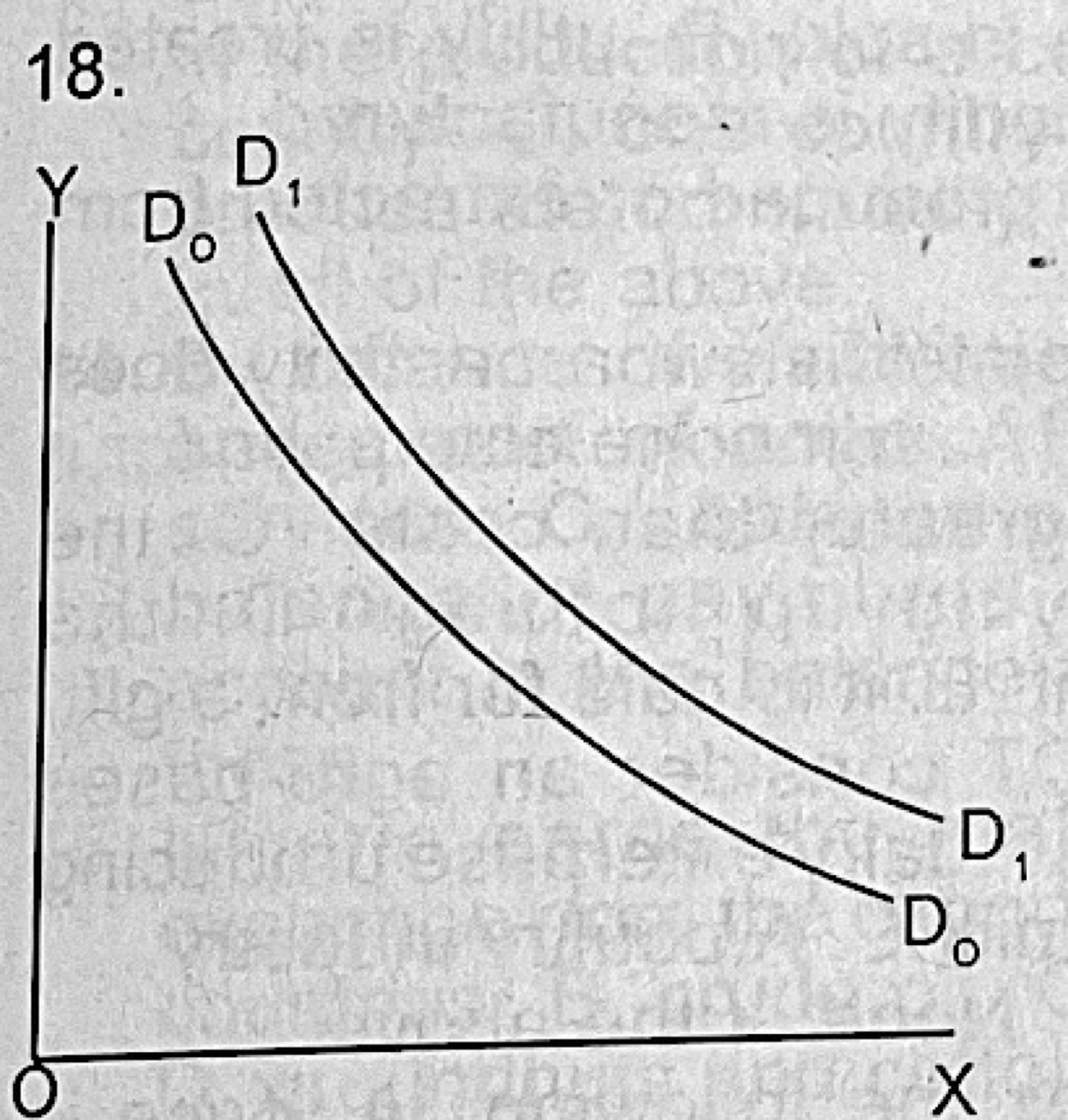
Question 18 Theory of Demand In the above diagram Do Do is the original demand curve. D1 D1 is
A. a fall in the demand curve B. a rise in the demand curve C. an extension in the demand curve D. a contraction in the demand curve E. none of these curves. Show the answer and explanation Answer: B (a rise in the demand curve )
Explanation D1 D1 lies to the right of the original curve, so more is demanded at every price: the whole demand curve has risen.
Open this question
Question 19 Population The country will be over-populated when
A. the birth rate is high B. the death rate is low C. the growth rate is high D. the population is increasing more than the resources of the country E. unemployment is high in the country. Show the answer and explanation Answer: D (the population is increasing more than the resources of the country )
Explanation Over-population means the population is too large for the country's resources, so output per head falls.
Open this question
Question 20 Money and Inflation The value of money is generally measured by reference to
A. the interest rate charged on bank loans B. the general price level C. the size of a country's gold stock D. the level of economic development in a country E. the price of stocks and shares on the stock exchange. Show the answer and explanation Answer: B (the general price level )
Explanation The value of money is what it can buy, so it moves opposite to the general price level.
Open this question
Question 21 Elasticity If the quantity demanded of a commodity increases from 20 to 30 when there is an increase in price from N4 to N5, the elasticity of demand is
A. 0 B. 1 C. 2 D. 5 E. 10. Show the answer and explanation Answer: C (2 )
Explanation % change in quantity = 10/20 = 50%; % change in price = 1/4 = 25%; elasticity = 50 ÷ 25 = 2.
Open this question
Question 22 Balance of Payments and Exchange Rates The total value of goods and services sold and bought by a country across its border during a given period, usually a year, is known as
A. visible trade B. invisible trade C. balance of payments D. balance of trade E. terms of trade. Show the answer and explanation Answer: C (balance of payments )
Explanation The balance of payments records all of a country's dealings in goods and services (and capital) with the rest of the world; the balance of trade covers goods only.
Open this question
Question 23 Business Organisations Which of the following types of capital is not rewarded by means of dividends?
A. Ordinary shares B. Preference shares C. Cumulative preference shares D. Participating preference shares E. Debentures. Show the answer and explanation Answer: E (Debentures. )
Explanation Debenture holders are lenders and receive fixed interest, not dividends.
Open this question
Question 24 Distributive Trade Which of the following is not usually the function of a wholesaler?
A. Transport B. Storage C. Advertising D. After-sales service E. Branding. Show the answer and explanation Answer: D (After-sales service )
Explanation Wholesalers buy in bulk, store, transport, advertise and often pack and brand goods. After-sales service is given to final buyers by retailers or manufacturers.
Open this question
Question 25 National Income Net national income is
A. gross national income minus depreciation B. gross domestic product plus net income from abroad C. nominal national income deflated by the price level D. gross national income divided by the total population E. gross national product plus subsidies minus indirect taxes. Show the answer and explanation Answer: A (gross national income minus depreciation )
Explanation Net national income is gross national income less depreciation (capital consumption).
Open this question
Question 26 Public Finance If Mr. A earns N2,000 a year while Mr. B earns N8,000 a year but Mr. A pays N200 per annum in tax while Mr. B pays N400, such a tax is
A. progressive B. indirect C. regressive D. proportional E. none of the above. Show the answer and explanation Answer: C (regressive )
Explanation Mr A pays 10% of his income but Mr B pays only 5%, so the lower earner pays a higher rate: the tax is regressive.
Open this question
Question 27 Financial Institutions Which of the following is not an asset of a commercial bank?
A. Cash B. Money at call C. Treasury bills D. Reserve funds E. Loans and overdrafts. Show the answer and explanation Answer: D (Reserve funds )
Explanation Cash, money at call, Treasury bills and loans are things a bank owns. Reserve funds are profits kept back that belong to shareholders, so they are shown as liabilities.
Open this question
Question 28 Balance of Payments and Exchange Rates The lowering of the exchange rate between a country's currency and other currencies is known as
A. the foreign exchange rate B. deflation C. exchange control D. the law of comparative advantage E. none of the above. Show the answer and explanation Answer: E (none of the above. )
Explanation Lowering the exchange value of a currency is called devaluation, which is not among options A to D.
Open this question
Question 29 Theory of Production When the average physical product curve is rising, the marginal physical product is
A. below it B. above it C. falling D. zero E. none of the above. Show the answer and explanation Answer: B (above it )
Explanation An average rises only when the marginal value added is greater than it, so MP is above a rising AP.
Open this question
Question 30 Money and Inflation The proportion of currency in the money supply
A. is higher in developing countries than advanced countries B. is lower in developing countries than advanced countries C. is the same in both developing and advanced countries D. grows as the economy develops E. none of the above. Show the answer and explanation Answer: A (is higher in developing countries than advanced countries )
Explanation Banking habits are weaker in developing countries, so cash makes up a bigger share of money supply there.
Open this question
Question 31 Public Finance If a government is running a deficit, this means
A. terms of trade are unfavourable B. more projects cannot be undertaken C. tax inflow is greater than expenditure D. aggregate demand is greater than aggregate supply E. tax inflow is less than expenditure. Show the answer and explanation Answer: E (tax inflow is less than expenditure. )
Explanation A budget deficit means government spending is greater than its revenue from taxes.
Open this question
Question 32 Market Structures Pure monopoly describes a market where
A. there are many sellers and a few buyers B. goods are sold at different prices C. entry is not blocked, but no one cares to enter D. a few sellers and one buyer exist E. none of the above. Show the answer and explanation Answer: E (none of the above. )
Explanation A pure monopoly has a single seller of a product with no close substitutes and entry blocked; none of A to D says this.
Open this question
Question 33 Financial Institutions Which of the following assets of a commercial bank does not yield revenue?
A. Money in the tills of the bank B. Money at call C. Treasury certificates D. Treasury bills E. Bills of exchange. Show the answer and explanation Answer: A (Money in the tills of the bank )
Explanation Cash kept in the tills earns no interest; the other assets are loans or securities that pay interest.
Open this question
Question 34 National Income Which of the following is not a component of National Income at factor cost?
A. Wages earned by doctors B. Rent paid to landlords C. Indirect taxes D. Undistributed company profits E. Interest on loans. Show the answer and explanation Answer: C (Indirect taxes )
Explanation Factor cost counts only payments to factors (wages, rent, interest, profit); indirect taxes are not factor incomes.
Open this question
Question 35 Financial Institutions Which of the financial institutions cannot direct loans to individuals?
A. The Agricultural Bank B. The Industrial Bank C. The Central Bank D. The Co-operative Bank E. The Standard Bank. Show the answer and explanation Answer: C (The Central Bank )
Explanation The Central Bank deals with the government and banks, not with private individuals.
Open this question
Question 36 Public Finance An ad valorem tax means
A. total amount of an income tax B. a certain percentage tax on the value of a commodity C. a certain percentage tax on the volume of commodity D. a tax on capital gains E. a profit tax. Show the answer and explanation Answer: B (a certain percentage tax on the value of a commodity )
Explanation 'Ad valorem' means 'according to value': the tax is a percentage of the price of the good.
Open this question
Question 37 Balance of Payments and Exchange Rates The foreign exchange rate of a country is
A. the interest rate fixed by the Central Bank B. the price of one national currency in terms of another C. the rate at which the Central Bank issues money D. the rate of interest on government bonds E. none of the above. Show the answer and explanation Answer: B (the price of one national currency in terms of another )
Explanation An exchange rate is the price of one currency expressed in another currency.
Open this question
Question 38 International Trade The 'terms of trade' means
A. the trade agreement between two countries B. the difference in the volumes of exports of two countries C. the value of a unit of export in relation to the value of a unit of import D. the proportion of total value of exports to the value of total trade E. none of the above. Show the answer and explanation Answer: C (the value of a unit of export in relation to the value of a unit of import )
Explanation Terms of trade compare export prices with import prices, i.e. how much import one unit of export buys.
Open this question
Question 39 Money and Inflation Which is the most liquid of the following financial assets held by an individual?
A. Outstanding balance on the current account of a commercial bank B. A credit balance on a savings account C. A crossed postal order D. An insurance policy E. All of the above. Show the answer and explanation Answer: A (Outstanding balance on the current account of a commercial bank )
Explanation A current account balance can be spent at once by cheque, so it is the closest to cash.
Open this question
Question 40 Economic Systems The price mechanism
A. regulates supply and demand B. rations the consumers C. rewards the producers D. allocates scarce resources E. does all of the above. Show the answer and explanation Answer: E (does all of the above. )
Explanation Prices do several jobs at once: they bring supply and demand together, ration scarce goods among buyers, reward producers with profit and so direct scarce resources to where they are wanted. All four options are functions of the price mechanism.
Open this question
Question 41 Theory of Costs and Revenue When marginal cost equals marginal revenue product
A. the firm is producing at a loss B. the firm is at a break-even point C. the firm is making the least profit D. the supplementary cost of the firm is highest E. the firm has maximum profit. Show the answer and explanation Answer: E (the firm has maximum profit. )
Explanation A firm maximises profit where the cost of the last unit equals the revenue it brings in (MC = MR).
Open this question
Question 42 Theory of Production Study the table below:
A. 10 B. 20 C. 15 D. 18 E. 43. Show the answer and explanation Answer: D (18 )
Explanation Marginal product of the 2nd worker = 28 − 10 = 18.
Open this question
Question 43 National Income Disposable income equals
A. personal income less business profits B. personal income less taxes and subsidies C. national income less borrowing from abroad D. national income plus transfer payments E. personal income less taxes plus subsidies. Show the answer and explanation Answer: E (personal income less taxes plus subsidies. )
Explanation Disposable income is what households can actually spend: personal income after paying personal taxes, plus any subsidies they receive.
Open this question
Question 44 Market Structures What do we call a market where there is a large number of buyers and sellers, such that no one has an appreciable influence on prices?
A. Free market B. Perfectly competitive market C. Controlled market D. Stock exchange market E. Open market. Show the answer and explanation Answer: B (Perfectly competitive market )
Explanation In perfect competition there are so many buyers and sellers that each is a price taker.
Open this question
Question 45 Business Organisations A typical corporate form of business organization is owned by
A. presidents of the country B. shareholders C. the general manager and the executives of the business concern D. a local government E. foreigners and citizens of the country. Show the answer and explanation Answer: B (shareholders )
Explanation A company (corporation) is owned by the people who hold its shares.
Open this question
Question 46 Public Finance The burden of tax on a commodity whose demand is infinitely inelastic
A. is zero B. will be borne by seller alone C. will be borne by buyer alone D. will be borne by both seller and buyer E. is impossible to tell who bears it. Show the answer and explanation Answer: C (will be borne by buyer alone )
Explanation If buyers will purchase the same quantity at any price, the seller can pass the whole tax on to them.
Open this question
Question 47 National Income The predominance of non-working wives and housemaids in West Africa
A. will understate the National Income of the countries B. will overstate the National Income of the countries C. will lead to constant per capita income over the years D. will lead to balance of payment deficits E. will cause unfavourable terms of trade. Show the answer and explanation Answer: A (will understate the National Income of the countries )
Explanation Unpaid housework is not counted in national income, so a lot of real output is left out and income is understated.
Open this question
Question 48 Money and Inflation Inflation can be curbed by
A. increasing aggregate demand B. paying higher wages C. increasing government expenditure D. reducing aggregate demand E. a deficit budget. Show the answer and explanation Answer: D (reducing aggregate demand )
Explanation Inflation is often caused by too much spending, so reducing aggregate demand slows price rises; the other options add to demand.
Open this question
Question 49 Theory of Consumer Behaviour In most cases, the marginal utility derived from a particular good
A. increases as additional units are consumed B. increases at a decreasing rate as additional units are consumed C. decreases at a constant rate as additional units are consumed D. decreases as additional units are consumed E. remains constant as additional units are consumed. Show the answer and explanation Answer: D (decreases as additional units are consumed )
Explanation The law of diminishing marginal utility says each extra unit consumed gives less satisfaction than the one before.
Open this question
Question 50 Industrialisation Infant industries are
A. baby clothing factories B. those which are introducing new products C. cases of arrested development D. industries temporarily protected by tariff barriers until mature enough to compete on world markets E. industries that are allowed to remain permanent cases of adolescence. Show the answer and explanation Answer: D (industries temporarily protected by tariff barriers until mature enough to compete on world markets )
Explanation Infant industries are new local industries given temporary protection until they can compete with foreign producers.
Open this question Sign up free for every JAMB Economics year, practice by topic and timed mocks.
Start practising free