Home › Past questions › JAMB › Economics › 1978 48 questions. Try each one, then open the answer to check yourself and read the explanation.
Sign up free to answer these questions on a CBT screen with a timer, then see your score and every answer explained.
Start practising free
Question 1 Price Determination Suppose that the equilibrium price of an article is N5.00 but the government fixes the price by law at N4.00, the supply will be
A. the same as the equilibrium supply B. greater than the equilibrium supply C. less than the equilibrium supply D. determined later by government E. none of these. Show the answer and explanation Answer: C (less than the equilibrium supply )
Explanation A legal maximum price below equilibrium lowers the price sellers receive, so they offer less than the equilibrium quantity.
Open this question
Question 2 Public Finance A budget deficit means
A. that a country is buying more than it is selling B. that a country is selling more than it is buying C. a government is spending more than it takes in taxation D. a government is spending less than it takes in taxation E. a government is spending as much as it takes in taxation. Show the answer and explanation Answer: C (a government is spending more than it takes in taxation )
Explanation A budget deficit happens when government spending is greater than its revenue (mainly taxes).
Open this question
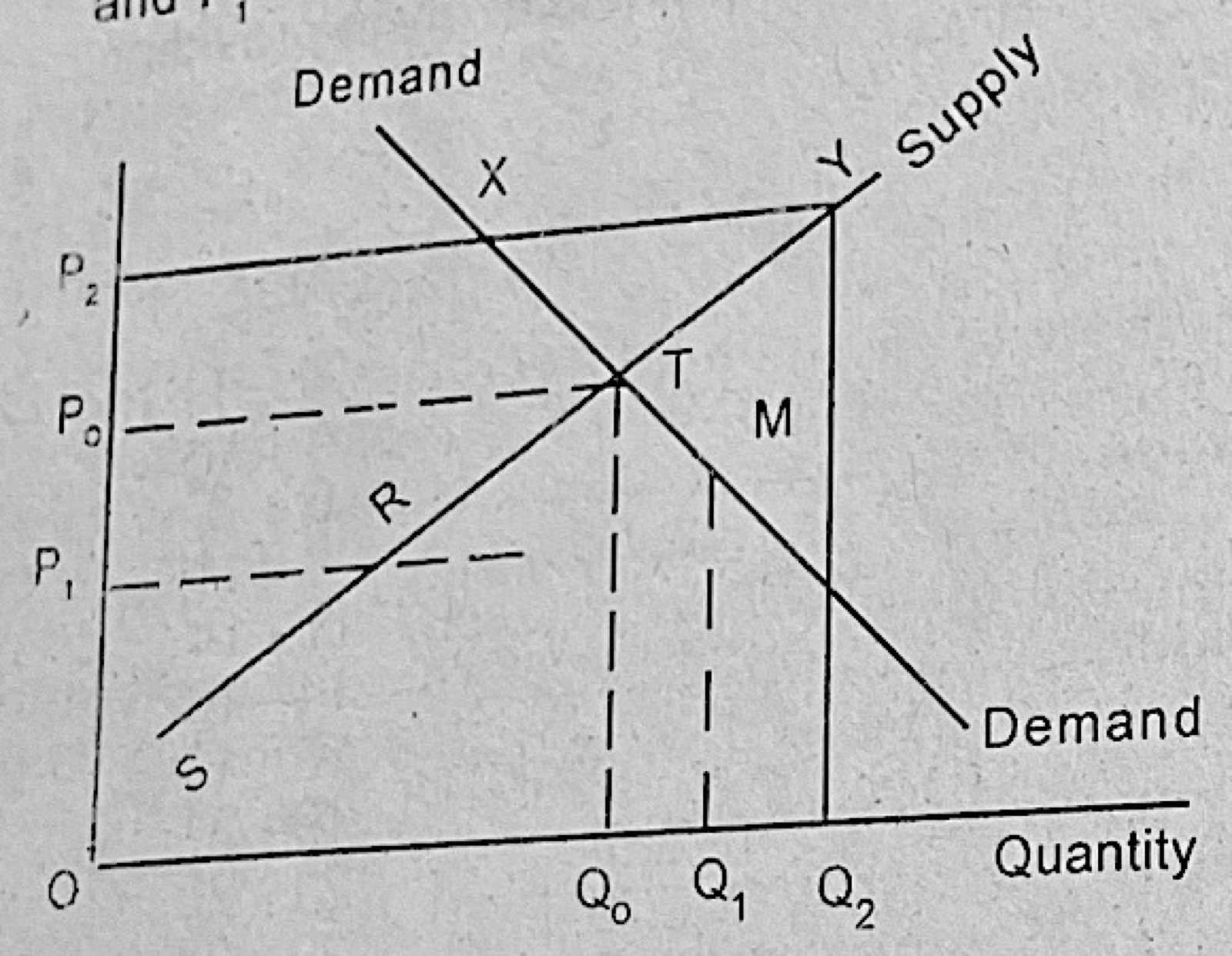
Question 3 Price Determination In the diagram below, equilibrium price is:
A. P2 B. Po C. P1 D. indeterminate E. between Po and P1 Show the answer and explanation Answer: B (Po )
Explanation Equilibrium is where the demand and supply curves cross (point T), and the price there is Po .
Open this question
Question 4 Elasticity When elasticity is zero, the demand curve is
A. perfectly elastic B. perfectly inelastic C. concave D. downward sloping E. circular. Show the answer and explanation Answer: B (perfectly inelastic )
Explanation Zero elasticity means quantity demanded does not change at all when price changes, giving a vertical, perfectly inelastic demand curve.
Open this question
Question 5 Business Organisations The following is NOT a reason for the existence of small firms:
A. scale of production is limited by size of market B. expansion brings diminishing returns C. large firms can cater for wide markets D. small firms can provide personal services E. all of the above. Show the answer and explanation Answer: C (large firms can cater for wide markets )
Explanation Small firms survive because markets are small, growth brings diseconomies and they give personal service. The fact that large firms can serve wide markets is an argument for big firms, not small ones.
Open this question
Question 6 Theory of Demand Inferior goods are defined in Economics as goods
A. whose quality is low B. consumed by very poor people C. whose consumption falls when consumer income rises D. which satisfy only the basic needs E. none of the above. Show the answer and explanation Answer: C (whose consumption falls when consumer income rises )
Explanation An inferior good is one people buy less of as their income rises, because they switch to better substitutes.
Open this question
Question 7 Population Malthus became famous through his theory which may be stated simply
A. the death rate may become so high that people may not be able to produce B. population may outgrow the means of subsistence C. people will eventually decide not to have children D. migration of people from one place to another may leave some parts of the world barren E. all of the above. Show the answer and explanation Answer: B (population may outgrow the means of subsistence )
Explanation Malthus argued that population grows faster (geometrically) than food supply (arithmetically), so population may outgrow the means of subsistence.
Open this question
Question 8 Financial Institutions A commercial bank is unique in that it is the only institution that
A. makes loans to private people and businessmen B. accepts deposits C. can store people's valuables D. can transfer money from one place to another for its customers E. saves money through the granting of credits. Show the answer and explanation Answer: E (saves money through the granting of credits. )
Explanation Many institutions lend, take deposits or keep valuables, but only commercial banks create new money (bank deposits) when they grant loans. Option E describes this credit creation.
Open this question
Question 9 Balance of Payments and Exchange Rates Which is an example of an invisible item in the Trade Account of Ghana?
A. Export of cocoa from Ghana B. Import of oil from Nigeria C. A gift of a Peugeot 504 by a firm in Nigeria to another firm in Ghana D. Payment for shipping and insurance by a Ghanaian company to companies outside Ghana E. None of the above. Show the answer and explanation Answer: D (Payment for shipping and insurance by a Ghanaian company to companies outside Ghana )
Explanation Invisible items are services such as shipping and insurance; cocoa, oil and cars are physical goods (visibles).
Open this question
Question 10 Agriculture Which is NOT a direct effort to increase agricultural production in Nigeria?
A. Operation Feed the Nation B. Nigerian Youth Service Corps C. Increased loans to farmers and cooperatives D. Research in agriculture and extension services E. Mechanization of agriculture. Show the answer and explanation Answer: B (Nigerian Youth Service Corps )
Explanation The NYSC is a national service scheme for graduates; the other options are aimed directly at raising farm output.
Open this question
Question 11 Theory of Production If a company doubles all its inputs and discovers that its output more than doubles, we can say that the company is experiencing
A. increasing marginal utility B. diseconomies of scale C. increasing costs D. constant returns to scale E. increasing returns to scale. Show the answer and explanation Answer: E (increasing returns to scale. )
Explanation When output rises by a bigger proportion than all inputs, the firm enjoys increasing returns to scale.
Open this question
Question 12 Price Determination Price control cannot work in Nigeria because
A. the population is too large B. the policemen hate to arrest people C. while it is fairly easy to control the producers and the importing firms, the small distributors are too many to be controlled D. control cannot work under a military rule E. too many things are produced in the country. Show the answer and explanation Answer: C (while it is fairly easy to control the producers and the importing firms, the small distributors are too many to be controlled )
Explanation Price control fails mainly because the huge number of small traders and retailers makes enforcement very difficult.
Open this question
Question 13 Balance of Payments and Exchange Rates A country has a surplus in its balance of visible trade if
A. the value of imports exceeds the value of exports of goods B. the value of exports exceeds the value of imports of goods C. the value of goods exported is equal to the value of goods imported D. it is able to spend a lot on capital programmes E. commercial banks' assets increase. Show the answer and explanation Answer: B (the value of exports exceeds the value of imports of goods )
Explanation Visible trade is trade in goods; a surplus means the value of goods exported is greater than the value of goods imported.
Open this question
Question 14 Financial Institutions The Foreign Exchange Market is a market where
A. graded commodities like wheat, coffee, etc. are sold and bought B. currencies are sold and bought C. treasury bills are sold and bought D. government bonds are sold and bought E. Treasury certificates are sold. Show the answer and explanation Answer: B (currencies are sold and bought )
Explanation The foreign exchange market is where one country's currency is exchanged for another's.
Open this question
Question 16 Elasticity The effects on the demand for product A caused by a change in the price of product B is called
A. cross-elasticity of demand B. elasticity of supply C. competitive demand D. composite demand E. joint demand. Show the answer and explanation Answer: A (cross-elasticity of demand )
Explanation Cross elasticity of demand measures how demand for one good responds to a change in the price of another good.
Open this question
Question 17 Financial Institutions Which of the following can be regarded as a liability of a commercial bank?
A. Advances B. Deposits C. Treasury bills D. Overdrafts E. Cash. Show the answer and explanation Answer: B (Deposits )
Explanation Customers' deposits are money the bank owes to depositors, so they are liabilities; advances, overdrafts, bills and cash are assets.
Open this question
Question 18 Public Finance Tax which takes a higher percentage from higher incomes is called
A. a regressive tax B. a progressive tax C. a proportional tax D. an indirect tax E. a direct tax. Show the answer and explanation Answer: B (a progressive tax )
Explanation A progressive tax rate rises as income rises, so higher earners pay a bigger percentage.
Open this question
Question 19 Basic Concepts Which one of the following statements is true?
A. A proportional tax is one which takes from high income people a larger fraction of their income than it takes from low income people B. Taxes on commodities or services which can be shifted elsewhere are usually called direct taxes C. The sole proprietor is a legal entity D. The influence of demand on price will be smallest in the short-run E. The cost of production is the most important determining factor of supply in the long-run. Show the answer and explanation Answer: E (The cost of production is the most important determining factor of supply in the long-run. )
Explanation A is progressive tax, B describes indirect taxes, a sole proprietor is not a separate legal entity, and demand matters most in the short run. In the long run, cost of production is the main thing that decides supply.
Open this question
Question 20 Financial Institutions The largest liability appearing on the books of a commercial bank is
A. cash B. deposits C. loans and advances D. capital and reserves E. Treasury bills. Show the answer and explanation Answer: B (deposits )
Explanation Customers' deposits are by far the biggest item a bank owes, so they are its largest liability.
Open this question
Question 21 Financial Institutions The Lagos Clearing House is
A. a commodity market B. an import licensing centre C. another name for the Lagos Stock Exchange D. an insurance and underwriting centre E. a cheque sorting centre. Show the answer and explanation Answer: E (a cheque sorting centre. )
Explanation A clearing house is where banks exchange and settle the cheques drawn on one another.
Open this question
Question 22 Public Finance The biggest source of government revenue in Nigeria is
A. mining rents and royalties B. company income tax C. import duties D. export duties E. petroleum profit tax. Show the answer and explanation Answer: E (petroleum profit tax. )
Explanation Since the oil boom, petroleum profit tax paid by oil companies has been Nigeria's largest single source of revenue.
Open this question
Question 23 Financial Institutions An increase in liquid reserve requirements by the Central Bank of Nigeria will result in
A. a reduction in commercial banks' excess reserves B. more commercial bank loans to members of the public C. an increase in commercial banks' excess reserves D. no change in commercial banks' excess reserves E. a reduction in Central Bank's gold reserves. Show the answer and explanation Answer: A (a reduction in commercial banks' excess reserves )
Explanation If banks must keep a larger share of deposits as reserves, less is left over as excess reserves for lending.
Open this question
Question 24 Business Organisations A distinguishing characteristic of a consumers' cooperative is the fact that
A. the customers are the owners B. the customers are the workers C. the customers are the managers D. the customers are low income people E. the customers are high income people. Show the answer and explanation Answer: A (the customers are the owners )
Explanation In a consumers' cooperative the members who buy from the shop also own it and share its surplus.
Open this question
Question 25 National Income Disposable income is the same thing as
A. personal income minus personal saving B. personal income minus taxes C. national income minus depreciation D. exports minus imports E. savings plus investment. Show the answer and explanation Answer: B (personal income minus taxes )
Explanation Disposable income is what a person has left to spend or save after paying personal taxes.
Open this question
Question 26 Theory of Costs and Revenue Marginal cost is
A. the lowest cost of producing goods B. the cost of production of the most efficient firm in an industry C. the cost of production of the most inefficient firm in an industry D. the cost of production of the last or extra unit of goods produced by a firm E. the cost of production at which the minimum profit is obtained by a firm. Show the answer and explanation Answer: D (the cost of production of the last or extra unit of goods produced by a firm )
Explanation Marginal cost is the addition to total cost from producing one more unit of output.
Open this question
Question 27 Business Organisations Which of the following is not a form of business organization?
A. Sole proprietorship B. Cartel C. Partnership D. Joint stock E. Cooperative societies. Show the answer and explanation Answer: B (Cartel )
Explanation A cartel is an agreement among separate firms to fix prices or output, not a form of owning a business.
Open this question
Question 28 Theory of Consumer Behaviour As consumption of beer increases, its marginal utility to a drinker will
A. increase B. remain constant C. fluctuate D. decrease E. change proportionately. Show the answer and explanation Answer: D (decrease )
Explanation By the law of diminishing marginal utility, each extra bottle gives less satisfaction than the one before.
Open this question
Question 29 Agriculture Which of the following sectors of the economy is estimated to be the largest employer of labour in the country?
A. Construction B. Agriculture C. Distribution D. Mining and petroleum E. Transport and communications. Show the answer and explanation Answer: B (Agriculture )
Explanation Most Nigerians work in farming, so agriculture employs the largest share of the labour force.
Open this question
Question 30 International Trade The expression 'Terms of Trade' is used to describe
A. the quality of exports B. the direction of foreign trade C. terms of purchase on deferred payment basis D. the rate at which exports exchange for imports E. import licensing. Show the answer and explanation Answer: D (the rate at which exports exchange for imports )
Explanation Terms of trade measure how many imports a unit of exports can buy, i.e. the ratio of export prices to import prices.
Open this question
Question 31 Price Determination If the demand for a product with a perfectly elastic supply increases, there will be
A. an increase in price and quantity offered B. an increase in quantity offered but price will remain the same C. a reduction in price and quantity offered D. an increase in price but a reduction in quantity offered for sale E. an increase in quantity offered but a reduction in price. Show the answer and explanation Answer: B (an increase in quantity offered but price will remain the same )
Explanation A perfectly elastic supply curve is horizontal, so a rise in demand raises the quantity sold while the price stays the same.
Open this question
Question 32 Economic Systems Which of these would not be included in the fundamental principles of a free enterprise economy?
A. Private ownership of factors of production B. The right to organize factors for productive purposes C. The right to make private profit D. Government's control of the mobility of factors of production E. Government's efforts to encourage competitive capitalism within the laws of the country. Show the answer and explanation Answer: D (Government's control of the mobility of factors of production )
Explanation Free enterprise rests on private ownership, profit and free movement of resources; government control of factor mobility goes against it.
Open this question
Question 33 Basic Concepts Economics is called a social science because it is
A. a branch of the social studies B. a study of the ways man devises to satisfy his unlimited wants from limited resources C. a dismal science in the Malthusian sense D. governed by scientific laws E. the study of human wants by means of scientific methods of observation. Show the answer and explanation Answer: B (a study of the ways man devises to satisfy his unlimited wants from limited resources )
Explanation Economics studies human behaviour in society, how people use scarce resources to satisfy unlimited wants.
Open this question
Question 34 Basic Concepts Opportunity cost is a term which describes
A. the initial cost of setting up a business venture B. cost of one product in terms of foregone production of others C. the monetary equivalent of the utility of a commodity D. costs related to an optimum level of production E. implicit costs. Show the answer and explanation Answer: B (cost of one product in terms of foregone production of others )
Explanation Opportunity cost is the next best alternative given up, e.g. the other goods that could have been produced instead.
Open this question
Question 35 Theory of Demand If consumer demand for product X increases as the price of product Y decreases, we can be fairly certain that
A. X and Y are complementary goods B. X and Y are substitute goods C. X and Y are independent goods D. X and Y are jointly supplied E. X and Y are inferior commodities. Show the answer and explanation Answer: A (X and Y are complementary goods )
Explanation When Y gets cheaper people buy more Y and so more X with it, which is how complements behave.
Open this question
Question 36 Balance of Payments and Exchange Rates Which of the following items in the Balance of Payments Account is an invisible transaction?
A. Import of cars B. Export of cocoa C. Export of crude petroleum D. Tourism E. Import of building materials. Show the answer and explanation Answer: D (Tourism )
Explanation Tourism is a service, so it is an invisible item; the others are trade in goods.
Open this question
Question 37 Labour Market Which of the following is a term used to describe a payment representing a surplus in excess of transfer costs?
A. Interest rates B. Opportunity costs C. Economic rent D. Indirect costs E. Wages. Show the answer and explanation Answer: C (Economic rent )
Explanation Economic rent is any payment to a factor above its transfer earnings, the minimum needed to keep it in its present use.
Open this question
Question 38 International Trade Less developed countries obtain foreign reserves mainly from the export of
A. manufactured goods B. processed and semi-processed commodities C. invisible items D. primary products E. all of the above. Show the answer and explanation Answer: D (primary products )
Explanation Developing countries earn most of their foreign exchange from primary products such as crops and minerals.
Open this question
Question 39 Money and Inflation By 'trade by barter', we mean
A. trade done by people in villages B. exchange of goods for money C. international trade D. exchange of goods for goods E. the trade of the Middle Ages. Show the answer and explanation Answer: D (exchange of goods for goods )
Explanation Barter is direct exchange of goods for goods without using money.
Open this question
Question 40 Economic Growth and Development In order to build up its capital stock, the typical less developed country should ideally
A. increase total savings B. depend on handouts from foreigners C. nationalize all foreign concerns D. impose tariffs on imports E. none of the above. Show the answer and explanation Answer: A (increase total savings )
Explanation Capital formation is financed by saving, so raising domestic savings is the sound way to build capital.
Open this question
Question 41 Business Organisations The advantage of the sole proprietorship is as follows:
A. it is always successful B. continuity is no problem C. control and supervision is under one man D. funds are easy to obtain E. inter-generational equity is assured. Show the answer and explanation Answer: C (control and supervision is under one man )
Explanation A sole trader controls and supervises the business personally, allowing quick decisions; the other options are not true of sole proprietorships.
Open this question
Question 42 Economic Systems Which of these should determine, in a planned economy, how the factors of production are to be allocated among different production activities?
A. Fairness B. The distribution of income and wealth C. Public need, which is determined by the government D. Private needs determined by the market E. The ability of an individual to make profit. Show the answer and explanation Answer: C (Public need, which is determined by the government )
Explanation In a planned economy the government decides what is needed and allocates resources accordingly, not the market.
Open this question
Question 43 Economic Systems Which of the following activities of Government precludes the existence of a market economy?
A. The imposition of taxes B. the control of the location of industry C. The central planning of all production D. The fixing of maximum prices for all necessities E. The establishment of laws requiring the registration of business firms Show the answer and explanation Answer: C (The central planning of all production )
Explanation If the state plans all production, prices and markets no longer decide what is produced, so a market economy cannot exist.
Open this question
Question 44 Basic Concepts Which of the following is NOT strictly included in the study of Economics?
A. The study of wants B. The study of choice C. Whether a particular want satisfies a good or bad purpose D. The study of scarcity E. the study of substitution. Show the answer and explanation Answer: C (Whether a particular want satisfies a good or bad purpose )
Explanation Economics is a positive science about wants, scarcity and choice; judging whether a want is good or bad is a moral question outside it.
Open this question
Question 46 Population The optimum population of a country is reached when
A. all factors of production have been fully employed B. the productive effort per man is at its highest with a given volume of resources C. the total population of a country increases D. the natural resources of a country increases E. the working population of a country increases. Show the answer and explanation Answer: B (the productive effort per man is at its highest with a given volume of resources )
Explanation Optimum population is the size at which output per head is greatest, given the country's other resources.
Open this question
Question 47 Theory of Production In Economics, production is complete when
A. goods are produced in the factories B. goods are sold to the wholesalers C. goods and services are produced by the government D. prices are fixed for goods and services E. goods and services finally reach the consumers. Show the answer and explanation Answer: E (goods and services finally reach the consumers. )
Explanation Production includes distribution, so it is complete only when the goods or services reach the final consumer.
Open this question
Question 48 Theory of Consumer Behaviour A rational consumer will adjust his spending pattern so that:
A. he buys only the one item that gives him the most total satisfaction B. the marginal utility he gets from the last unit of each item is the same C. the marginal utility he gets from the last naira spent on each item is the same D. the total utility he gets from each item is the same E. the total amount of money he spends on each item is the same. Show the answer and explanation Answer: C (the marginal utility he gets from the last naira spent on each item is the same )
Explanation A consumer maximises satisfaction when the last naira spent on each good gives equal marginal utility (equi-marginal principle).
Open this question
Question 49 Business Organisations Bondholders are treated more favourably than shareholders because
A. they are not liable for the company's losses B. they have a greater voice in electing board of directors C. they control the management D. they have a prior claim on the company's assets E. none of the above. Show the answer and explanation Answer: D (they have a prior claim on the company's assets )
Explanation Bondholders lent money to the company, so they must be paid before shareholders receive anything, including when the company is wound up.
Open this question
Question 50 Elasticity The numerical measure of elasticity is:
A. % change in Q / % change in P B. change in Q / change in P C. % change in P / % change in Q D. change in P / change in Q E. change in P plus change in Q / change in P Show the answer and explanation Answer: A (% change in Q / % change in P )
Explanation Price elasticity of demand = percentage change in quantity demanded ÷ percentage change in price.
Open this question Sign up free for every JAMB Economics year, practice by topic and timed mocks.
Start practising free