Home › Past questions › JAMB › Chemistry › 2022 22 questions. Try each one, then open the answer to check yourself and read the explanation.
Sign up free to answer these questions on a CBT screen with a timer, then see your score and every answer explained.
Start practising free
Question 4 Rates of Reaction Na2 S2 O3 (aq) + 2HCl(aq) → 2NaCl(aq) + H2 O + SO2 (g) + S(s)
A. a decrease in volume and an increase in pressure of the reactants B. an increase in temperature and a decrease in the concentration of the reactants C. an increase in temperature and an increase in the concentration of the reactants D. A decrease in temperature and an increase in the concentration of the reactants Show the answer and explanation Answer: C (an increase in temperature and an increase in the concentration of the reactants )
Explanation The reactants are in solution, so pressure has no effect. Raising both temperature and concentration increases the number of effective collisions most.
Open this question
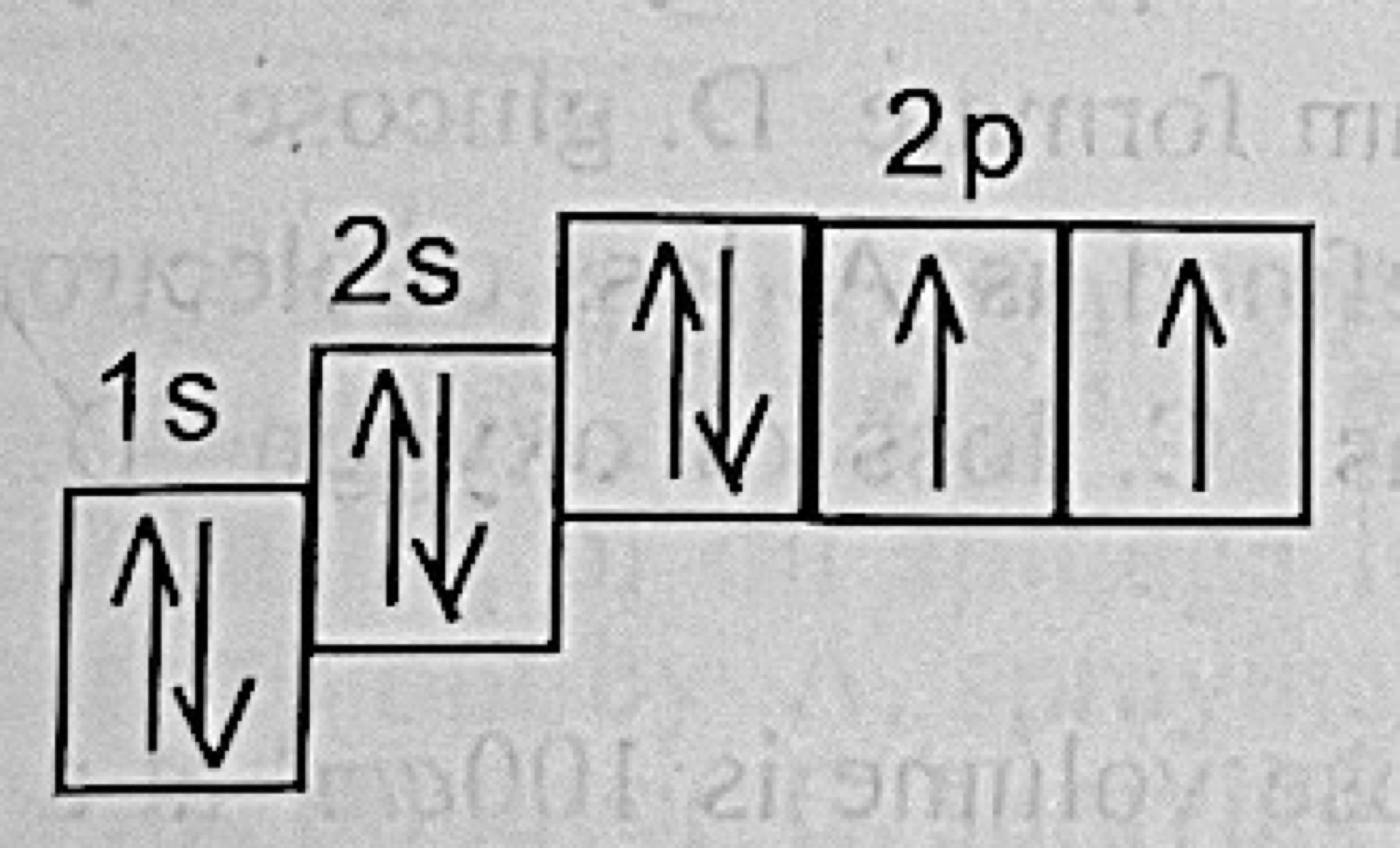
Question 5 Atomic Structure The above diagram illustrates the electron sub-level for
A. nitrogen B. carbon C. fluorine D. oxygen Show the answer and explanation Answer: D (oxygen )
Explanation The boxes show 1s2 2s2 2p4 , a total of 8 electrons, which is oxygen.
Open this question
Question 7 Water The process whereby Na2 CO3 .10H2 O loses its water of crystallization to the atmosphere is called
A. efflorescence B. deliquescence C. effervescence D. hygroscopic Show the answer and explanation Answer: A (efflorescence )
Explanation Efflorescence is the loss of water of crystallisation from a hydrated crystal when it is exposed to air.
Open this question
Question 9 Carbon and its Compounds It is dangerous to inhale CO(g) mainly because it
A. competes with oxygen in the blood B. can cause injury to the nervous system C. can cause lung cancer D. competes with CO2(g) in the blood Show the answer and explanation Answer: A (competes with oxygen in the blood )
Explanation Carbon(II) oxide binds to haemoglobin far more strongly than oxygen, so the blood cannot carry enough oxygen.
Open this question
Question 13 Electrolysis Calculate the number of moles of Cu(s) that will be deposited by 360 coulombs of electricity during the electrolysis of CuSO4(aq) using graphite electrodes.
A. 1.87×10⁻³ mole B. 5.36×10⁻⁴ mole C. 3.73×10⁻³ mole D. 3.95×10⁻⁴ mole Show the answer and explanation Answer: A (1.87×10⁻³ mole )
Explanation Cu2+ + 2e− → Cu, so 1 mole of Cu needs 2 × 96500 C. Moles = 360 ÷ 193000 = 1.87 × 10⁻³ .
Open this question
Question 14 Nitrogen and its Compounds A gas that has a pungent smell, turns red litmus paper blue and forms dense white fumes with hydrogen chloride is
A. N2 O B. N2 C. NH3 D. Cl2 Show the answer and explanation Answer: C (NH3 )
Explanation Ammonia is the only common alkaline gas; it forms white fumes of NH4 Cl with HCl.
Open this question
Question 17 Mole Concept and Stoichiometry Calculate the percentage of sulphur in sulphur (iv) oxide [S=32, O = 16].
A. 25% B. 66% C. 50% D. 40% Show the answer and explanation Answer: C (50% )
Explanation SO2 has molar mass 32 + 32 = 64, so %S = 32/64 × 100 = 50%.
Open this question
Question 23 Hydrocarbons Which of the following flames is used by welders in the cutting of metals?
A. acetylene flame B. butane gas flame C. oxy-acetylene flame D. kerosene flame Show the answer and explanation Answer: C (oxy-acetylene flame )
Explanation Burning ethyne (acetylene) in pure oxygen gives a very hot flame used to cut and weld metals.
Open this question
Question 25 Chemical Equilibrium aA + bB ⇌ cC + dD
A. [A][B]/[C][D] B. [A]a [B]b /[C]c [D]d C. [C][D]/[A][B] D. [C]c [D]d /[A]a [B]b Show the answer and explanation Answer: D ([C]c [D]d /[A]a [B]b )
Explanation K is products over reactants, each concentration raised to the power of its coefficient in the balanced equation.
Open this question
Question 26 Acids, Bases and Salts The gas that cannot be dried with concentrated sulphuric acid is?
A. NH3 B. HCl C. SO2 D. Cl2 Show the answer and explanation Answer: A (NH3 )
Explanation Ammonia is basic, so it reacts with sulphuric acid to form ammonium sulphate instead of being dried.
Open this question
Question 27 Hydrocarbons Which of the following will decolourized the purple colour of tetraoxomanganate (vii) ion?
A. alkanols B. alkenes C. alkanes D. alkanals Show the answer and explanation Answer: B (alkenes )
Explanation Alkenes have a C=C double bond that is oxidised by acidified KMnO4 , removing its purple colour.
Open this question
Question 28 Acids, Bases and Salts What is the pH of an anhydride made from oxygen and non-metal when dissolved in water.
A. pH > 7 B. pH = 7 C. it will not dissolve in water D. pH < 7 Show the answer and explanation Answer: D (pH < 7 )
Explanation Non-metal oxides such as SO2 and CO2 are acid anhydrides; they dissolve to form acids, so the pH is below 7.
Open this question
Question 29 Hydrocarbons A type of chemical reaction that alkanes undergo is?
A. addition B. substitution C. polymerization D. condensation Show the answer and explanation Answer: B (substitution )
Explanation Alkanes are saturated, so they react by substitution, e.g. a hydrogen atom replaced by chlorine in sunlight.
Open this question
Question 30 Redox Reactions In the below redox equation H2 O + 2Fe2+ + Cl2 ⇌ 2Fe3+ + 2Cl− + H2 O which of the following behaves as an oxidising agent?
A. Cl2 B. Fe2+ C. Cl− D. Fe3+ Show the answer and explanation Answer: A (Cl2 )
Explanation Chlorine gains electrons (0 → −1), taking them from Fe2+ , so Cl2 is the oxidising agent.
Open this question
Question 32 Hydrogen, Oxygen and Oxides The only pair that contains two amphoteric oxides is?
A. aluminium oxide, calcium oxide, zinc oxide B. sodium oxide, zinc oxide, magnesium oxide C. silver oxide, lead oxide, sodium oxide D. potassium oxide, lithium oxide, carbon dioxide Show the answer and explanation Answer: A (aluminium oxide, calcium oxide, zinc oxide )
Explanation Aluminium oxide and zinc oxide are both amphoteric; each other set has at most one amphoteric oxide.
Open this question
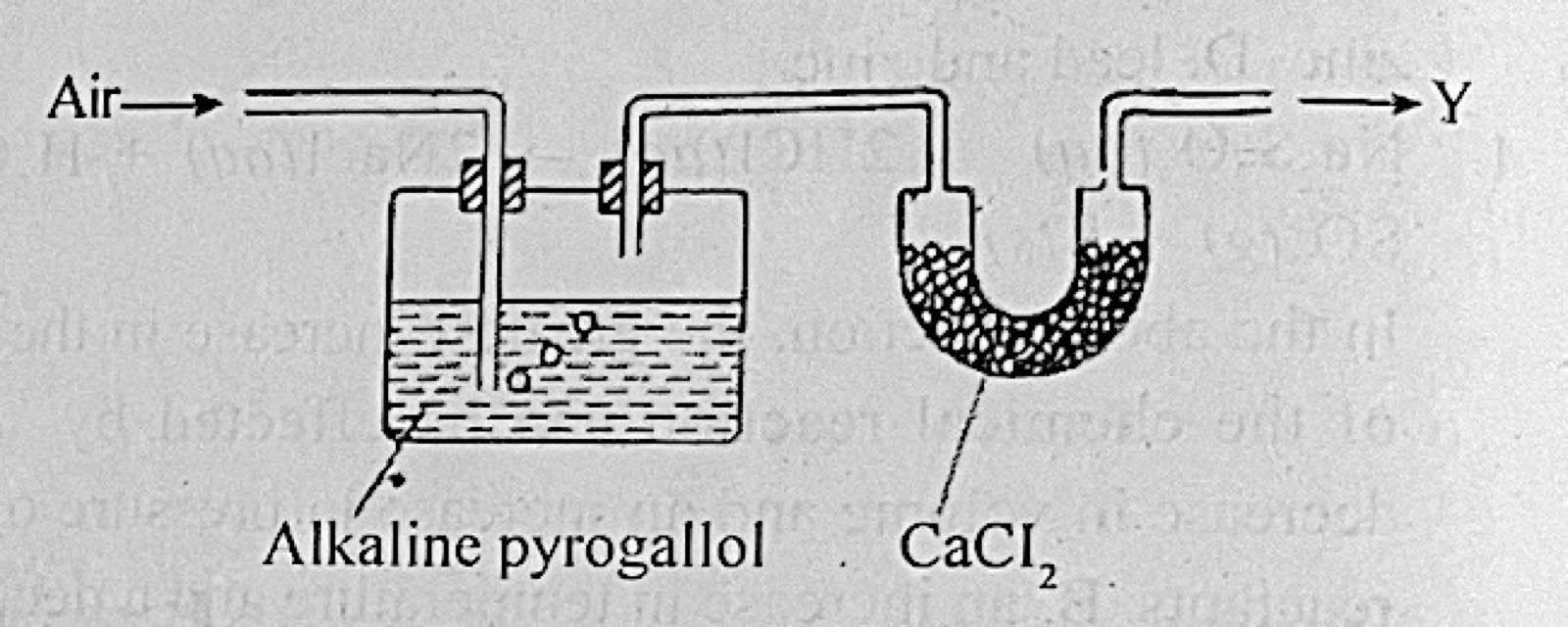
Question 34 Air In the above experiment Y is
A. pure nitrogen B. a mixture of nitrogen and oxygen C. a mixture of nitrogen and carbon dioxide D. a mixture of nitrogen and inert gases Show the answer and explanation Answer: D (a mixture of nitrogen and inert gases )
Explanation Alkaline pyrogallol absorbs oxygen (and carbon(IV) oxide) and CaCl2 absorbs water vapour, leaving nitrogen with the noble gases.
Open this question
Question 35 Electrolysis Which of these is a strong electrolyte?
A. ethyl acetate B. ethanol C. sodium formate D. glucose Show the answer and explanation Answer: C (sodium formate )
Explanation Sodium formate is an ionic salt that ionises fully in water; the others are covalent non-electrolytes.
Open this question
Question 36 Redox Reactions Oxidation can be defined as
A. loss of electrons B. gain of electrons C. loss of oxygen D. gain of hydrogen Show the answer and explanation Answer: A (loss of electrons )
Explanation In electronic terms, oxidation is the loss of electrons (OIL RIG).
Open this question
Question 37 Gas Laws An oxygen gas whose volume is 100cm 3 at a pressure of 750mm Hg. Find the volume of the gas if the temperature is constant and the pressure is increased to 1000mmHg
A. 85cm 3 B. 136.3cm 3 C. 65cm 3 D. 75cm 3 Show the answer and explanation Answer: D (75cm 3 )
Explanation Boyle's law: V2 = P1 V1 /P2 = 750 × 100/1000 = 75 cm3 .
Open this question
Question 38 Carbohydrates, Proteins and Amines Cotton consists almost pure.
A. starch B. protein C. cellulose D. animal fibre Show the answer and explanation Answer: C (cellulose )
Explanation Cotton fibre is nearly pure cellulose, a polysaccharide.
Open this question
Question 39 Fats, Oils and Soaps Alkanol obtained from the manufacture of soap is called
A. ethanol B. glycol C. glycerol D. propanol Show the answer and explanation Answer: C (glycerol )
Explanation Saponification of fats with alkali gives soap and glycerol (propane-1,2,3-triol).
Open this question
Question 40 Metals and their Compounds Stainless steel consists of
A. carbon, iron and lead B. carbon, iron and chromium C. carbon and iron only D. carbon, iron and copper Show the answer and explanation Answer: B (carbon, iron and chromium )
Explanation Stainless steel is iron with carbon and chromium (often nickel too); chromium stops rusting.
Open this question Sign up free for every JAMB Chemistry year, practice by topic and timed mocks.
Start practising free JAMB, UTME, WAEC, WASSCE, NECO, NABTEB and GCE are names of their respective examining bodies. Passwella is an independent practice platform and is not affiliated with or endorsed by any of them.