Home › Past questions › JAMB › Chemistry › 2001 48 questions. Try each one, then open the answer to check yourself and read the explanation.
Sign up free to answer these questions on a CBT screen with a timer, then see your score and every answer explained.
Start practising free
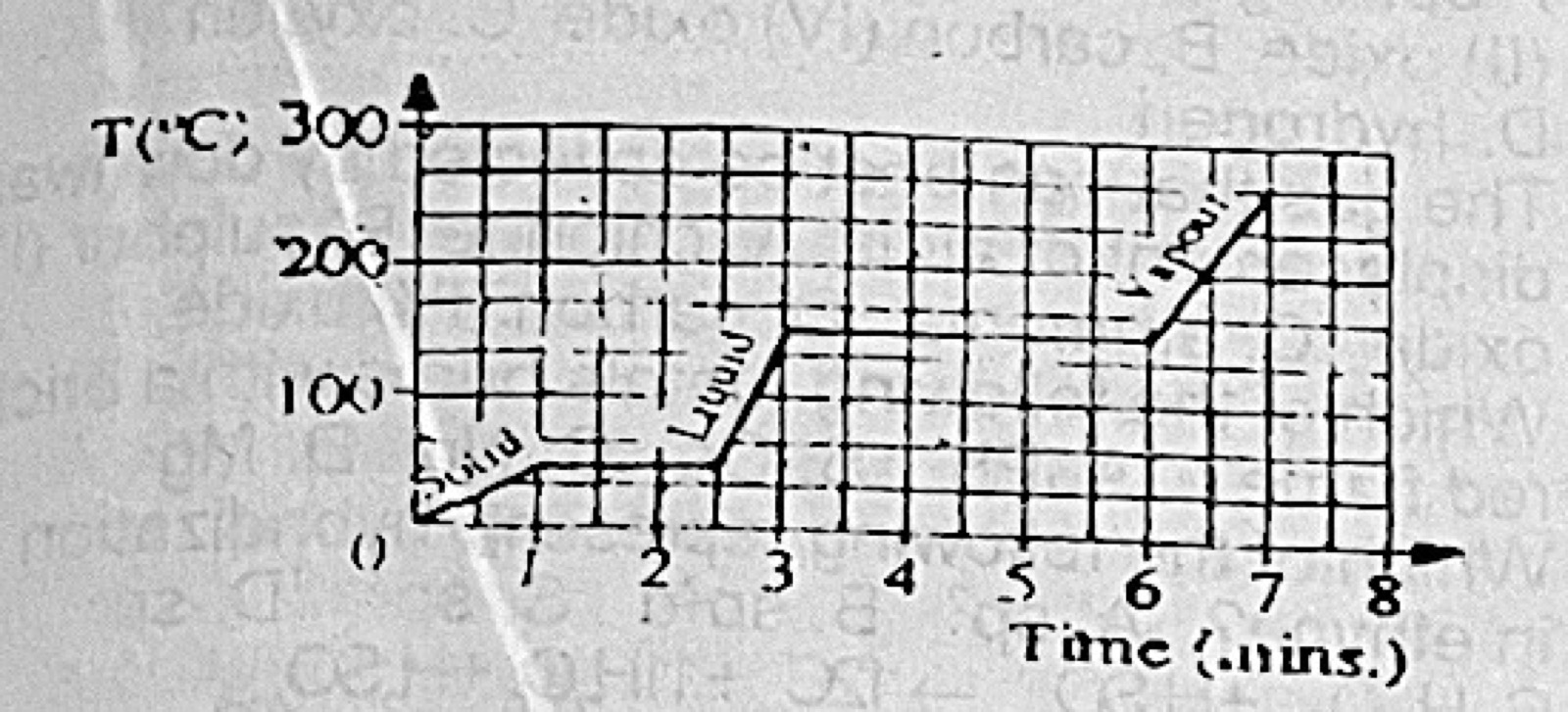
Question 1 Kinetic Theory and States of Matter Use the graph below to answer questions 1 and 2.
A. 125°C B. 150°C C. 175°C D. 250°C Show the answer and explanation Answer: B (150°C )
Explanation The flat part of the graph between 3 and 6 minutes is at 150°C: this is the boiling point, and a gas condenses at the same temperature at which the liquid boils.
Open this question
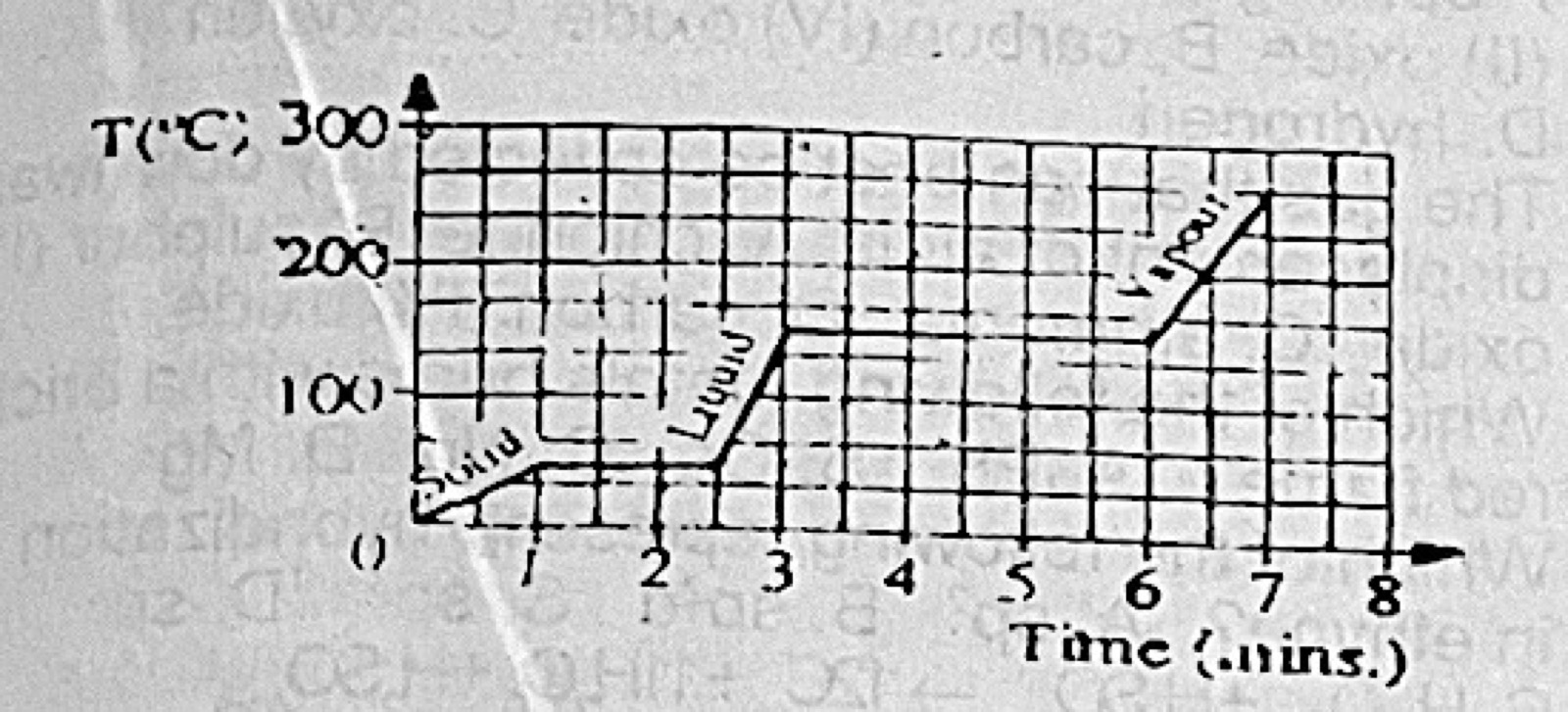
Question 2 Kinetic Theory and States of Matter Use the graph below to answer questions 1 and 2.
A. 2.5 mins. B. 6.0 mins. C. 1.0 min. D. 3.0 mins. Show the answer and explanation Answer: A (2.5 mins. )
Explanation Melting happens along the first flat part of the graph, which ends at 2.5 minutes; after that the substance is all liquid and its temperature rises.
Open this question
Question 3 Gas Laws 25cm3 of a gas X contains Z molecules at 15°C and 75 mmHg. How many molecules will 25 cm3 of another gas Y contain at the same temperature and pressure?
A. 2Y B. 2Z C. Z D. Y Show the answer and explanation Answer: C (Z )
Explanation Avogadro's law: equal volumes of all gases at the same temperature and pressure contain the same number of molecules, so Y also contains Z molecules.
Open this question
Question 4 Mole Concept and Stoichiometry What mass of water is produced when 8.0g of hydrogen reacts with excess oxygen? [H=1, O = 16]
A. 36.0g B. 8.0g C. 72.0g D. 16.0g Show the answer and explanation Answer: C (72.0g )
Explanation 2H2 + O2 → 2H2 O: 4 g of hydrogen gives 36 g of water, so 8 g gives 72 g.
Open this question
Question 5 Atomic Structure A particle that contains 9 protons, 10 neutrons and 10 electrons is a
A. negative ion B. positive ion C. neutral atom of a non-metal D. neutral atom of a metal. Show the answer and explanation Answer: A (negative ion )
Explanation It has one more electron (10) than protons (9), so it carries a charge of −1: a negative ion (F− ).
Open this question
Question 6 Radioactivity Cancerous growths are cured by exposure to
A. γ-rays B. β-rays C. α-rays D. x-rays Show the answer and explanation Answer: A (γ-rays )
Explanation Gamma rays are very penetrating and are used in radiotherapy to destroy cancer cells deep in the body.
Open this question
Question 7 Gas Laws An oxide XO2 has a vapour density of 32. What is the atomic mass of X?
A. 32 B. 20 C. 14 D. 12 Show the answer and explanation Answer: A (32 )
Explanation Relative molecular mass = 2 × vapour density = 64. So X + 2(16) = 64 and X = 32.
Open this question
Question 8 Atomic Structure Millikan's contribution to the development of atomic theory is the determination of
A. charge on electron B. positive rays C. charge to mass ratio D. cathode rays. Show the answer and explanation Answer: A (charge on electron )
Explanation In his oil-drop experiment Millikan measured the charge carried by a single electron. J. J. Thomson had earlier found the charge-to-mass ratio.
Open this question
Question 9 Atomic Structure Four elements W , X , Y , and Z have atomic number 2, 6, 16 and 20 respectively. Which of these elements is a metal?
A. X B. W C. Z D. Y Show the answer and explanation Answer: C (Z )
Explanation Atomic number 20 is calcium (2, 8, 8, 2), a metal. The others are helium (2), carbon (6) and sulphur (16), all non-metals.
Open this question
Question 10 Atomic Structure An element X with relative atomic mass 16.2 contains two isotopes 16 8 X with relative abundance of 90% and m 8 X with relative abundance of 10%. The value of m is
A. 16 B. 18 C. 12 D. 14 Show the answer and explanation Answer: B (18 )
Explanation 16 × 0.90 + m × 0.10 = 16.2, so 14.4 + 0.1m = 16.2, giving 0.1m = 1.8 and m = 18.
Open this question
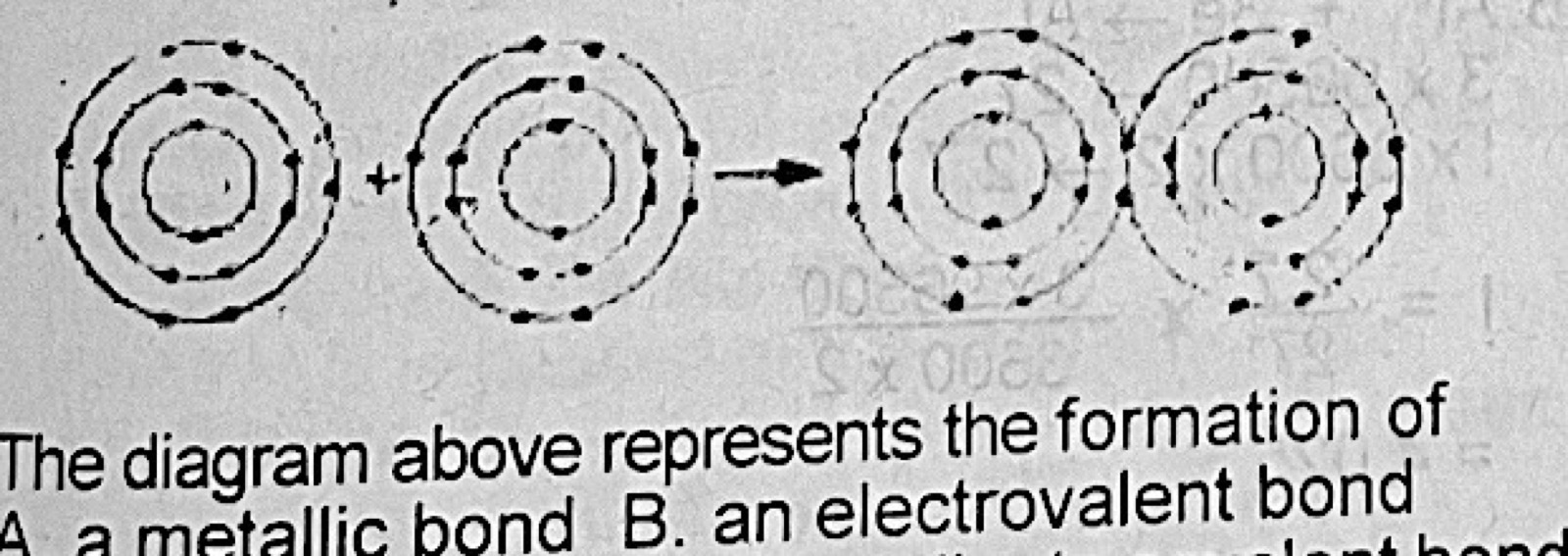
Question 11 Chemical Bonding The diagram above represents the formation of
A. a metallic bond B. an electrovalent bond C. a covalent bond D. a coordinate covalent bond. Show the answer and explanation Answer: C (a covalent bond )
Explanation The two atoms come together and share outer-shell electrons where their shells meet, with each atom giving electrons to the shared pair, so a covalent bond is formed.
Open this question
Question 12 Gas Laws Which of the following statements is correct about the average kinetic energy of the molecules of a gas?
A. It increases with increase in pressure B. It increases at constant pressure C. It increases with increase in temperature D. It increases with increase in volume. Show the answer and explanation Answer: C (It increases with increase in temperature )
Explanation The average kinetic energy of gas molecules is proportional to the absolute temperature, so it rises only when the temperature rises.
Open this question
Question 13 Environmental Pollution The pollution from petroleum spillage in rivers and lakes can best be dispersed by
A. pouring detergents B. passing of ships through the area C. pouring organic solvents D. evaporation Show the answer and explanation Answer: A (pouring detergents )
Explanation Detergents break the oil layer into tiny droplets (emulsify it) so that it spreads out in the water and is broken down more quickly.
Open this question
Question 14 Water Deliquescent substances are used for
A. cooling B. wetting C. melting D. drying Show the answer and explanation Answer: D (drying )
Explanation Deliquescent substances absorb so much water from the air that they dissolve in it, so they are good drying agents.
Open this question
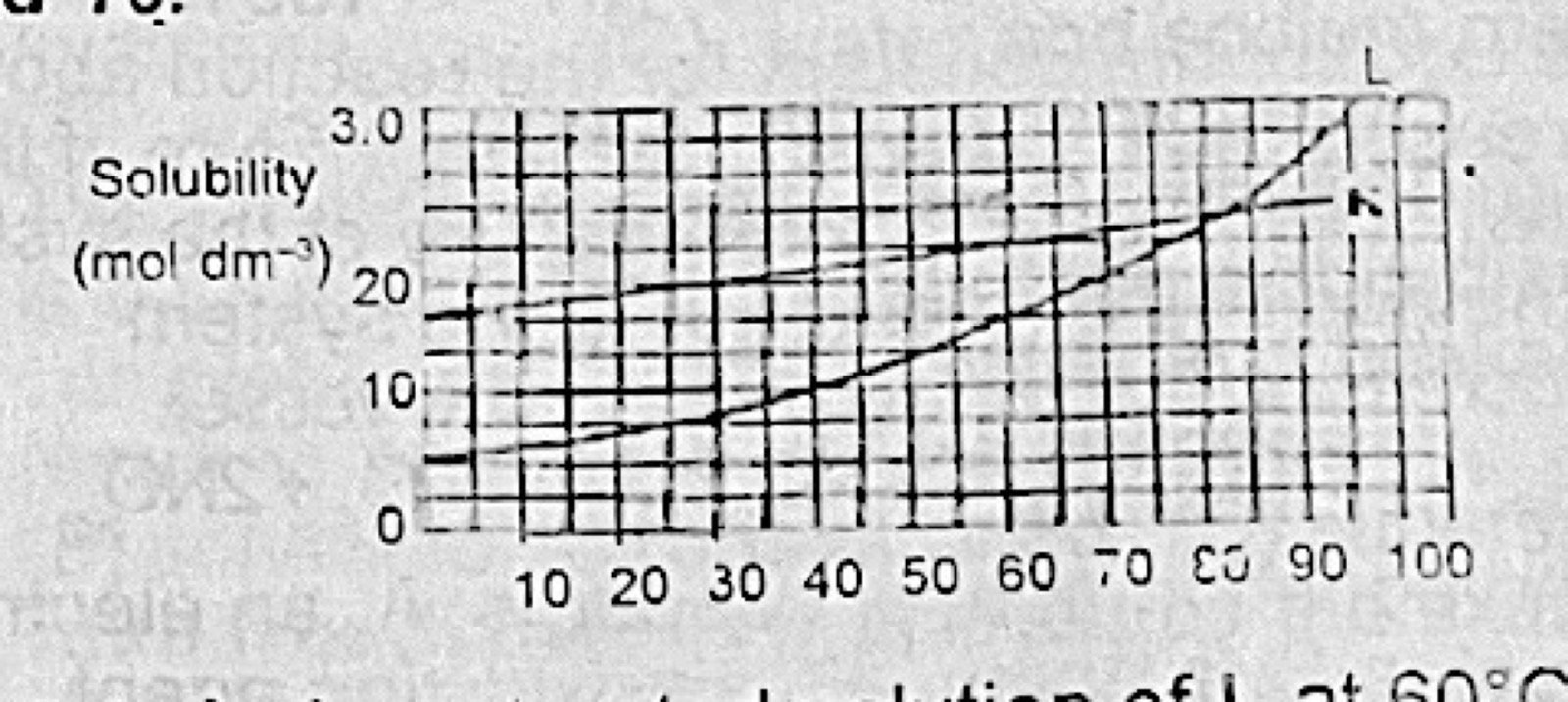
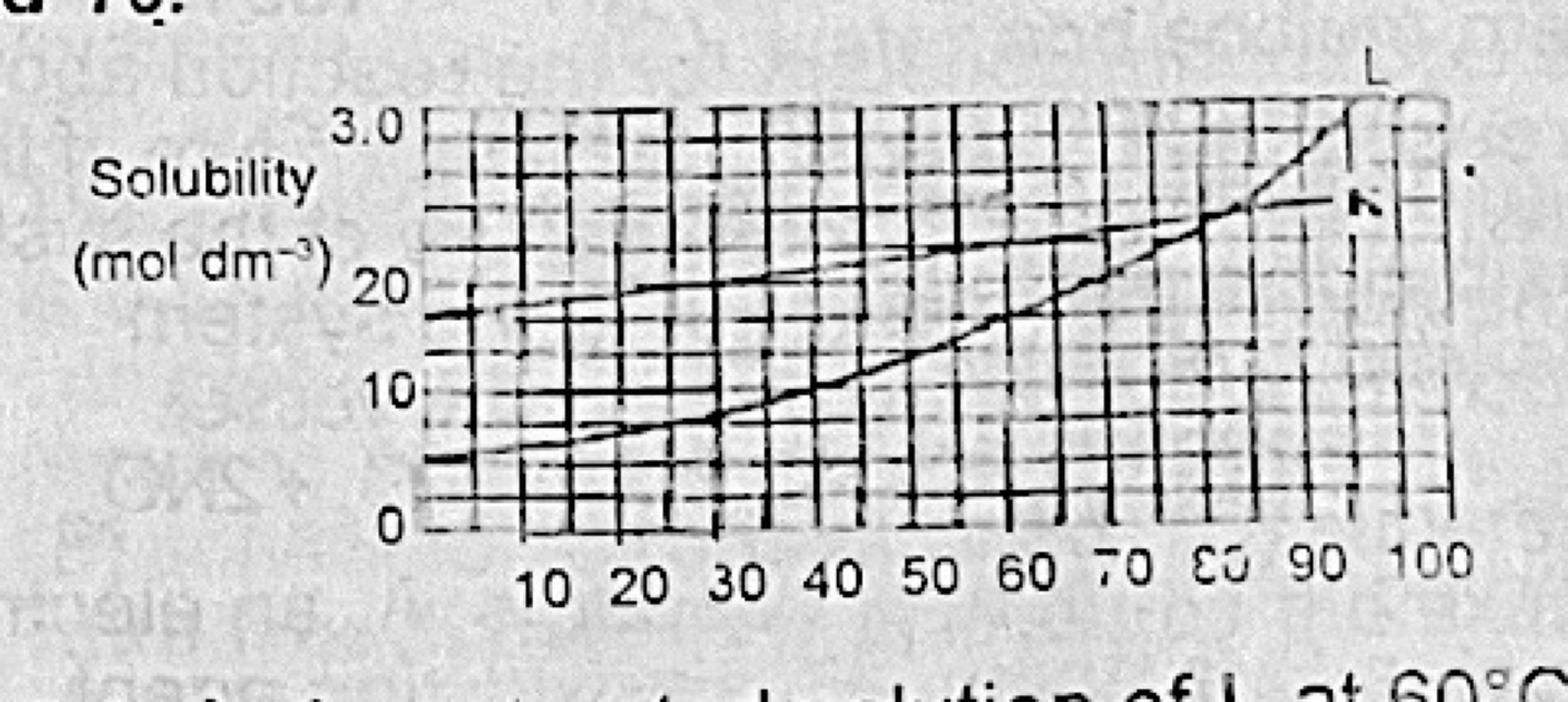
Question 15 Solubility and Solutions Use the solubility curves below to answer questions 15 and 16.3 of a saturated solution of L at 60°C is cooled to 25°C, what amount in mole will separate out?
A. 0.75 B. 0.25 C. 1.00 D. 0.50 Show the answer and explanation Answer: A (0.75 )
Explanation Read curve L: the solubility drops by about 0.75 mol dm−3 between 60°C and 25°C, so about 0.75 mol separates from 1 dm3 .
Open this question
Question 16 Solubility and Solutions Use the solubility curves below to answer questions 15 and 16.L and K the same?
A. 82°C B. 75°C C. 100°C D. 90°C Show the answer and explanation Answer: A (82°C )
Explanation The solubilities are equal where the two curves cross, which is at about 82°C.
Open this question
Question 17 Separation of Mixtures Pure solvents are obtained by
A. distillation B. condensation C. extraction D. evaporation Show the answer and explanation Answer: A (distillation )
Explanation Distillation boils off the solvent and condenses it separately, leaving the dissolved solids behind, so the solvent is collected pure.
Open this question
Question 18 Air What is the decrease in volume of air when pyrogallol is shaken with 30.00cm3 of air?
A. 15.00cm3 B. 6.30cm3 C. 0.63cm3 D. 0.06cm3 Show the answer and explanation Answer: B (6.30cm3 )
Explanation Alkaline pyrogallol absorbs the oxygen, which is about 21% of air: 21% × 30 = 6.30 cm3 .
Open this question
Question 19 Environmental Pollution Environmental pollution is worsened by the release from automobile exhausts of
A. water vapour B. steam C. smoke D. heavy metals Show the answer and explanation Answer: C (smoke )
Explanation Car exhausts give out smoke (soot and unburnt fuel) along with poisonous gases, which pollutes the air. Water vapour and steam are harmless.
Open this question
Question 20 Water The chemical used for coagulation in water purification is
A. aluminium tetraoxosulphate (VI) B. copper tetraoxosulphate (VI) C. sodium tetraoxosulphate (VI) D. calcium tetraoxosulphate (VI) Show the answer and explanation Answer: A (aluminium tetraoxosulphate (VI) )
Explanation Alum (aluminium tetraoxosulphate (VI)) makes fine suspended particles clump together so that they settle and can be removed.
Open this question
Question 21 Hydrogen, Oxygen and Oxides Phosphorus is stored under water to prevent it from
A. dehydrating B. becoming inert C. smelling D. catching fire. Show the answer and explanation Answer: D (catching fire. )
Explanation White phosphorus catches fire on its own in air at about 30°C, so it is kept under water away from oxygen.
Open this question
Question 22 Redox Reactions In which of the following reactions does reduction take place?
A. Fe2+ − e− → Fe3+ B. 2O2− → O2 + 4e− C. Cr − 2e− → Cr2+ D. 2H+ + 2e− → H2 Show the answer and explanation Answer: D (2H+ + 2e− → H2 )
Explanation Reduction is gain of electrons. Only in D does a species (H+ ) gain electrons; the others all lose electrons.
Open this question
Question 23 Chemical Equilibrium P(g) + Q(g) ⇌ 3R(s) + S(g) ΔH is negativeR ?
A. Using a larger closed vessel. B. Increasing the temperature C. Removing some S . D. Adding a positive catalyst. Show the answer and explanation Answer: C (Removing some S . )
Explanation Removing the product S makes the equilibrium shift to the right to replace it, forming more R. A larger vessel and a higher temperature both shift it to the left; a catalyst does not change the yield.
Open this question
Question 24 Electrolysis A metal M displaces zinc from zinc chloride solution. This shows that
A. M is more electronegative than zincB. zinc is above hydrogen in the series C. M is more electropositive than zincD. electrons flow from zinc to M . Show the answer and explanation Answer: C (M is more electropositive than zinc
Explanation A metal can only displace another metal from its salt if it is higher in the activity series, i.e. more electropositive.
Open this question
Question 25 Rates of Reaction Which of the following best explains the increase in the rate of a chemical reaction as the temperature rises?
A. The bonds in the reacting molecules are more readily broken. B. The molecular collisions become more violent. C. A lower proportion of the molecules has the necessary minimum energy to react. D. The collision frequency of the molecules increases. Show the answer and explanation Answer: D (The collision frequency of the molecules increases. )
Explanation Heating makes the molecules move faster, so they collide more often (and more of the collisions have enough energy), which speeds up the reaction.
Open this question
Question 26 Electrolysis What current in amperes will deposit 2.7g of aluminium in 2 hours? [Al = 27, F = 96 500 C mol−1 ]
A. 32 B. 8 C. 4 D. 16 Show the answer and explanation Answer: C (4 )
Explanation Al3+ + 3e− → Al, so 27 g needs 3 × 96 500 C and 2.7 g needs 28 950 C. I = Q ÷ t = 28 950 ÷ (2 × 3600) ≈ 4 A.
Open this question
Question 27 Acids, Bases and Salts Ethanoic acid is
A. tribasic B. unionizeable C. monobasic D. dibasic Show the answer and explanation Answer: C (monobasic )
Explanation Each ethanoic acid molecule (CH3 COOH) has only one replaceable hydrogen ion, so it is monobasic.
Open this question
Question 28 Energy Changes C(s) + 2S(g) → CS2(g) ΔH = +89 kJ mol−1
A. each of carbon and sulphur has 89kJ of energy B. both carbon and sulphur contribute 89kJ of energy C. 89 kJ of energy is released D. 89 kJ of energy is absorbed Show the answer and explanation Answer: D (89 kJ of energy is absorbed )
Explanation A positive ΔH means the reaction is endothermic: 89 kJ of heat is taken in for every mole of CS2 formed.
Open this question
Question 30 Redox Reactions 3Cu(s) + 8HNO3(aq) → 3Cu(NO3 )2(aq) + 4H2 O(l) + 2NO(g)
A. an electron acceptor B. a base C. an oxidizing agent D. a reducing agent Show the answer and explanation Answer: D (a reducing agent )
Explanation Copper goes from 0 to +2: it loses electrons and is oxidised, so it is the reducing agent (it reduces the nitric acid to NO).
Open this question
Question 31 Energy Changes When ΔH is negative, a reaction is said to be
A. ionic B. reversible C. exothermic D. endothermic Show the answer and explanation Answer: C (exothermic )
Explanation A negative ΔH means the products have less energy than the reactants: heat is given out, so the reaction is exothermic.
Open this question
Question 32 Electrolysis As the concentration of an electrolyte reduces, the conductivity
A. reduces to zero B. decreases C. increases D. is unaffected Show the answer and explanation Answer: B (decreases )
Explanation A more dilute solution has fewer ions in each unit volume to carry the current, so its conductivity decreases (it does not drop to zero).
Open this question
Question 34 Energy Changes NH3(g) + HCl(g) → NH4 Cl(s)
A. negative B. indeterminate C. positive D. zero Show the answer and explanation Answer: A (negative )
Explanation Two gases combine to form a solid, so the particles become far more ordered and the entropy falls (ΔS is negative).
Open this question
Question 35 Carbohydrates, Proteins and Amines Fermentation is the
A. breaking down of carbohydrate to glucose B. conversion of sugar to alcohol in the presence of yeast C. breaking down of sugar to carbohydrate D. conversion of alcohol to sugar in the presence of yeast. Show the answer and explanation Answer: B (conversion of sugar to alcohol in the presence of yeast )
Explanation In fermentation, enzymes in yeast convert sugar (glucose) into ethanol and carbon (IV) oxide.
Open this question
Question 36 Alkanals and Alkanones The general formula for the alkanals is
A. ROH B. R2 CO C. RCOOR' D. RCHO Show the answer and explanation Answer: D (RCHO )
Explanation Alkanals (aldehydes) contain the —CHO group, so their general formula is RCHO. ROH is an alkanol, R2 CO an alkanone and RCOOR' an ester.
Open this question
Question 37 Metals and their Compounds The main impurity in iron ore during the extraction of iron is
A. silicon (IV) oxide B. carbon (IV) oxide C. calcium trioxosilicate D. sulphur (II) oxide. Show the answer and explanation Answer: A (silicon (IV) oxide )
Explanation Iron ore contains sand, silicon (IV) oxide, which limestone removes in the blast furnace as slag (calcium trioxosilicate).
Open this question
Question 38 Polymers During the vulcanization of rubber, sulphur is added to
A. break down rubber polymer B. lengthen the chain of rubber C. bind rubber molecules together D. act as a catalyst Show the answer and explanation Answer: C (bind rubber molecules together )
Explanation Sulphur forms cross-links between neighbouring rubber chains, binding them together and making the rubber tougher and more elastic.
Open this question
Question 39 Hydrocarbons Catalytic hydrogenation of benzene produces
A. oil B. cyclohexene C. cyclohexane D. margarine Show the answer and explanation Answer: C (cyclohexane )
Explanation Benzene adds three molecules of hydrogen over a nickel catalyst to form the saturated ring compound cyclohexane, C6 H12 .
Open this question
Question 40 Alkanols A trihydric alkanol is
A. glycerol B. phenol C. glycol D. ethanol Show the answer and explanation Answer: A (glycerol )
Explanation Glycerol (propane-1,2,3-triol) has three —OH groups. Glycol has two and ethanol one; phenol is not an alkanol.
Open this question
Question 41 Halogens When chlorine is passed into water and the resulting solution exposed to sunlight, the products formed are
A. chlorine gas and hydrogen B. oxygen and oxochlorate (I) acid C. chlorine gas and oxochlorate (I) acid D. hydrochloric acid and oxygen Show the answer and explanation Answer: D (hydrochloric acid and oxygen )
Explanation Chlorine water contains HOCl, which decomposes in sunlight: 2HOCl → 2HCl + O2 . The products are hydrochloric acid and oxygen.
Open this question
Question 42 Carbohydrates, Proteins and Amines Proteins in acid solution undergo
A. polymerization B. substitution C. fermentation D. hydrolysis Show the answer and explanation Answer: D (hydrolysis )
Explanation Warm acid breaks the peptide links in proteins by adding water, so the proteins are hydrolysed to amino acids.
Open this question
Question 43 Hydrocarbons A characteristic reaction of the compounds with the general formula Cn H2n is
A. esterification B. polymerization C. decarboxylation D. substitution Show the answer and explanation Answer: B (polymerization )
Explanation Cn H2n are the alkenes. Their double bond lets them undergo addition reactions, including addition polymerization (e.g. ethene to polythene).
Open this question
Question 44 Introduction to Organic Chemistry The pair of organic compounds that are isomers is
A. benzene and methylbenzene B. trichloromethane and tetrachloromethane C. ethanol and propanone D. but-l-ene and but-2-ene. Show the answer and explanation Answer: D (but-l-ene and but-2-ene. )
Explanation Isomers have the same molecular formula but different structures. But-1-ene and but-2-ene are both C4 H8 ; they differ only in the position of the double bond.
Open this question
Question 45 Hydrocarbons A burning candle produces water and
A. carbon (II) oxide B. carbon (IV) oxide C. oxygen D. hydrogen Show the answer and explanation Answer: B (carbon (IV) oxide )
Explanation Candle wax is a hydrocarbon; when it burns in plenty of air the carbon forms carbon (IV) oxide and the hydrogen forms water.
Open this question
Question 46 Nitrogen and its Compounds The gas that can best be collected by downward displacement of air is
A. chlorine B. sulphur (IV) oxide C. ammonia D. carbon (IV) oxide. Show the answer and explanation Answer: C (ammonia )
Explanation Ammonia is lighter than air, so it rises into an inverted jar and pushes the air downwards and out. The other gases are denser than air.
Open this question
Question 47 Qualitative Analysis Which of the following metals burns with a brick-red flame?
A. Pb B. Ca C. Na D. Mg Show the answer and explanation Answer: B (Ca )
Explanation Calcium gives a brick-red flame. Sodium gives golden-yellow and magnesium burns with a dazzling white light.
Open this question
Question 48 Hydrocarbons Which of the following represents hybridization in ethyne?
A. sp2 B. sp2 d C. sp3 D. sp Show the answer and explanation Answer: D (sp )
Explanation Each carbon in ethyne (H—C≡C—H) forms two σ bonds in a straight line, so it is sp hybridized; the two remaining p orbitals form the π bonds.
Open this question
Question 49 Sulphur and its Compounds C12 H22 O11(s) + H2 SO4(aq) → 12C(s) + 11H2 O(l) + H2 SO4(aq)
A. a dehydrating agent B. an oxidizing agent C. a reducing agent D. a catalyst Show the answer and explanation Answer: A (a dehydrating agent )
Explanation Concentrated tetraoxosulphate (VI) acid removes the elements of water from sugar, leaving black carbon, so it acts as a dehydrating agent.
Open this question
Question 50 Metals and their Compounds When sodium reacts with water, the resulting solution is
A. weakly acidic B. neutral C. acidic D. alkaline Show the answer and explanation Answer: D (alkaline )
Explanation 2Na + 2H2 O → 2NaOH + H2 . Sodium hydroxide is a strong alkali, so the solution is alkaline.
Open this question Sign up free for every JAMB Chemistry year, practice by topic and timed mocks.
Start practising free