50 questions. Try each one, then open the answer to check yourself and read the explanation.
Question 1
Periodic Table
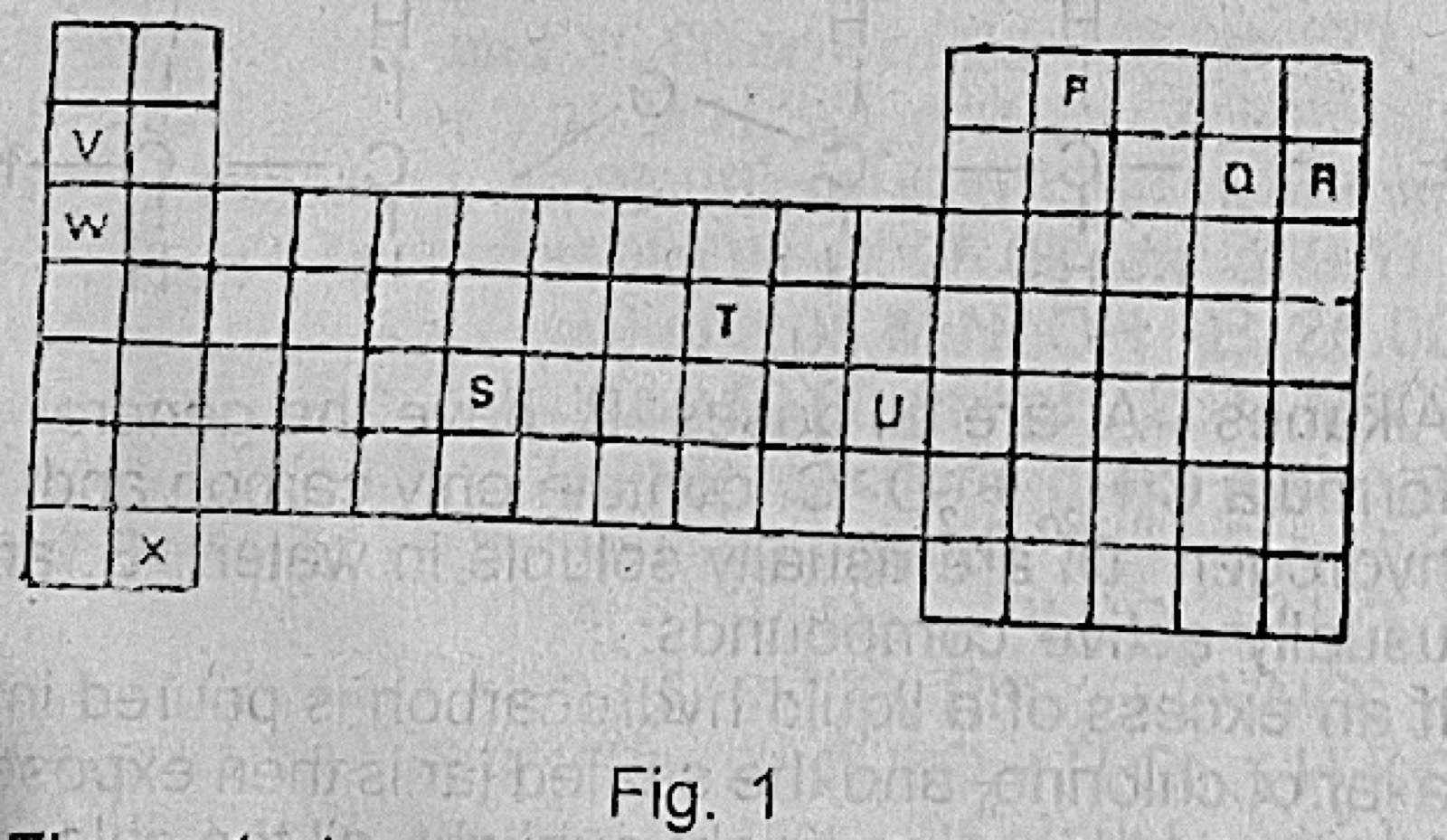
Figure 1 above shows part of the Periodic Table. Which of the elements belongs to the p-block?
A.S, T and U.
B.V, W and X
C.S and T only
D.P, Q and R
E.V, W, X and S
Show the answer and explanation
Answer: D (P, Q and R)
Explanation
The p-block is the block of six columns on the right of the Periodic Table (groups 3 to 0). Only P, Q and R are in that block; V, W and X are in the s-block and S, T and U are in the middle (d-block).
In an experiment, which of the following observations would suggest that a solid sample is a mixture? The
A.solid can be ground to a fine powder
B.density of the solid is 2.25 g dm−3
C.solid begins to melt at 573 K but is not completely melted until 648 K
D.solid absorbs moisture from the atmosphere and turns into a liquid
E.solid melts at 300 K.
Show the answer and explanation
Answer: C (solid begins to melt at 573 K but is not completely melted until 648 K)
Explanation
A pure solid melts sharply at one temperature. A sample that melts over a wide range of temperatures (573 K to 648 K) must contain more than one substance.
3.0 g of a mixture of potassium carbonate and potassium chloride were dissolved in a 250 cm3 standard flask. 25cm3 of this solution required 40.00 cm3 of 0.1 M HCl for neutralization. What is the percentage by weight of K2CO3 in the mixture (K = 39, O = 16, C = 12).
A.60
B.72
C.82
D.89
E.92
Show the answer and explanation
Answer: E (92)
Explanation
HCl used = 0.040 × 0.1 = 0.004 mol, which reacts with 0.002 mol of K2CO3 (K2CO3 + 2HCl). The whole 250 cm3 holds 0.02 mol × 138 g = 2.76 g, and 2.76/3.0 × 100 = 92%.
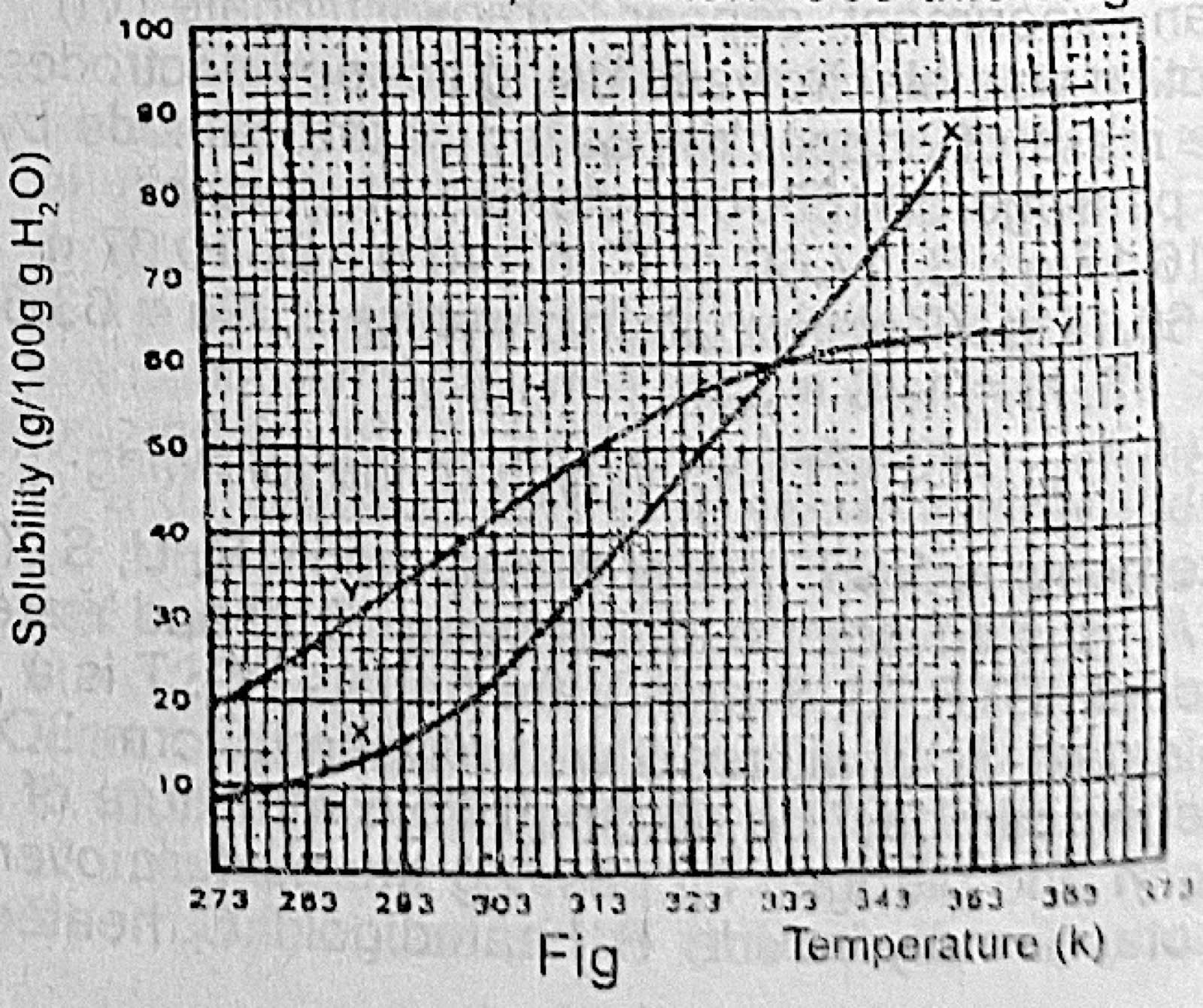
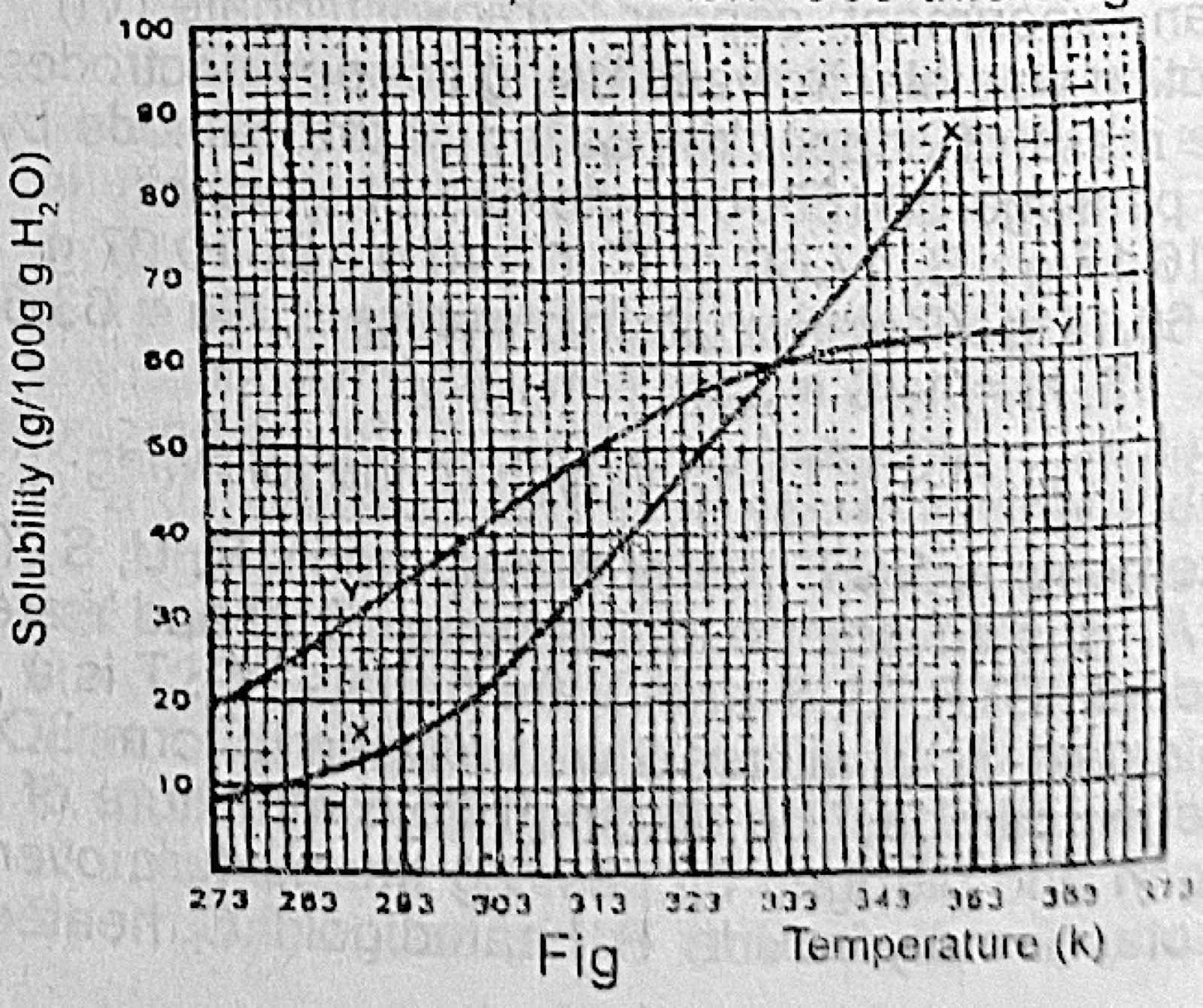
Figure 2 represents the solubility curves of two salts, X and Y, in water. If 80 g each of X and Y are taken up in 100 g of water at 353 K we shall have
A.only 10g of X undissolved
B.only 16 g of Y undissolved
C.10 g of X and 16 g of Y undissolved
D.all X and Y dissolved
E.all X and Y undissolved.
Show the answer and explanation
Answer: B (only 16 g of Y undissolved)
Explanation
At 353 K up to about 82 g of X dissolves in 100 g of water, so all 80 g of X dissolves. Only about 64 g of Y can dissolve, leaving 80 − 64 = 16 g of Y undissolved.
Figure 2 represents the solubility curves of two salts, X and Y, in water. If the molar mass of X is 36 g, the number of moles of X dissolved at 343 K is
A.0.2 moles
B.0.7 moles
C.1.5 moles
D.2.0 moles
E.3.0 moles
Show the answer and explanation
Answer: D (2.0 moles)
Explanation
From the graph, about 70 g of X dissolves in 100 g of water at 343 K. Moles = 70/36 ≈ 1.9, which is closest to 2.0 moles.
Some properties of chemical substances are mentioned below (i) sour taste (ii) slippery to touch (iii) yields alkaline gas with ammonium salts (iv) has pH less than 7 (v) turns phenolphthalein pink. Which of the above are NOT typical properties of alkalis?
A.(i), (iv) and (v)
B.(iv) and (v)
C.(i) and (iv)
D.(ii) and (v)
E.(ii), (iii) and (iv)
Show the answer and explanation
Answer: C ((i) and (iv))
Explanation
A sour taste and a pH below 7 are properties of acids. Alkalis feel slippery, release ammonia from ammonium salts and turn phenolphthalein pink.
Hydrogen is not liberated when trioxonitrate (V) acid reacts with zinc because
A.zinc is rendered passive by the acid
B.hydrogen produced is oxidized to water
C.oxides of nitrogen are produced
D.all nitrates are soluble in water
E.trioxonitrate (v) acid is a strong acid
Show the answer and explanation
Answer: B (hydrogen produced is oxidized to water)
Explanation
Trioxonitrate (V) acid is a powerful oxidising agent. Any hydrogen formed is at once oxidised to water, and the acid is reduced to oxides of nitrogen instead.
The boiling points of water, ethanol, toluene and butan-2-ol are 373. OK, 351.3K, 383.6 K and 372.5 K respectively. Which liquid has the highest vapour pressure at 323.0 K?
A.Water
B.Toluene
C.Ethanol
D.Butan-2-ol
E.None
Show the answer and explanation
Answer: C (Ethanol)
Explanation
The liquid with the lowest boiling point evaporates most easily, so at any temperature it has the highest vapour pressure. Ethanol boils lowest (351.3 K).
In what respect will two dry samples of nitrogen gas differ from each other if sample 1 is prepared by completely removing CO2 and O2 from air, and sample 2 is prepared by passing purified nitrogen (i) oxide over heated copper? Sample 1 is
A.purer than sample 2
B.slightly denser than sample 2
C.in all respects the same as sample 2
D.colourless but sample 2 has a light brown colour
E.slightly less reactive than sample 2.
Show the answer and explanation
Answer: B (slightly denser than sample 2)
Explanation
Nitrogen from air still contains about 1% of the noble gases, mainly argon, which is heavier than nitrogen. So it is slightly denser than pure nitrogen made chemically.
Copper sulphate solution is electrolysed using platinum electrodes. A current of 0.193 amperes is passed for 2 hrs. How many grams of copper are deposited? (Cu = 63.5, F = 96500 coulombs).
A.0.457 g
B.0.500 g
C.0.882 g
D.0.914 g
E.1.000 g.
Show the answer and explanation
Answer: A (0.457 g)
Explanation
Charge = 0.193 × 2 × 3600 = 1389.6 C. Cu2+ needs 2 × 96500 C per mole (63.5 g), so mass = 63.5 × 1389.6 / 193000 = 0.457 g.
X + Y ⇌ Z is an equilibrium reaction. The addition of a catalyst.
A.increases the amount of Z produced in a given time.
B.increases the rate of change in concentrations of X, Y and Z
C.increases the rate of disappearance of X and Y
D.increases the rate of the forward reaction
E.decreases the amounts of X and Y left after the attainment of equilibrium.
Show the answer and explanation
Answer: B (increases the rate of change in concentrations of X, Y and Z)
Explanation
A catalyst speeds up both the forward and backward reactions equally, so all the concentrations change faster and equilibrium is reached sooner. It does not change the amounts present at equilibrium.
If the ONLY pollutants found in the atmosphere over a city are oxides of nitrogen, suspended lead compounds. carbon monoxide and high levels of methane, the probable source(s) of the pollution must be
A.automobile exhaust and biological decomposition
B.combustion of coal and automobile exhaust
C.biological decomposition only
D.combustion of coal, automobile exhaust and biological decomposition
E.combustion of coal and biological decomposition
Show the answer and explanation
Answer: A (automobile exhaust and biological decomposition)
Explanation
Car exhaust gives oxides of nitrogen, lead compounds (from leaded petrol) and carbon monoxide; methane comes from rotting (biological decomposition). Coal burning would also give SO2, which is absent.
A certain industrial process is represented by the chemical equation 2A(g) + B(g) ⇌ C(g) + 3D(g) ΔH = X kJ mol−1. Which of the following conditions will favour the yield of the products?
A.increase in temperature, decrease in pressure
B.increase in temperature, increase in pressure
C.decrease in temperature, increase in pressure
D.decrease in temperature, decrease in pressure
E.constant temperature, increase in pressure.
Show the answer and explanation
Answer: A (increase in temperature, decrease in pressure)
Explanation
The products side has more gas molecules (4 against 3), so a lower pressure shifts the equilibrium to the right. Taking ΔH = +X (endothermic), a higher temperature also shifts it to the right.
In the reaction H2O(g) ⇌ H2(g) + ½O2(g) ΔH = −243600 kJ, which of the following has no effect on the equilibrium position?
A.Adding argon to the system
B.Lowering the temperature
C.Adding hydrogen to the system
D.Decreasing the pressure
E.Increasing the temperature
Show the answer and explanation
Answer: A (Adding argon to the system)
Explanation
Argon does not take part in the reaction and, added at constant volume, does not change the partial pressures of the reacting gases. Changing temperature, pressure or the amount of hydrogen all shift the equilibrium.
Which of the following metals will displace iron from a solution of iron (II) tetraoxosulphate (IV)?
A.Copper
B.Mercury
C.Silver
D.Zinc
E.Gold
Show the answer and explanation
Answer: D (Zinc)
Explanation
A metal displaces another from its salt only if it is higher in the electrochemical series. Zinc is above iron; copper, mercury, silver and gold are below it.
A man suspected of being drunk is made to pass his breath into acidified potassium dichromate solution. If his breath carries a significant level of ethanol, the final colour of the solution is
A.pink
B.purple
C.orange
D.blue-black
E.green
Show the answer and explanation
Answer: E (green)
Explanation
Ethanol reduces the orange dichromate (VI) ion to green chromium (III) ions, so the solution turns from orange to green.
The neutralization reaction between NaOH solution and nitrogen (IV) oxide (NO2) produces water and
A.NaNO2 and NaNO3
B.NaNO3 and HNO3
C.NaNO2
D.NaNO3
E.NaN2O4
Show the answer and explanation
Answer: A (NaNO2 and NaNO3)
Explanation
NO2 reacts with alkali as a mixture of two acids: 2NO2 + 2NaOH → NaNO2 + NaNO3 + H2O. Both sodium dioxonitrate (III) and sodium trioxonitrate (V) are formed.
Tetraoxosulphate (VI) ions are finally tested using
A.acidified silver nitrate
B.acidified barium chloride
C.lime-water
D.dilute hydrochloric acid
E.acidified lead nitrate
Show the answer and explanation
Answer: B (acidified barium chloride)
Explanation
Adding barium chloride acidified with dilute HCl to a sulphate solution gives a white precipitate of barium sulphate that does not dissolve in the acid.
The I.U.P.A.C name for the compound CH3—CH(CH3)—CH = CH—CH3 is
A.2-methyl-3-pentene
B.4-methyl-2-pentene
C.2-methyl-2-pentene
D.4-methyl-3-pentene
E.2-methyl-3-pentane
Show the answer and explanation
Answer: B (4-methyl-2-pentene)
Explanation
Number the five-carbon chain from the end nearer the double bond: the double bond starts at carbon 2 and the methyl group is on carbon 4, giving 4-methylpent-2-ene (4-methyl-2-pentene).
An organic compound decolorized acidified KMnO4 solution but failed to react with ammoniacal silver nitrate solution. The organic compound is likely to be
A.a carboxylic acid
B.an alkane
C.an alkene
D.an alkyne
E.an alkanone
Show the answer and explanation
Answer: C (an alkene)
Explanation
Decolourising KMnO4 shows a C=C or C≡C bond. Alkynes like ethyne give a precipitate with ammoniacal silver nitrate, alkenes do not, so it is an alkene.
A colourless organic compound X was burnt in excess air to give two colourless and odourless gases, Y and Z, as products. X does not decolorize bromine vapour, Y turns lime milky while Z gives a blue colour with copper (II) tetraoxosulphate (VI). Compound X is
A.an alkene
B.an alkane
C.an alkyne
D.tetrachloromethane
E.dichloromethane
Show the answer and explanation
Answer: B (an alkane)
Explanation
Burning gives only CO2 (turns limewater milky) and water (turns anhydrous CuSO4 blue), so X is a hydrocarbon. It does not decolourise bromine, so it is saturated: an alkane.
A colourless organic compound X was burnt in excess air to give two colourless and odourless gases, Y and Z, as products. X does not decolorize bromine vapour, Y turns lime milky while Z gives a blue colour with copper (II) tetraoxosulphate (VI). Y and Z are respectively
A.CO2 and NH3
B.CO and NH3
C.SO2 and H2O
D.CO2 and H2O
E.SO2 and NH3.
Show the answer and explanation
Answer: D (CO2 and H2O)
Explanation
Y turns limewater milky, so it is CO2. Z turns white anhydrous copper (II) sulphate blue, so it is water vapour.
Which of the following compounds is NOT the correct product formed when the parent metal is heated in air?
A.Calcium oxide (CaO)
B.Sodium oxide (Na2O)
C.Copper (II) oxide (CuO)
D.Tri-iron tetroxide (Fe3O4)
E.Aluminium oxide (Al2O3).
Show the answer and explanation
Answer: B (Sodium oxide (Na2O))
Explanation
Heated iron forms tri-iron tetroxide, and calcium, copper and aluminium form the oxides listed. Sodium burns in air to give mainly sodium peroxide, Na2O2, not Na2O.
When marble is heated to about 1473 K, another white solid is obtained which reacts vigorously with water to give an alkaline solution. The solution contains
A.NaOH
B.KOH
C.Mg(OH)2
D.Zn(OH)2
E.Ca(OH)2.
Show the answer and explanation
Answer: E (Ca(OH)2.)
Explanation
Marble (CaCO3) decomposes to quicklime, CaO. Quicklime reacts vigorously with water to give calcium hydroxide, Ca(OH)2.
Addition of dilute hydrochloric acid to an aqueous solution of a crystalline salt yielded a yellow precipitate and a gas which turned dichromate paper green. The crystalline salt was probably
A.Na2SO4
B.Na2S
C.Na2S2O3.5H2O
D.Na2CO3
E.NaHCO3.
Show the answer and explanation
Answer: C (Na2S2O3.5H2O)
Explanation
Acid decomposes sodium thiosulphate into a yellow precipitate of sulphur and sulphur (IV) oxide gas. SO2 turns orange dichromate paper green.
An aqueous solution of an inorganic salt gave white precipitate (i) soluble in excess aqueous NaOH (ii) insoluble in excess aqueous NH3 (iii) with dilute HCl. The cation present in the inorganic salt is
A.NH4+
B.Ca2+
C.Zn2+
D.Al3+
E.Pb2+.
Show the answer and explanation
Answer: E (Pb2+.)
Explanation
Lead (II) ions give a white Pb(OH)2 precipitate that dissolves in excess NaOH but not in excess ammonia, and dilute HCl gives white lead (II) chloride. Al3+ gives no precipitate with HCl.
Which of the following roles does sodium chloride play in soap preparation? It
A.reacts with glycerol
B.purifies the soap
C.accelerates the decomposition of the fat or oil
D.separates the soap from the glycerol
E.converts the fatty acid to its sodium salt.
Show the answer and explanation
Answer: D (separates the soap from the glycerol)
Explanation
Soap is less soluble in strong salt solution, so adding NaCl makes the soap come out of the mixture while the glycerol stays dissolved. This is called salting out.