Home › Past questions › JAMB › Biology › 2014 45 questions. Try each one, then open the answer to check yourself and read the explanation.
Sign up free to answer these questions on a CBT screen with a timer, then see your score and every answer explained.
Start practising free
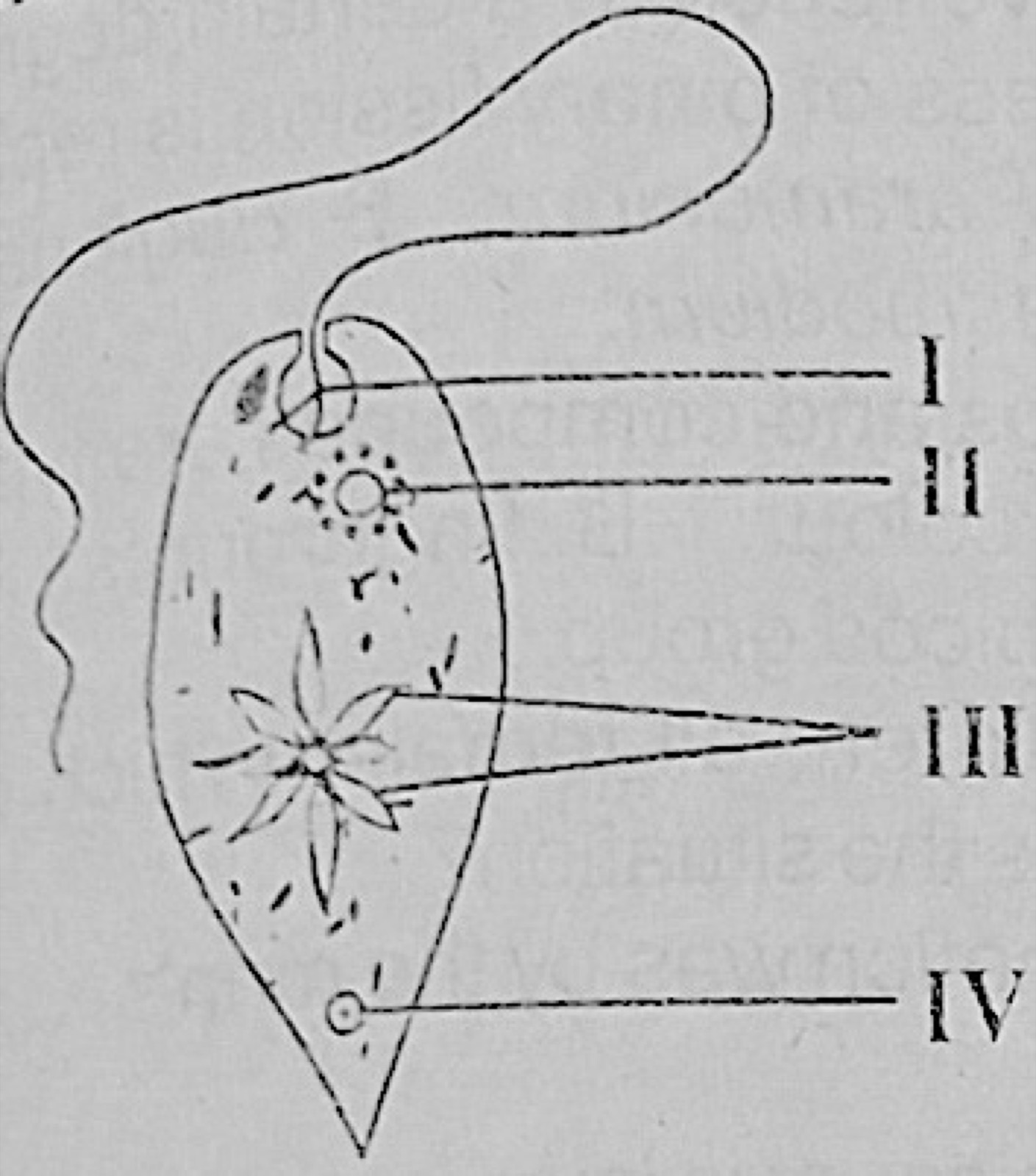
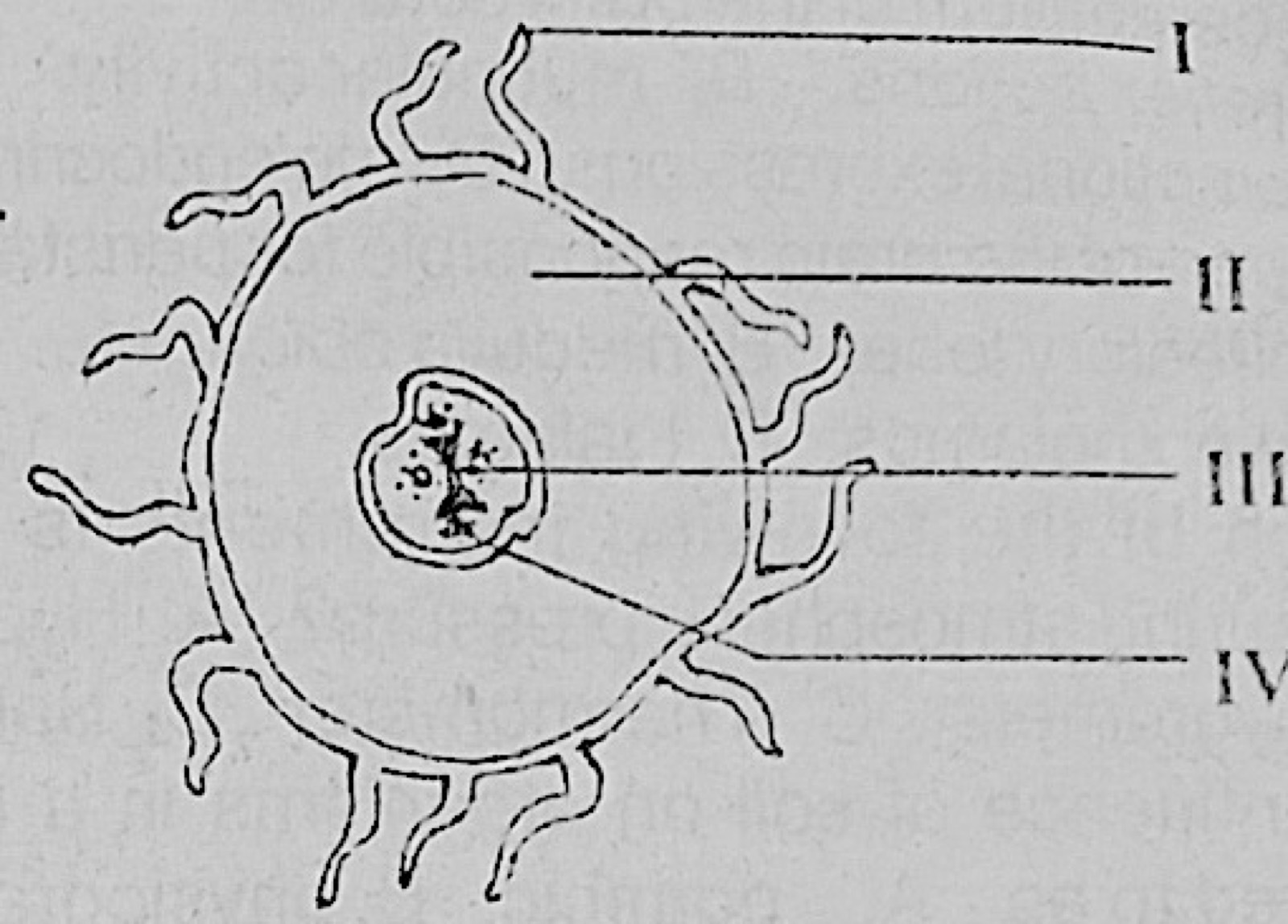
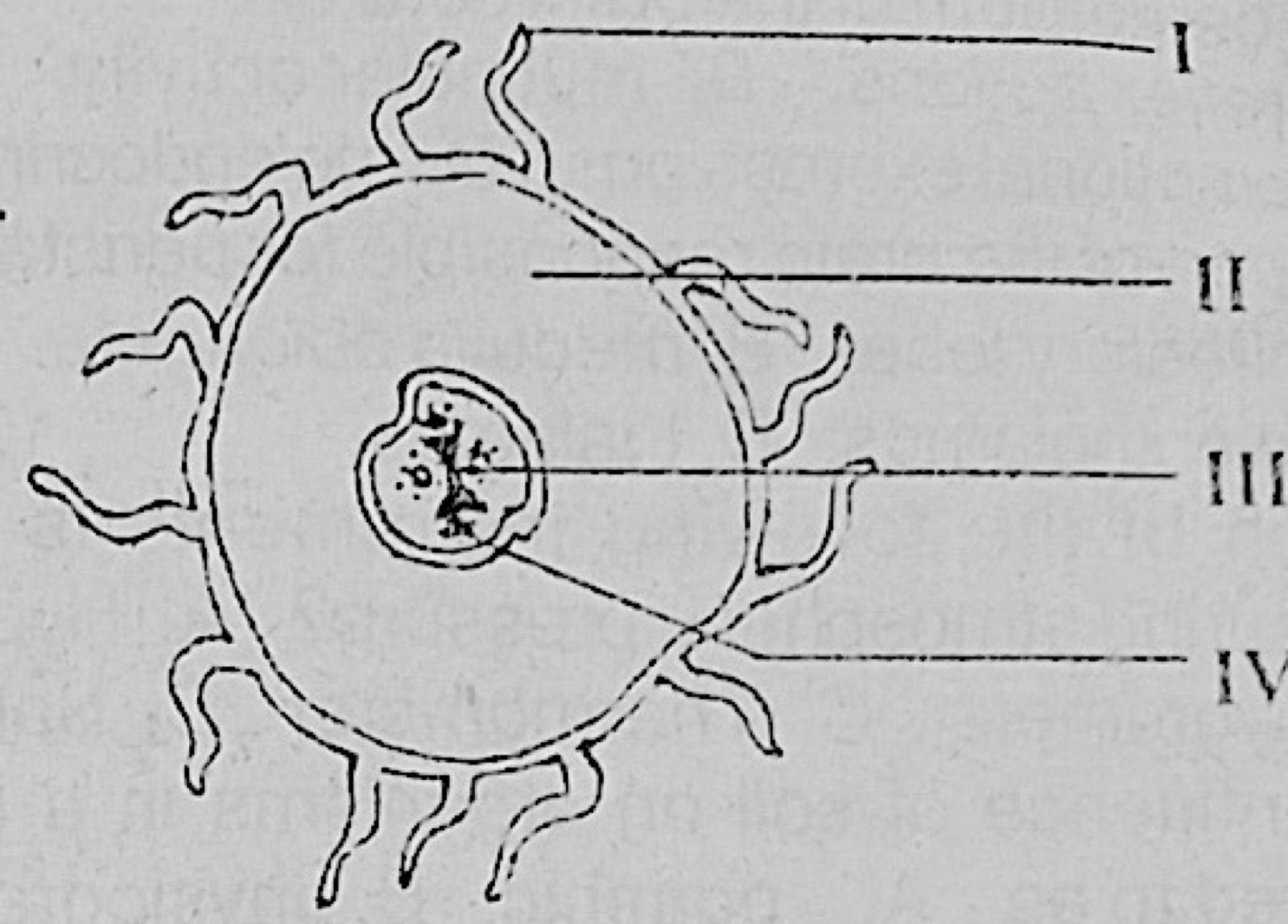
Question 2 Viruses, Monera, Protista and Fungi Use the diagram to answer: The part labelled II is the
A. nucleus. B. eyespot. C. basal granule. D. contractile vacuole. Show the answer and explanation Answer: D (contractile vacuole. )
Explanation The diagram is Euglena ; II points to the round vacuole with small feeding canals around it, the contractile vacuole that pumps out excess water.
Open this question
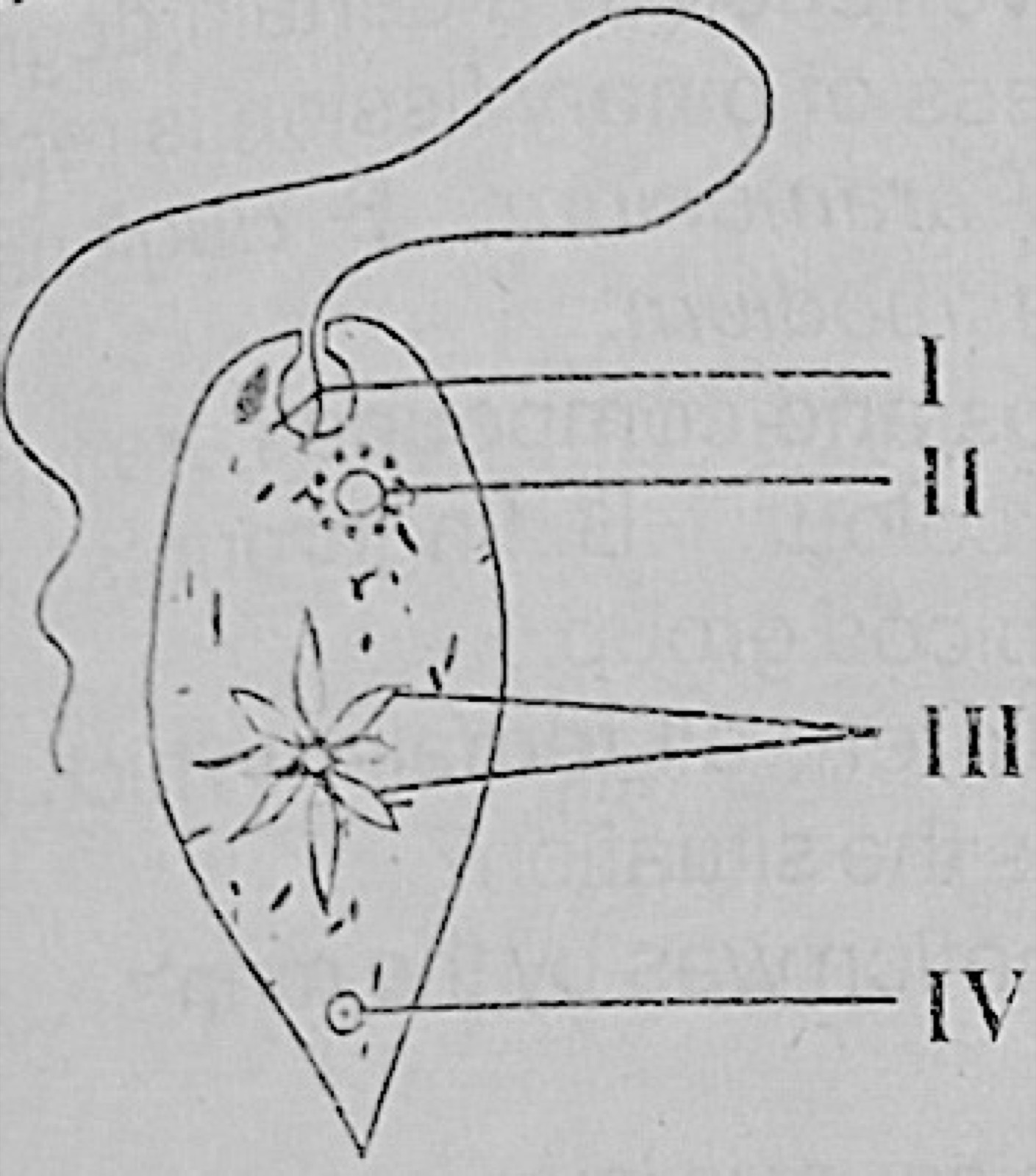
Question 3 Viruses, Monera, Protista and Fungi Use the diagram to answer: The part responsible for photosynthesis is labelled
A. III. B. IV. C. I. D. II. Show the answer and explanation Answer: A (III. )
Explanation III points to the star-shaped chloroplasts, which contain chlorophyll and carry out photosynthesis.
Open this question
Question 4 Cell Structure and Organisation The lowest level of organization in living organisms is
A. organ. B. cell. C. system. D. tissue. Show the answer and explanation Answer: B (cell. )
Explanation The levels go cell → tissue → organ → system → organism, so the cell is the lowest (simplest) level.
Open this question
Question 5 Cell Structure and Organisation Which of the following is the most complex according to their cellular level of organization?
A. Heart. B. Hair. C. Euglena .D. Hydra .Show the answer and explanation Answer: A (Heart. )
Explanation The heart is an organ made of several tissues, the highest level here. Euglena is a single cell and Hydra is at the tissue level.
Open this question
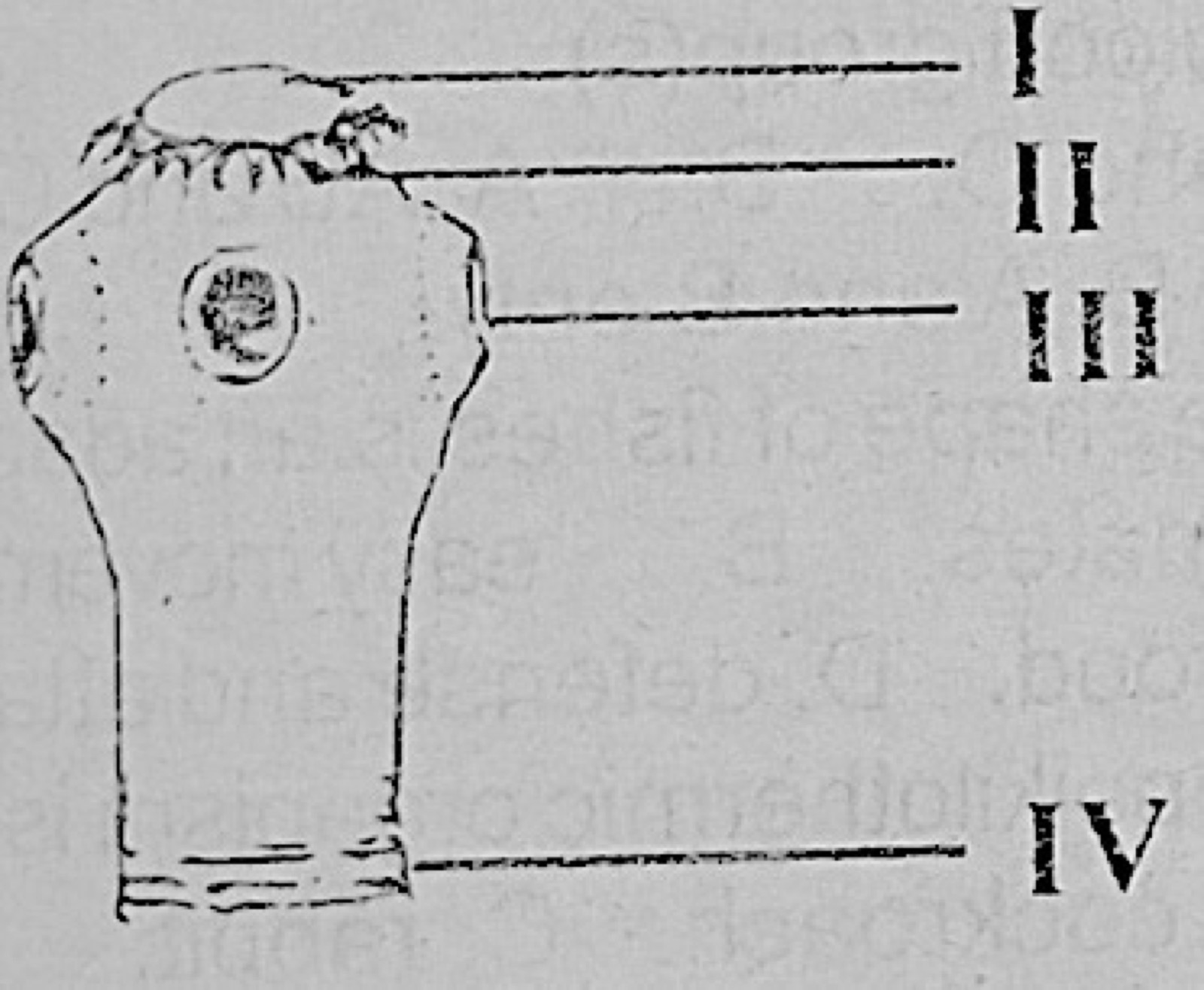
Question 6 Animal Kingdom Use the diagram to answer: The organs for attachment to the lining of the host's intestine are labelled
A. II and III. B. III and IV. C. I and II. D. I and III. Show the answer and explanation Answer: A (II and III. )
Explanation The diagram is the head (scolex) of a tapeworm: II is the ring of hooks and III is a sucker, both used to hold on to the intestine wall.
Open this question
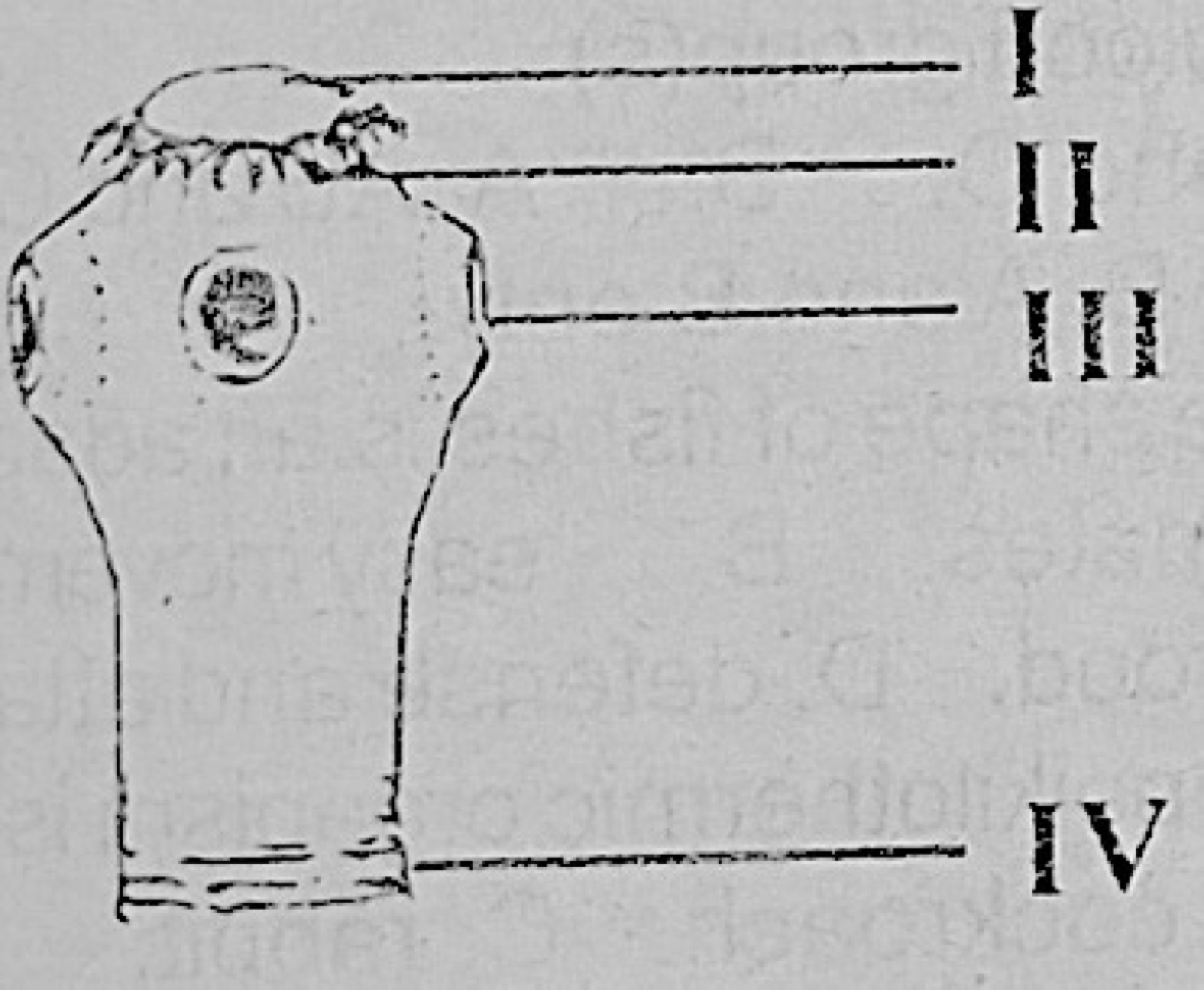
Question 7 Animal Kingdom Use the diagram to answer: The young proglottid is represented by
A. III. B. IV. C. I. D. II. Show the answer and explanation Answer: B (IV. )
Explanation New proglottids are budded off just behind the neck, so the youngest segment is the one at IV, nearest the head.
Open this question
Question 8 Viruses, Monera, Protista and Fungi Which of the following organisms is multicellular?
A. Chlamydomonas .B. Spirogyra .C. Amoeba .D. Euglena .Show the answer and explanation Answer: B (Spirogyra .
Explanation Spirogyra is a filament made of many cells joined end to end. The other three are single-celled.
Open this question
Question 10 Plant Kingdom Seed plants are the most dominant vegetation on land because of
A. their motile gametes. B. their ability to photosynthesize. C. efficient seed dispersal. D. availability of water. Show the answer and explanation Answer: C (efficient seed dispersal. )
Explanation Seeds protect the embryo and are spread widely by wind, animals and water, so seed plants can colonise most land areas. All plants photosynthesise, so that does not explain it.
Open this question
Question 11 Adaptation Which of the following is an aboreal organism?
A. Elephant. B. Fish. C. Antelope. D. Bird. Show the answer and explanation Answer: D (Bird. )
Explanation Arboreal means living in trees; birds nest and perch in trees, unlike the others.
Open this question
Question 12 Structure of Flowering Plants Use the diagram to answer: The part labelled I is the
A. xylem. B. phloem. C. root hairs. D. cortex. Show the answer and explanation Answer: C (root hairs. )
Explanation I points to the thin outgrowths on the outer surface of the root, the root hairs, which absorb water and mineral salts.
Open this question
Question 13 Structure of Flowering Plants Use the diagram to answer: The diagram is the transverse section of a
A. Monocotyledonous stem. B. Dicotyledonous stem. C. Monocotyledonous root. D. Dicotyledonous root. Show the answer and explanation Answer: D (Dicotyledonous root. )
Explanation Root hairs show it is a root, and the small central star-shaped vascular core without a large pith is typical of a dicotyledonous root.
Open this question
Question 14 Animal Nutrition i 2/1, c 0/0, pm 3/2, m 3/3
A. an omnivore. B. a detritus feeder. C. a carnivore. D. a herbivore. Show the answer and explanation Answer: D (a herbivore. )
Explanation There are no canines (c 0/0) and many premolars and molars for grinding; this is the rabbit's formula, a herbivore.
Open this question
Question 15 Transport in Animals A circulatory system is very essential in mammals but not in smaller organisms like Amoeba because
A. Amoeba lives in freshwater.B. diffusion is sufficient to transport materials in Amoeba . C. Amoeba lacks bood, containing haemoglobin.D. Amoeba exhibits anaerobic respiration.Show the answer and explanation Answer: B (diffusion is sufficient to transport materials in Amoeba . )
Explanation Amoeba is tiny with a large surface area to volume ratio, so diffusion alone moves materials fast enough; large mammals need a transport system.
Open this question
Question 16 Transport in Plants In vascular plants, the sieve tubes and companion cells are present in the
A. cambium. B. cortex. C. xylem. D. phloem. Show the answer and explanation Answer: D (phloem. )
Explanation Phloem is made of sieve tubes and companion cells and carries manufactured food.
Open this question
Question 17 Respiration The stomata of leaves are similar in function to the
A. pharynx of humans. B. scales of fish. C. spiracle of insects. D. trachea of toads. Show the answer and explanation Answer: C (spiracle of insects. )
Explanation Stomata and spiracles are both small openings on the surface through which gases enter and leave.
Open this question
Question 18 Respiration The use of moist skin for respiration in amphibians is known as
A. cellular respiration. B. cutaneous respiration. C. buccal respiration. D. pulmonary respiration. Show the answer and explanation Answer: B (cutaneous respiration. )
Explanation Cutaneous means 'of the skin'; frogs and toads exchange gases through their thin, moist skin. Buccal is through the mouth lining, pulmonary through the lungs.
Open this question
Question 19 Transport in Plants Water in plants is removed as water vapour through the process of
A. diffusion. B. osmosis. C. evaporation. D. transpiration. Show the answer and explanation Answer: D (transpiration. )
Explanation Transpiration is the loss of water vapour from plants, mainly through the stomata of the leaves.
Open this question
Question 20 Reproduction in Plants An example of an organ of perennation in plants is
A. rhizome. B. seed. C. petal of a flower. D. calyx of flower. Show the answer and explanation Answer: A (rhizome. )
Explanation Organs of perennation store food and let a plant survive bad seasons and sprout again; the rhizome (e.g. ginger) is an underground stem that does this.
Open this question
Question 21 Plant Kingdom Alternation of generation is a feature shown in
A. mosses. B. fungi. C. grasses. D. conifers. Show the answer and explanation Answer: A (mosses. )
Explanation Mosses clearly alternate between a gametophyte generation (the leafy plant) and a sporophyte generation (the capsule on a stalk).
Open this question
Question 22 Growth and Development I Growth is mainly apical.
A. I, II and III only. B. II and III only. C. I and II only. D. I and III only. Show the answer and explanation Answer: D (I and III only. )
Explanation Plants grow mainly at the tips of roots and shoots (apical meristems) and keep growing all their lives. Growth with a fixed, definite shape is typical of animals.
Open this question
Question 23 Nervous Coordination Coordination and regulation of body activities in mammals are achieved by the
A. nerves and muscles. B. nerves and hormones. C. nerves only. D. hormones only. Show the answer and explanation Answer: B (nerves and hormones. )
Explanation Mammals use two coordinating systems: the nervous system (fast nerve impulses) and the endocrine system (hormones).
Open this question
Question 24 Nervous Coordination The cerebellum of the brain controls
A. reflex actions. B. muscular activity. C. emotional expressions. D. the endocrine system. Show the answer and explanation Answer: B (muscular activity. )
Explanation The cerebellum coordinates muscular activity, keeping movements smooth and the body balanced.
Open this question
Question 25 Nervous Coordination The part of the brain responsible for peristalsis is the
A. olfactory lobe. B. medulla oblongata. C. hypothalamus. D. thalamus. Show the answer and explanation Answer: B (medulla oblongata. )
Explanation The medulla oblongata controls involuntary actions such as heartbeat, breathing and peristalsis.
Open this question
Question 26 Ecosystem and Ecological Factors Which of the following instruments is used for measuring atmospheric pressure?
A. Hydrometer. B. Hygrometer. C. Thermometer. D. Barometer. Show the answer and explanation Answer: D (Barometer. )
Explanation A barometer measures air pressure. A hygrometer measures humidity and a hydrometer measures the density of liquids.
Open this question
Question 27 Ecosystem and Ecological Factors The influence of soil on organisms in a habitat is referred to as
A. edaphic. B. physiographic. C. biotic. D. topographic. Show the answer and explanation Answer: A (edaphic. )
Explanation Edaphic factors are soil factors such as texture, pH and water content. Biotic factors come from other living organisms.
Open this question
Question 28 Mendelian Inheritance The genetic make-up of an organism is described as
A. allele. B. chromosome. C. phenotype. D. genotype. Show the answer and explanation Answer: D (genotype. )
Explanation Genotype is the set of genes an organism carries; phenotype is how it actually looks.
Open this question
Question 29 Habitats and Biomes The major limiting factor of productivity in the aquatic habitat is
A. food. B. temperature. C. water. D. sunlight. Show the answer and explanation Answer: D (sunlight. )
Explanation Light fades quickly with depth in water, so photosynthesis by plankton, the base of productivity, is limited mainly by sunlight.
Open this question
Question 30 Feeding Relationships and Energy Flow Which of the following group of organisms feeds directly on green plants?
A. Primary consumers. B. Secondary consumers. C. Producers. D. Decomposers. Show the answer and explanation Answer: A (Primary consumers. )
Explanation Primary consumers are herbivores that eat green plants (producers) directly. Secondary consumers eat the herbivores.
Open this question
Question 31 Habitats and Biomes A characteristic feature of tropical rainforest is that it
A. contains trees with narrow leaves. B. contains large number of plant species. C. contains fewer number of plants species. D. has total annual rainfall of less than 50cm. Show the answer and explanation Answer: B (contains large number of plant species. )
Explanation The warm, wet tropical rainforest has the greatest variety of plant species of any land biome; its trees mostly have broad leaves and rainfall is very high.
Open this question
Question 32 Population Ecology The study of how and why population size change over time is
A. population estimation. B. population dynamics. C. population ecology. D. population cycles. Show the answer and explanation Answer: B (population dynamics. )
Explanation Population dynamics studies changes in population size and the births, deaths and migration that cause them.
Open this question
Question 33 Habitats and Biomes A severe and long dry season is a characteristics feature of
A. Sahel savanna. B. Mangrove swamps. C. Sudan savanna. D. Guinea savanna. Show the answer and explanation Answer: A (Sahel savanna. )
Explanation The Sahel savanna in the far north has the lowest rainfall and the longest dry season (about 8-9 months) of Nigeria's vegetation zones.
Open this question
Question 34 Nutrient Cycling Which of the following is a nitrogen-fixing blue-green algae soil?
A. Rhizobium .B. Nitrosomonas .C. Clostridium .D. Anabaena .Show the answer and explanation Answer: D (Anabaena .
Explanation Anabaena is a blue-green alga that fixes nitrogen. Rhizobium and Clostridium are nitrogen-fixing bacteria, and Nitrosomonas is a nitrifying bacterium.
Open this question
Question 35 Soil The soil with the highest water-retaining capacity is
A. clayey soil. B. stoney soil. C. sandy soil. D. loamy soil. Show the answer and explanation Answer: A (clayey soil. )
Explanation Clay has very fine particles with tiny pore spaces, so it holds water strongly and retains the most water.
Open this question
Question 36 Microorganisms and Health The causative agent of poliomyelitis is
A. virus. B. fungus. C. protozoan. D. bacterium. Show the answer and explanation Answer: A (virus. )
Explanation Poliomyelitis (polio) is caused by the polio virus, which is why it is prevented by vaccination.
Open this question
Question 37 Pollution One of the ways of controlling noise pollution in urban areas is
A. by siting industries away from residential areas. B. that fuel should be completely combusted by engines. C. by planting trees on both sides of the road. D. by wearing ear devices. Show the answer and explanation Answer: A (by siting industries away from residential areas. )
Explanation Placing noisy factories far from where people live removes the source of noise from homes; complete combustion of fuel reduces air pollution, not noise.
Open this question
Question 38 Pollution A constituent of the exhaust fumes from electricity generating sets which causes serious air pollution is
A. carbon(II)oxide. B. water vapour. C. ozone. D. carbon(IV)oxide. Show the answer and explanation Answer: A (carbon(II)oxide. )
Explanation Generators burn fuel incompletely and release carbon(II) oxide (carbon monoxide), a poisonous gas that combines with haemoglobin and can kill.
Open this question
Question 39 Microorganisms and Health Which of the following is true of smallpox?
A. It is transmitted by bacteria. B. It can effectively be controlled with antibiotics. C. It can effectively be controlled by vaccination. D. It is a waterborne infection. Show the answer and explanation Answer: C (It can effectively be controlled by vaccination. )
Explanation Smallpox is caused by a virus, so antibiotics have no effect on it. Worldwide vaccination wiped the disease out.
Open this question
Question 40 Pollution A pollutant that is mostly associated with acid rain is
A. nitrogen(IV)oxide. B. ozone. C. fluorine. D. carbon(IV)oxide. Show the answer and explanation Answer: A (nitrogen(IV)oxide. )
Explanation Nitrogen(IV) oxide (and sulphur(IV) oxide) dissolve in rain water to form strong acids, giving acid rain.
Open this question
Question 41 Reproduction in Animals When the adults have reached a certain degree of weakness, the process of binary fission is replaced by conjugation in
A. Paramecium .B. Euglena .C. Amoeba .D. Plasmodium .Show the answer and explanation Answer: A (Paramecium .
Explanation Paramecium normally divides by binary fission, but after many divisions two individuals pair up and exchange nuclear material (conjugation), which renews their vigour.
Open this question
Question 42 Variation Whorls, arches, loops and compounds are types of variation in
A. eye colour. B. fingerprints. C. hair colour. D. blood group. Show the answer and explanation Answer: B (fingerprints. )
Explanation Fingerprint ridges form patterns called whorls, arches, loops and compounds.
Open this question
Question 43 Chromosomes, DNA and Sex Linkage A couple has 10 children, all female. Which of the following best explains the situation?
A. The sex determination was by the man's X chromosome. B. The man's sperm count is low. C. The woman is not capable of producing male children. D. The sex determination was by the man's Y chromosome. Show the answer and explanation Answer: A (The sex determination was by the man's X chromosome. )
Explanation The mother always gives an X; a child is female when the father's sperm also carries an X. So each daughter came from a sperm with the man's X chromosome.
Open this question
Question 44 Microorganisms and Health A biological agent with antiviral property is
A. interferon. B. enzyme. C. antibiotic. D. disinfectant. Show the answer and explanation Answer: A (interferon. )
Explanation Interferon is a protein made by infected cells that protects neighbouring cells from viruses. Antibiotics kill bacteria but not viruses.
Open this question
Question 46 Transport in Animals An individual with blood group AB can receive blood from those in blood group(s)
A. A, B, AB and O. B. A, AB and O only. C. AB only. D. A and B only. Show the answer and explanation Answer: A (A, B, AB and O. )
Explanation Group AB plasma has no anti-A or anti-B antibodies, so it can accept blood of every group; AB is the universal recipient.
Open this question
Question 47 Adaptation The streamline shape of fishes is an adaptation for
A. securing mates. B. easy movement. C. obtaining food. D. defense and attack. Show the answer and explanation Answer: B (easy movement. )
Explanation A streamlined body, tapered at both ends, reduces water resistance so the fish moves easily through water.
Open this question
Question 49 Evolution All living organisms are constantly involved in a struggle for existence. This was proposed by
A. Morgan. B. Darwin. C. Lamarck. D. Wallace. Show the answer and explanation Answer: B (Darwin. )
Explanation The struggle for existence is part of Darwin's theory of natural selection: more young are born than can survive, so they compete.
Open this question Sign up free for every JAMB Biology year, practice by topic and timed mocks.
Start practising free