Home › Past questions › JAMB › Biology › 2013 46 questions. Try each one, then open the answer to check yourself and read the explanation.
Sign up free to answer these questions on a CBT screen with a timer, then see your score and every answer explained.
Start practising free
Question 2 Food Substances and Enzymes The process in which complex substances are broken down into simpler ones is referred to as
A. catabolism. B. metabolism. C. tropism. D. anabolism. Show the answer and explanation Answer: A (catabolism. )
Explanation Catabolism is the breakdown part of metabolism (e.g. respiration), while anabolism builds complex substances up. Tropism is a plant growth movement, not a chemical process.
Open this question
Question 3 Viruses, Monera, Protista and Fungi The organ which is sensitive to light in Euglena is the
A. flagellum. B. chloroplast. C. eyespot. D. gullet Show the answer and explanation Answer: C (eyespot. )
Explanation Euglena has a red eyespot near the base of its flagellum that detects light, so it can swim towards light for photosynthesis.
Open this question
Question 5 Animal Kingdom Taenia solium can be found in
A. goat. B. dog. C. pig. D. cow. Show the answer and explanation Answer: C (pig. )
Explanation Taenia solium is the pork tapeworm: its larval stage lives in the muscles of the pig, which is its secondary host.
Open this question
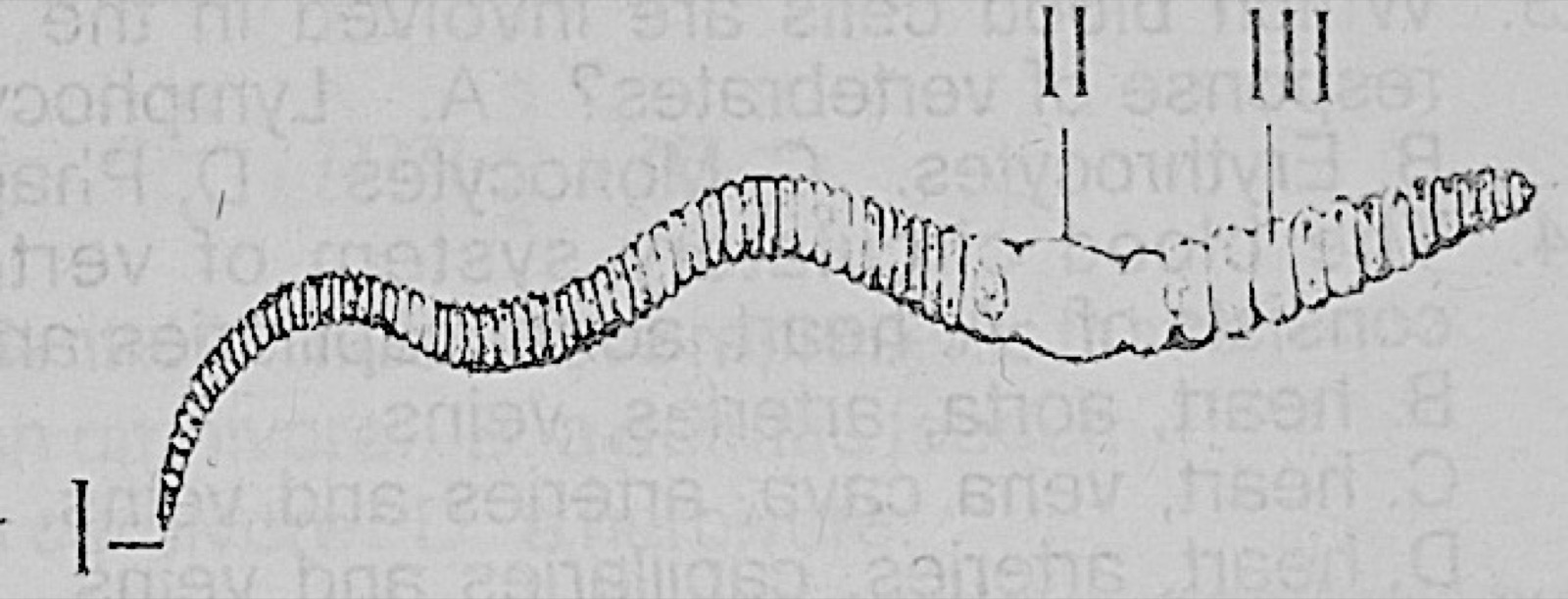
Question 6 Animal Kingdom Use the diagram to answer: The structure labelled II is the
A. cocoon. B. clitellum. C. chaetae. D. spermathecal pore. Show the answer and explanation Answer: B (clitellum. )
Explanation The diagram shows an earthworm; II points to the thick swollen band near the front, the clitellum, which secretes the cocoon.
Open this question
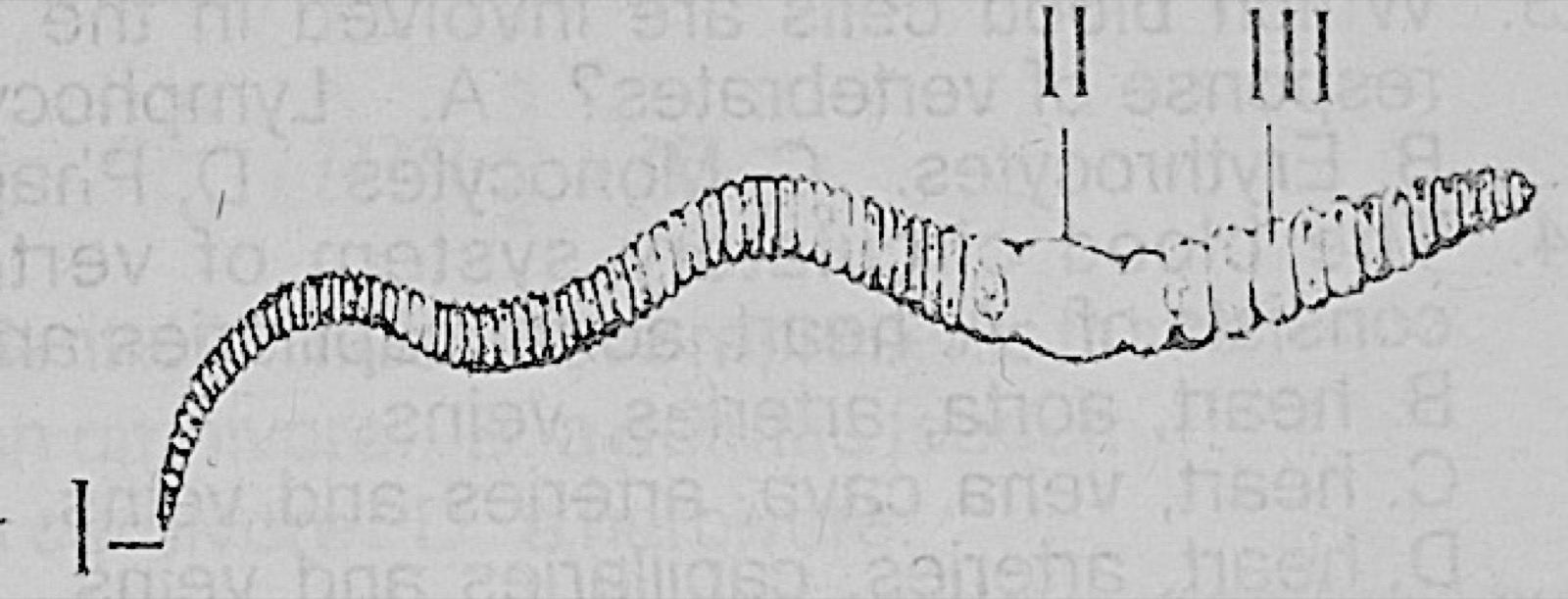
Question 7 Soil Use the diagram to answer: The organism is found in soils rich in
A. humus. B. clay. C. sand. D. mud. Show the answer and explanation Answer: A (humus. )
Explanation The earthworm feeds on decaying organic matter and needs moist soil, so it is found in soil rich in humus.
Open this question
Question 8 Animal Kingdom Which of the following describes a characteristic of anthropods?
A. The organism has a pair of jointed appendages. B. The body is not divided into a number of segments. C. The body is covered by chitin. D. The organism finds it easy to grow freely. Show the answer and explanation Answer: C (The body is covered by chitin. )
Explanation Arthropods have an exoskeleton made of chitin; they have many pairs of jointed limbs, segmented bodies, and must moult to grow.
Open this question
Question 9 Animal Kingdom Which of the following distinguishes a butterfly from a moth?
A. Both are active during the day. B. They have similar antennae. C. The abdomen of a moth is fatter than that of a butterfly. D. The wings of a butterfly rest horizontally but those of a moth rest vertically. Show the answer and explanation Answer: C (The abdomen of a moth is fatter than that of a butterfly. )
Explanation Moths have stout, hairy, fat abdomens, while butterflies are slender. Moths are active at night, the antennae differ, and it is the moth that rests with wings spread flat.
Open this question
Question 10 Animal Kingdom Which of the following types of feathers is used for flight in birds?
A. Filoplume. B. Covert. C. Down. D. Quill. Show the answer and explanation Answer: D (Quill. )
Explanation Quill feathers on the wings and tail are long and stiff and push against the air in flight. Down feathers keep the bird warm.
Open this question
Question 11 Adaptation The plants that grow in deserts or very dry areas are referred to as
A. hydrophytes. B. epiphytes. C. xerophytes. D. mesophytes. Show the answer and explanation Answer: C (xerophytes. )
Explanation Xerophytes are plants adapted to very dry places, such as cactus. Hydrophytes live in water and mesophytes in moderately wet places.
Open this question
Question 12 Viruses, Monera, Protista and Fungi Which of the following is the simplest living organism?
A. Virus. B. Amoeba .C. Chlamydomonas .D. Paramecium. Show the answer and explanation Answer: A (Virus. )
Explanation A virus is just genetic material in a protein coat with no cell at all, so it is simpler than any single-celled organism.
Open this question
Question 13 Animal Nutrition Proboscis is a structure that is mostly found in
A. tapeworms. B. amphibians. C. molluscs. D. insects. Show the answer and explanation Answer: D (insects. )
Explanation A proboscis is a long tube-like mouthpart for sucking, found in insects such as butterflies, mosquitoes and houseflies.
Open this question
Question 14 Adaptation The structural adaptation of desert plants for water conservation is
A. spongy mesophyll. B. spiny leaves. C. prominent stomata in leaves. D. broad leaves with numerous stomata. Show the answer and explanation Answer: B (spiny leaves. )
Explanation Leaves reduced to spines have very little surface, so the plant loses much less water by transpiration.
Open this question
Question 15 Adaptation The long and sharp clawed feet of birds is an adaptation for
A. scooping mud. B. tearing flesh. C. grasping prey. D. crushing seeds. Show the answer and explanation Answer: C (grasping prey. )
Explanation Birds of prey such as hawks use their long, sharp claws (talons) to seize and hold their prey; the beak is used for tearing.
Open this question
Question 16 Photosynthesis and Plant Nutrition During the manufacture of food by plants, which of the following organisms use energy from the sun?
A. Sulfur bacteria. B. Nitrosomonas sp. C. Nitrobacter sp .D. Anabaena .Show the answer and explanation Answer: D (Anabaena .
Explanation Anabaena is a blue-green alga with chlorophyll, so it makes food using light energy. Nitrosomonas , Nitrobacter and sulfur bacteria get their energy from chemical reactions (chemosynthesis).
Open this question
Question 17 Transport in Plants Movement of minerals and chemical compounds within a plant occurs during
A. translocation. B. transpiration. C. diffusion. D. osmosis. Show the answer and explanation Answer: A (translocation. )
Explanation Translocation is the movement of dissolved substances such as sugars and minerals from one part of a plant to another.
Open this question
Question 18 Animal Nutrition The enzyme that is present in the saliva is
A. lipase. B. pepsin. C. ptyalin. D. rennin. Show the answer and explanation Answer: C (ptyalin. )
Explanation Saliva contains ptyalin (salivary amylase), which starts the digestion of starch in the mouth. Pepsin and rennin work in the stomach.
Open this question
Question 19 Photosynthesis and Plant Nutrition Plants that have special devices for trapping and digesting insects are
A. symbiotic. B. parasitic. C. saprophytic. D. carnivorous. Show the answer and explanation Answer: D (carnivorous. )
Explanation Insectivorous (carnivorous) plants like sundew and pitcher plant trap insects and digest them to get nitrogen.
Open this question
Question 20 Respiration The process of transforming the chemical energy of cellular fuels into high energy bonds of ATP in plants is
A. photosynthesis. B. photolysis. C. respiration. D. autotrophism. Show the answer and explanation Answer: C (respiration. )
Explanation Respiration breaks down food such as glucose and stores the energy released in ATP. Photosynthesis does the opposite job, trapping light energy in food.
Open this question
Question 21 Viruses, Monera, Protista and Fungi Fungi are referred to as heterotrophs because they
A. lack chlorophyll. B. have mycelium. C. lack roots. D. are filamentous. Show the answer and explanation Answer: A (lack chlorophyll. )
Explanation Without chlorophyll fungi cannot make their own food, so they must feed on other organic matter, which makes them heterotrophs.
Open this question
Question 22 Viruses, Monera, Protista and Fungi An example of a parasitic protozoan is
A. Plasmodium .B. Euglena .C. Chlamydomonas .D. Paramecium .Show the answer and explanation Answer: A (Plasmodium .
Explanation Plasmodium lives in human blood and liver cells and causes malaria. The others are free-living.
Open this question
Question 23 Transport in Animals Which blood cells are involved in the immune response of vertebrates?
A. Lymphocytes. B. Erythrocytes. C. Monocytes. D. Phagocytes. Show the answer and explanation Answer: A (Lymphocytes. )
Explanation Lymphocytes make antibodies and recognise particular germs, which is the immune response. Red cells (erythrocytes) carry oxygen.
Open this question
Question 24 Transport in Animals The blood circulatory system of vertebrates consists of
A. heart, aorta, capillaries and veins. B. heart, aorta, arteries, veins. C. heart, vena cava, arteries and veins. D. heart, arteries, capillaries and veins. Show the answer and explanation Answer: D (heart, arteries, capillaries and veins. )
Explanation Blood is pumped by the heart into arteries, passes through capillaries in the tissues and returns in veins.
Open this question
Question 25 Transport in Plants A plant tissue that carries water and mineral salts is the
A. xylem. B. cortex. C. phloem. D. cambium. Show the answer and explanation Answer: A (xylem. )
Explanation Xylem carries water and dissolved mineral salts up from the roots; phloem carries manufactured food.
Open this question
Question 26 Transport in Animals Which of the following helps in the clotting of blood?
A. White blood cells. B. Plasma. C. Platelets. D. Red blood cells. Show the answer and explanation Answer: C (Platelets. )
Explanation Platelets release thrombokinase at a wound, starting the reactions that turn fibrinogen into a fibrin clot.
Open this question
Question 27 Transport in Animals Which of the following forms about 55% of the volume of the blood in man?
A. Platelets. B. Plasma. C. Erythrocytes. D. Leucocytes. Show the answer and explanation Answer: B (Plasma. )
Explanation Plasma, the pale yellow liquid part of blood, makes up about 55% of its volume; the cells make up the rest.
Open this question
Question 28 Excretion The part of the mammalian skin involved in excretion is the
A. Malpighian layer. B. sebaceous gland. C. horny layer. D. sweat gland. Show the answer and explanation Answer: D (sweat gland. )
Explanation Sweat glands remove water, salts and a little urea from the body in sweat, so they are the excretory part of the skin.
Open this question
Question 29 Excretion Which of the following is a waste product of an insect?
A. Uric acid. B. Sweat. C. Mucillage. D. Alkaloids. Show the answer and explanation Answer: A (Uric acid. )
Explanation Insects excrete nitrogen as solid uric acid through their Malpighian tubules, which saves water. Mucilage and alkaloids are plant products.
Open this question
Question 30 Support and Movement The main structure in vertebrates that supports and protects the body is the
A. ligament. B. muscle. C. joint. D. skeleton. Show the answer and explanation Answer: D (skeleton. )
Explanation The skeleton gives the body its shape, supports it and protects organs such as the brain, heart and lungs.
Open this question
Question 32 Reproduction in Plants The transfer of pollen grains from the anther to a receptive stigma is
A. placentation. B. pollination. C. fertilization. D. propagation. Show the answer and explanation Answer: B (pollination. )
Explanation Pollination is the transfer of pollen from anther to stigma; fertilization is the later fusion of the male and female gametes.
Open this question
Question 33 Reproduction in Plants The male reproductive organ of a flower is the
A. stamen. B. petal. C. sepal. D. carpel. Show the answer and explanation Answer: A (stamen. )
Explanation The stamen (anther and filament) produces pollen, so it is the male part. The carpel is the female part.
Open this question
Question 34 Hormonal Coordination The gland that is found just below the hypothalamus is the
A. adrenal. B. pituitary. C. thyroid. D. parathyroid. Show the answer and explanation Answer: B (pituitary. )
Explanation The pituitary gland hangs just below the hypothalamus at the base of the brain and is controlled by it.
Open this question
Question 35 Plant Responses and Hormones The most important plant hormone is
A. abscisic acid. B. auxin. C. gibberellin. D. cytokinin. Show the answer and explanation Answer: B (auxin. )
Explanation Auxins control many key processes such as cell elongation, tropisms, root formation and apical dominance, so they are regarded as the main plant hormone.
Open this question
Question 36 Sense Organs The sensory cell that responds to dim light is referred to as the
A. lens. B. rod. C. iris. D. cone. Show the answer and explanation Answer: B (rod. )
Explanation Rods in the retina are very sensitive and work in dim light; cones need bright light and detect colour.
Open this question
Question 37 Excretion The absence of anti-diuretic hormone in humans results in
A. drastic dehydration. B. eliminating dehydration. C. increasing dehydration. D. decreasing dehydration. Show the answer and explanation Answer: C (increasing dehydration. )
Explanation Without ADH the kidney tubules reabsorb little water, so large amounts of dilute urine are lost and the body becomes more and more dehydrated.
Open this question
Question 38 Hormonal Coordination Oestrogen is a hormone that is synthesized in the
A. testes. B. anterior pituitary. C. adrenal cortex. D. ovaries. Show the answer and explanation Answer: D (ovaries. )
Explanation Oestrogen, the main female sex hormone, is made by the ovaries (in the developing follicles).
Open this question
Question 39 Sense Organs The eye defect caused by the development of cloudy areas in the lenses is
A. glaucoma. B. cataract. C. astigmatism. D. presbyopia. Show the answer and explanation Answer: B (cataract. )
Explanation In a cataract the lens becomes cloudy so light cannot pass through clearly. Glaucoma is high pressure in the eye.
Open this question
Question 40 Pollution A pollutant that is biodegradable is
A. heavy metals. B. cellophane. C. sewage. D. crude oil. Show the answer and explanation Answer: C (sewage. )
Explanation Sewage is organic waste that bacteria and fungi can break down, so it is biodegradable. Heavy metals and cellophane are not broken down by microbes.
Open this question
Question 41 Microorganisms and Health A tropical disease caused by Trypanosoma is
A. river blindness. B. yellow fever. C. malaria. D. sleeping sickness. Show the answer and explanation Answer: D (sleeping sickness. )
Explanation Trypanosoma , spread by the tsetse fly, causes sleeping sickness. Malaria is caused by Plasmodium and yellow fever by a virus.
Open this question
Question 42 Ecosystem and Ecological Factors The solid part of the ecosystem is referred to as the
A. hydrosphere. B. biosphere. C. lithosphere. D. atmosphere. Show the answer and explanation Answer: C (lithosphere. )
Explanation The lithosphere is the rock and soil (solid) part of the earth; the hydrosphere is water and the atmosphere is air.
Open this question
Question 43 Microorganisms and Health Which of the following is caused by Treponema pallidum ?
A. Leprosy. B. Tuberculosis. C. Syphilis. D. Gonorrhoea. Show the answer and explanation Answer: C (Syphilis. )
Explanation Treponema pallidum is the spiral bacterium that causes syphilis. Gonorrhoea is caused by Neisseria .
Open this question
Question 44 Transport in Animals To which blood group do universal recipients belong?
A. A. B. O. C. AB. D. B. Show the answer and explanation Answer: C (AB. )
Explanation Group AB has no anti-A or anti-B antibodies in its plasma, so it can receive blood from all groups.
Open this question
Question 45 Transport in Animals The clumping together of red blood cells is
A. fussion. B. transfusion. C. compatibility. D. agglutination. Show the answer and explanation Answer: D (agglutination. )
Explanation Agglutination is the clumping of red cells when antibodies react with antigens of an incompatible blood group.
Open this question
Question 47 Adaptation One adaptation of Cactus opuntia to conserve water is the reduction of
A. stem to leaves. B. leaves to spine. C. flower size. D. internodes. Show the answer and explanation Answer: B (leaves to spine. )
Explanation In cactus the leaves are reduced to spines, which cuts down water loss by transpiration; the green stem does the photosynthesis.
Open this question
Question 48 Adaptation Which of the following structures is adapted for feeding in a bird of prey?
A. Smooth beak and strong claws. B. Big beaks and strong feet. C. Pointed beak and strong claws. D. Hooked beak and sharp claws. Show the answer and explanation Answer: D (Hooked beak and sharp claws. )
Explanation Birds of prey such as eagles hold prey with sharp claws (talons) and tear the flesh with a strong hooked beak.
Open this question
Question 49 Adaptation The special pigment for colour change in chameleon is
A. caratenoid. B. chromatin. C. chromatophore. D. melanin. Show the answer and explanation Answer: C (chromatophore. )
Explanation Chameleons change colour using chromatophores, special pigment cells in the skin that spread or concentrate their pigment.
Open this question
Question 50 Behaviour The behavioural adaptation in social insects could best be described as
A. saprophytism. B. parasitism. C. commensalism. D. symbiosis. Show the answer and explanation Answer: D (symbiosis. )
Explanation In social insects such as termites and bees, members of different castes live together and depend on each other, so the relationship benefits all of them.
Open this question Sign up free for every JAMB Biology year, practice by topic and timed mocks.
Start practising free