46 questions. Try each one, then open the answer to check yourself and read the explanation.
Question 2
Cell Structure and Organisation
Which of the following characterizes a mature plant cell?
A.The nucleus is pushed to the centre of the cell.
B.The cell wall is made up of cellulose.
C.The nucleus is small and irregular in shape.
D.The cytoplasm fills up the entire cell space.
Show the answer and explanation
Answer: B (The cell wall is made up of cellulose.)
Explanation
A mature plant cell has a cellulose cell wall and a large central vacuole. The vacuole pushes the cytoplasm and nucleus to the side, so the cytoplasm does not fill the cell.
Which of the following is NOT a function of the nucleus of a cell?
A.It translates genetic information for the manufacture of proteins.
B.It stores and carries hereditary information
C.It is a reservoir of energy for the cell.
D.It controls the life processes of the cell.
Show the answer and explanation
Answer: C (It is a reservoir of energy for the cell.)
Explanation
The nucleus holds the genes and controls the cell's activities. Energy is released in the mitochondria and stored in food reserves, not in the nucleus.
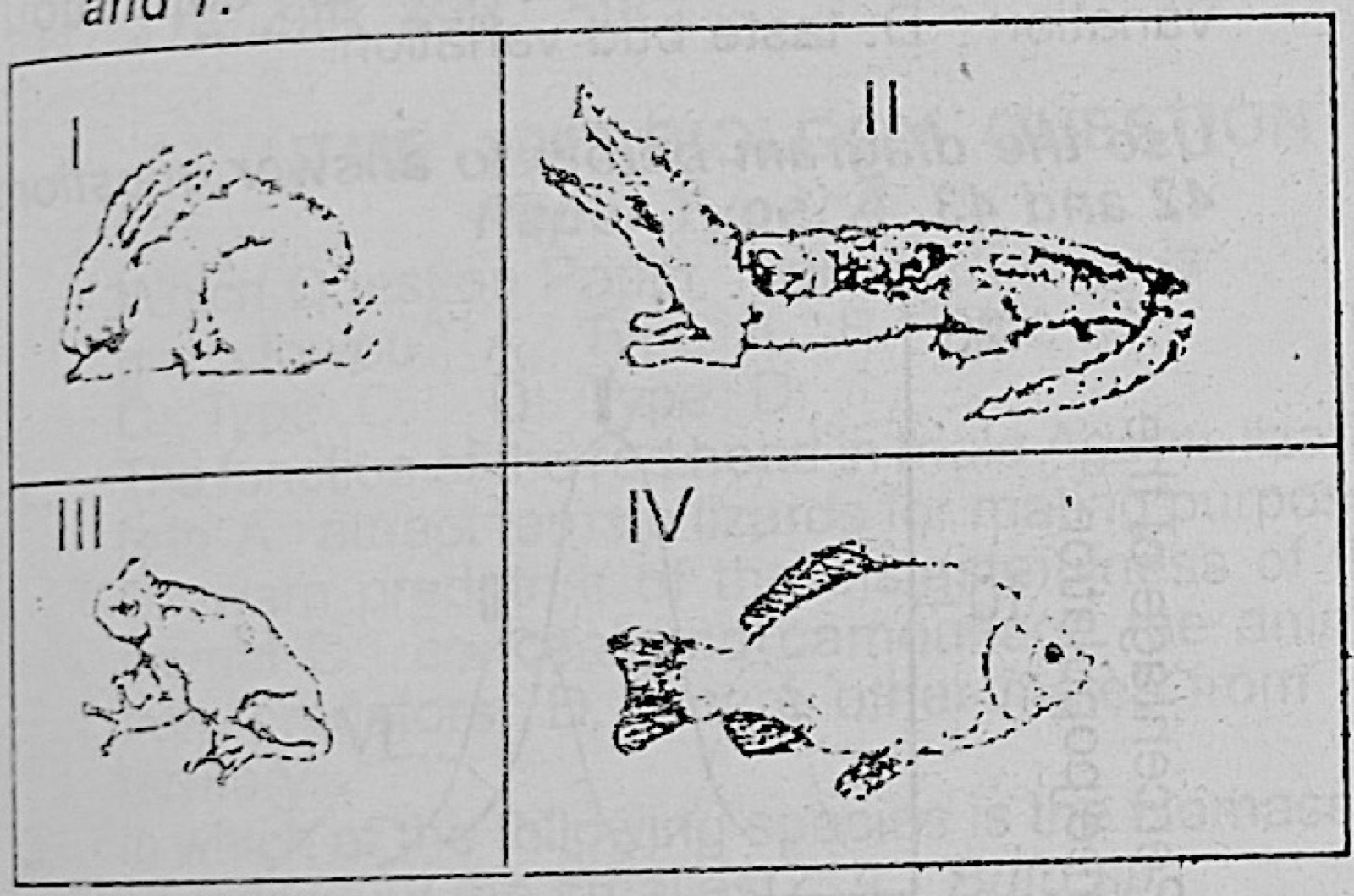
Use the diagram to answer: With respect to their decreasing dependence on aquatic conditions for reproduction, which of the following is the correct arrangement of the animals represented?
A.IV, III, II and I
B.I, II, IV and III
C.III, II, IV and I
D.I, IV, II and III
Show the answer and explanation
Answer: A (IV, III, II and I)
Explanation
The fish (IV) breeds entirely in water, the toad (III) must lay eggs in water, the crocodile (II) lays shelled eggs on land, and the rabbit (I) develops young inside its body.
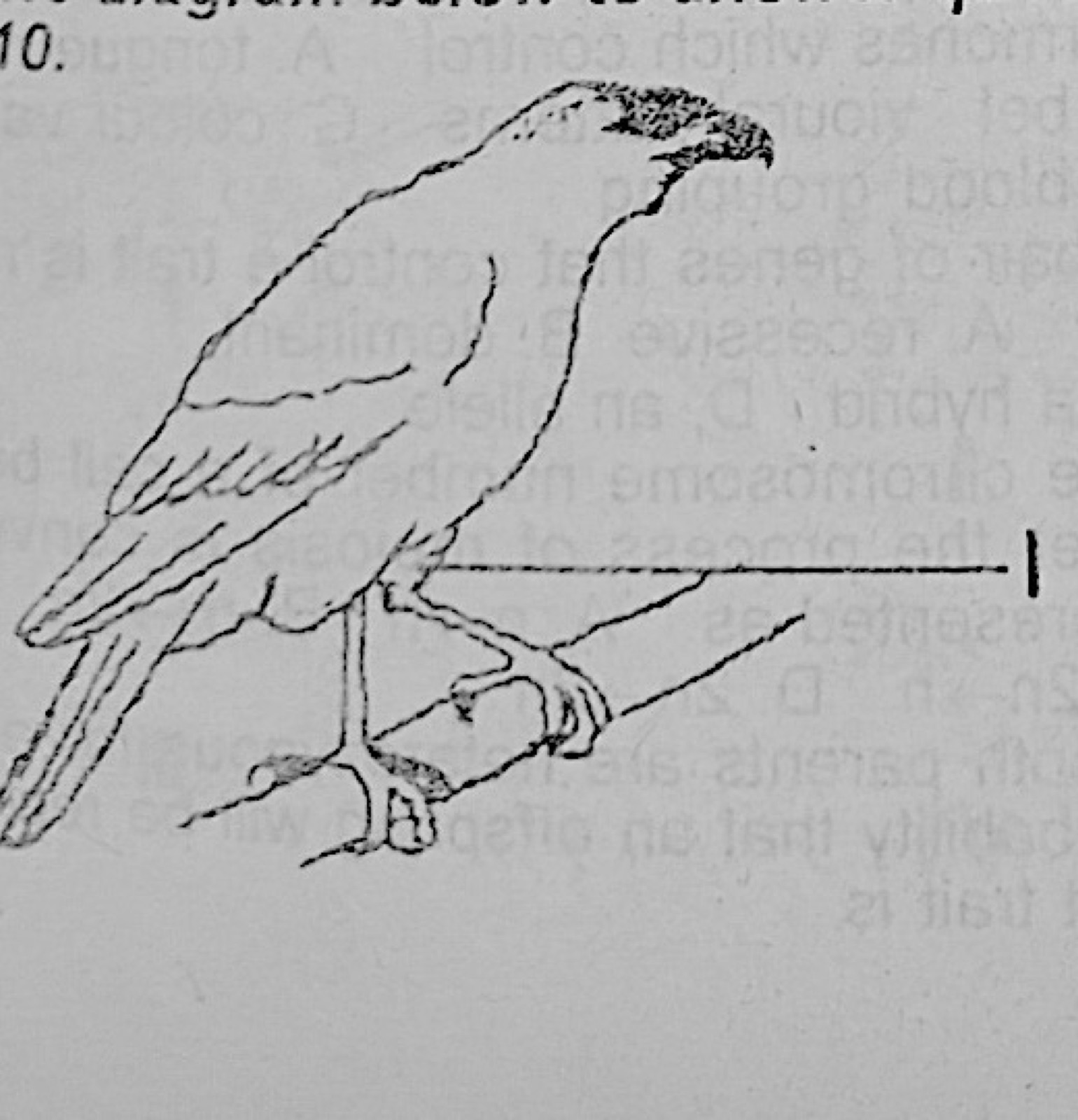
Use the diagram to answer: The main function of the feathers covering the part labelled I is to
A.generate heat to keep the animal warm
B.provide some power for flight
C.serve as insulator to maintain body heat
D.prevent ectoparasites from attacking the animal.
Show the answer and explanation
Answer: C (serve as insulator to maintain body heat)
Explanation
The feathers on the body trap a layer of air close to the skin. Air is a poor conductor of heat, so they keep body heat in. Feathers do not make heat themselves.
Which of the following is true of the transverse section of a dicot stem?
A.The xylem is more interiorly located than the phloem.
B.The cambium lies between the cortex and the vascular bundles.
C.The vascular bundles are randomly scattered within the cortex.
D.The epidermis is completely encircled by the cortex.
Show the answer and explanation
Answer: A (The xylem is more interiorly located than the phloem.)
Explanation
In a dicot stem the vascular bundles form a ring with phloem on the outside and xylem on the inside, separated by cambium. Scattered bundles are found in monocots.
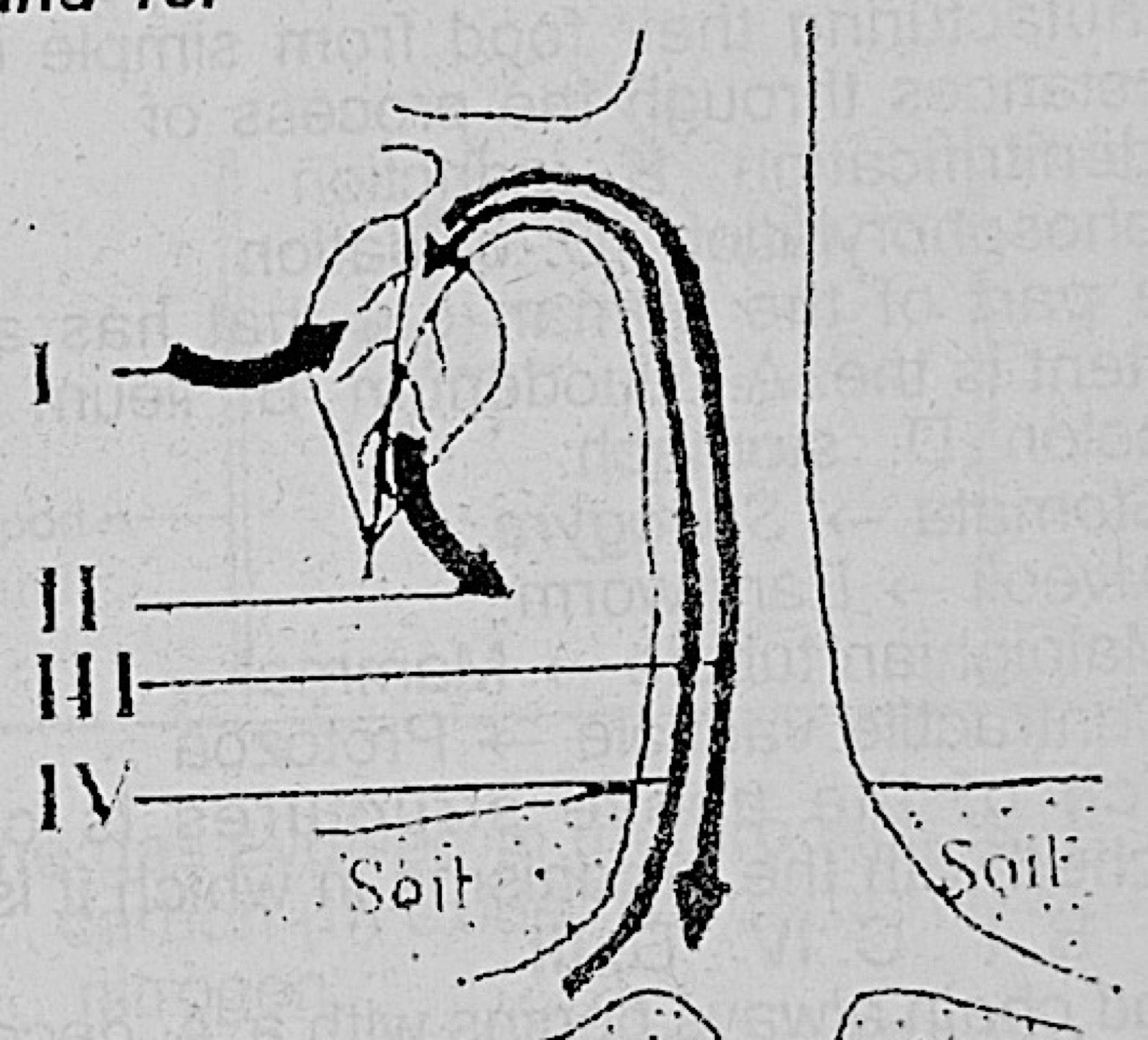
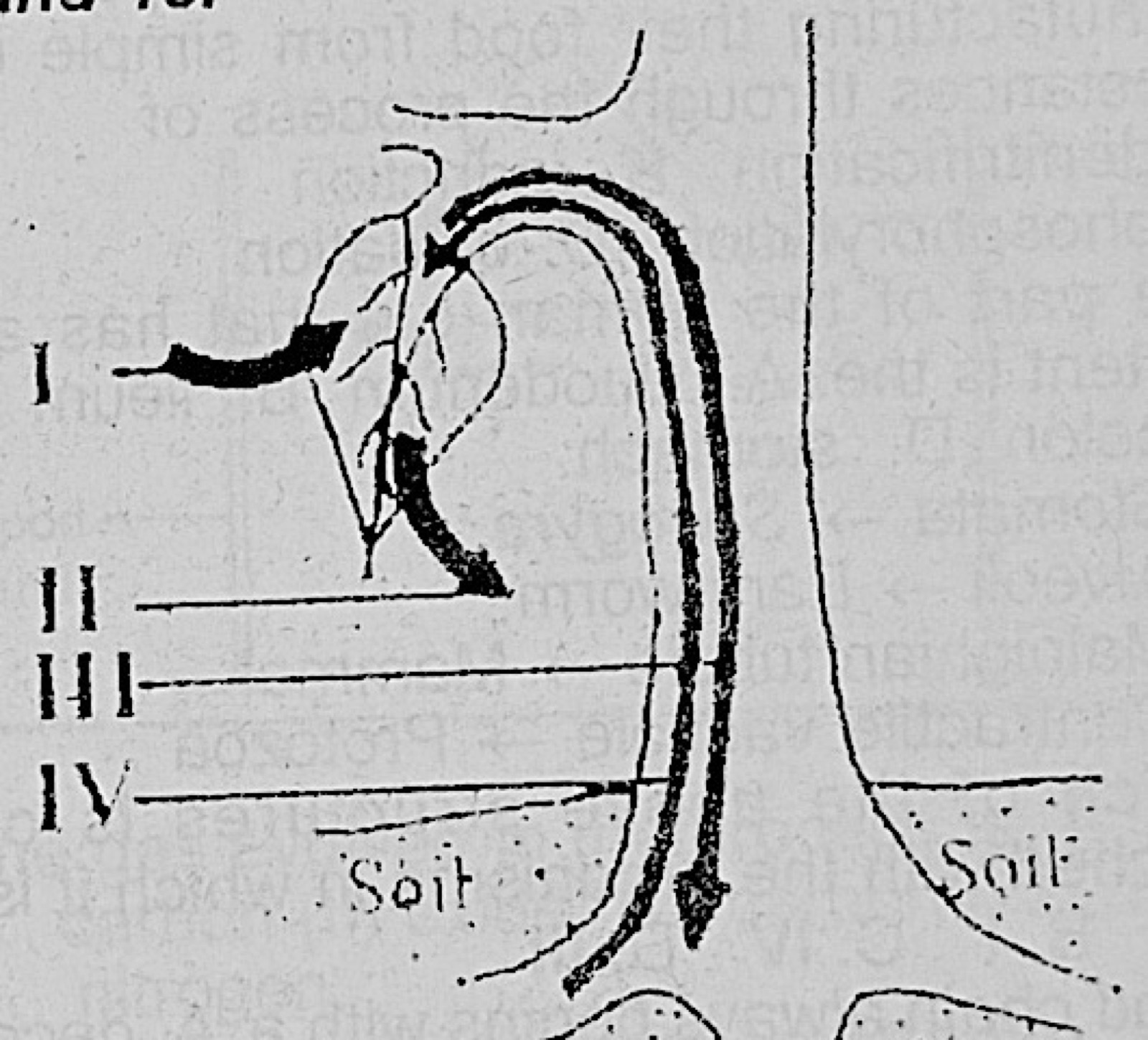
Use the diagram to answer: The movement of material in the xylem and phloem tissues of the plant are represented by the arrows labelled
A.II and I respectively
B.I and II respectively
C.IV and III respectively
D.III and IV respectively.
Show the answer and explanation
Answer: C (IV and III respectively)
Explanation
Xylem carries water up from the roots to the leaves and phloem carries food from the leaves to other parts. The two long arrows in the stem, IV and III, show these two streams.
Use the diagram to answer: During photosynthesis, the arrow labelled II represents the
A.absorption of energy from the sun
B.release of carbon(IV) oxide
C.release of oxygen as a by-product
D.escape of mineral salts.
Show the answer and explanation
Answer: C (release of oxygen as a by-product)
Explanation
Arrow I shows carbon (IV) oxide entering the leaf, and arrow II shows a gas leaving it. During photosynthesis the gas given off is oxygen, a by-product.
Which of the following is lacking in the diet of a person with kwashiorkor?
A.Proteins.
B.Carbohydrates.
C.Minerals.
D.Vitamins.
Show the answer and explanation
Answer: A (Proteins.)
Explanation
Kwashiorkor is a protein-deficiency disease, common in children fed mainly on starchy food. It causes swollen belly, thin limbs and changes in hair colour.
When a mixture of a food substance and Benedict's solution was warmed, the solution changed from blue to brick-red. This indicates the presence of
A.fatty acid
B.sucrose
C.amino acid
D.reducing sugar.
Show the answer and explanation
Answer: D (reducing sugar.)
Explanation
Reducing sugars such as glucose reduce the blue copper(II) ions in Benedict's solution to a brick-red precipitate when heated. Sucrose is not a reducing sugar.
Circulation of blood to all parts of the body except the lungs is through
A.systemic circulation
B.the lymphatic system
C.pulmonary circulation
D.the pulmonary artery.
Show the answer and explanation
Answer: A (systemic circulation)
Explanation
Systemic circulation carries blood from the left ventricle to all body organs and back. Pulmonary circulation goes only between the heart and the lungs.
I. Stomata → Spirogyra II. Alveoli → Earthworm III. Malpighian tubule → Mammal IV. Contractile vacuole → Protozoa Which of the above structures is correctly matched with the organisms in which it is found?
A.II
B.I
C.IV
D.III
Show the answer and explanation
Answer: C (IV)
Explanation
Contractile vacuoles are found in freshwater protozoa such as Amoeba. Spirogyra has no stomata, earthworms have no alveoli, and Malpighian tubules belong to insects.
I. Adoption of appropriate nocturnal habits II. Burrowing. III. Adjusting their internal body temperature. IV. Possession of many sweat pores. Which of the above are ways in which desert animals adapt to extreme heat of the environment?
A.II and III only.
B.I and II only.
C.I, II and III only.
D.I and IV only.
Show the answer and explanation
Answer: B (I and II only.)
Explanation
Desert animals avoid the heat by being active at night and hiding in cool burrows by day. Many sweat pores would waste scarce water.
Thyroxine and adrenalin are examples of hormones which control
A.tongue rolling
B.behavioural patterns
C.colour variation
D.blood grouping.
Show the answer and explanation
Answer: B (behavioural patterns)
Explanation
Adrenalin prepares the body for 'fight or flight' and thyroxine affects activity and alertness, so both influence behaviour. Tongue rolling and blood group are fixed by genes.
The flippers of a whale and the fins of a fish are examples of
A.coevolution
B.continuous variation
C.convergent evolution
D.divergent evolution.
Show the answer and explanation
Answer: C (convergent evolution)
Explanation
Whales and fish are not closely related, but both evolved paddle-like limbs for swimming. Unrelated groups becoming alike through similar ways of life is convergent evolution.