Home › Past questions › JAMB › Biology › 2000 48 questions. Try each one, then open the answer to check yourself and read the explanation.
Sign up free to answer these questions on a CBT screen with a timer, then see your score and every answer explained.
Start practising free
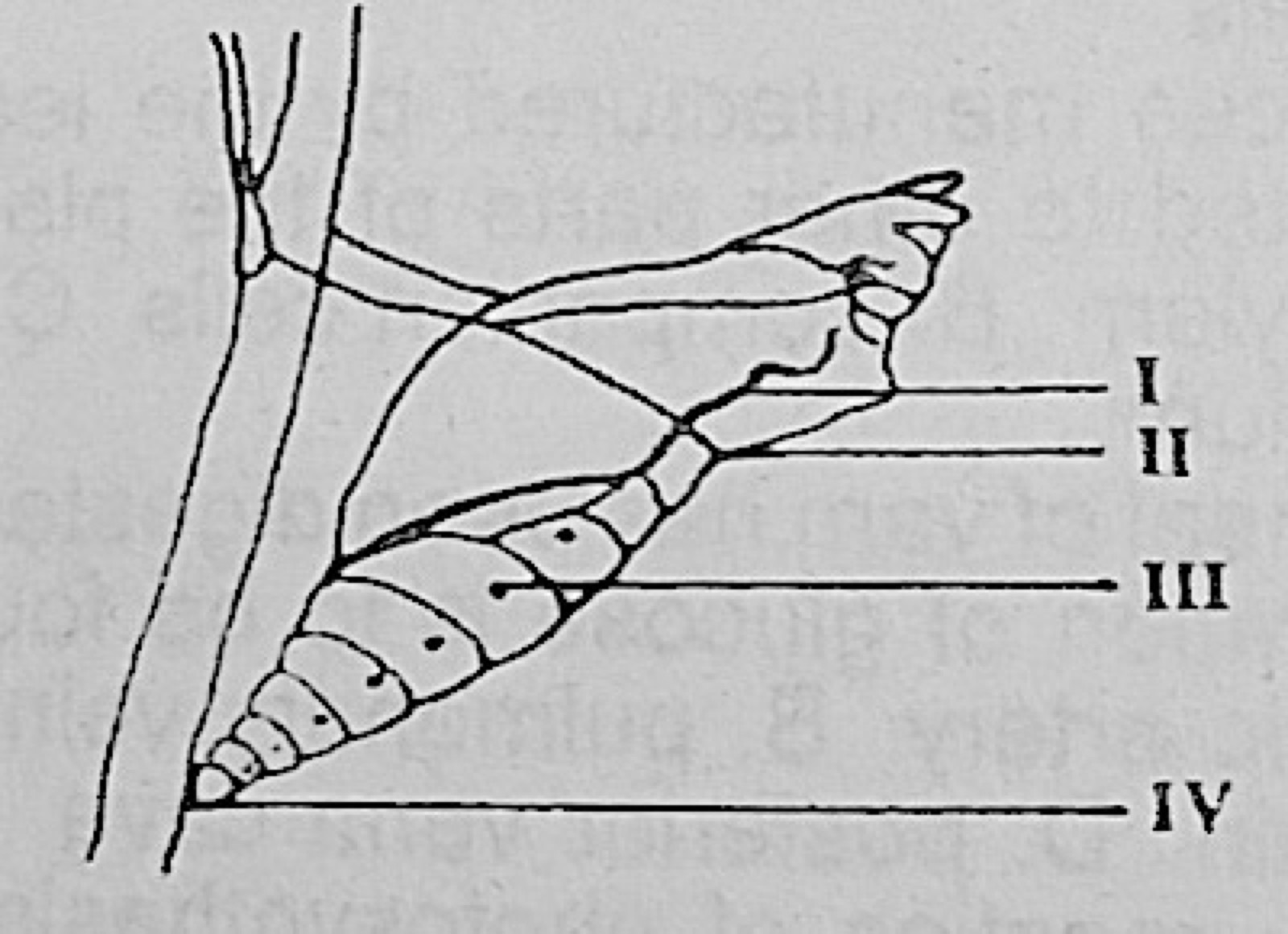
Question 1 Reproduction in Animals Use the diagram to answer questions 1 and 2. The part that will develop into an organ for feeling is labelled
A. IV B. III C. II D. I. Show the answer and explanation Answer: D (I. )
Explanation Part I is the head end of the pupa, where the antennae (organs of touch and smell) of the adult insect develop.
Open this question
Question 2 Reproduction in Animals Use the diagram to answer questions 1 and 2. The part labelled II is the
A. silk thread B. thorax C. fore wing D. anchor. Show the answer and explanation Answer: A (silk thread )
Explanation The pupa is held to the stem by a girdle of silk thread, labelled II.
Open this question
Question 3 Plant Kingdom Which of the following features are all associated with monocots?
A. Fibrous root system, branched network of veins and one seed leaf B. Fibrous root system, two seed leaves and floral parts in threes C. One seed leaf, petals in threes or groups of threes and parallel venation of leaves D. One seed leaf, net-veined leaves and petals in threes or multiples of three. Show the answer and explanation Answer: C (One seed leaf, petals in threes or groups of threes and parallel venation of leaves )
Explanation Monocots have one cotyledon, parallel leaf veins and flower parts in threes; net veins and two seed leaves belong to dicots.
Open this question
Question 4 Support and Movement The set of fins that controls steering, balancing and change of direction and pitch in fish is
A. dorsal and anal B. pectoral and pelvic C. caudal and dorsal D. anal and pelvic. Show the answer and explanation Answer: B (pectoral and pelvic )
Explanation The paired pectoral and pelvic fins steer the fish, change its direction and control up-and-down tilt (pitch).
Open this question
Question 5 Evolution The most recently evolved structure in animals is the
A. hair B. cilium C. scale D. feather. Show the answer and explanation Answer: A (hair )
Explanation Cilia occur in protozoa and scales in fishes, both ancient groups; hair is found only in mammals, which are treated as the most recently evolved animals.
Open this question
Question 6 Animal Kingdom Coelom is absent in the class of animals termed
A. mollusca B. reptilia C. arthropoda D. coelenterata. Show the answer and explanation Answer: D (coelenterata. )
Explanation Coelenterates such as Hydra have only two body layers and a single gut cavity, with no coelom.
Open this question
Question 7 Animal Kingdom A characteristic of vertebrates that is unique to mammals is
A. the presence of pentadactyl limbs B. parental care C. the possession of scrotum D. pulmonary circulation. Show the answer and explanation Answer: C (the possession of scrotum )
Explanation Pentadactyl limbs, parental care and pulmonary circulation are found in other vertebrates too, but a scrotum holding the testes outside the body is found only in mammals.
Open this question
Question 8 Evolution The order in which organic evolution has progressed in plants is
A. thallophyta, schizophyta, bryophyta, pteridophyta and spermatophyta B. schizophyta, thallophyta, bryophyta, pteridophyta and spermatophyta C. pteridophyta, spermatophyta, thallophyta, schizophyta and bryophyta D. bryophyta, pteridophyta, spermatophyta, thallophyta and schizophyta. Show the answer and explanation Answer: B (schizophyta, thallophyta, bryophyta, pteridophyta and spermatophyta )
Explanation Plant evolution runs from the simplest (schizophytes such as bacteria and blue-green algae) to algae, mosses, ferns and finally seed plants.
Open this question
Question 9 Hormonal Coordination In which part of the human body does the secretion of the growth hormone occur?
A. Head region B. Waist region C. Neck region D. Gonads. Show the answer and explanation Answer: A (Head region )
Explanation Growth hormone is made by the pituitary gland at the base of the brain, in the head.
Open this question
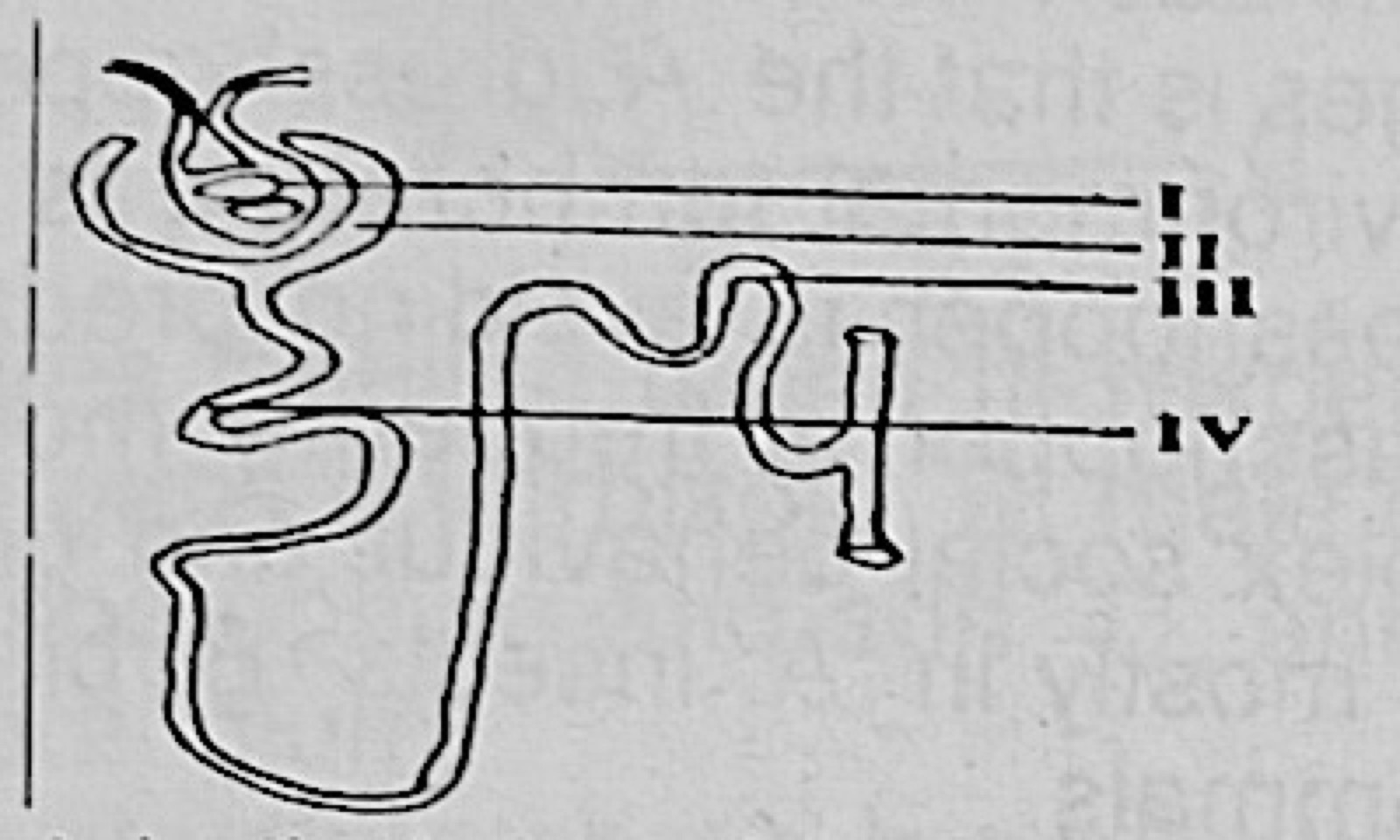
Question 10 Excretion Use the diagram to answer questions 10 and 11. The parts labelled I and II make up the
A. glomerulus B. convoluted tubules C. Malpighian body D. Bowman's capsule. Show the answer and explanation Answer: C (Malpighian body )
Explanation The knot of capillaries (glomerulus, I) inside the cup-shaped Bowman's capsule (II) together make up the Malpighian body.
Open this question
Question 11 Excretion Use the diagram to answer questions 10 and 11. In mammals, reabsorption of salt takes place in
A. IV B. III C. II D. I. Show the answer and explanation Answer: B (III )
Explanation Salts are reabsorbed from the filtrate back into the blood in the convoluted tubules of the nephron.
Open this question
Question 12 Nervous Coordination The part of the brain that controls body posture in mammals is the
A. thalamus B. cerebellum C. spinal cord D. cerebrum. Show the answer and explanation Answer: B (cerebellum )
Explanation The cerebellum co-ordinates muscles to keep balance and posture.
Open this question
Question 13 Structure of Flowering Plants Peripheral arrangement of vascular tissues in dicots is a characteristic of the internal structure of the
A. leaf B. petiole C. stem D. root. Show the answer and explanation Answer: C (stem )
Explanation In a dicot stem the vascular bundles form a ring near the outside; in the root they are in the centre.
Open this question
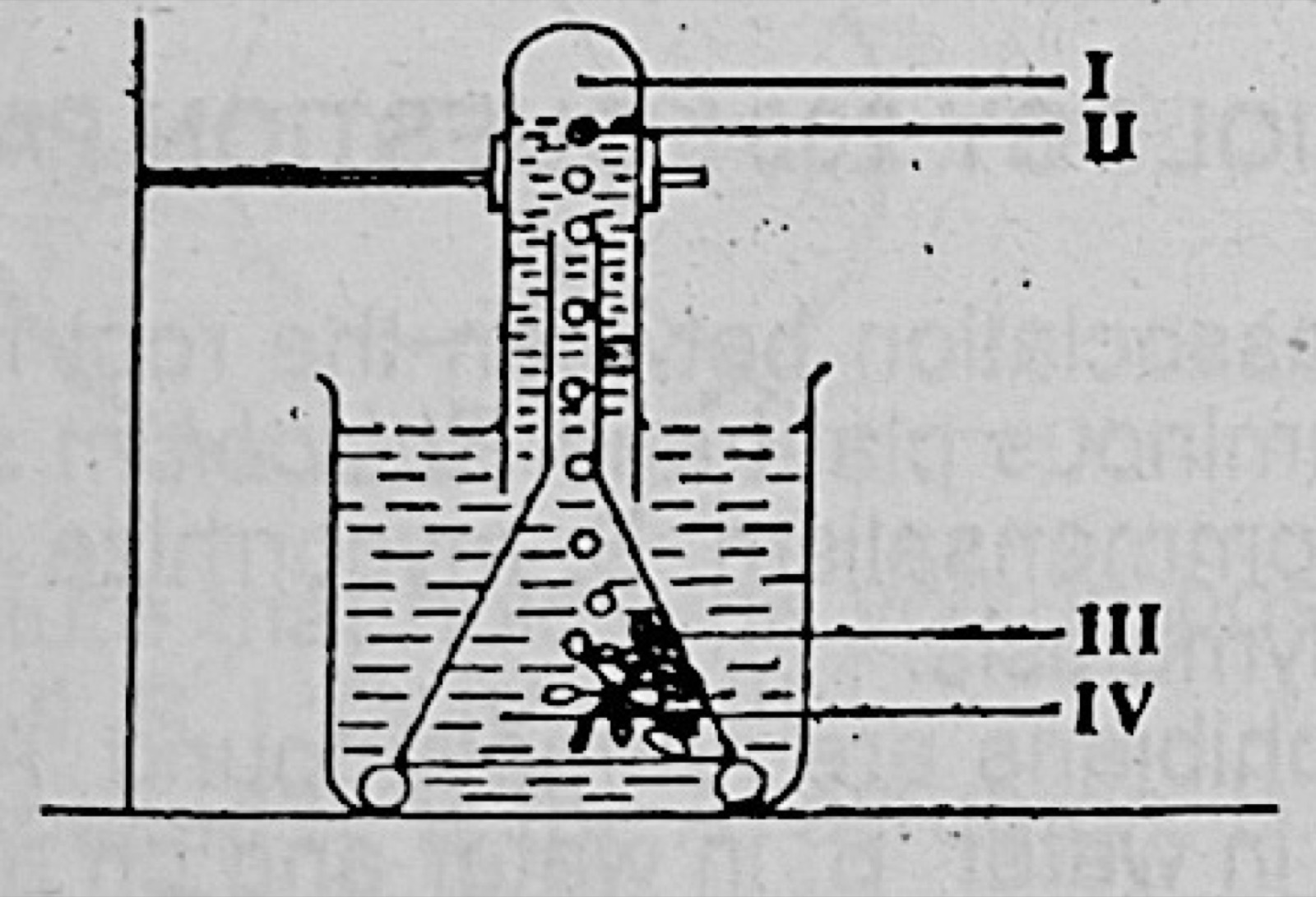
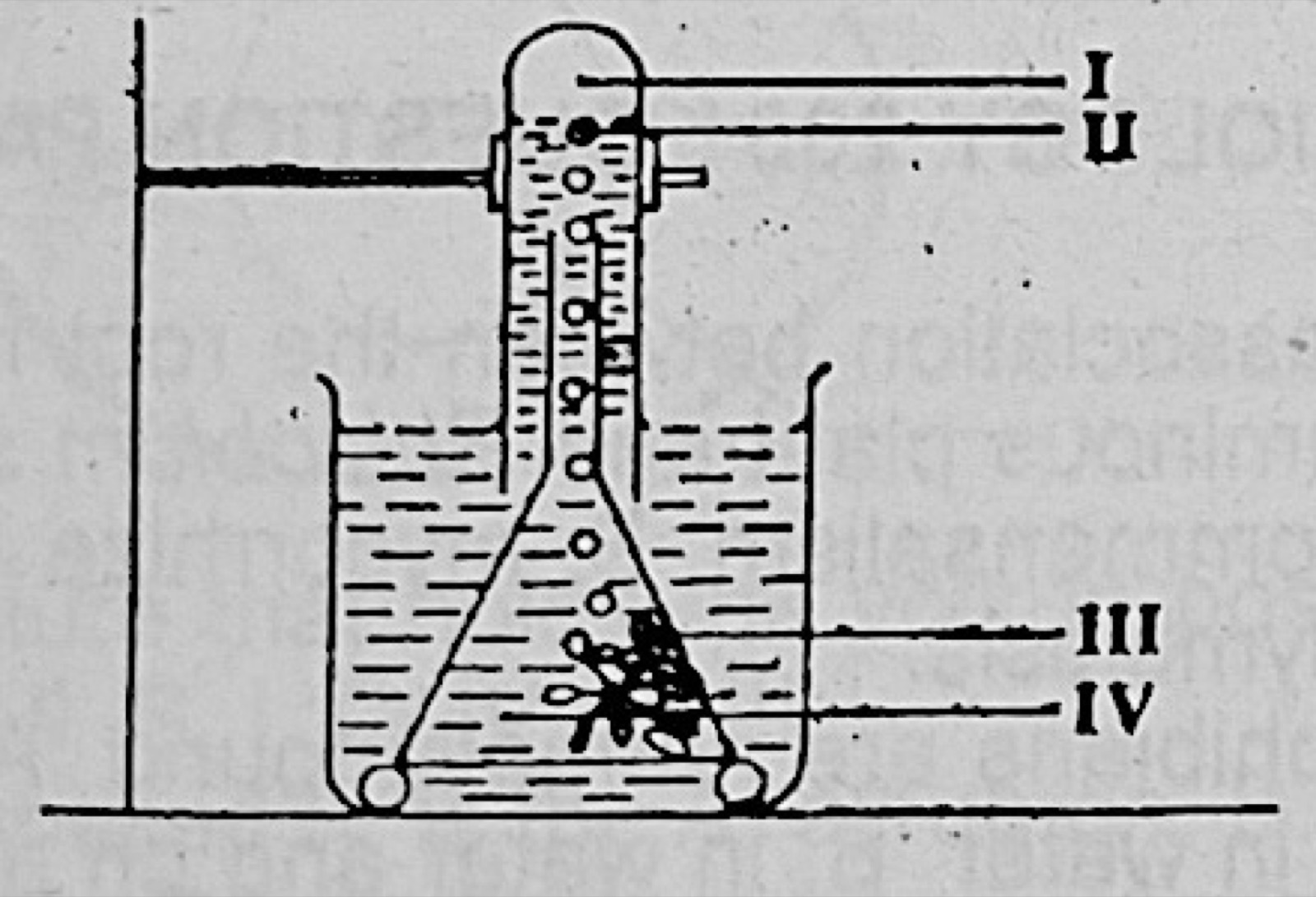
Question 14 Photosynthesis and Plant Nutrition Use the diagram to answer questions 14 and 15. The substance labelled II originates from
A. III only B. IV only C. I and IV D. III and IV. Show the answer and explanation Answer: A (III only )
Explanation The gas (II) collecting at the top is oxygen. In photosynthesis this oxygen comes from water molecules split by light energy, and the water is the part labelled III.
Open this question
Question 15 Photosynthesis and Plant Nutrition Use the diagram to answer questions 14 and 15. The gas occupying the space labelled I is
A. carbon (IV) oxide B. nitrogen C. hydrogen D. oxygen. Show the answer and explanation Answer: D (oxygen. )
Explanation A water plant in light photosynthesises and releases oxygen, which collects at the top of the tube.
Open this question
Question 16 Support and Movement The scapula and the ischium are part of the
A. pectoral girdle B. pelvic girdle C. appendicular skeleton D. hind limb. Show the answer and explanation Answer: C (appendicular skeleton )
Explanation The scapula is in the pectoral girdle and the ischium in the pelvic girdle; both girdles belong to the appendicular skeleton.
Open this question
Question 17 Animal Nutrition Bacteria in the large intestine of man are important in the
A. synthesis of vitamins K and B2 B. digestion of vegetables C. synthesis of vitamins A and D D. absorption of water. Show the answer and explanation Answer: A (synthesis of vitamins K and B2 )
Explanation Gut bacteria in the colon make vitamin K and some B vitamins, which the body absorbs.
Open this question
Question 18 Sense Organs Short-sightedness can be corrected by lenses which are
A. convex B. biconvex C. plano-convex D. concave. Show the answer and explanation Answer: D (concave. )
Explanation In short sight the image forms in front of the retina; a concave (diverging) lens moves it back onto the retina.
Open this question
Question 19 Sense Organs The inner ear contains two main organs, namely, the
A. eardrum and eustachian tube B. cochlea and semi-circular canals C. oval window and ossicles D. pinna and cochlea. Show the answer and explanation Answer: B (cochlea and semi-circular canals )
Explanation The inner ear holds the cochlea (hearing) and the semicircular canals (balance).
Open this question
Question 20 Growth and Development For growth to occur in organisms, the rate of
A. food storage must be low B. catabolism must exceed that of anabolism C. anabolism must exceed that of catabolism D. food storage must be high. Show the answer and explanation Answer: C (anabolism must exceed that of catabolism )
Explanation Growth means building up more body material than is broken down, so anabolism must be faster than catabolism.
Open this question
Question 21 Food Substances and Enzymes The production of violet colouration, when dilute NaOH solution is added to a solution of food substance, followed by drops of 1% CuSO4 solution while shaking indicates the presence of
A. protein B. carbohydrates C. fats D. reducing sugar. Show the answer and explanation Answer: A (protein )
Explanation This is the Biuret test; a violet colour shows protein.
Open this question
Question 22 Food Substances and Enzymes The greatest amount of energy will be obtained by the oxidation of 100 kg of
A. meat B. butter C. sugar D. biscuits. Show the answer and explanation Answer: B (butter )
Explanation Fats release about 38 kJ per gram, roughly twice as much as carbohydrates or proteins, so butter gives the most energy.
Open this question
Question 23 Transport in Animals The chamber of the mammalian heart with the thickest wall is the
A. right ventricle B. left auricle C. right auricle D. left ventricle. Show the answer and explanation Answer: D (left ventricle. )
Explanation The left ventricle pumps blood round the whole body, so it has the thickest, most muscular wall.
Open this question
Question 24 Transport in Animals Serum differs from blood plasma because it
A. contains blood cells and fibrinogen B. contains soluble food and mineral salts C. lacks the blood protein, fibrinogen D. lacks blood cells and albumin. Show the answer and explanation Answer: C (lacks the blood protein, fibrinogen )
Explanation Serum is plasma after clotting, so its fibrinogen has been used up.
Open this question
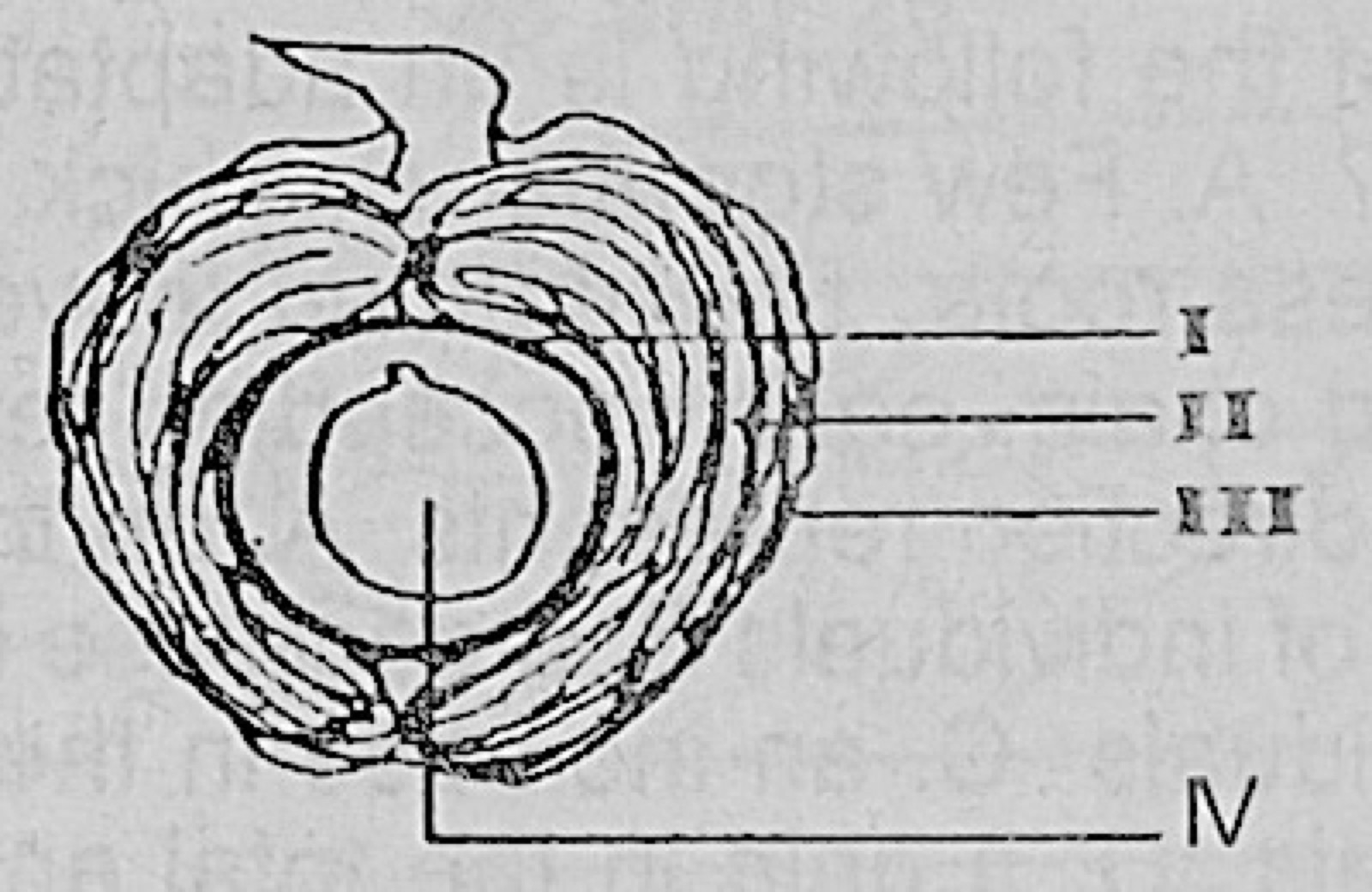
Question 25 Reproduction in Plants Use the diagram to answer questions 25 and 26. The part labelled II is the
A. mesocarp B. pericarp C. endocarp D. epicarp. Show the answer and explanation Answer: A (mesocarp )
Explanation II is the thick fibrous middle layer of the fruit wall, the mesocarp.
Open this question
Question 26 Reproduction in Plants Use the diagram to answer questions 25 and 26. The fruit represented is mainly dispersed by
A. animals B. water C. wind D. birds. Show the answer and explanation Answer: B (water )
Explanation The fruit has a thick, fibrous, air-filled mesocarp, like a coconut, which lets it float and be carried by water.
Open this question
Question 27 Soil In an experiment to estimate the volume of air in a soil sample using a measuring cylinder, it was found that:3 3 3
A. r = p + q B. r > p + q C. q = r - p D. r < p + q. Show the answer and explanation Answer: D (r < p + q. )
Explanation When soil is added, water replaces the air in its pores, so the final volume r is smaller than p + q; the difference is the volume of air.
Open this question
Question 28 Population Ecology An ecological succession often leads to
A. an increase in species diversity B. a decrease in species diversity C. an unstable community D. the dispersal of species. Show the answer and explanation Answer: A (an increase in species diversity )
Explanation As succession proceeds, conditions become more varied and more species can live there, until a stable climax is reached.
Open this question
Question 30 Population Ecology I. High birth rate and high immigration rate II. Low birth rate and high immigration rate III. Low mortality rate and low emigration rate IV. High mortality rate and high emigration rate. Which combination of the above can cause rapid over -crowding in climax biotic communities and human settlements?
A. II and III B. I and III C. I and IV D. I and II. Show the answer and explanation Answer: B (I and III )
Explanation Many arrivals (high births and immigration) and few losses (low deaths and emigration) make a population grow fastest.
Open this question
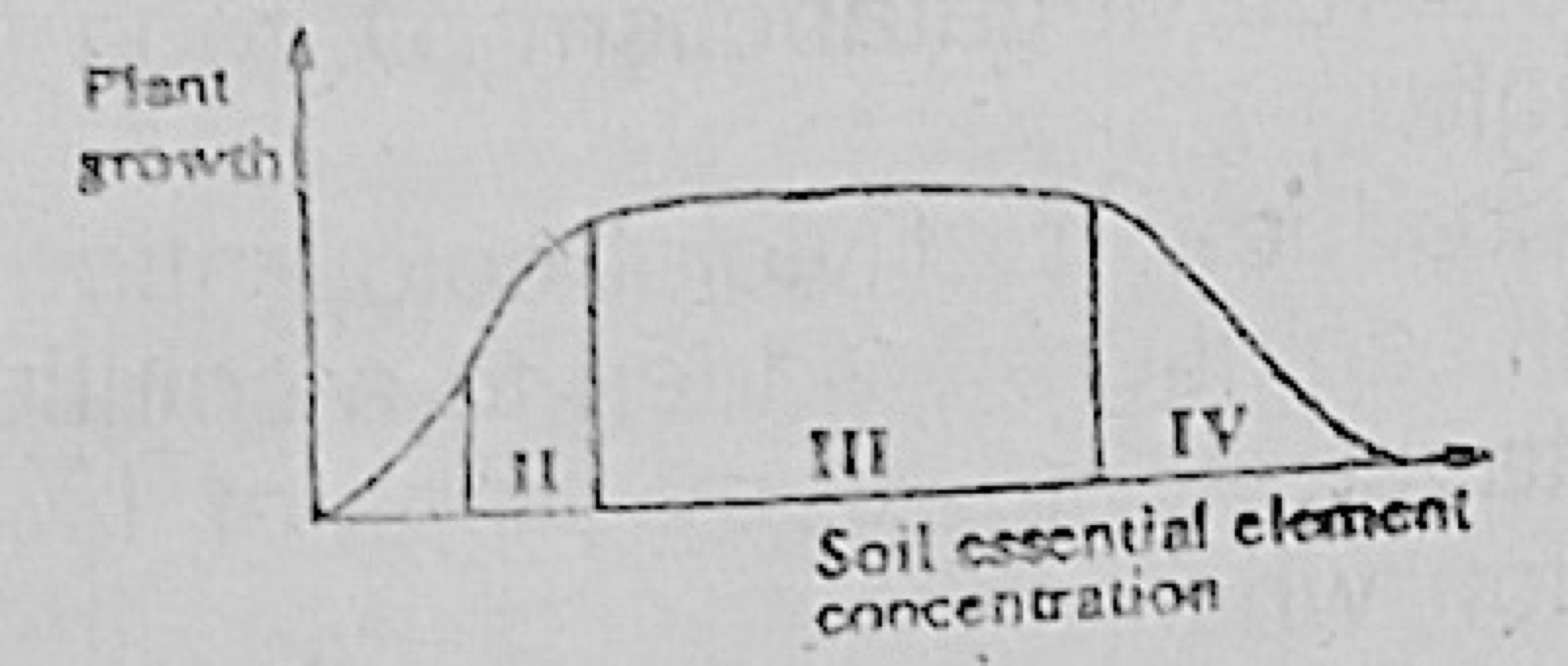
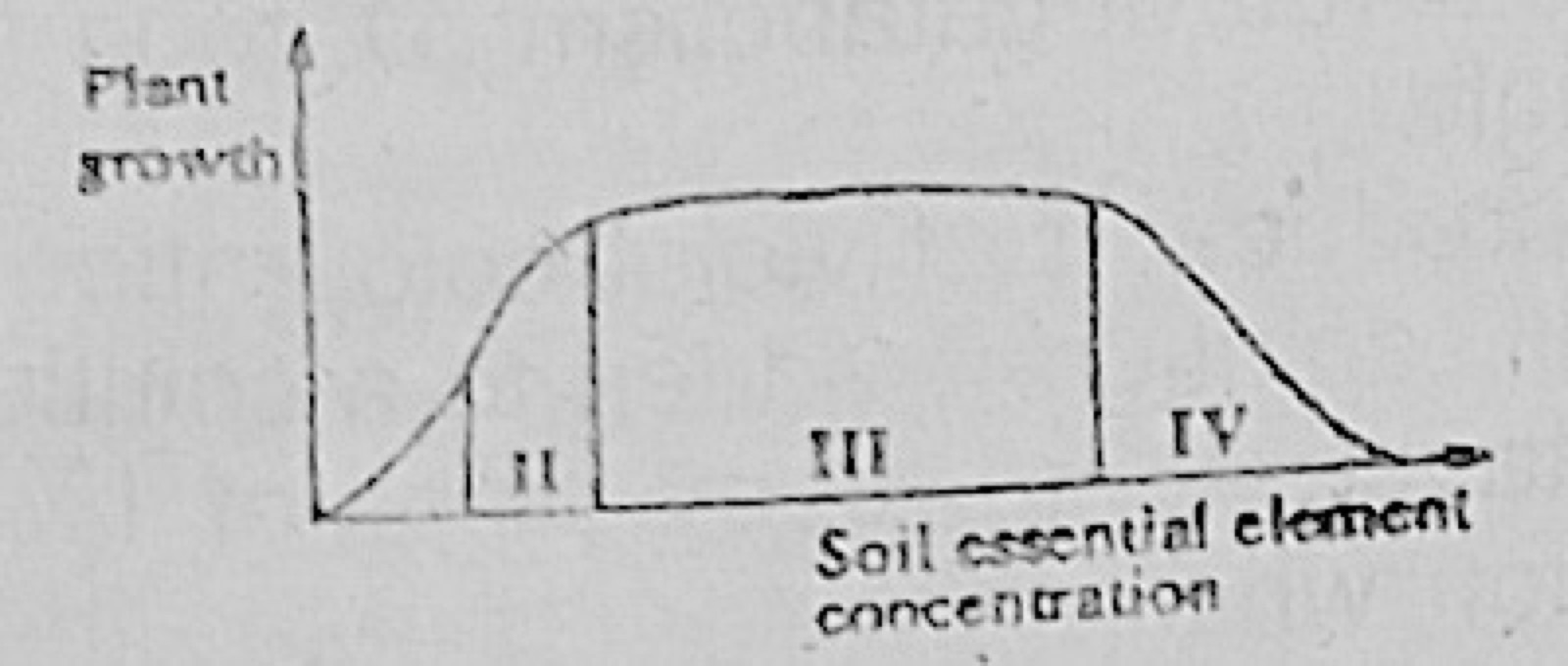
Question 31 Photosynthesis and Plant Nutrition Use the graph (plant growth against soil essential element concentration) to answer questions 31 and 32. The soil becomes toxic to plants when the concentration of its essential elements is in the range labelled
A. IV B. III C. II D. I. Show the answer and explanation Answer: A (IV )
Explanation In range IV the concentration is so high that plant growth falls sharply, showing toxicity.
Open this question
Question 32 Photosynthesis and Plant Nutrition Use the graph (plant growth against soil essential element concentration) to answer questions 31 and 32. The range at which soil essential elements concentration is recorded for optimal plant growth is marked
A. IV B. III C. II D. I. Show the answer and explanation Answer: B (III )
Explanation Range III is the flat top of the curve, where growth is highest.
Open this question
Question 33 Plant Responses and Hormones Which of the following growth activities in plants is brought about by gibberellins?
A. Rapid cell division B. Tropic response C. cell elongation D. Main stem elongation. Show the answer and explanation Answer: C (cell elongation )
Explanation Gibberellins make stems grow taller mainly by making cells elongate.
Open this question
Question 34 Adaptation Which of the following are adaptations of animals to aquatic habitats?
A. Gills, streamlined bodies and lateral line B. Lateral line, streamlined bodies and lungs C. Gills, scaly skin and lungs D. Gills, streamlined bodies and spiracles. Show the answer and explanation Answer: A (Gills, streamlined bodies and lateral line )
Explanation Fish breathe with gills, move easily with streamlined bodies and sense water movement with the lateral line.
Open this question
Question 35 Adaptation Which of the following is an adaptation of forest species?
A. Few stomata B. Thick bark C. Buttress roots D. Reduced leaves. Show the answer and explanation Answer: C (Buttress roots )
Explanation Tall rain forest trees have buttress roots to support them in shallow soil.
Open this question
Question 36 Feeding Relationships and Energy Flow In a food chain, each succeeding level in a forward direction represents
A. an increase in the number of individuals B. a decrease in the number of individuals C. an increase in the biomass of individuals D. a gain in the total energy being transferred. Show the answer and explanation Answer: B (a decrease in the number of individuals )
Explanation Energy is lost at every feeding level, so each level up the chain usually has fewer individuals (pyramid of numbers).
Open this question
Question 37 Pollution The disaster that would have the least destructive impact on animal life and balance in nature is
A. chemical polllution B. forest fires C. oil spillage D. grasshopper pests. Show the answer and explanation Answer: D (grasshopper pests. )
Explanation Grasshopper pests damage crops, but they are part of natural food webs; pollution, oil spills and fires destroy whole habitats.
Open this question
Question 39 Habitats and Biomes The factors that determine the distribution of vegetation zones are
A. temperature, light, rain and humidity B. light, humidity, air and mist C. temperature, light, air and humidity D. humidity, snow, frost and dew. Show the answer and explanation Answer: A (temperature, light, rain and humidity )
Explanation Climate factors, especially temperature, light, rainfall and humidity, decide which vegetation grows where.
Open this question
Question 40 Mendelian Inheritance A cross between an albino female and a genetically normal male will result in offspring that are
A. all albino B. all phenotypically normal C. all genetically normal D. half albino and half normal. Show the answer and explanation Answer: B (all phenotypically normal )
Explanation aa × AA gives all Aa: they look normal but carry the albino allele.
Open this question
Question 41 Pollution The pollutants that contribute to the depletion of the ozone layer in the atmosphere are
A. radioactive materials B. oxides of sulphur C. oxides of carbon D. chlorofluorocarbons. Show the answer and explanation Answer: D (chlorofluorocarbons. )
Explanation CFCs release chlorine in the upper atmosphere, which breaks down ozone molecules.
Open this question
Question 42 Mendelian Inheritance The surest way to combine the best qualities of both parents in the offspring is by
A. cross-breeding B. inbreeding C. selective breeding D. pure breeding. Show the answer and explanation Answer: A (cross-breeding )
Explanation Cross-breeding two different parents brings the good traits of each together in the offspring.
Open this question
Question 43 Mendelian Inheritance Blood grouping in human beings is derived from combinations of
A. two different alleles B. four different alleles C. three different alleles D. two different genes. Show the answer and explanation Answer: C (three different alleles )
Explanation The ABO groups are controlled by one gene with three alleles (A, B and O); pairs of these give groups A, B, AB and O.
Open this question
Question 44 Evolution The older fossil-bearing rocks, in contrast to the more recent ones, are more likely to contain
A. animal rather than plant remains B. invertebrates rather than birds C. flowering plants rather than mosses D. reptiles rather than fishes. Show the answer and explanation Answer: B (invertebrates rather than birds )
Explanation Invertebrates evolved hundreds of millions of years before birds, so older rocks hold invertebrate fossils.
Open this question
Question 45 Behaviour In a group of male Agama lizards, the one with the brightest head colour is the
A. dominant B. youngest C. oldest D. largest. Show the answer and explanation Answer: A (dominant )
Explanation The dominant male Agama has the brightest colours to show his rank and hold his territory.
Open this question
Question 46 Microorganisms and Health Examples of water-borne and sex-linked diseases are
A. taeniasis and malaria B. cholera and gonorrhoea C. typhoid and syphilis D. dracunculiasis and haemophilia. Show the answer and explanation Answer: D (dracunculiasis and haemophilia. )
Explanation Guinea worm is caught from drinking water, and haemophilia is inherited on the X chromosome (sex-linked).
Open this question
Question 47 Evolution The mutation theory of organic evolution was propounded by
A. Gregor Mendel B. Hugo de Vries C. Jean Lamarck D. Charles Darwin. Show the answer and explanation Answer: B (Hugo de Vries )
Explanation Hugo de Vries proposed that new species arise through sudden changes called mutations.
Open this question
Question 48 Adaptation A certain savanna grasshopper changes colour from green during the rainy season to brown during the dry season and black after the dry season bush fires. The reason for these colour changes is that the
A. grasshopper is getting older B. environmental temperature is changing C. grasshopper is avoiding predation D. grasshopper is frequently moulting. Show the answer and explanation Answer: C (grasshopper is avoiding predation )
Explanation By matching its background through the seasons, the grasshopper is camouflaged and less likely to be seen by predators.
Open this question
Question 49 Behaviour Complex social behaviour and organization are found mostly in
A. insects B. birds C. reptiles D. mammals. Show the answer and explanation Answer: A (insects )
Explanation Termites, bees and ants live in colonies with castes (queen, workers, soldiers) that share the work, the most complex social organisation known.
Open this question
Question 50 Adaptation Which of the following structural features are adapted for uses other than water conservation?
A. Succulent stems B. Scales in animals C. Spines in plants D. Feathers in birds. Show the answer and explanation Answer: D (Feathers in birds. )
Explanation Succulent stems, scales and spines all help save water, but feathers are adapted mainly for flight and insulation.
Open this question Sign up free for every JAMB Biology year, practice by topic and timed mocks.
Start practising free