Home › Past questions › JAMB › Biology › 1999 48 questions. Try each one, then open the answer to check yourself and read the explanation.
Sign up free to answer these questions on a CBT screen with a timer, then see your score and every answer explained.
Start practising free
Question 1 Microorganisms and Health The habitat of the cysticercus of Taenia solium is
A. alimentary canal of cattle B. muscles of pig C. alimentary canal of pig D. muscles of cattle. Show the answer and explanation Answer: B (muscles of pig )
Explanation Taenia solium is the pork tapeworm; its larval stage (cysticercus) forms cysts in the muscles of pigs, and people are infected by eating undercooked pork.
Open this question
Question 2 Support and Movement The organism that has a hydrostatic skeleton is
A. Tilapia B. Hydra C. mosquito larva D. earthworm. Show the answer and explanation Answer: D (earthworm. )
Explanation The earthworm's body is supported by fluid under pressure in its coelom, which is a hydrostatic skeleton.
Open this question
Question 3 Animal Kingdom The possession of scales, laying of eggs with shells and bony structure of the head are characteristics shared by
A. birds and reptiles B. fishes and birds C. reptiles and fishes D. birds and molluscs. Show the answer and explanation Answer: A (birds and reptiles )
Explanation Reptiles and birds both lay shelled eggs, have bony skulls and have scales (birds on their legs).
Open this question
Question 4 Animal Kingdom The group of Arthropods that has no antennae is the
A. Crustacea B. Chilopoda C. Arachnida D. Diplopoda. Show the answer and explanation Answer: C (Arachnida )
Explanation Arachnids such as spiders and scorpions have no antennae; the other groups all have them.
Open this question
Question 5 Cell Structure and Organisation The structure that is most commonly identified in all living cells under the light microscope is the
A. mitochondrion B. chloroplast C. nucleus D. ribosome. Show the answer and explanation Answer: C (nucleus )
Explanation The nucleus is large and easily stained, so it is the organelle most readily seen with a light microscope.
Open this question
Question 6 Cell Structure and Organisation Which of the following is an organ?
A. Guard cell B. Liver C. Xylem bundle D. Blood. Show the answer and explanation Answer: B (Liver )
Explanation An organ is made of several tissues working together; the liver is an organ, while the others are cells or tissues.
Open this question
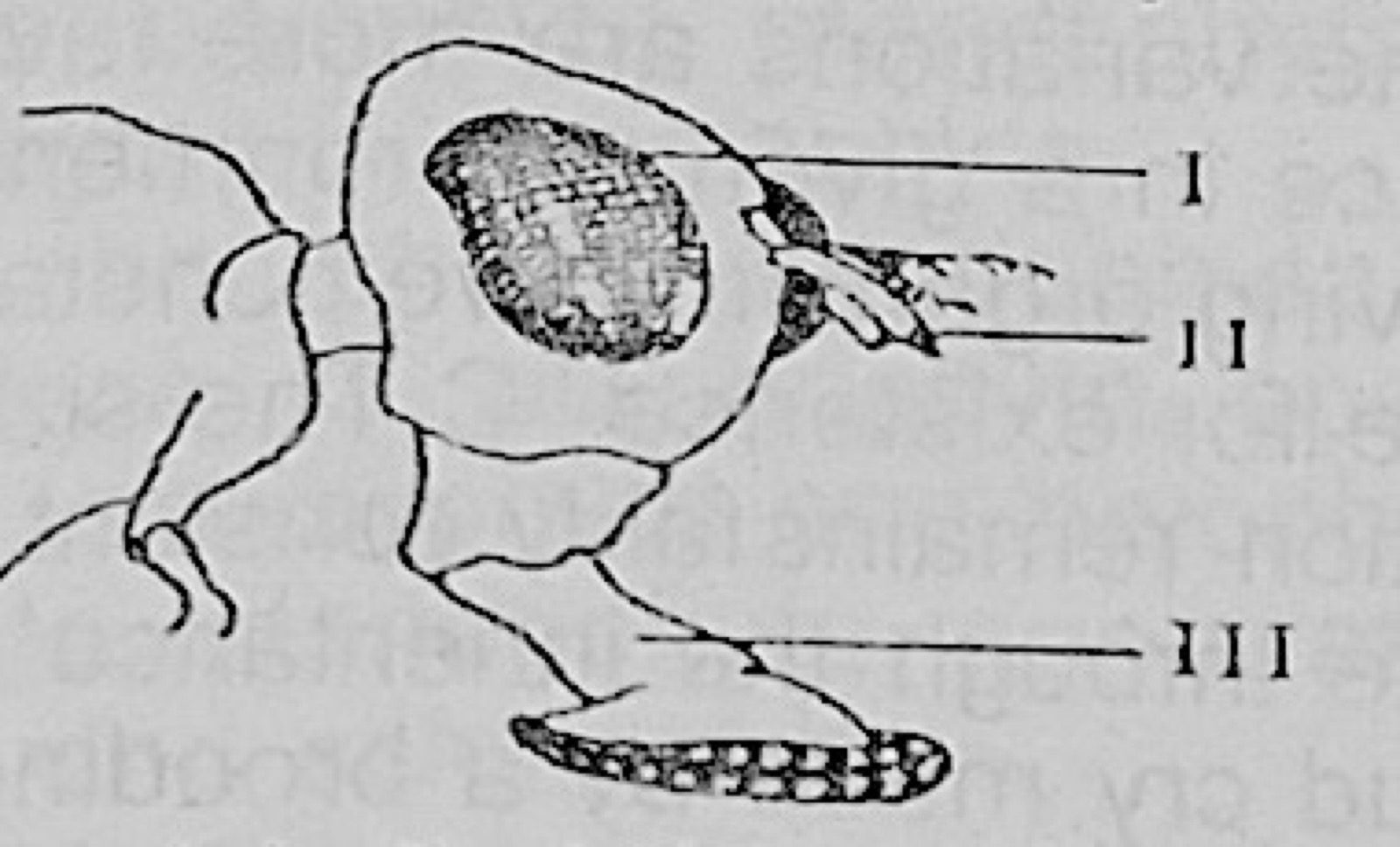
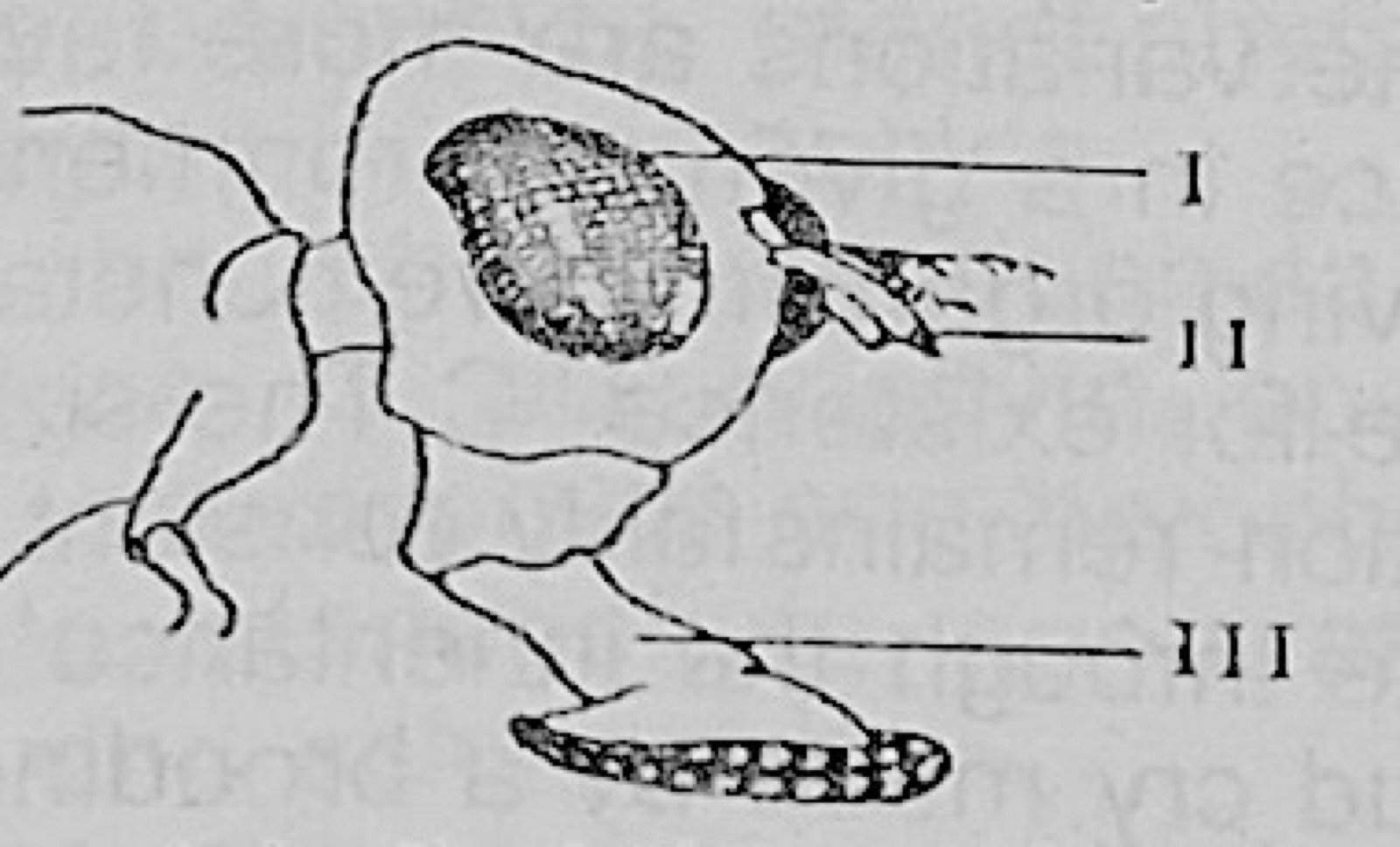
Question 7 Animal Kingdom Use the diagram to answer questions 7 and 8. The structure labelled II is used for
A. tasting B. feeling C. biting D. sucking. Show the answer and explanation Answer: B (feeling )
Explanation II is the antenna of the housefly, which is a sense organ for touch (feeling) and smell.
Open this question
Question 8 Animal Kingdom Use the diagram to answer questions 7 and 8. The structure labelled III represents the
A. mandible B. palp C. proboscis D. labium Show the answer and explanation Answer: C (proboscis )
Explanation The housefly feeds with a long proboscis ending in a spongy pad (labellum), shown as III.
Open this question
Question 9 Animal Kingdom The division of a body into two equal halves along a longitudinal plane is called
A. bilateral symmetry B. transverse section C. radial symmetry D. longitudinal section. Show the answer and explanation Answer: A (bilateral symmetry )
Explanation In bilateral symmetry only one lengthwise cut divides the body into two mirror-image halves.
Open this question
Question 10 Viruses, Monera, Protista and Fungi In which of the following organisms does each cell combine the functions of nutrition, reproduction and growth?
A. Rhizopus B. Dryopteris C. Brachymenium D. Spirogyra. Show the answer and explanation Answer: D (Spirogyra. )
Explanation Spirogyra is a simple filament in which every cell photosynthesises, grows and can divide or conjugate on its own.
Open this question
Question 11 Evolution The key event in the transition of the amphibians from water to land is the
A. replacement of the gills with lungs B. possession of webbed limbs C. development of long hind limbs D. possession of tympanic membrane. Show the answer and explanation Answer: A (replacement of the gills with lungs )
Explanation To live on land an animal must breathe air, so replacing gills with lungs was the key change.
Open this question
Question 12 Cell Structure and Organisation In plant cells, the chloroplasts are located
A. inside the cell wall B. outside the protoplasm C. within the vacuole D. within the cytoplasm. Show the answer and explanation Answer: D (within the cytoplasm. )
Explanation Chloroplasts are organelles suspended in the cytoplasm, usually in the thin layer around the vacuole.
Open this question
Question 13 Transport in Plants In woody stems, gaseous exchange takes place through the
A. micropyles B. stomata C. lenticels D. vessels. Show the answer and explanation Answer: C (lenticels )
Explanation Lenticels are loose pores in the bark of woody stems that allow air in and out.
Open this question
Question 14 Transport in Plants Substances manufactured by the leaves are transported to other parts of the plant through the
A. xylem B. companion cells C. sieve tubes D. cambium. Show the answer and explanation Answer: C (sieve tubes )
Explanation Food made in the leaves is translocated through the sieve tubes of the phloem.
Open this question
Question 15 Transport in Animals After a meal of yam has been digested, the highest concentration of glucose is to be found in the
A. hepatic artery B. pulmonary vein C. hepatic portal vein D. posterior vena cava Show the answer and explanation Answer: C (hepatic portal vein )
Explanation Glucose absorbed in the small intestine goes straight to the liver in the hepatic portal vein, so it is richest there.
Open this question
Question 16 Photosynthesis and Plant Nutrition The dark reaction of photosynthesis involves
A. fixation of carbon (IV) oxide to give a six-carbon sugar B. fixation of carbon (IV) oxide with the help of oxygen C. use of carbon (IV) oxide to produce glucose using ATP. D. fixation of carbon (IV) oxide on chlorophyll using hydrogen. Show the answer and explanation Answer: C (use of carbon (IV) oxide to produce glucose using ATP. )
Explanation In the dark (light-independent) stage, carbon (IV) oxide is fixed and turned into glucose using the ATP and hydrogen made in the light stage.
Open this question
Question 17 Transport in Animals Mammals acclimatize to reduced oxygen content at high altitudes by
A. the stimulation of marrow to reduce the amount of erythrocytes produced B. increasing the rate at which erythrocytes are destroyed C. the stimulation of marrow to produce more erythrocytes D. increasing the break down of the protein portion of the erythrocytes. Show the answer and explanation Answer: C (the stimulation of marrow to produce more erythrocytes )
Explanation With less oxygen in the air, bone marrow produces more red blood cells so the blood can still carry enough oxygen.
Open this question
Question 18 Animal Nutrition The modes of nutrition in Nitrobacter, Ascaris and Homo sapiens respectively are
A. photosynthetic, parasitic and holozoic B. chemosynthetic, parasitic and holozoic C. photosynthetic, parasitic and heterophytic D. chemosynthetic, holophytic and holozoic. Show the answer and explanation Answer: B (chemosynthetic, parasitic and holozoic )
Explanation Nitrobacter gets energy by oxidising nitrites (chemosynthesis), Ascaris lives in the gut of its host (parasitic) and humans ingest solid food (holozoic).
Open this question
Question 19 Food Substances and Enzymes The richest sources of vitamin A are
A. palm oil and groundnut oil B. palm oil and carrots C. rice and groundnut oil D. oranges and carrots. Show the answer and explanation Answer: B (palm oil and carrots )
Explanation Red palm oil and carrots are rich in carotene, which the body turns into vitamin A.
Open this question
Question 20 Transport in Plants The force that holds water together in the form of a stream within the xylem tube is the
A. cohesion of water molecules to one another by hydrogen bonds B. force of gravity attacting the water molecules through the hydrogen bonds C. attraction between the water and xylem osmotic force D. normal flow of water from the ground with the help of gravitational force. Show the answer and explanation Answer: A (cohesion of water molecules to one another by hydrogen bonds )
Explanation Water molecules stick to each other by hydrogen bonds (cohesion), so the column in the xylem does not break as it is pulled up.
Open this question
Question 21 Photosynthesis and Plant Nutrition Yellowing of leaves is a symptom associated with deficiency of
A. iron, calcium and magnesium B. nitrongen, sulphur and potassium C. sulphur, phosphorus and iron D. magnesium, nitrogen and iron. Show the answer and explanation Answer: D (magnesium, nitrogen and iron. )
Explanation Magnesium and nitrogen are part of chlorophyll and iron is needed to make it, so lack of any of them causes yellow leaves (chlorosis).
Open this question
Question 22 Transport in Animals The lymphatic system of mammals rejoins the blood circulatory system at the
A. hepatic vein B. subclavian vein C. renal vein D. common iliac vein. Show the answer and explanation Answer: B (subclavian vein )
Explanation Lymph collects in the thoracic duct and right lymphatic duct, which drain into the subclavian veins.
Open this question
Question 23 Transport in Animals In dissection, the rib cage of a mammal has to be opened in order to expose the
A. diaphragm B. liver C. heart D. sternum. Show the answer and explanation Answer: C (heart )
Explanation The heart and lungs lie inside the rib cage, so it must be cut open to see them.
Open this question
Question 24 Reproduction in Animals Fertilization in humans usually takes place in the
A. lower part of the uterus B. upper part of the uterus C. lower part of the oviduct D. upper part of the oviduct. Show the answer and explanation Answer: D (upper part of the oviduct. )
Explanation Sperm meet the egg in the upper third of the oviduct (Fallopian tube), close to the ovary.
Open this question
Question 25 Reproduction in Plants Insects visit flowers in order to
A. feed on the nectar B. deposit pollen on the stigma C. pollinate the flowers D. transfer pollen from anthers Show the answer and explanation Answer: A (feed on the nectar )
Explanation Insects come for food (nectar and pollen); pollination happens by accident as they move between flowers.
Open this question
Question 26 Growth and Development In epigeal germination, the cotyledons are
A. carried above the ground by the elongating hypocotyl B. pulled underground by the elongating hypocotyl C. pulled underground by the elongating epicotyl D. carried above the ground by the elongating epicotyl. Show the answer and explanation Answer: A (carried above the ground by the elongating hypocotyl )
Explanation In epigeal germination (e.g. bean) the hypocotyl grows fast and pushes the cotyledons above the soil.
Open this question
Question 27 Reproduction in Animals Bacteria multiply rapidly by means of
A. budding B. fragmentation C. binary fission D. spore formation. Show the answer and explanation Answer: C (binary fission )
Explanation A bacterium grows and then splits into two identical cells, which is binary fission.
Open this question
Question 28 Sense Organs The correct sequence for the perception of smell in mammals is
A. chemicals → olfactory nerve endings → brain B. dissolved chemicals → nasal sensory cells → brain C. chemicals → mucus membrane → sensory cells → brain D. dissolved chemicals → sensory cells → olfactory nerve → brain. Show the answer and explanation Answer: D (dissolved chemicals → sensory cells → olfactory nerve → brain. )
Explanation Chemicals dissolve in the nasal mucus, stimulate sensory cells, and impulses travel along the olfactory nerve to the brain.
Open this question
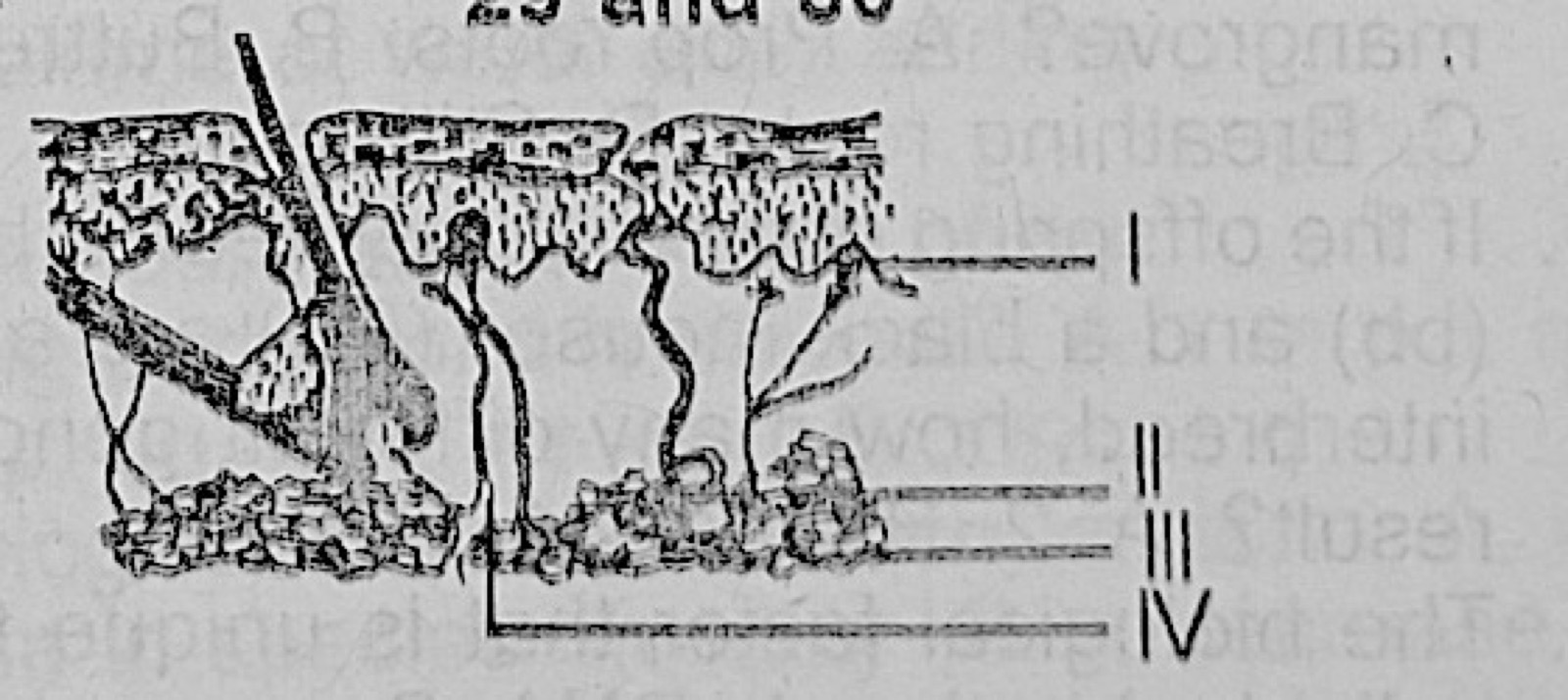
Question 29 Homeostasis Use the diagram to answer questions 29 and 30. The part labelled III is for
A. protection B. insulation C. lubrication D. growth. Show the answer and explanation Answer: B (insulation )
Explanation III is the layer of fat under the skin, which insulates the body against heat loss.
Open this question
Question 30 Homeostasis Use the diagram to answer questions 29 and 30. The structure labelled II is known as
A. sweat gland B. lymph vessel C. blood vessel D. nerve ending. Show the answer and explanation Answer: A (sweat gland )
Explanation II points to the coiled tube deep in the dermis, which is the sweat gland.
Open this question
Question 31 Hormonal Coordination In mammals, the organ which performs digestive and endocrine functions is the
A. liver B. pancreas C. gastric gland D. salivary gland. Show the answer and explanation Answer: B (pancreas )
Explanation The pancreas makes digestive enzymes and also releases the hormones insulin and glucagon into the blood.
Open this question
Question 32 Support and Movement The chitin in the exoskeleton of many arthropods is strengthened by
A. calcium compounds B. organic salts C. lipids D. proteins. Show the answer and explanation Answer: D (proteins. )
Explanation In insects the chitin is hardened by tanned proteins (sclerotin); crustaceans also add calcium salts.
Open this question
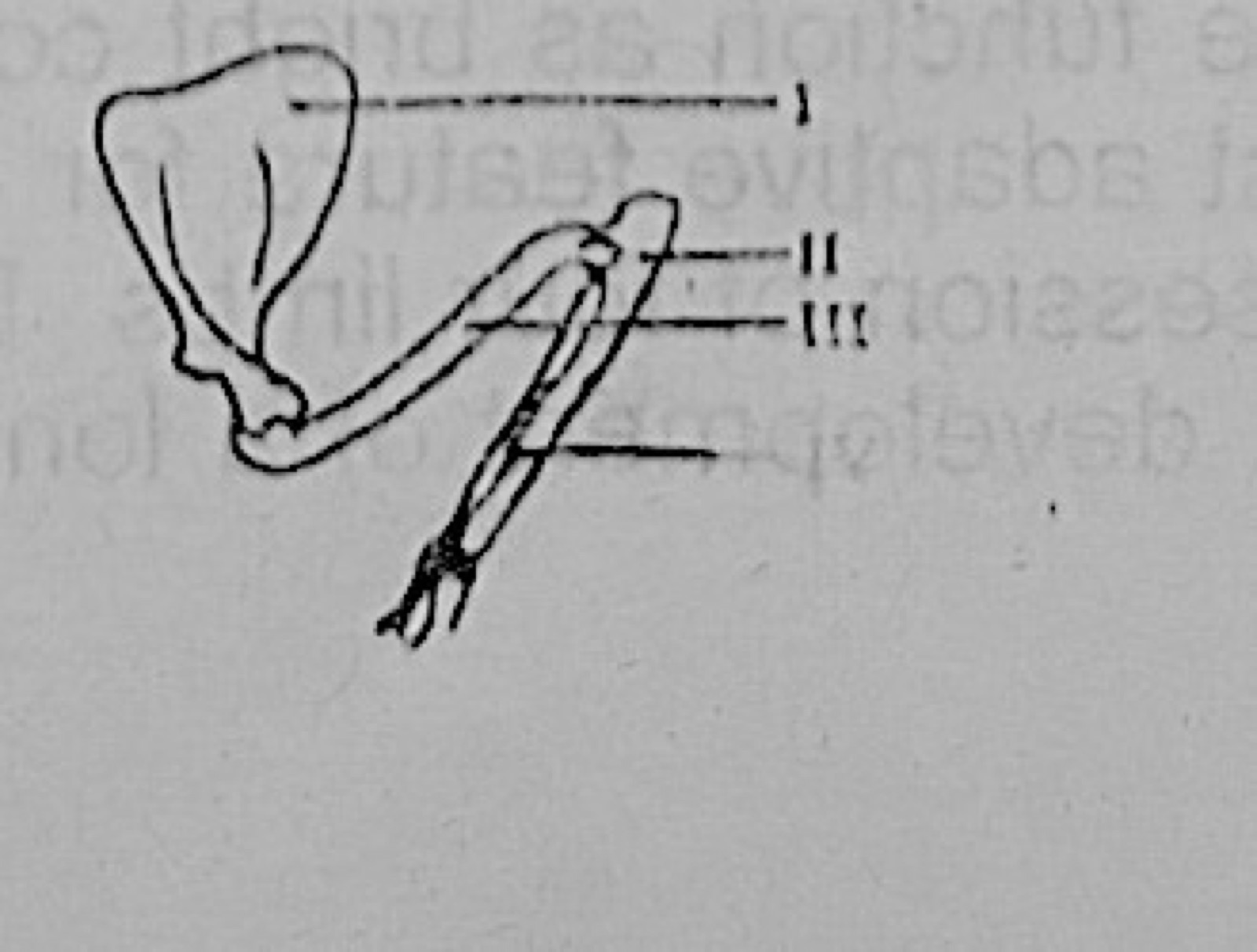
Question 33 Support and Movement Use the diagram to answer questions 33 and 34. The structure labelled II articulates with III to form a
A. sliding joint B. hinge joint C. pivot joint D. ball-and-socket joint. Show the answer and explanation Answer: B (hinge joint )
Explanation II and III meet at the elbow, which bends in one plane only, so it is a hinge joint.
Open this question
Question 34 Support and Movement Use the diagram to answer questions 33 and 34. Which of the bones is the radius?
A. I B. II C. III D. IV Show the answer and explanation Answer: D (IV )
Explanation The radius is one of the two forearm bones between the elbow and the wrist, labelled IV.
Open this question
Question 35 Microorganisms and Health The construction of dams may lead to an increase in the prevalence of
A. typhoid fever, measles and yellow fever B. tuberculosis, leprosy and trypanosomiasis C. guineaworm, malaria and tuberculosis D. malaria, bilharziasis and onchocerciasis. Show the answer and explanation Answer: D (malaria, bilharziasis and onchocerciasis. )
Explanation Dams create still and fast-flowing water where mosquitoes, snails and blackflies breed, spreading malaria, bilharzia and river blindness.
Open this question
Question 36 Habitats and Biomes Floating microscopic heterotrophs are mostly grouped as
A. phytoplankton B. zooplankton C. microbes D. nekton. Show the answer and explanation Answer: B (zooplankton )
Explanation Zooplankton are tiny drifting animals that feed on other organisms; phytoplankton make their own food.
Open this question
Question 37 Microorganisms and Health Vaccination is carried out in order to
A. check theproduction of poison B. increase the activity of white blood cells C. increase the number of red blood cells D. stimulate the production of antibodies Show the answer and explanation Answer: D (stimulate the production of antibodies )
Explanation A vaccine contains weakened or dead germs that make the body produce antibodies, giving immunity.
Open this question
Question 38 Soil A soil consisting of alumina and iron (II) oxide is known as
A. loamy soil B. clayey soil C. laterite D. podzol. Show the answer and explanation Answer: C (laterite )
Explanation Laterite forms in hot, wet regions where leaching leaves mainly iron and aluminium oxides.
Open this question
Question 39 Ecological Associations The sign + is used to indicate an association where an organism gains, while 0 is used where an organism is unaffected. An association indicated as + 0 is known as
A. predation B. commensalism C. parasitism D. competition. Show the answer and explanation Answer: B (commensalism )
Explanation In commensalism one partner benefits (+) and the other is neither helped nor harmed (0).
Open this question
Question 42 Habitats and Biomes Which of the following characterizes the white mangrove?
A. Prop roots B. Buttress roots C. Breathing roots D. Stilt roots. Show the answer and explanation Answer: C (Breathing roots )
Explanation The white mangrove grows in waterlogged mud and sends up breathing roots (pneumatophores) to get air.
Open this question
Question 43 Mendelian Inheritance If the offspring of a cross between a brown mouse (bb) and a black mouse (BB) are allowed to interbreed, how many different genotypes would result?
A. 2 B. 3 C. 4 D. 5. Show the answer and explanation Answer: B (3 )
Explanation The first cross gives all Bb. Crossing Bb × Bb gives BB, Bb and bb, which is 3 genotypes.
Open this question
Question 44 Chromosomes, DNA and Sex Linkage The biological factor that is unique to each individual is the
A. DNA B. eye colour C. blood group D. RNA. Show the answer and explanation Answer: A (DNA )
Explanation Except for identical twins, every person's DNA sequence is different, which is why DNA fingerprinting works.
Open this question
Question 45 Evolution From an evolutionary standpoint, the older a fossil-bearing rock is, the more likely it is to contain
A. aves as opposed to amphibians B. invertebrates as opposed to vertebrates C. angiosperms as opposed to algae D. vertebrates as opposed to invertebrates. Show the answer and explanation Answer: B (invertebrates as opposed to vertebrates )
Explanation Simpler organisms appeared first, so older rocks contain invertebrates and newer rocks contain vertebrates.
Open this question
Question 46 Adaptation The very bright colours in some types of mushroom
A. are a warning that they may be poisonous B. indicate that they are very tasty C. attract potential transporters of their spores D. perform the same function as bright colours in flowers Show the answer and explanation Answer: A (are a warning that they may be poisonous )
Explanation Bright colours often warn animals that the mushroom is poisonous (warning colouration).
Open this question
Question 47 Adaptation The least adaptive feature for arboreal life is the
A. possession of four limbs B. possession of claws C. development of a long tail D. shading of coat colour. Show the answer and explanation Answer: D (shading of coat colour. )
Explanation Limbs, claws and a long tail all help an animal climb and balance in trees; coat shading does not help tree life.
Open this question
Question 48 Evolution Which of the following is one of Lamarck's theories?
A. Some variations are more favourable to existence in a given environment than others B. All living organisms are constantly involved in a struggle for existence C. The size of a given population remains fairly constant D. New species originate through the inheritance of acquired traits. Show the answer and explanation Answer: D (New species originate through the inheritance of acquired traits. )
Explanation Lamarck proposed that traits acquired during life are passed on to offspring; the others are Darwin's ideas.
Open this question
Question 49 Behaviour The loud cry made by a brooding hen when a predator is around is meant to
A. alert the poultry attendants B. attract cocks to come and fight the predator C. advertise the boundaries of its territory to intruders D. warn its chicks and other chickens of impending danger. Show the answer and explanation Answer: D (warn its chicks and other chickens of impending danger. )
Explanation It is an alarm call that warns the chicks and other birds to hide.
Open this question
Question 50 Habitats and Biomes The most important environmental factor which epiphytes in the rain forest compete for is
A. water B. nutrient C. light D. space. Show the answer and explanation Answer: C (light )
Explanation The rain forest floor is shaded, so epiphytes perch on tall trees to reach sunlight for photosynthesis.
Open this question Sign up free for every JAMB Biology year, practice by topic and timed mocks.
Start practising free