Home › Past questions › JAMB › Biology › 1995 49 questions. Try each one, then open the answer to check yourself and read the explanation.
Sign up free to answer these questions on a CBT screen with a timer, then see your score and every answer explained.
Start practising free
Question 1 Viruses, Monera, Protista and Fungi Which of the following does a virus have in common with animal cells?
A. Nucleus B. DNA C. Gycogen D. Cytoplasm. Show the answer and explanation Answer: B (DNA )
Explanation A virus is just nucleic acid (DNA or RNA) in a protein coat; it has no nucleus, cytoplasm or stored glycogen, so DNA is what it shares with animal cells.
Open this question
Question 2 Cell Structure and Organisation Which of the following organelles are likely to be present in cells that are actively respiring and photosynthesizing?
A. Nucleolus and centrioles B. Mitochondria and chloroplasts C. Lysosomes and ribosomes D. Golgi apparatus and endoplasmic reticulum. Show the answer and explanation Answer: B (Mitochondria and chloroplasts )
Explanation Mitochondria carry out aerobic respiration and chloroplasts carry out photosynthesis.
Open this question
Question 3 Plant Kingdom One common characteristic of fungi, algae, mosses and ferns is that they
A. show alternation of generations B. reproduce sexually by conjugation C. produce spores that are dispersed D. possess chlorophyll in their tissues. Show the answer and explanation Answer: C (produce spores that are dispersed )
Explanation Fungi, algae, mosses and ferns all reproduce by spores that are scattered to new places. Fungi lack chlorophyll and only some algae and fungi conjugate.
Open this question
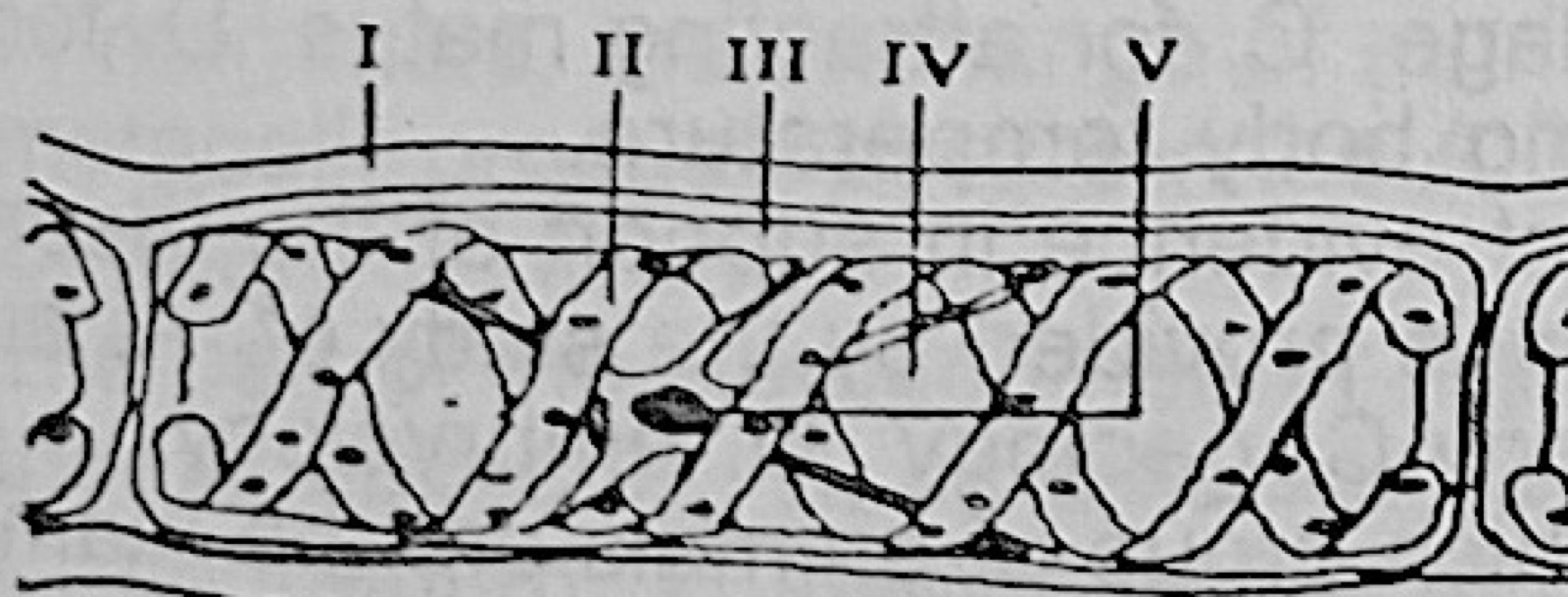
Question 4 Viruses, Monera, Protista and Fungi Protein-like bodies are borne on the part labelled
A. II B. III C. IV D. V Show the answer and explanation Answer: A (II )
Explanation The diagram is a Spirogyra filament. The protein-like pyrenoids sit on the spiral chloroplast, labelled II.
Open this question
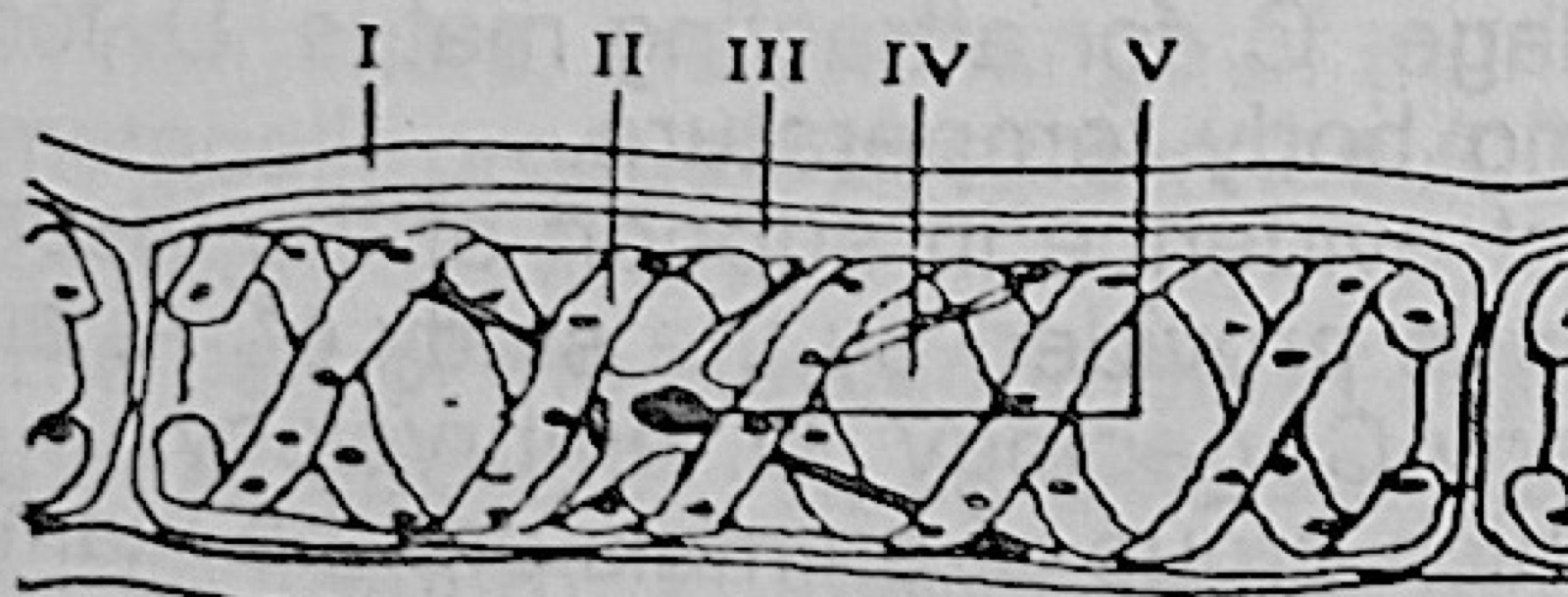
Question 5 Reproduction in Animals The sexual reproductive function is performed by the part labelled
A. I B. II C. IV D. V Show the answer and explanation Answer: D (V )
Explanation V is the nucleus; in conjugation the nuclei of the two gametes fuse to form the zygote, so the nucleus carries out the sexual function.
Open this question
Question 6 Microorganisms and Health Which of the following is transmitted through mosquito bite?
A. Filariasis B. Typhus C. Plague D. Schistosomiasis. Show the answer and explanation Answer: A (Filariasis )
Explanation Filariasis (elephantiasis) worms are spread by Culex mosquitoes. Typhus is spread by lice, plague by fleas and schistosomiasis through water snails.
Open this question
Question 7 Reproduction in Animals Which of the following insects lays its eggs in horny, purse-like cases?
A. Mosquito B. Butterfly C. Termite D. Cockroach. Show the answer and explanation Answer: D (Cockroach. )
Explanation The female cockroach lays her eggs inside a hard, purse-shaped case called an ootheca.
Open this question
Question 8 Respiration In which of the following vertebrates does the skin function as a respiratory surface?
A. Rat B. Lizard C. Fish D. Frog. Show the answer and explanation Answer: D (Frog. )
Explanation A frog's skin is thin, moist and full of blood vessels, so oxygen diffuses through it.
Open this question
Question 9 Homeostasis Birds maintain their body temperature with the help of their
A. blood which maintains constant temperature B. feathers which cover the body C. skin which conserves moisture D. veins which transport fluid of constant temperature to all body tissues. Show the answer and explanation Answer: B (feathers which cover the body )
Explanation Feathers trap a layer of air that insulates the bird's body and reduces heat loss.
Open this question
Question 10 Growth and Development Secondary thickening in dicotyledonous stem is controlled by the
A. xylem B. phloem C. cambium D. pericycle. Show the answer and explanation Answer: C (cambium )
Explanation The cambium divides to add new xylem inside and new phloem outside, making the stem thicker.
Open this question
Question 11 Photosynthesis and Plant Nutrition 2H2 O → 2H2 + O2(g) . The equation above represents a part of the light stage of photosynthesis. Which of the following must be present for this reaction to occur?
A. Enzyme and light energy B. Carbondioxide and light energy C. Light energy and chlorophyll D. Chlorophyll and enzyme. Show the answer and explanation Answer: C (Light energy and chlorophyll )
Explanation Splitting water (photolysis) needs light energy trapped by chlorophyll; carbon dioxide is used later, in the dark stage.
Open this question
Question 12 Photosynthesis and Plant Nutrition In an experiment to investigate the effect of nitrogen on the growth of plants, the substrate should be a medium of
A. washed sand B. saw dust C. cow dung D. clay soil. Show the answer and explanation Answer: A (washed sand )
Explanation The medium must contain no nitrogen of its own so the effect of adding it can be seen; washed sand is nearly free of nutrients. Cow dung and clay soil already contain nitrogen.
Open this question
Question 13 Transport in Animals Which vitamin plays an important role in blood clotting?
A. Vitamin A B. Vitamin K C. Vitamin B12 D. Vitamin C. Show the answer and explanation Answer: B (Vitamin K )
Explanation Vitamin K is needed by the liver to make prothrombin and other clotting factors.
Open this question
Question 14 Hormonal Coordination The mammalian organ which acts both as a digestive and as an endocrine organ is the
A. oesophagus B. liver C. pancreas D. spleen. Show the answer and explanation Answer: C (pancreas )
Explanation The pancreas releases digestive enzymes into the duodenum and also makes the hormones insulin and glucagon.
Open this question
Question 15 Transport in Animals Which of the following is NOT involved in the transport of substances in the body?
A. Lymph B. Plasma C. Leucocytes D. Erythrocytes. Show the answer and explanation Answer: C (Leucocytes )
Explanation Leucocytes (white blood cells) defend the body against germs. Plasma, lymph and red cells carry food, wastes and gases.
Open this question
Question 16 Respiration The end product of glycolysis in plants and animals is
A. pyruvic acid B. citric acid C. aspartic acid D. malic acid. Show the answer and explanation Answer: A (pyruvic acid )
Explanation Glycolysis splits glucose into two molecules of pyruvic acid in the cytoplasm.
Open this question
Question 17 Respiration During respiration, air circulates round plant tissues via the
A. lenticels B. stomata C. guard cells D. intercellular spaces. Show the answer and explanation Answer: D (intercellular spaces. )
Explanation Air enters through stomata and lenticels but then moves around the inner tissues through the intercellular air spaces.
Open this question
Question 18 Excretion The excretory structure in the earthworm is the
A. malpighian tubule B. flame cell C. nephridium D. kidney. Show the answer and explanation Answer: C (nephridium )
Explanation Earthworms excrete with nephridia, tubes found in nearly every body segment.
Open this question
Question 19 Support and Movement During the bending of the arm, the biceps muscle
A. contracts and the triceps muscle relaxes B. relaxes and the triceps muscle contracts C. and the triceps muscle contract D. and the triceps muscle relax. Show the answer and explanation Answer: A (contracts and the triceps muscle relaxes )
Explanation Biceps and triceps are an antagonistic pair: to bend the arm the biceps contracts while the triceps relaxes.
Open this question
Question 20 Plant Responses and Hormones When a healthy shoot of a flowering plant is illuminated from one side, auxins, accumulate on the
A. non-illuminated side of the shoot B. illuminated side of the shoot C. upper side of the shoot D. lower side of the shoot. Show the answer and explanation Answer: A (non-illuminated side of the shoot )
Explanation Auxin moves to the shaded side, making those cells grow faster so the shoot bends towards the light.
Open this question
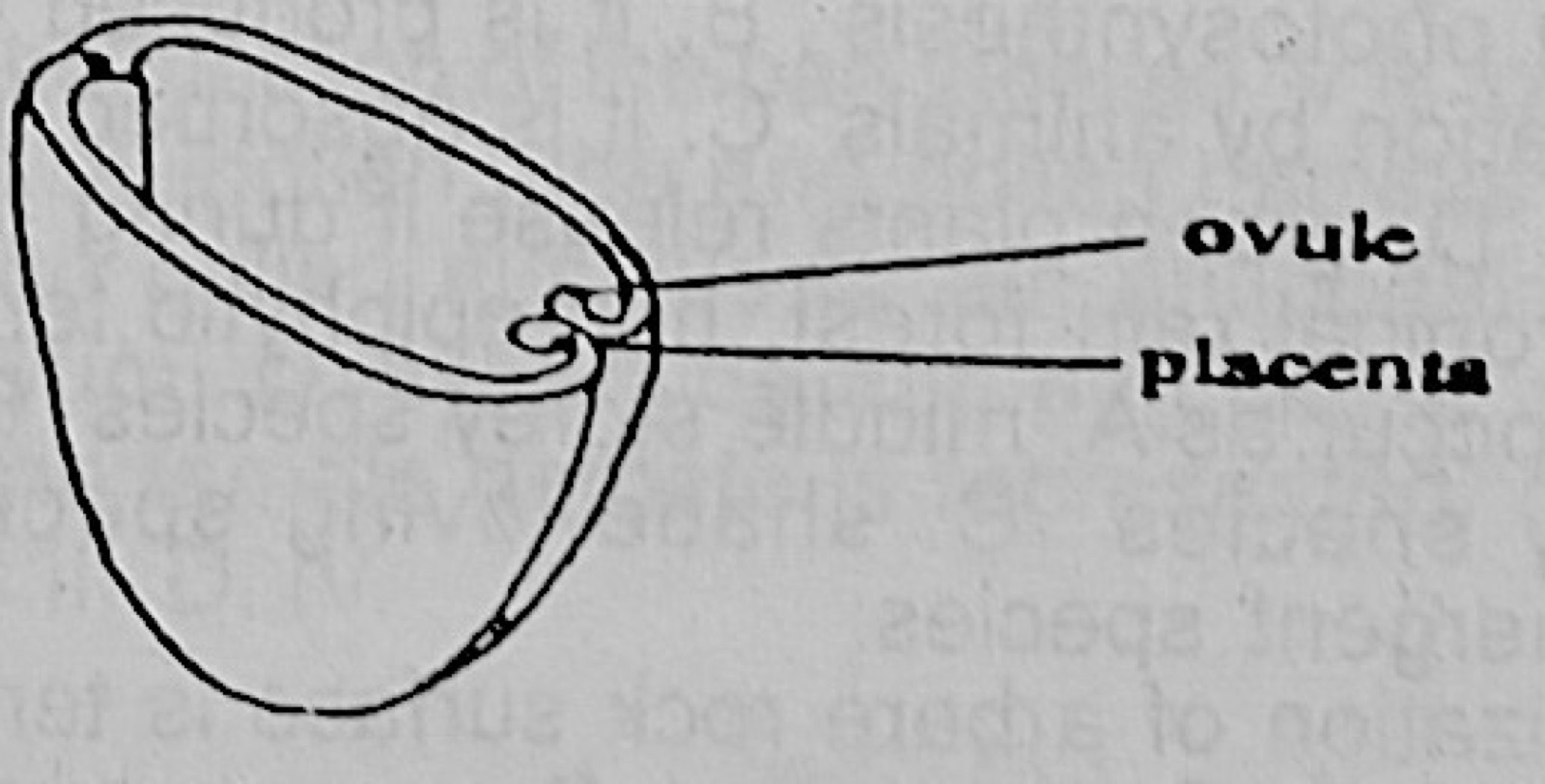
Question 21 Reproduction in Plants The type of placentation shown is
A. axial B. marginal C. parietal D. central Show the answer and explanation Answer: B (marginal )
Explanation The ovules are attached along one edge (margin) of a single carpel, which is marginal placentation.
Open this question
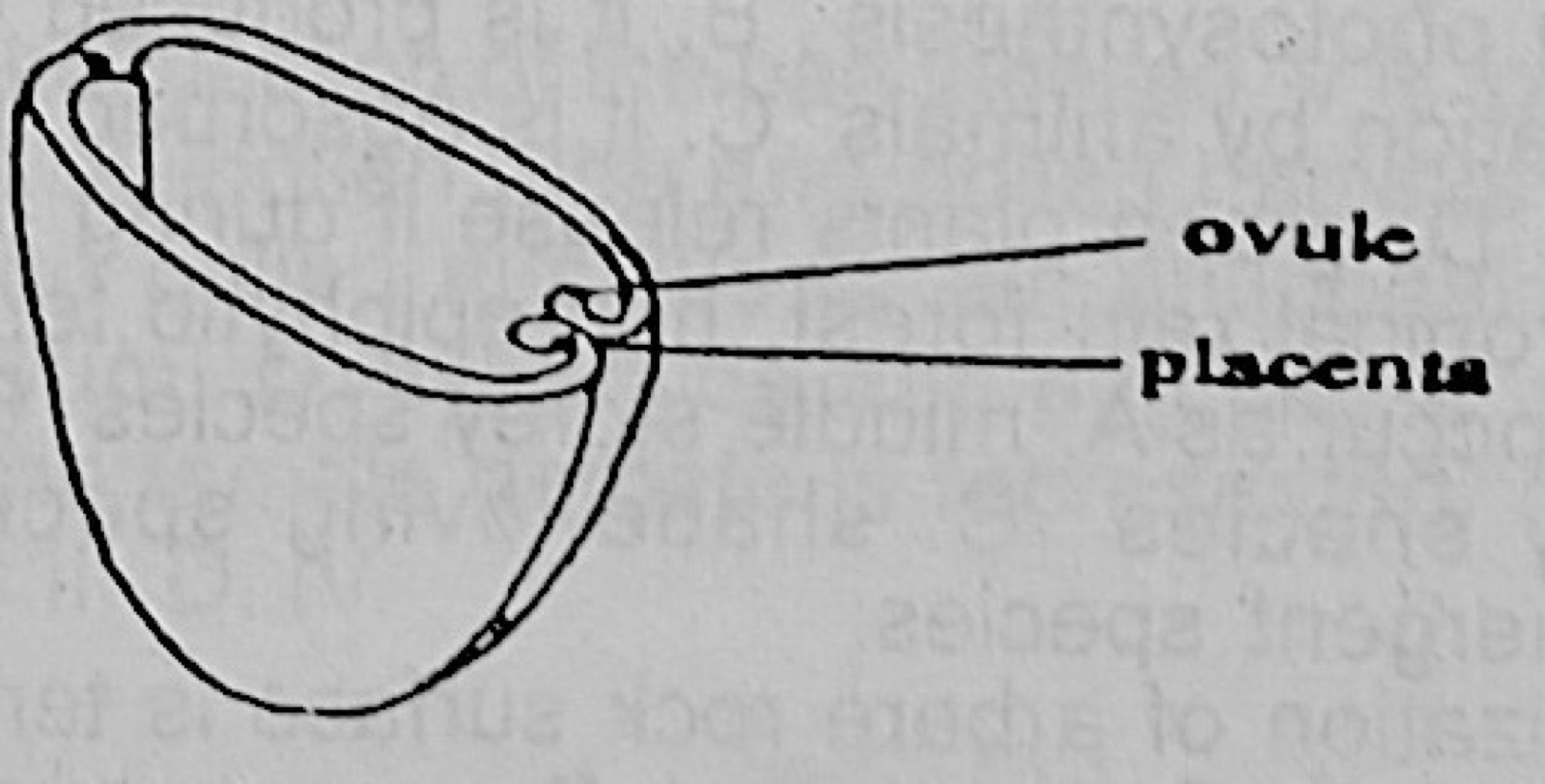
Question 22 Reproduction in Plants An example of a plant having the placentation shown is
A. allamander B. hibiscus C. water lily D. pride of Barbados. Show the answer and explanation Answer: D (pride of Barbados. )
Explanation Pride of Barbados is a legume; legume pods have marginal placentation with seeds along one edge.
Open this question
Question 23 Reproduction in Plants The term caryopsis is used to describe a fruit in which the
A. testa and pericarp are separate B. seed and endocarp are fused C. testa and pericarp are fused D. seed coat and fruit wall are impermeable. Show the answer and explanation Answer: C (testa and pericarp are fused )
Explanation A caryopsis, such as a maize grain, is a dry one-seeded fruit in which the seed coat (testa) is fused to the fruit wall (pericarp).
Open this question
Question 24 Chromosomes, DNA and Sex Linkage The sex of a foetus is determined during
A. meiosis B. copulation C. fertilization D. placentation. Show the answer and explanation Answer: C (fertilization )
Explanation Sex depends on whether an X or a Y sperm fuses with the egg, so it is fixed at fertilisation.
Open this question
Question 26 Nervous Coordination The process of walking is under the control of the part of the brain called
A. optic lobe B. olfactory lobe C. cerebellum D. medulla oblongata. Show the answer and explanation Answer: C (cerebellum )
Explanation The cerebellum coordinates muscle movements and balance, which walking needs.
Open this question
Question 27 Hormonal Coordination The gland directly affecting metabolic rate, growth and development is known as
A. adrenal gland B. thyroid gland C. mammary gland D. parathyroid gland. Show the answer and explanation Answer: B (thyroid gland )
Explanation The thyroid gland produces thyroxine, which controls the rate of metabolism and normal growth and development.
Open this question
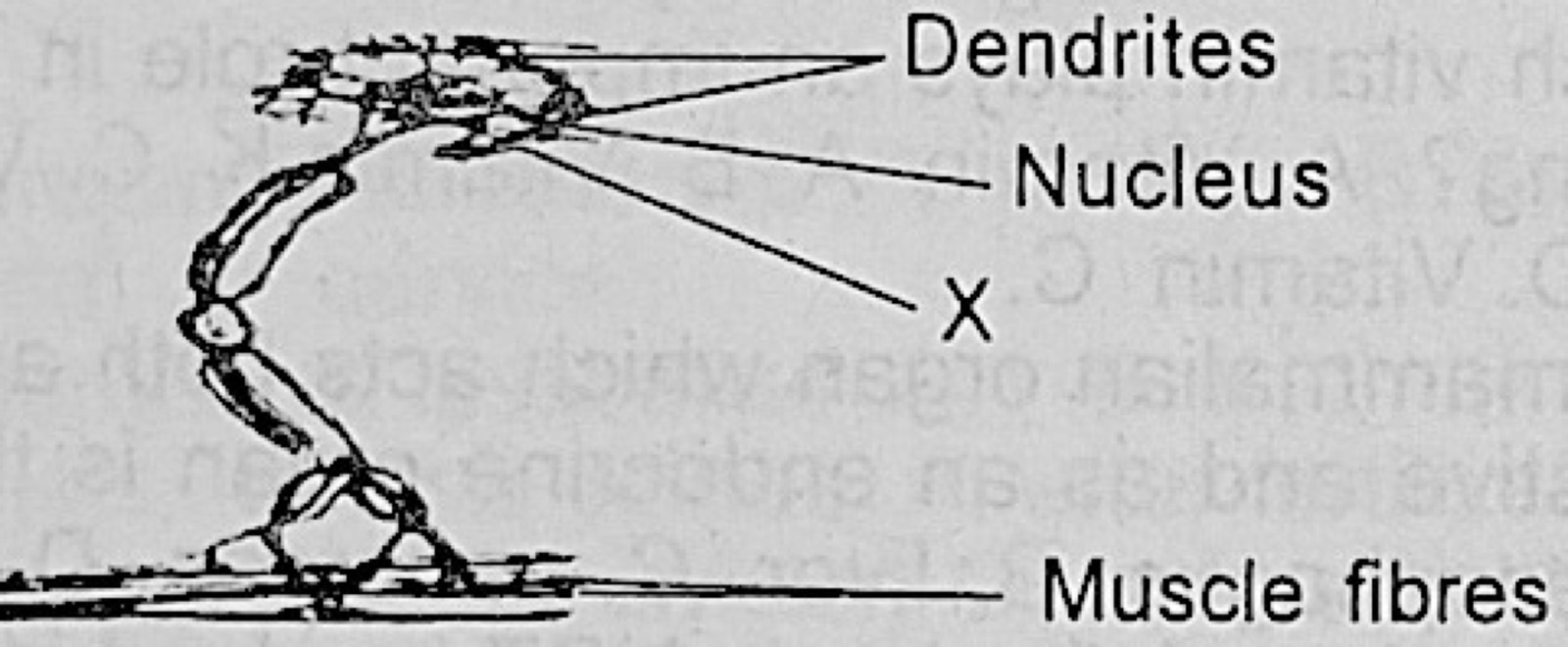
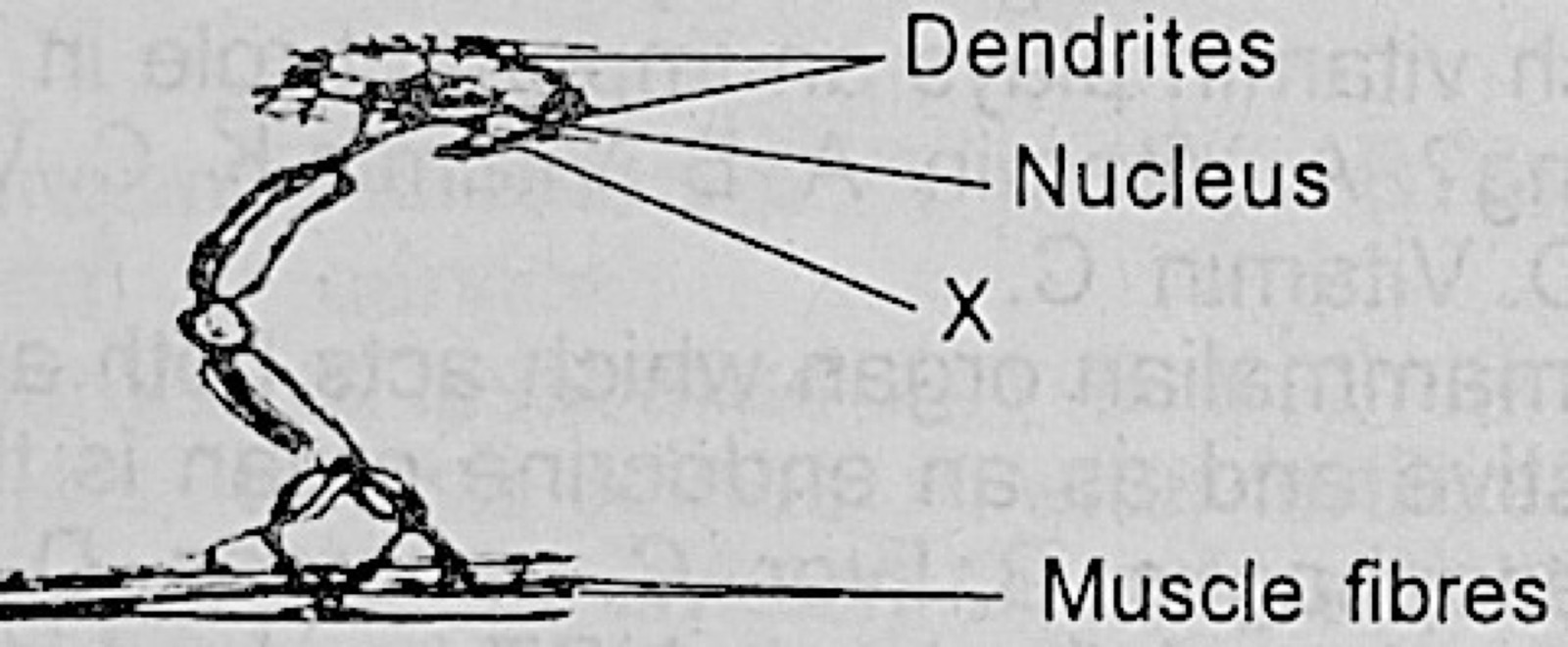
Question 28 Nervous Coordination The diagram represents
A. sensory neurone B. relay neurone C. afferent neurone D. motor neurone Show the answer and explanation Answer: D (motor neurone )
Explanation The neurone has its cell body at one end and its axon ending on muscle fibres, so it carries impulses to a muscle: a motor neurone.
Open this question
Question 29 Nervous Coordination The part labelled X is the
A. axon B. cell body C. terminal dendrites D. synapse. Show the answer and explanation Answer: B (cell body )
Explanation X points to the swollen part near the dendrites and nucleus, which is the cell body of the neurone.
Open this question
Question 30 Nervous Coordination Which of the following ions is involved in the conduction of the nerve impulse?
A. Ca2+ B. K+ C. H+ D. Mg2+ . Show the answer and explanation Answer: B (K+ )
Explanation A nerve impulse depends on the movement of sodium and potassium (K+ ) ions across the nerve cell membrane.
Open this question
Question 31 Ecosystem and Ecological Factors The depth of illumination in a water body can be measured with a
A. photometer B. secchi disc C. hydrometer D. anemometer. Show the answer and explanation Answer: B (secchi disc )
Explanation A Secchi disc is lowered into water until it disappears; the depth shows how far light gets through.
Open this question
Question 32 Feeding Relationships and Energy Flow In a food chain involving a primary producer, a primary consumer as well as a secondary consumer, the sharing of trophic energy is in the form that the
A. primary consumer has more energy than the primary producer B. secondary consumer takes up all the energy contents of the primary consumer C. energy is shared equally between the three groups of organisms D. secondary consumer gets only a small portion of the energy contained in the primary producer. Show the answer and explanation Answer: D (secondary consumer gets only a small portion of the energy contained in the primary producer. )
Explanation Only about a tenth of the energy passes from one level to the next; the rest is lost as heat and waste, so the secondary consumer gets only a small share of what the producer trapped.
Open this question
Question 33 Nutrient Cycling In spite of the removal of carbondioxide from the atmosphere, its amount remains more or less constant because
A. it is produced by green plants during photosynthesis B. it is produced during respiration by animals C. it is absorbed in ocean water D. green plants release it during the day. Show the answer and explanation Answer: B (it is produced during respiration by animals )
Explanation Respiration by animals (and plants and decomposers) puts carbon dioxide back into the air, balancing what photosynthesis removes.
Open this question
Question 34 Habitats and Biomes In a tropical rain forest, non-epiphytic ferns and allies occur as
A. middle storey species B. upper storey species C. shade-loving species D. emergent species. Show the answer and explanation Answer: C (shade-loving species )
Explanation Ferns on the forest floor live in deep shade under the tree layers, so they are shade-loving plants.
Open this question
Question 35 Population Ecology Colonization of a bare rock surface is termed
A. evolution B. speciation C. primary succession D. secondary succession. Show the answer and explanation Answer: C (primary succession )
Explanation Succession that starts on bare ground with no soil, such as rock, is primary succession.
Open this question
Question 36 Microorganisms and Health Which of the following is a measure for the control of bilharzia?
A. Cutting low bushes around homes B. Application of molluscicides in water bodies C. Screening windows and doors with mosquito nets D. Application of herbicides in water bodies. Show the answer and explanation Answer: B (Application of molluscicides in water bodies )
Explanation Bilharzia worms pass part of their life in water snails, so killing the snails with molluscicides breaks the cycle.
Open this question
Question 37 Microorganisms and Health Some of the diseases caused by bacteria are
A. tuberculosis, gonorrhoea and syphilis B. tuberculosis, gonorrhoea and AIDS C. Poliomyelitis, syphilis and gonorrhoea D. AIDS, cholera and tuberculosis. Show the answer and explanation Answer: A (tuberculosis, gonorrhoea and syphilis )
Explanation Tuberculosis, gonorrhoea and syphilis are all bacterial. AIDS and poliomyelitis are caused by viruses.
Open this question
Question 38 Pollution Environmental pollutants which can work through the media of water, soil and air include
A. carbon monoxide B. noise C. sulphur (IV) oxide D. smoke Show the answer and explanation Answer: C (sulphur (IV) oxide )
Explanation Sulphur(IV) oxide pollutes the air and dissolves in rain to form acid rain, which then harms soil and water.
Open this question
Question 39 Variation Human height is an example of a feature which depends on both
A. genotype and phenotype B. genetic and environmental factors C. mother's genotype and environmental factors D. phenotipic and environmental factors. Show the answer and explanation Answer: B (genetic and environmental factors )
Explanation Genes set a person's possible height, but food and health (the environment) affect how tall they actually grow.
Open this question
Question 40 Transport in Animals A person with type O blood can donate to a patient with type A because the donor's blood
A. lacks antigens B. lacks anti-A antibodies C. lacks anti-B antibodies D. has both anti-A and anti-B antibodies Show the answer and explanation Answer: A (lacks antigens )
Explanation Group O red cells carry no A or B antigens, so the patient's antibodies have nothing to clump; that is why O is the universal donor.
Open this question
Question 41 Chromosomes, DNA and Sex Linkage The DNA molecule is a chain of repeating
A. nucleosides B. nitrogenous bases C. sugar phosphates D. nucleotides. Show the answer and explanation Answer: D (nucleotides. )
Explanation DNA is a polymer of nucleotides, each made of a sugar, a phosphate and a nitrogenous base.
Open this question
Question 42 Chromosomes, DNA and Sex Linkage The specific number of chromosomes in each somatic cell is represented by
A. 2N B. 23 C. 2N D. N Show the answer and explanation Answer: C (2N )
Explanation Body (somatic) cells are diploid, with two sets of chromosomes, written 2N; gametes have N.
Open this question
Question 43 Mendelian Inheritance A man with blood group A is married to a woman with blood group A. Which of the followng group combinations is possible if the family has three children?
A. B, A, AB B. O, A, B C. B, AB, AB D. A, O, A. Show the answer and explanation Answer: D (A, O, A. )
Explanation If both parents are AO, their children can be A (AA or AO) or O (OO); B and AB are impossible as neither parent has a B allele.
Open this question
Question 44 Mendelian Inheritance The F1 of a cross between a tall and a dwarf plant was tall. The F1 was advanced to F2 . How many of 120 F2 plants will be dwarf?
A. 30 B. 60 C. 90 D. 120. Show the answer and explanation Answer: A (30 )
Explanation F1 plants are Tt; crossing Tt × Tt gives 3 tall : 1 dwarf, so a quarter of 120 = 30 are dwarf.
Open this question
Question 45 Chromosomes, DNA and Sex Linkage All the sons of a colour-blind woman will be colour blind regardless of the state of the father because
A. the egg determines the phenotype of the son B. sons inherit the sex chromosomes of their mothers C. the father's sex chromosome is weaker in sons D. sex-linked traits express dominance in females. Show the answer and explanation Answer: B (sons inherit the sex chromosomes of their mothers )
Explanation A son receives his X chromosome from his mother and his Y from his father. A colour-blind mother has the gene on both X chromosomes, so every son gets it.
Open this question
Question 46 Adaptation The slender, long and slightly curved beak of the sun-bird is an adaptation for feeding on
A. nectar B. small seeds C. big seeds D. insects. Show the answer and explanation Answer: A (nectar )
Explanation A long, thin, curved beak can reach deep into flowers to suck nectar.
Open this question
Question 47 Animal Kingdom Scales on reptiles are a feature for
A. conserving water B. conserving food C. protecting the skin D. locomotion. Show the answer and explanation Answer: A (conserving water )
Explanation The dry, horny scales of reptiles form a waterproof covering that stops the body drying out on land.
Open this question
Question 48 Adaptation The colour of the ventral surface of a fish is lighter than that of the dorsal. This is mainly
A. an adaptation for movement B. an adaptation for camouflage C. for attracting mates D. for regulating body temperature. Show the answer and explanation Answer: B (an adaptation for camouflage )
Explanation Seen from below, the pale belly blends with the bright water surface; seen from above, the dark back blends with the deep water. This countershading hides the fish.
Open this question
Question 49 Evolution The least evidence in support of the theory of evolution is provided by the study of
A. anatomy B. ecology C. geology D. embryology. Show the answer and explanation Answer: B (ecology )
Explanation Comparative anatomy, embryology and fossils in rocks (geology) give direct evidence of evolution; ecology studies organisms and their surroundings and gives the least.
Open this question
Question 50 Evolution From which group of animals are the mammals generally believed to have most recently evolved?
A. Reptiles B. Fishes C. Amphibians D. Birds. Show the answer and explanation Answer: A (Reptiles )
Explanation Fossils show mammals arose from a group of reptiles called mammal-like reptiles; fish came much earlier in the line.
Open this question Sign up free for every JAMB Biology year, practice by topic and timed mocks.
Start practising free