Home › Past questions › JAMB › Biology › 1993 47 questions. Try each one, then open the answer to check yourself and read the explanation.
Sign up free to answer these questions on a CBT screen with a timer, then see your score and every answer explained.
Start practising free
Question 1 Chromosomes, DNA and Sex Linkage On what structures are the units of inheritance situated?
A. Golgi bodies B. Ribosomes C. Chromosomes D. Endoplasmic reticulum. Show the answer and explanation Answer: C (Chromosomes )
Explanation Genes, the units of inheritance, are carried along the chromosomes in the nucleus.
Open this question
Question 2 Plant Kingdom Production of naked seeds is a distinctive feature of the group of plant called
A. grasses B. conifers C. legumes D. palms. Show the answer and explanation Answer: B (conifers )
Explanation Conifers are gymnosperms: their seeds lie exposed on cone scales instead of inside a fruit.
Open this question
Question 3 Plant Kingdom In which of these features do bryophytes differ from pteridophytes?
A. Absence of flower B. Alternation of generation C. Dependence on water for reproduction D. Presence of a vascular system. Show the answer and explanation Answer: D (Presence of a vascular system. )
Explanation Ferns (pteridophytes) have xylem and phloem but mosses (bryophytes) do not. Both lack flowers, show alternation of generations and need water for fertilisation.
Open this question
Question 4 Plant Kingdom Which of the following organs or cell components are common to both the sporophyte and the gametophyte of a fern?
A. Rhizoids B. Roots C. Chloroplasts D. Leaves. Show the answer and explanation Answer: C (Chloroplasts )
Explanation Both the leafy fern plant and the small prothallus are green and make their own food, so both have chloroplasts. Rhizoids belong only to the prothallus; roots and leaves only to the sporophyte.
Open this question
Question 5 Viruses, Monera, Protista and Fungi In which of the following organisms does a single cell perform all the functions of movement, nutrition, growth, excretion and photosynthesis?
A. Paramecium B. Euglena C. Amoeba D. Spirogyra. Show the answer and explanation Answer: B (Euglena )
Explanation Euglena is a single cell that moves with a flagellum and has chloroplasts for photosynthesis. Paramecium and Amoeba cannot photosynthesise, and Spirogyra is a filament of many cells.
Open this question
Question 6 Food Substances and Enzymes In which of the following organisms would glycogen be stored?
A. Spirogyra B. Chlamydomonas C. Rattus D. Magnifera. Show the answer and explanation Answer: C (Rattus )
Explanation Glycogen is the storage carbohydrate of animals; Rattus (the rat) is the only animal listed. Plants and algae store starch.
Open this question
Question 7 Animal Kingdom The most successful group of animals in terms of diversity of species is
A. mollusca B. arthropoda C. mammalia D. platyhelminthes. Show the answer and explanation Answer: B (arthropoda )
Explanation Arthropods, especially insects, have more species than all other animal groups put together.
Open this question
Question 8 Excretion Flame cells are the
A. excretory system of worms B. excretory and respiratory systems of flatworms C. secretory system of flatworms D. excretory system of flatworms Show the answer and explanation Answer: D (excretory system of flatworms )
Explanation Flame cells remove waste and excess water in flatworms such as planaria and tapeworms; they are not used for breathing.
Open this question
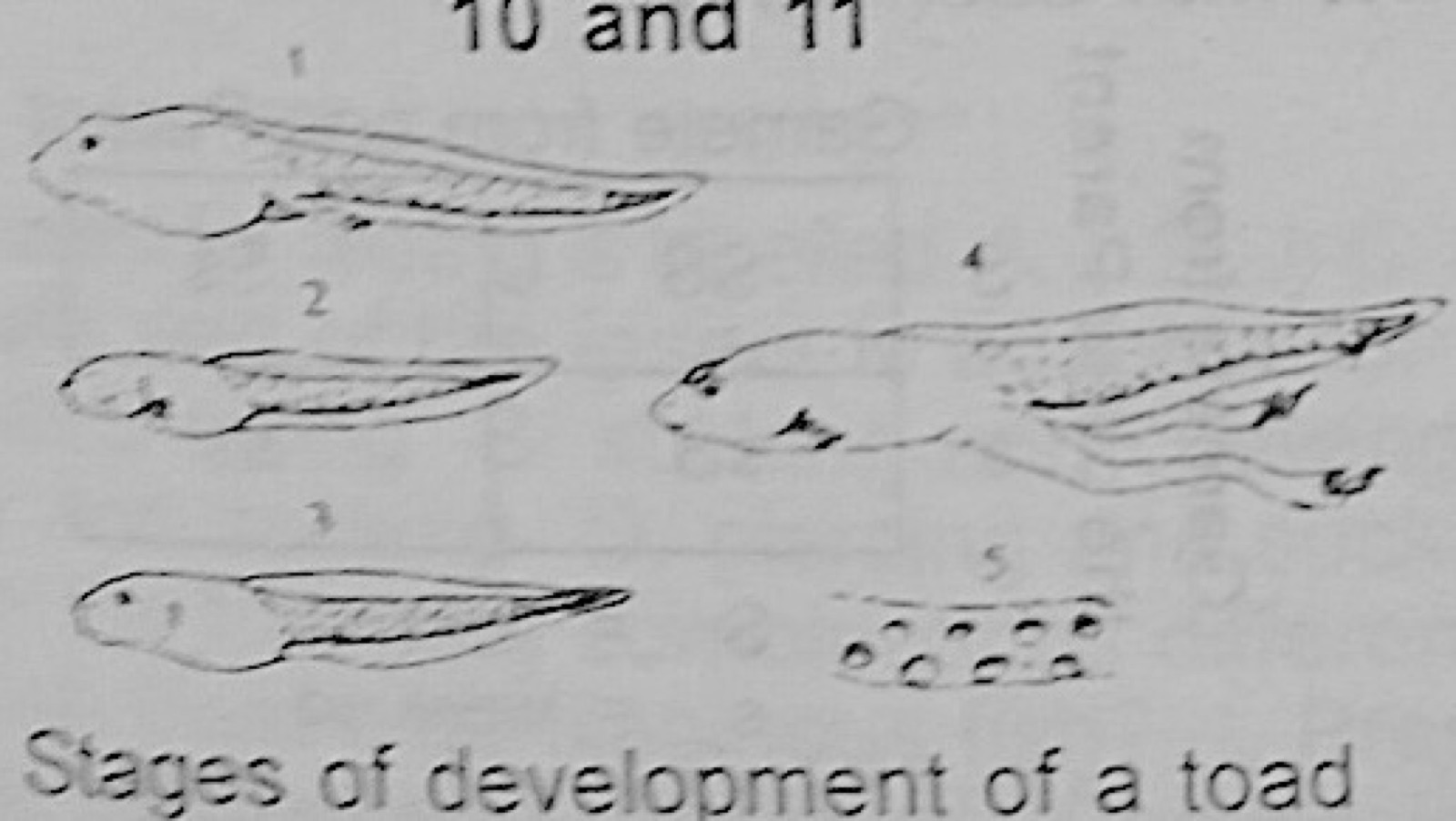
Question 10 Reproduction in Animals Which of the following is the correct order of the developmental stages?
A. 1 → 2 → 3 → 4 → 5 B. 5 → 1 → 3 → 2 → 4 C. 2 → 1 → 3 → 4 → 5 D. 5 → 3 → 2 → 1 → 4. Show the answer and explanation Answer: D (5 → 3 → 2 → 1 → 4. )
Explanation Development starts with the eggs (5), then the young tadpoles (3, 2), the larger tadpole (1) and finally the tadpole with legs (4).
Open this question
Question 12 Animal Kingdom The butterfly is of great economic importance because
A. of its use in scientific studies B. it sucks nectar from flowers C. it adds to the beauty of the environment D. it pollinates flowers of crops and other plants. Show the answer and explanation Answer: D (it pollinates flowers of crops and other plants. )
Explanation As butterflies feed on nectar they carry pollen between flowers, helping crops to set fruit and seed.
Open this question
Question 13 Transport in Plants Manufactured food in the plant is transported through the
A. xylem B. phloem C. cambium D. cortex. Show the answer and explanation Answer: B (phloem )
Explanation Phloem carries sugars made in the leaves to other parts of the plant (translocation); xylem carries water and minerals.
Open this question
Question 14 Photosynthesis and Plant Nutrition Interveinal chlorosis is normally associated with the deficiency of
A. magnesium B. potassium C. iron D. calcium Show the answer and explanation Answer: A (magnesium )
Explanation Magnesium is part of chlorophyll; when it is lacking, the leaf turns yellow between the veins while the veins stay green.
Open this question
Question 15 Food Substances and Enzymes Osmic acid boiled with a solution of food substance gave a black precipitate. This indicates the presence of
A. fats and oils B. proteins C. amino acids D. starch. Show the answer and explanation Answer: A (fats and oils )
Explanation Osmic acid (osmium tetroxide) turns black with fats and oils, so it is a test for lipids.
Open this question
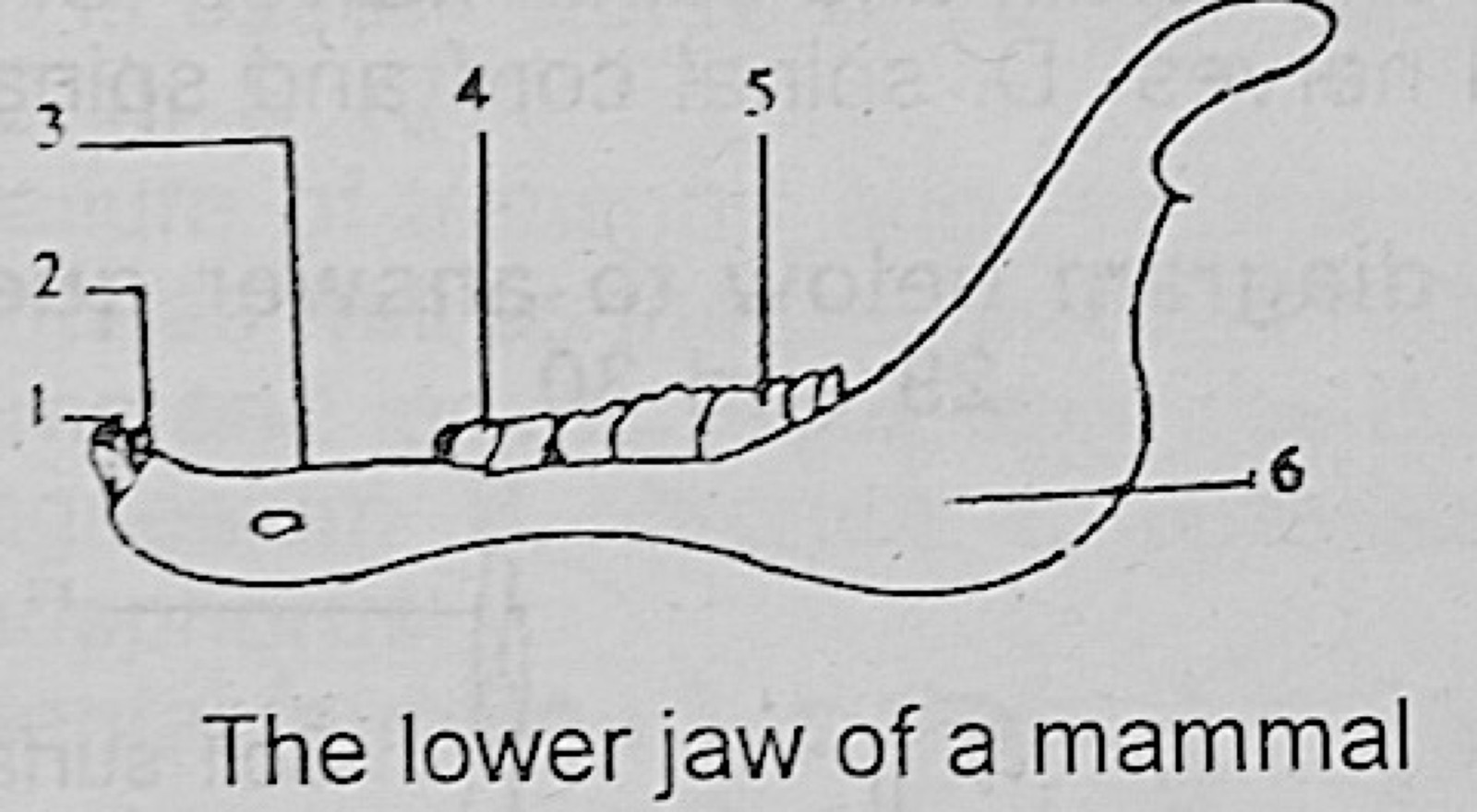
Question 16 Animal Nutrition Which of the labelled parts is the diastema?
A. 2 B. 3 C. 4 D. 6. Show the answer and explanation Answer: B (3 )
Explanation The diastema is the toothless gap between the front teeth and the cheek teeth; label 3 points to this gap.
Open this question
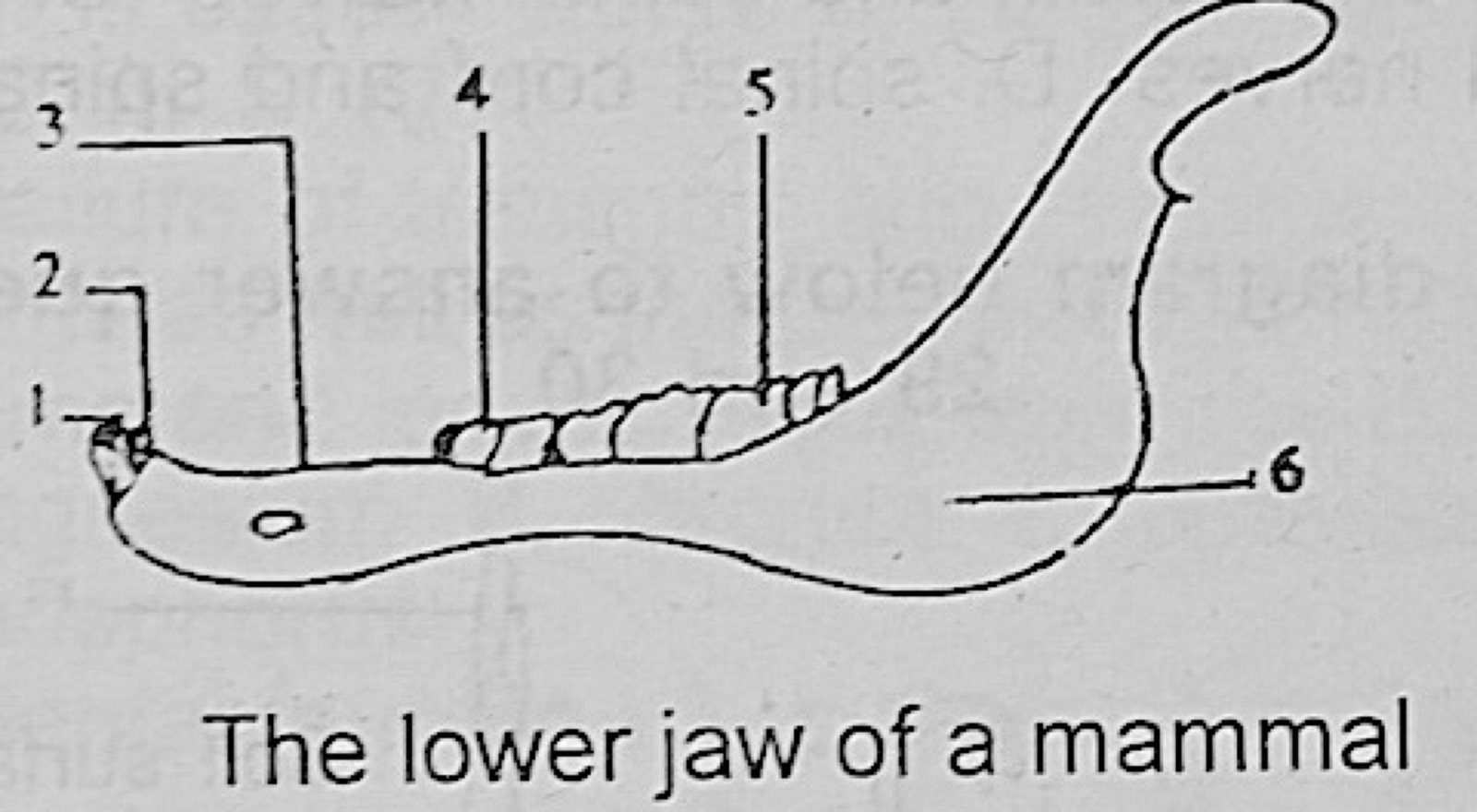
Question 17 Animal Nutrition This lower jaw is typical of a
A. sheep B. rabbit C. dog D. cat. Show the answer and explanation Answer: A (sheep )
Explanation The jaw has front incisors, no canine, a wide gap (diastema) and ridged grinding cheek teeth, the pattern of a herbivore such as the sheep. Dogs and cats have large canines and no diastema.
Open this question
Question 18 Animal Nutrition The end products of the digestion of fats and oils in mammals are
A. maltose and fatty acids B. amino acids and glucose C. fatty acids and fructose D. fatty acids and glycerin. Show the answer and explanation Answer: D (fatty acids and glycerin. )
Explanation Lipase breaks fats and oils into fatty acids and glycerol (glycerin).
Open this question
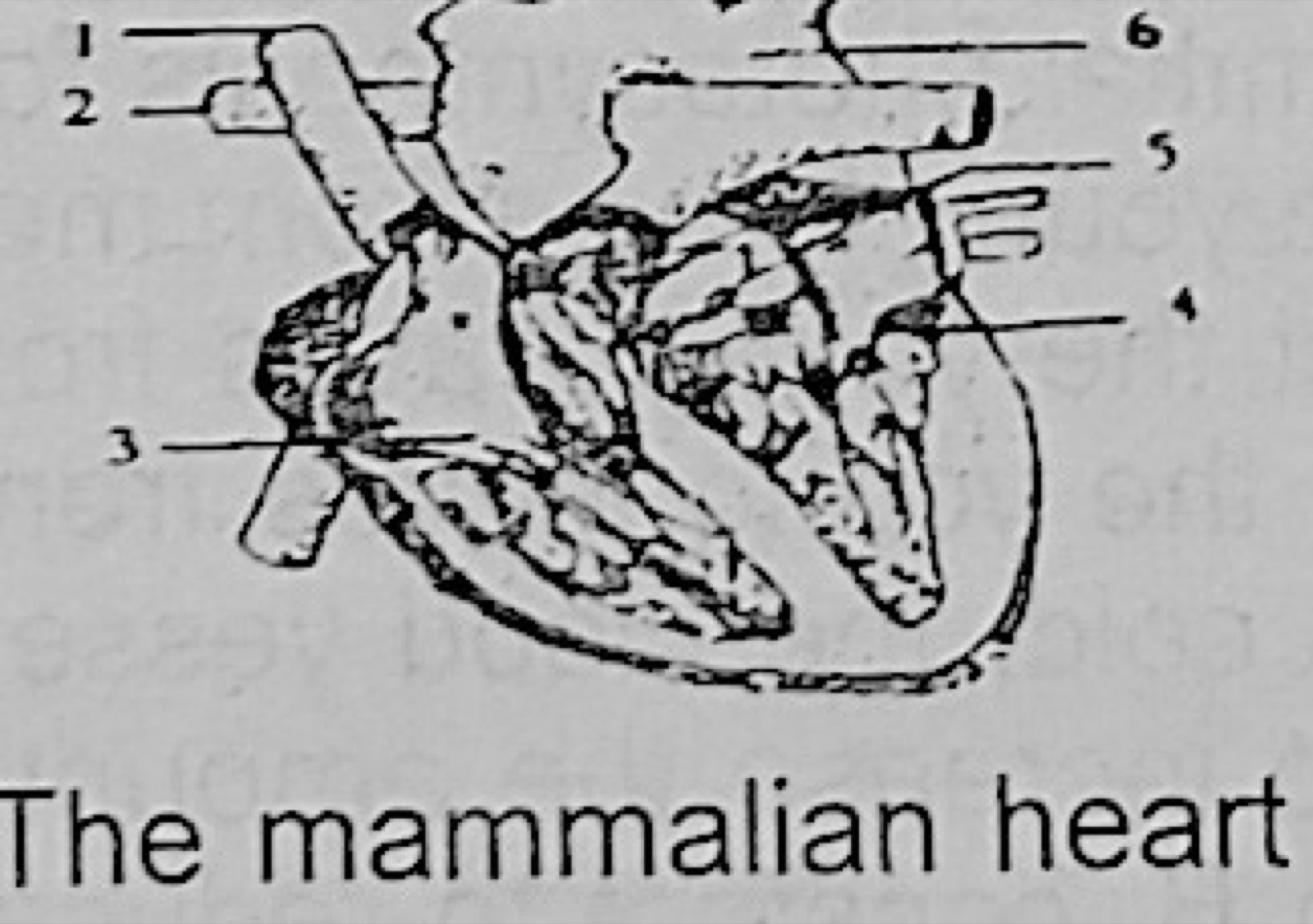
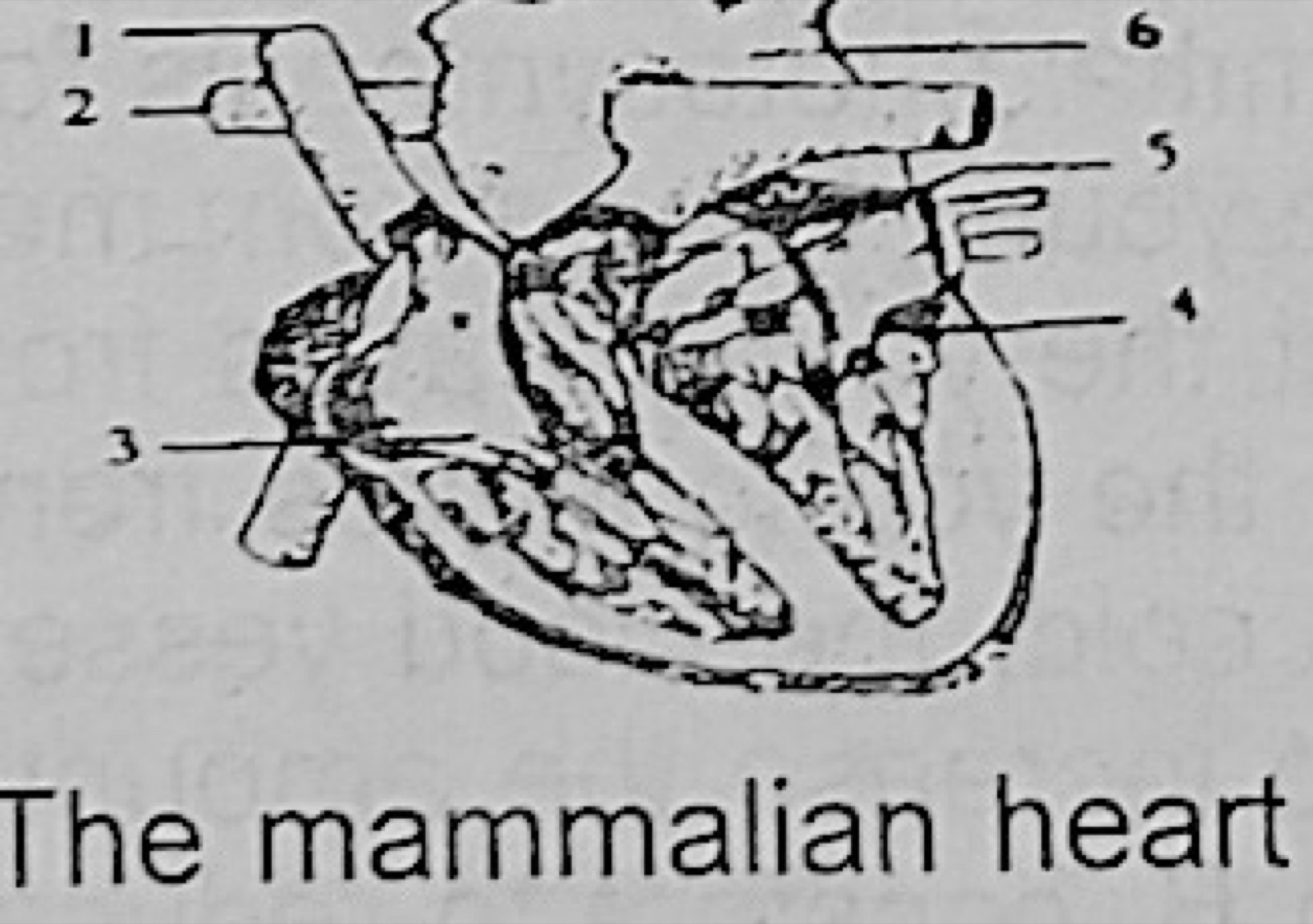
Question 19 Transport in Animals Blood is pumped into the right ventricle by the contraction of the auricle wall through
A. 1 B. 3 C. 5 D. 6 Show the answer and explanation Answer: B (3 )
Explanation Label 3 is at the opening between the right auricle and right ventricle (the tricuspid valve region), through which blood passes when the auricle contracts.
Open this question
Question 20 Transport in Animals After circulation in the lungs, the blood returns to the left auricle through
A. 1 B. 4 C. 5 D. 6 Show the answer and explanation Answer: C (5 )
Explanation Blood coming back from the lungs reaches the left auricle through the pulmonary veins. In the diagram these are the small vessels labelled 5 entering the left side of the heart.
Open this question
Question 21 Transport in Animals The main function of blood in mammals is to transport
A. excretory materials from tissues B. carbondioxide from lungs to tissues C. digested food from all the body tissues D. oxygen to the lungs. Show the answer and explanation Answer: A (excretory materials from tissues )
Explanation Blood carries wastes such as urea and carbon dioxide away from the tissues. The other options have the direction wrong: CO2 goes to the lungs, food goes to the tissues and oxygen comes from the lungs.
Open this question
Question 22 Excretion Members of the phylum Protozoa use the contractile vacuole
A. to remove excess food B. for movement C. for digestion D. to remove excess water. Show the answer and explanation Answer: D (to remove excess water. )
Explanation Water keeps entering a freshwater protozoan by osmosis; the contractile vacuole collects it and pumps it out (osmoregulation).
Open this question
Question 23 Plant Responses and Hormones The response shown by the tips of the root and shoot of a plant to the stimulus of gravity is
A. haptotropism B. phototropism C. hydrotropism D. geotropism. Show the answer and explanation Answer: D (geotropism. )
Explanation A growth response to gravity is geotropism: roots grow down (positive) and shoots grow up (negative).
Open this question
Question 24 Support and Movement Which of the following is the correct order of the vertebrae along the spinal column?
A. Axis → atlas → thoracic → lumbar → cervical → sacral B. Atlas → cervical → axis → thoracic → lumbar → sacral C. Atlas → axis → cervical → thoracic → lumbar → sacral D. Axis → atlas → cervical → thoracic → sacral → lumbar. Show the answer and explanation Answer: C (Atlas → axis → cervical → thoracic → lumbar → sacral )
Explanation From the skull down: atlas, axis, the other cervical vertebrae, then thoracic, lumbar and sacral (followed by caudal).
Open this question
Question 25 Reproduction in Animals Which of the following is TRUE of the process of conjugation in Paramecium?
A. Micronucleus disintegrates B. Each ex-conjugant divides only once C. Macronucleus undergoes division D. Each micronucleus divides twice. Show the answer and explanation Answer: D (Each micronucleus divides twice. )
Explanation During conjugation the macronucleus breaks down while each micronucleus divides twice by meiosis, forming nuclei that are exchanged between the partners.
Open this question
Question 26 Behaviour The bright colours of the comb and feathers in the peacock are for
A. sex differentiation B. beauty C. courtship D. defence. Show the answer and explanation Answer: C (courtship )
Explanation The male peacock displays its bright comb and feathers to attract a female for mating, which is courtship.
Open this question
Question 27 Reproduction in Plants The main function of the petal of a flower is to
A. attract pollination agents B. protect the flower while still in bud C. serve as landing stage for insects D. protect the inner pairs from desiccation Show the answer and explanation Answer: A (attract pollination agents )
Explanation Brightly coloured, scented petals attract insects and birds that carry pollen. Protecting the bud is the job of the sepals.
Open this question
Question 28 Nervous Coordination In the mammal, the autonomic nervous system consists of
A. sympathetic and parasympathetic systems B. brain and spinal nerves C. brain and cranial nerves D. spinal cord and spinal nerves. Show the answer and explanation Answer: A (sympathetic and parasympathetic systems )
Explanation The autonomic system, which controls involuntary actions, has two parts: sympathetic and parasympathetic.
Open this question
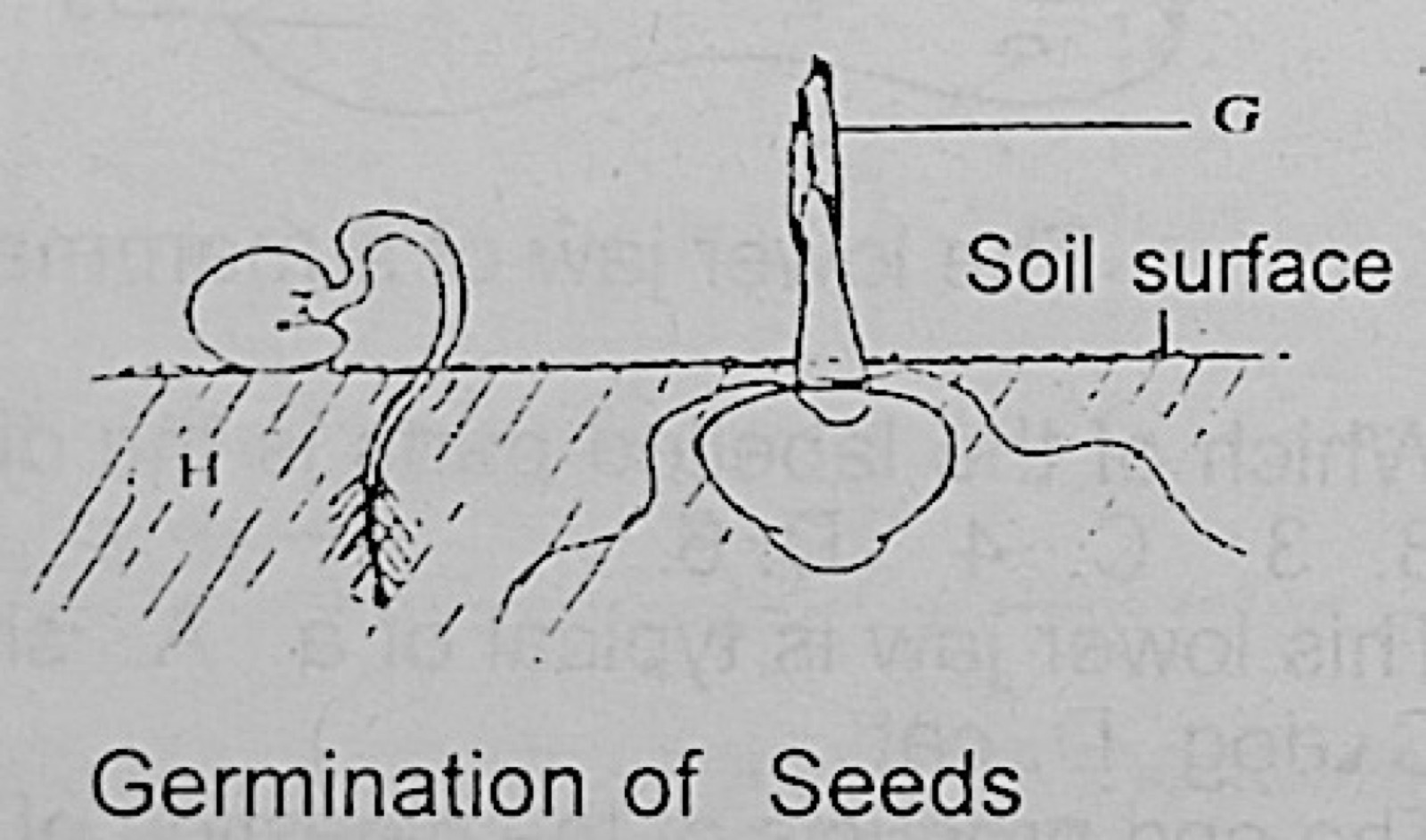
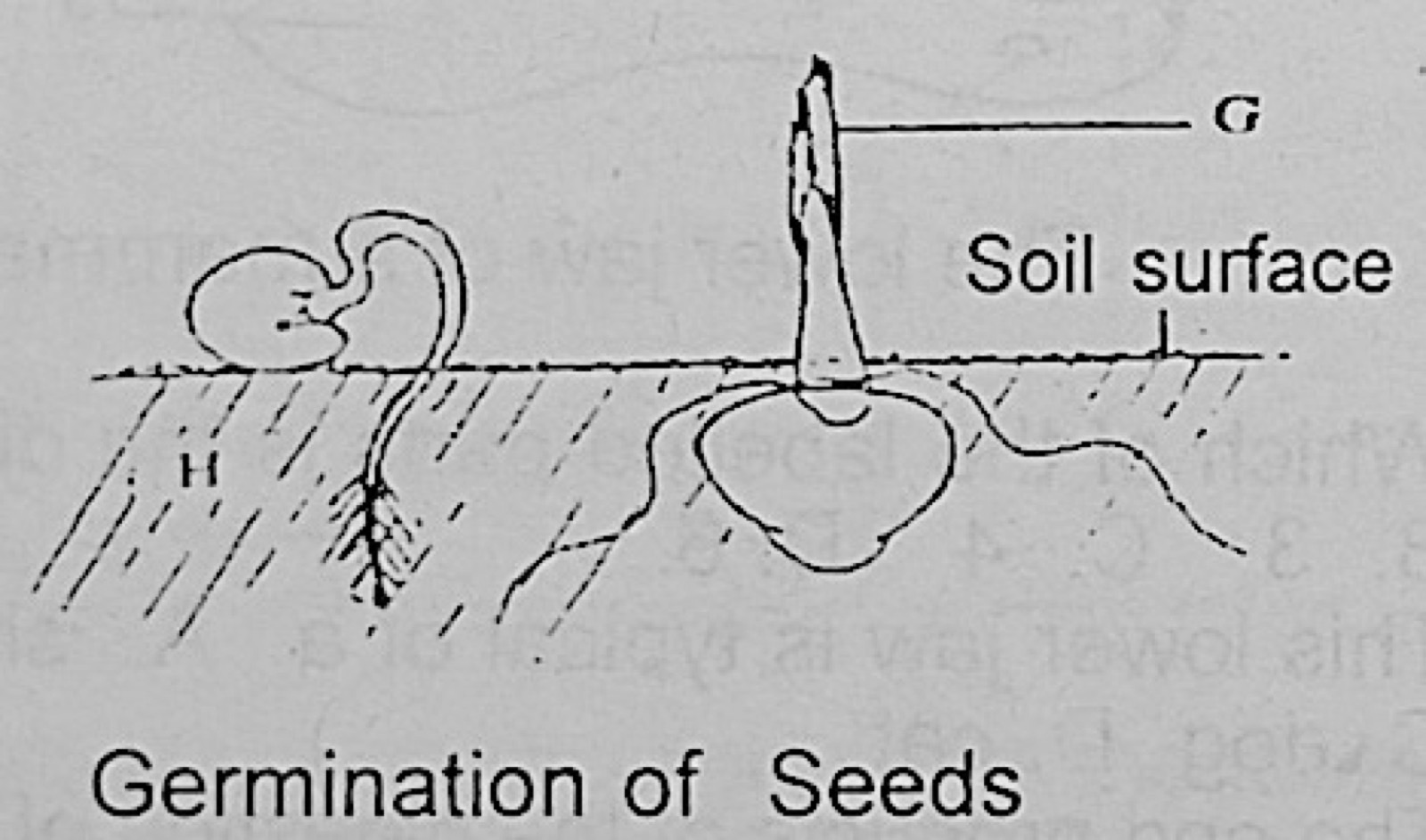
Question 29 Growth and Development In H, the cotyledons are carried above the soil because
A. the epicotyl grows faster than the hypocotyl B. the hypocotyl grows faster than the epicotyl C. both grow at the same rate D. the epicotyl outgrows the radicle. Show the answer and explanation Answer: B (the hypocotyl grows faster than the epicotyl )
Explanation In epigeal germination (H) the hypocotyl lengthens quickly and lifts the cotyledons above the ground.
Open this question
Question 30 Growth and Development The function of the structure labelled G is to
A. carry out initial photosynthesis for the seedling B. protect the young leaves from mechanical damage C. protect the young leaves from sunlight D. protect the young leaves from insect pests. Show the answer and explanation Answer: B (protect the young leaves from mechanical damage )
Explanation G is the coleoptile, a sheath covering the plumule of a grass seedling; it protects the young leaves as they push through the soil.
Open this question
Question 31 Homeostasis When it is cold, the blood vessels of the skin
A. dilate to increase the amount of blood flowing to the skin B. constrict to reduce the amount of blood flowing to the skin C. dilate to reduce the amount of blood flowing to the skin D. constrict to increase the amount of blood flowing to the skin Show the answer and explanation Answer: B (constrict to reduce the amount of blood flowing to the skin )
Explanation In the cold, skin blood vessels narrow (vasoconstriction) so less warm blood reaches the surface and less heat is lost.
Open this question
Question 32 Sense Organs Which path does sound entering the human ear follow?
A. Oval window → ossicles → ear drum B. Ear drum → oval window → ossicles C. Ear drum → ossicles → oval window D. Ossicles → ear drum → oval window Show the answer and explanation Answer: C (Ear drum → ossicles → oval window )
Explanation Sound makes the ear drum vibrate; the ossicles pass and magnify the vibrations to the oval window of the inner ear.
Open this question
Question 33 Hormonal Coordination What would happen to a man whose pancreas has been surgically removed?
A. The level of blood sugar would increase B. The glycogen content of the liver would increase C. His blood pressure would decrease D. His weight would increase appreciably. Show the answer and explanation Answer: A (The level of blood sugar would increase )
Explanation Without the pancreas there is no insulin, so glucose is not stored and blood sugar rises (diabetes).
Open this question
Question 34 Photosynthesis and Plant Nutrition Carnivorous plants are usually found in areas
A. which are deficient in nitrate B. which are deficient in oxygen C. with low pH D. where insects are abundant. Show the answer and explanation Answer: A (which are deficient in nitrate )
Explanation Insect-eating plants grow in poor soils such as bogs that lack nitrates; they digest insects to get nitrogen.
Open this question
Question 35 Ecosystem and Ecological Factors What is the term used to describe the sum total of biotic and abiotic factors in the environment of the organism?
A. Habitat B. Biome C. Ecosystem D. Ecological niche. Show the answer and explanation Answer: C (Ecosystem )
Explanation An ecosystem is the living community together with its non-living (abiotic) surroundings, interacting as one unit.
Open this question
Question 36 Ecosystem and Ecological Factors Important abiotic factors which affect all plants and animals in the habitat are
A. temperature and turbidity B. rainfall and relative humidity C. salinity and wind direction D. temperature and rainfall Show the answer and explanation Answer: D (temperature and rainfall )
Explanation Temperature and rainfall affect every habitat; turbidity and salinity matter mainly in water, and humidity and wind mainly on land.
Open this question
Question 37 Habitats and Biomes The most important physical factor which affects an organism living in the intertidal zone of the seashore is
A. pH B. salinity C. wave action D. temperature. Show the answer and explanation Answer: C (wave action )
Explanation Organisms on the shore between high and low tide are constantly beaten by waves, so they need strong attachment or shells to survive.
Open this question
Question 38 Pollution At which trophic level would the highest accumulation of a non-biodegradable substance occur?
A. Primary producers B. Tertiary consumers C. Primary consumers D. Secondary consumers. Show the answer and explanation Answer: B (Tertiary consumers )
Explanation Non-biodegradable chemicals such as DDT build up at each step of a food chain (biomagnification), so the top consumers hold the most.
Open this question
Question 39 Ecological Associations Two organisms of different species, living in close association but not dependent on each other are referred to as
A. parasites B. commensals C. symbionts D. autotrophs. Show the answer and explanation Answer: B (commensals )
Explanation In commensalism two species live together; one gains and the other is not harmed, and they do not depend on each other.
Open this question
Question 40 Ecosystem and Ecological Factors Which of the following instruments is NOT used in measuring abiotic factors in any habitat?
A. Microscope B. Thermometer C. Hygrometer D. Wind vane. Show the answer and explanation Answer: A (Microscope )
Explanation A microscope is used to look at small organisms; thermometer, hygrometer and wind vane measure temperature, humidity and wind direction.
Open this question
Question 41 Adaptation Plants adapted for life in salty marsh are called
A. hydrophytes B. xerophytes C. halophytes D. epiphytes. Show the answer and explanation Answer: C (halophytes )
Explanation Halophytes are plants that can live in salty soils or water, such as mangroves.
Open this question
Question 42 Population Ecology Which group of plants would be the first colonizers in an ecological succession changing rocks to soil?
A. Mosses B. Ferns C. Lichens D. Grasses. Show the answer and explanation Answer: C (Lichens )
Explanation Lichens can live on bare rock; they release acids that break the rock down and start soil formation, so they are the pioneers.
Open this question
Question 43 Soil Soil fertility can be conserved and renewed by
A. yearly monocropping B. crop rotation and cover crops C. bush burning to remove unwanted debris D. avoiding artificial manures. Show the answer and explanation Answer: B (crop rotation and cover crops )
Explanation Rotating crops (including legumes) and keeping a cover crop restores nutrients and protects the soil from erosion.
Open this question
Question 44 Microorganisms and Health What ecological condition favours the breeding of black flies?
A. Fresh water habitat B. Water in ponds and swamps C. Water in small containers D. Fast flowing streams. Show the answer and explanation Answer: D (Fast flowing streams. )
Explanation Black-fly (Simulium) larvae attach to rocks in fast-flowing rivers and streams, which is why river blindness is common near rapids.
Open this question
Question 45 Respiration Carbon monoxide poisons tissues by
A. constricting the blood vessels B. killing the cells C. combining with haemoglobin D. rupturing the blood vessels. Show the answer and explanation Answer: C (combining with haemoglobin )
Explanation Carbon monoxide binds to haemoglobin much more strongly than oxygen, so blood cannot carry enough oxygen to the tissues.
Open this question
Question 46 Variation Which of the following is an example of discontinuous variation observed in man?
A. Skin colours B. Tongue rolling C. Body weight D. Height. Show the answer and explanation Answer: B (Tongue rolling )
Explanation A person either can or cannot roll the tongue, with no in-between, so it is discontinuous. Height, weight and skin colour vary gradually.
Open this question
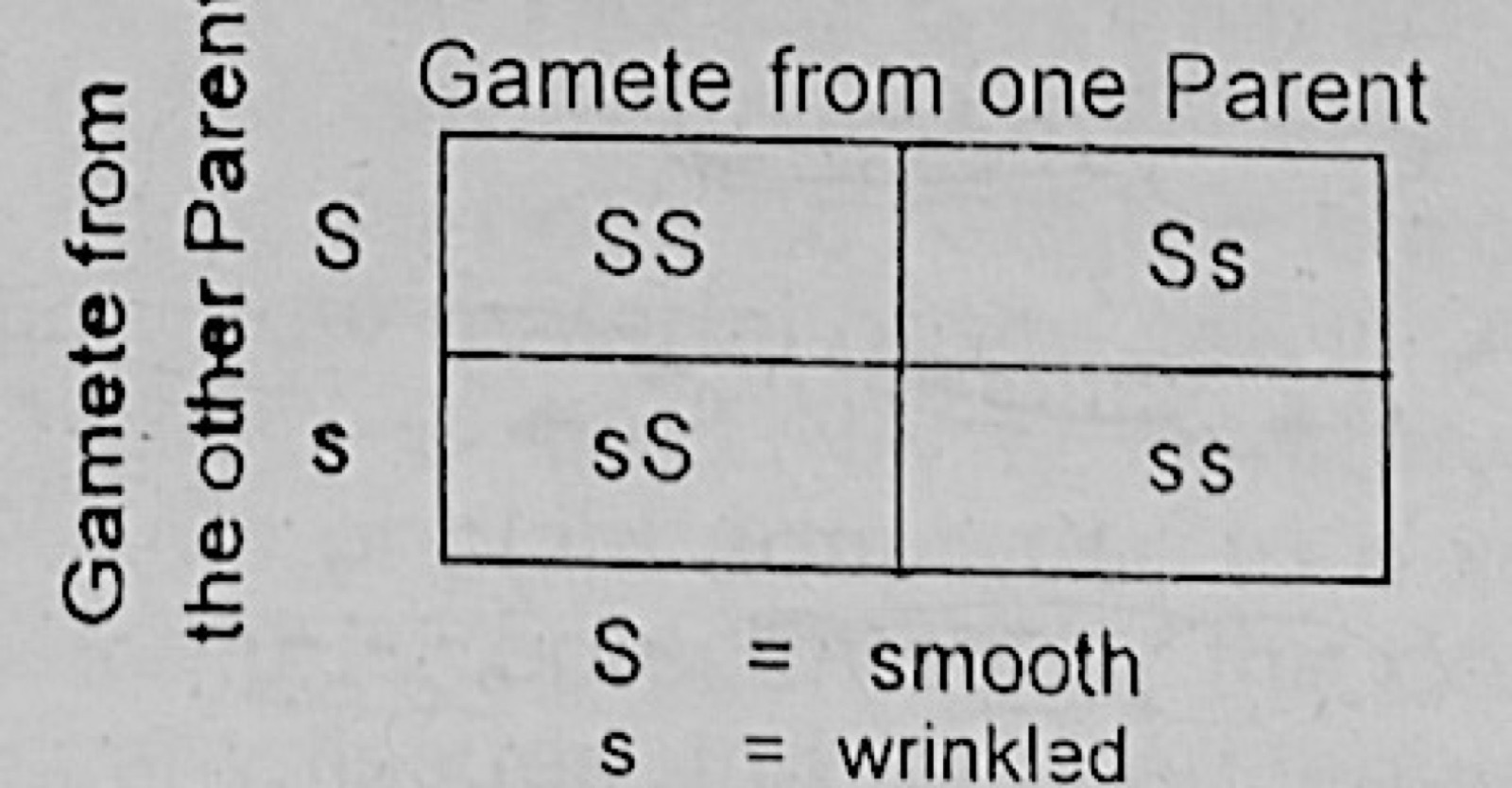
Question 48 Mendelian Inheritance In the illustration above, the genotypes of the offsprings are
A. 1 heterozygous smooth : 2 homozygous smooth : 1 wrinkled B. 1 homozygous smooth : 2 heterozygous smooth : 1 wrinkled C. 2 homozygous smooth : 2 wrinkled D. 3 heterozygous smooth : 1 wrinkled. Show the answer and explanation Answer: B (1 homozygous smooth : 2 heterozygous smooth : 1 wrinkled )
Explanation The square gives SS, Ss, sS and ss: one homozygous smooth, two heterozygous smooth (Ss) and one wrinkled (ss).
Open this question
Question 49 Homeostasis Cold blooded animals are referred to as
A. poikilothermic B. homothermic C. polythermic D. homeostatic. Show the answer and explanation Answer: A (poikilothermic )
Explanation Poikilotherms are animals whose body temperature changes with the surroundings, such as lizards and fishes.
Open this question
Question 50 Evolution Which of the following organisms has lost the pentadactyl limb structure?
A. Bat B. Fish C. Frog D. Pigeon Show the answer and explanation Answer: B (Fish )
Explanation Bats, frogs and pigeons all have five-digit (pentadactyl) limbs modified for their way of life; fish have fins instead of pentadactyl limbs.
Open this question Sign up free for every JAMB Biology year, practice by topic and timed mocks.
Start practising free