Home › Past questions › JAMB › Biology › 1992 48 questions. Try each one, then open the answer to check yourself and read the explanation.
Sign up free to answer these questions on a CBT screen with a timer, then see your score and every answer explained.
Start practising free
Question 1 Cell Structure and Organisation The organelle involved in tissue respiration is the
A. endoplasmic reticulum B. ribosome C. golgi body D. mitochondrion Show the answer and explanation Answer: D (mitochondrion )
Explanation Aerobic respiration (the Krebs cycle and electron transport) happens in the mitochondria, which release most of the cell's energy.
Open this question
Question 2 Cell Structure and Organisation A tissue can best be defined as
A. an aggregate of similar cells B. an aggregate of cells performing a similar function C. an aggregate of similar cells performing the same function D. a mixture of different cell types performing the same function. Show the answer and explanation Answer: C (an aggregate of similar cells performing the same function )
Explanation A tissue is a group of similar cells working together to carry out the same function, e.g. muscle tissue. Both parts (similar cells and the same function) are needed.
Open this question
Question 3 Plant Kingdom Which of the following correctly summarizes the life cycle of a fern plant?
A. Spore → prothallus → thallus → sporangium B. Male and female gamentangia → zygospore → sporangium → spores C. Spore → thallus → spermatozoa + ovum → sporangium D. Prothallus → spermatozoid + egg cell → leafy plant → sporangium → spore Show the answer and explanation Answer: D (Prothallus → spermatozoid + egg cell → leafy plant → sporangium → spore )
Explanation The fern prothallus (gametophyte) makes sperms and eggs; the zygote grows into the leafy fern plant, which bears sporangia that release spores.
Open this question
Question 4 Animal Kingdom A major difference between platyhelminthes and coelenterates is that platyhelminthes
A. are multicellular B. have developed a mesoderm C. reproduce sexually D. reproduce asexually. Show the answer and explanation Answer: B (have developed a mesoderm )
Explanation Flatworms are triploblastic (they have a middle layer, the mesoderm), while coelenterates have only two cell layers. Both groups are multicellular and reproduce in both ways.
Open this question
Question 5 Animal Kingdom The essential structural difference between hydra and tapeworm is that while hydra
A. has tentacles, tapeworm is parasitic B. is diploblastic, tapeworm is triplobastic C. has a mouth, tapeworm feeds by suckers D. has mesoderm, tapeworm has mesogloea. Show the answer and explanation Answer: B (is diploblastic, tapeworm is triplobastic )
Explanation Hydra has two body layers (diploblastic) joined by jelly-like mesogloea; the tapeworm has three layers (triploblastic). Being parasitic is a way of life, not a structure.
Open this question
Question 6 Ecosystem and Ecological Factors The flowering period of plants in a habitat is determined by the
A. duration of sunlight B. intensity and duration of rainfall C. relative humidity of the atmosphere D. temperature of the habitat. Show the answer and explanation Answer: A (duration of sunlight )
Explanation Many plants flower in response to day length (photoperiodism), so the duration of sunlight controls when they flower.
Open this question
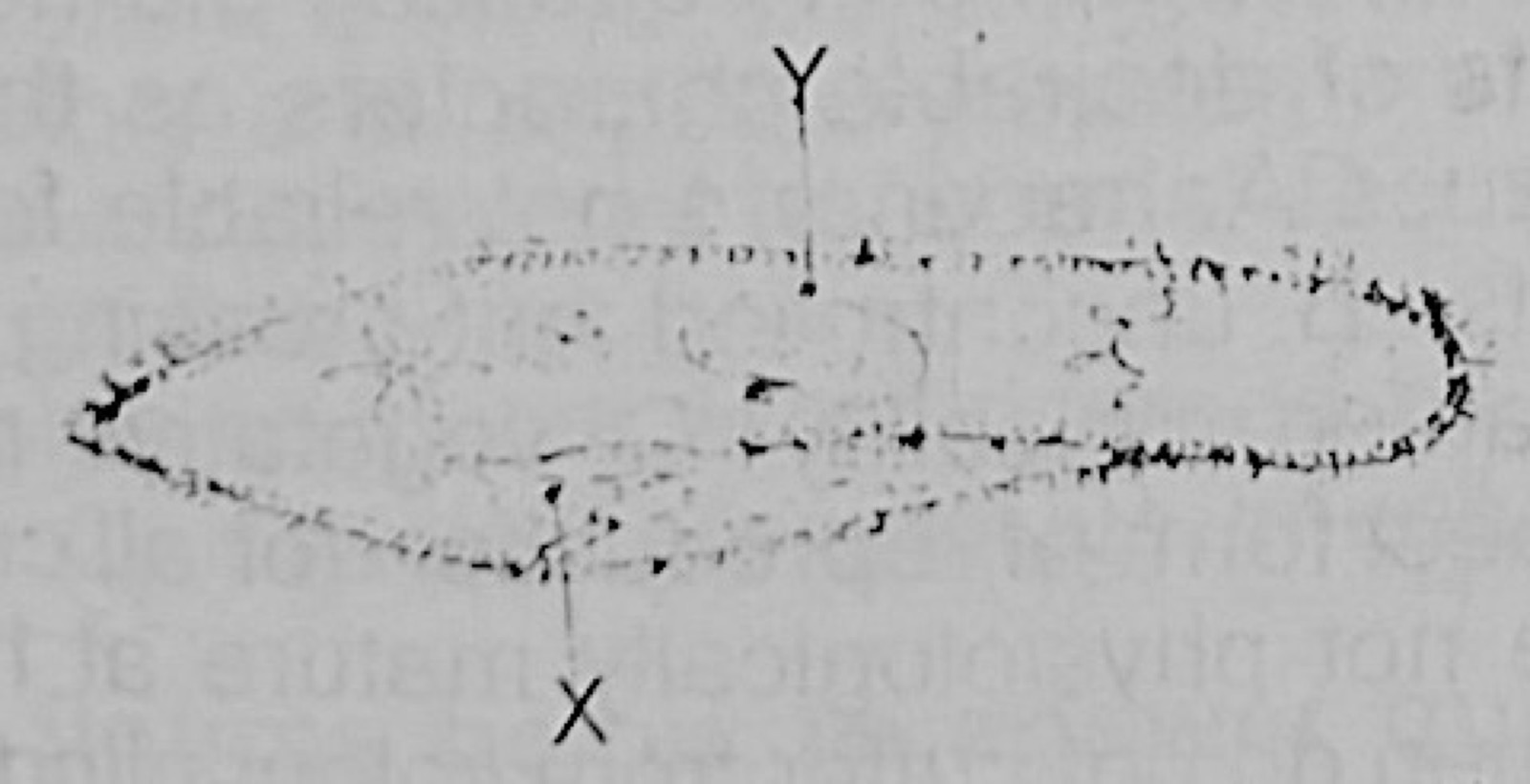
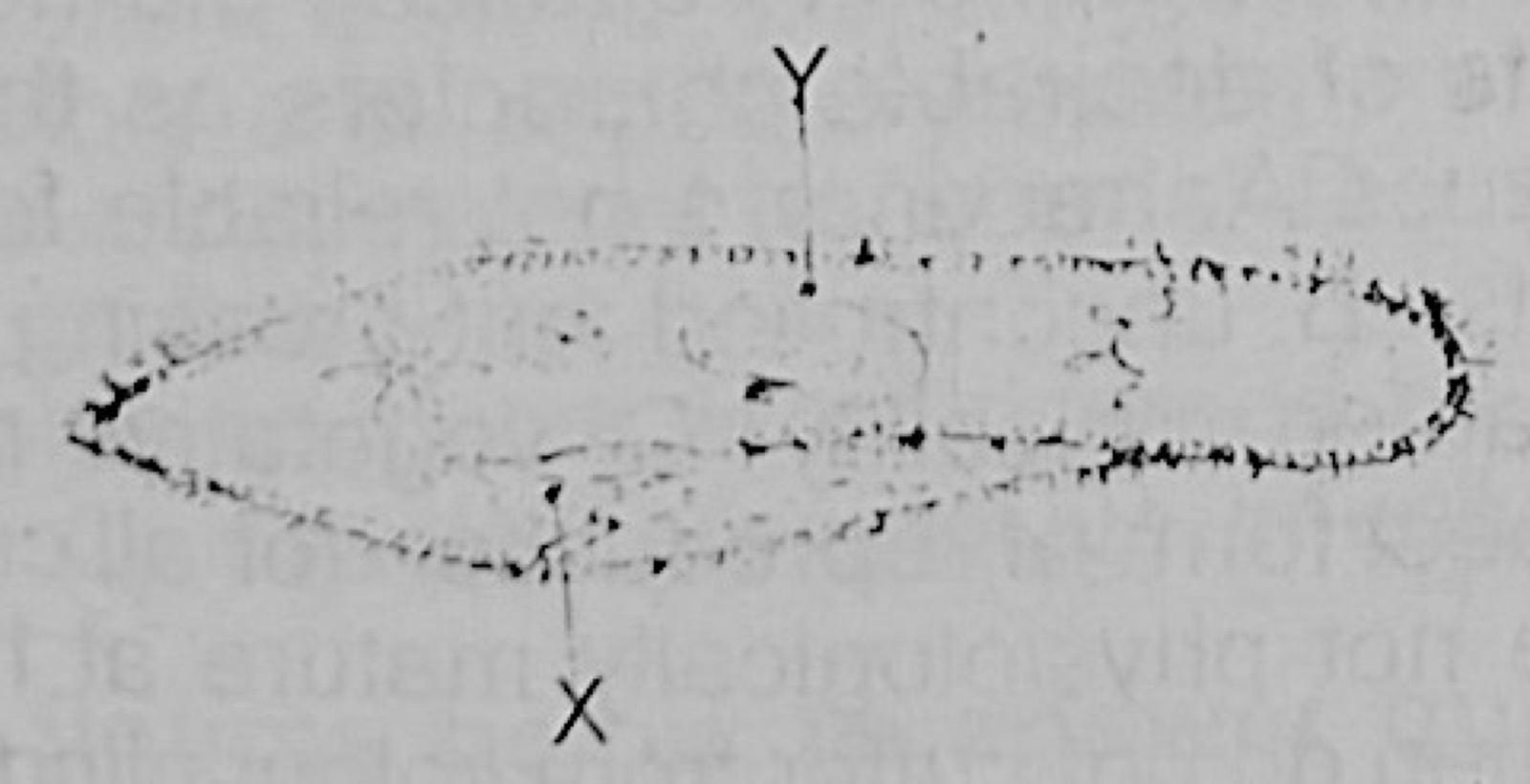
Question 7 Animal Kingdom The structure labelled X is used by the organism in the same way as man uses his
A. oesophagus B. trachea C. stomach D. intestine. Show the answer and explanation Answer: A (oesophagus )
Explanation X is the oral groove leading to the gullet, which takes food into the cell, just as the oesophagus carries food in man.
Open this question
Question 8 Viruses, Monera, Protista and Fungi The structure labelled Y is the
A. food vacuole B. nucleolous C. macronucleus D. contractile vacuole Show the answer and explanation Answer: C (macronucleus )
Explanation Y points to the large central nucleus of the protozoan, the macronucleus, which controls the cell's everyday activities.
Open this question
Question 9 Reproduction in Animals Which of the following insects undergoes incomplete metamorphosis?
A. Mosquito B. Termite C. Housefly D. Moth Show the answer and explanation Answer: B (Termite )
Explanation Termites hatch as nymphs that look like small adults and moult to grow (egg → nymph → adult). Mosquito, housefly and moth have a larva and pupa stage.
Open this question
Question 10 Reproduction in Plants An onion is a bulb because it
A. has a tuberous stem B. has a reduced stem and thick fleshy leaves C. has adventitious roots D. bears many buds at the nodes. Show the answer and explanation Answer: B (has a reduced stem and thick fleshy leaves )
Explanation A bulb is a very short, flattened stem surrounded by thick, fleshy leaves that store food, as in the onion.
Open this question
Question 11 Photosynthesis and Plant Nutrition The flow of air and water in or out of the mesophyll layer of a leaf is controlled by the
A. stomata B. lenticels C. air spaces D. guard cells. Show the answer and explanation Answer: D (guard cells. )
Explanation Gases and water vapour pass through the stomata, but it is the guard cells that change shape to open or close each pore, so they control the flow.
Open this question
Question 12 Viruses, Monera, Protista and Fungi Fungi are heterotrophic because they
A. have no leaves B. lack roots C. are filamentous D. lack chlorophyll. Show the answer and explanation Answer: D (lack chlorophyll. )
Explanation Without chlorophyll fungi cannot make their own food by photosynthesis, so they must get food from other organisms (heterotrophic).
Open this question
Question 13 Photosynthesis and Plant Nutrition The major site of photosynthesis in the leaf is the
A. palisade parenchyma B. mesophyll parenchyma C. upper epidermis D. lower epidermis. Show the answer and explanation Answer: A (palisade parenchyma )
Explanation Palisade cells are packed with chloroplasts and lie just below the upper surface where light is strongest, so most photosynthesis happens there.
Open this question
Question 14 Food Substances and Enzymes 5 cm3 dilute sodium hydroxide solution and 5 cm3 one percent copper sulphate solution are added to a solution of food specimen. The purple colour which is observed shows the presence of
A. glucose B. starch C. fat D. protein. Show the answer and explanation Answer: D (protein. )
Explanation This is the Biuret test: sodium hydroxide and copper sulphate give a purple or violet colour with protein.
Open this question
Question 15 Transport in Animals The blood vessel which carries blood from the alimentary canal to the liver is the
A. hepatic artery B. hepatic vein C. hepatic portal vein D. mesenteric artery. Show the answer and explanation Answer: C (hepatic portal vein )
Explanation The hepatic portal vein carries blood rich in digested food from the gut straight to the liver.
Open this question
Question 17 Respiration In the absence of oxygen, the pyruvic acid produced during glycolysis is converted to CO2 and
A. water B. glycerol C. ethanol D. citric acid. Show the answer and explanation Answer: C (ethanol )
Explanation In anaerobic respiration in plants and yeast, pyruvic acid is turned into ethanol (alcohol) and carbon dioxide.
Open this question
Question 18 Excretion The excretory organ in insects is the
A. kidney B. malpighian tubule C. flame cell D. nephridium. Show the answer and explanation Answer: B (malpighian tubule )
Explanation Insects remove nitrogenous waste with Malpighian tubules. Flame cells are in flatworms and nephridia in earthworms.
Open this question
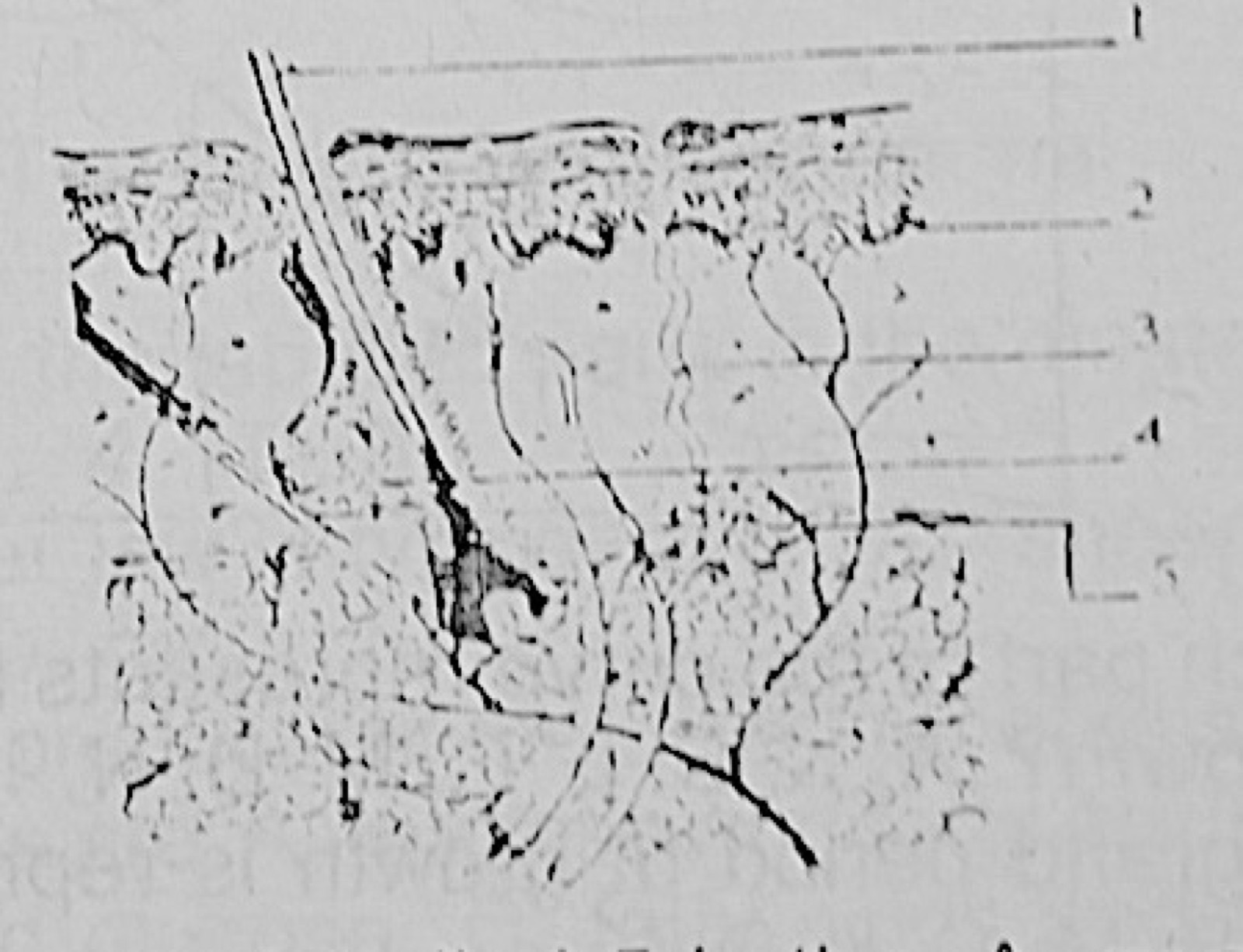
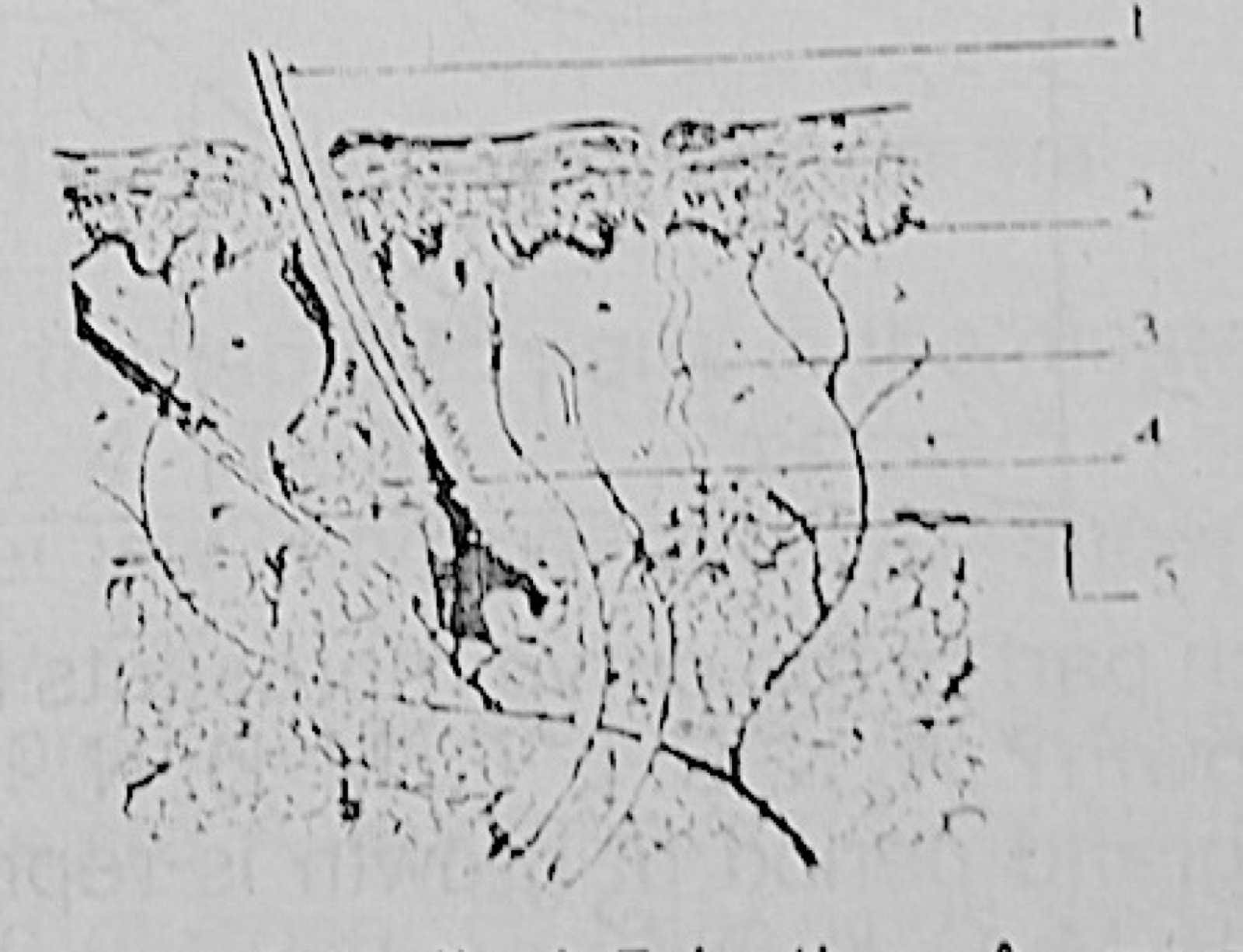
Question 19 Homeostasis The structure labelled 5 is the
A. sweat gland B. sebaceous gland C. blood vessel D. nerve fibre. Show the answer and explanation Answer: A (sweat gland )
Explanation Part 5 is the coiled gland deep in the dermis of the skin, the sweat gland, which produces sweat.
Open this question
Question 20 Homeostasis Melanin and keratin are produced in the part labelled
A. 2 B. 3 C. 4 D. 5. Show the answer and explanation Answer: A (2 )
Explanation Part 2 is the Malpighian (growing) layer of the epidermis, whose cells make the pigment melanin and the protein keratin.
Open this question
Question 21 Support and Movement The bone of the neck on which the skull rests is known as the
A. odontoid process B. axis C. atlas D. occipital condyle. Show the answer and explanation Answer: C (atlas )
Explanation The first neck vertebra, the atlas, carries the skull; its joint with the occipital condyles allows nodding.
Open this question
Question 22 Animal Nutrition Which enzymes are contained in the pancreatic juice?
A. Ptyalin, lipase and pepsin B. Maltase, erepsin and trypsin C. Renin, sucrase and lipase D. Amylase, lipase and trypsin. Show the answer and explanation Answer: D (Amylase, lipase and trypsin. )
Explanation Pancreatic juice contains amylase (starch), lipase (fats) and trypsin (proteins). Ptyalin is in saliva and pepsin and rennin in the stomach.
Open this question
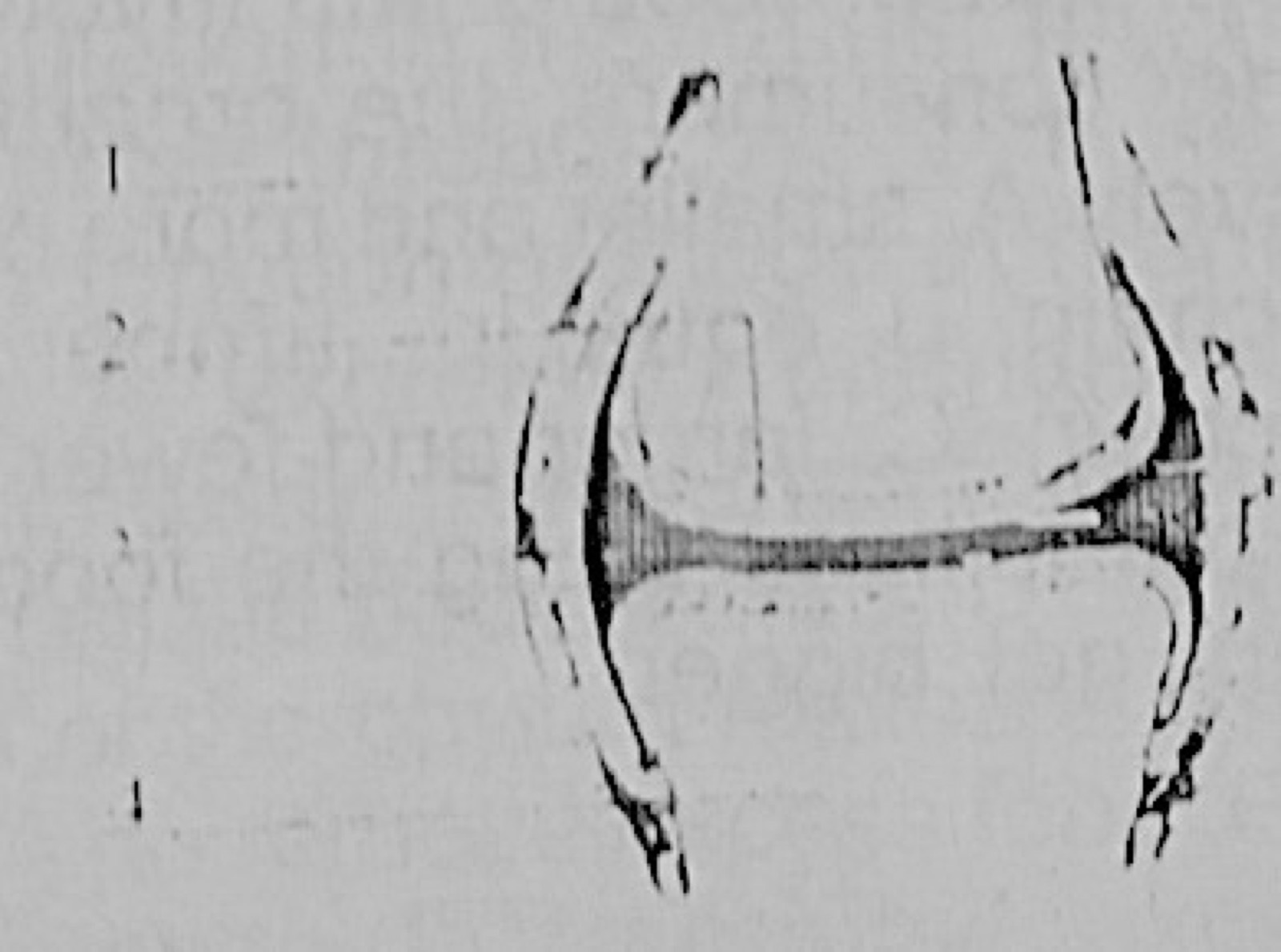
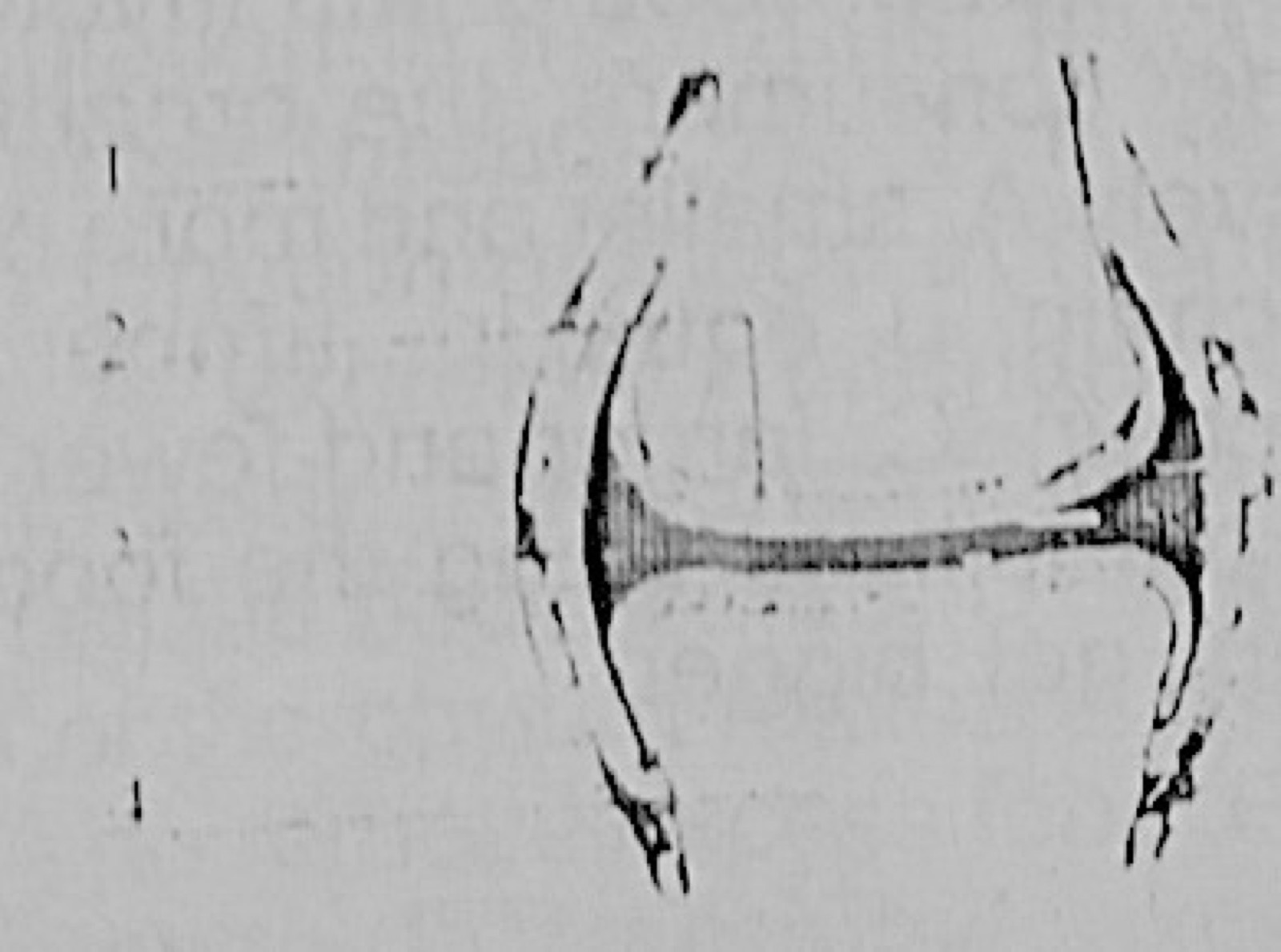
Question 23 Support and Movement The part labelled 3 is the
A. cartilage B. ligament C. synovial fluid D. bone. Show the answer and explanation Answer: C (synovial fluid )
Explanation Part 3 is the space between the two bone ends filled with synovial fluid, which lubricates the joint.
Open this question
Question 24 Support and Movement The function of the part labelled 1 is to
A. secrete a fluid which lubricates the joint B. attach muscles to the bones at the joint C. bend the bones at the joint D. hold the joint in place. Show the answer and explanation Answer: D (hold the joint in place. )
Explanation Part 1 is the ligament, a tough band that joins bone to bone and holds the joint together.
Open this question
Question 25 Reproduction in Plants Double fertilization in higher plants is significant because it ensures the
A. formation of a fertile embryo B. formation of a fertile embryo and the endosperm C. development of the seed D. development of the fruit. Show the answer and explanation Answer: B (formation of a fertile embryo and the endosperm )
Explanation One male nucleus fuses with the egg to form the embryo and the other fuses with the polar nuclei to form the endosperm, the food store of the seed.
Open this question
Question 26 Reproduction in Animals In mammalian development, the function of the yolk is to
A. supply nutrients to the embryo B. act as the shock-absorber to the foetus C. supply air to the embryo D. facilitate the process of excretion in the foetus. Show the answer and explanation Answer: A (supply nutrients to the embryo )
Explanation Yolk is stored food; it nourishes the early embryo before the placenta takes over.
Open this question
Question 27 Growth and Development Hypogeal germination is characterized by the
A. emergence of the plumule out of the ground B. provision of nourishment by the endosperm C. elongation of the hypocotyl D. elongation of the epicotyl. Show the answer and explanation Answer: D (elongation of the epicotyl. )
Explanation In hypogeal germination the epicotyl grows longer, pushing the plumule up while the cotyledons stay below the soil.
Open this question
Question 28 Reproduction in Plants Fruits which develop without fertilization of the ovule are
A. false B. multiple C. aggregate D. parthenocarpic. Show the answer and explanation Answer: D (parthenocarpic. )
Explanation Parthenocarpy is fruit formation without fertilisation, giving seedless fruits such as some bananas.
Open this question
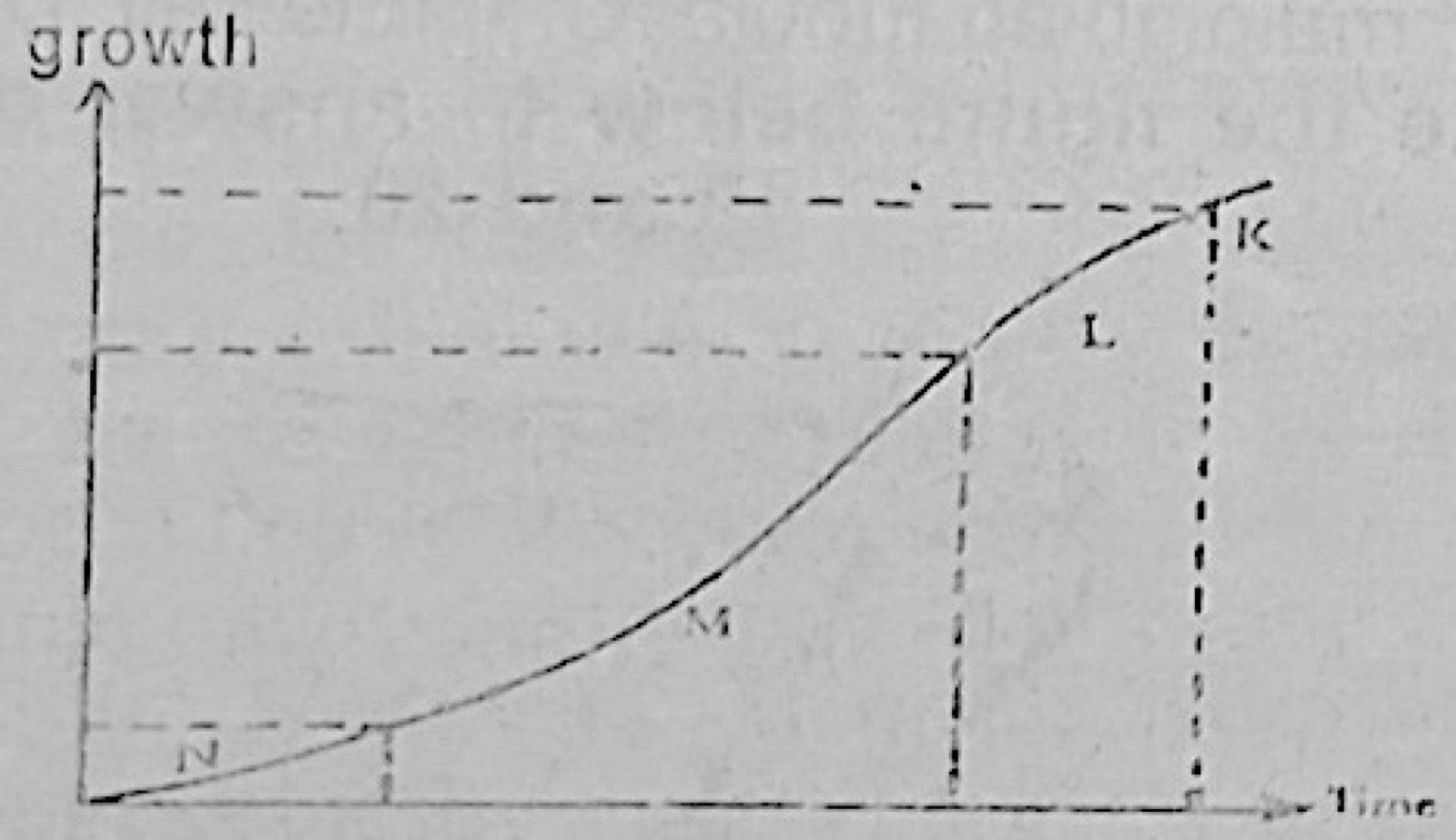
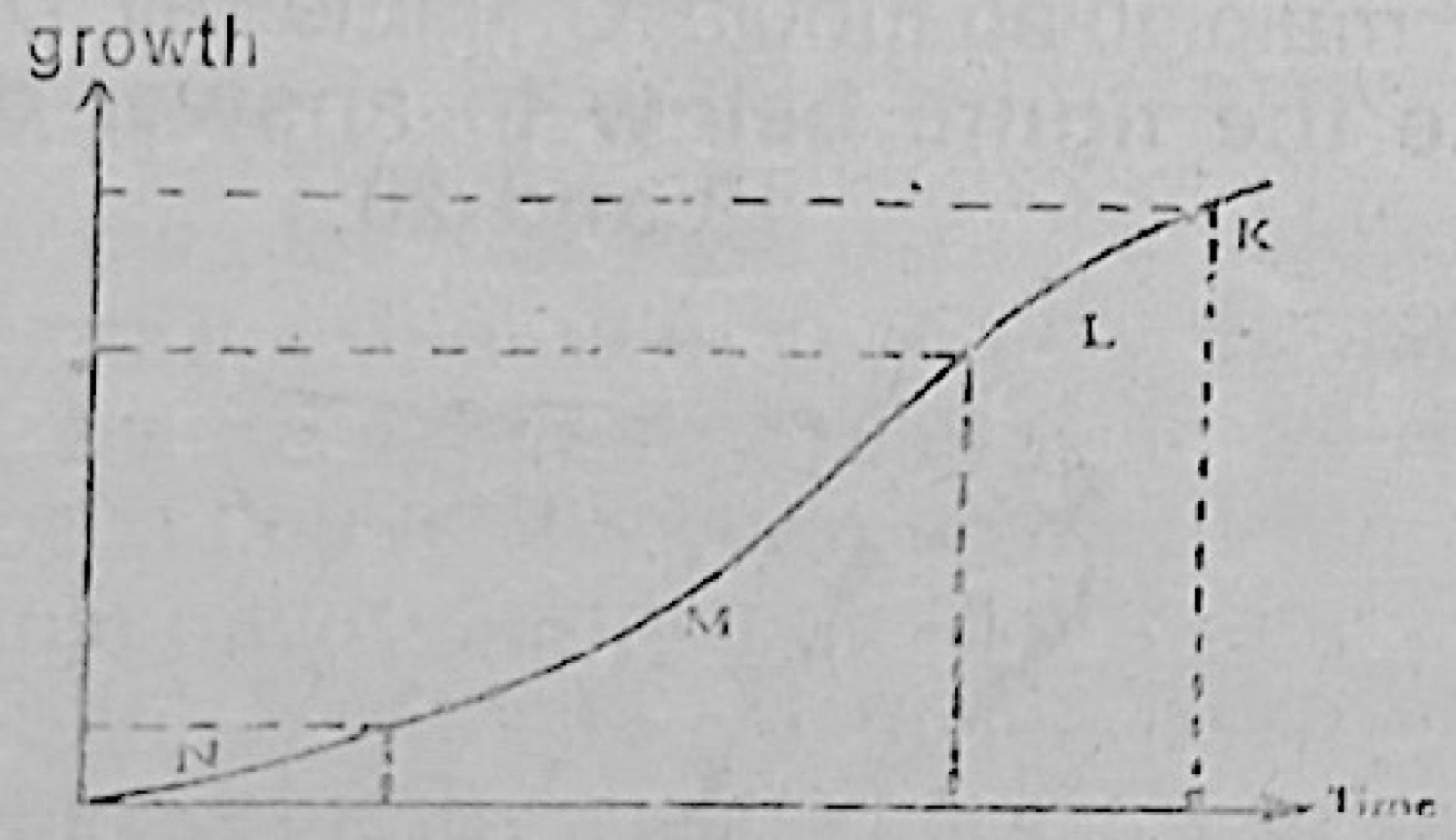
Question 29 Growth and Development Which part of the curve represents the fastest rate of growth?
A. K B. L C. M D. N. Show the answer and explanation Answer: C (M )
Explanation The curve is steepest around M, so growth is fastest there; it is slow at the start (N) and levels off at the top (K).
Open this question
Question 30 Growth and Development The grand period of growth is represented by
A. N B. M C. L D. K. Show the answer and explanation Answer: B (M )
Explanation The grand period of growth is the stage of rapid (exponential) growth, shown by the steep middle part of the S-shaped curve at M.
Open this question
Question 31 Nervous Coordination Neurones that receive stimuli from the body or internal organs are called
A. sensory neurones B. efferent neurones C. motor neurones D. relay neurones. Show the answer and explanation Answer: A (sensory neurones )
Explanation Sensory (afferent) neurones carry impulses from receptors in the body to the central nervous system.
Open this question
Question 32 Population Ecology Which of the following is true of a climax community?
A. It persists until the environment or climate changes B. It changes drastically from one year to the next C. It is the first stage in succession D. It is made up of the tallest trees and the smallest animals. Show the answer and explanation Answer: A (It persists until the environment or climate changes )
Explanation A climax community is the stable final stage of succession and stays the same unless the climate or environment changes.
Open this question
Question 34 Feeding Relationships and Energy Flow In typical predator food chain involving secondary and tertiary consumers, the organisms become progressively
A. smaller and more numerous along the food chain B. equal in number and size along the food chain C. larger and fewer along the food chain D. parasitized along the food chain as consumers get bigger Show the answer and explanation Answer: C (larger and fewer along the food chain )
Explanation In a predator chain each predator is usually bigger than its prey, and because energy is lost at each level there are fewer of them.
Open this question
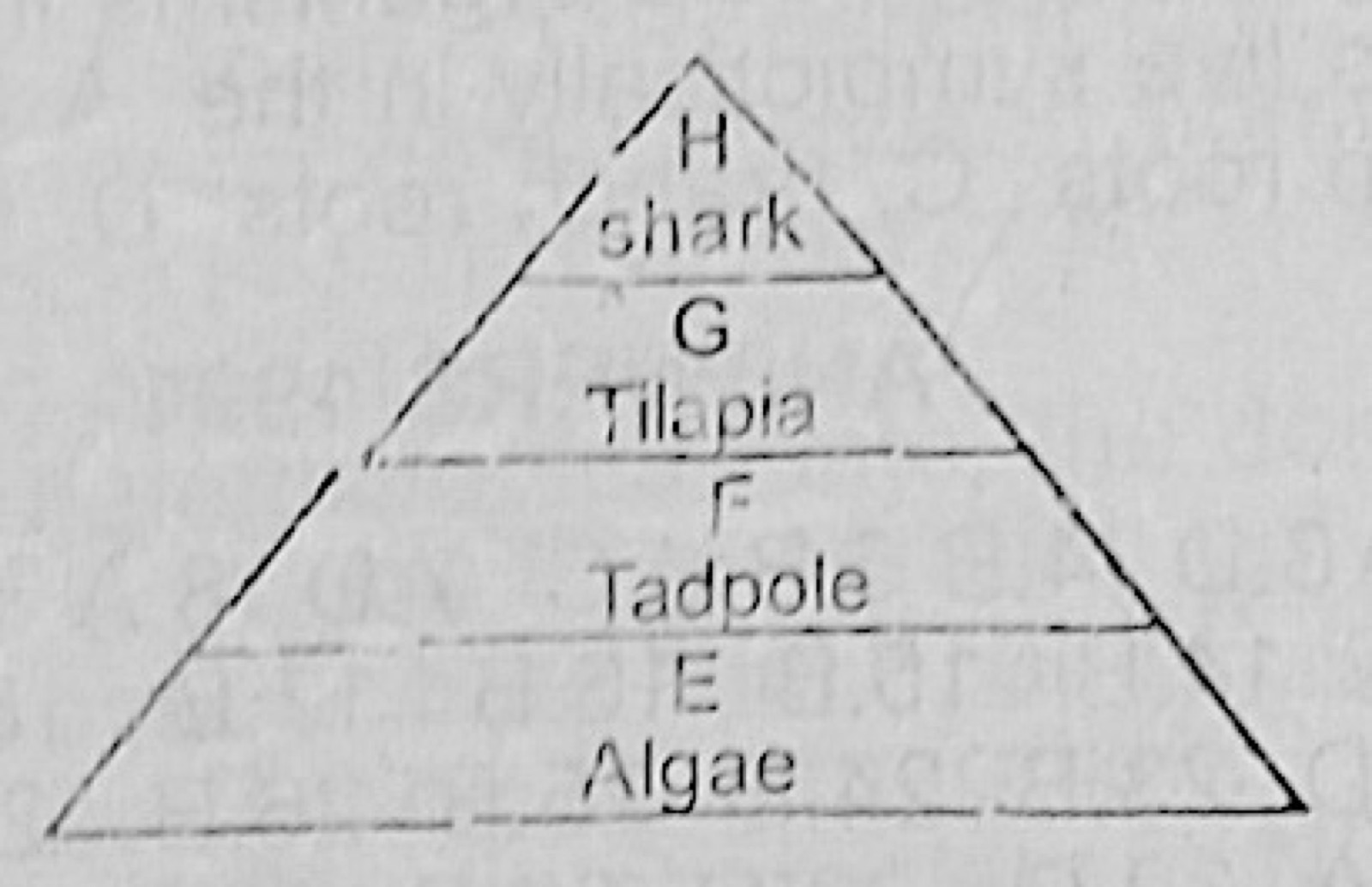
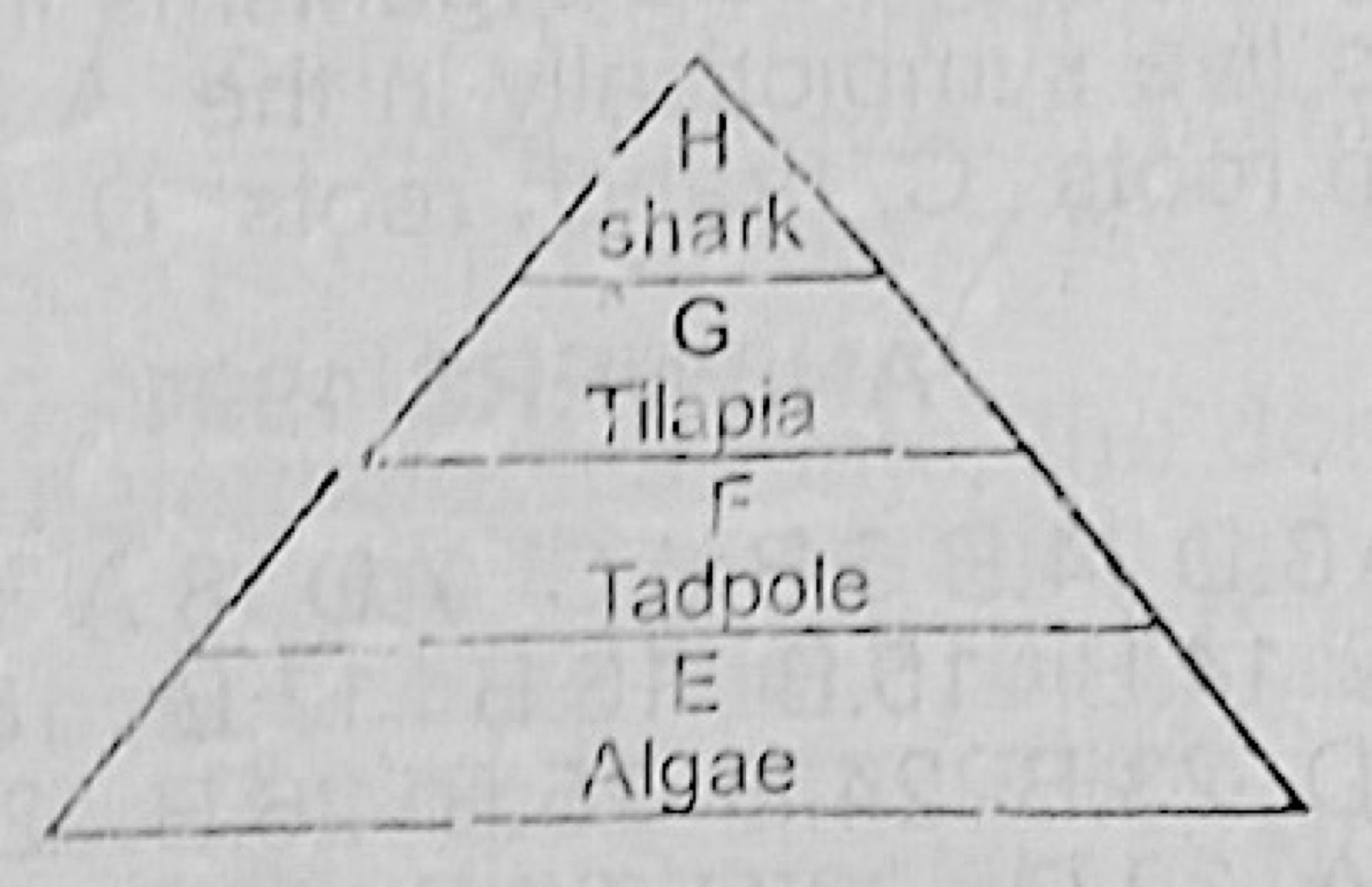
Question 35 Feeding Relationships and Energy Flow Which level of the pyramid has the least total stored energy?
A. E B. F C. G D. H. Show the answer and explanation Answer: D (H. )
Explanation Energy is lost at each step up a pyramid, so the top level H (shark) holds the least total energy.
Open this question
Question 36 Feeding Relationships and Energy Flow Which organism in the pyramid functions as a tertiary consumer?
A. Algae B. Shark C. Tadpole D. Tilapia. Show the answer and explanation Answer: B (Shark )
Explanation Algae are producers, tadpoles eat algae (primary), tilapia eat tadpoles (secondary) and sharks eat tilapia, so the shark is the tertiary consumer.
Open this question
Question 37 Habitats and Biomes Mangrove swamp can be found
A. on a seashore with flat terrain B. where a river meets the sea C. on a mud flat near the sea D. where two rivers meet. Show the answer and explanation Answer: B (where a river meets the sea )
Explanation Mangroves grow in brackish water of estuaries, where rivers flow into the sea, such as the Niger Delta.
Open this question
Question 38 Soil Soil with the finest particles is called
A. silt B. clay C. sand D. gravel. Show the answer and explanation Answer: B (clay )
Explanation Clay particles are the smallest of all soil particles, smaller than silt, sand and gravel.
Open this question
Question 39 Microorganisms and Health Malaria symptoms are caused by
A. toxins released into the blood as a result of the destruction of red blood cells B. the multiplication of the malaria sporozoites in the liver C. the invasion of the red blood cells by the trophozoites D. the developemnt of merozoites into gametocytes. Show the answer and explanation Answer: A (toxins released into the blood as a result of the destruction of red blood cells )
Explanation When infected red cells burst, merozoites and toxins are released into the blood, causing the fever and chills of malaria.
Open this question
Question 40 Chromosomes, DNA and Sex Linkage Which of the following is true of the children of a haemophilic man who marries a woman that is not haemophilic and does not carry the trait?
A. All their sons will be haemophilic B. all their daughters will be haemophilic C. All their daughters will be carriers D. All their sons will be carriers. Show the answer and explanation Answer: C (All their daughters will be carriers )
Explanation The father passes his X chromosome (carrying the gene) to every daughter, so all daughters are carriers; sons get his Y and are normal.
Open this question
Question 41 Mendelian Inheritance A child with blood group genotype different from those of both parents and with a mother of genotype OO, can only have a father of genotype
A. A B. B C. AB D. OO. Show the answer and explanation Answer: C (AB )
Explanation An AB father and OO mother give children AO or BO, which differ from both parents. Other fathers would give at least some children like one parent.
Open this question
Question 42 Mendelian Inheritance If R and r, denote the genes for a character, the offsprings of the cross between RR and Rr are
A. RR, 2Rr, rr B. 2RR, 2rr C. 2RR, 2Rr D. 4Rr. Show the answer and explanation Answer: C (2RR, 2Rr )
Explanation RR gives only R gametes; Rr gives R and r. The combinations are RR, RR, Rr, Rr, i.e. 2RR : 2Rr.
Open this question
Question 43 Mendelian Inheritance A mammal with red fur and long ears was crossed with another having white fur and short ears. If the offspring had red fur and short ears, then the
A. characters are linked B. characters are not linked C. parents are related D. parents are not related. Show the answer and explanation Answer: B (characters are not linked )
Explanation Red fur came from one parent and short ears from the other, so the two characters were inherited separately and are not linked.
Open this question
Question 44 Mendelian Inheritance Pawpaw seeds collected from a tree with many desirable agronomic qualities did not give rise to plants of desirable characters as the parent because
A. seeds are not reliable for propagating plants B. uncontrolled out-crossing can introduce unwanted variability C. vegetative propagation is the best form of reproduction for all crops D. seeds were not physiologically mature at harvest. Show the answer and explanation Answer: B (uncontrolled out-crossing can introduce unwanted variability )
Explanation The seeds came from cross-pollination with unknown plants, so they carry new gene combinations and the offspring vary from the parent tree.
Open this question
Question 45 Chromosomes, DNA and Sex Linkage Women do not suffer from colour blindness because
A. the trait is sex-linked B. only men are colour blind C. the genes are recessive and sex-linked D. the genes occur on both the X and Y chromosomes. Show the answer and explanation Answer: C (the genes are recessive and sex-linked )
Explanation The gene is recessive and on the X chromosome; a woman has two X chromosomes, so a normal allele on the other X usually masks it.
Open this question
Question 46 Chromosomes, DNA and Sex Linkage The hereditary material of the cell is
A. the RNA B. protein C. the DNA D. carbohydrate. Show the answer and explanation Answer: C (the DNA )
Explanation Genes are made of DNA, which is passed from parents to offspring and carries hereditary information.
Open this question
Question 47 Adaptation An example of plant adaptation to a xerophytic environment is represented by the development of
A. fleshy tissues and reduced leaves B. broad canopy and extensive surface root system C. thick barks and broad leaves D. rough leaves and shallow root system. Show the answer and explanation Answer: A (fleshy tissues and reduced leaves )
Explanation Desert plants store water in fleshy tissues and have small or spiny leaves to cut down water loss, as in cacti.
Open this question
Question 48 Habitats and Biomes Which of the following factors is LEAST likely to affect the animals living in a fresh water habitat?
A. Turbidity B. Temperature C. pH D. Salinity. Show the answer and explanation Answer: D (Salinity. )
Explanation Fresh water has almost no salt, so salinity hardly changes there; turbidity, temperature and pH do vary and affect the animals.
Open this question
Question 49 Evolution The theory of natural selection was developed by
A. Lamarck and Darwin B. Darwin and Wallace C. Wallace and Mendel D. Mendel and Lamarck. Show the answer and explanation Answer: B (Darwin and Wallace )
Explanation Charles Darwin and Alfred Wallace independently proposed natural selection and presented it together in 1858.
Open this question
Question 50 Evolution Fossil records found in sedimentary rocks offer some explanation for the theory of evolution because
A. the deposits have remains of organisms characteristic of when they were formed B. different strata have remains of organisms of the same kind C. only organisms with strong parts are fossilized D. most animal and plant fossils bear little resemblance to present day living specimens. Show the answer and explanation Answer: A (the deposits have remains of organisms characteristic of when they were formed )
Explanation Each rock layer holds the organisms living when it was laid down, so older layers show simpler forms and younger ones show later, more complex forms.
Open this question Sign up free for every JAMB Biology year, practice by topic and timed mocks.
Start practising free