Home › Past questions › JAMB › Biology › 1990 47 questions. Try each one, then open the answer to check yourself and read the explanation.
Sign up free to answer these questions on a CBT screen with a timer, then see your score and every answer explained.
Start practising free
Question 1 Viruses, Monera, Protista and Fungi Viruses are considered to be living organisms because they
A. possess transmittable characters B. move from one place to another C. respond to stimulation D. ingest food materials Show the answer and explanation Answer: A (possess transmittable characters )
Explanation Viruses carry genetic material and reproduce inside host cells, passing their characters on to new viruses; this is why they are counted as living.
Open this question
Question 2 Viruses, Monera, Protista and Fungi Which of the following characteristics is common to Amoeba and Paramecium?
A. Oral groove, B. Trichocyst C. Contractile vacuole D. Cilia Show the answer and explanation Answer: C (Contractile vacuole )
Explanation Both are freshwater protozoa that use a contractile vacuole to pump out excess water; oral groove, trichocysts and cilia belong only to Paramecium.
Open this question
Question 3 Animal Nutrition Hydra removes undigested food by
A. passing it through the anus B. passing it through the mouth C. means of a contractile vacuole D. egesting it through the body surface Show the answer and explanation Answer: B (passing it through the mouth )
Explanation Hydra's gut has only one opening, so undigested food goes out through the mouth.
Open this question
Question 4 Reproduction in Animals Which of the following groups of invertebrates reproduces by budding?
A. Arthropoda B. Annelida C. Mollusca D. Coelenterata Show the answer and explanation Answer: D (Coelenterata )
Explanation Coelenterates such as Hydra grow buds on their body that break off as new individuals.
Open this question
Question 5 Plant Kingdom The algae, bryophytes and pteriodophytes are similar in that they
A. are sea weeds B. have no vascular tissues C. require moisture for fertilization D. are microscopic plants Show the answer and explanation Answer: C (require moisture for fertilization )
Explanation In all three groups the male gametes swim to the egg, so water is needed for fertilization. Pteridophytes do have vascular tissue.
Open this question
Question 6 Plant Kingdom The spores of ferns are dispersed by
A. wind B. water C. insects D. explosive mechanism Show the answer and explanation Answer: D (explosive mechanism )
Explanation When the fern sporangium dries, its annulus straightens and then snaps back, flinging the spores out explosively.
Open this question
Question 7 Plant Kingdom In bryophytes, sex organs are produced in the
A. gametophyte B. rhizoid C. protonema D. sporophyte Show the answer and explanation Answer: A (gametophyte )
Explanation The leafy moss plant is the gametophyte, and it carries the antheridia and archegonia.
Open this question
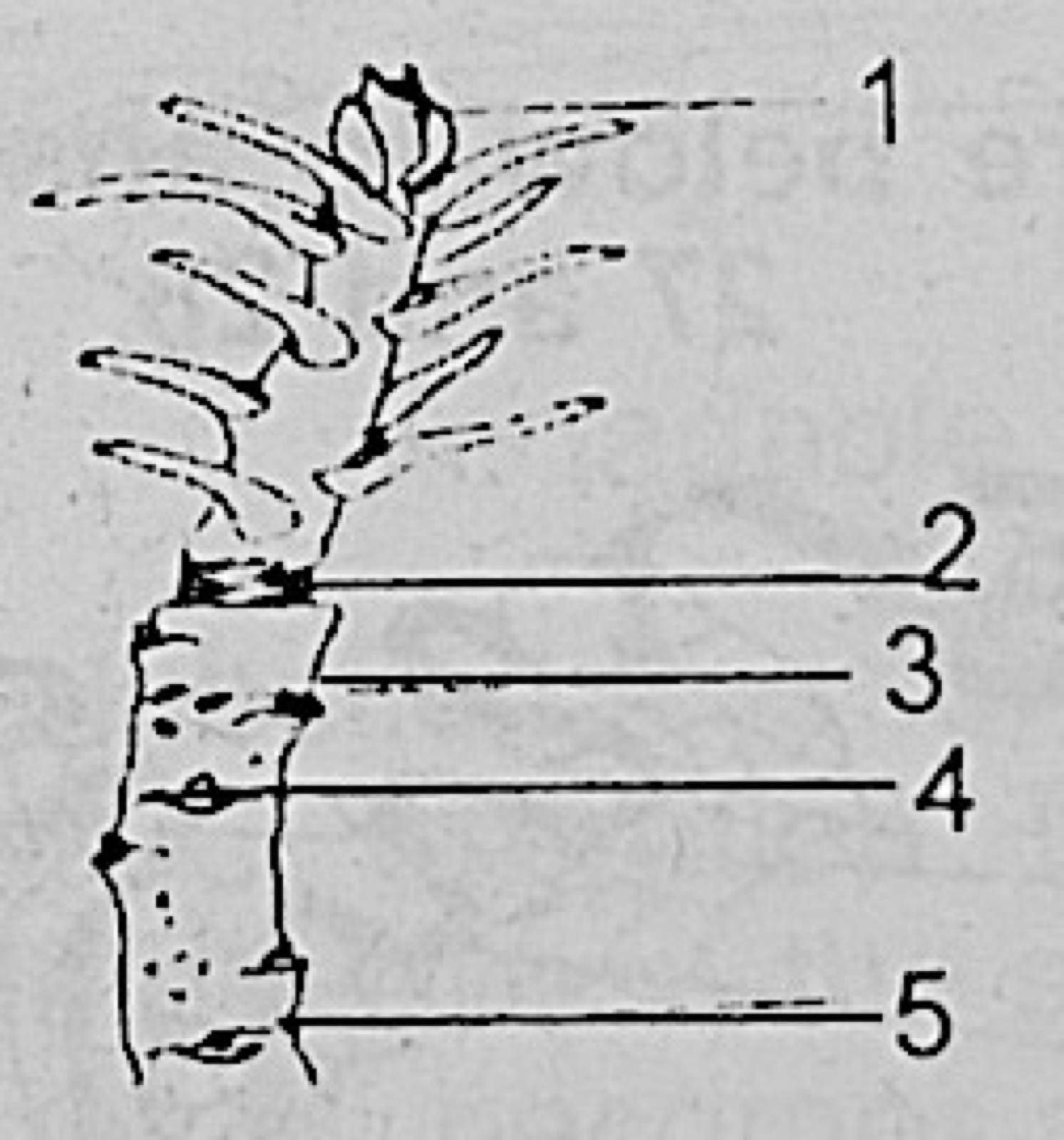
Question 9 Plant Responses and Hormones Use the figure (a twig) to answer: Which part of the twig produces auxins?
A. 4 B. 3 C. 2 D. 1 Show the answer and explanation Answer: D (1 )
Explanation Auxins are made at the growing tip, the terminal bud labelled 1.
Open this question
Question 10 Animal Nutrition Which of the following animals has homodont dentition?
A. Rat B. Man C. Lizard D. Pigeon Show the answer and explanation Answer: C (Lizard )
Explanation A lizard's teeth are all of the same type (homodont); mammals like rats and man have different types, and pigeons have no teeth.
Open this question
Question 11 Reproduction in Animals In which of the following does external fertilization take place?
A. Toad B. Lizard C. Bird D. Cockroach Show the answer and explanation Answer: A (Toad )
Explanation Toads shed eggs and sperm into water, where fertilization takes place outside the body.
Open this question
Question 12 Animal Kingdom In the tapeworm, the suckers on the scolex are used for
A. sucking the blood of the host B. holding fast to the host C. reproduction D. locomotion Show the answer and explanation Answer: B (holding fast to the host )
Explanation The suckers and hooks on the head grip the gut wall of the host so the worm is not swept away.
Open this question
Question 13 Adaptation A feature which adapts birds to flight is the possession of
A. scaly legs B. light bones C. two walking legs D. a pointed beak Show the answer and explanation Answer: B (light bones )
Explanation Hollow, air-filled bones make a bird light enough to fly.
Open this question
Question 14 Excretion The nephridia in the earthworm form part of the
A. reproductive system B. respiratory system C. circulatory system D. excretory system Show the answer and explanation Answer: D (excretory system )
Explanation Nephridia are the earthworm's excretory organs, removing nitrogenous waste from each segment.
Open this question
Question 15 Microorganisms and Health Which of the following diseases is rarely spread by a housefly?
A. Yellow fever B. Dysentery C. Typhoid fever D. Poliomyelitis Show the answer and explanation Answer: A (Yellow fever )
Explanation Yellow fever is spread by the Aedes mosquito; houseflies carry germs of dysentery, typhoid and polio on their bodies to food.
Open this question
Question 16 Structure of Flowering Plants Which of the following cells is thin-walled and living at maturity?
A. Collenchyma B. Sieve tube C. Xylem vessel D. Sclerenchyma Show the answer and explanation Answer: B (Sieve tube )
Explanation Sieve tubes have thin cellulose walls and remain living. Collenchyma walls are thickened at the corners; xylem vessels and sclerenchyma are dead and thick-walled.
Open this question
Question 17 Animal Nutrition The mode of nutrition in which digestion is extracellular is
A. holophytic B. parasitic C. holozoic D. saprophytic Show the answer and explanation Answer: D (saprophytic )
Explanation Saprophytes such as Mucor release enzymes onto their food and absorb the digested products, so digestion happens outside the organism.
Open this question
Question 18 Photosynthesis and Plant Nutrition The first step in the process of photosynthesis is the
A. activation of the chlorophyll B. photolysis of water C. reduction of carbondioxide D. formation of sugar Show the answer and explanation Answer: A (activation of the chlorophyll )
Explanation Photosynthesis starts when chlorophyll absorbs light energy and becomes activated; this energy then splits water.
Open this question
Question 20 Animal Nutrition The organ which secretes digestive enzymes as well as a hormone is the
A. liver B. salivary gland C. pancreas D. spleen Show the answer and explanation Answer: C (pancreas )
Explanation The pancreas makes digestive enzymes (amylase, lipase, trypsin) and the hormone insulin.
Open this question
Question 21 Animal Nutrition The villus in the small intestine is significant because it
A. increases the surface area for absorption B. increases the surface area for digestion C. assists in mixing digested food D. assists in filtering undigested food Show the answer and explanation Answer: A (increases the surface area for absorption )
Explanation Millions of finger-like villi give the small intestine a huge surface for absorbing digested food.
Open this question
Question 22 Transport in Plants If a ring of bark and phloem is removed from a stem, the
A. plant dies immediately B. plant dies after two days C. movement of food is not affected D. movement of mineral salts is hardly affected Show the answer and explanation Answer: D (movement of mineral salts is hardly affected )
Explanation Ringing removes the phloem but leaves the xylem, so water and mineral salts still move up; only food transport is cut.
Open this question
Question 23 Transport in Plants Transpiration can be measured with a
A. photometer B. hygrometer C. potometer D. barometer Show the answer and explanation Answer: C (potometer )
Explanation A potometer measures how fast a leafy shoot takes up water, which shows the rate of transpiration.
Open this question
Question 24 Excretion Excretory products responsible for the red, purple and blue colours of flowers are called
A. alkaloids B. tannins C. anthocyanins D. resins Show the answer and explanation Answer: C (anthocyanins )
Explanation Anthocyanins are the water-soluble pigments that give red, purple and blue colours.
Open this question
Question 25 Growth and Development Etiolation is caused by the influence of
A. mineral salts B. water C. carbondioxide D. light Show the answer and explanation Answer: D (light )
Explanation Plants grown without light become etiolated: pale, with long thin stems and small leaves.
Open this question
Question 26 Support and Movement Muscles are indirectly attached to bones by means of
A. ligaments B. membranes C. tendons D. sutures Show the answer and explanation Answer: C (tendons )
Explanation Tendons are tough, inelastic cords that join muscles to bones; ligaments join bone to bone.
Open this question
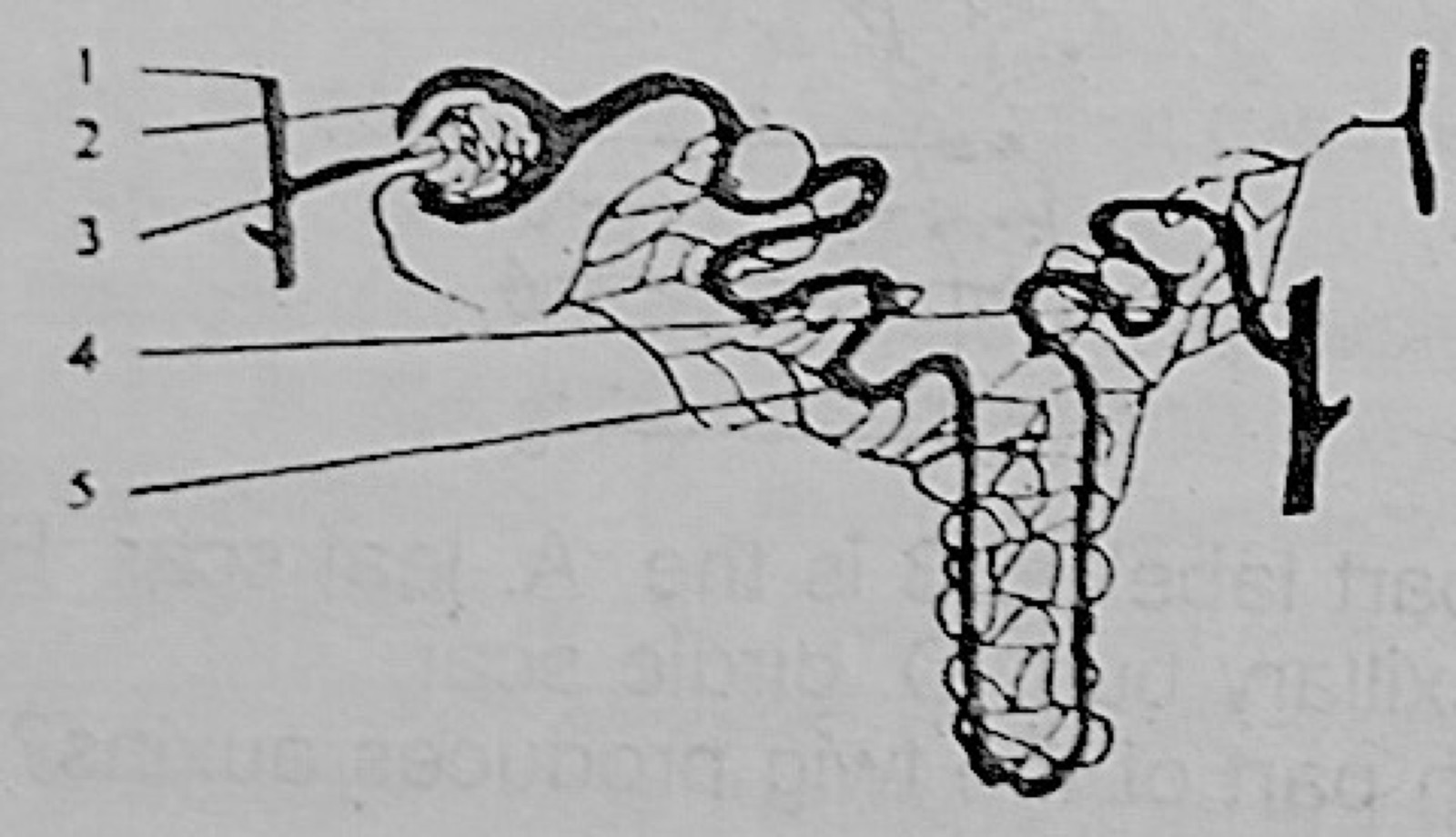
Question 27 Excretion Use the figure (a kidney tubule) to answer: Which structure is the glomerulus?
A. 5 B. 3 C. 2 D. 1 Show the answer and explanation Answer: C (2 )
Explanation The glomerulus is the knot of capillaries inside the cup of Bowman's capsule, which is the part labelled 2.
Open this question
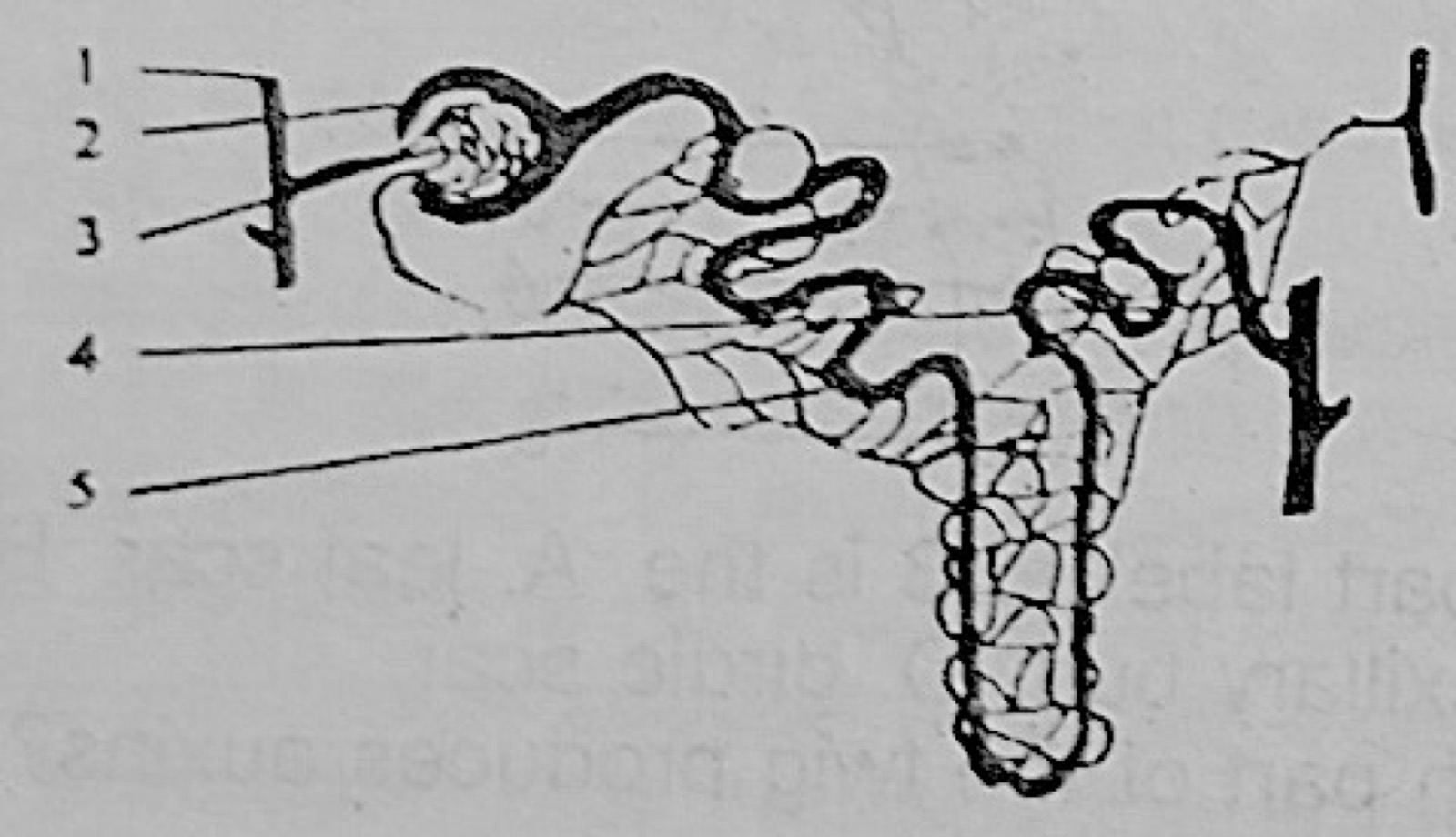
Question 28 Excretion Use the figure (a kidney tubule) to answer: If the blood is too concentrated, more water is absorbed from
A. 5 B. 4 C. 3 D. 1 Show the answer and explanation Answer: B (4 )
Explanation When the blood is too concentrated, ADH makes the tubule and collecting duct walls reabsorb more water; the tubule is the part labelled 4.
Open this question
Question 29 Reproduction in Animals During mammalian embryo development, large amounts of oestrogen and progesterone are produced in the
A. umbilical cord B. amnion C. placenta D. amniotic fluid Show the answer and explanation Answer: C (placenta )
Explanation From about the third month of pregnancy the placenta produces oestrogen and progesterone, which keep the pregnancy going.
Open this question
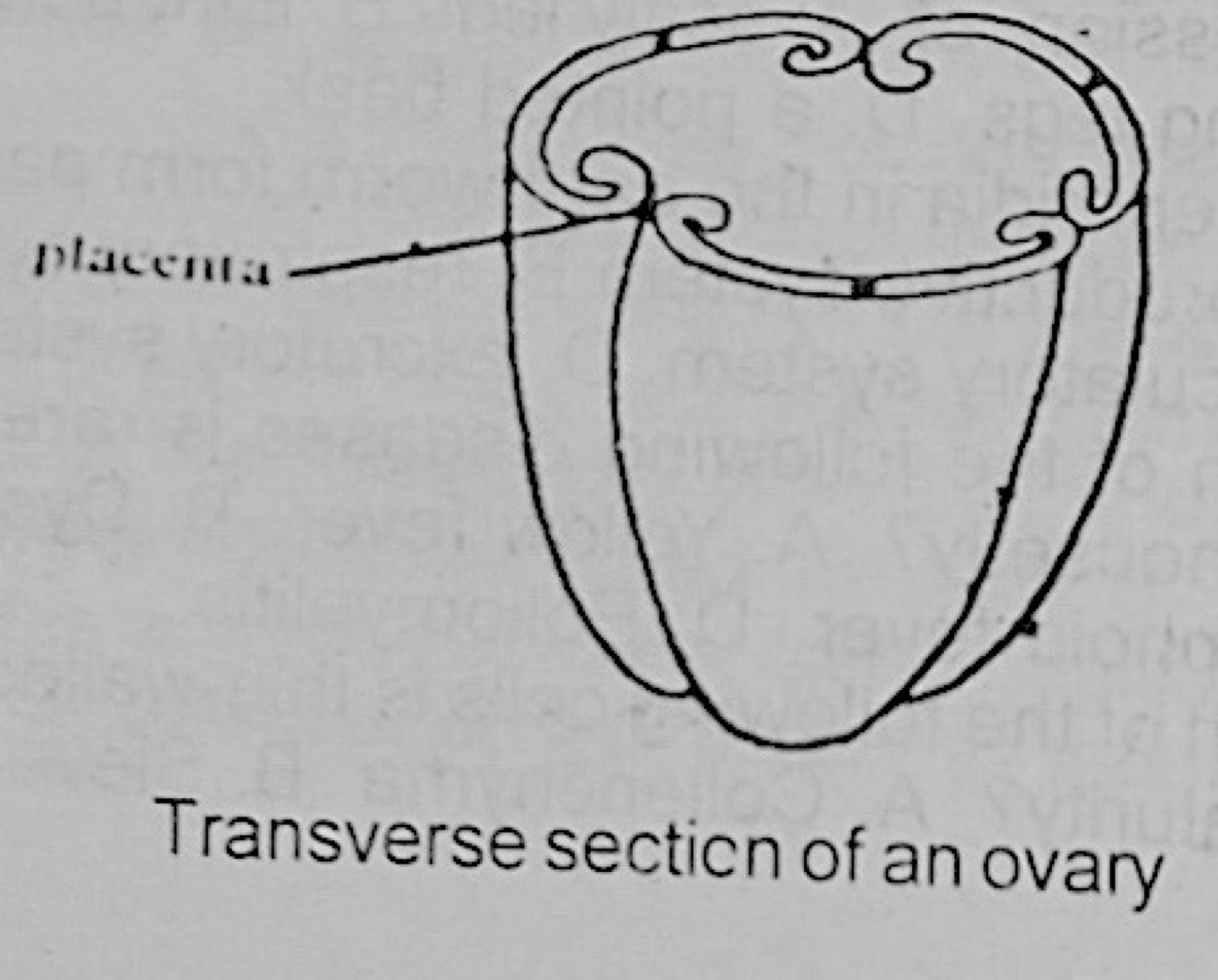
Question 30 Reproduction in Plants Use the figure (transverse section of an ovary): The type of placentation shown in the figure above is
A. parietal B. marginal C. axile D. free-central Show the answer and explanation Answer: A (parietal )
Explanation The ovules are attached to the inner wall of a one-chambered ovary, which is parietal placentation.
Open this question
Question 31 Reproduction in Plants Fruits which develop without fertilization are described as
A. simple B. pathenocarpic C. aggregate D. compound Show the answer and explanation Answer: B (pathenocarpic )
Explanation Parthenocarpic fruits, like some bananas, form without fertilization and so have no seeds.
Open this question
Question 32 Reproduction in Plants The elephant grass is propagated vegetatively by means of
A. corms B. bulbils C. suckers D. solons Show the answer and explanation Answer: D (solons )
Explanation Elephant grass spreads by stolons and runners (creeping stems) that root at the nodes.
Open this question
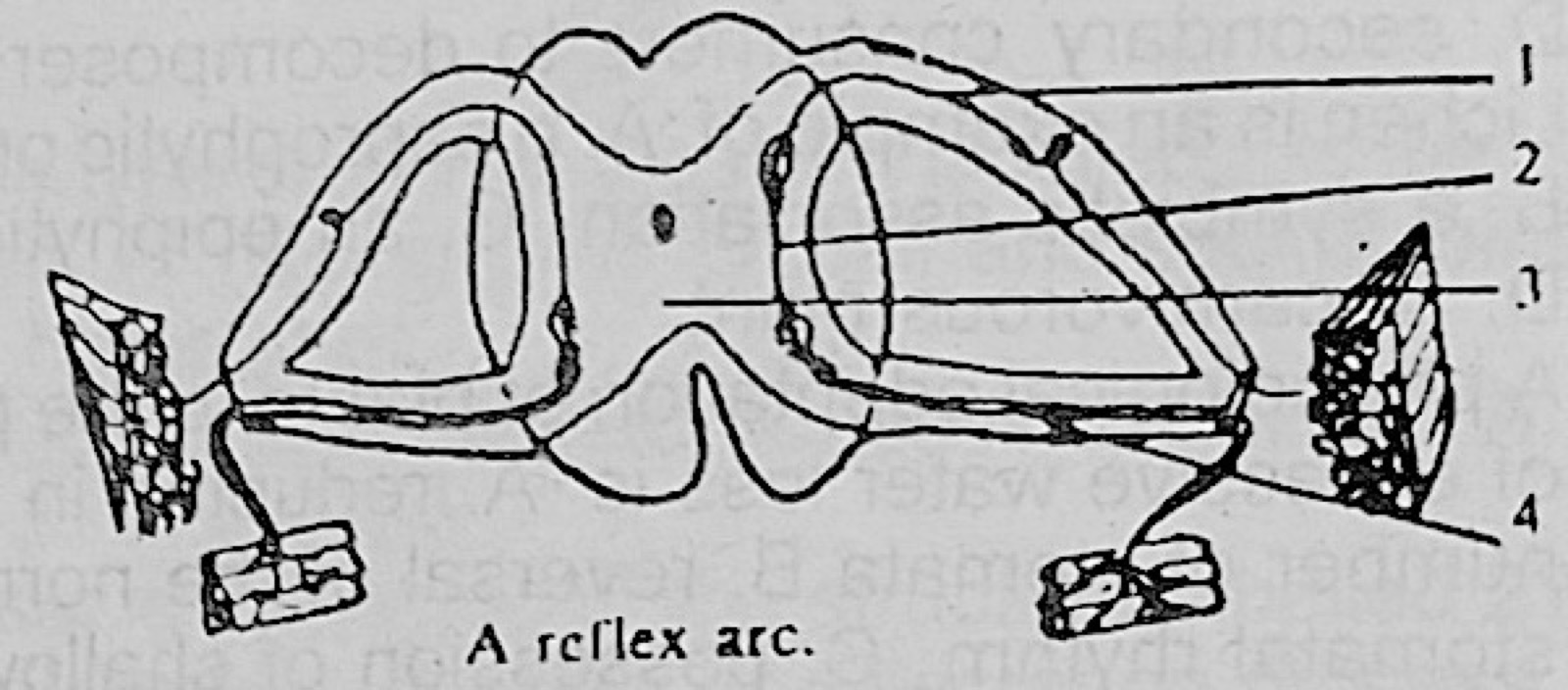
Question 34 Nervous Coordination Use the figure (a reflex arc) to answer: In a reflex action, impulse flows from
A. 1 to 2 B. 2 to 1 C. 4 to 1 D. 4 to 2 Show the answer and explanation Answer: A (1 to 2 )
Explanation The impulse travels along the sensory neuron, through the ganglion (1), into the spinal cord (2) and then out along the motor neuron.
Open this question
Question 35 Sense Organs The part of the ear that is concerned with balance is the
A. semi-circular canals B. incus C. malleus D. Eustachian tube Show the answer and explanation Answer: A (semi-circular canals )
Explanation The fluid in the semicircular canals moves when the head moves, and this is sensed for balance.
Open this question
Question 36 Chromosomes, DNA and Sex Linkage In an organism where the 2n number of chromosomes is 16, the number of chromosomes in each gamete will be
A. 32 B. 16 C. 8 D. 4 Show the answer and explanation Answer: C (8 )
Explanation Gametes are haploid (n), so they have half of 16, which is 8.
Open this question
Question 37 Mendelian Inheritance What would be the result of the first filial generation (F1 ) and the second filial generation (F2 ) of a monohybrid cross between pure line normal-winged Drosophila flies and pure line short-winged flies, if the gene for the normal wing is dominant?
A. F1 flies all short-winged and F2 flies all normal-winged B. F1 flies all normal-winged and F2 flies all short-winged C. F1 flies all short-winged and three-quarters of F2 flies are short-winged D. F1 flies all normal-winged and three-quarters of F2 flies are normal-winged Show the answer and explanation Answer: D (F1 flies all normal-winged and three-quarters of F2 flies are normal-winged )
Explanation NN × nn gives all Nn (normal) in F1 ; Nn × Nn gives 3 normal : 1 short in F2 .
Open this question
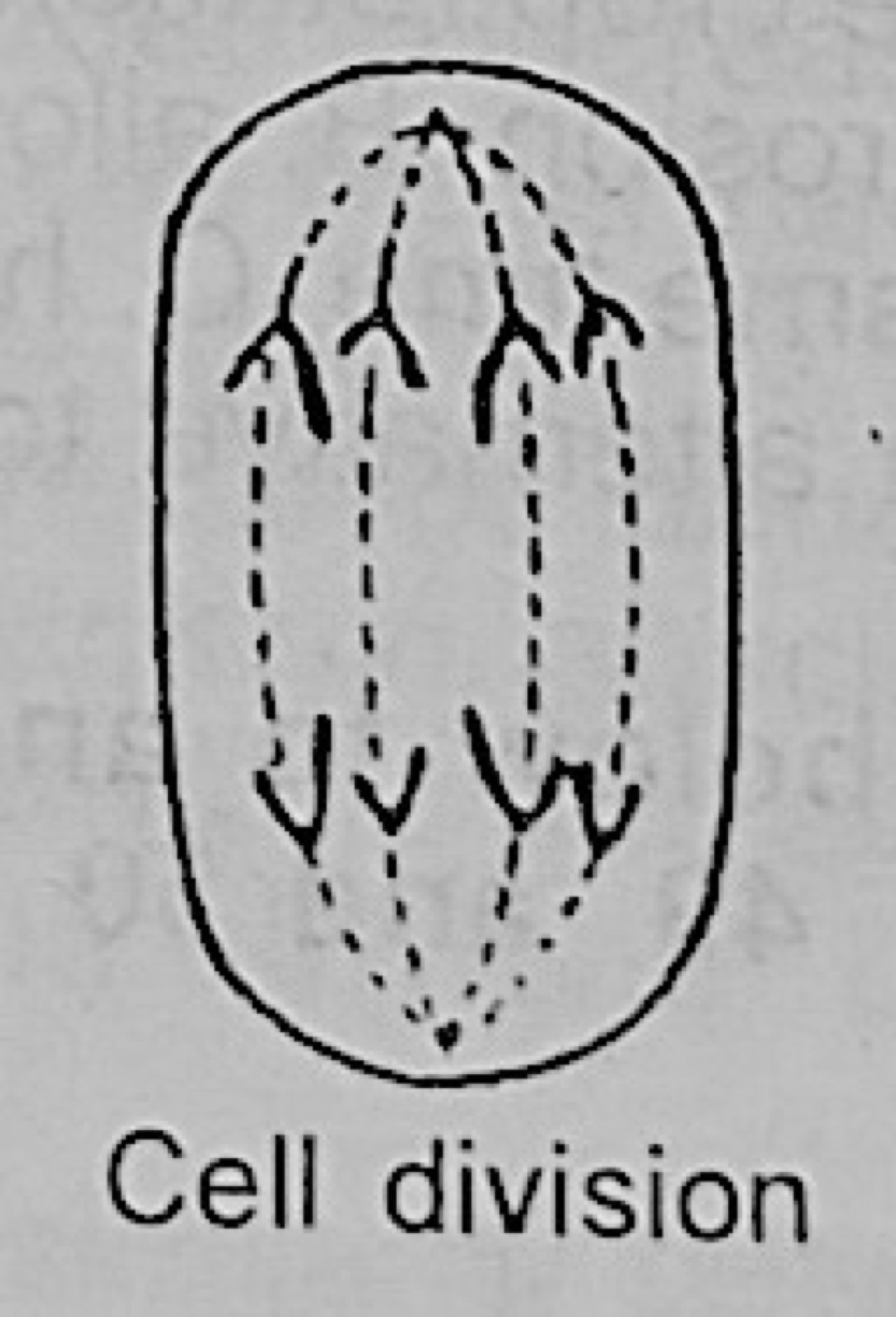
Question 38 Cell Division Use the figure (cell division): What stage during cell division is represented in the figure above?
A. Prophase B. Metaphase C. Anaphase D. Telophase Show the answer and explanation Answer: C (Anaphase )
Explanation The arrows show chromatids being pulled apart to opposite poles on the spindle, which happens in anaphase.
Open this question
Question 39 Transport in Animals An individual in the AB blood group is a universal recipient for blood donation because
A. all the red blood cells do not carry antigen B. all the red blood cells carry antigen A C. all the red blood cells carry antigen B D. there are no anti-A and anti-B antibodies in the serum Show the answer and explanation Answer: D (there are no anti-A and anti-B antibodies in the serum )
Explanation Group AB plasma has no anti-A or anti-B antibodies, so donated cells of any group are not clumped.
Open this question
Question 40 Chromosomes, DNA and Sex Linkage Haemophilia results from the mutation of the genes
A. in the sex chromosomes B. which control skin colour C. which control the mechanism for blood-clotting D. which control the formation of haemoglobin Show the answer and explanation Answer: C (which control the mechanism for blood-clotting )
Explanation Haemophilia is a failure of blood clotting caused by a faulty gene for a clotting factor.
Open this question
Question 41 Habitats and Biomes In a savanna ecosystem the abiotic factors include
A. legumes, temperature and sandy soil B. water, temperature and soil C. minerals, oxygen and reptiles D. water, soil and grasses Show the answer and explanation Answer: B (water, temperature and soil )
Explanation Abiotic factors are non-living; water, temperature and soil are all non-living, while legumes, reptiles and grasses are living.
Open this question
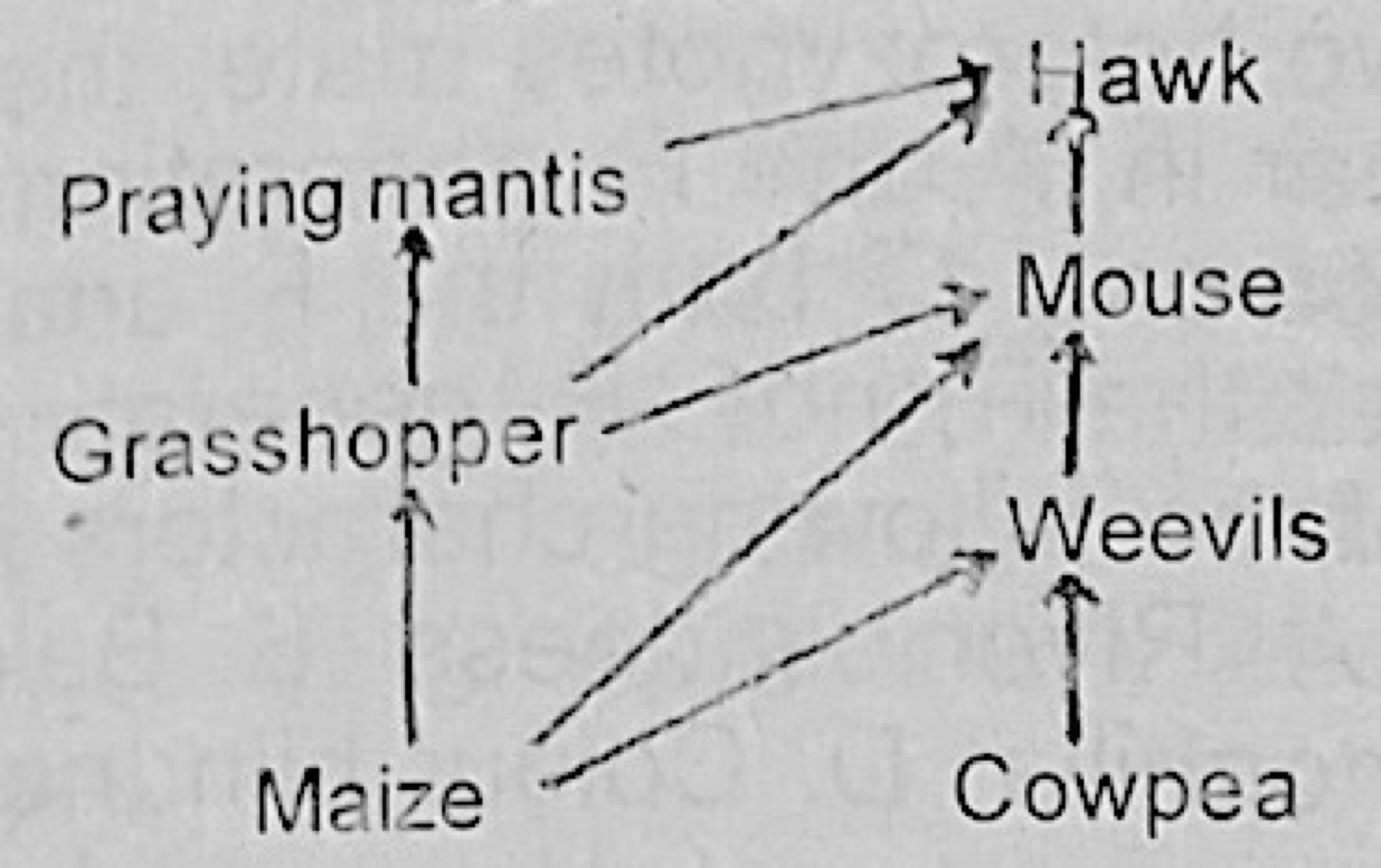
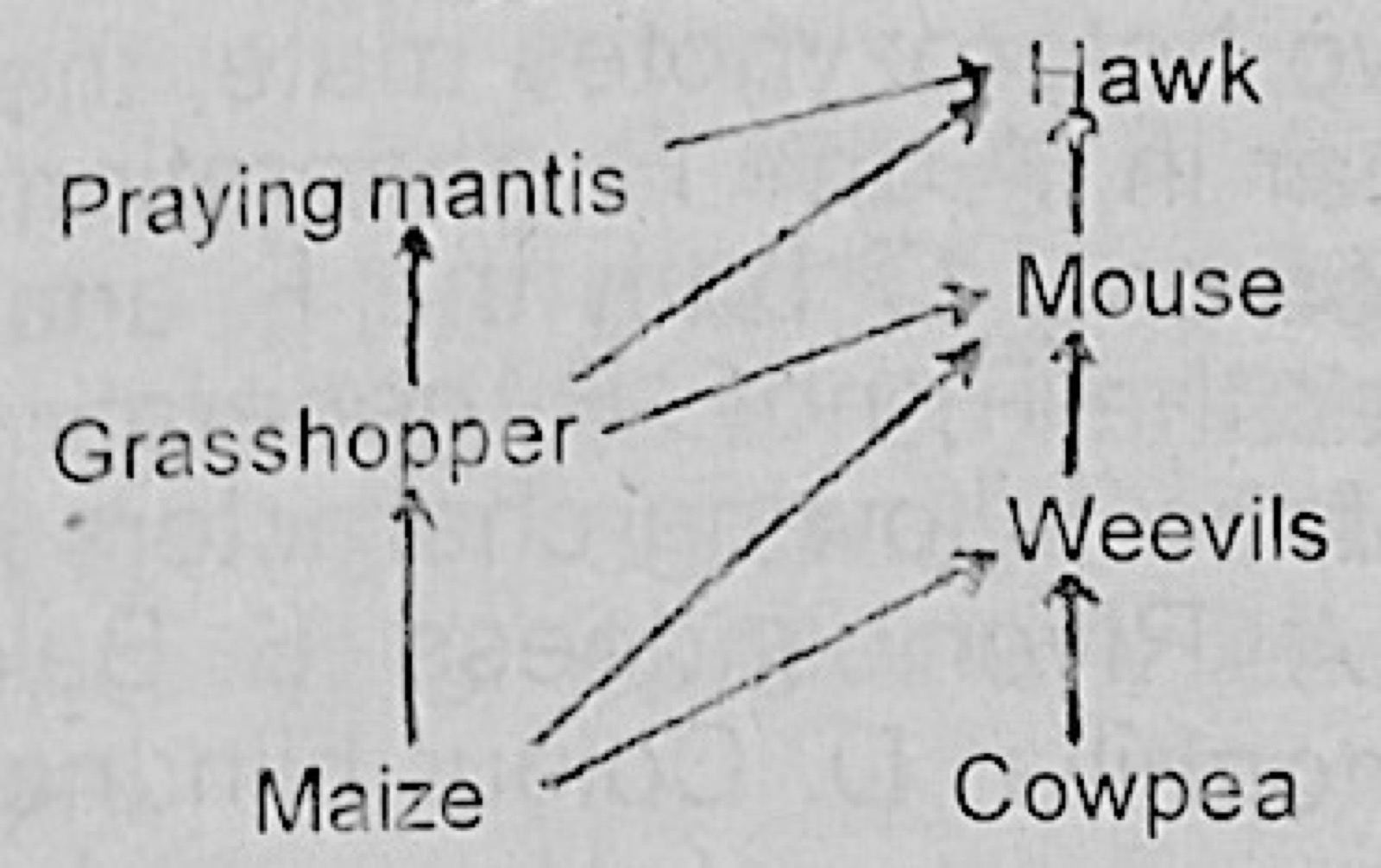
Question 42 Feeding Relationships and Energy Flow Use the diagram (a food web) to answer: Which organism is an omnivore?
A. Praying manits B. Hawk C. Mouse D. Grasshopper Show the answer and explanation Answer: C (Mouse )
Explanation The arrows show the mouse eating maize (a plant) as well as grasshoppers and weevils (animals), so it is an omnivore.
Open this question
Question 43 Feeding Relationships and Energy Flow Use the diagram (a food web) to answer: Which of the organisms will have the lowest population in an ecosystem?
A. Hawk B. Cowpea C. Praying mantis D. Mouse Show the answer and explanation Answer: A (Hawk )
Explanation The hawk is the top carnivore; energy is lost at each level, so the top of the web supports the fewest individuals.
Open this question
Question 44 Habitats and Biomes The salinity of a brackish environment
A. increases immediately after rain B. increases at the end of the rainy season C. decreases with increase in micro-organisms D. increases during the dry season Show the answer and explanation Answer: D (increases during the dry season )
Explanation In the dry season less fresh water flows in and more water evaporates, so the water becomes saltier.
Open this question
Question 45 Adaptation Physiological adaptation to very dry condition in animals is called
A. hibernation B. aestivation C. rejuvenation D. xeromorphism Show the answer and explanation Answer: B (aestivation )
Explanation Aestivation is the inactive state some animals enter to survive hot, dry periods. Xeromorphism is a structural adaptation of plants.
Open this question
Question 46 Microorganisms and Health Which set of diseases is spread mainly by insect vectors?
A. Cholera, tenia and gonorrhoea B. Poliomyelitis, tuberculosis and syphilis C. Cholera, malaria and tuberculosis D. Malaria, cholera and river blindness Show the answer and explanation Answer: D (Malaria, cholera and river blindness )
Explanation Malaria (mosquito) and river blindness (blackfly) are insect-borne, and houseflies help spread cholera; the other sets are spread mainly by contact, air or food.
Open this question
Question 47 Pollution Which of the following constitutes pollution?
A. Droppings from birds B. Loud disco music C. A pack of cigarettes D. Refuse in an incinerator Show the answer and explanation Answer: B (Loud disco music )
Explanation Very loud music is noise pollution, which can damage hearing and disturb others.
Open this question
Question 48 Soil An acidic soil can be improved upon by
A. sedimentation B. leaching C. flocculation D. watering Show the answer and explanation Answer: C (flocculation )
Explanation Adding lime neutralises acidity and makes clay particles clump together (flocculation), which improves the soil.
Open this question
Question 49 Ecological Associations What do bacteria in root nodules derive from the host plant?
A. Protection and minerals B. Water and minerals C. Carbohydrates and water D. Protection and carbodydrates Show the answer and explanation Answer: D (Protection and carbodydrates )
Explanation Rhizobium lives sheltered inside the nodule and gets sugars from the plant, while it gives the plant fixed nitrogen.
Open this question
Question 50 Nutrient Cycling Free nitrogen is released to the atmosphere by
A. Nitrogen- fixing bacteria B. nitrifying bacteria C. denitrifying bacteria D. saprophytic bacteria Show the answer and explanation Answer: C (denitrifying bacteria )
Explanation Denitrifying bacteria break down nitrates and release nitrogen gas back into the air.
Open this question Sign up free for every JAMB Biology year, practice by topic and timed mocks.
Start practising free