Home › Past questions › JAMB › Biology › 1989 50 questions. Try each one, then open the answer to check yourself and read the explanation.
Sign up free to answer these questions on a CBT screen with a timer, then see your score and every answer explained.
Start practising free
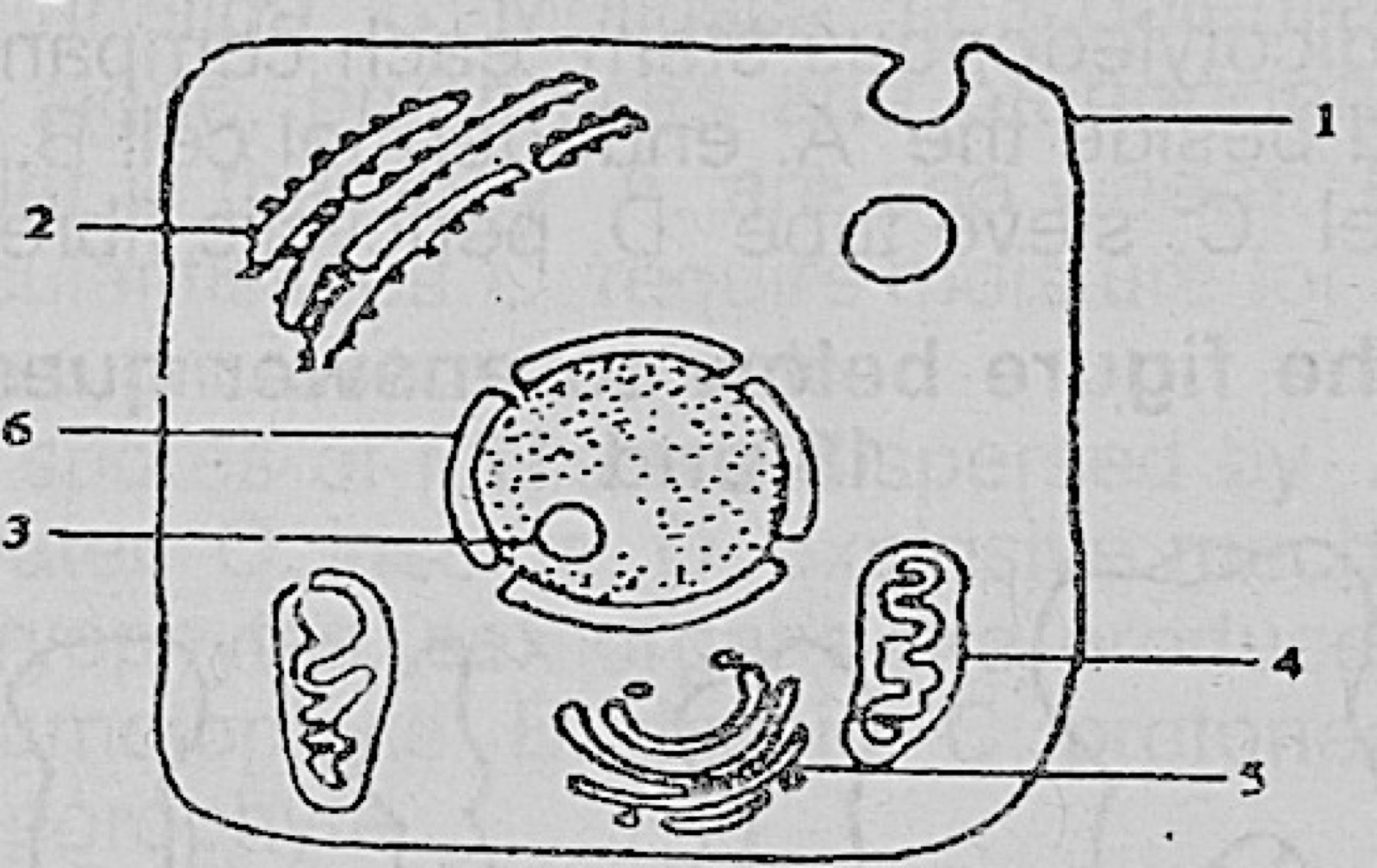
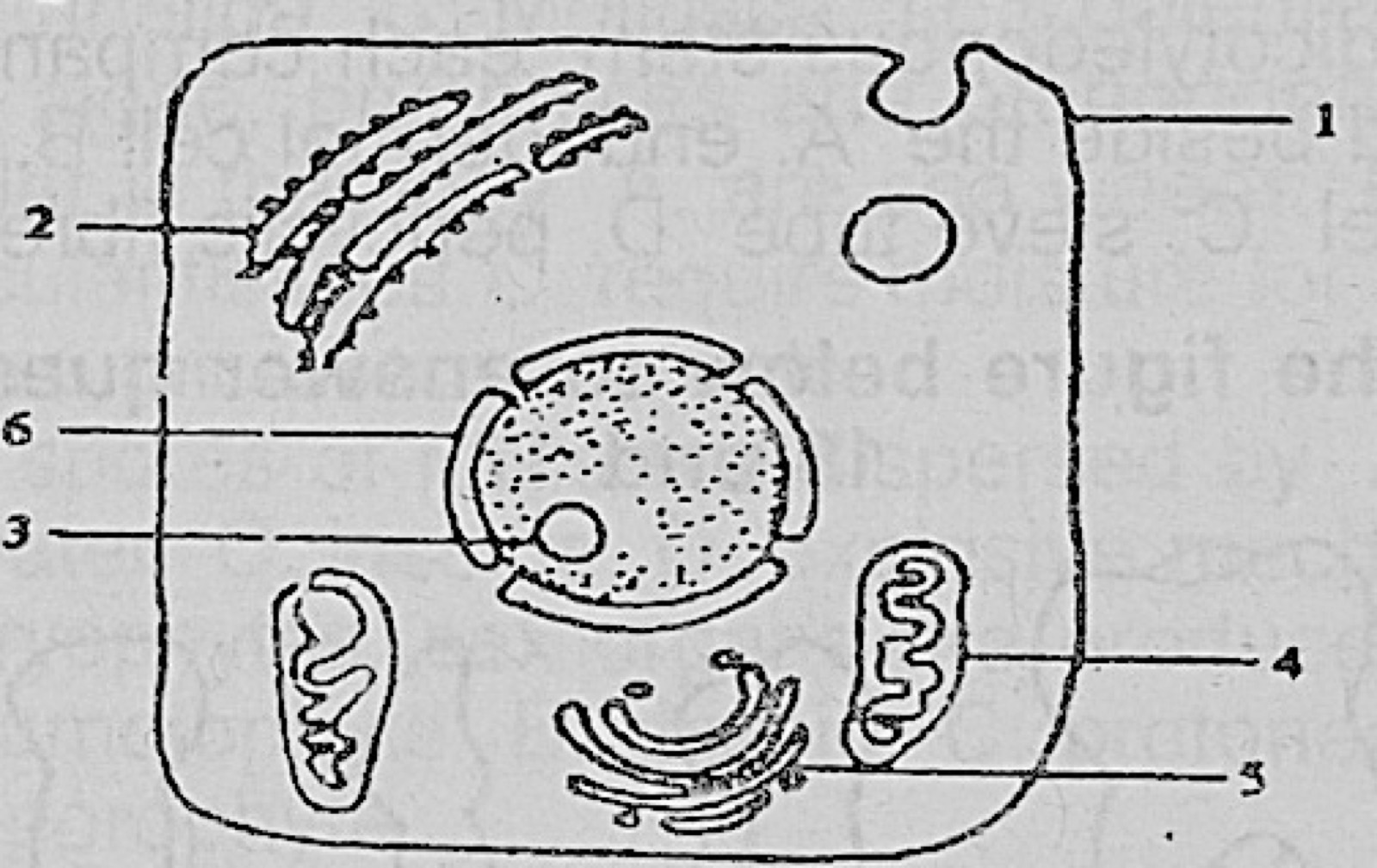
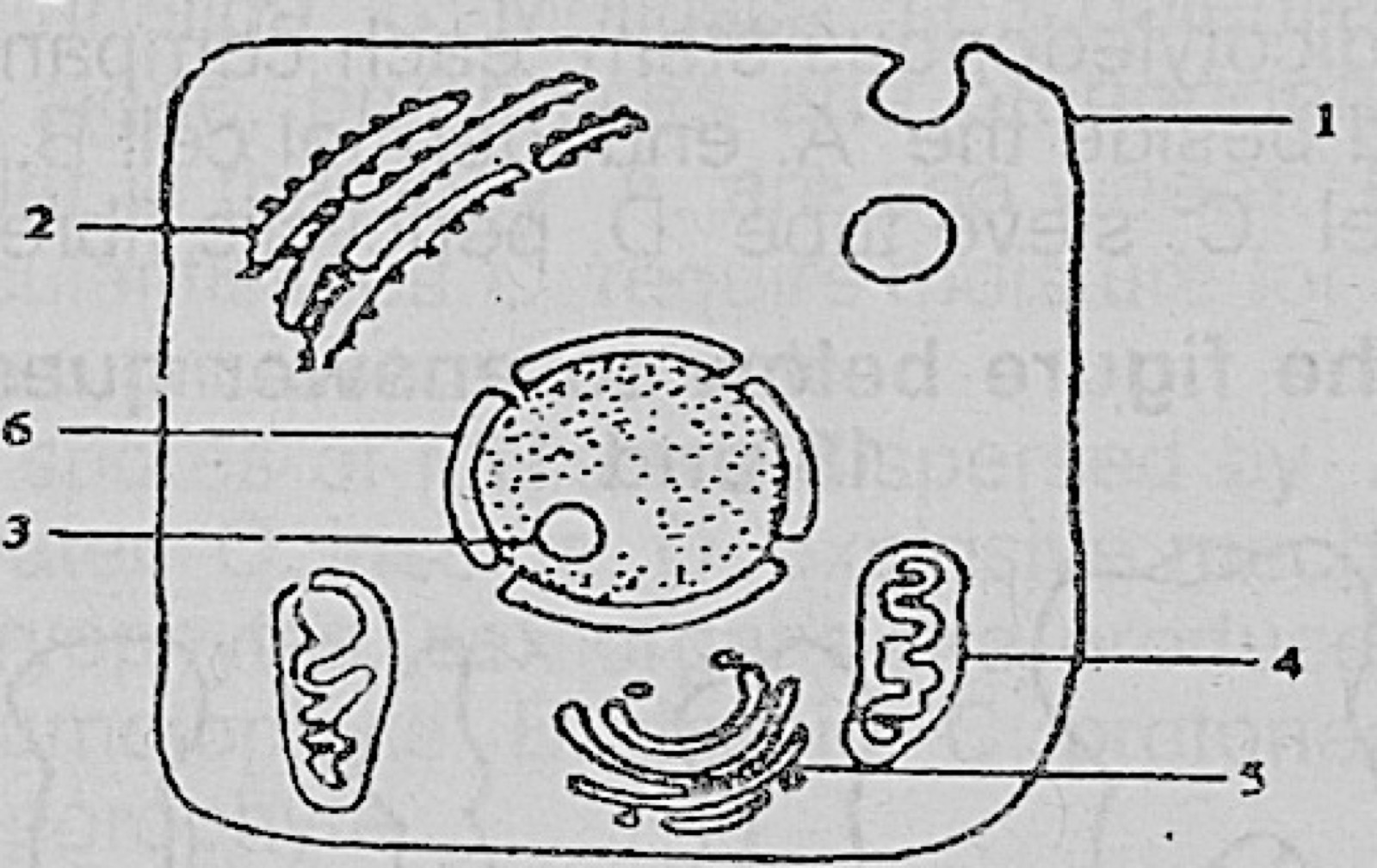
Question 1 Cell Structure and Organisation Use the figure (a cell) to answer: The structure labelled 5 is the
A. neucleolus B. Golgi body C. mitochondrion D. vacuole Show the answer and explanation Answer: B (Golgi body )
Explanation Structure 5 is a stack of curved, flattened sacs with small vesicles at the edges, which is the Golgi body.
Open this question
Question 2 Cell Structure and Organisation Use the figure (a cell) to answer: Which of the labelled parts of the cell contains ribonucleic acid?
A. 1 B. 2 C. 3 D. 5 Show the answer and explanation Answer: C (3 )
Explanation Part 3 is the nucleolus, which is made largely of RNA and is where ribosomal RNA is produced.
Open this question
Question 3 Cell Structure and Organisation Use the figure (a cell) to answer: Which structure is known as the power house of the cell?
A. 6 B. 5 C. 4 D. 3 Show the answer and explanation Answer: C (4 )
Explanation Structure 4 has a folded inner membrane (cristae): it is a mitochondrion, where respiration releases energy.
Open this question
Question 4 Viruses, Monera, Protista and Fungi When a virus is placed in a non-living medium it
A. becomes dehydrated B. forms spores C. forms flagella D. becomes crystallized Show the answer and explanation Answer: D (becomes crystallized )
Explanation Outside a living cell a virus shows no life activity and can exist as an inert crystal.
Open this question
Question 5 Animal Kingdom A characteristic of the phylum coelenterata is that
A. most of them are marine B. they possess a gut with a single opening C. they possess numerous pores on their body D. they are bilaterally symmetrical Show the answer and explanation Answer: B (they possess a gut with a single opening )
Explanation Coelenterates like Hydra have a sac-like gut with only one opening, the mouth; they are radially symmetrical, and pores are a feature of sponges.
Open this question
Question 6 Viruses, Monera, Protista and Fungi A multinucleate body without internal cell boundaries is characteristic of
A. bryophytes B. fungi C. algae D. gymnosperms Show the answer and explanation Answer: B (fungi )
Explanation Fungi such as Mucor have hyphae with many nuclei and no cross walls (coenocytic).
Open this question
Question 7 Reproduction in Plants Double fertilization is a unique feature of
A. angiosperms B. bryophytes C. pteridophytes D. algae Show the answer and explanation Answer: A (angiosperms )
Explanation Only flowering plants have double fertilization: one male nucleus fuses with the egg and the other with the polar nuclei to form endosperm.
Open this question
Question 8 Animal Kingdom Which of the following phyla have members with both internal and external segmentation?
A. Platyhelminthes B. Nematoda C. Annelida D. Mollusca Show the answer and explanation Answer: C (Annelida )
Explanation In annelids like the earthworm the rings on the outside match internal partitions (septa) dividing the body cavity.
Open this question
Question 9 Transport in Plants Mineral salts can be absorbed into the roots by
A. osmosis only B. osmosis and diffusion C. diffusion and active transport D. imbibition only Show the answer and explanation Answer: C (diffusion and active transport )
Explanation Ions enter root hairs by diffusion when more concentrated outside, and by active transport (using energy) against a concentration gradient. Osmosis moves only water.
Open this question
Question 10 Animal Kingdom Which of the following is a common characteristic of crustaceans?
A. Possession of a pair of antennae B. Possession of two pairs of antennae C. Each segment has a pair of walking legs D. Four pairs of walking legs on the cephalothorax Show the answer and explanation Answer: B (Possession of two pairs of antennae )
Explanation Crustaceans such as crayfish have two pairs of antennae (antennae and antennules); insects have one pair.
Open this question
Question 11 Animal Kingdom The pedipalpi in spiders are used for
A. grasping B. walking C. feeling D. web spinning Show the answer and explanation Answer: A (grasping )
Explanation Pedipalps are the small leg-like parts beside the mouth that spiders use to hold and handle their prey.
Open this question
Question 12 Animal Kingdom The body of a snail is divided into head,
A. thorax and abdomen B. visceral mass and abdomen C. thorax and foot D. visceral mass and foot Show the answer and explanation Answer: D (visceral mass and foot )
Explanation A mollusc's body has a head, a muscular foot and a visceral mass holding the organs, covered by the mantle and shell.
Open this question
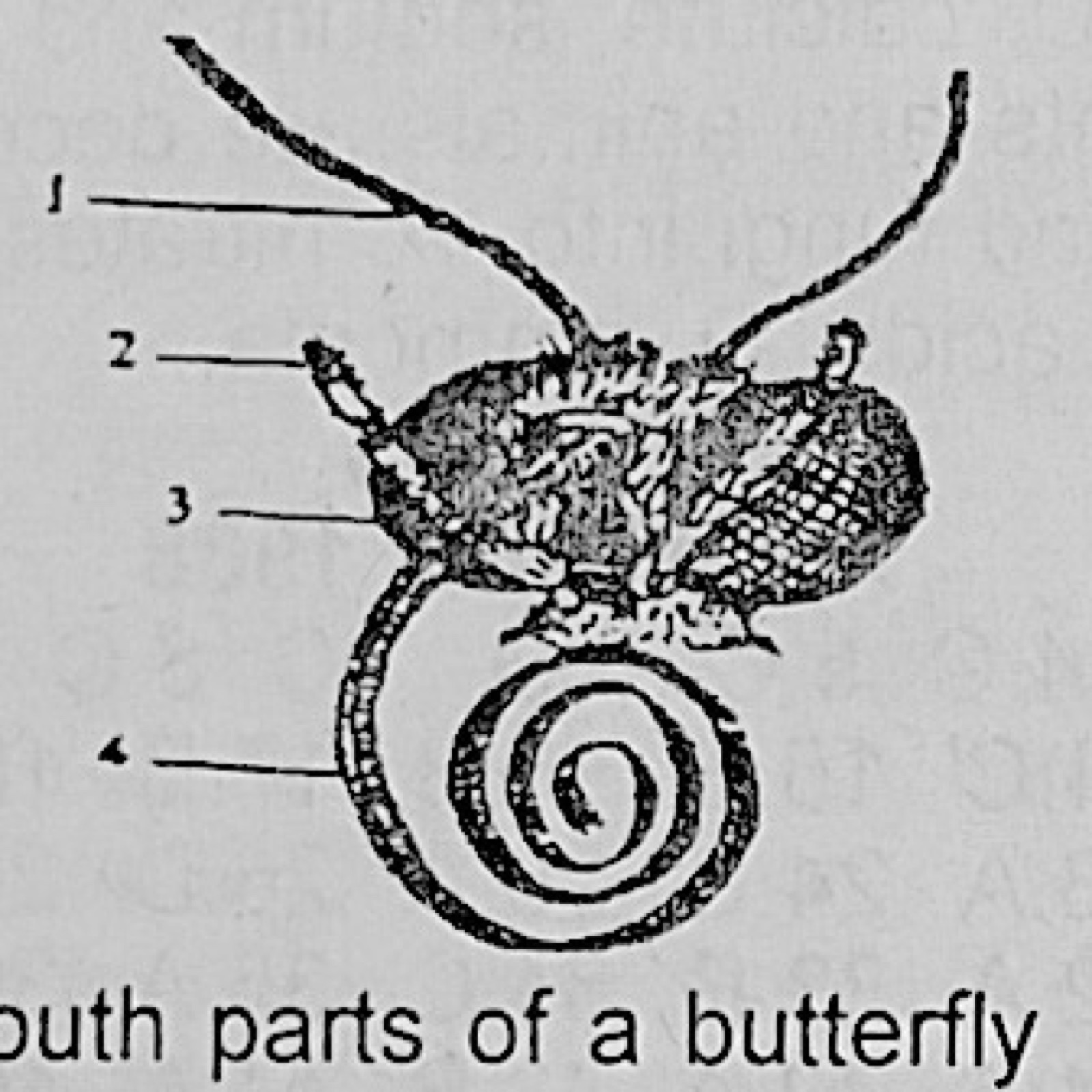
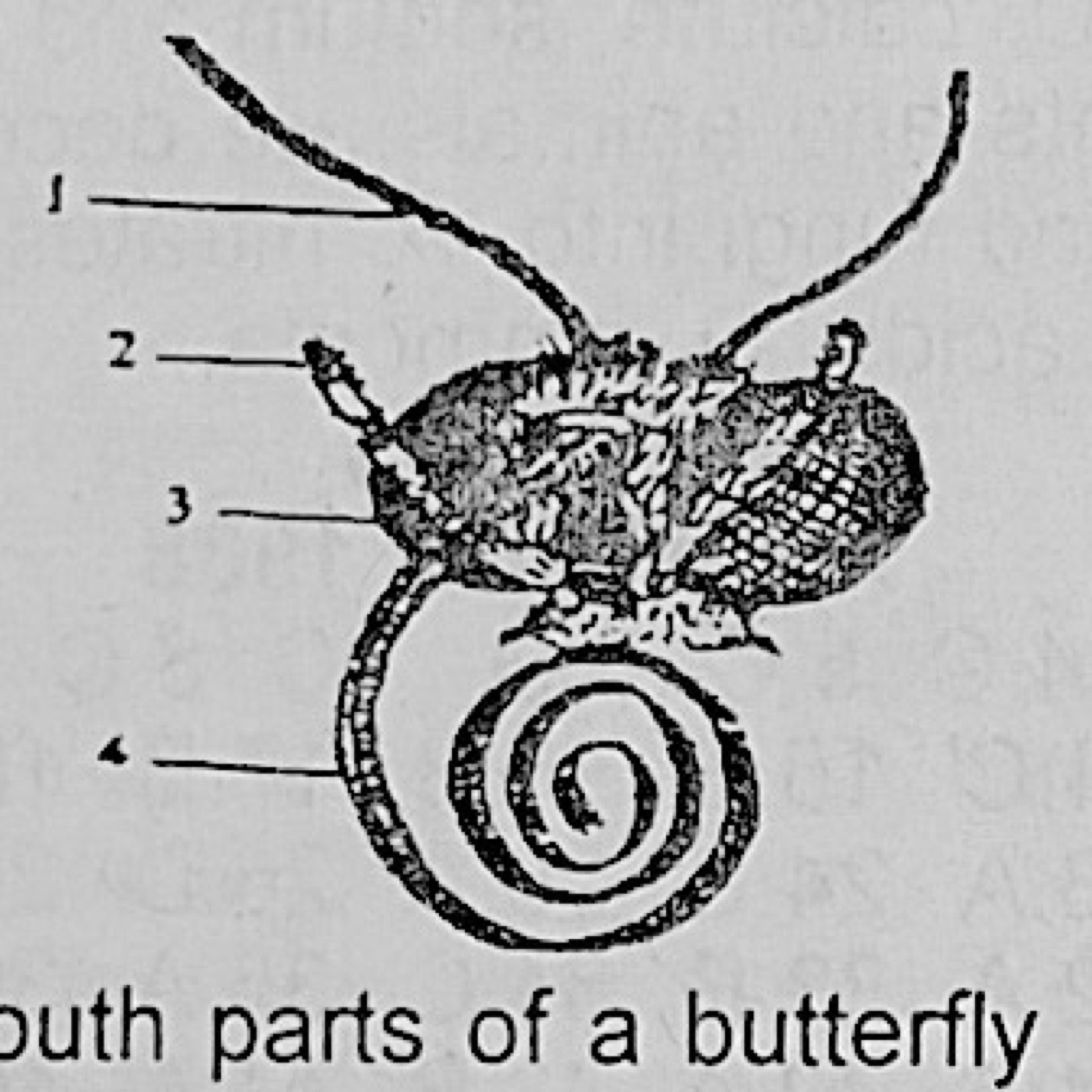
Question 13 Animal Kingdom Use the figure (mouth parts of a butterfly) to answer: Which of the labelled parts is used for feeling?
A. 1 B. 2 C. 3 D. 4 Show the answer and explanation Answer: A (1 )
Explanation Part 1 is the antenna, the butterfly's organ of touch and smell.
Open this question
Question 14 Animal Kingdom Use the figure (mouth parts of a butterfly) to answer: The structure labelled 2 is the
A. compound eye B. ocellus C. antenna D. labial palp Show the answer and explanation Answer: D (labial palp )
Explanation Part 2 is the short hairy projection beside the proboscis, the labial palp.
Open this question
Question 15 Structure of Flowering Plants In a dicotyledonous stem, each companion cell is found beside the
A. endodermal cell B. xylem vessel C. sieve tube D. pericyclic fibre Show the answer and explanation Answer: C (sieve tube )
Explanation Companion cells lie next to sieve tubes in the phloem and control their activities.
Open this question
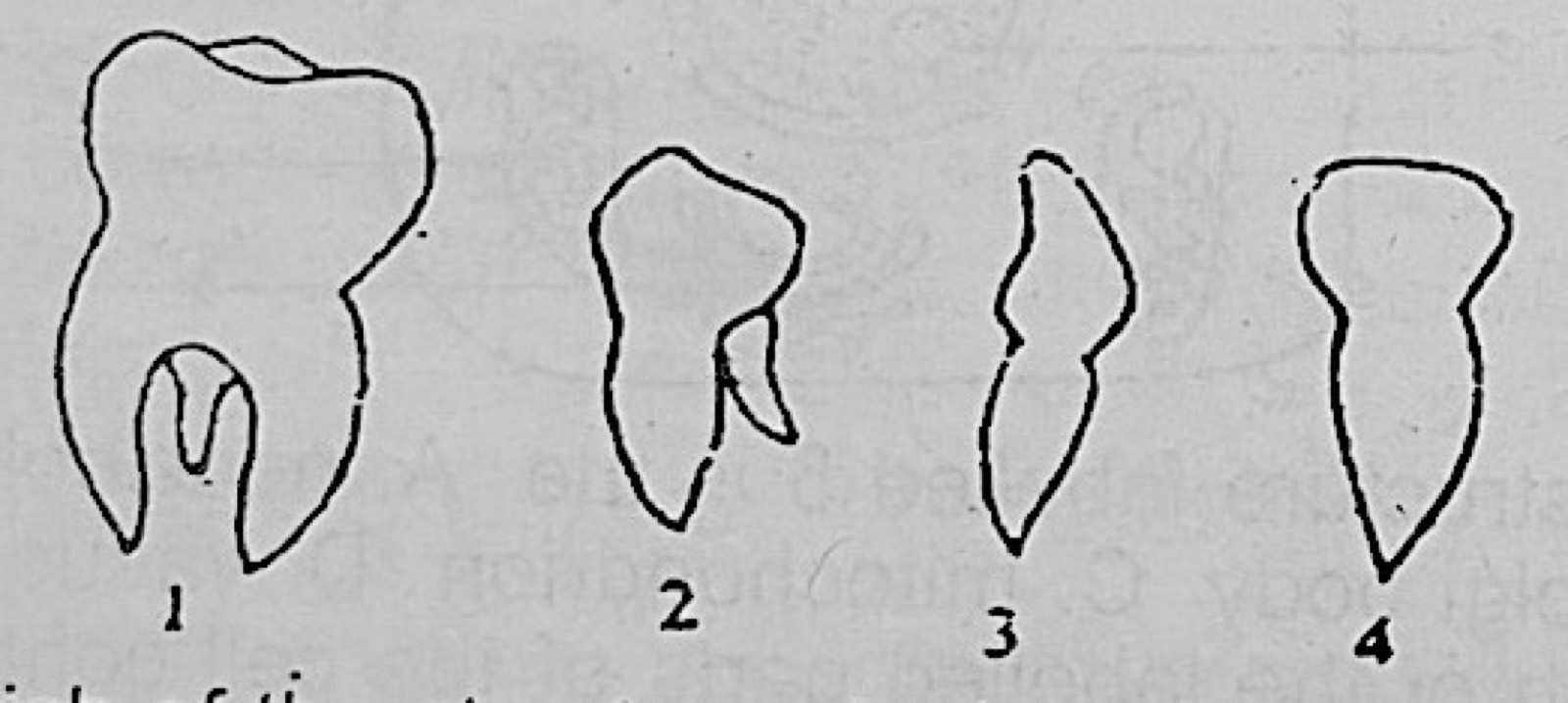
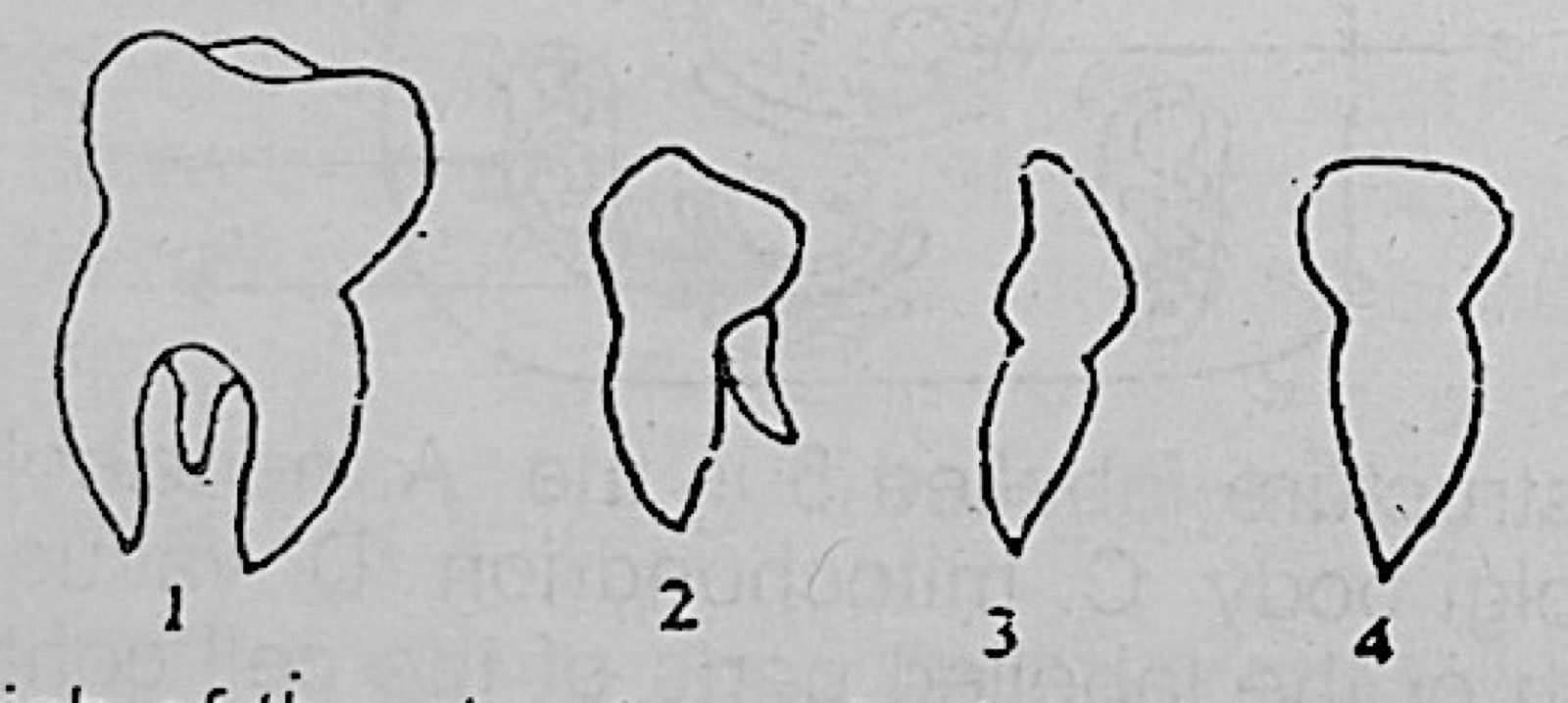
Question 16 Animal Nutrition Use the figure (four teeth labelled 1 to 4) to answer: Which of the structures is the molar?
A. 1 B. 2 C. 3 D. 4 Show the answer and explanation Answer: A (1 )
Explanation Tooth 1 has a broad, ridged crown and two roots, the shape of a molar used for grinding.
Open this question
Question 17 Animal Nutrition Use the figure (four teeth labelled 1 to 4) to answer: What is the function of 3?
A. Cutting off large pieces of food B. seizure and tearing of prey C. Grinding of food D. Tearing of flesh only Show the answer and explanation Answer: B (seizure and tearing of prey )
Explanation Tooth 3 is long, pointed and single-rooted, a canine, which holds and tears prey.
Open this question
Question 18 Respiration If a healthy potted plant is continuously kept in dim light
A. the rate of respiration may equal that of photosynthesis B. more carbondioxide and water are taken in C. respiration may be halted D. the volume of oxygen released increases Show the answer and explanation Answer: A (the rate of respiration may equal that of photosynthesis )
Explanation In dim light photosynthesis slows until it just balances respiration (the compensation point), so no extra food or oxygen is produced.
Open this question
Question 19 Animal Nutrition The pancreatic juice contains the enzymes amylopsin,
A. pepsin and trypsinogen B. rennin and steapsin C. steapsin and trypsinogen D. steapsin and ptyalin Show the answer and explanation Answer: C (steapsin and trypsinogen )
Explanation Pancreatic juice contains amylase (amylopsin), lipase (steapsin) and trypsinogen. Pepsin and rennin come from the stomach, ptyalin from saliva.
Open this question
Question 20 Transport in Animals Aged erythrocytes are destroyed in the
A. pancreas B. liver C. lymph nodes D. kidney Show the answer and explanation Answer: B (liver )
Explanation Old red blood cells are broken down in the liver (and spleen); the haemoglobin is turned into bile pigments.
Open this question
Question 21 Photosynthesis and Plant Nutrition The seedlings in a rice field were found to have thin lanky growth with reddish leaves and poor root development. This is because the soil lacks
A. sulphur B. phosphorus C. potassium D. iron Show the answer and explanation Answer: B (phosphorus )
Explanation Phosphorus shortage causes poor root growth, stunted thin stems and purplish-red leaves.
Open this question
Question 22 Transport in Animals There will be agglutination when the
A. Group A serum mixes with Group A erythrocytes B. Group A serum mixes with Group B erythrocytes C. Group AB serum mixes with Group O erythrocytes D. Group B serum mixes with Group B erythrocytes Show the answer and explanation Answer: B (Group A serum mixes with Group B erythrocytes )
Explanation Group A serum contains anti-B antibodies, which clump red cells carrying antigen B.
Open this question
Question 23 Transport in Animals Which of the following is the function of lymph?
A. Carries hormones round the body B. Transports nutrients and oxygen from blood capillaries to the cells C. Distributes heat uniformly round the body D. Conveys amino acids and glucose from the small intestine to the liver Show the answer and explanation Answer: B (Transports nutrients and oxygen from blood capillaries to the cells )
Explanation Lymph (tissue fluid) bathes the cells and passes food and oxygen from the capillaries to them.
Open this question
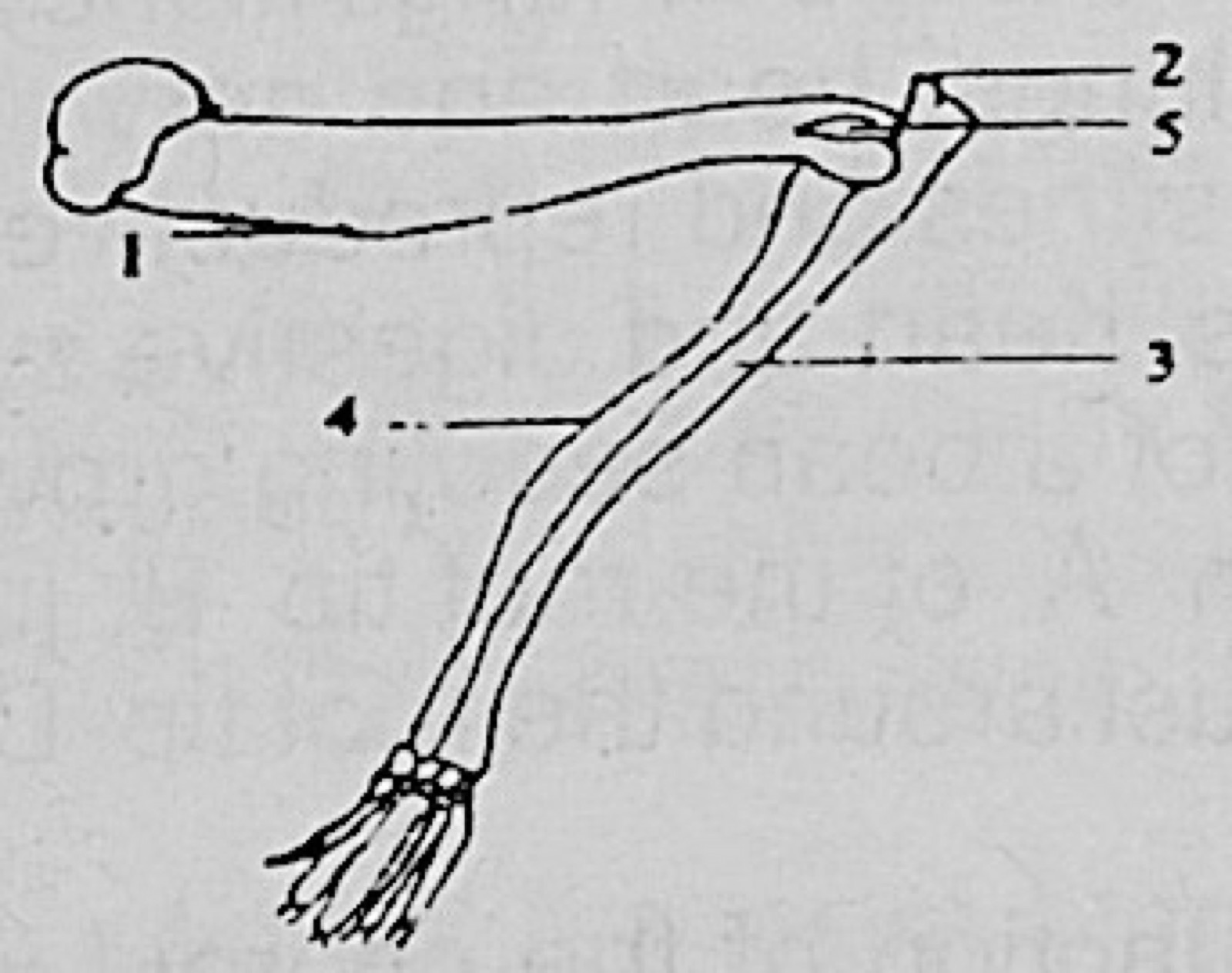
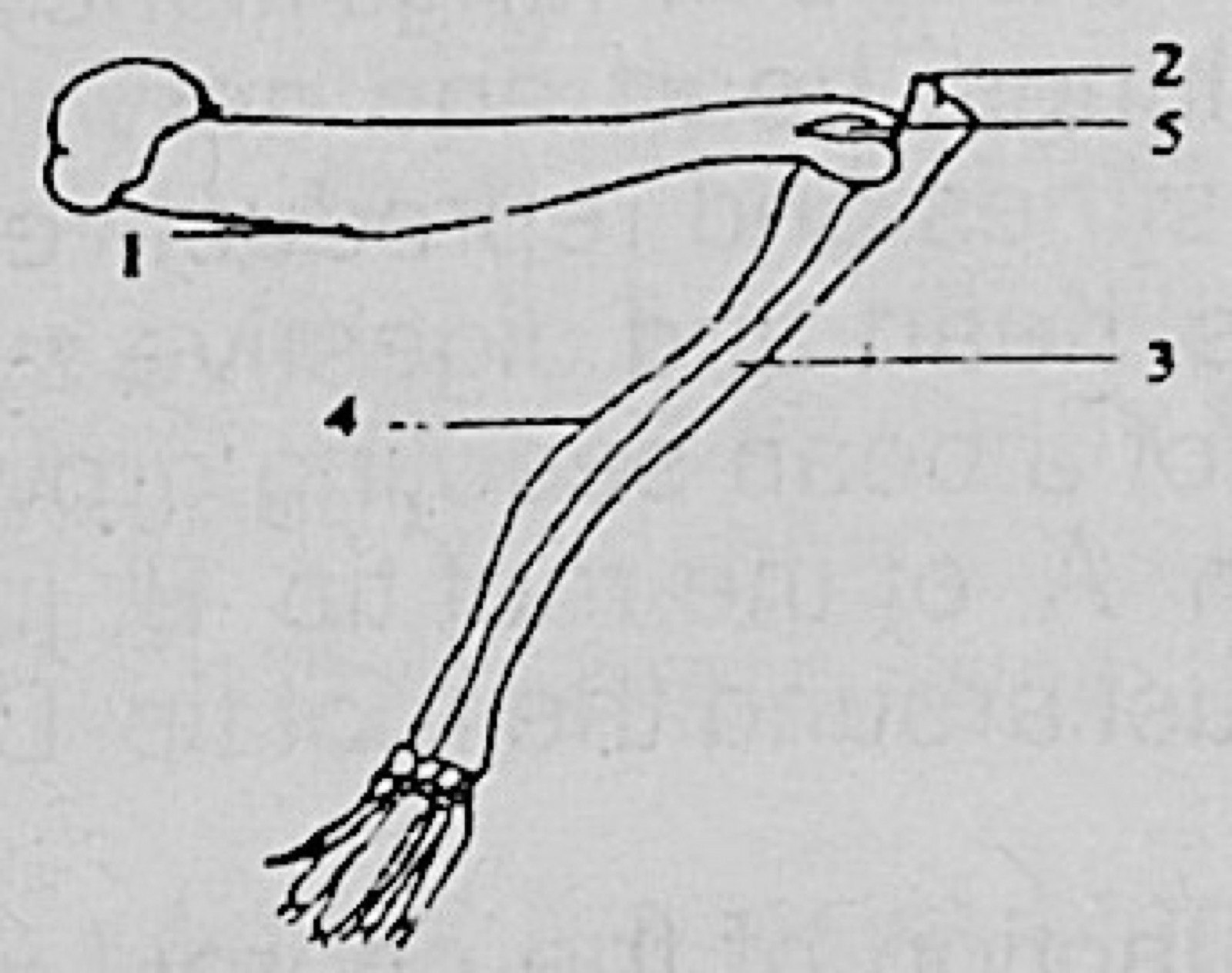
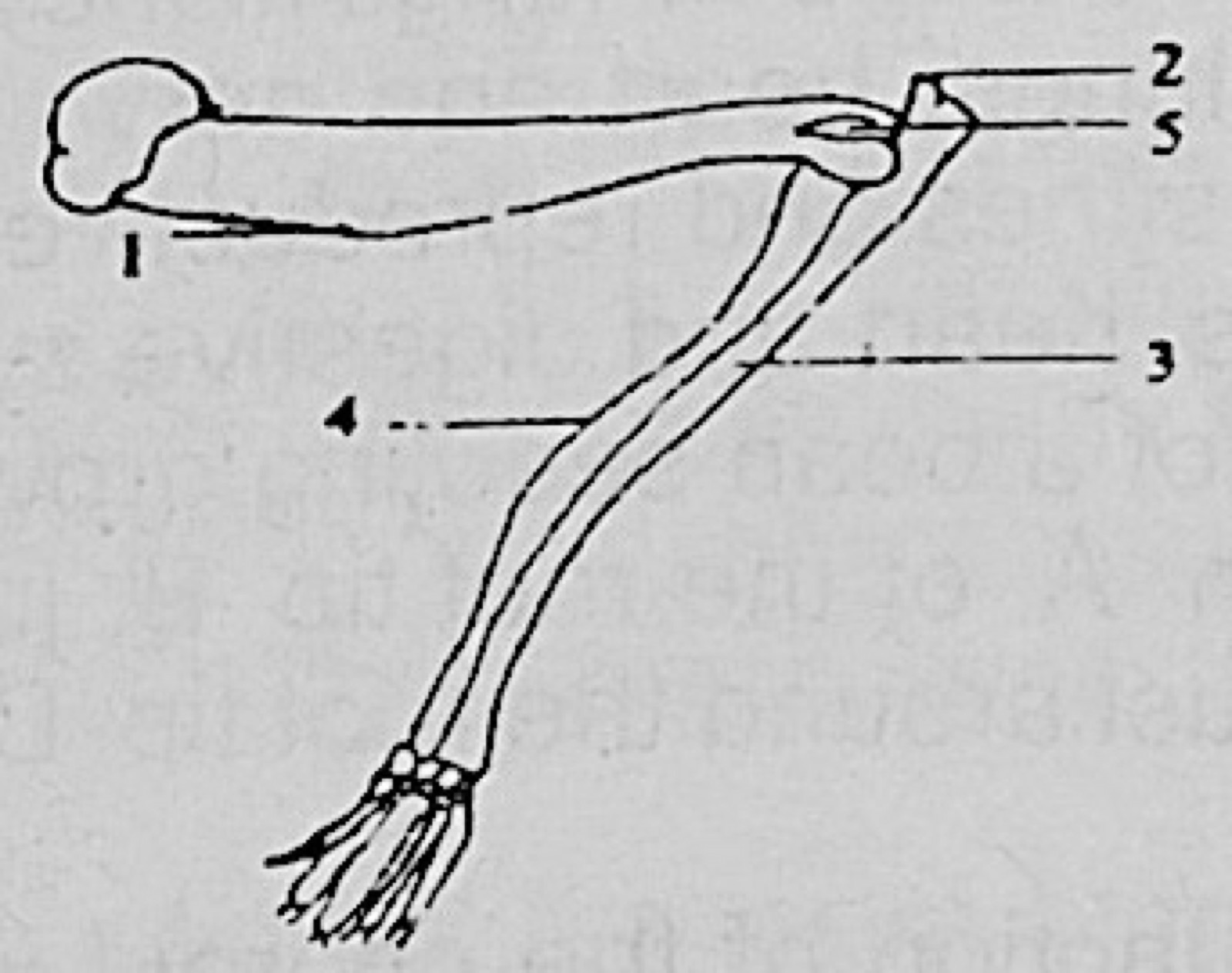
Question 24 Support and Movement Use the figure (bones of the forelimb) to answer: The type of joint at the point labelled 5 is the
A. pivot joint B. gliding joint C. ball and socket joint D. hinge joint Show the answer and explanation Answer: D (hinge joint )
Explanation Point 5 is the elbow, a hinge joint that moves in one plane only.
Open this question
Question 25 Support and Movement Use the figure (bones of the forelimb) to answer: Which of the labelled bones is the ulna?
A. 1 B. 3 C. 4 D. 5 Show the answer and explanation Answer: B (3 )
Explanation Bone 3 carries the olecranon process at the elbow, so it is the ulna; bone 4 is the radius and 1 is the humerus.
Open this question
Question 26 Support and Movement Use the figure (bones of the forelimb) to answer: What is the name of the structure labelled 2?
A. Odontoid process B. Olecranon process C. Patella D. Condyle Show the answer and explanation Answer: B (Olecranon process )
Explanation Structure 2 is the projection of the ulna behind the elbow, the olecranon process, which stops the arm over-straightening.
Open this question
Question 27 Support and Movement The lumbar vertebra when compared wtih a thoracic vertebra has a
A. longer neural spine B. wider neural canal C. thicker centrum D. shorter transverse process Show the answer and explanation Answer: C (thicker centrum )
Explanation Lumbar vertebrae carry much of the body's weight, so they have a large, thick centrum.
Open this question
Question 28 Reproduction in Plants Wind-pollinated flowers usually have
A. rough pollen grains B. sticky stigmas C. small and short stigmas D. long styles Show the answer and explanation Answer: D (long styles )
Explanation Wind-pollinated flowers hang their stigmas out on long styles to catch pollen from the air; their pollen is smooth and light.
Open this question
Question 29 Reproduction in Plants The components of castor oil seed and the maize grain are similar EXCEPT for the
A. number of cotyledons B. location of the embryo C. number of radicles D. number of plumules Show the answer and explanation Answer: A (number of cotyledons )
Explanation Castor is a dicot with two cotyledons; maize is a monocot with one. Both have one radicle and one plumule.
Open this question
Question 30 Reproduction in Plants A corm differs from a bulb in that
A. its stem is the main food storage organ B. it has a flattened disc-shaped stem C. buds are absent in the axils of the leaves D. adventitious roots are present Show the answer and explanation Answer: A (its stem is the main food storage organ )
Explanation A corm stores food in its swollen stem; a bulb stores food in fleshy leaves around a small disc-shaped stem.
Open this question
Question 31 Reproduction in Animals Exponential increase in the population of an organism is a characteristic feature of
A. binary fission B. sexual reproduction C. budding D. vegetative propagation Show the answer and explanation Answer: A (binary fission )
Explanation In binary fission each cell divides into two, then four, then eight, so numbers double every generation.
Open this question
Question 32 Growth and Development The irreversible life process by which new protoplasm is added to increase the size and weight of an organism can be termed
A. anabolism B. catabolism C. growth D. development Show the answer and explanation Answer: C (growth )
Explanation Growth is the permanent increase in size and dry weight caused by making new protoplasm.
Open this question
Question 33 Plant Responses and Hormones Fruit enlargement can be induced by spraying young ovary with
A. cytokinin, abscisic acid and ethylene B. gibberellin, ethylene and abscisic acid C. auxin, abscisic acid and ethylene D. auxin, cytokinin and gibberellin Show the answer and explanation Answer: D (auxin, cytokinin and gibberellin )
Explanation Auxins, gibberellins and cytokinins all promote growth and fruit development; abscisic acid and ethylene promote ripening, ageing and fall.
Open this question
Question 34 Nervous Coordination A fundamental similarity between nervous and hormonal system is that both
A. involve chemical transmission B. have widespread effects C. shed chemicals into the blood stream D. evoke rapid responses Show the answer and explanation Answer: A (involve chemical transmission )
Explanation Hormones are chemicals carried in the blood, and nerve impulses cross synapses by chemical transmitters, so both use chemical messages.
Open this question
Question 35 Nervous Coordination The region that controls most of the unconscious processes of a mammalian body is the
A. cerebellum B. cerebrum C. spinal cord D. medulla oblongata Show the answer and explanation Answer: D (medulla oblongata )
Explanation The medulla oblongata controls involuntary activities such as breathing, heartbeat and blood pressure.
Open this question
Question 36 Cell Division During cell division, the two strands of chromosomes are joined at a point called
A. spindle B. chromatid C. centromere D. aster Show the answer and explanation Answer: C (centromere )
Explanation The two chromatids of a chromosome are held together at the centromere.
Open this question
Question 37 Mendelian Inheritance When the two alleles present in an organism are of the the same type, the genotype is described as
A. heterozygous B. heterogamous C. homozygous D. homologous Show the answer and explanation Answer: C (homozygous )
Explanation Homozygous means both alleles are the same, e.g. TT or tt.
Open this question
Question 38 Mendelian Inheritance If parents with blood groups AB and OO produce six children
A. three of them will have group B B. two of them will have group A C. all the offspring will have group O D. none of them will have group A Show the answer and explanation Answer: A (three of them will have group B )
Explanation AB × OO gives AO and BO in equal proportion, so on average half of six children, three, will be group B.
Open this question
Question 39 Chromosomes, DNA and Sex Linkage Which of the following is a sex-linked character?
A. Sickle-cell anaemia B. Tongue rolling C. Skin colour D. Colour blindness Show the answer and explanation Answer: D (Colour blindness )
Explanation The gene for colour blindness is carried on the X chromosome, so it is sex-linked.
Open this question
Question 40 Feeding Relationships and Energy Flow In an ecosystem, the LEAST efficient energy transfer link is from
A. producers to primary consumers B. sun to producers C. primary consumers to secondary consumers D. secondary consumers to decomposers Show the answer and explanation Answer: B (sun to producers )
Explanation Green plants capture only about 1% of the sunlight falling on them, far less than the roughly 10% passed between feeding levels.
Open this question
Question 41 Ecological Associations Lichen is an example of
A. a saprophytic organism B. a symbiotic association C. an epiphytic plant D. a carnivorous plant Show the answer and explanation Answer: B (a symbiotic association )
Explanation A lichen is an alga and a fungus living together, each benefiting the other: symbiosis.
Open this question
Question 42 Adaptation A physiological adaptation of plants to the problem of excessive water loss is
A. reducton in the number of stomata B. reversal of the normal stomatal rhythm C. possession of shallow roots D. possession of waxy cuticle Show the answer and explanation Answer: B (reversal of the normal stomatal rhythm )
Explanation Opening stomata at night and closing them by day is a change in how the plant works (physiological); fewer stomata and waxy cuticle are structural.
Open this question
Question 43 Microorganisms and Health Which of the ways of controlling bilharzia can result in pollution?
A. Clearing water weeds on which the snails feed B. Treating infected people with drugs C. Preventing contamination of water by infected urine and faeces D. Applying chemical to kill the snails Show the answer and explanation Answer: D (Applying chemical to kill the snails )
Explanation Chemicals (molluscicides) poured into water to kill snails also poison the water and other living things.
Open this question
Question 44 Microorganisms and Health Which of the following diseases can be caused by a bacterium?
A. Ringworm B. Poliomyelitis C. Malaria D. Syphilis Show the answer and explanation Answer: D (Syphilis )
Explanation Syphilis is caused by the bacterium Treponema; ringworm is a fungus, polio a virus and malaria a protozoan.
Open this question
Question 45 Pollution Which of the following is a dangerous product of coal burning?
A. Sulphur dioxide B. Carbon dioxide C. Carbon D. Nitrogen Show the answer and explanation Answer: A (Sulphur dioxide )
Explanation Coal contains sulphur, which burns to sulphur dioxide, a poisonous gas that causes acid rain.
Open this question
Question 46 Soil 5 g of oven dried soil was heated in a furnace for 24 hours. After cooling, it weighed 4.8 g. What is the amount of humus in the soil?
A. 40.0g per 100 g dry soil B. 4.4g per 100 g dry soil C. 4.0 g per 100 g dry soil D. 0.4g per 100 g dry soil Show the answer and explanation Answer: C (4.0 g per 100 g dry soil )
Explanation Humus burnt off = 5 − 4.8 = 0.2 g in 5 g of soil, which is 0.2 × 100/5 = 4.0 g per 100 g.
Open this question
Question 47 Soil Most irrigated lands often become unproductive in later years because of
A. loss of fertility B. increase in salinity C. soil erosion D. loss of water Show the answer and explanation Answer: B (increase in salinity )
Explanation Irrigation water evaporates and leaves its dissolved salts behind, so salt builds up in the soil (salinisation) and crops fail.
Open this question
Question 48 Soil Farmers practise crop rotation because it
A. helps to prevent soil erosion B. allows two crops to be planted at the same time C. helps to conserve soil fertility D. is an alternative to shifting cultivation Show the answer and explanation Answer: C (helps to conserve soil fertility )
Explanation Growing different crops in turn (including legumes) stops one crop exhausting the same nutrients, so soil fertility is kept.
Open this question
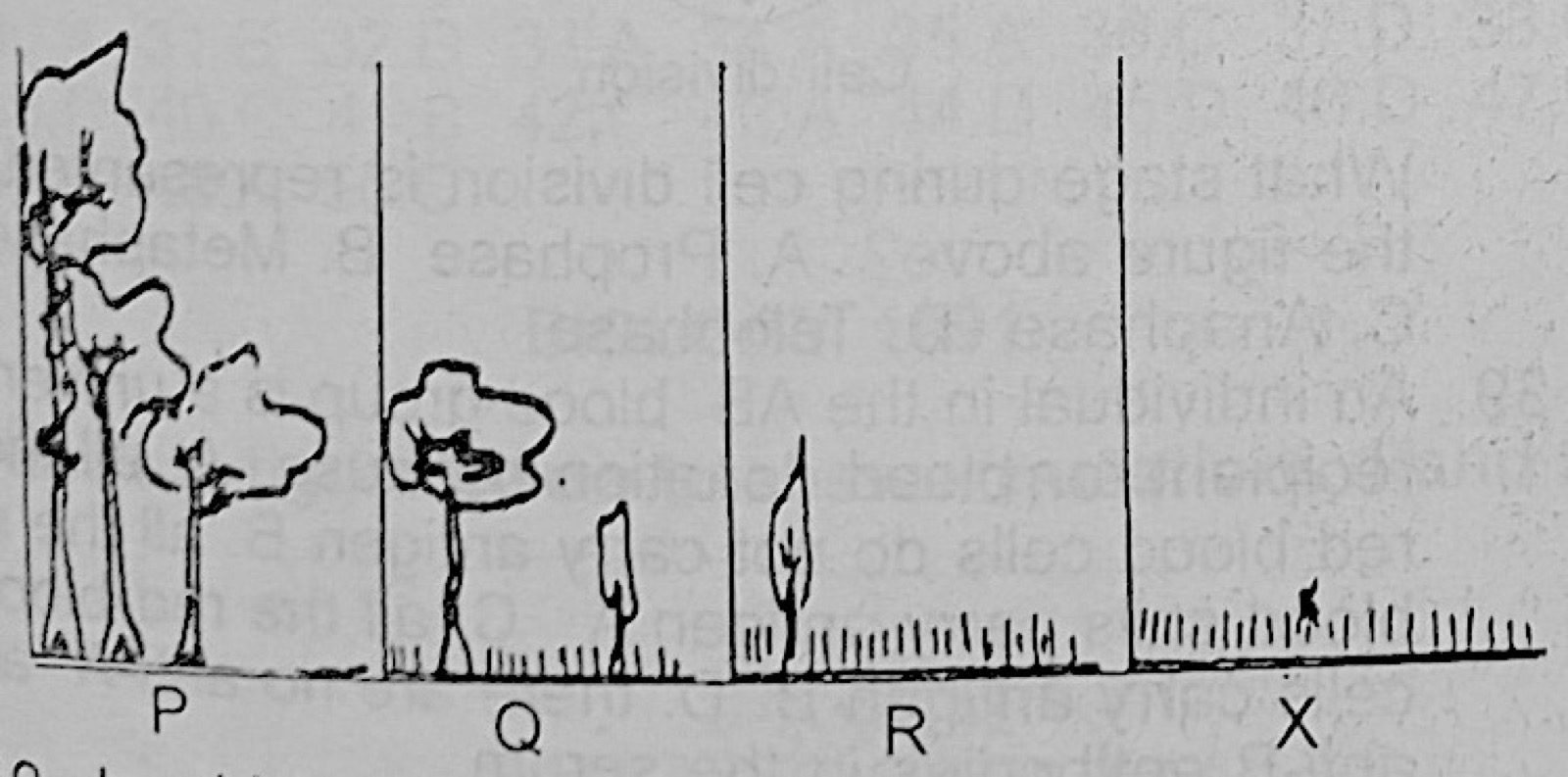
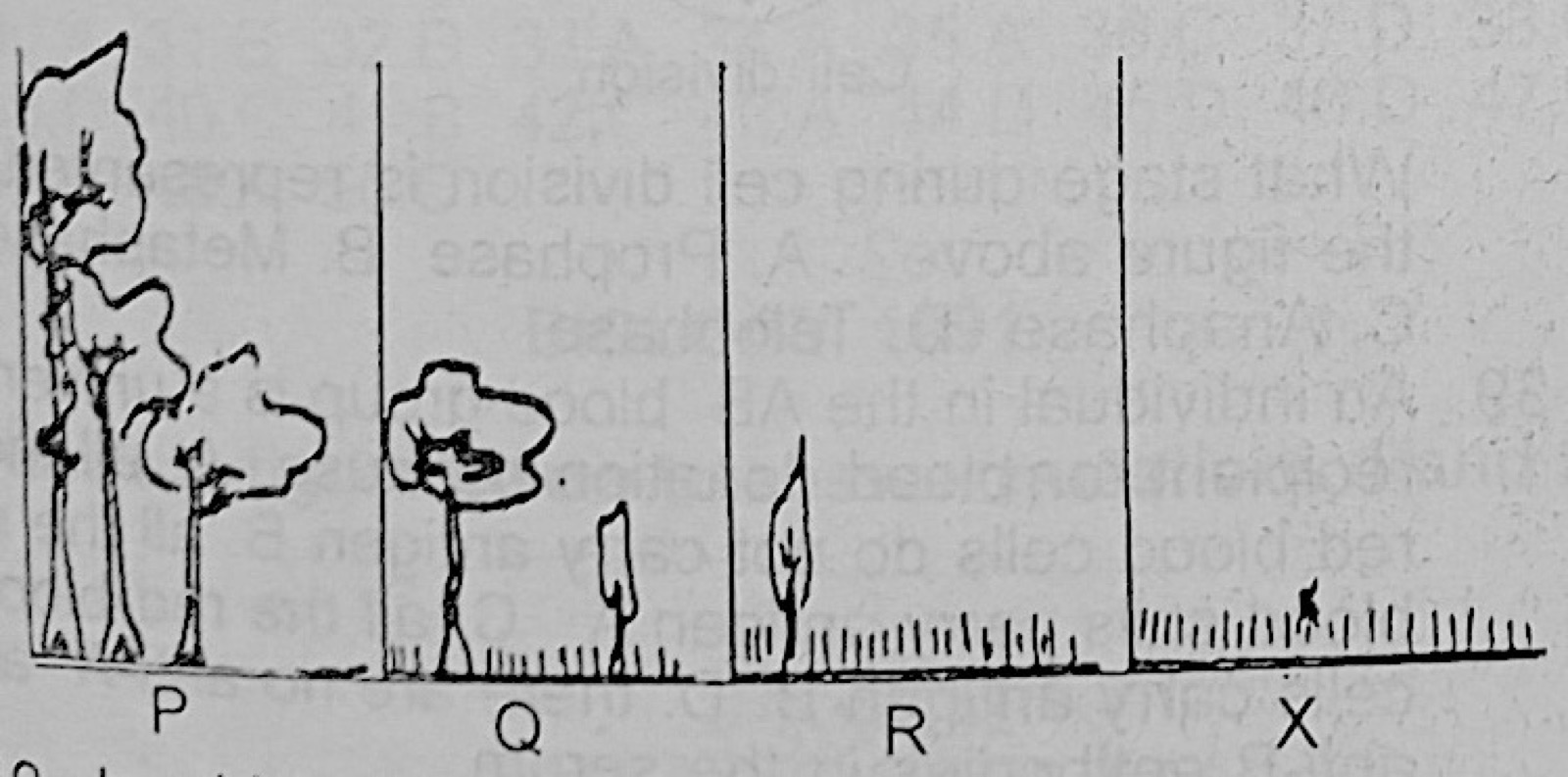
Question 49 Habitats and Biomes Use the figure (vegetation profiles P, Q, R and X) to answer: In which of the habitats will the plants show xeromorphic features most prominently?
A. X B. R C. P D. Q Show the answer and explanation Answer: A (X )
Explanation Profile X has only sparse, short grass, showing the driest habitat, so its plants need the most adaptations against water loss.
Open this question
Question 50 Habitats and Biomes Use the figure (vegetation profiles P, Q, R and X) to answer: Which ecological factor exerts the greatest influence on the structure of the profiles?
A. Topographic B. Edaphic C. Biotic D. Climatic Show the answer and explanation Answer: D (Climatic )
Explanation The change from forest to sparse grass follows falling rainfall, which is a climatic factor.
Open this question Sign up free for every JAMB Biology year, practice by topic and timed mocks.
Start practising free