Home › Past questions › JAMB › Biology › 1988 48 questions. Try each one, then open the answer to check yourself and read the explanation.
Sign up free to answer these questions on a CBT screen with a timer, then see your score and every answer explained.
Start practising free
Question 1 Cell Structure and Organisation The function of ribosomes in cells is
A. protein synthesis B. starch synthesis C. transport of materials D. lipid storage Show the answer and explanation Answer: A (protein synthesis )
Explanation Ribosomes are the sites where amino acids are joined together to make proteins.
Open this question
Question 2 Cell Structure and Organisation Which of the following structures is common to Euglena, white blood cell and Amoeba?
A. Vacuole B. Cell wall C. Cilia D. Cell membrane Show the answer and explanation Answer: D (Cell membrane )
Explanation Every living cell is bounded by a cell membrane. None of these three has a cell wall, and none has cilia.
Open this question
Question 3 Plant Kingdom The term 'Thallophyta' refers to
A. ferns and mosses B. algae and fungi C. mosses and liverworts D. fungi and ferns Show the answer and explanation Answer: B (algae and fungi )
Explanation Thallophytes have a simple body (thallus) not divided into true roots, stems and leaves; the group is made up of algae and fungi.
Open this question
Question 4 Reproduction in Animals The following organisms are hermaphrodites EXCEPT
A. snail B. Taenia C. Schistosoma D. Earthworm Show the answer and explanation Answer: C (Schistosoma )
Explanation Schistosoma (the blood fluke) has separate male and female worms, unlike most flatworms. Snails, tapeworms and earthworms carry both sex organs.
Open this question
Question 5 Animal Kingdom Parasitic forms are NOT found among
A. platyhelminthes B. nematodes C. molluscs D. annelids Show the answer and explanation Answer: C (molluscs )
Explanation Flatworms (tapeworm, liver fluke), roundworms (Ascaris) and annelids (leeches) all include parasites, but molluscs are free-living.
Open this question
Question 6 Evolution Which of the following sets of organisms represents the correct trend from simple to complex structural organization? 1 Mollusca 2 Platyhelminthes 3 Nematoda 4 Protozoa
A. 4 → 1 → 2 → 3 B. 4 → 3 → 2 → 1 C. 4 → 2 → 1 → 3 D. 4 → 2 → 3 → 1 Show the answer and explanation Answer: D (4 → 2 → 3 → 1 )
Explanation Protozoa are single-celled, flatworms have three cell layers but no body cavity, roundworms have a simple body cavity, and molluscs have organ systems and a true coelom.
Open this question
Question 7 Viruses, Monera, Protista and Fungi Spirogyra, Euglena and Chlamydomonas share many characteristics EXCEPT
A. nutrition B. reproduction C. mobility D. irritability Show the answer and explanation Answer: C (mobility )
Explanation All three photosynthesise and respond to stimuli, but Spirogyra is a filament that cannot swim, while Euglena and Chlamydomonas move with flagella.
Open this question
Question 8 Plant Kingdom The prothallus of a fern is equivalent to the gametophyte generation of a moss because it
A. is inconspicuous B. has rhizoids C. bears sexual organs D. is multicellular Show the answer and explanation Answer: C (bears sexual organs )
Explanation The gametophyte is the generation that carries the sex organs (antheridia and archegonia), and in ferns these are found on the prothallus.
Open this question
Question 9 Viruses, Monera, Protista and Fungi What is the function of trichocyst in Paramecium?
A. Movement B. Defence C. Excretion D. Reproduction Show the answer and explanation Answer: B (Defence )
Explanation Trichocysts are tiny threads that Paramecium shoots out when disturbed, to defend itself and to anchor itself.
Open this question
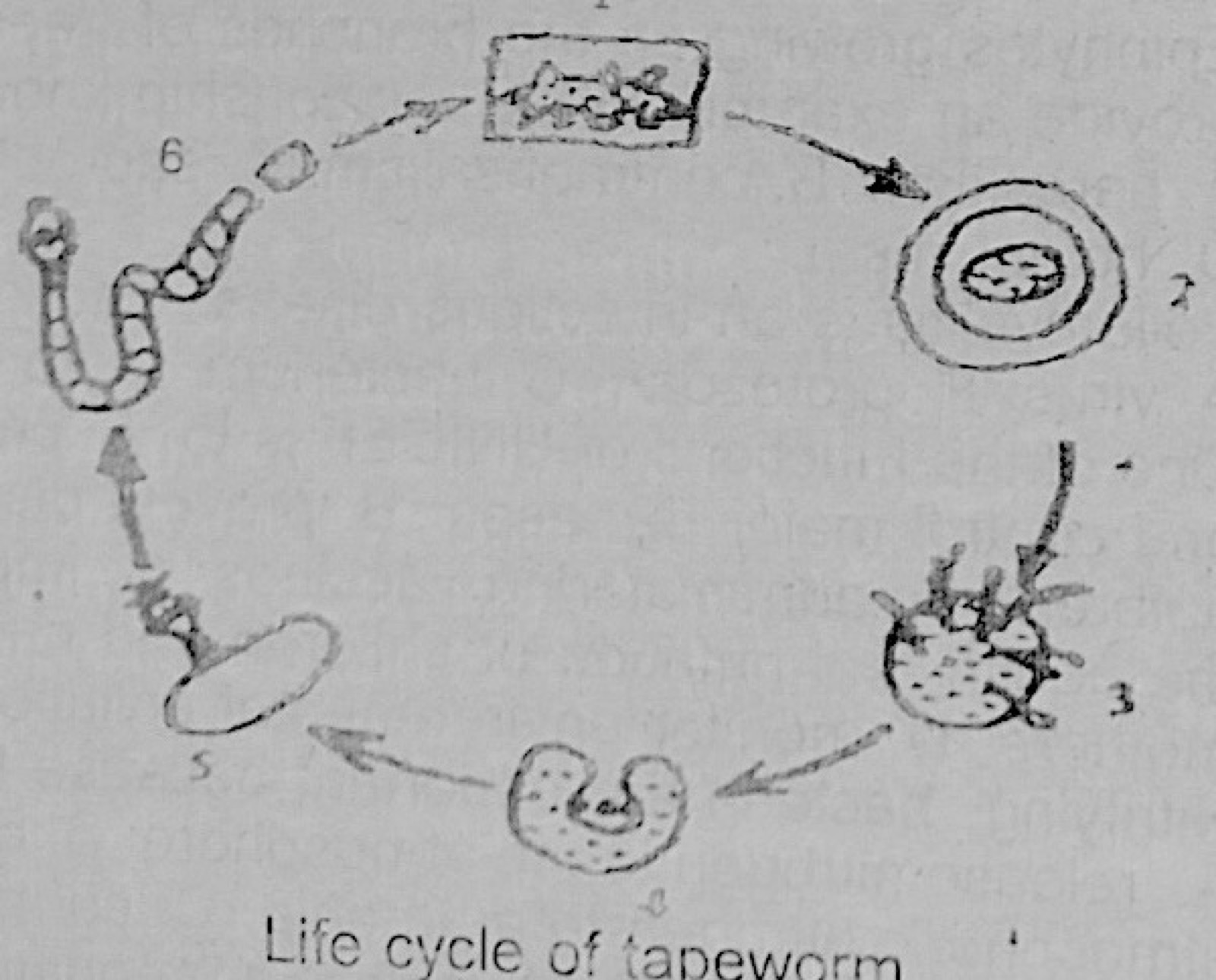
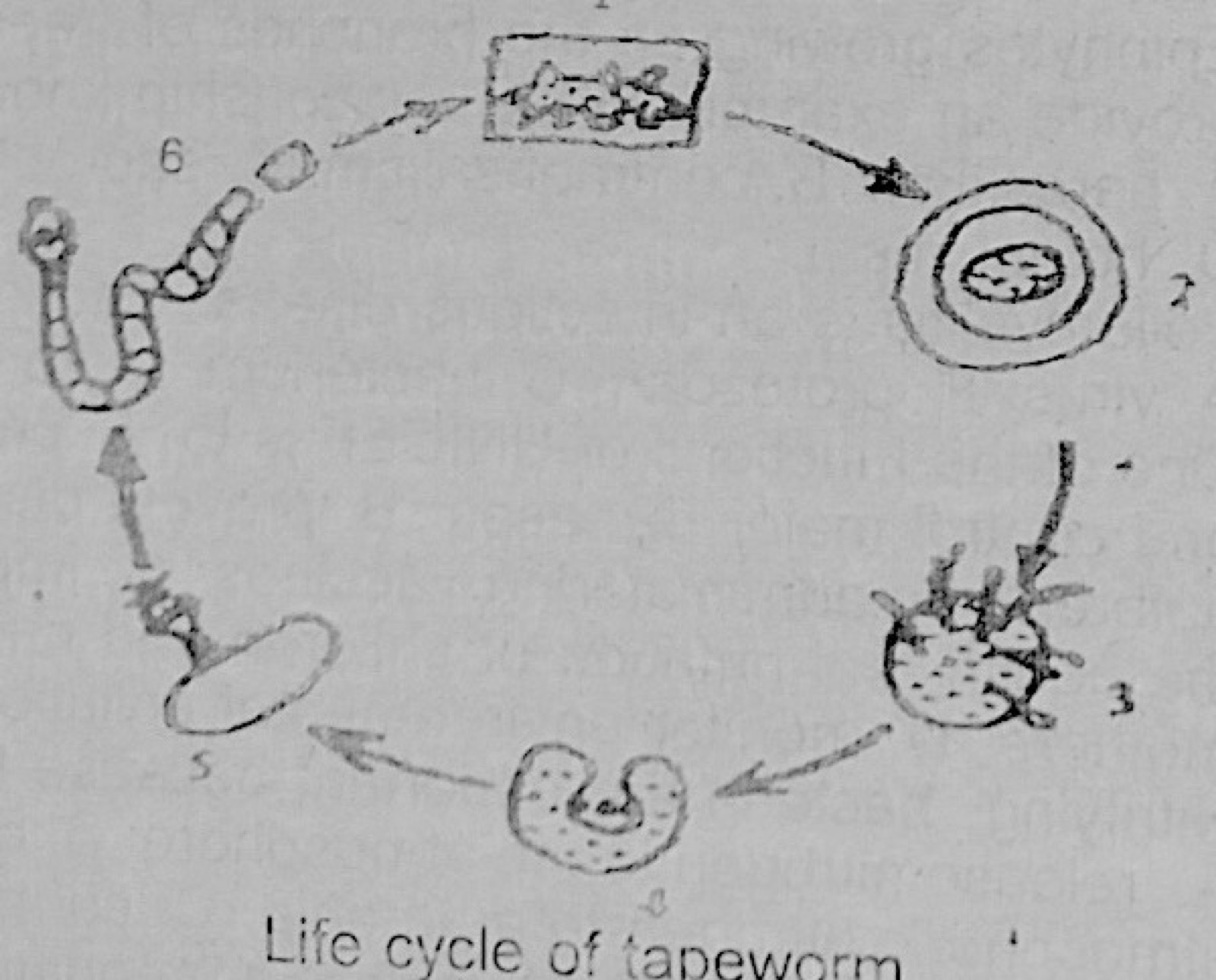
Question 10 Animal Kingdom Use the diagram (life cycle of tapeworm) to answer: At which stage in this cycle can man be infected?
A. 2 B. 4 C. 5 D. 6 Show the answer and explanation Answer: B (4 )
Explanation Man is infected by eating undercooked pork containing the bladder worm (cysticercus), the stage labelled 4.
Open this question
Question 11 Animal Kingdom Use the diagram (life cycle of tapeworm) to answer: Which stage is found in the muscle of an infected pig?
A. 3 B. 4 C. 5 D. 6 Show the answer and explanation Answer: B (4 )
Explanation The six-hooked embryo (3) bores out of the pig's gut and settles in the muscle, where it becomes the bladder worm (4); so stage 4 is what is found in the muscle.
Open this question
Question 12 Animal Nutrition The long and coiled intestine of a young tadpole is an adaptation to its
A. herbivorous diet B. carnivorous diet C. aquatic habitat D. insectivorous habit Show the answer and explanation Answer: A (herbivorous diet )
Explanation Young tadpoles feed on plant material, which is slow to digest, so they need a long gut.
Open this question
Question 13 Respiration Lung books are used for respiration in
A. spiders B. insects C. millipedes D. snails Show the answer and explanation Answer: A (spiders )
Explanation Spiders and scorpions breathe with lung books; insects and millipedes use tracheae.
Open this question
Question 14 Animal Kingdom Insects and millipedes have many features in common EXCEPT
A. exoskeleton B. jointed appendages C. compound eyes D. segmented body Show the answer and explanation Answer: C (compound eyes )
Explanation Both are arthropods with an exoskeleton, jointed legs and a segmented body, but millipedes have only simple eyes (ocelli), not compound eyes.
Open this question
Question 15 Support and Movement The major function of the swim-bladder in fishes is
A. breathing B. buoyancy C. swimming D. diving Show the answer and explanation Answer: B (buoyancy )
Explanation The swim-bladder is a gas-filled sac that the fish adjusts so it can float at any depth without effort.
Open this question
Question 16 Structure of Flowering Plants Which of the following statements gives the BEST description of bark?
A. Tissues outside the vascular cambium B. Cork-like tissues found only in stems C. Brown tissues never found in primary growth D. Cork-like tissues of old trees Show the answer and explanation Answer: A (Tissues outside the vascular cambium )
Explanation Bark is everything outside the vascular cambium: secondary phloem, cortex and the cork layers.
Open this question
Question 17 Structure of Flowering Plants In the transverse section of the leaf of maize vascular bundles are arranged in
A. a row B. one circle C. alternate positions D. two circles Show the answer and explanation Answer: A (a row )
Explanation A maize leaf has parallel veins, so in a cross-section the vascular bundles lie side by side in a single row.
Open this question
Question 18 Animal Nutrition If an animal has diastema, it would NOT possess
A. incissors B. cannines C. premolars D. molars Show the answer and explanation Answer: B (cannines )
Explanation A diastema is the gap in the jaw of herbivores such as rabbits and goats where canine teeth would be.
Open this question
Question 19 Animal Nutrition If the gall bladder of a mammal is damaged, which of the following will be most seriously affected?
A. Glycolysis B. Digestion of starch C. Digestion of fats and oils D. Digestion of proteins Show the answer and explanation Answer: C (Digestion of fats and oils )
Explanation The gall bladder stores bile, which emulsifies fats so that lipase can digest them.
Open this question
Question 20 Animal Nutrition Which of the following will be first digested if ingested at the same time?
A. Cooked beans B. Cooked rice C. Cod liver oil D. Roasted beef Show the answer and explanation Answer: B (Cooked rice )
Explanation Rice is mostly starch, and starch digestion starts in the mouth with salivary amylase; protein and fat digestion start later in the gut.
Open this question
Question 21 Transport in Plants If the phloem of a healthy plant is killed by heat treatment the
A. upward movement of salts will cease B. food manufacture in the leaves will accumulate C. whole plant will die immediately D. leaves of the plant will become yellow Show the answer and explanation Answer: B (food manufacture in the leaves will accumulate )
Explanation Phloem carries food made in the leaves to the rest of the plant; if it is killed, the food stays and builds up in the leaves.
Open this question
Question 22 Respiration In the mammalian respiratory system, exchange of gases occurs in the
A. lungs B. bronchi C. bronchioles D. alveoli Show the answer and explanation Answer: D (alveoli )
Explanation The alveoli have thin, moist walls surrounded by capillaries, which is where oxygen and carbon dioxide are exchanged.
Open this question
Question 24 Excretion In the kidney, the malpighian corpuscle is located in the
A. medulla B. hilium C. cortex D. pelvis Show the answer and explanation Answer: C (cortex )
Explanation The Malpighian corpuscle (glomerulus with Bowman's capsule) lies in the outer region, the cortex.
Open this question
Question 25 Excretion The skin, through the sweat glands, functions as
A. an excretory organ B. a respiratory organ C. a sensory organ D. a protective organ Show the answer and explanation Answer: A (an excretory organ )
Explanation Sweat glands remove water, salts and a little urea from the body, so the skin acts as an excretory organ.
Open this question
Question 26 Support and Movement Parenchyma cells serve as supporting tissue when they
A. contain chloroplasts B. have crystals C. become flaccid D. become turgid Show the answer and explanation Answer: D (become turgid )
Explanation When parenchyma cells are full of water (turgid) they press against each other and hold soft parts of the plant firm.
Open this question
Question 27 Plant Responses and Hormones Taxism differs from tropism because
A. the whole organism is affected B. it is a directional movement C. it is a response to multi-directional stimuli D. part of the organism is affected Show the answer and explanation Answer: A (the whole organism is affected )
Explanation In a taxis the whole organism moves towards or away from a stimulus; in a tropism only part of a plant grows towards or away from it.
Open this question
Question 28 Reproduction in Plants A dry dehiscent fruit which breaks up into one-seeded parts is a
A. schizocarp B. capsule C. follicle D. legume Show the answer and explanation Answer: A (schizocarp )
Explanation A schizocarp splits into one-seeded pieces called mericarps, as in Desmodium.
Open this question
Question 29 Reproduction in Plants Airspaces are characteristic of seeds or fruits dispersed by
A. birds B. water C. wind D. explosive mechanism Show the answer and explanation Answer: B (water )
Explanation Air spaces make fruits like the coconut light enough to float, so they are carried by water.
Open this question
Question 30 Reproduction in Plants In vegetation propagation, which of the following requires part of another plant to develop?
A. Scion B. Bulb C. Rhizome D. Sucker Show the answer and explanation Answer: A (Scion )
Explanation A scion is a shoot that is grafted onto the stock (rooted part) of another plant, so it cannot grow on its own.
Open this question
Question 31 Reproduction in Plants Which of these plant groups are normally propagated by asexual means?
A. Banana, yam, pineapple and cassava B. Yam, cassava, rubber and banana C. Yam, cassava, orange and banana D. Banana, cashew, coffee and pineapple Show the answer and explanation Answer: A (Banana, yam, pineapple and cassava )
Explanation Banana (suckers), yam (tubers), pineapple (crowns/suckers) and cassava (stem cuttings) are all grown from vegetative parts; rubber, orange, cashew and coffee are usually raised from seed or budding.
Open this question
Question 32 Reproduction in Animals In a mammal, the placenta performs functions similar to those to the
A. lungs kidneys and digestive system B. lungs, heart and nervous system C. liver, intestines and reproductive system D. intestines, heart and digestive system Show the answer and explanation Answer: A (lungs kidneys and digestive system )
Explanation Through the placenta the foetus gets oxygen (like lungs), gets rid of wastes (like kidneys) and receives digested food (like the gut).
Open this question
Question 33 Growth and Development The radicle of a bean seedling grows most rapidly in the region
A. of the root tip B. just above the root tip C. just around the root tip D. just below the root tip Show the answer and explanation Answer: B (just above the root tip )
Explanation The region of elongation lies just behind (above) the root tip, where newly formed cells grow longer.
Open this question
Question 34 Sense Organs The main function of the choroid is
A. protection of the eye ball B. transmission of light C. supply of nutrients to tissues of the eye D. converging light Show the answer and explanation Answer: C (supply of nutrients to tissues of the eye )
Explanation The choroid is full of blood vessels that nourish the eye; its dark pigment also stops reflection.
Open this question
Question 35 Nervous Coordination What part of the central nervous system is concerned with answering an examination question
A. Cerebrum B. Cerebellum C. Medulla oblongata D. Spinal cord Show the answer and explanation Answer: A (Cerebrum )
Explanation Thinking, memory and reasoning are controlled by the cerebrum.
Open this question
Question 36 Mendelian Inheritance If a dark-skinned woman (Bb) marries an albino man (bb) and they have four children, how many of the children will be dark-skinned?
A. 3 B. 2 C. 1 D. 0 Show the answer and explanation Answer: B (2 )
Explanation Bb × bb gives Bb and bb in equal numbers, so half of four children, 2, are expected to be dark-skinned.
Open this question
Question 37 Mendelian Inheritance A red-coloured flower when crossed with a white-coloured one produced pink flowers. This is an example of
A. complete dominance B. blending inheritance C. interaction of genes D. back crossing Show the answer and explanation Answer: B (blending inheritance )
Explanation Neither colour is dominant, so the offspring show a mix of both (pink); this is called incomplete dominance or blending.
Open this question
Question 38 Habitats and Biomes The turbidity of a pond can be measured using the
A. anaemometer B. secchi disc C. theodolite D. hydrometer Show the answer and explanation Answer: B (secchi disc )
Explanation A Secchi disc is lowered into the water until it disappears; the depth shows how cloudy (turbid) the water is.
Open this question
Question 40 Animal Nutrition If an organism obtains its food by means of haustoria, it is said to be
A. holophytic B. heterophytic C. saprophytic D. parasitic Show the answer and explanation Answer: D (parasitic )
Explanation Haustoria are special roots that a parasitic plant like dodder pushes into its host to suck out food.
Open this question
Question 41 Ecological Associations Which of the following relationships involves only one organism?
A. Saprophytism B. Commensalism C. Parasitism D. Symbiosis Show the answer and explanation Answer: A (Saprophytism )
Explanation A saprophyte feeds on dead matter on its own; the other relationships all involve two living organisms.
Open this question
Question 42 Habitats and Biomes Which of the following has the greatest influence on the distribution of animals in marine and fresh water habitats?
A. pH B. Salinity C. Water current D. Turbidity Show the answer and explanation Answer: B (Salinity )
Explanation The main difference between sea water and fresh water is salt content, and most animals can only live within a narrow salinity range.
Open this question
Question 43 Habitats and Biomes Which of these groups of animals is likely to be found in fresh water?
A. Blood worm, pond skater and scorpion B. Blood worm, pond skater and dragonfly larva C. Pond skater, scorpion and dragonfly larva D. Pond skater, blood worm and ant-lion Show the answer and explanation Answer: B (Blood worm, pond skater and dragonfly larva )
Explanation Blood worms, pond skaters and dragonfly nymphs all live in ponds; scorpions and ant-lions live on land.
Open this question
Question 44 Habitats and Biomes One of the characteristics of plants in the savanna is the
A. possession of thin, smooth barks B. possession of large tap roots C. production of seedlings on mother plant D. possession of thick, flaky barks Show the answer and explanation Answer: D (possession of thick, flaky barks )
Explanation Savanna trees have thick, corky bark that protects them from bush fires and dry weather.
Open this question
Question 45 Microorganisms and Health Which of the following diseases can be contracted in areas with fast flowing rivers?
A. Schistosomiasis B. Elephantiasis C. Syphilis D. Onchocerciasis Show the answer and explanation Answer: D (Onchocerciasis )
Explanation Onchocerciasis (river blindness) is spread by the blackfly Simulium, which breeds in fast-flowing rivers.
Open this question
Question 46 Pollution Which of the following causes pollution?
A. Consumption of canned drinks B. The addition of fertilizer to farmland C. Respiration of living organisms D. Burning of refuse Show the answer and explanation Answer: D (Burning of refuse )
Explanation Burning refuse releases smoke, soot and poisonous gases into the air.
Open this question
Question 47 Soil The mineral nutrient that is most bound to the soil is
A. phosphorus B. calcium C. iron D. potassium Show the answer and explanation Answer: A (phosphorus )
Explanation Phosphate ions combine tightly with soil particles and with iron, aluminium and calcium, so phosphorus barely moves in soil.
Open this question
Question 48 Soil The mineral nutrient that easily gets leached out of the soil is
A. phosphorus B. calcium C. magnesium D. nitrate Show the answer and explanation Answer: D (nitrate )
Explanation Nitrate ions are very soluble and are not held by soil particles, so rain washes them down easily.
Open this question
Question 49 Soil Most commercial fertilizers are rich in salts of
A. sodium, iron and calcium B. nitrogen, phosphorus and potassium C. iron, copper and nitrogen D. calcium, sodium and phosphorus Show the answer and explanation Answer: B (nitrogen, phosphorus and potassium )
Explanation Common fertilizers are NPK fertilizers, supplying nitrogen, phosphorus and potassium.
Open this question
Question 50 Nutrient Cycling Dead plants and animals are decomposed by bacteria and fungi into
A. nitrates B. nitrites C. amino acids D. ammonia Show the answer and explanation Answer: D (ammonia )
Explanation Decomposers break down proteins in dead bodies and release ammonia (ammonification); nitrifying bacteria later change it to nitrites and nitrates.
Open this question Sign up free for every JAMB Biology year, practice by topic and timed mocks.
Start practising free