Home › Past questions › JAMB › Biology › 1986 48 questions. Try each one, then open the answer to check yourself and read the explanation.
Sign up free to answer these questions on a CBT screen with a timer, then see your score and every answer explained.
Start practising free
Question 1 Viruses, Monera, Protista and Fungi Viruses are regarded as non-living because they
A. can neither reproduce asexually nor sexually B. cannot survive in their respective environments C. do not possess characteristics that can be transmitted from one generation to the next D. can neither respire nor excrete. Show the answer and explanation Answer: D (can neither respire nor excrete. )
Explanation Outside a host cell a virus carries out no life processes such as respiration or excretion; it can even be crystallised like a chemical.
Open this question
Question 2 Plant Kingdom Which of the following pairs are fully adapted to terrestrial life?
A. Ferns and algae B. Ferns and mosses C. Bryophytes and flowering plants D. Flowering plants and conifers. Show the answer and explanation Answer: D (Flowering plants and conifers. )
Explanation Conifers and flowering plants have seeds, pollen tubes and good vascular tissue, so they do not need water for fertilisation. Mosses and ferns still need water for their male gametes to swim.
Open this question
Question 3 Animal Kingdom Which of these animals is radially symmetrical?
A. Squid B. Hydra C. Snail D. Cockroach Show the answer and explanation Answer: B (Hydra )
Explanation Hydra, a coelenterate, is radially symmetrical: its body can be cut into similar halves along many planes through its central axis.
Open this question
Question 4 Plant Kingdom Which of the following has cones?
A. Angiosperm B. Gymnosperm C. Pteridophyte D. Bryophyte Show the answer and explanation Answer: B (Gymnosperm )
Explanation Gymnosperms such as pines bear their seeds on cones instead of inside fruits.
Open this question
Question 5 Animal Kingdom For effective functioning of a bird's quill feather, hooks fit on the ridges of the
A. vane B. rachis C. barbules D. barbs Show the answer and explanation Answer: C (barbules )
Explanation The barbules on one side of each barb carry tiny hooks that catch on the ridged barbules of the next barb, locking the vane into a smooth surface.
Open this question
Question 6 Viruses, Monera, Protista and Fungi Which of the following is NOT true of Spirogyra?
A. Reproduces by conjugation B. Reproduces by fragmentation C. Consists of branched filaments D. Consists of unbranched filaments. Show the answer and explanation Answer: C (Consists of branched filaments )
Explanation Spirogyra is made of unbranched filaments of cells. It reproduces sexually by conjugation and asexually by fragmentation.
Open this question
Question 8 Reproduction in Animals Incomplete metamorphosis occurs in the
A. butterfly B. grasshopper C. mosquito D. housefly Show the answer and explanation Answer: B (grasshopper )
Explanation The grasshopper goes from egg to nymph to adult, with no larva or pupa. Butterflies, mosquitoes and houseflies have complete metamorphosis.
Open this question
Question 9 Animal Kingdom Fishes are cold-blooded because their body temperature is
A. constantly low B. Constantly high C. dependent on that of their surroundings D. regulated at will. Show the answer and explanation Answer: C (dependent on that of their surroundings )
Explanation Cold-blooded (poikilothermic) animals cannot keep their own body temperature steady; it rises and falls with the temperature of the surroundings.
Open this question
Question 10 Behaviour When the original king and queen of termites die, they are replaced by
A. the king and queen of another colony B. some adult reproductives from the same colony C. some adult workers which are specially fed to breed D. developing nymphs nurtured as secondary reproductives. Show the answer and explanation Answer: D (developing nymphs nurtured as secondary reproductives. )
Explanation When the king and queen die, some nymphs in the colony are fed and develop into secondary reproductives. These take over egg-laying and keep the colony going.
Open this question
Question 11 Animal Kingdom The male cockroach differs from the female by having
A. mandibles B. a pair of styles C. spiracles D. a pair of cerci. Show the answer and explanation Answer: B (a pair of styles )
Explanation Both sexes have mandibles, spiracles and cerci, but only the male has a pair of short anal styles at the tip of the abdomen.
Open this question
Question 12 Support and Movement The fins making up the limbs of the bony fish are
A. caudal and ventral B. ventral and pelvic C. pelvic and pectoral D. pectoral and dorsal. Show the answer and explanation Answer: C (pelvic and pectoral )
Explanation The paired pectoral and pelvic fins match the fore and hind limbs of land vertebrates.
Open this question
Question 13 Structure of Flowering Plants The stem differs from the root in having the xylem and phloem strands
A. on the same radii B. scattered C. on alternate radii D. towards the pith. Show the answer and explanation Answer: A (on the same radii )
Explanation In a stem each vascular bundle has its xylem and phloem on the same radius (phloem outside, xylem inside). In a root they alternate on different radii.
Open this question
Question 14 Photosynthesis and Plant Nutrition Oxygen liberated during photosynthesis has been demonstrated to come from
A. carbondioxide B. air C. water D. chlorophyll. Show the answer and explanation Answer: C (water )
Explanation Experiments with water labelled with heavy oxygen showed that the oxygen released comes from the splitting of water (photolysis).
Open this question
Question 15 Photosynthesis and Plant Nutrition Which of these is a trace element?
A. Iron B. copper C. Calcium D. Sulphur Show the answer and explanation Answer: B (copper )
Explanation Copper is needed only in tiny (trace) amounts. Calcium and sulphur are major elements, needed in much larger quantities.
Open this question
Question 16 Food Substances and Enzymes The main organic substances found in the human body are
A. carbohydrates, proteins and salts B. salts, fats and proteins C. fats, carbohydrates and proteins D. salts, fats and carbohydrates Show the answer and explanation Answer: C (fats, carbohydrates and proteins )
Explanation Carbohydrates, fats and proteins are organic (carbon) compounds. Salts are inorganic.
Open this question
Question 17 Food Substances and Enzymes Which of the following elements is essential for the formation of haemoglobin?
A. Sodium B. Potassium C. Calcium D. iron Show the answer and explanation Answer: D (iron )
Explanation Each haemoglobin molecule contains iron, which binds the oxygen. Lack of iron causes anaemia.
Open this question
Question 18 Food Substances and Enzymes The severe deficiency of vitamin C leads to
A. kwashiorkor B. beriberi C. pellagra D. scurvy. Show the answer and explanation Answer: D (scurvy. )
Explanation Lack of vitamin C causes scurvy, with bleeding gums and slow healing of wounds.
Open this question
Question 19 Food Substances and Enzymes In addition to the high calories derived from fats and oils, they are
A. used in producing new cells B. necessary for enzyme formation C. used as insulators from cold D. required for growth. Show the answer and explanation Answer: C (used as insulators from cold )
Explanation Fat stored under the skin is a poor conductor of heat, so it insulates the body against cold.
Open this question
Question 20 Food Substances and Enzymes The extract from a food substance reacting with sodium hydroxide and copper sulphate solutions will produce violet to purple coloration if
A. fats are present B. carbohydrate is present C. protein is present D. reducing sugar is present. Show the answer and explanation Answer: C (protein is present )
Explanation This is the Biuret test: a violet or purple colour shows protein.
Open this question
Question 21 Animal Nutrition The three important organs that are situated close to the stomach are
A. kidney, liver and gall bladder B. pancreas, liver and kidney C. liver, kidney and spleen D. gall bladder, pancreas and spleen. Show the answer and explanation Answer: D (gall bladder, pancreas and spleen. )
Explanation The gall bladder (under the liver), the pancreas (in the loop below it) and the spleen (beside it) all lie next to the stomach. The kidneys are at the back of the abdomen.
Open this question
Question 22 Animal Nutrition Evidence that a tooth is a living part of the mammalian body can be found within the
A. gum B. pulp cavity C. cement D. enamel. Show the answer and explanation Answer: B (pulp cavity )
Explanation The pulp cavity contains blood vessels and nerves, which keep the tooth alive.
Open this question
Question 23 Transport in Animals Blood circulation in a mammal is said to be double because
A. it passes twice through the heart in a complete circuit B. it moves in both arteries and veins C. it circulates in both the heart and other organs D. the heart contain auricles and ventricles. Show the answer and explanation Answer: A (it passes twice through the heart in a complete circuit )
Explanation On one full trip round the body, blood passes through the heart twice: once on the way to the lungs and once on the way to the rest of the body.
Open this question
Question 24 Transport in Plants Which is the correct order of water loss from the leaf? 1 Mesophyll 2 Veins 3 Substomatal cavity 4 Stomata
A. 3 → 2 → 1 → 4 B. 2 → 3 → 1 → 4 C. 2 → 1 → 3 → 4 D. 1 → 2 → 3 → 4. Show the answer and explanation Answer: C (2 → 1 → 3 → 4 )
Explanation Water arrives in the veins, moves into the mesophyll cells, evaporates into the substomatal air space and diffuses out through the stomata.
Open this question
Question 25 Transport in Animals The aperture between the left auricle and the left ventricle is guarded by the
A. auricular valve B. tricuspid valve C. ventricular valve D. bicuspid valve. Show the answer and explanation Answer: D (bicuspid valve. )
Explanation The bicuspid (mitral) valve, with two flaps, lies between the left auricle and left ventricle. The tricuspid valve is on the right side.
Open this question
Question 26 Transport in Plants A major limitation in the use of the potometer for measuring the rate of transpiration is that
A. it is made of breakable glass material B. it measures the rate of water intake C. it measures the rate of water loss through the stem only D. the movement of the air bubble in the potometer cannot be timed accurately. Show the answer and explanation Answer: B (it measures the rate of water intake )
Explanation A potometer measures how fast the shoot takes up water. Some of that water is used in photosynthesis or kept in the cells, so uptake is only an estimate of transpiration.
Open this question
Question 27 Respiration Which of the following statements is NOT correct with respect to inhalation in mammals? The
A. intercostal muscles contract B. diaphragm is raised C. ribs are raised D. pressure of the thoracic cavity decreases. Show the answer and explanation Answer: B (diaphragm is raised )
Explanation During inhalation the diaphragm muscles contract and the diaphragm flattens (is lowered), making the chest cavity larger.
Open this question
Question 28 Respiration The equation that can be used to summarize the process of anaerobic breakdown of sugar is
A. C6 H12 O6 → 2C2 H5 OH + 2CO2 B. 6CO2 + 6H2 O → C6 H12 O6 + 6O2 C. C6 H12 O6 + 6O2 → 6CO2 + 6H2 O + energy D. C6 H12 O6 → 2C2 H5 OH + 2CO2 + energy. Show the answer and explanation Answer: D (C6 H12 O6 → 2C2 H5 OH + 2CO2 + energy. )
Explanation Anaerobic breakdown of glucose (as in yeast) gives ethanol and carbon dioxide and releases a little energy. B is photosynthesis and C is aerobic respiration.
Open this question
Question 29 Transport in Animals If a person is bitten by a snake on the leg, it is advisable for him to
A. keep moving so that the venom will ooze out with bleeding B. Wash the wound with water containing antiseptic C. bandage the wound so that germs do not get in through it D. keep still and apply a tourniquet above the wound. Show the answer and explanation Answer: D (keep still and apply a tourniquet above the wound. )
Explanation Keeping still slows the blood flow, and a band above the bite (between it and the heart) slows the spread of venom until medical help arrives.
Open this question
Question 30 Excretion Deamination occurs in the
A. kidney B. pancreas C. spleen D. liver. Show the answer and explanation Answer: D (liver. )
Explanation The liver removes the amino group from excess amino acids (deamination) and turns it into urea.
Open this question
Question 31 Homeostasis In the mammalian skin, melanin and keratin are contained in the
A. sebaceous gland B. sweat gland C. subcutaneous layer D. malpighian layer. Show the answer and explanation Answer: D (malpighian layer. )
Explanation The Malpighian (growing) layer of the epidermis contains the pigment melanin, and its cells become filled with keratin as they move up to form the horny layer.
Open this question
Question 32 Support and Movement Two main distinguishing features of the cervical vertebra are the presence of
A. short neural spine and vertebraterial canal B. prezygapophysis and cervical ribs C. large centrum and cervical ribs D. vertebraterial canal and large centrum. Show the answer and explanation Answer: A (short neural spine and vertebraterial canal )
Explanation Cervical vertebrae have a short neural spine and a vertebrarterial canal on each side through which the vertebral artery runs to the head.
Open this question
Question 33 Plant Responses and Hormones Nastic movement is
A. response to light stimulus B. non-directional C. directional D. response to internal stimulus. Show the answer and explanation Answer: B (non-directional )
Explanation Nastic movements, like the folding of Mimosa leaves, do not depend on the direction from which the stimulus comes.
Open this question
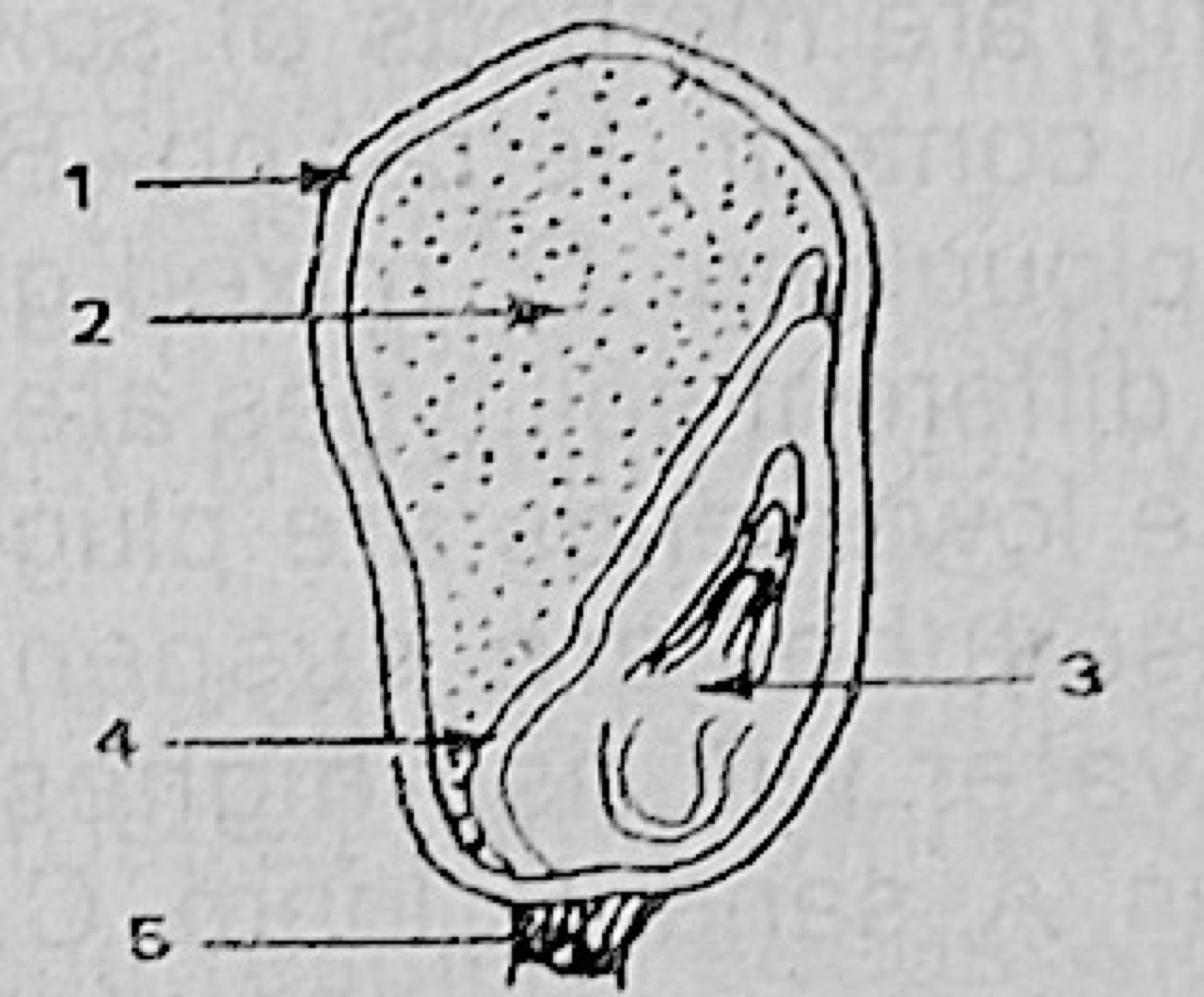
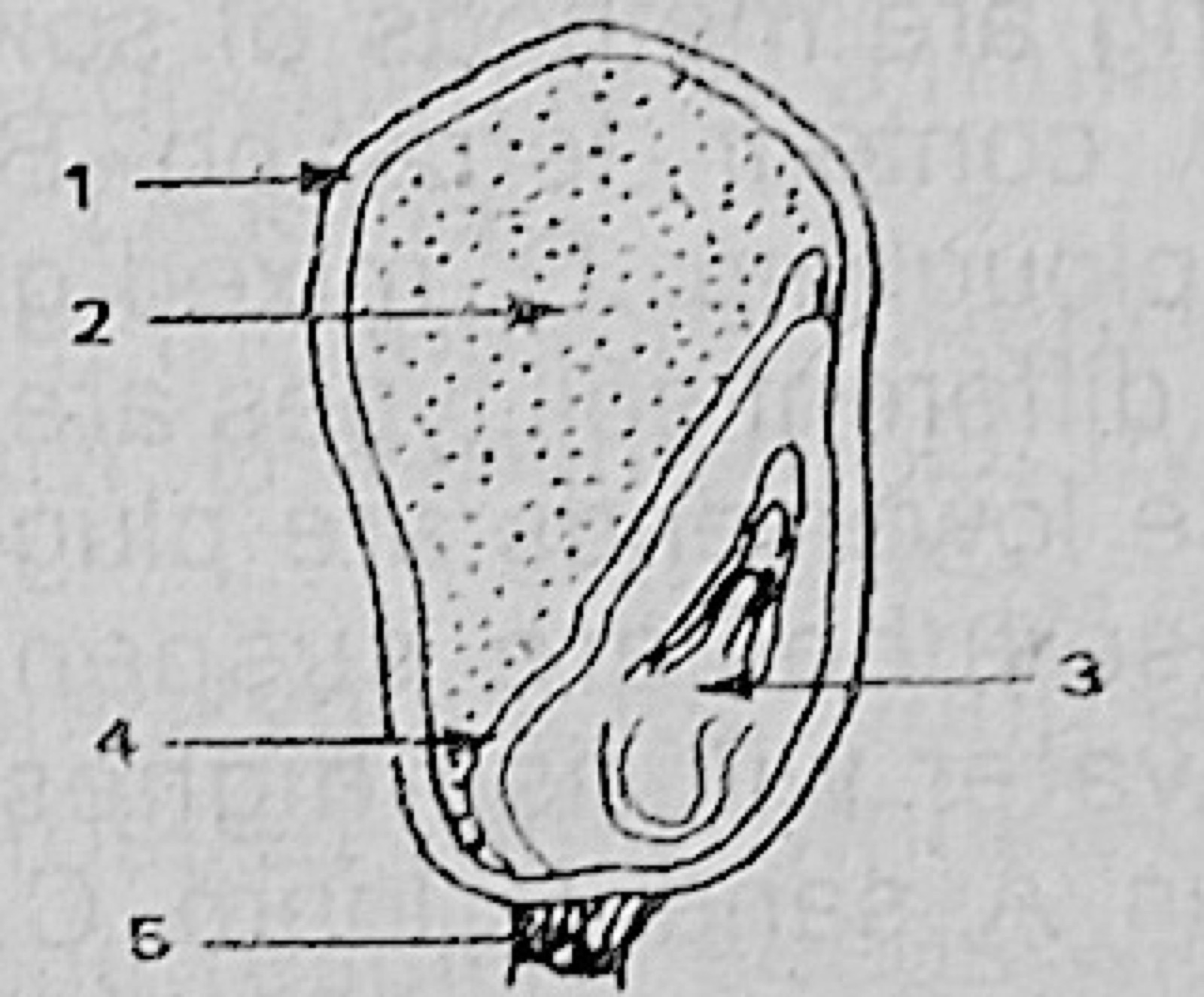
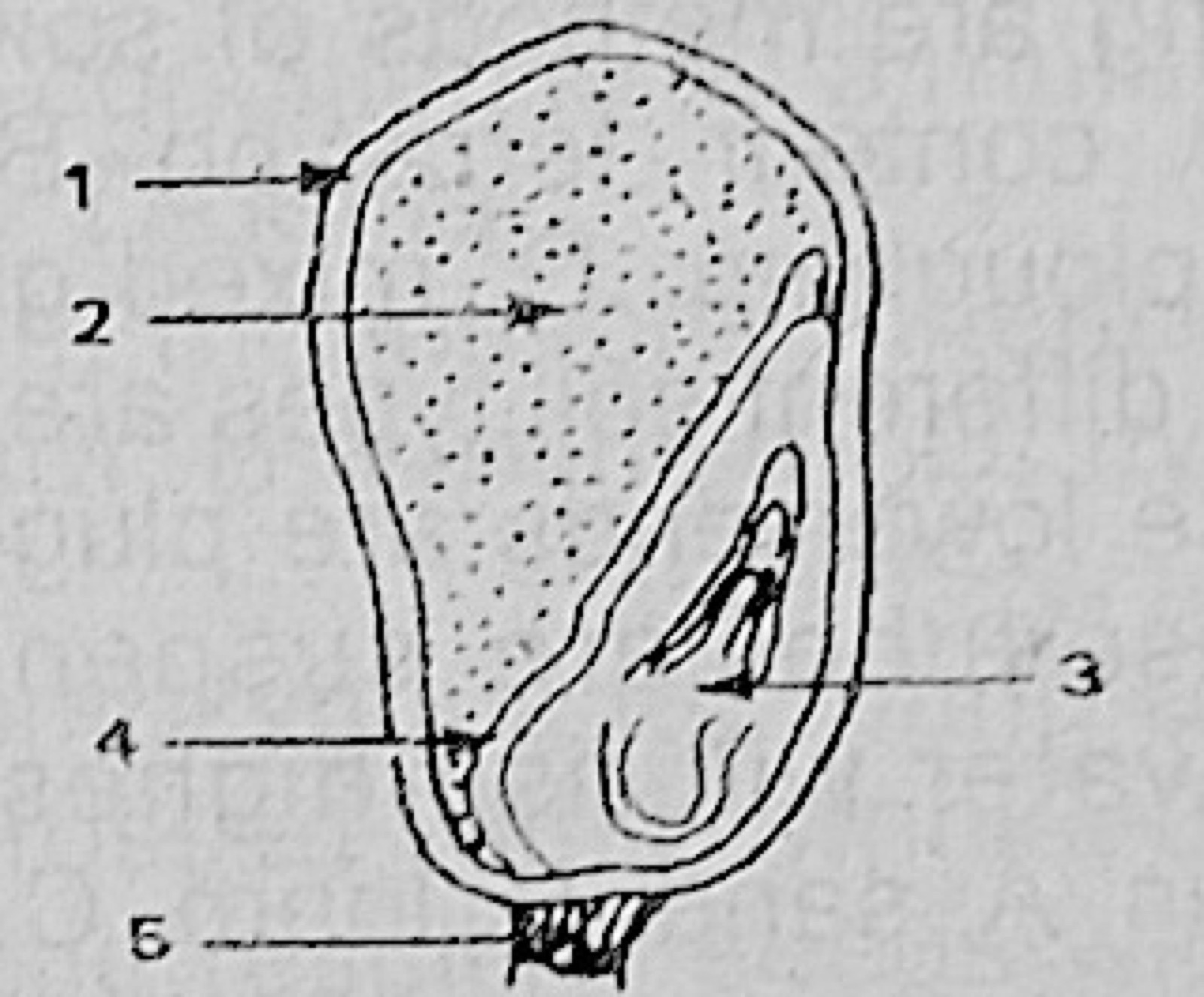
Question 34 Reproduction in Plants Use the figure (vertical section of a maize grain) to answer this question. Which of the labelled parts will develop into a new maize plant?
A. 2 B. 3 C. 4 D. 5. Show the answer and explanation Answer: B (3 )
Explanation Part 3 is the embryo (plumule and radicle), which grows into the new plant. Part 2 is the endosperm, the food store.
Open this question
Question 35 Reproduction in Plants Use the figure (vertical section of a maize grain) to answer this question. The structure labelled 1 is the
A. plumule B. radicle C. cell membrane D. seed coat. Show the answer and explanation Answer: D (seed coat. )
Explanation Part 1 is the thin outer covering of the grain, the seed coat fused with the fruit wall.
Open this question
Question 36 Reproduction in Plants Use the figure (vertical section of a maize grain) to answer this question. The main function of the structure labelled 2 is to
A. protect the inner parts of the seed B. nourish the embryo and the growing parts C. keep the inner parts moist D. maintain the shape of the seed Show the answer and explanation Answer: B (nourish the embryo and the growing parts )
Explanation Part 2 is the endosperm, which stores starch that feeds the embryo as it germinates.
Open this question
Question 37 Reproduction in Animals Gestation in mammals is the period
A. required for growth after birth B. between the formation of the foetus and birth C. of development from zygote to birth D. before the formation of the zygote. Show the answer and explanation Answer: C (of development from zygote to birth )
Explanation Gestation (pregnancy) runs from fertilisation, when the zygote forms, until the baby is born.
Open this question
Question 38 Mendelian Inheritance If a woman who is a carrier of sickle cell trait (AS) married a man who is a sickler (SS) and they had four children, how many of them would be normal?
A. Three B. Two C. One D. None. Show the answer and explanation Answer: B (Two )
Explanation AS × SS gives AS and SS in equal numbers. Of four children, about two would be AS carriers, who are healthy (normal), and two would be sicklers.
Open this question
Question 39 Variation Which of the following is an example discontinuous variation?
A. Skin coloration B. Left-handedness C. Body weight D. Height Show the answer and explanation Answer: B (Left-handedness )
Explanation Discontinuous variation puts people into clear groups with no in-betweens: you are either left-handed or not. Height, weight and skin colour vary continuously.
Open this question
Question 40 Hormonal Coordination The hormone which regulates the amount of glucose in the blood is called
A. adrenalin B. auxin C. insulin D. thyroxine. Show the answer and explanation Answer: C (insulin )
Explanation Insulin from the pancreas lowers blood glucose by making the liver and muscles take it up and store it as glycogen.
Open this question
Question 41 Plant Responses and Hormones An instrument that can be used to demonstrate phototropism and geotropism in plants is the
A. auxanometer B. potometer C. klinostat D. photometer. Show the answer and explanation Answer: C (klinostat )
Explanation A klinostat slowly rotates a plant so that every side gets the same stimulus. Comparing it with a still plant shows the effect of light or gravity.
Open this question
Question 42 Feeding Relationships and Energy Flow In an ecosystem, animals which feed directly on plants are called
A. secondary consumers B. primary consumers C. producers D. predators Show the answer and explanation Answer: B (primary consumers )
Explanation Herbivores, which eat producers directly, are the primary consumers.
Open this question
Question 43 Ecosystem and Ecological Factors In an agricultural ecosystem, the biotic component consists of
A. crops, pests and beneficial insects B. crops, temperature and humidity C. pests, beneficial insects and water D. crops, water and soil. Show the answer and explanation Answer: A (crops, pests and beneficial insects )
Explanation Biotic means living. Crops, pests and insects are all living; temperature, humidity, water and soil are abiotic.
Open this question
Question 44 Microorganisms and Health Which of these diseases CANNOT be prevented by immunization?
A. Poliomyelitis B. Tuberculosis C. Cholera D. Onchocerciasis. Show the answer and explanation Answer: D (Onchocerciasis. )
Explanation There are vaccines for polio, tuberculosis (BCG) and cholera, but none for onchocerciasis, which is controlled with drugs and by killing blackflies.
Open this question
Question 45 Habitats and Biomes Which of the following ecological factors are common to both terrestrial and aquatic habitats?
A. Rainfall, temperature, light and wind B. Salinity, rainfall, temperature and light C. Tides, wind, rainfall and altitude D. pH, salinity, rainfall and humidity. Show the answer and explanation Answer: A (Rainfall, temperature, light and wind )
Explanation Rainfall, temperature, light and wind act on land and water habitats alike. Salinity and tides are aquatic factors, and altitude and humidity are terrestrial ones.
Open this question
Question 46 Feeding Relationships and Energy Flow In a community, bacteria and fungi are referred to as
A. producers B. decomposers C. scavengers D. consumers. Show the answer and explanation Answer: B (decomposers )
Explanation Bacteria and fungi break down dead organisms and wastes, returning nutrients to the soil, so they are decomposers.
Open this question
Question 47 Microorganisms and Health The swollen shoot disease of cocoa tree is caused by a
A. virus B. fungus C. bacterium D. protozoan Show the answer and explanation Answer: A (virus )
Explanation Cocoa swollen shoot is a viral disease spread by mealybugs.
Open this question
Question 48 Soil A large percentage of tropical soils tends to be acidic because they
A. contain large quantities of potash B. contain large quantities of lime C. lose a high proportion of their organic matter to running water D. lose lime and potash from the top soil through rain action. Show the answer and explanation Answer: D (lose lime and potash from the top soil through rain action. )
Explanation Heavy tropical rain leaches basic minerals such as lime (calcium) and potash out of the topsoil, leaving it acidic.
Open this question
Question 49 Soil The following are methods of soil conservation EXCEPT
A. contour terracing B. strip cropping C. contour ploughing D. mixed grazing. Show the answer and explanation Answer: D (mixed grazing. )
Explanation Contour terracing, strip cropping and contour ploughing all slow down running water and reduce erosion. Mixed grazing is a way of managing livestock, not of conserving soil.
Open this question Sign up free for every JAMB Biology year, practice by topic and timed mocks.
Start practising free