Home › Past questions › JAMB › Biology › 1985 50 questions. Try each one, then open the answer to check yourself and read the explanation.
Sign up free to answer these questions on a CBT screen with a timer, then see your score and every answer explained.
Start practising free
Question 1 Viruses, Monera, Protista and Fungi In Spirogyra, the pyrenoid
A. excretes waste products B. is suspended by cytoplasmic strands C. is mainly used for respiration D. usually contains starch E. makes the plant slimy to touch. Show the answer and explanation Answer: D (usually contains starch )
Explanation Pyrenoids are small bodies on the spiral chloroplast of Spirogyra where starch is formed and stored.
Open this question
Question 2 Animal Kingdom In which of the following groups of animals are flagella and cilia found?
A. Flatworms B. Annelids C. Coelenterates D. Protozoa E. Nematodes. Show the answer and explanation Answer: D (Protozoa )
Explanation Many protozoa move with flagella (e.g. Euglena) or cilia (e.g. Paramecium).
Open this question
Question 3 Plant Kingdom Which of the following is seed bearing?
A. Mosses B. Whistling pine C. Algal filaments D. Liverwort E. Fern fronds. Show the answer and explanation Answer: B (Whistling pine )
Explanation The whistling pine (Casuarina) is a seed plant. Mosses, algae, liverworts and ferns reproduce by spores.
Open this question
Question 4 Animal Kingdom Each of the following is an arthropod EXCEPT the
A. crab B. spider C. snail D. millipede E. cockroach Show the answer and explanation Answer: C (snail )
Explanation The snail is a mollusc with a soft body and a shell, not jointed legs.
Open this question
Question 5 Sense Organs In fish the sense organs which detect movements in the water are located within the
A. gills B. operculum C. nostrils D. median fins E. lateral line Show the answer and explanation Answer: E (lateral line )
Explanation The lateral line along each side of the fish contains sense organs that detect vibrations and water movements.
Open this question
Question 6 Photosynthesis and Plant Nutrition Euglena is an autotrophic organism because it
A. has flagella B. has plant and animal features C. is found in water D. can manufacture its food E. move fast Show the answer and explanation Answer: D (can manufacture its food )
Explanation Autotrophic means 'self-feeding': Euglena has chloroplasts and makes its own food by photosynthesis.
Open this question
Question 7 Viruses, Monera, Protista and Fungi Which of the following is NOT true of Mucor? It
A. contains chlorophyll B. grows saprophytically C. bears spores in sporangium D. consists of hyphae E. reproduces by conjugation. Show the answer and explanation Answer: A (contains chlorophyll )
Explanation Mucor is a fungus, so it has no chlorophyll and feeds saprophytically on dead matter.
Open this question
Question 8 Plant Kingdom Bryophytes are different from flower because they
A. live in moist habitats B. are small plants C. reproduce sexually and asexually D. have small leaves E. have no vascular tissues. Show the answer and explanation Answer: E (have no vascular tissues. )
Explanation Bryophytes (mosses and liverworts) have no xylem or phloem, while flowering plants have vascular tissues.
Open this question
Question 9 Reproduction in Animals At what stage in the life history of a toad is its mode of breathing similar to that of a fish?
A. Tadpole stage B. External gill stage C. Adult stage D. Internal gill stage E. Larval stage. Show the answer and explanation Answer: D (Internal gill stage )
Explanation Fish breathe with internal gills covered by an operculum. The older tadpole has internal gills covered by a fold of skin and pumps water over them in the same way.
Open this question
Question 10 Plant Kingdom In lower plants like mosses, the structure which performs the functions of roots of higher plants is called
A. root hairs B. rootlets C. hyphae D. rhizoids E. thalli. Show the answer and explanation Answer: D (rhizoids )
Explanation Mosses have no true roots; thin threads called rhizoids anchor them and absorb water.
Open this question
Question 11 Structure of Flowering Plants In an angiosperm leaf, the xylem is
A. beside the phloem B. surrounded by the phloem C. above the phloem D. around the phloem E. in separate bundles from the phloem. Show the answer and explanation Answer: C (above the phloem )
Explanation In the veins of a leaf, xylem and phloem share each vascular bundle. The xylem lies on the upper side and the phloem on the lower side.
Open this question
Question 12 Cell Structure and Organisation A group of similar cells performing the same function is
A. an organ B. a system C. a tissue D. an organelle E. an enzyme. Show the answer and explanation Answer: C (a tissue )
Explanation A tissue is a group of similar cells working together, e.g. muscle tissue. Several tissues make an organ.
Open this question
Question 13 Structure of Flowering Plants Which of the following is common to a dicotyledonous stem and a monocotyledonous root?
A. Medullary rays B. Central pith C. Wide cortex D. Narrow cortex E. Pericyclic fibres. Show the answer and explanation Answer: B (Central pith )
Explanation Both the dicot stem and the monocot root have a central pith of parenchyma; the dicot root usually has none.
Open this question
Question 14 Animal Nutrition Which of the following represents the sequence of protein hydrolysis? 1. Polypeptides 2 Amino acids 3. Proteins 4. Peptones
A. 3 → 1 → 2 → 4 B. 3 → 2 → 4 → 1 C. 3 → 4 → 2 → 1 D. 3 → 4 → 1 → 2 E. 3 → 1 → 4 → 2 Show the answer and explanation Answer: D (3 → 4 → 1 → 2 )
Explanation Proteins are broken into peptones, then into shorter polypeptides, and finally into amino acids.
Open this question
Question 15 Food Substances and Enzymes A food substance which produces red colouration with Sudan III contains
A. protein B. sugar C. starch D. cellulose E. fat. Show the answer and explanation Answer: E (fat. )
Explanation Sudan III is a red dye that dissolves in fats and oils, so a red colour shows fat is present.
Open this question
Question 16 Food Substances and Enzymes If calcium is deficient in food this may cause
A. anaemia B. retarded growth C. sterility D. goitre E. beri-beri. Show the answer and explanation Answer: B (retarded growth )
Explanation Calcium is needed to build bones and teeth, so lack of it gives weak bones (rickets) and poor growth. Anaemia is from lack of iron and goitre from lack of iodine.
Open this question
Question 17 Animal Nutrition Partially digested food ready to leave the stomach is referred to as
A. chyme B. curd C. glycogen D. paste E. roughage. Show the answer and explanation Answer: A (chyme )
Explanation Food churned with gastric juice in the stomach becomes a creamy liquid called chyme, which passes into the duodenum.
Open this question
Question 18 Transport in Animals The function of lymph nodes is to
A. supply oxygen B. filter out bacteria C. form red blood cells D. supply amino acids E. supply simple sugars. Show the answer and explanation Answer: B (filter out bacteria )
Explanation Lymph nodes filter the lymph, and their white blood cells trap and destroy bacteria.
Open this question
Question 19 Transport in Animals The vein which returns blood from the head and arms to the heart is called
A. aorta B. inferior vena cava C. superior vena cava D. pulmonary vein E. pulmonary artery. Show the answer and explanation Answer: C (superior vena cava )
Explanation The superior (anterior) vena cava brings blood from the head and arms; the inferior vena cava brings it from the lower body.
Open this question
Question 20 Transport in Animals Blood platelets are important because they
A. are amoeboid and nucleated B. produce antitoxins C. produce antibodies D. digest harmful bacteria E. release thrombin for blood clotting. Show the answer and explanation Answer: E (release thrombin for blood clotting. )
Explanation Platelets start blood clotting at a wound by releasing the substance that leads to thrombin being formed. Antibodies and antitoxins come from white cells.
Open this question
Question 21 Transport in Animals If a child can receive blood from all donors, he belongs to the blood group
A. O B. A C. B D. AB E. AS. Show the answer and explanation Answer: D (AB )
Explanation Group AB blood has no anti-A or anti-B antibodies in its plasma, so it does not clump donor cells of any group. AB is the universal recipient.
Open this question
Question 22 Respiration Which of the following events does NOT occur during anaerobic respiration of glucose?
A. Muscle cells produce lactic acid B. Carbon dioxide is produced C. Milk bacteria produce lactic acid D. Energy is not produced E. Germinating seeds produce alcohol. Show the answer and explanation Answer: D (Energy is not produced )
Explanation Anaerobic respiration still releases energy, though much less than aerobic respiration, so 'energy is not produced' is false.
Open this question
Question 23 Respiration Identify which of the following are characteristics of the vertebrate respiratory surface. 1. Moist 2. Vascularized 3. Semipermeable 4 Freely permeable 5. Dry
A. 1,2,3 B. 1,2,5 C. 2,3,5 D. 2,4,5 E. 1,3,5. Show the answer and explanation Answer: A (1,2,3 )
Explanation Gases must dissolve in water before they can diffuse, so respiratory surfaces are moist. They are also thin and permeable, and well supplied with blood vessels to carry the gases away.
Open this question
Question 24 Homeostasis In mammals, the function of the sebaceous gland is to
A. produce sweat B. secrete sodium chloride C. secrete water D. produce an oily substance E. manufacture vitamin D for the skin. Show the answer and explanation Answer: D (produce an oily substance )
Explanation Sebaceous glands open into hair follicles and secrete sebum, an oily substance that keeps skin and hair soft and waterproof.
Open this question
Question 25 Excretion Which of the following organs regulates the amount of amino acids and glucose in the body?
A. Kidney B. Liver C. Pancreas D. Spleen E. Stomach Show the answer and explanation Answer: B (Liver )
Explanation The liver stores excess glucose as glycogen and breaks down excess amino acids (deamination), keeping their blood levels steady.
Open this question
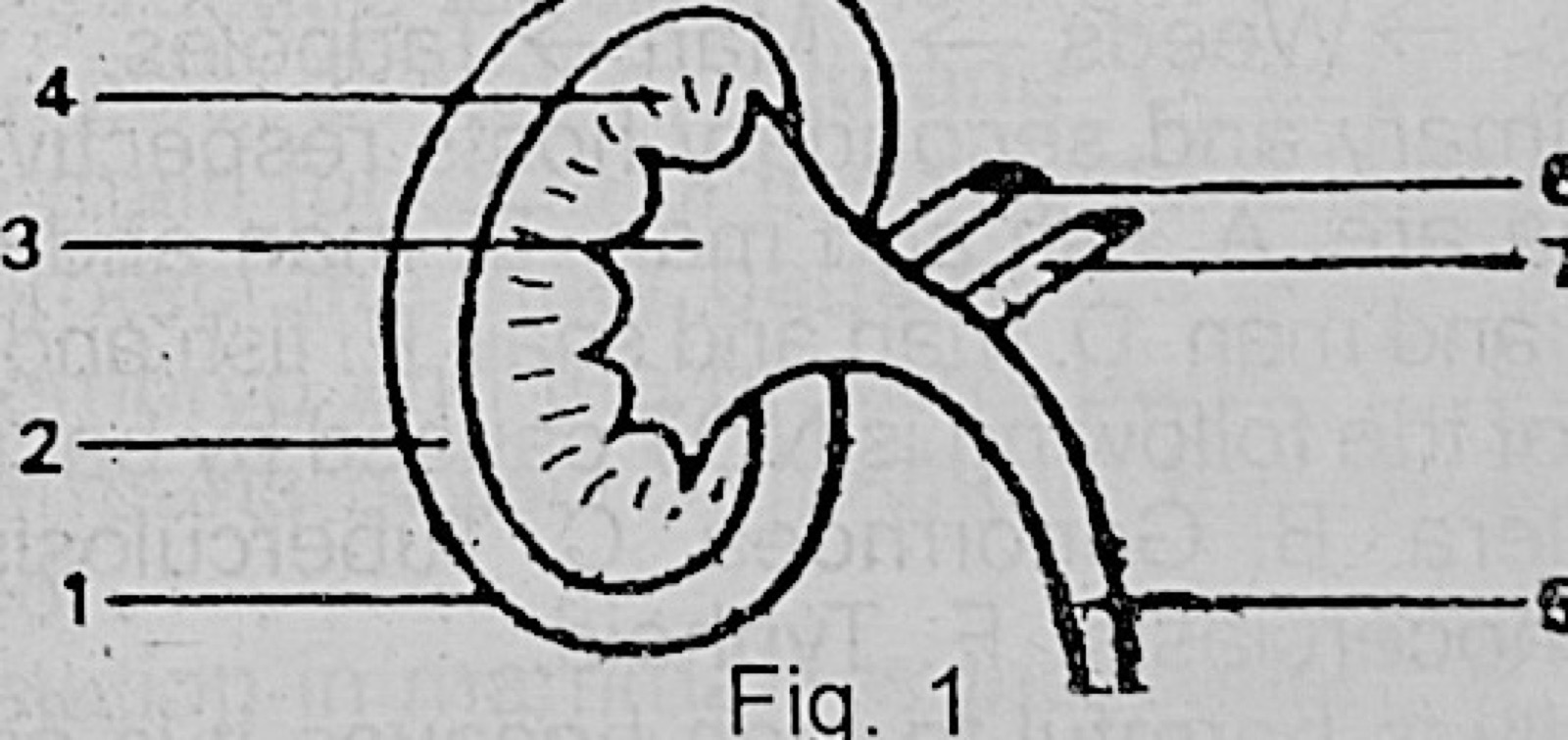
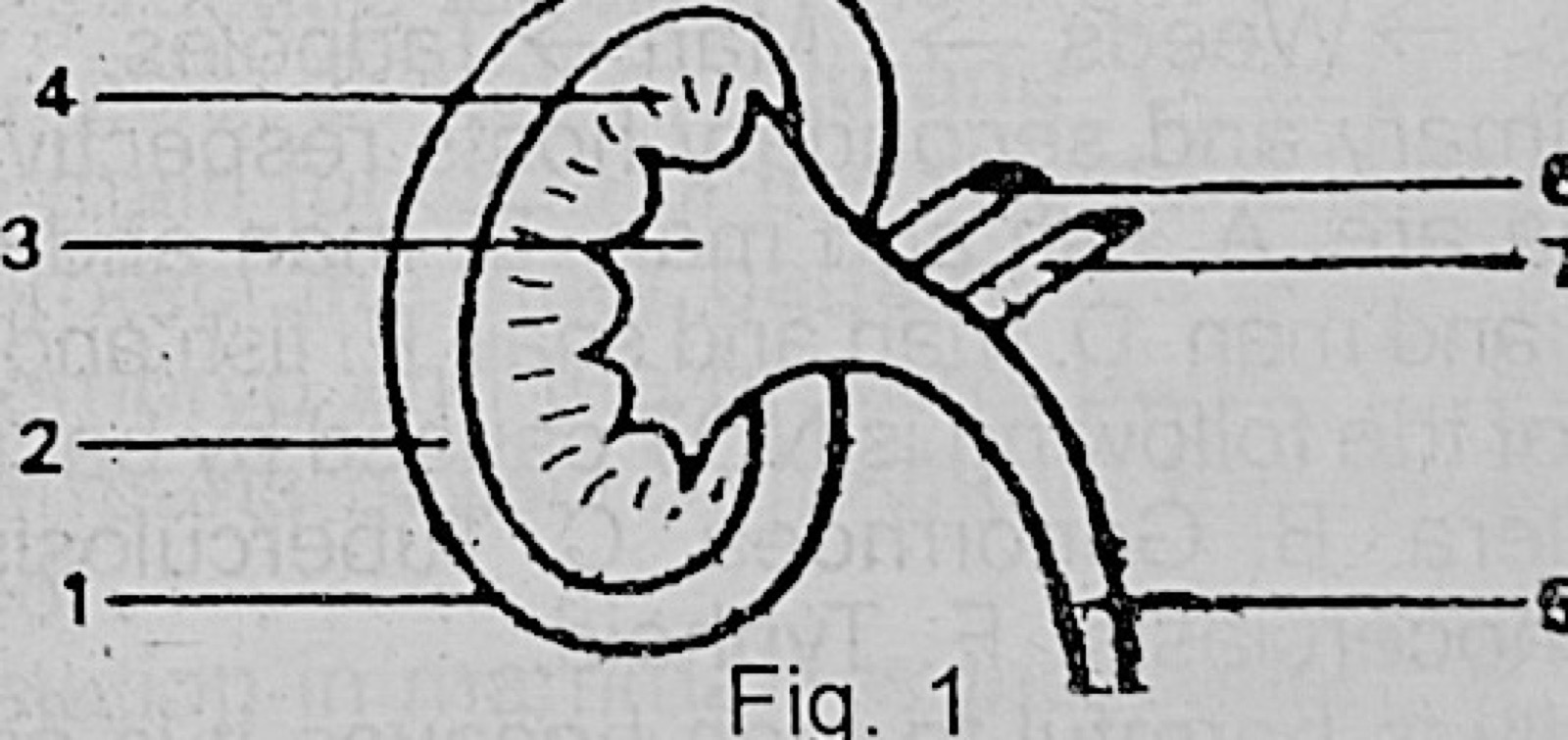
Question 26 Excretion Use the diagram (Fig. 1, a section of a mammalian kidney) to answer this question. Bowman's capsules are located in the part labelled
A. 1 B. 2 C. 3 D. 4 E. 5 Show the answer and explanation Answer: B (2 )
Explanation The Bowman's capsules (with their glomeruli) lie in the cortex, the outer layer of the kidney, labelled 2.
Open this question
Question 27 Excretion Use the diagram (Fig. 1, a section of a mammalian kidney) to answer this question. Reabsorption of useful materials takes place in the parts labelled
A. 1 and 3 B. 3 and 5 C. 5 and 6 D. 6 and 7 E. 2 and 4. Show the answer and explanation Answer: E (2 and 4. )
Explanation Useful substances are taken back into the blood from the kidney tubules, which run through the cortex (2) and down into the inner region (4); 1 is the capsule and 5, 7 and 8 are tubes and vessels.
Open this question
Question 28 Sense Organs Movements and positions of the head in man are detected by the
A. cochlea B. malleus C. utriculus D. semicircular canals E. outer ear. Show the answer and explanation Answer: D (semicircular canals )
Explanation The fluid in the semicircular canals moves when the head turns, stimulating sense cells that detect the movement and help keep balance.
Open this question
Question 29 Support and Movement The appendicular skeleton is made up of the
A. limbs B. skull and limbs C. phalanges D. ulna and radius E. girdles and limbs. Show the answer and explanation Answer: E (girdles and limbs. )
Explanation The appendicular skeleton is the bones of the limbs together with the pectoral and pelvic girdles that join them to the axial skeleton.
Open this question
Question 30 Reproduction in Plants The maize grain is a fruit and not a seed because it
A. has a large endosperm B. is formed from an ovary C. is a monocotyledon D. has no plumule and radicle E. has a hypogeal germination. Show the answer and explanation Answer: B (is formed from an ovary )
Explanation A fruit develops from an ovary. The maize grain is a whole ovary whose wall (pericarp) is fused to the seed coat.
Open this question
Question 31 Reproduction in Plants If a flower is protandrous then it
A. must be unisexual B. has an undeveloped androecium C. has no androecium D. must be insect-pollinated E. can prevent self-pollination. Show the answer and explanation Answer: E (can prevent self-pollination. )
Explanation In a protandrous flower the anthers ripen before the stigma, so its own pollen is usually shed before the stigma can receive it. This prevents self-pollination.
Open this question
Question 32 Reproduction in Plants For pollen to be released in Crotalaria the insect must depress the
A. wing B. keel C. standard D. antepetalous stamen E. antesepalous stamen Show the answer and explanation Answer: B (keel )
Explanation In Crotalaria the stamens and stigma are hidden inside the keel petals. When an insect lands and presses the keel down, the pollen is pushed out onto it.
Open this question
Question 33 Reproduction in Plants Irish potato is a
A. bulb B. tap root C. rhizome D. root tuber E. stem tuber. Show the answer and explanation Answer: E (stem tuber. )
Explanation Irish potato tubers form at the tips of underground stems and carry buds (eyes) that sprout into new shoots, which shows they are stem tubers.
Open this question
Question 34 Mendelian Inheritance The characters by which an organism is recognized are termed its
A. phenotype B. genotype C. morphology D. anatomy E. physiology. Show the answer and explanation Answer: A (phenotype )
Explanation The phenotype is the set of visible (observable) characters of an organism. The genotype is its genetic make-up.
Open this question
Question 35 Chromosomes, DNA and Sex Linkage The hereditary material in a cell is known as
A. ADP B. CNS C. RNA D. ATP E. DNA. Show the answer and explanation Answer: E (DNA. )
Explanation DNA (deoxyribonucleic acid) in the chromosomes carries the genes passed from parents to offspring.
Open this question
Question 36 Photosynthesis and Plant Nutrition A young plant showing yellow leaves is likely to be deficient in
A. calcium B. magnesium C. potassium D. boron E. molybdenum Show the answer and explanation Answer: B (magnesium )
Explanation Magnesium is part of the chlorophyll molecule, so without it leaves cannot make chlorophyll and turn yellow (chlorosis).
Open this question
Question 37 Growth and Development Germination which results in the cotyledons being brought above ground is called
A. hypocotyl B. epicotyl C. epigeal D. hypogeal E. plumule Show the answer and explanation Answer: C (epigeal )
Explanation In epigeal germination (e.g. bean) the hypocotyl grows and lifts the cotyledons above the soil. In hypogeal germination they stay below.
Open this question
Question 38 Hormonal Coordination The mammalian endocrine system is responsible for
A. transmitting impulses B. regulating body temperature C. regulating osmotic pressure of blood D. chemical co-ordination E. the manufacture of blood. Show the answer and explanation Answer: D (chemical co-ordination )
Explanation Endocrine glands release hormones into the blood, which coordinate body activities chemically. Nerves transmit impulses.
Open this question
Question 39 Sense Organs An old man is likely to be long-sighted because age affects the
A. optic nerves B. retina C. ciliary muscles D. cornea E. aqueous humour. Show the answer and explanation Answer: C (ciliary muscles )
Explanation With age the ciliary muscles weaken and the lens loses its elasticity, so the eye cannot thicken the lens to focus on near objects (long-sightedness).
Open this question
Question 40 Nervous Coordination In a mammal, stimulus is transferred from the receptor muscle to the central nervous system through the
A. motor neurons B. effector muscles C. dendrites D. sensory neurons E. synapses. Show the answer and explanation Answer: D (sensory neurons )
Explanation Sensory neurons carry impulses from receptors to the brain or spinal cord. Motor neurons carry them out to the effectors.
Open this question
Question 41 Ecological Associations A relationship between living organisms which is of mutual benefit is
A. parasitism B. saprophytism C. ecosystem D. symbiosis E. commensalism. Show the answer and explanation Answer: D (symbiosis )
Explanation In symbiosis (mutualism) both partners gain, e.g. legumes and their nitrogen-fixing bacteria. In commensalism only one gains.
Open this question
Question 42 Feeding Relationships and Energy Flow Which of the following food chains is in the correct sequence?
A. Weeds → Tadpoles → Beetles → Fish → Man B. Weeds → Tadpoles → Fish → Beetles → Man C. Tadpoles → Beetles → Weeds → Man → Fish D. Man → Fish → Beetles → Tadpoles → Weeds E. Fish → Beetles → Weeds → Man → Tadpoles. Show the answer and explanation Answer: A (Weeds → Tadpoles → Beetles → Fish → Man )
Explanation A food chain starts with the producer (weeds), eaten by tadpoles. Water beetles eat tadpoles, fish eat the beetles and man eats the fish.
Open this question
Question 43 Microorganisms and Health The primary and secondary hosts respectively of bilharzia are
A. fish and man B. man and dog C. snail and man D. man and snail E. fish and snail. Show the answer and explanation Answer: D (man and snail )
Explanation The adult Schistosoma lives and breeds in man (primary host); its larvae develop in the water snail (secondary host).
Open this question
Question 44 Microorganisms and Health Which of the following is NOT caused by bacteria?
A. Cholera B. Gonorrhoea C. Tuberculosis D. Onchocerciasis E. Typhoid. Show the answer and explanation Answer: D (Onchocerciasis )
Explanation Onchocerciasis (river blindness) is caused by a filarial worm, Onchocerca volvulus. Cholera, gonorrhoea, tuberculosis and typhoid are bacterial diseases.
Open this question
Question 45 Microorganisms and Health Tsetse fly is harmful to man because it is associated with the spread of
A. river blindness B. malaria C. sleeping sickness D. leprosy E. dysentery. Show the answer and explanation Answer: C (sleeping sickness )
Explanation The tsetse fly carries Trypanosoma, which causes sleeping sickness. River blindness is spread by blackflies and malaria by mosquitoes.
Open this question
Question 46 Soil Soil erosion CANNOT be controlled by
A. planting cover crops B. contouring of sloping ground C. terracing of slopes D. laying of mulch E. burning of bush. Show the answer and explanation Answer: E (burning of bush. )
Explanation Burning bush removes the plant cover that protects the soil, so it increases erosion. The others all protect the soil.
Open this question
Question 47 Soil Water retention is highest in soils which are rich in
A. sand, poor in humus and devoid of clay B. clay and sand, but poor in humus C. clay and humus, but poor in sand D. clay, poor in humus and devoid of sand E. sand and humus, but poor in clay. Show the answer and explanation Answer: C (clay and humus, but poor in sand )
Explanation Clay particles have tiny spaces that hold water, and humus soaks up water like a sponge. Sand drains quickly, so a soil rich in clay and humus but poor in sand holds the most water.
Open this question
Question 48 Soil The origin of mineral particles in the soil is
A. humus B. water C. micro-organisms D. weathered rock E. organic matter. Show the answer and explanation Answer: D (weathered rock )
Explanation Sand, silt and clay particles are formed when rocks are broken down by weathering. Organic matter forms humus.
Open this question
Question 49 Nutrient Cycling Atmospheric nitrogen is directly replenished in nature through
A. the activities of denitrifying bacteria B. the breakdown of ammonium salts in the soil C. the activities of nitrifying bacteria D. the activities of nitrogen-fixing bacteria in root nodules E. egestion, death and decay. Show the answer and explanation Answer: A (the activities of denitrifying bacteria )
Explanation Denitrifying bacteria break down nitrates in the soil and release free nitrogen gas, which goes back into the atmosphere.
Open this question
Question 50 Soil The initial volume of water poured into a bag of dry soil was 50ml and the amount that drained through was 35ml. The percentage water content of the fully soaked soil is therefore
A. 46.7 B. 25.0 C. 20.0 D. 30.0 E. 58.3. Show the answer and explanation Answer: D (30.0 )
Explanation Water held by the soil = 50 − 35 = 15 ml. As a percentage of the water added: 15/50 × 100 = 30.0%.
Open this question Sign up free for every JAMB Biology year, practice by topic and timed mocks.
Start practising free