JAMB Biology 1983 past questions and answers

47 questions. Try each one, then open the answer to check yourself and read the explanation.

Question 1

Structure of Flowering Plants

Root hairs are developed from the

  1. A.root apex
  2. B.epidermis of roots
  3. C.vascular bundles
  4. D.endodermis
  5. E.pericycle
Show the answer and explanation

Answer: B (epidermis of roots)

Explanation

Each root hair is a long, thin outgrowth of a single epidermal cell of the root (the piliferous layer). The pericycle gives rise to lateral roots, not root hairs.

Open this question

Question 2

Structure of Flowering Plants

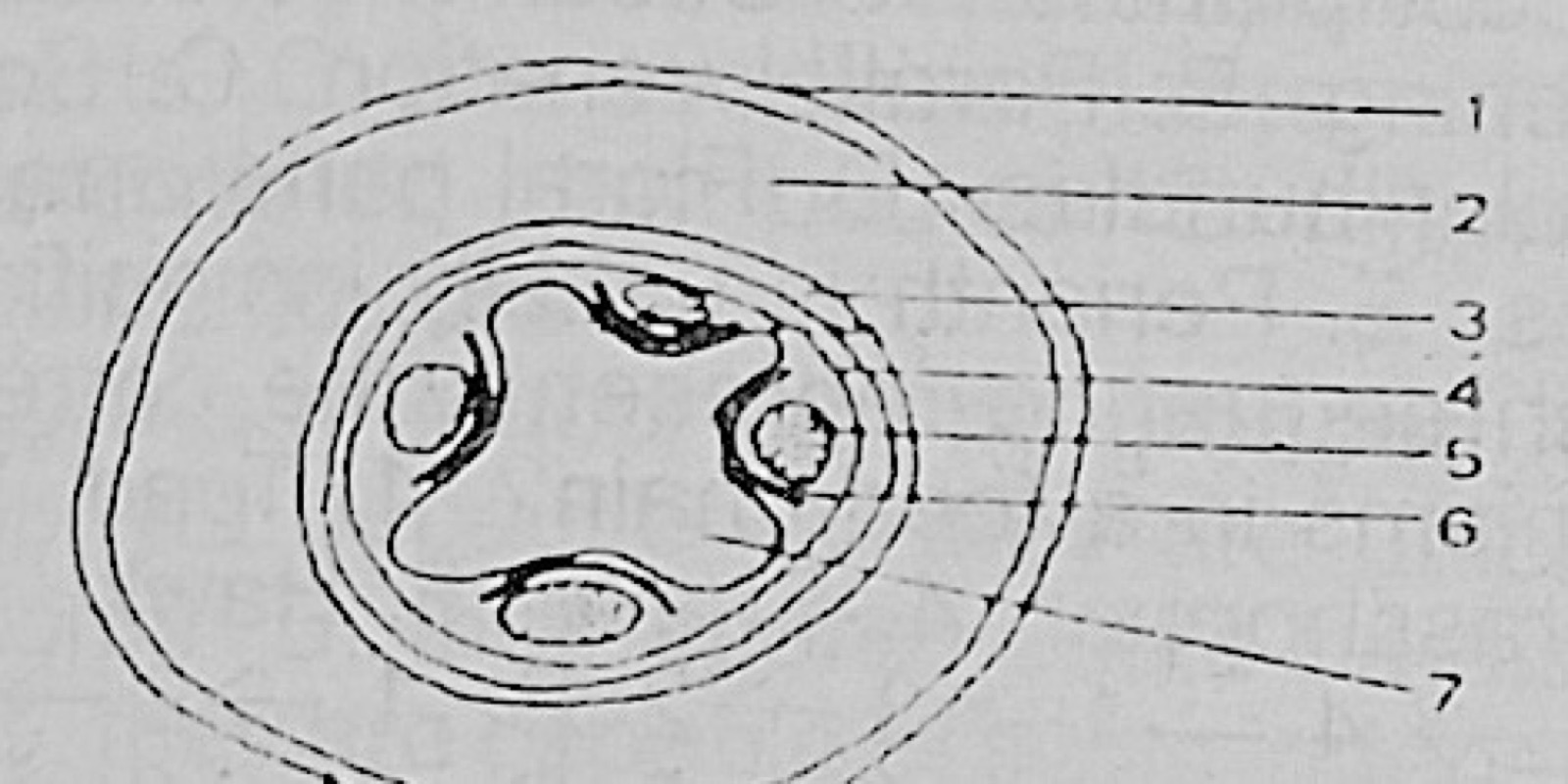
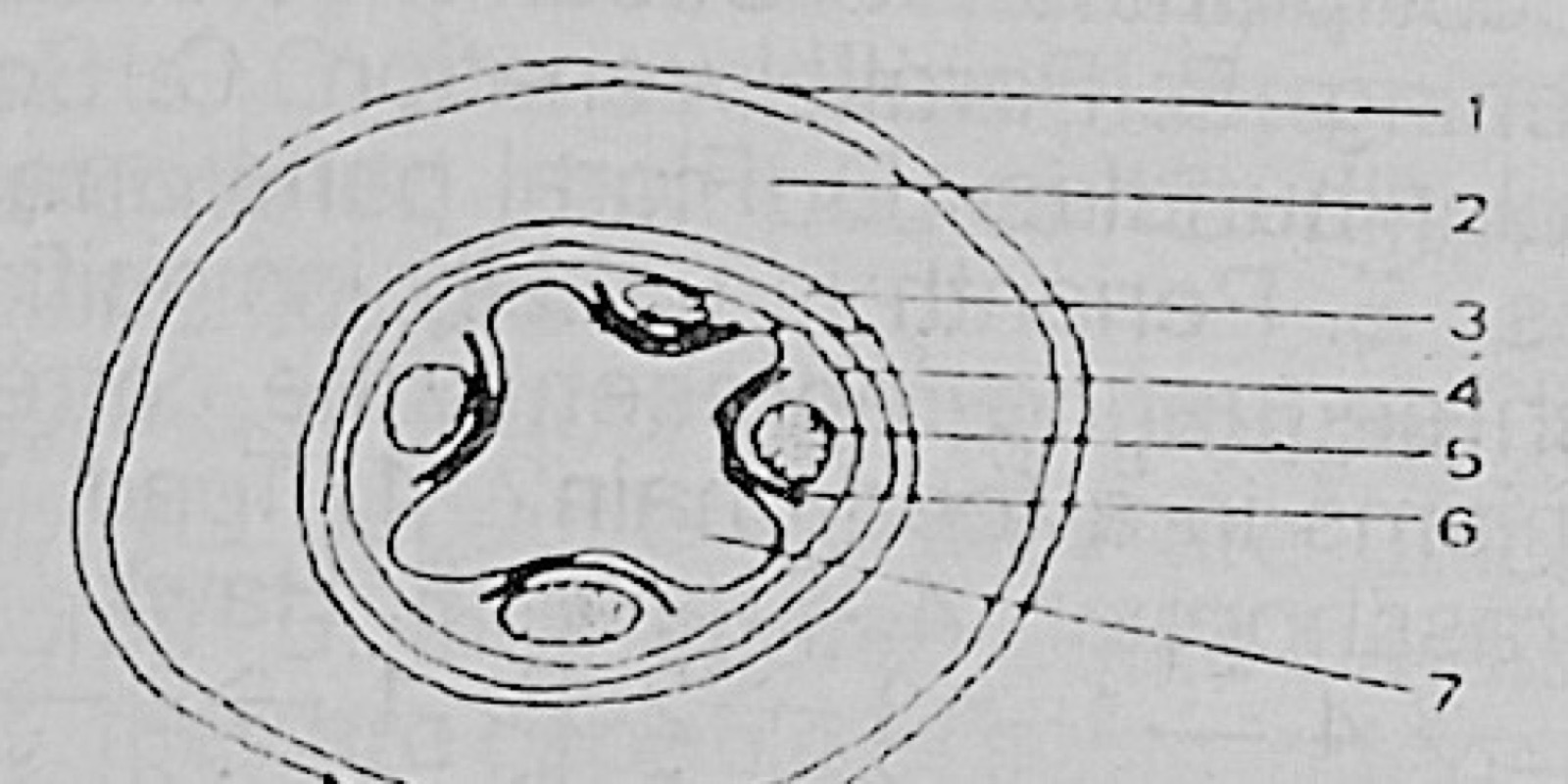
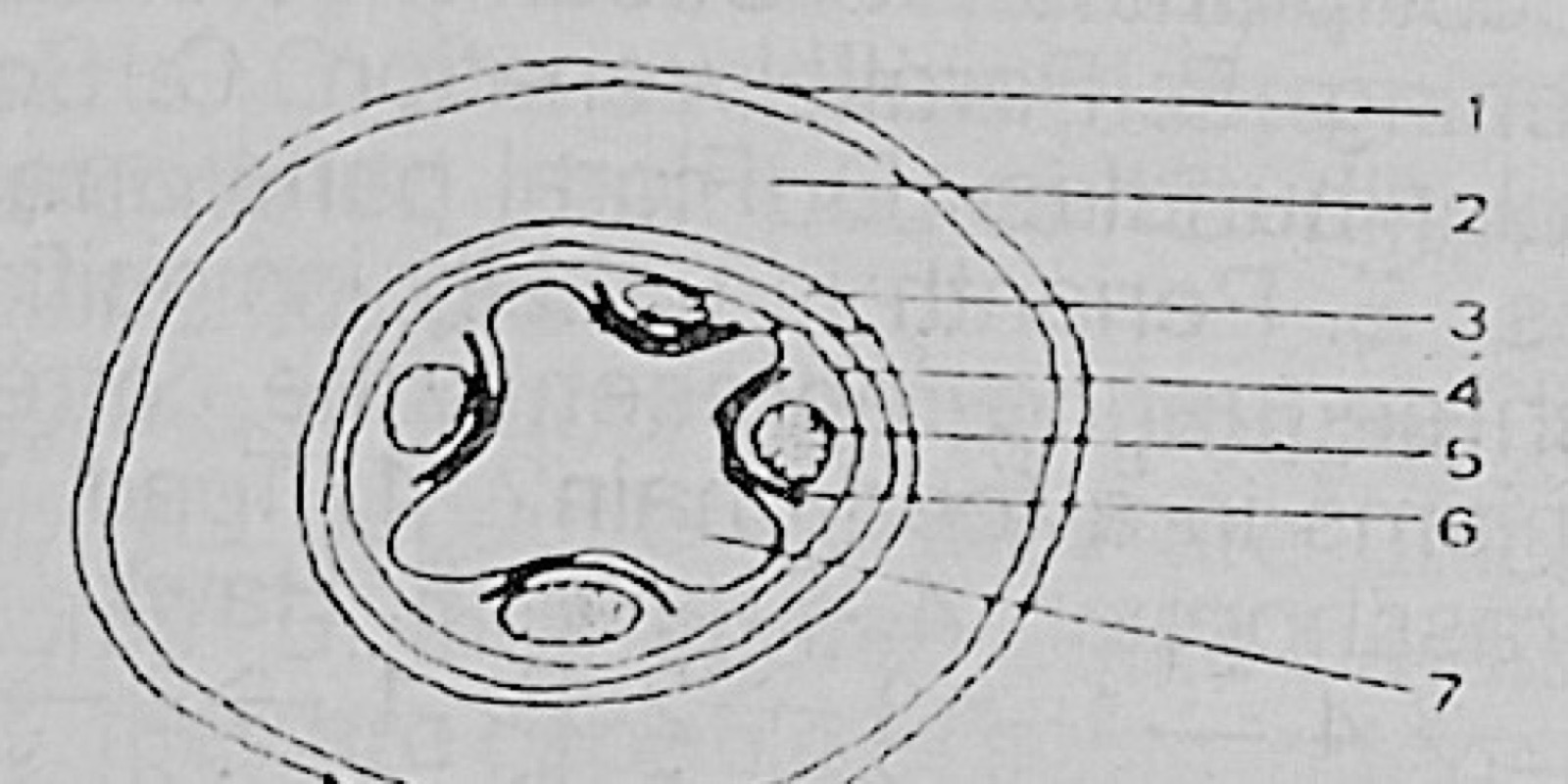
Use Fig. 1 to answer questions 2-4. Fig 1 represents a cross section of part of a dicot plant. Which of the following features can be used to identify Fig. 1?

Diagram for this question
  1. A.Position of 7
  2. B.Its circular nature
  3. C.Number of 5
  4. D.Presence of 3
  5. E.Width of 2
Show the answer and explanation

Answer: A (Position of 7)

Explanation

Fig. 1 is a young dicot root: the xylem (7) forms a star in the very centre with the phloem between its arms. This central, radial position of the xylem is what marks it out as a root.

Open this question

Question 3

Structure of Flowering Plants

Use Fig. 1 to answer questions 2-4. Fig 1 represents a cross section of part of a dicot plant. The main function of 6 is to

Diagram for this question
  1. A.separate 5 from 7
  2. B.produce more of 5 and 7
  3. C.produce cork
  4. D.translocate water and mineral salt
  5. E.conduct carbondioxide to the other parts
Show the answer and explanation

Answer: B (produce more of 5 and 7)

Explanation

Part 6 is the cambium lying between the phloem (5) and the xylem (7). Cambium cells divide to form new phloem and new xylem.

Open this question

Question 4

Structure of Flowering Plants

Use Fig. 1 to answer questions 2-4. Fig 1 represents a cross section of part of a dicot plant. The main function of 4 is to

Diagram for this question
  1. A.surround the inner tissues
  2. B.produce cork
  3. C.produce root hairs
  4. D.produce lateral roots
  5. E.produce more of 3
Show the answer and explanation

Answer: D (produce lateral roots)

Explanation

In a root, the pericycle is the layer just inside the endodermis. Its cells can divide to form lateral (branch) roots, which push out through the cortex.

Open this question

Question 5

Structure of Flowering Plants

In a dicot leaf, guard cells differ from other epidermal cells because they

  1. A.have no definite shape
  2. B.lack nuclei
  3. C.are smaller
  4. D.contain chloroplasts
  5. E.lack vacuole.
Show the answer and explanation

Answer: D (contain chloroplasts)

Explanation

Guard cells are the only epidermal cells of a leaf that contain chloroplasts; the other epidermal cells are colourless.

Open this question

Question 6

Animal Kingdom

Which of the following structures is NOT found in the female agama lizard?

  1. A.Pre-anal pads.
  2. B.Eardrum
  3. C.Gular fold
  4. D.Nasal scale
  5. E.Nuchal crest.
Show the answer and explanation

Answer: E (Nuchal crest.)

Explanation

The nuchal crest (the ridge of scales on the neck) is a feature of the adult male agama. Both sexes have eardrums, a gular fold and nasal scales.

Open this question

Question 7

Plant Kingdom

Herbs differ from shrubs because they

  1. A.do not produce fruits
  2. B.are useful to herbalists
  3. C.do not become woody
  4. D.are only annuals
  5. E.are only perennials.
Show the answer and explanation

Answer: C (do not become woody)

Explanation

Herbs have soft, green stems that do not become woody, while shrubs have woody stems.

Open this question

Question 8

Cell and Its Environment

If an isolated living cell is left in distilled water for two hours, it is likely to

  1. A.lose some of its water to the surrounding water
  2. B.lose all of its water to the surrounding water
  3. C.reproduce by binary fission
  4. D.become more turgid
  5. E.die due to excess water
Show the answer and explanation

Answer: D (become more turgid)

Explanation

Distilled water is less concentrated than the cell sap, so water enters the cell by osmosis and the cell swells and becomes turgid.

Open this question

Question 9

Food Substances and Enzymes

If an organic compound has its hydrogen: oxygen ratio as 2:1, it is likely to be

  1. A.a protein
  2. B.a carbohydrate
  3. C.a fat
  4. D.a fatty acid and glycerol
  5. E.an amino acid
Show the answer and explanation

Answer: B (a carbohydrate)

Explanation

Carbohydrates have the general formula Cx(H2O)y, so hydrogen and oxygen are in the same 2:1 ratio as in water.

Open this question

Question 10

Photosynthesis and Plant Nutrition

Which of the following elements are necessary for the formation of chlorophyll in a plant?

  1. A.Magnesium and iron
  2. B.Calcium and potassium
  3. C.Calcium and sulphur
  4. D.Potassium and sulphur
  5. E.Phosphorus and potassium
Show the answer and explanation

Answer: A (Magnesium and iron)

Explanation

Magnesium is part of the chlorophyll molecule, and iron is needed for the plant to make chlorophyll; lack of either causes yellowing (chlorosis).

Open this question

Question 11

Transport in Animals

Which of the following statements is NOT true of mammalian erythrocytes?

  1. A.They have haemoglobin
  2. B.They appear yellow when looked at singly
  3. C.They are disc-shaped
  4. D.The cells are more numerous than leucocytes
  5. E.They have nuclei at maturity.
Show the answer and explanation

Answer: E (They have nuclei at maturity.)

Explanation

Mature mammalian red blood cells lose their nuclei, which leaves more room for haemoglobin. All the other statements are true.

Open this question

Question 12

Transport in Plants

In woody plants, gases and water vapour are transported across the stems by the

  1. A.xylem fibres
  2. B.medullary rays
  3. C.sieve tubes
  4. D.phloem fibres
  5. E.phloem parenchyma.
Show the answer and explanation

Answer: B (medullary rays)

Explanation

Medullary rays are bands of parenchyma running outwards from the centre of the stem to the bark. They carry water, food and gases sideways across the stem.

Open this question

Question 13

Excretion

Which of the following substances is NOT found in urine?

  1. A.Water
  2. B.Sodium chloride
  3. C.Nitrogenous compounds
  4. D.Calcium chloride
  5. E.Nitrogenous salts
Show the answer and explanation

Answer: D (Calcium chloride)

Explanation

Urine is mainly water with urea and other nitrogenous compounds and salts such as sodium chloride. Calcium chloride is not one of its normal components.

Open this question

Question 14

Excretion

The kidneys of all vertebrates act as osmoregulators. This means that they

  1. A.keep the composition of the plasma constant
  2. B.regulate osmotic processes
  3. C.control the volume of blood entering the kidneys
  4. D.decrease the osmotic pressure of blood.
  5. E.increase the osmotic pressure of blood.
Show the answer and explanation

Answer: A (keep the composition of the plasma constant)

Explanation

Osmoregulation means keeping the water and salt content (and so the osmotic pressure) of the blood plasma constant. The kidneys do this by removing more or less water and salts.

Open this question

Question 15

Plant Responses and Hormones

The movement of part of a plant in response to external stimulus of no particular direction is

  1. A.taxism
  2. B.tropism
  3. C.haptotropic movement
  4. D.nastic movement
  5. E.phototropism.
Show the answer and explanation

Answer: D (nastic movement)

Explanation

Nastic movements, such as the closing of flowers at night, respond to a stimulus but not to its direction. Tropisms depend on the direction of the stimulus.

Open this question

Question 17

Reproduction in Plants

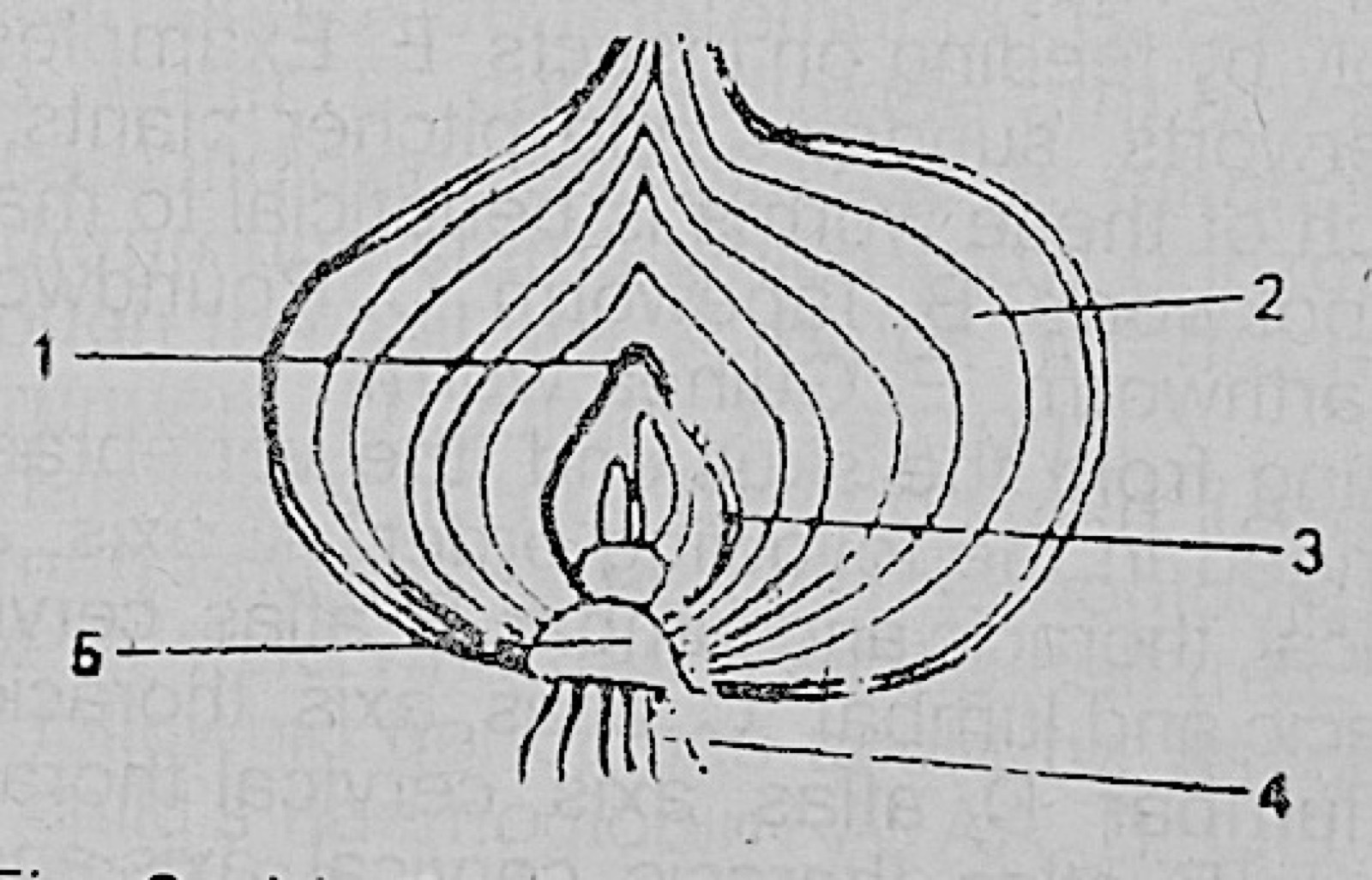
Fig. 2: Vertical section of onion bulb. Which of the labelled parts in Fig. 2 will develop into a new bulb?

Diagram for this question
  1. A.1
  2. B.4
  3. C.2
  4. D.3
  5. E.5
Show the answer and explanation

Answer: D (3)

Explanation

A new bulb grows from a lateral (axillary) bud in the axil of a scale leaf, the part labelled 3. Part 5 is the stem, 4 the roots and 2 a scale leaf.

Open this question

Question 18

Reproduction in Plants

In the onion bulb, food is stored in the

  1. A.stem
  2. B.lateral buds
  3. C.cotyledons
  4. D.outer scale leaves
  5. E.leaf bases.
Show the answer and explanation

Answer: E (leaf bases.)

Explanation

The onion stores food in its fleshy inner scale leaves, which are swollen leaf bases. The outer scale leaves are dry and protective.

Open this question

Question 19

Reproduction in Plants

Groundnut is not really a 'nut' in the biological sense because

  1. A.it is harvested from inside the ground
  2. B.its pericarp is not hard and tough
  3. C.the fruit is not as hard as coconut
  4. D.the fruit is not succulent
  5. E.it is an achene.
Show the answer and explanation

Answer: B (its pericarp is not hard and tough)

Explanation

A true nut has a hard, woody pericarp. The groundnut shell is papery and splits open, so it is a legume (pod), not a nut.

Open this question

Question 21

Soil

28 g soil sample was heated to a constant weight of 24g. When further heated to red hot and cooled, it weighed 18 g. What is the percentage of humus in the soil?

  1. A.22.2
  2. B.55.6
  3. C.75.0
  4. D.25.0
  5. E.35.7
Show the answer and explanation

Answer: D (25.0)

Explanation

Heating to constant weight drives off water, leaving 24 g of dry soil. Red heat burns off the humus: 24 − 18 = 6 g. Percentage humus in the dry soil = 6/24 × 100 = 25.0%.

Open this question

Question 22

Microorganisms and Health

Which of the following diseases is NOT caused by a virus?

  1. A.Rinderpest
  2. B.Maize rust
  3. C.Newcastle disease
  4. D.Swine fever
  5. E.Cassava mosaic disease.
Show the answer and explanation

Answer: B (Maize rust)

Explanation

Maize rust is a fungal disease. Rinderpest, Newcastle disease, swine fever and cassava mosaic disease are all caused by viruses.

Open this question

Question 23

Animal Kingdom

A centipede differs from a millipede by its

  1. A.colour
  2. B.numerous abdominal segments
  3. C.paired legs on each abdominal segment
  4. D.poison claws
  5. E.cylindrical body.
Show the answer and explanation

Answer: D (poison claws)

Explanation

A centipede has a pair of poison claws behind the head for killing prey. A millipede has no poison claws, and it has a cylindrical body with two pairs of legs on most segments.

Open this question

Question 24

Mendelian Inheritance

An organism having one pair of identical genes is

  1. A.a heterozygote
  2. B.a hybrid
  3. C.an allelomorph
  4. D.a homozygote
  5. E.a diploid.
Show the answer and explanation

Answer: D (a homozygote)

Explanation

When the two alleles of a gene pair are the same (e.g. TT or tt), the organism is homozygous for that gene.

Open this question

Question 25

Adaptation

Plants which can survive in places where the water supply is limited are

  1. A.bryophytes
  2. B.mesophytes
  3. C.xerophytes
  4. D.hydrophytes
  5. E.pteridophytes.
Show the answer and explanation

Answer: C (xerophytes)

Explanation

Xerophytes are plants adapted to dry places, e.g. with thick cuticles, reduced leaves or water-storing tissues.

Open this question

Question 26

Reproduction in Plants

Banana, plantain and pineapple can be grouped together because they

  1. A.produce small seeds
  2. B.are multiple fruits
  3. C.produce suckers
  4. D.have runners
  5. E.have bulbils
Show the answer and explanation

Answer: C (produce suckers)

Explanation

All three are propagated by suckers, shoots that grow up from the base of the parent plant.

Open this question

Question 27

Microorganisms and Health

One disease NOT caused directly by bacteria is

  1. A.malaria
  2. B.tuberculosis
  3. C.pneumonia
  4. D.tetanus
  5. E.cholera
Show the answer and explanation

Answer: A (malaria)

Explanation

Malaria is caused by a protozoan, Plasmodium, carried by mosquitoes. The others are bacterial diseases.

Open this question

Question 28

Reproduction in Animals

In what order do the following structures develop during the metamorphosis of the toad? 1 External gills 2. Internal gills 3. Forelimbs 4. Hindlimbs 5. Mouth

  1. A.1 2 3 4 5
  2. B.1 5 2 4 3
  3. C.2 1 3 4 5
  4. D.5 3 4 1 2
  5. E.5 4 3 2 1.
Show the answer and explanation

Answer: B (1 5 2 4 3)

Explanation

The tadpole first has external gills, then its mouth opens, then internal gills form. The hindlimbs appear before the forelimbs.

Open this question

Question 29

Animal Nutrition

The dental formula i 3/3: c 1/1 pm 4/4: m 2/3 = 42 represents that of a

  1. A.rabbit
  2. B.full grown man
  3. C.young child
  4. D.dog
  5. E.sheep
Show the answer and explanation

Answer: D (dog)

Explanation

This formula, with canines and 42 teeth in all, belongs to the dog. Man has 32 teeth, and the rabbit and sheep have no canines.

Open this question

Question 30

Photosynthesis and Plant Nutrition

Which of the following statements is NOT true of insectivorous plants?

  1. A.They obtain part of their food by trapping and feeding on insects
  2. B.They attract insects simply because of pollination
  3. C.They can grow in soils poor in nitrogenous salts.
  4. D.They can supplement their nitrogen supply by feeding on insects
  5. E.Examples include butterworts, sundews and pitcher plants.
Show the answer and explanation

Answer: B (They attract insects simply because of pollination)

Explanation

Insectivorous plants trap and digest insects to get extra nitrogen, which lets them grow in nitrogen-poor soils. They attract insects to catch them, not just for pollination.

Open this question

Question 31

Animal Kingdom

Which of these worms is beneficial to man?

  1. A.Hookworm
  2. B.Tapeworm
  3. C.Roundworm
  4. D.Earthworm
  5. E.Guinea worm
Show the answer and explanation

Answer: D (Earthworm)

Explanation

Earthworms improve the soil by mixing it, aerating it and adding humus. The others are parasites of man.

Open this question

Question 32

Support and Movement

Starting from the skull end, the vertebrae are arranged in the following order

  1. A.axis, atlas, cervical, thoracic and lumbar
  2. B.atlas, cervical, axis, thoracic and lumbar
  3. C.atlas, axis, thoracic, cervical and lumbar
  4. D.atlas, axis, cervical thoracic and lumbar
  5. E.atlas, thoracic, cervical, axis and lumbar.
Show the answer and explanation

Answer: D (atlas, axis, cervical thoracic and lumbar)

Explanation

The atlas is the first vertebra (it holds the skull), then the axis, then the other cervical (neck) vertebrae, then the thoracic and then the lumbar vertebrae.

Open this question

Question 33

Microorganisms and Health

Which of the following diseases could be exclusively associated with a river basin?

  1. A.Malaria
  2. B.Syphilis
  3. C.Onchocerciasis
  4. D.Cholera
  5. E.Poliomyelitis
Show the answer and explanation

Answer: C (Onchocerciasis)

Explanation

Onchocerciasis (river blindness) is spread by blackflies (Simulium), which breed in fast-flowing rivers, so it is found along river basins.

Open this question

Question 34

Evolution

Which of the following represents the evolutionary sequence in these plants? 1 Flowering plants 2 Ferns 3 Mosses 4 Algae 5 Conifers

  1. A.2 → 1 → 4 → 3 → 5
  2. B.5 → 4 → 3 → 2 → 1
  3. C.2 → 4 → 5 → 1 → 3
  4. D.3 → 2 → 4 → 5 → 1
  5. E.4 → 3 → 2 → 5 → 1
Show the answer and explanation

Answer: E (4 → 3 → 2 → 5 → 1)

Explanation

Plants evolved from simple to complex: algae, then mosses, then ferns, then conifers (gymnosperms), and last the flowering plants.

Open this question

Question 35

Cell and Its Environment

Which of the following will NOT allow osmosis to take place?

  1. A.Pig's bladder
  2. B.Cellophane
  3. C.Parchment paper
  4. D.Transparent polythene
  5. E.Cow's bladder.
Show the answer and explanation

Answer: D (Transparent polythene)

Explanation

Osmosis needs a semi-permeable membrane that lets water through. Polythene is waterproof, so no water can pass through it.

Open this question

Question 36

Transport in Animals

Which of the following statements on the mammalian circulatory system is NOT true?

  1. A.Blood in the pulmonary artery is richer in oxygen content than blood in the pulmonary vein
  2. B.The blood in the hepatic portal vein is the richest in food substances
  3. C.Blood flow is controlled by valves in the veins
  4. D.Arteries are generally thicker and larger than veins
  5. E.Fibrin helps in the formation of blood clot.
Show the answer and explanation

Answer: A (Blood in the pulmonary artery is richer in oxygen content than blood in the pulmonary vein)

Explanation

The pulmonary artery carries deoxygenated blood to the lungs, and the pulmonary vein brings oxygenated blood back, so statement A is the wrong way round.

Open this question

Question 37

Plant Responses and Hormones

In a positive phototropic response of a coleoptile, the region of greatest curvature is brought about by the

  1. A.movement of auxins away from the region of curvature
  2. B.even distribution of auxins in all parts of the coleoptile
  3. C.inhibition of growth by auxins in the region of smaller curvature
  4. D.concentration of auxins in the region of curvature
  5. E.absence of auxins in the coleoptile
Show the answer and explanation

Answer: D (concentration of auxins in the region of curvature)

Explanation

Auxin collects on the shaded side of the coleoptile, so cells there grow longer and the tip bends towards the light where the auxin is concentrated.

Open this question

Question 38

Reproduction in Plants

The tuber of cassava is NOT a stem tuber because it

  1. A.is distended with food reserve
  2. B.has an aerial shoot portion
  3. C.has other structures that could be called roots
  4. D.lacks axillary buds
  5. E.has a bark over its stored food.
Show the answer and explanation

Answer: D (lacks axillary buds)

Explanation

Stem tubers such as yam and Irish potato have buds (eyes) at nodes. The cassava tuber has no buds, which shows it is a swollen root.

Open this question

Question 39

Sense Organs

The function of the ossicles (maleus, incus and stapes) in the mammalian ear is the

  1. A.transmission of vibrations
  2. B.regulation of pressures
  3. C.support of the inner ear
  4. D.maintenance of balance during motion
  5. E.secretion of oil.
Show the answer and explanation

Answer: A (transmission of vibrations)

Explanation

The three ear ossicles pass sound vibrations from the eardrum to the oval window of the inner ear, amplifying them on the way.

Open this question

Question 40

Ecosystem and Ecological Factors

Which of the following instruments is used for determining turbidity of water?

  1. A.Thermometer
  2. B.Secchi disc
  3. C.Rain gauge
  4. D.Hygrometer
  5. E.Wind vane.
Show the answer and explanation

Answer: B (Secchi disc)

Explanation

A Secchi disc is lowered into water until it disappears from view; the depth tells how cloudy (turbid) the water is.

Open this question

Question 41

Plant Kingdom

Which of the following is NOT a characteristic of monocot plants?

  1. A.Occurrence of secondary thickening
  2. B.Parallel venation
  3. C.Scattered vascular bundles
  4. D.Floral parts arranged in threes
  5. E.Perianth is usually insignificant.
Show the answer and explanation

Answer: A (Occurrence of secondary thickening)

Explanation

Monocots have no cambium in their vascular bundles, so they normally show no secondary thickening. The other features are typical of monocots.

Open this question

Question 43

Viruses, Monera, Protista and Fungi

In Rhizopus carbohydrate is stored in the form of

  1. A.glucose
  2. B.paramylon
  3. C.glycogen
  4. D.starch
  5. E.oil
Show the answer and explanation

Answer: C (glycogen)

Explanation

Fungi such as Rhizopus store carbohydrate as glycogen, like animals, not as starch.

Open this question

Question 44

Transport in Plants

Which of the following statements about the rate of transpiration is INCORRECT? It is

  1. A.dependent on temperature
  2. B.affected by changes in light intensity
  3. C.unaffected by humidity
  4. D.dependent on air movement
  5. E.affected by availability of water
Show the answer and explanation

Answer: C (unaffected by humidity)

Explanation

Humidity strongly affects transpiration: humid air slows water loss from leaves and dry air speeds it up.

Open this question

Question 45

Animal Kingdom

'Jointed skeleton' is absent in the

  1. A.cockroach
  2. B.spider
  3. C.millipede
  4. D.snail
  5. E.dragon fly
Show the answer and explanation

Answer: D (snail)

Explanation

The snail is a mollusc with an unjointed shell. The others are arthropods with jointed exoskeletons.

Open this question

Question 46

Animal Nutrition

Which of the following statements about the dentition of man is INCORRECT? Man has

  1. A.more molars than incisors
  2. B.no diastema
  3. C.the same number of teeth on upper and lower jaws
  4. D.a total of thirty -two teeth
  5. E.a total of six molars
Show the answer and explanation

Answer: E (a total of six molars)

Explanation

An adult man has 12 molars (3 in each half-jaw), not six. He has 8 incisors, no diastema and 16 teeth in each jaw.

Open this question

Question 47

Cell and Its Environment

When a Spirogyra cell is immersed in a salt solution more concentrated than its cell sap, it

  1. A.remains unchanged
  2. B.takes up water and burst
  3. C.absorbs a little water
  4. D.loses water and shrivels
  5. E.becomes turgid.
Show the answer and explanation

Answer: D (loses water and shrivels)

Explanation

In a more concentrated solution water leaves the cell by osmosis, so the cytoplasm shrinks away from the wall (plasmolysis).

Open this question

Question 48

Excretion

Urea is produced in the

  1. A.liver
  2. B.bladder
  3. C.spleen
  4. D.kidneys
  5. E.gall bladder
Show the answer and explanation

Answer: A (liver)

Explanation

The liver breaks down excess amino acids (deamination) and turns the ammonia into urea. The kidneys only remove it from the blood.

Open this question

Question 49

Mendelian Inheritance

What is the genetic ratio of the F2 generation if members of F generation are allowed to self-pollinate?

  1. A.1 tall : 3 short
  2. B.3 tall : 1 short
  3. C.1 tall : 1 short
  4. D.4 short : 0 tall
  5. E.4 tall : 0 short
Show the answer and explanation

Answer: B (3 tall : 1 short)

Explanation

Crossing two heterozygous F1 plants (Tt × Tt) gives TT, Tt, Tt and tt, which is 3 tall to 1 short.

Open this question

Question 50

Transport in Animals

The path taken by glucose from the ileum to the heart is

  1. A.ileum → hepatic portal vein → hepatic artery → vena cava → heart
  2. B.ileum → hepatic portal artery → hepatic artery → vena cava → heart
  3. C.ileum → hepatic portal vein → vena cava → heart
  4. D.ileum → hepatic vein → vena cava → heart
  5. E.ileum → hepatic portal vein → hepatic vein → vena cava → heart.
Show the answer and explanation

Answer: E (ileum → hepatic portal vein → hepatic vein → vena cava → heart.)

Explanation

Glucose absorbed in the ileum goes in the hepatic portal vein to the liver, leaves the liver in the hepatic vein, and reaches the heart through the vena cava.
Open this question