Home › Past questions › JAMB › Biology › 1982 47 questions. Try each one, then open the answer to check yourself and read the explanation.
Sign up free to answer these questions on a CBT screen with a timer, then see your score and every answer explained.
Start practising free
Question 1 Population Ecology A population is defined as the collection of
A. similar organisms that are found in the same habitat B. similar organisms that breed in the same habitat C. similar organisms that interbreed freely in the same habitat D. similar organisms that eat the same food E. different organisms in the same habitat. Show the answer and explanation Answer: A (similar organisms that are found in the same habitat )
Explanation A population is a group of organisms of the same kind (species) living together in one habitat.
Open this question
Question 2 Cell Structure and Organisation Which of these combinations is common to plant and animal cells?
A. Centriole, middle lamella, Golgi bodies, mitochondrion B. Cytoplasm, sap vacuole, starch grains, leucoplasts C. Plasma membranes, chromosomes, mitochondria, lysosomes. D. Nucleus, nucleolus, cellulose cell wall, endoplasmic reticulum E. Cytoplasm, centriole, cellulose cell wall, nucleolus. Show the answer and explanation Answer: C (Plasma membranes, chromosomes, mitochondria, lysosomes. )
Explanation Plasma membranes, chromosomes, mitochondria and lysosomes occur in both; cellulose walls, sap vacuoles and starch grains are plant features and centrioles animal features.
Open this question
Question 4 Photosynthesis and Plant Nutrition Some of the major elements required by plants are
A. Potassium, nitrogen, phosphorus, sodium,calcium B. Nitrogen, phosphorus, molybdenum, sodium, calcium. C. Potassium, phosphorus, molybdenum, sodium, calcium D. Potassium, nitrogen, iron, sodium, calcium E. Potassium, nitrogen, phosphorus, silicon, cadmium. Show the answer and explanation Answer: A (Potassium, nitrogen, phosphorus, sodium,calcium )
Explanation Only A avoids trace elements (molybdenum, iron) and non-nutrients (silicon, cadmium); nitrogen, phosphorus, potassium and calcium are major nutrients.
Open this question
Question 5 Reproduction in Animals In human reproduction, the zygote formed as a result of fertilization gets attached to the wall of the uterus. The process is called
A. sexual reproduction B. cohesion C. pregnancy D. implantation E. viviparity. Show the answer and explanation Answer: D (implantation )
Explanation Implantation is the embedding of the early embryo in the uterine lining.
Open this question
Question 6 Food Substances and Enzymes Kwashiorkor is caused by severe deficiency of
A. water B. oil C. drugs D. proteins E. sugars Show the answer and explanation Answer: D (proteins )
Explanation Kwashiorkor is a disease of children whose diet lacks enough protein.
Open this question
Question 7 Homeostasis An homoiothermic animal kept in a room where the temperature is lower than the body temperature may lose heat by four physical processes. Which of the following processes is NOT connected with body temperature regulation?
A. Radiation B. Sweat C. Evaporation D. Conduction E. Convection Show the answer and explanation Answer: B (Sweat )
Explanation Heat is lost by the physical processes of radiation, conduction, convection and evaporation; sweat is a secretion, not one of these processes.
Open this question
Question 9 Mendelian Inheritance If a tall man (TT) marries a dwarf woman (gg) and they have four male children, the offspring will be
A. all short B. three short and one tall C. two short and two tall D. one short and three tall E. all tall. Show the answer and explanation Answer: E (all tall. )
Explanation The father is homozygous tall, so every child gets a dominant tall allele and all four are tall.
Open this question
Question 10 Chromosomes, DNA and Sex Linkage A married couple have 10 children and they are all girls. Which of the following is the CORRECT explanation?
A. The woman is incapable of producing male children B. The man's sperms are very weak C. The man is not athletic enough D. The Y component of the man's sex chromosomes was always involved. E. The X component of the man's sex chromosomes was always involved. Show the answer and explanation Answer: E (The X component of the man's sex chromosomes was always involved. )
Explanation The child's sex depends on the father's sperm; a girl results each time an X-carrying sperm fertilises the egg.
Open this question
Question 11 Mendelian Inheritance If a 26 year old blind man married a young one-eyed woman and they had four children, how many of them would be blind like their father?
A. All B. 3 C. 2 D. 1 E. None Show the answer and explanation Answer: E (None )
Explanation Blindness and loss of an eye caused during life are acquired, not inherited, so the children would not be blind.
Open this question
Question 12 Respiration The glottis is the opening which leads to the
A. oesophagus B. larynx C. nostrils D. pharynx E. mouth. Show the answer and explanation Answer: B (larynx )
Explanation The glottis is the opening from the pharynx into the larynx and on to the trachea.
Open this question
Question 13 Animal Nutrition A tapeworm has no alimentary canal bacause
A. it is autotrophic B. it does not feed C. it has no enzymes D. its body absorbs digested food E. the suckers on the scolex suck blood. Show the answer and explanation Answer: D (its body absorbs digested food )
Explanation Living in the host's gut, the tapeworm absorbs already digested food through its body surface.
Open this question
Question 14 Respiration A grasshopper respires by means of its
A. lung-books B. gills C. lungs D. antennae E. tracheal tubes. Show the answer and explanation Answer: E (tracheal tubes. )
Explanation Insects breathe through spiracles that open into a system of tracheal tubes.
Open this question
Question 15 Reproduction in Plants An onion bulb stores its food in the
A. stem B. leaves C. roots D. cotyledon E. branches Show the answer and explanation Answer: B (leaves )
Explanation The onion bulb is made of fleshy scale leaves that store food.
Open this question
Question 16 Plant Responses and Hormones Roots of plants are normally
A. positively phototropic B. negatively geotropic C. negatively hydrotropic D. positively hydrotropic E. negatively chemotropic. Show the answer and explanation Answer: D (positively hydrotropic )
Explanation Roots grow towards water (positive hydrotropism) and towards gravity.
Open this question
Question 17 Animal Kingdom The main function of the swim-bladder is for
A. swimming B. detecting sound C. buoyancy D. breathing E. reproduction. Show the answer and explanation Answer: C (buoyancy )
Explanation The gas-filled swim bladder lets a bony fish float at any depth without effort.
Open this question
Question 18 Food Substances and Enzymes Which of the following pairs are the products of sucrose hydrolysis?
A. Glucose+ glucose B. Fructose+ fructose C. Glucose + fructose D. Galactose + glucose E. Fructose + galactose Show the answer and explanation Answer: C (Glucose + fructose )
Explanation Sucrose is made of one glucose and one fructose unit, which are released when it is hydrolysed.
Open this question
Question 19 Support and Movement Which vertebra has a projection called odontoid process?
A. Atlas B. Axis C. Thoracic D. Lumbar E. Caudal. Show the answer and explanation Answer: B (Axis )
Explanation The axis (second neck vertebra) has the odontoid peg on which the atlas turns.
Open this question
Question 20 Microorganisms and Health Refrigeneration, as a method of food preservation, has ONE of the following characteristics:
A. kills all the bacteria B. kills most of the bacteria C. makes the bacteria inactive D. dries food E. hydrolyses food. Show the answer and explanation Answer: C (makes the bacteria inactive )
Explanation Cold slows down or stops bacterial growth but does not kill the bacteria.
Open this question
Question 21 Soil Treatment of a poor soil with lime supplies
A. sulphur B. calcium C. phosphorus D. sodium E. nitrogen Show the answer and explanation Answer: B (calcium )
Explanation Lime is calcium oxide or calcium carbonate; it adds calcium and reduces soil acidity.
Open this question
Question 22 Food Substances and Enzymes In the enzymic reactions starch → (amylase) sugar, starch is referred to as the
A. substrate B. product C. enzyme D. enzyme-substrate complex E. reaction mixture. Show the answer and explanation Answer: A (substrate )
Explanation The substance an enzyme acts on is the substrate; sugar is the product.
Open this question
Question 23 Transport in Animals ONE of the major causes of haemophilia is lack of
A. fibrinogen B. amylase C. white blood corpuscles D. red blood corpuscles E. plasma Show the answer and explanation Answer: A (fibrinogen )
Explanation In haemophilia the blood fails to clot properly because a clotting factor is missing; of these options only fibrinogen is a clotting substance.
Open this question
Question 24 Mendelian Inheritance In man identical twins occur when
A. an ovum is fertilized by a sperm and then divides into two each forming a separate embryo B. an ovum is fertilized by two sperms and then divides into two, each forming an embryo C. two ova are fertilized at the same time each forming an embryo D. two ova are fertilized by a single sperm each forming an embryo after fertilization E. one ovum first divides into two and each half is fertilized by a sperm before developing into an embryo. Show the answer and explanation Answer: A (an ovum is fertilized by a sperm and then divides into two each forming a separate embryo )
Explanation Identical twins come from one zygote that splits into two, so they have the same genes.
Open this question
Question 25 Sense Organs The parts of the mammalian eye that strongly bend light rays are the
A. cornea and the lens B. cornea and aqueous humour C. cornea and vitreous humour D. lens and aqueous humour E. lens and vitreous humour. Show the answer and explanation Answer: A (cornea and the lens )
Explanation Most bending (refraction) of light happens at the curved cornea, and the lens adds the fine focusing.
Open this question
Question 26 Animal Kingdom Which of these statements is NOT true of insects?
A. They are arthropods B. Their body is divided into three distinct regions of head, thorax and abdomen C. Their thorax comprises three segments, only two of which bear a pair of appendages each D. Respiration is by means of trachea E. They undergo metamorphosis. Show the answer and explanation Answer: C (Their thorax comprises three segments, only two of which bear a pair of appendages each )
Explanation Each of the three thoracic segments of an insect carries a pair of legs.
Open this question
Question 27 Respiration When an operculate fish breathes it takes in water through the
A. mouth and passes it out through the same way B. mouth and passes it out through the operculum C. operculum and passes it out through the mouth D. operculum and passes it out through the nostrils E. nostrils and passes it out through the operculum. Show the answer and explanation Answer: B (mouth and passes it out through the operculum )
Explanation Water enters through the mouth, flows over the gills and leaves under the operculum.
Open this question
Question 28 Structure of Flowering Plants Which of the following tissues are made up of dead cells?
A. Meristematic B. Xylem vessels C. Cambium D. Mesophyll E. Palisade. Show the answer and explanation Answer: B (Xylem vessels )
Explanation Mature xylem vessels are hollow, lignified tubes with no living contents.
Open this question
Question 29 Sense Organs External ears of mammals consist of
A. pinna and tympanum B. pinna only C. auditory meatus only D. auditory meatus and pinna E. auditory meatus and tympanum Show the answer and explanation Answer: D (auditory meatus and pinna )
Explanation The outer ear is the pinna and the ear canal (auditory meatus); the eardrum separates it from the middle ear.
Open this question
Question 30 Reproduction in Plants Any dry fruit which can break into several parts each containing one seed is a
A. capsule B. aggregate fruit C. legume D. schizocarp E. follicle Show the answer and explanation Answer: D (schizocarp )
Explanation A schizocarp splits into one-seeded parts (mericarps).
Open this question
Question 31 Transport in Animals Which of the following is NOT a function of mammalian blood?
A. Engulfing bacteria B. Production of hormones C. Transporting urea D. Distribution of heat E. Transporting glucose Show the answer and explanation Answer: B (Production of hormones )
Explanation Blood carries hormones, but they are produced by endocrine glands.
Open this question
Question 32 Reproduction in Plants The maize grain is regarded as a fruit and not a seed because
A. it has a coleorhiza B. it has a coleoptile C. of the relatively large endosperm D. there is the remains of a style E. of the relatively small scutellum. Show the answer and explanation Answer: D (there is the remains of a style )
Explanation A fruit develops from an ovary, and the maize grain still carries the remains of the style, which only an ovary has.
Open this question
Question 33 Sense Organs Which of these parts of the mammalian ear is directly concerned with the sense of balance?
A. Cochlea B. Eustachian tube C. Ear-drum D. Pinna E. Semicircular canals. Show the answer and explanation Answer: E (Semicircular canals. )
Explanation The semicircular canals detect movement of the head and help maintain balance.
Open this question
Question 34 Respiration When freshly tapped palm wine was kept overnight it was found to be more alcoholic. This effect must have been due to
A. the addition of saccharin B. the addition of sugar C. the addition of whisky or local gin D. some complex hydrolytic reactions E. anaerobic respiration of an organism. Show the answer and explanation Answer: E (anaerobic respiration of an organism. )
Explanation Yeasts in the palm wine ferment its sugar anaerobically, producing more alcohol.
Open this question
Question 35 Soil If a farmer left his land uncultivated for five years before returning to it, he must be practising
A. modern agriculture B. strip cropping C. contour ridging D. crop rotation E. the bush fallow system Show the answer and explanation Answer: E (the bush fallow system )
Explanation In bush fallowing land is rested for some years so that the soil can recover its fertility.
Open this question
Question 36 Feeding Relationships and Energy Flow A pyramid of numbers can be defined as
A. the number of plants and animals in an ecosystem B. an arrangement of organisms according to their habitats C. the numerical relationships of a food chain D. the number of plants and animals in a population E. the total number of species and general in a community. Show the answer and explanation Answer: C (the numerical relationships of a food chain )
Explanation A pyramid of numbers shows how many organisms are at each feeding level of a food chain.
Open this question
Question 37 Reproduction in Animals In man, spermatozoa are never found in the
A. testis B. urethra C. epididymis D. prostate gland E. vas deferens. Show the answer and explanation Answer: D (prostate gland )
Explanation Sperm are made in the testis and pass through the epididymis, vas deferens and urethra; the prostate only adds fluid.
Open this question
Question 38 Respiration Which of the following statements is TRUE of inhalation of air by man?
A. The ribs are not raised B. Diaphragm is raised C. Intercostal muscles relax D. Pressure of the thoracic cavity increases E. Size of thoracic cavity increases. Show the answer and explanation Answer: E (Size of thoracic cavity increases. )
Explanation During breathing in, the ribs rise and the diaphragm flattens, so the chest cavity gets bigger and pressure falls.
Open this question
Question 39 Animal Nutrition If the gall bladder of a man is removed by surgery, which of the following processes will be most seriously affected?
A. Digestion of fats and oils B. Formation of urea C. Digestion of starch D. Conversion of proteins E. Storage and release of urine. Show the answer and explanation Answer: A (Digestion of fats and oils )
Explanation The gall bladder stores bile, which emulsifies fats; without it fat digestion suffers.
Open this question
Question 40 Animal Kingdom Flatworms and roundworms are said to be invertebrates because
A. they are small animals B. they can live inside the vertebrates C. some of them are unicellular D. they have no backbones E. they are parasitic. Show the answer and explanation Answer: D (they have no backbones )
Explanation Invertebrates are animals without a backbone.
Open this question
Question 41 Cell Structure and Organisation Where is energy produced in a cell?
A. Nucleus B. Nucleolus C. Lysosomes D. Chloroplast E. Mitochondria. Show the answer and explanation Answer: E (Mitochondria. )
Explanation Mitochondria are where respiration releases energy from food.
Open this question
Question 43 Excretion Which of the following is NOT associated with excretion in mammals?
A. Glomerulus B. Urea C. Faeces D. Carbondioxide E. Bowman's capsule Show the answer and explanation Answer: C (Faeces )
Explanation Faeces are undigested food removed by egestion, not waste made by the body's metabolism.
Open this question
Question 44 Transport in Animals The three blood vessels that supply the mammalian alimentary canals are
A. segmented artery, hepatic artery and coeliac artery B. coeliac artery, anterior mesenteric artery and posterior mesenteric artery C. coeliac artery, segmental artery and hepatic artery D. hepatic artery, anterior mesenteric artery and posterior mesenteric artery E. hepatic portal vein,anterior mesenteric artery and posterior mesenteric artery. Show the answer and explanation Answer: B (coeliac artery, anterior mesenteric artery and posterior mesenteric artery )
Explanation The gut is supplied by the coeliac artery and the anterior and posterior mesenteric arteries from the aorta.
Open this question
Question 45 Cell Structure and Organisation In Fig. 1, the structure labelled X is the
A. cellulose cell wall B. plasma membrane C. nuclear membrane D. mucilage wall E. ectoplasm. Show the answer and explanation Answer: D (mucilage wall )
Explanation X is the outermost layer of the Spirogyra filament, the slimy mucilage sheath outside the cellulose wall.
Open this question
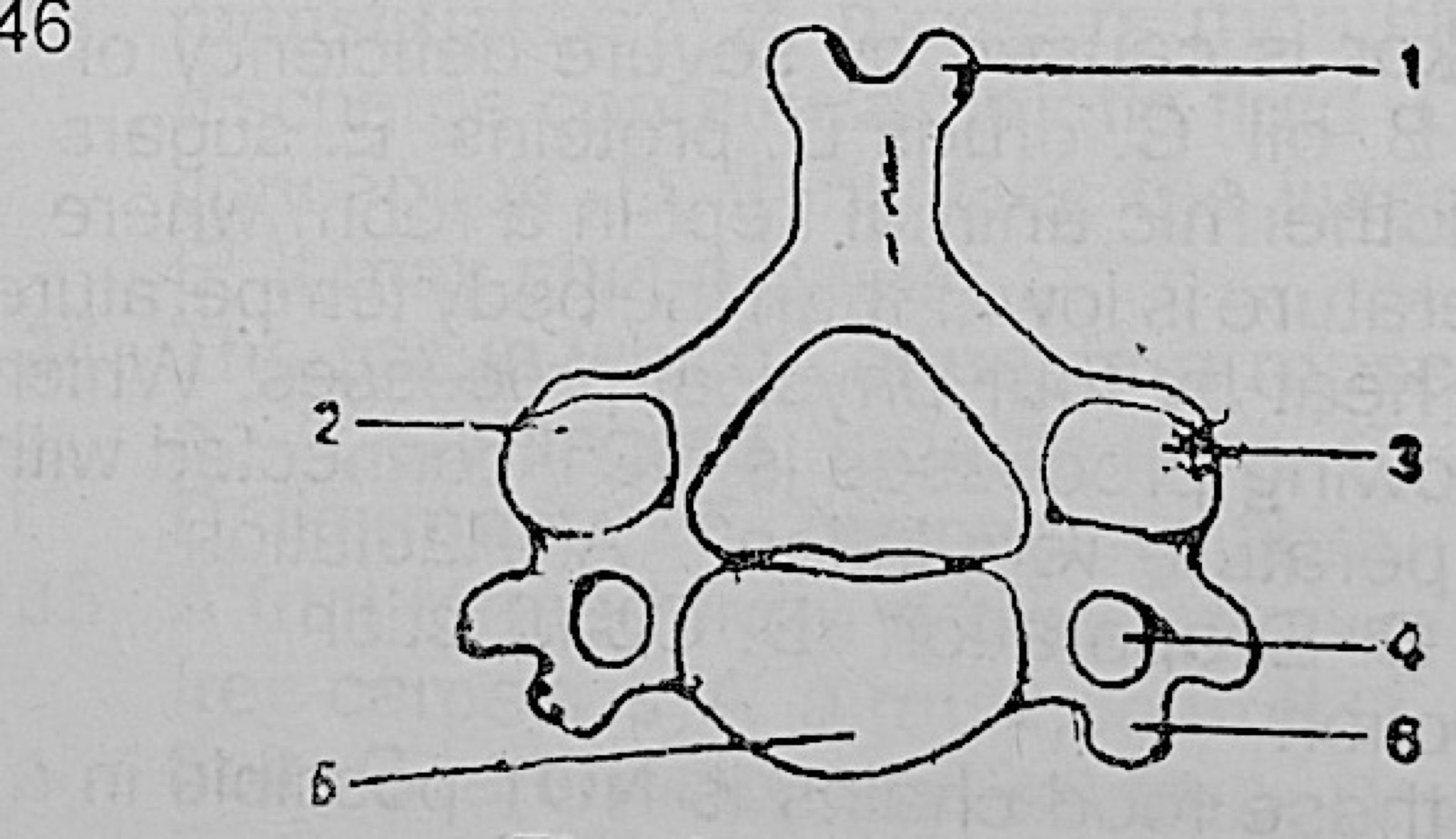
Question 46 Support and Movement Fig. 2: Cervical vertebra
A. 1 and 4 B. 2 and 3 C. 3 and 5 D. 1,2 and 6 E. 4 and 5. Show the answer and explanation Answer: A (1 and 4 )
Explanation A cervical vertebra is recognised by its forked (bifid) neural spine (1) and its vertebrarterial canals (4).
Open this question
Question 47 Growth and Development In an epigeal germination, it is the
A. epicotyl that elongates fast B. hypocotyl that elongates fast C. hypogeal that elongates fast D. plumule that elongates fast E. roots that elongate fast. Show the answer and explanation Answer: B (hypocotyl that elongates fast )
Explanation In epigeal germination the hypocotyl grows quickly and lifts the cotyledons above the soil.
Open this question
Question 48 Animal Nutrition The mammalian pancreas is involved with the
A. digestion of food only B. digestion and absorption of food C. digestion of food and regulation of blood sugar D. digestion of food, production of hormone and the regulation of blood sugar E. digestion of food, and the production of insulin. Show the answer and explanation Answer: D (digestion of food, production of hormone and the regulation of blood sugar )
Explanation The pancreas makes digestive enzymes and also the hormones insulin and glucagon that control blood sugar.
Open this question
Question 49 Transport in Animals When a person with blood belonging to group O has lost much blood due to an accident, he can be given blood from persons who have blood belonging to
A. group O only B. group A only C. group AB only D. groups A and O E. groups AB and O. Show the answer and explanation Answer: A (group O only )
Explanation Group O plasma has both anti-A and anti-B antibodies, so a group O person can receive only group O blood.
Open this question
Question 50 Structure of Flowering Plants The absence of stomata shows that a leaf may be
A. from a floating plant B. from a submerged plant C. variegated D. from a terrestrial plant E. from a parasitic green plant. Show the answer and explanation Answer: B (from a submerged plant )
Explanation A fully submerged leaf exchanges gases directly with the water, so it has no stomata.
Open this question Sign up free for every JAMB Biology year, practice by topic and timed mocks.
Start practising free