Home › Past questions › JAMB › Biology › 1978 48 questions. Try each one, then open the answer to check yourself and read the explanation.
Sign up free to answer these questions on a CBT screen with a timer, then see your score and every answer explained.
Start practising free
Question 1 Ecological Associations A plant which grows on another plant without apparent harm to the host plant is called
A. a parasite B. an epiphyte C. a saprophyte D. a predator E. a hermaphrodite Show the answer and explanation Answer: B (an epiphyte )
Explanation An epiphyte uses another plant only for support and does not take food from it, so the host is not harmed.
Open this question
Question 2 Photosynthesis and Plant Nutrition 6CO2 + 6H2 O → (sunlight, chlorophyll) C6 H12 O6 + 6O2 ↑
A. proteinsynthesis B. respiration C. photosynthesis D. transpiration E. translocation Show the answer and explanation Answer: C (photosynthesis )
Explanation Carbon dioxide and water are turned into glucose and oxygen using light energy trapped by chlorophyll: this is photosynthesis.
Open this question
Question 3 Photosynthesis and Plant Nutrition The oxygen given off during the process is derived from
A. sunlight B. chlorophyll C. carbon dioxide D. atmosphere E. water Show the answer and explanation Answer: E (water )
Explanation In the light stage water is split (photolysis); its oxygen is released as oxygen gas.
Open this question
Question 4 Transport in Plants One of the functions of the xylem is
A. strengthening the stem B. manufacturing food C. reducing loss of water D. conducting manufactured food E. storing unused sugar Show the answer and explanation Answer: A (strengthening the stem )
Explanation Xylem vessels have lignified walls that give the stem strength, as well as carrying water; manufactured food is carried by phloem.
Open this question
Question 5 Sense Organs People suffering from myopia
A. can see near objects clearly B. can see far away objects clearly C. cannot see any object clearly D. are colour-blind E. are able to see better in the dark Show the answer and explanation Answer: A (can see near objects clearly )
Explanation Myopia is short sight: near objects are seen clearly but light from distant objects focuses in front of the retina.
Open this question
Question 6 Viruses, Monera, Protista and Fungi The cilia in paramecium are used for
A. respirating B. locomotion C. protection D. regulating food intake E. excretion Show the answer and explanation Answer: B (locomotion )
Explanation Paramecium beats its many cilia to swim through water.
Open this question
Question 7 Viruses, Monera, Protista and Fungi Euglena may be classified as a plant because it
A. has chloroplasts B. has a gullet C. lives in a pond D. possesses a flagellum E. has a pellicle Show the answer and explanation Answer: A (has chloroplasts )
Explanation Chloroplasts let Euglena make its own food by photosynthesis, a plant feature; the gullet, flagellum and pellicle are animal-like features.
Open this question
Question 8 Animal Kingdom A trawler on a fishing trip landed a type of animal with hairs on its body. This animal could have been
A. an amphibian B. a reptile C. a shark D. a mammal E. a seagull Show the answer and explanation Answer: D (a mammal )
Explanation Hair is found only in mammals, e.g. whales, dolphins or seals caught at sea.
Open this question
Question 9 Support and Movement Which of these types of skeleton is most appropriate to the cockroach?
A. Hydrostatic skeleton B. Exoskeleton C. Endoskeleton D. Cartilaginous skeleton E. Bony skeleton Show the answer and explanation Answer: B (Exoskeleton )
Explanation Insects such as the cockroach have a hard chitin covering outside the body, an exoskeleton.
Open this question
Question 10 Food Substances and Enzymes When proteins are broken down they also provide
A. oxygen B. carbohydrates C. energy D. amino-acids E. carbon dioxide Show the answer and explanation Answer: D (amino-acids )
Explanation Digestion (hydrolysis) of proteins breaks them into their building units, amino acids.
Open this question
Question 11 Transport in Plants The function of lenticels is
A. to remove excess water in the plant B. to absorb water from the atmosphere C. for gaseous exchange D. to absorb light E. to store food Show the answer and explanation Answer: C (for gaseous exchange )
Explanation Lenticels are loose pores in the bark of woody stems through which oxygen and carbon dioxide are exchanged.
Open this question
Question 12 Reproduction in Plants The following events take place during conjugation in Spirogyra 1. The protoplasm in each of the conjugating cells separate from the cell wall to form a gamete; the gamete of one filament passes through the conjugation tube to meet the gamete of the other filament 2. The zygote soon become surrounded by a thick brown wall to become zygospore which bursts after a short rest and germinates to produce a new filament 3. The nuclei of the gametes fuse to form a zygote 4. The protuberances meet and where they touch the cell-wall disappears so that a conjugation tube joining the two cells is formed 5. Protuberances appear on the walls of cells of two filaments of Spirogyra lying side by side opposite one another. Now, what is the correct sequence in which the above events occur?
A. 1,2,3,4,5 B. 1,2,4,5,3 C. 3,4,5,2,1 D. 5,4,1,3,2 E. 5,4,3,1,2 Show the answer and explanation Answer: D (5,4,1,3,2 )
Explanation Protuberances form first (5), they join into a tube (4), a gamete moves across (1), the nuclei fuse into a zygote (3) and the zygote becomes a zygospore (2).
Open this question
Question 13 Cell Structure and Organisation Which of the following is characteristic of the animal cell?
A. Presence of chloroplasts B. Possession of a cellulose cell wall C. Absence of large vacuoles D. Presence of large vacuoles E. Presence of chromosomes Show the answer and explanation Answer: C (Absence of large vacuoles )
Explanation Animal cells have no large central vacuole; chloroplasts, cellulose walls and large vacuoles are plant features, and chromosomes occur in both.
Open this question
Question 14 Nutrient Cycling Nitrifying bacteria keep the soil fertile by
A. converting nitrates to nitrogen B. converting ammonium salts to nitrates C. converting atmospheric nitrogen to plant protein D. converting nitrates to nitrous oxide E. converting atmospheric nitrogen to nitrates Show the answer and explanation Answer: B (converting ammonium salts to nitrates )
Explanation Nitrifying bacteria (Nitrosomonas, Nitrobacter) oxidise ammonium compounds to nitrites and then nitrates that plants can absorb.
Open this question
Question 15 Microorganisms and Health In the life history of Schistosoma (Bilharzia), one of the following is the intermediate host:
A. man B. snail C. mosquito larva D. crayfish E. fish Show the answer and explanation Answer: B (snail )
Explanation The larvae of Schistosoma develop in freshwater snails before infecting man, the primary host.
Open this question
Question 16 Reproduction in Plants In which one of the following groups of organisms do all the members have asexual methods of reproduction?
A. A green filamentous alga, a flowering plant and a bird B. A toad (or frog), Amoeba and Mucor (or Penicillium) C. A flowering plant, tapeworm (or Ascaris) and a green filamentous alga D. Mucor (or Penicillium), a bird and a toad (or frog) E. Amoeba, Mucor (or Penicillium) and a green filamentous alga Show the answer and explanation Answer: E (Amoeba, Mucor (or Penicillium) and a green filamentous alga )
Explanation Amoeba divides by binary fission, Mucor forms spores and filamentous algae fragment; birds, toads and Ascaris reproduce only sexually.
Open this question
Question 17 Hormonal Coordination The hormone which tones up the muscles of a person in time of danger is from the
A. thyroid gland B. pancreas C. adrenal gland D. liver E. spleen Show the answer and explanation Answer: C (adrenal gland )
Explanation The adrenal glands release adrenaline, the "fight or flight" hormone that prepares muscles for action.
Open this question
Question 18 Ecosystem and Ecological Factors The study of the organism and the environment of an abandoned farmland is the ecology of
A. a community B. a population C. a species D. a habitat E. an ecosystem Show the answer and explanation Answer: E (an ecosystem )
Explanation Studying all the organisms together with their non-living surroundings is studying an ecosystem.
Open this question
Question 19 Excretion Which one of the following statements about the mammalian kidney is false?
A. The glomerulus is formed by a branch of the renal artery B. The glomerulus is a part of uriniferous tubules C. The Bowman's capsule is in the cortex of the kidney D. The uriniferous tubules are richly supplied with blood vessels E. The glomerulus is lodged in the Bowman's capsule Show the answer and explanation Answer: B (The glomerulus is a part of uriniferous tubules )
Explanation The glomerulus is a knot of blood capillaries sitting inside Bowman's capsule; it is not part of the tubule itself.
Open this question
Question 20 Transport in Plants A potometer with a leafy shoot weighed 18.9g initially and 17.9g after 1 hour. From this it follows that
A. the shoot absorbed 1 g of water per hour B. 1 g of water per hour evaporates from the potometer C. the shoot lost 1 g of water per hour D. the potometer water receded at the rate of 1 g per hour E. the shoot was respiring and lost weight at the rate of 1 g per hour Show the answer and explanation Answer: C (the shoot lost 1 g of water per hour )
Explanation The whole set-up lost 1 g in 1 hour; this loss is water given off by the leafy shoot in transpiration.
Open this question
Question 21 Reproduction in Animals At fertilisation
A. one chromosome from the male joins another from the female B. one gene from the male combines with another from the female C. the male nucleus fuses with the female nucleus D. one set of chromosomes combines with another set from the female E. one cell from the male fuses with another from the female Show the answer and explanation Answer: C (the male nucleus fuses with the female nucleus )
Explanation Fertilisation is the fusion of the male gamete nucleus with the female gamete nucleus to form a zygote.
Open this question
Question 22 Animal Kingdom The neck region of the tapeworm, (taenia) is responsible for the
A. production of eggs B. storage of eggs C. formation of new segments D. development of the suckers E. fragmentation of the body segments Show the answer and explanation Answer: C (formation of new segments )
Explanation New proglottids (segments) are budded off continually from the neck, just behind the scolex.
Open this question
Question 23 Animal Kingdom Which of these is not true of the insect? The possession of
A. two pairs of antennae B. jointed appendages C. exoskeleton D. three pairs of legs E. segmented body Show the answer and explanation Answer: A (two pairs of antennae )
Explanation Insects have only one pair of antennae; two pairs is a feature of crustaceans.
Open this question
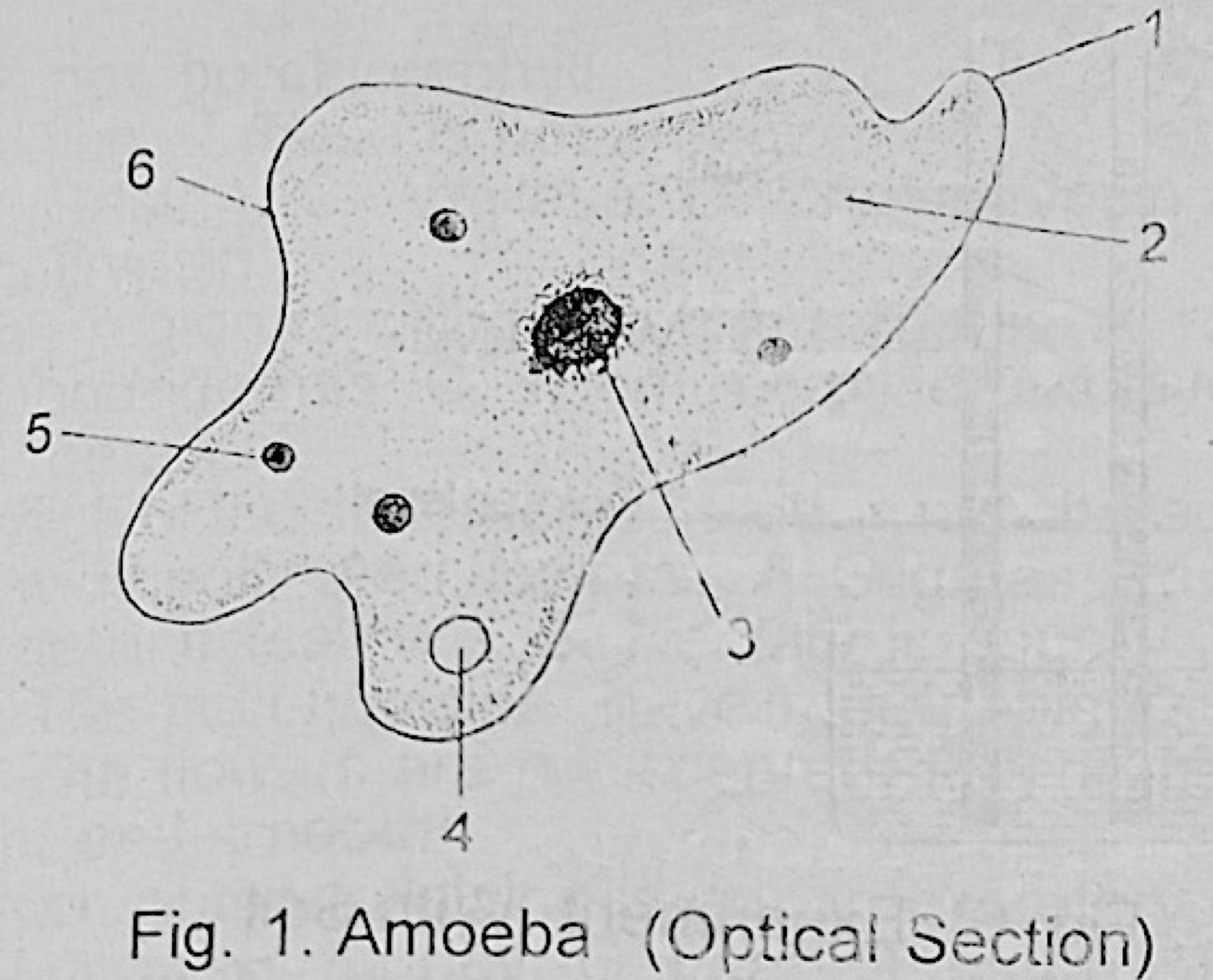
Question 24 Reproduction in Animals Fig. 1. Amoeba (Optical Section)
A. 1 B. 2 C. 3 D. 4 E. 5 Show the answer and explanation Answer: C (3 )
Explanation In binary fission of Amoeba the nucleus (part 3) divides first, then the cytoplasm.
Open this question
Question 25 Animal Nutrition Rhizopus (or Mucor) obtains its food from dead organic matter extracellularly. It is said to be
A. a facultative parasite B. a saprophyte C. an obligate parasite D. a commensal E. an autotroph Show the answer and explanation Answer: B (a saprophyte )
Explanation An organism that digests dead organic matter outside its body and absorbs the products is a saprophyte.
Open this question
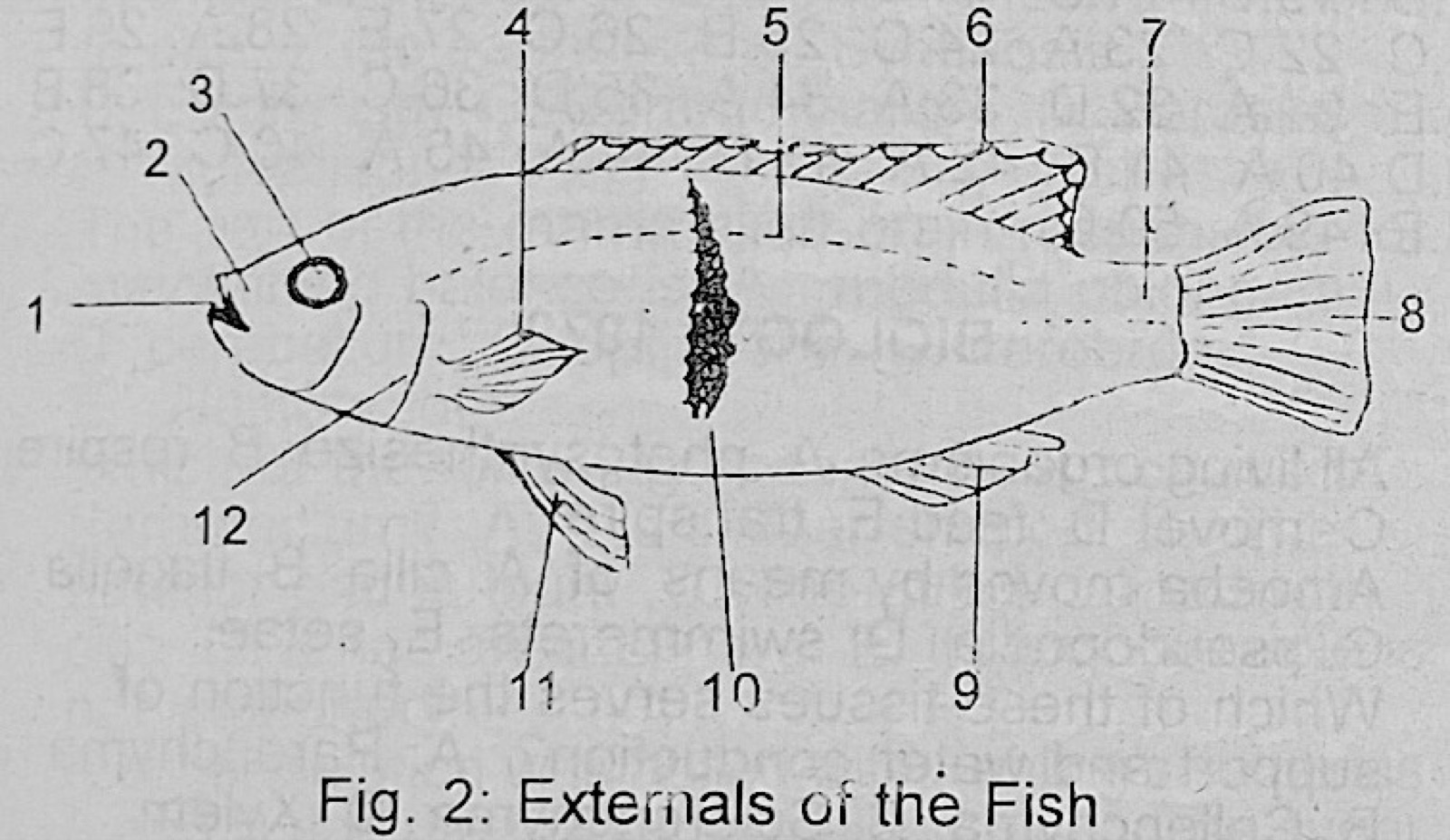
Question 26 Animal Kingdom Figure 2 shows the externals of a bony fish.
A. pectoral fin B. scale C. opercular plate D. gill plate E. pectoral girdle Show the answer and explanation Answer: C (opercular plate )
Explanation Part 12 points to the hind edge of the head, the bony operculum (gill cover).
Open this question
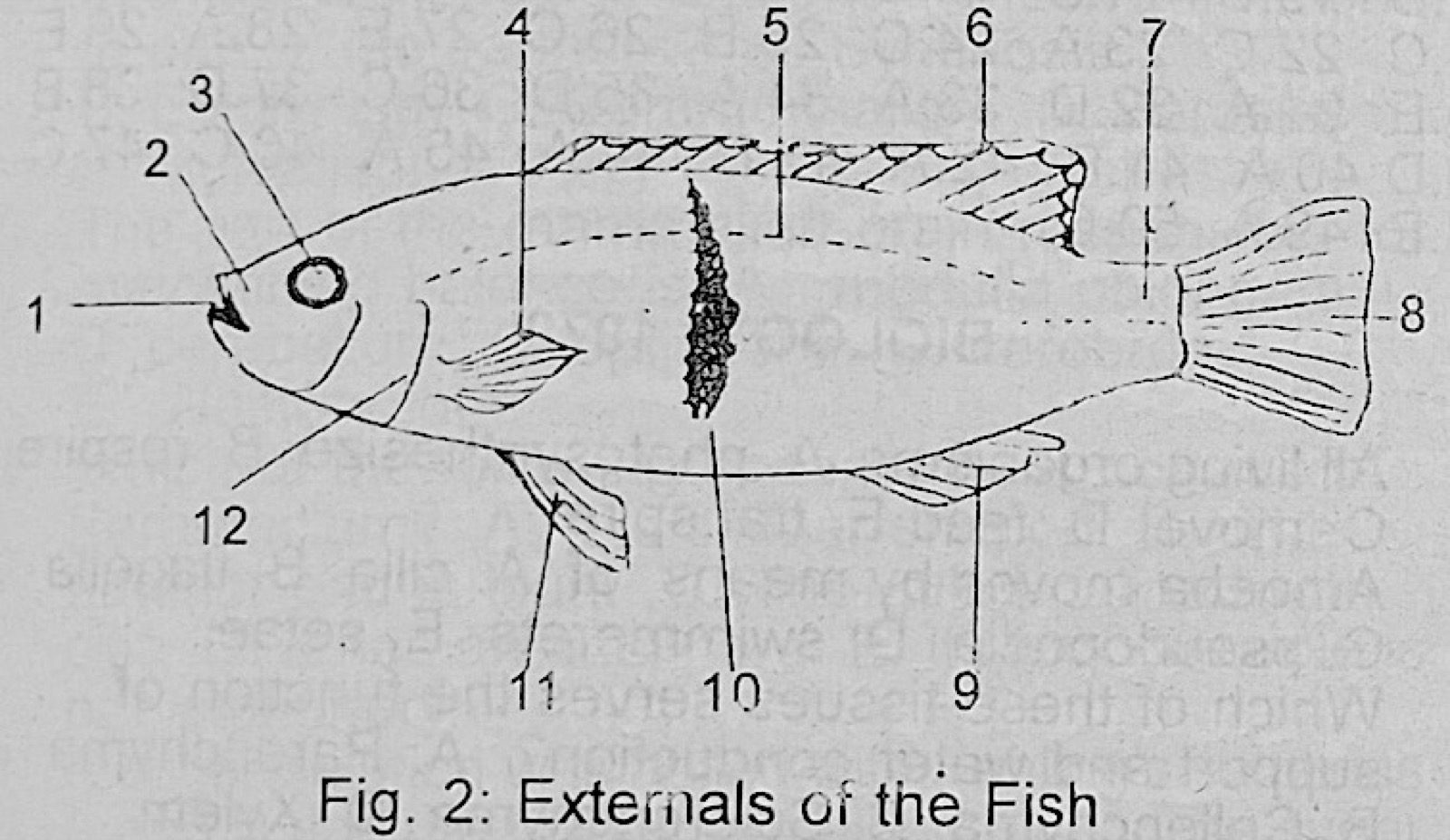
Question 27 Support and Movement Figure 2 shows the externals of a bony fish.
A. 7 B. 5 C. 3 D. 6 E. 10 Show the answer and explanation Answer: E (10 )
Explanation The fins (such as the dorsal fin, 6, and the tail region, 7) drive and steer the fish, and the eye (3) and lateral line (5) guide it to the target. Part 10, the scales, only cover and protect the body, so they are not involved.
Open this question
Question 28 Animal Kingdom The feature that distinguishes the toad or frog from a fish is the absence of
A. scales B. lungs C. paired appendages D. a tail E. skin glands Show the answer and explanation Answer: A (scales )
Explanation Toads and frogs have a moist naked skin without scales, while fish are covered with scales.
Open this question
Question 29 Reproduction in Animals Which of these is not associated with the tadpole stages of the toad or frog?
A. V-shaped gland B. Operculum C. External gills D. Jelly E. shell Show the answer and explanation Answer: E (shell )
Explanation Frog eggs are laid in jelly and have no shell; tadpoles have external gills, an operculum and a sucker (V-shaped gland).
Open this question
Question 30 Support and Movement Which of these is not associated with the movement of the toad, reptile or birds?
A. Hopping B. Bopping C. Flapping D. Gliding E. Pecking Show the answer and explanation Answer: E (Pecking )
Explanation Pecking is a way of feeding in birds, not a way of moving about.
Open this question
Question 31 Animal Kingdom Which of these is not a part of the feather of a bird?
A. Wing B. Aftershaft C. Inferior umbilicus D. Vane E. Barbule Show the answer and explanation Answer: A (Wing )
Explanation The wing is a limb that carries feathers; aftershaft, inferior umbilicus, vane and barbules are parts of a feather.
Open this question
Question 32 Homeostasis Which of these is not a function of the mammalian skin?
A. Protection against bacterial infection B. Excretion of wastes and water C. Production of vitamin D when exposed to light D. Production of pigments to reduce temperature E. Regulation of body temperature Show the answer and explanation Answer: D (Production of pigments to reduce temperature )
Explanation Skin pigment (melanin) protects against ultraviolet light; it does not lower body temperature.
Open this question
Question 33 Photosynthesis and Plant Nutrition Which of the these elements is required by plants in small quantities only?
A. Boron B. Nitrogen C. Phosphorus D. Magnesium E. Potassium Show the answer and explanation Answer: A (Boron )
Explanation Boron is a trace (micro) element; nitrogen, phosphorus, magnesium and potassium are needed in large amounts.
Open this question
Question 34 Photosynthesis and Plant Nutrition Which of these is a direct photosynthetic product
A. Glucose B. Starch C. Protein D. Fats E. Latex Show the answer and explanation Answer: A (Glucose )
Explanation Glucose is the first sugar formed in photosynthesis; starch, proteins and fats are made from it later.
Open this question
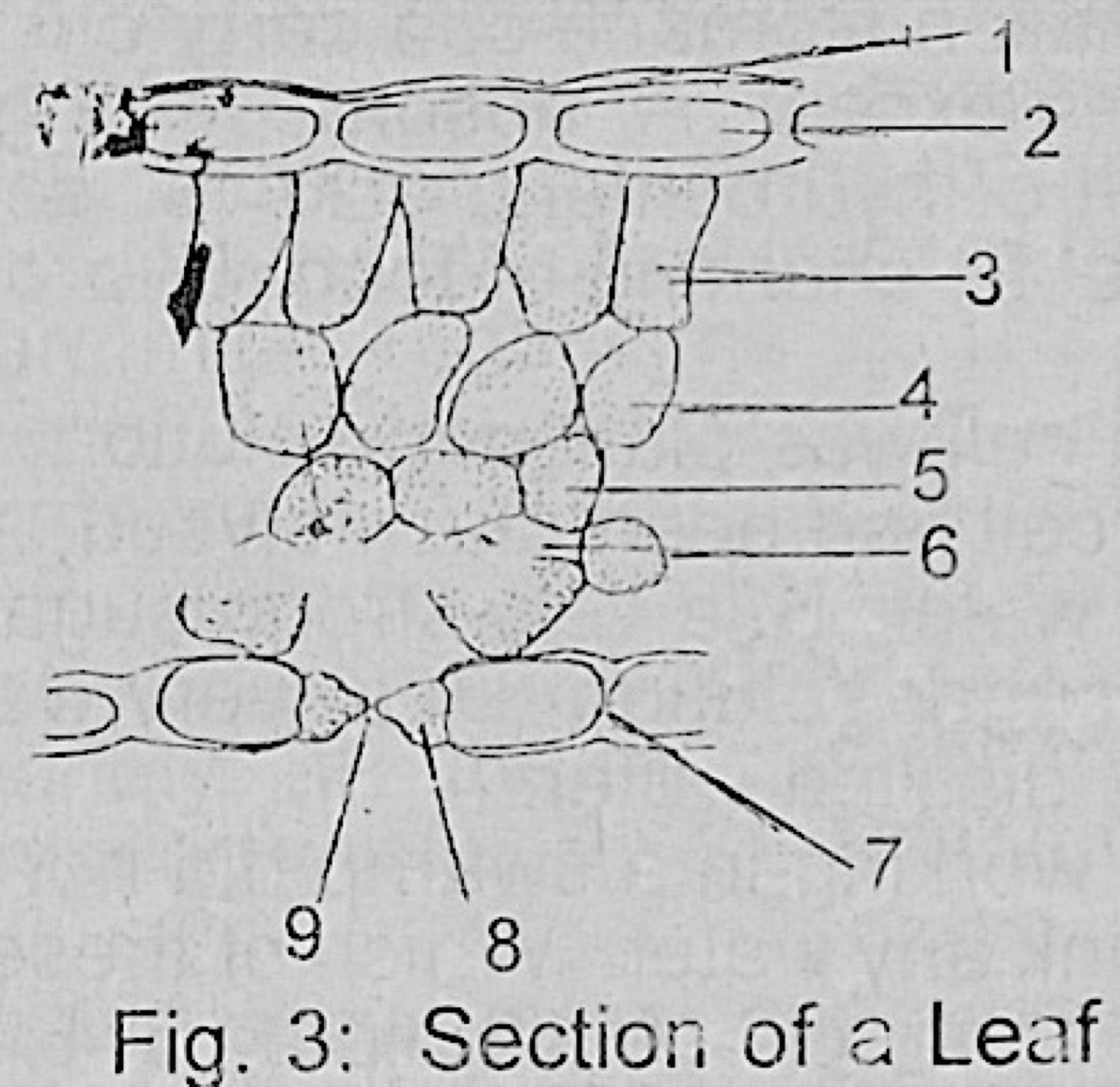
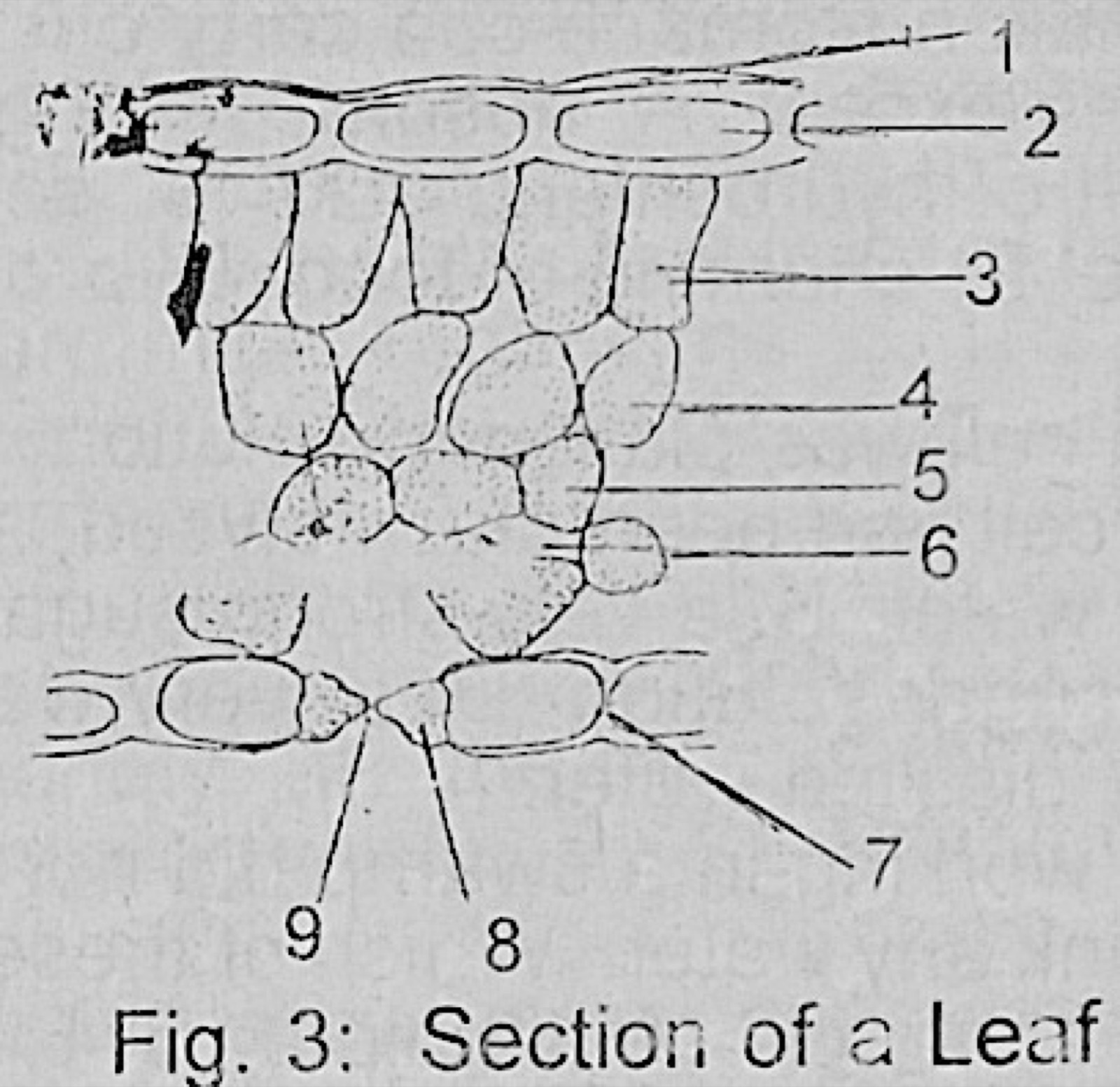
Question 35 Structure of Flowering Plants Figure 3 is a section of a leaf.
A. upper epidermis B. cuticle C. stoma D. guard cell E. lower epidermis Show the answer and explanation Answer: D (guard cell )
Explanation Label 8 points to one of the two bean-shaped cells around the pore in the lower epidermis, a guard cell.
Open this question
Question 36 Photosynthesis and Plant Nutrition Figure 3 is a section of a leaf.
A. 5 B. 6 C. 3 D. 2 E. 8 Show the answer and explanation Answer: C (3 )
Explanation Part 3 is the palisade mesophyll, whose cells are packed with chloroplasts that trap light.
Open this question
Question 37 Photosynthesis and Plant Nutrition Figure 3 is a section of a leaf.
A. 9 B. 8 C. 5 D. 2 E. 3 Show the answer and explanation Answer: D (2 )
Explanation Part 2 is the upper epidermis, whose cells lack chloroplasts; stomata, guard cells and mesophyll all take part.
Open this question
Question 38 Transport in Plants A potometer was used to compare the rate of loss of the same volume of water from a plant under different environmental conditions as under a fan, at the sea shore, under the sun, in the airy laboratory and in cupboard. Which of the items was likely to have been obtained in a cupboard?
A. 15 secs B. 30 secs C. 25 secs D. 20 secs E. 28 secs Show the answer and explanation Answer: B (30 secs )
Explanation A dark, still, humid cupboard gives the slowest transpiration, so the same volume takes the longest time (30 s).
Open this question
Question 41 Cell and Its Environment A spirogyra cell was placed in solution X. After 1 minute the cell had been plasmolysed, solution X was
A. tap water B. a very strong sugar solution C. a weak sugar solution D. a very weak salt solution E. distilled water. Show the answer and explanation Answer: B (a very strong sugar solution )
Explanation A cell plasmolyses when water leaves it by osmosis into a more concentrated (hypertonic) solution, such as strong sugar solution.
Open this question
Question 42 Microorganisms and Health A farmer X working in a swamp did not eat any food nor drink any water. Which of these diseases can he not contract?
A. Cholera B. Bilharzia C. River blindness D. Malaria E. Sleeping sickness Show the answer and explanation Answer: A (Cholera )
Explanation Cholera is caught by swallowing contaminated food or water; the others enter through the skin or insect bites.
Open this question
Question 43 Transport in Animals A carbohydrate molecule in the right ventricle of the heart is pumped into the cell of the toe of man. Which of these structures is it unlikely to pass through en-route?
A. Pulmonary artery B. Lungs C. Heart D. Liver E. Aorta. Show the answer and explanation Answer: D (Liver )
Explanation Its route is pulmonary artery → lungs → left side of the heart → aorta → leg arteries; it does not pass through the liver.
Open this question
Question 44 Plant Responses and Hormones In a phototropic experiment, young seedlings in a box were subjected to light from one direction. The seedlings continued to grow erect. Which of the following statements is correct?
A. Only the tips of the seedlings received light B. The light was not strong enough C. The seedlings were rather too young. D. The tips of the seedlings may have been covered E. The box containing the seedlings should have been placed on a laboratory bench. Show the answer and explanation Answer: D (The tips of the seedlings may have been covered )
Explanation The shoot tip detects one-sided light; if the tips were covered, no bending would occur.
Open this question
Question 45 Reproduction in Plants Which of these is not a characteristic of wind pollinated flowers?
A. Smaller quantities of sticky pollen produced B. Feathery styles of stigmas pendulously hang outside the flower. C. Small, inconspicuous scentless flowers D. Large anthers which are loosely attached to filaments E. Light pollen grains produced in large quantities from anthers. Show the answer and explanation Answer: A (Smaller quantities of sticky pollen produced )
Explanation Wind-pollinated flowers make huge amounts of light, dry pollen; small amounts of sticky pollen belong to insect-pollinated flowers.
Open this question
Question 46 Respiration A germinating seed requires oxygen which is essential for
A. converting carbohydrate into glucose B. transporting energy from one part of the plant to another C. the production of energy by oxidising essential carbohydrates D. hydrolysis of proteins E. the formation of water molecules within the germinating seed. Show the answer and explanation Answer: C (the production of energy by oxidising essential carbohydrates )
Explanation Oxygen is used in aerobic respiration to oxidise stored food and release energy for growth.
Open this question
Question 47 Excretion Which of these products obtained from analysing sweat from the skin is not an excretory product?
A. Water B. Salts C. Dust D. Urea E. Urates Show the answer and explanation Answer: C (Dust )
Explanation Dust comes from outside the body and is not a waste of metabolism, so it is not excreted.
Open this question
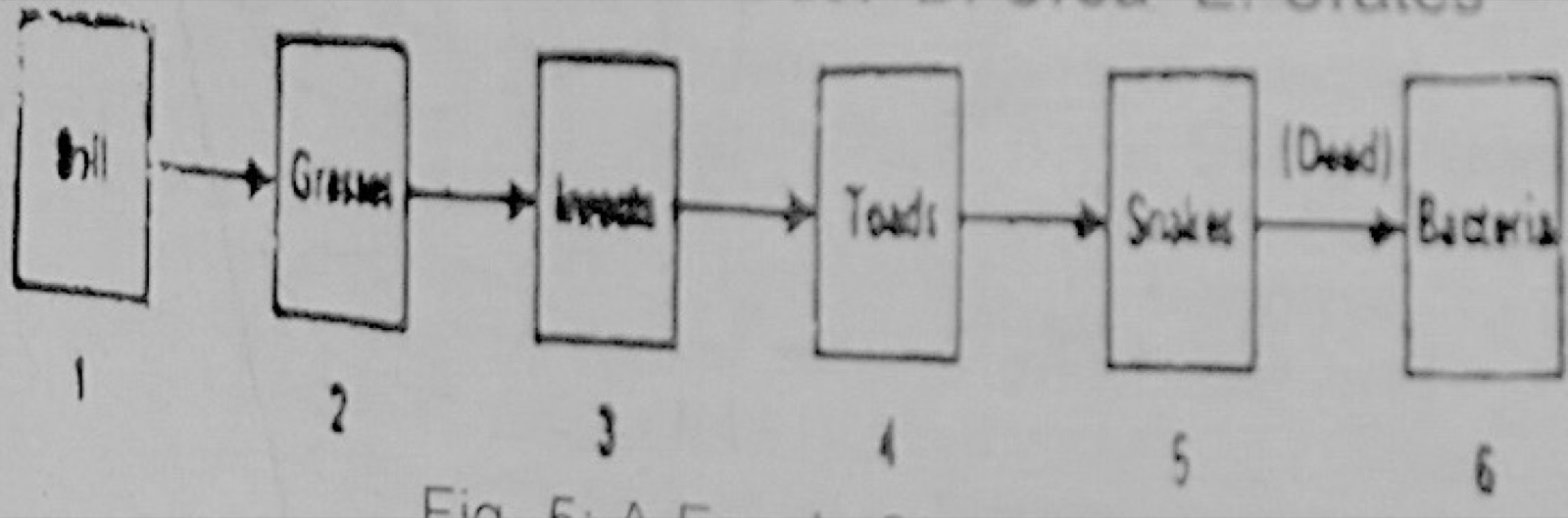
Question 48 Feeding Relationships and Energy Flow Fig. 5: A Food Chain
A. 6 B. 2 C. 3 D. 5 E. 4 Show the answer and explanation Answer: E (4 )
Explanation Grasses (2) are producers, insects (3) primary consumers and toads (4) eat the insects, so toads are the secondary consumers.
Open this question
Question 49 Mendelian Inheritance In a breeding programme a cross was made between two true-breeding cowpea types: one with round seeds and the other with wrinkled seeds. If roundness is dominant while wrinkleness is recessive, in the first filial generation all the seeds produced will be
A. 25 per cent wrinkled, 75 per cent round B. 100 per cent wrinkled C. 50 per cent wrinkled, 50 per cent round D. 75 per cent wrinkled, 25 per cent round E. 100 per cent round. Show the answer and explanation Answer: E (100 per cent round. )
Explanation RR × rr gives only Rr offspring; since round is dominant, every F1 seed is round.
Open this question
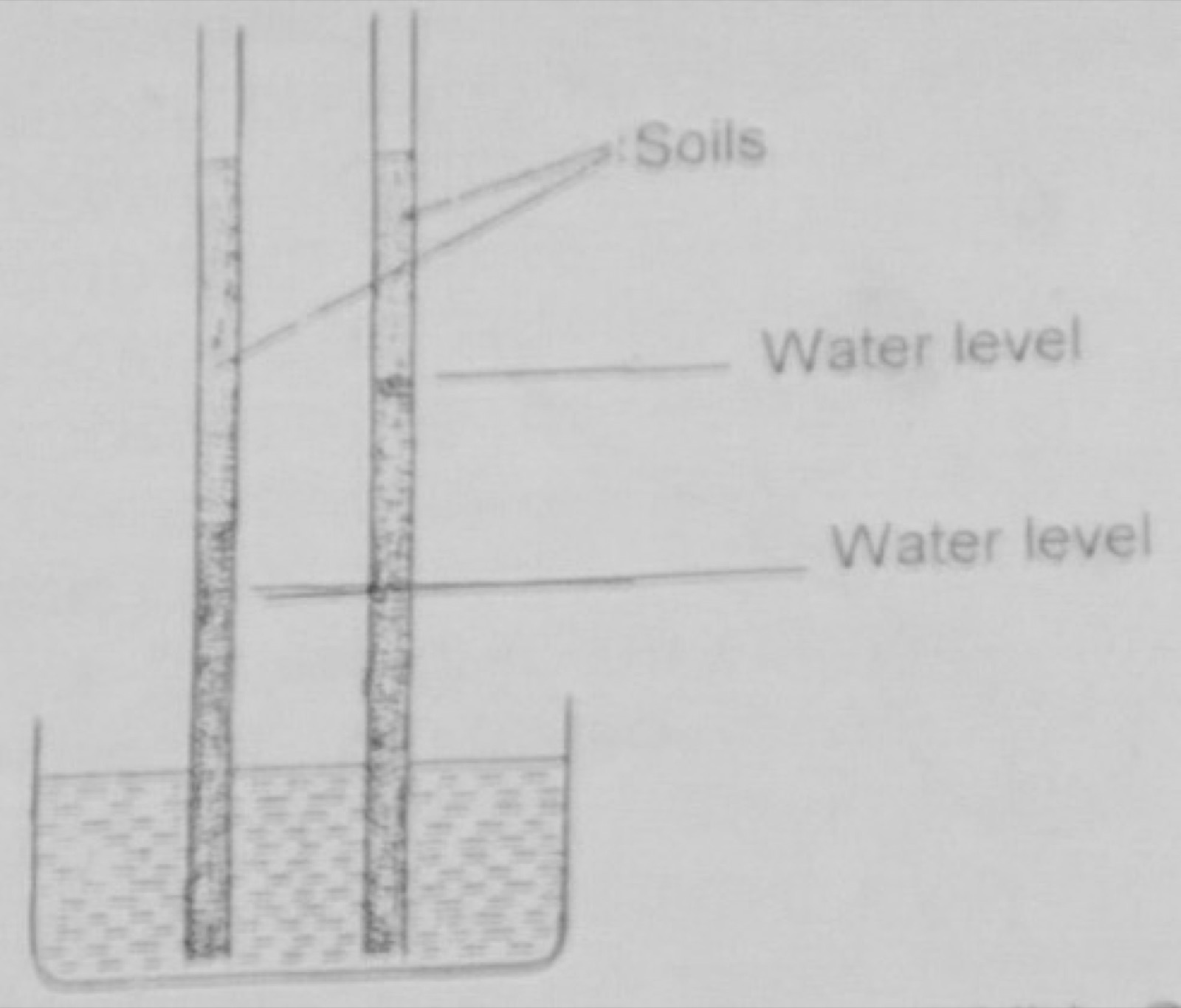
Question 50 Soil Figure 6 represents an experiment with two types of soil. The experiment demonstrates
A. soil attraction for water B. soil porosity C. soil capillarity D. draining capacity of soils E. soil permeability. Show the answer and explanation Answer: C (soil capillarity )
Explanation Water rises up the soil-filled tubes from the dish below, showing capillarity; the finer soil lifts water higher.
Open this question Sign up free for every JAMB Biology year, practice by topic and timed mocks.
Start practising free