Question 1
IndicesSimplify: 125−1/3 × 49−1/2 × 100
- A.350
- B.35
- C.1/35
- D.1/350
- E.0
Show the answer and explanation
Answer: C (1/35)
Explanation
125−1/3 = 1/5, 49−1/2 = 1/7 and 100 = 1, so the product is 1/35.
60 questions. Try each one, then open the answer to check yourself and read the explanation.
Simplify: 125−1/3 × 49−1/2 × 100
Answer: C (1/35)
125−1/3 = 1/5, 49−1/2 = 1/7 and 100 = 1, so the product is 1/35.
If 32x = 27, what is x?
Answer: B (1.5)
27 = 33, so 2x = 3 and x = 1.5.
Express 0.00562 in standard form
Answer: A (5.62 × 10⁻³)
Move the decimal point 3 places to the right to get 5.62, so the power of 10 is −3.
Given that 1/3 log10P = 1, find the value of P.
Answer: E (1000)
Multiply by 3: log10P = 3, so P = 103 = 1000.
Simplify: (log√8)/(log 8)
Answer: B (1/2)
log√8 = log 81/2 = ½ log 8, so the fraction is ½.
Evaluate, using logarithm table, log(0.65)2
Answer: D (1̄.6258)
log 0.65 = 1̄.8129, and log(0.65)2 = 2 × 1̄.8129 = 1̄.6258.
If log x = 2̄.3675 and log y = 0.9750, what is the value of x + y? Correct to three significant figures.
Answer: E (9.46)
x = antilog 2̄.3675 = 0.02331 and y = antilog 0.9750 = 9.441, so x + y = 9.464 ≈ 9.46.
While doing his Physics practicals, Idowu recorded a reading as 1.12cm instead of 1.21cm. Calculate his percentage error.
Answer: C (7.44%)
Error = 1.21 − 1.12 = 0.09. Percentage error = 0.09/1.21 × 100 ≈ 7.44%.
Find the 4th term of an A.P. whose first term is 2 and the common difference is 0.5.
Answer: C (3.5)
4th term = a + 3d = 2 + 3(0.5) = 3.5.
From the graph, determine the roots of the equation y = 2x2 + x − 6.
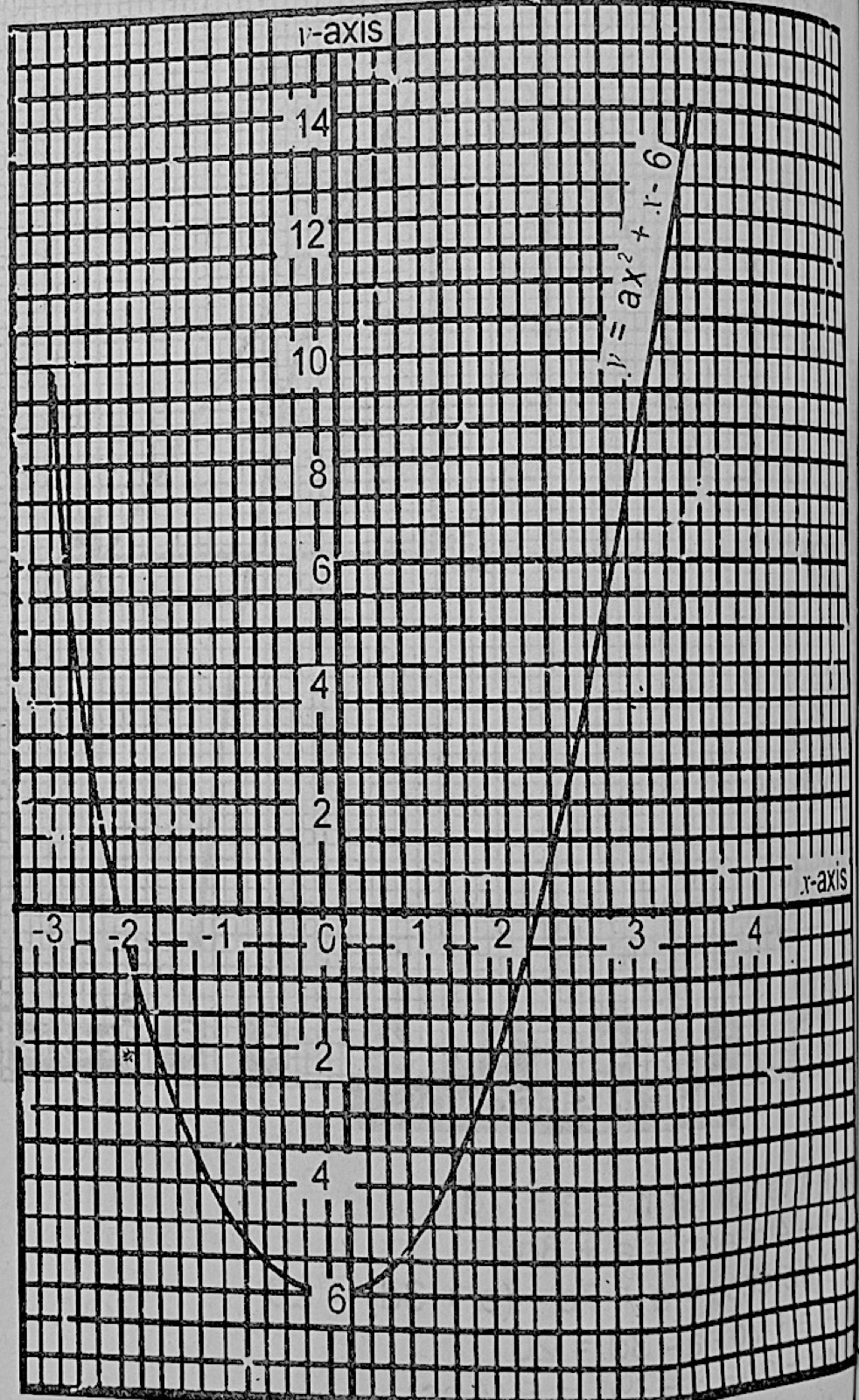
Answer: C (−2, 1.5)
The roots are where the curve crosses the x-axis: x = −2 and x = 1.5. Check: 2x2 + x − 6 = (2x − 3)(x + 2).
From the graph of y = 2x2 + x − 6, find the values of x for which y = 5
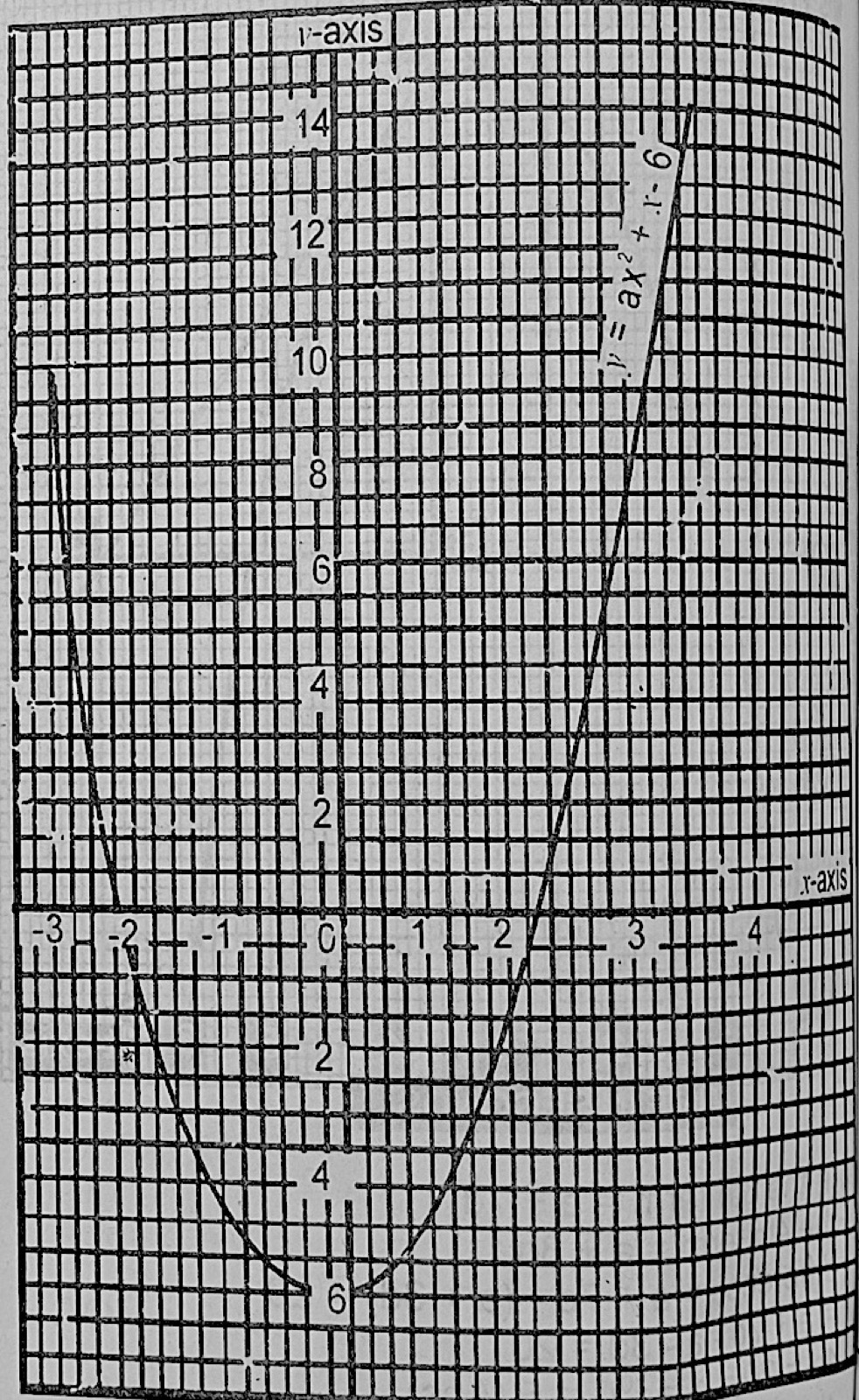
Answer: B (−2.6, 2.1)
Draw the line y = 5 and read where it meets the curve: about x = −2.6 and x = 2.1 (solving 2x2 + x − 11 = 0 gives −2.61 and 2.11).
An arc of length 22cm subtends an angle of θ at the centre of the circle. What is the value of θ if the radius of the circle is 15cm? (Take π = 22/7)
Answer: B (84°)
θ/360 × 2 × 22/7 × 15 = 22, so θ = 22 × 360 × 7/(44 × 15) = 84°.
Find the sum of the first five terms of the G.P. 2, 6, 18, ...
Answer: C (242)
a = 2, r = 3. S5 = 2(35 − 1)/(3 − 1) = 35 − 1 = 242.
Let J be the set of positive integers. If H = {x : x ∈ J, x2 < 3 and x ≠ 0}, then
Answer: A (H = {1})
The only positive integer whose square is less than 3 is 1 (22 = 4 is too big), so H = {1}.
In a class of 80 students, every student had to study Economics or Geography, or both Economics and Geography. If 65 students studied Economics and 50 studied Geography, how many studied both subjects?
Answer: C (35)
n(E ∪ G) = n(E) + n(G) − n(E ∩ G), so 80 = 65 + 50 − n(E ∩ G) and n(E ∩ G) = 35.
The area shaded with horizontal lines is the solution set of the inequalities:
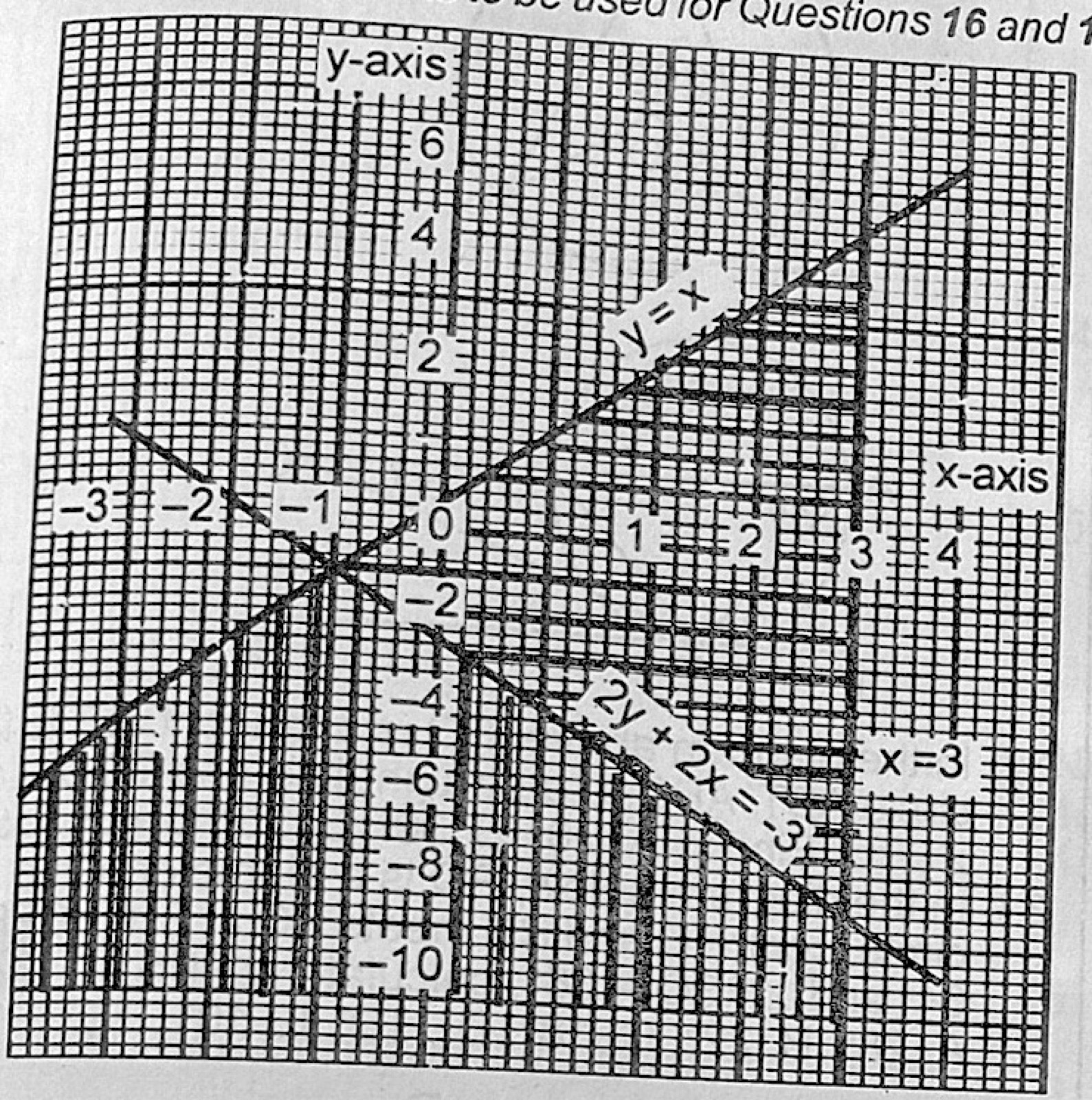
Answer: B (y ≤ x, y + 2x ≥ −3, x ≤ 3)
The horizontal-lined region lies below y = x, above the falling line y + 2x = −3 and to the left of x = 3.
The area shaded with vertical lines is the solution set of the inequalities:
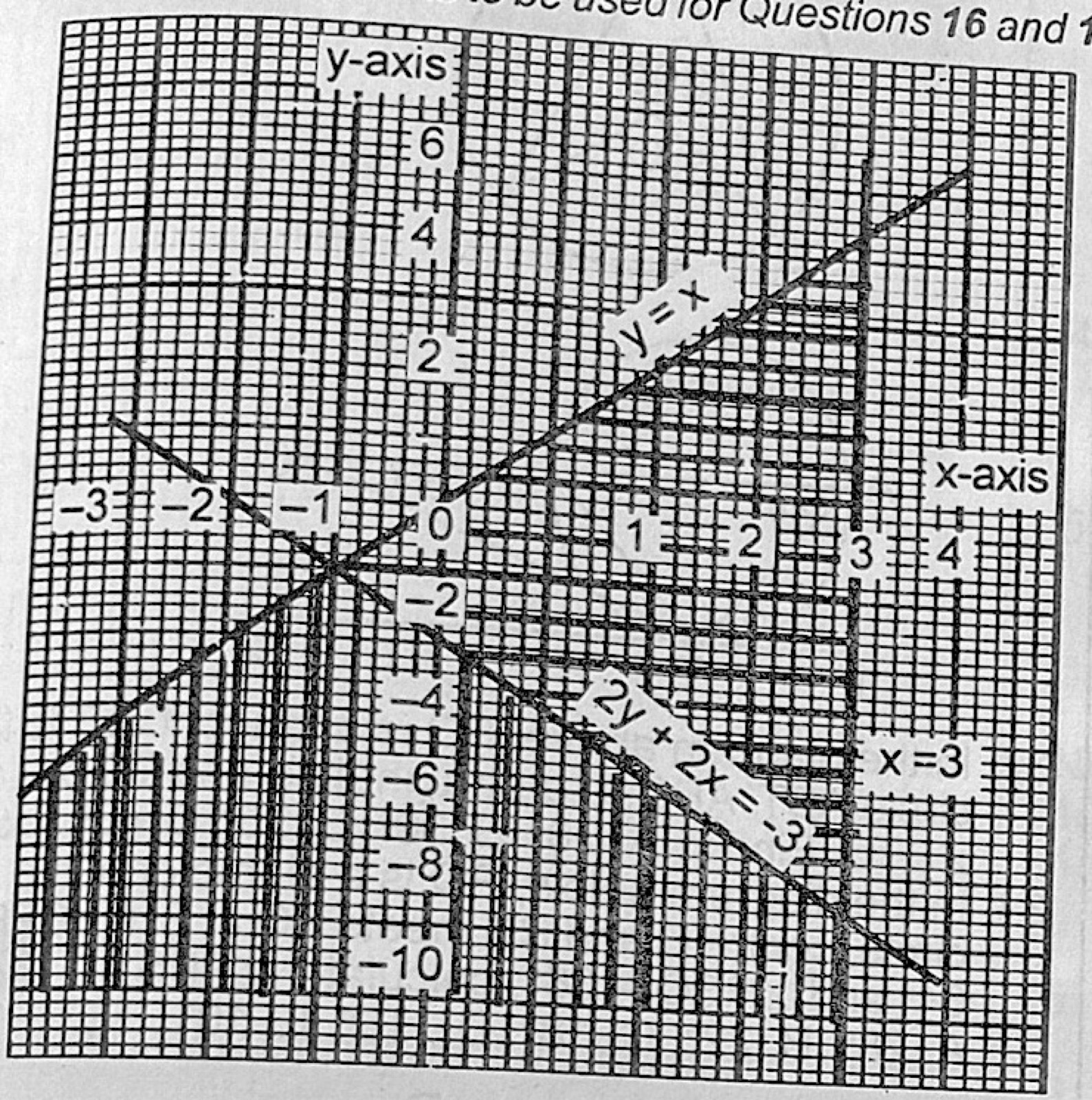
Answer: A (y ≤ x, y + 2x ≤ −3)
The vertical-lined region lies below the line y = x and below the falling line y + 2x = −3, so y ≤ x and y + 2x ≤ −3.
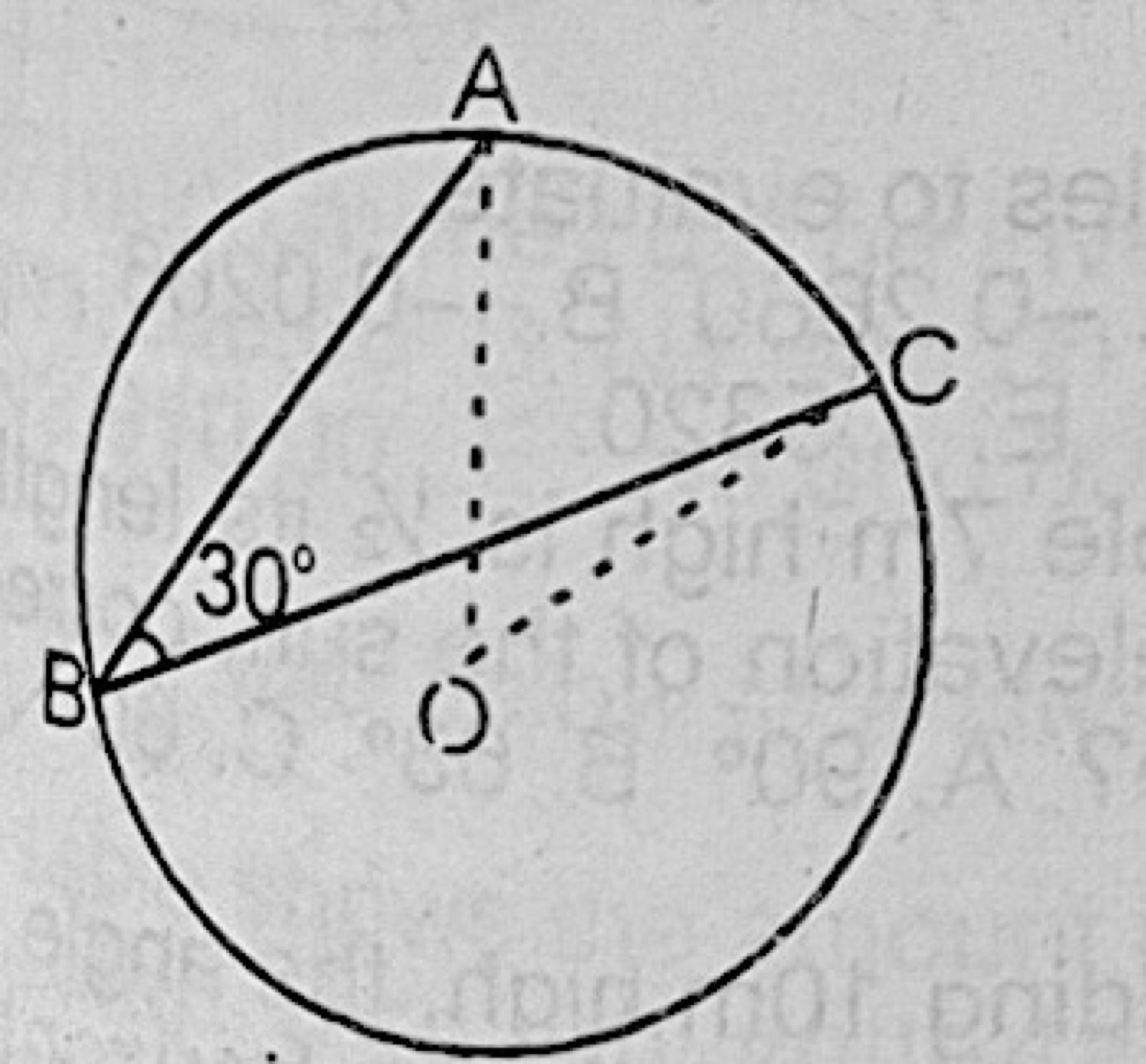
In the diagram below, O is the centre of the circle with radius 10cm, and ∠ABC = 30°. Calculate, correct to 1 decimal place, the length of arc AC. (Take π = 3.14)
Answer: B (10.5cm)
The angle at the centre is twice the angle at the circumference: ∠AOC = 60°. Arc AC = 60/360 × 2 × 3.14 × 10 = 10.47 ≈ 10.5cm.
Factorize x2 + 4x − 192
Answer: C ((x − 12)(x + 16))
Find two numbers with product −192 and sum 4: 16 and −12. So x2 + 4x − 192 = (x − 12)(x + 16).
Factorize 2e2 − 3e + 1
Answer: A ((2e − 1)(e − 1))
(2e − 1)(e − 1) = 2e2 − 2e − e + 1 = 2e2 − 3e + 1.
Solve the equation 7y2 = 3y.
Answer: C (y = 0 or 3/7)
7y2 − 3y = 0 gives y(7y − 3) = 0, so y = 0 or y = 3/7.
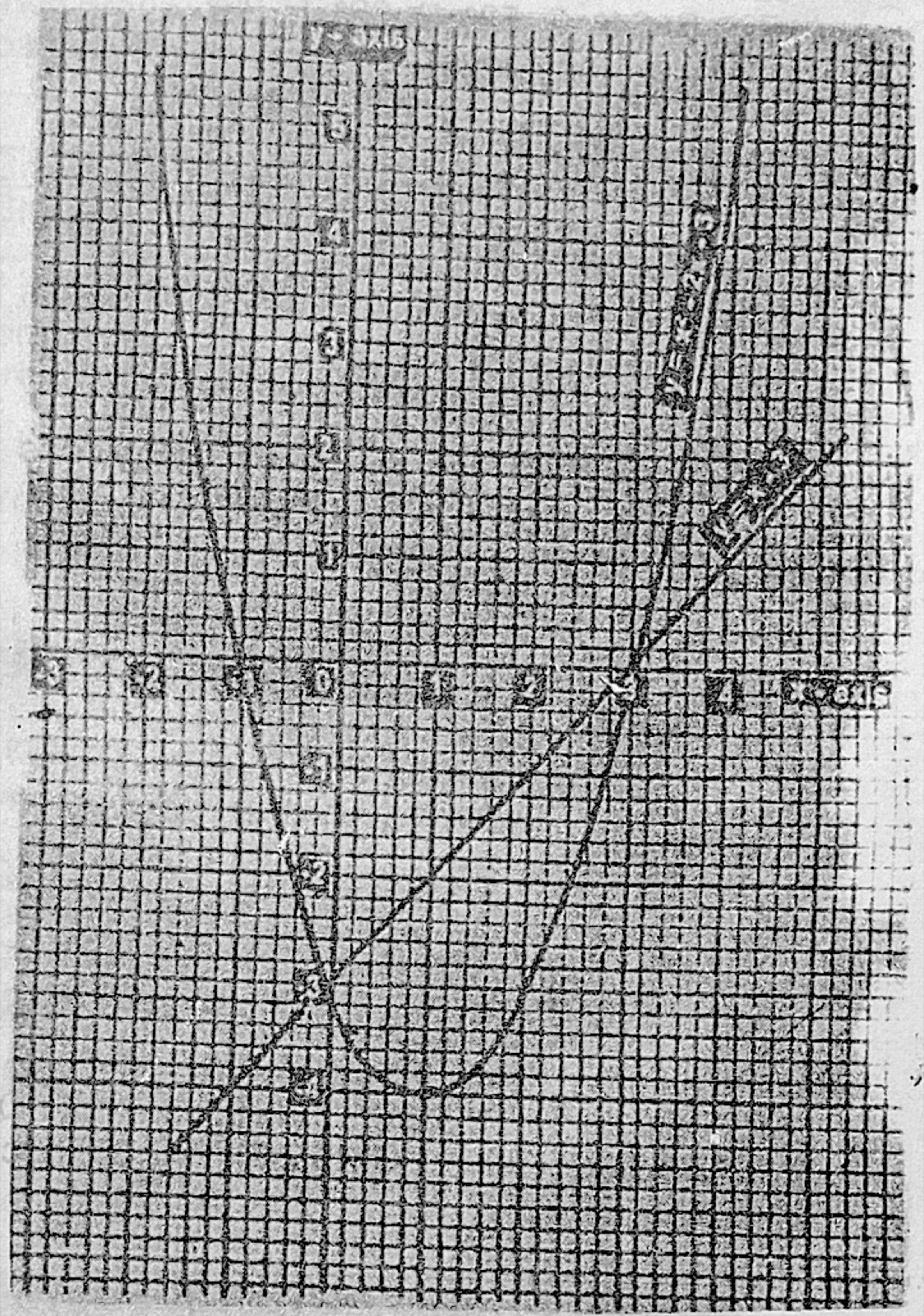
Use the graph to answer this question. Locate the points where y = x − 3 intersects y = x2 − 2x − 3
Answer: D ((3,0), (0,−3))
Set x2 − 2x − 3 = x − 3: x2 − 3x = 0, so x = 0 or 3, giving the points (0, −3) and (3, 0).
Find the value of m which makes x2 + 8x + m a perfect square.
Answer: E (16)
m must be (half of 8)2 = 16, giving (x + 4)2.
Solve the equation 2a2 − 3a − 27 = 0.
Answer: E (−3, 9/2)
2a2 − 3a − 27 = (2a − 9)(a + 3) = 0, so a = 9/2 or a = −3.
A sector of a circle of radius 7cm has an area of 44cm2. Calculate the angle of the sector, correct to the nearest degree. (Take π = 22/7)
Answer: D (103°)
θ/360 × 22/7 × 72 = 44 gives θ/360 × 154 = 44, so θ = 102.9° ≈ 103°.
Calculate the surface area of a sphere of radius 7cm. (Take π = 22/7)
Answer: C (616cm2)
Surface area = 4πr2 = 4 × 22/7 × 49 = 616cm2.
If the radius of the parallel of latitude 30°N is equal to the radius of the parallel of latitude θ°S, what is the value of θ?
Answer: D (30°)
The radius of a parallel of latitude is R cos(latitude). R cos 30° = R cos θ, so θ = 30°.
A cylindrical container closed at both ends, has a radius of 7cm and height 5cm. (Take π = 22/7)
Find the total surface area of the container.
Answer: D (528cm3)
Total surface area = 2πr2 + 2πrh = 2(154) + 2 × 22/7 × 7 × 5 = 308 + 220 = 528cm2 (the options print the unit as cm3).
A cylindrical container closed at both ends, has a radius of 7cm and height 5cm. (Take π = 22/7)
What is the volume of the container?
Answer: E (770cm3)
Volume = πr2h = 22/7 × 49 × 5 = 770cm3.
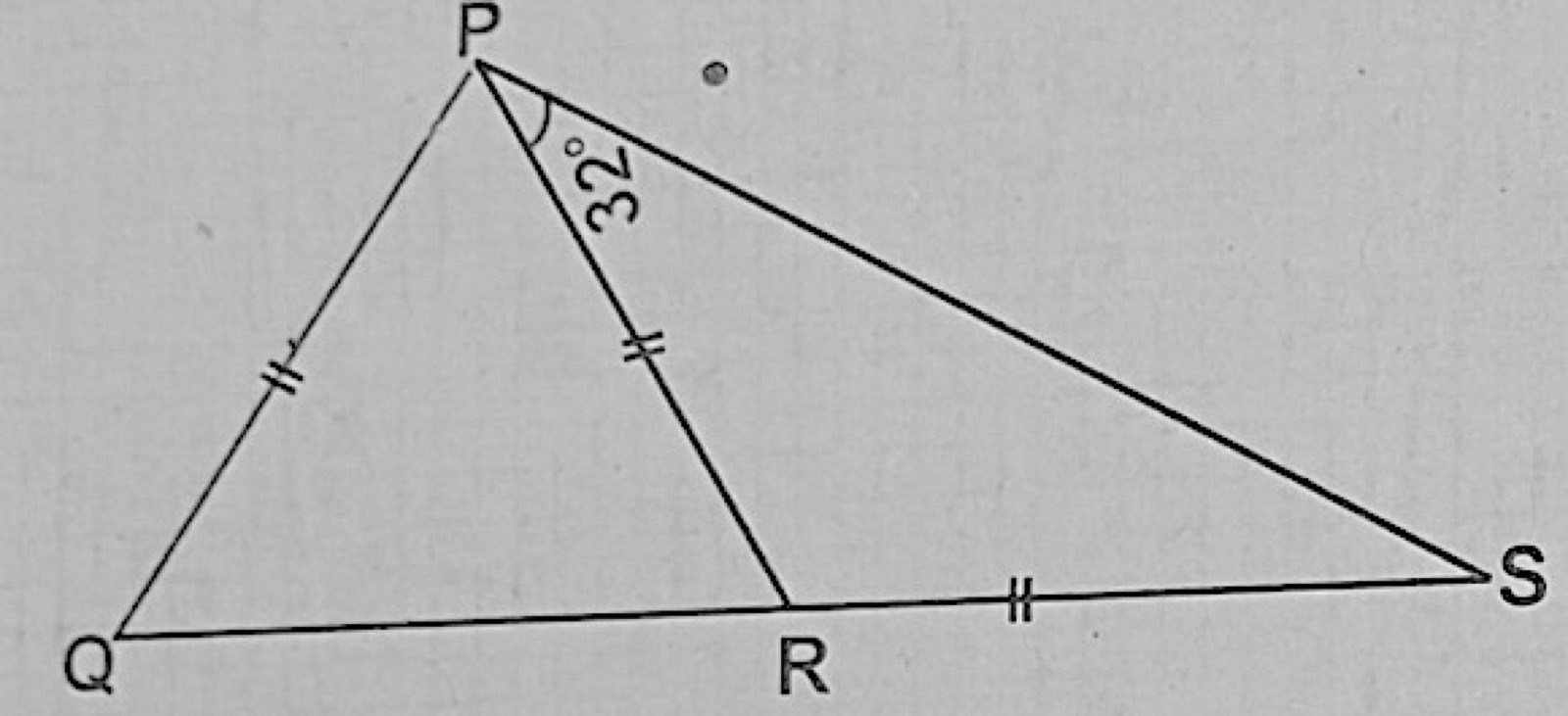
In the diagram below, |PQ| = |PR| = |RS| and ∠RPS = 32°. Find the value of ∠QPR.
Answer: C (52°)
Triangle PRS is isosceles, so ∠RSP = 32° and the exterior angle ∠PRQ = 32° + 32° = 64°. Triangle PQR is isosceles, so ∠PQR = 64° and ∠QPR = 180° − 128° = 52°.
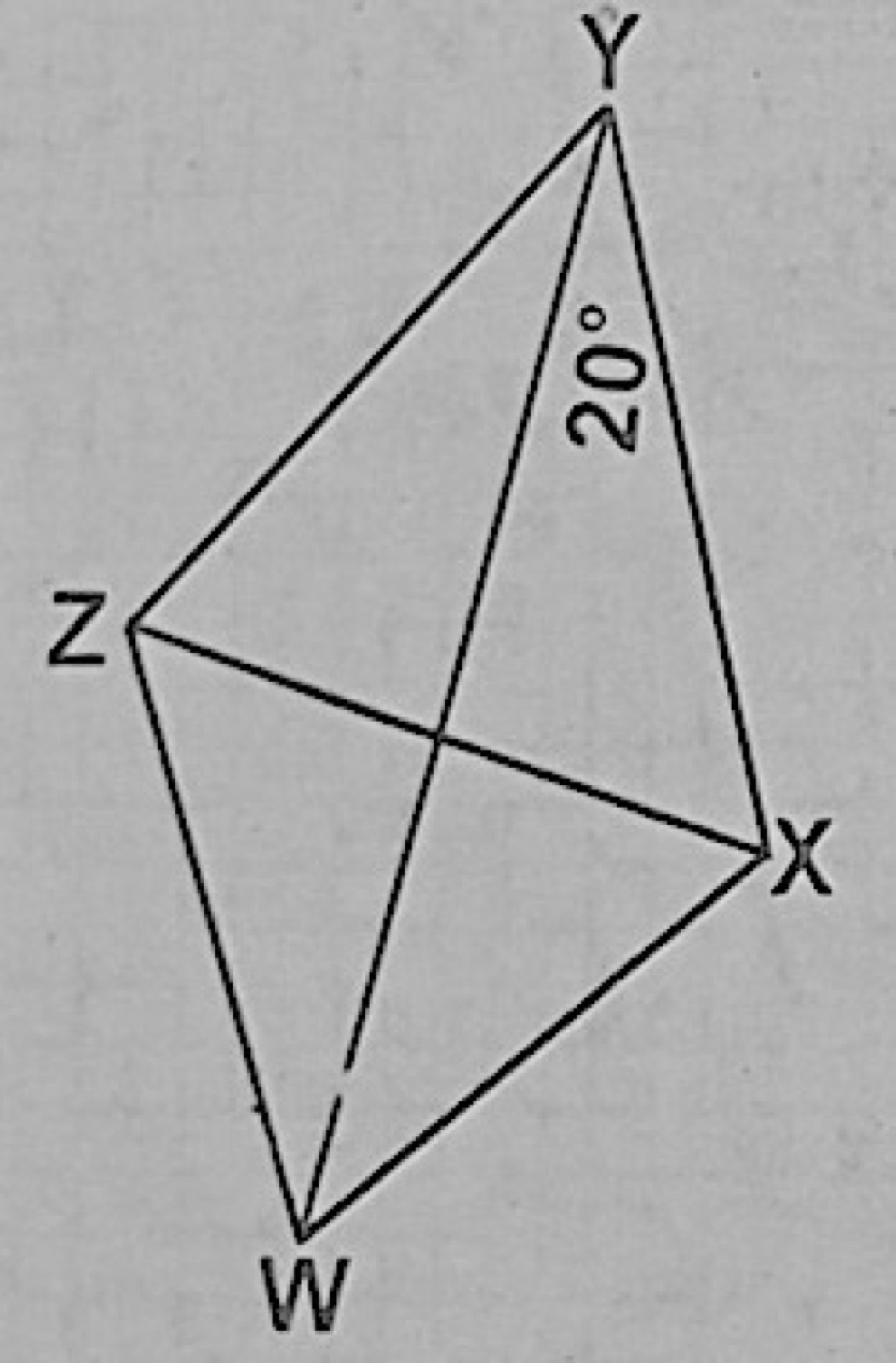
In the diagram below, WXYZ is a rhombus and ∠WYX = 20°. What is the value of ∠XZY?
Answer: E (70°)
A diagonal of a rhombus bisects its angles, so ∠XYZ = 40°. Triangle XYZ is isosceles (YX = YZ), so ∠XZY = (180° − 40°)/2 = 70°.
In the diagram below, PS||RQ, |RQ| = 6.4cm and perpendicular PH = 3.2cm. Find the area of SQR.
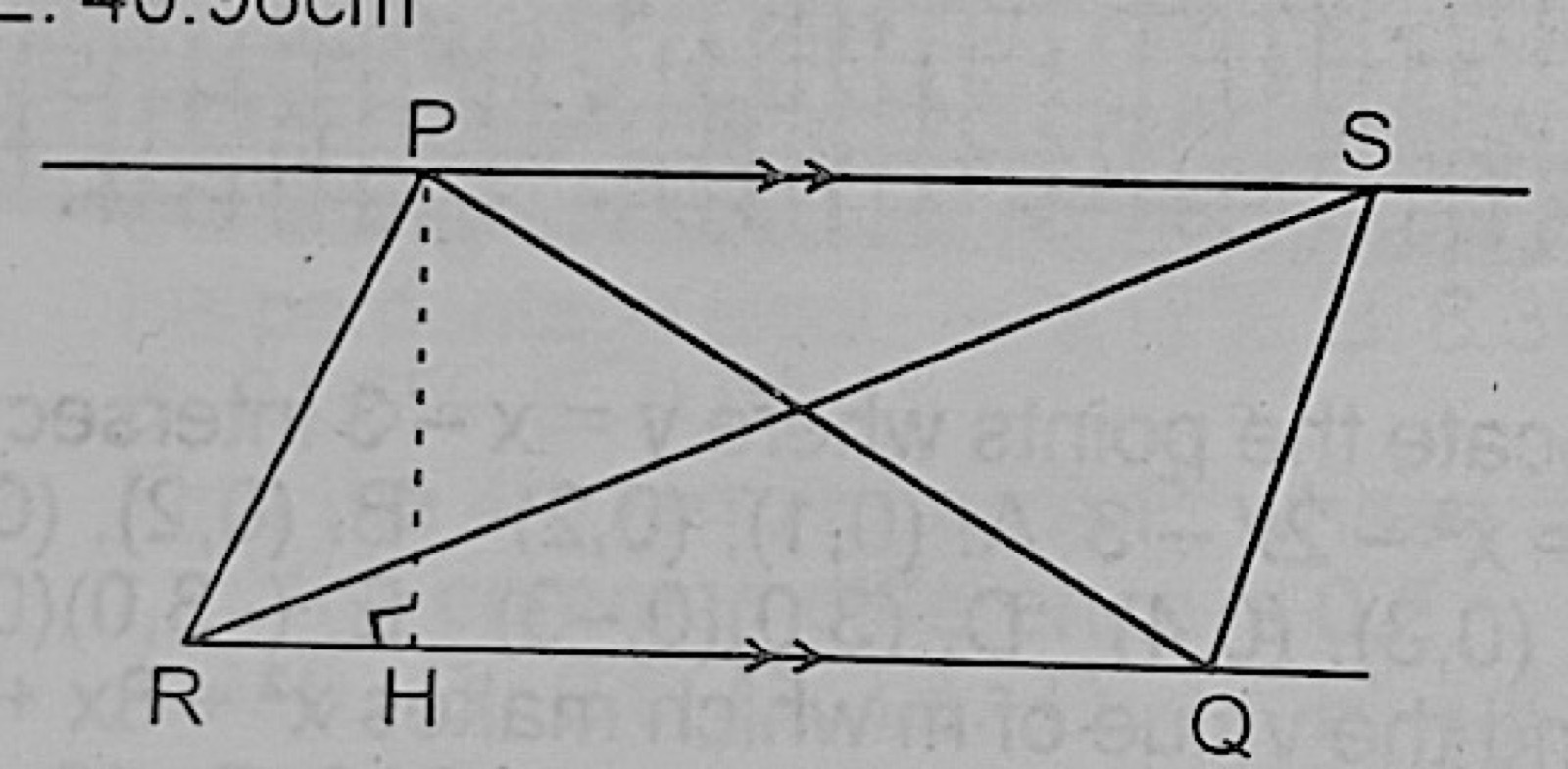
Answer: C (10.24cm2)
S lies on the line PS, which is parallel to RQ, so the height of triangle SQR is also 3.2cm. Area = ½ × 6.4 × 3.2 = 10.24cm2.
Use the diagram below. Which angle is equal to ∠VWZ?
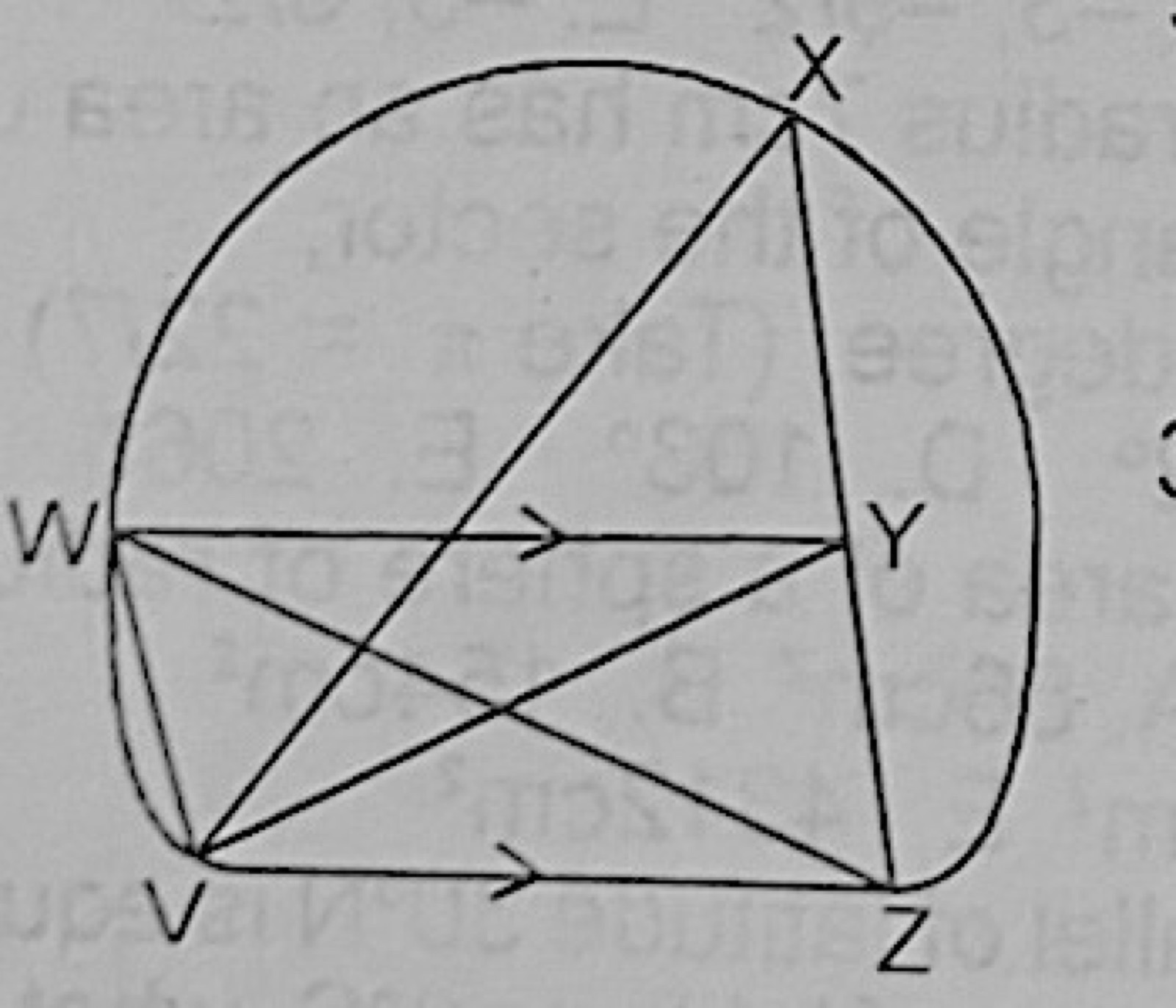
Answer: A (∠VXZ)
W, X, Z and V lie on the circle, so ∠VWZ and ∠VXZ stand on the same chord VZ in the same segment and are equal. Y is not on the circle.
Use the diagram below. Which triangle is equal in area to ΔVWZ?
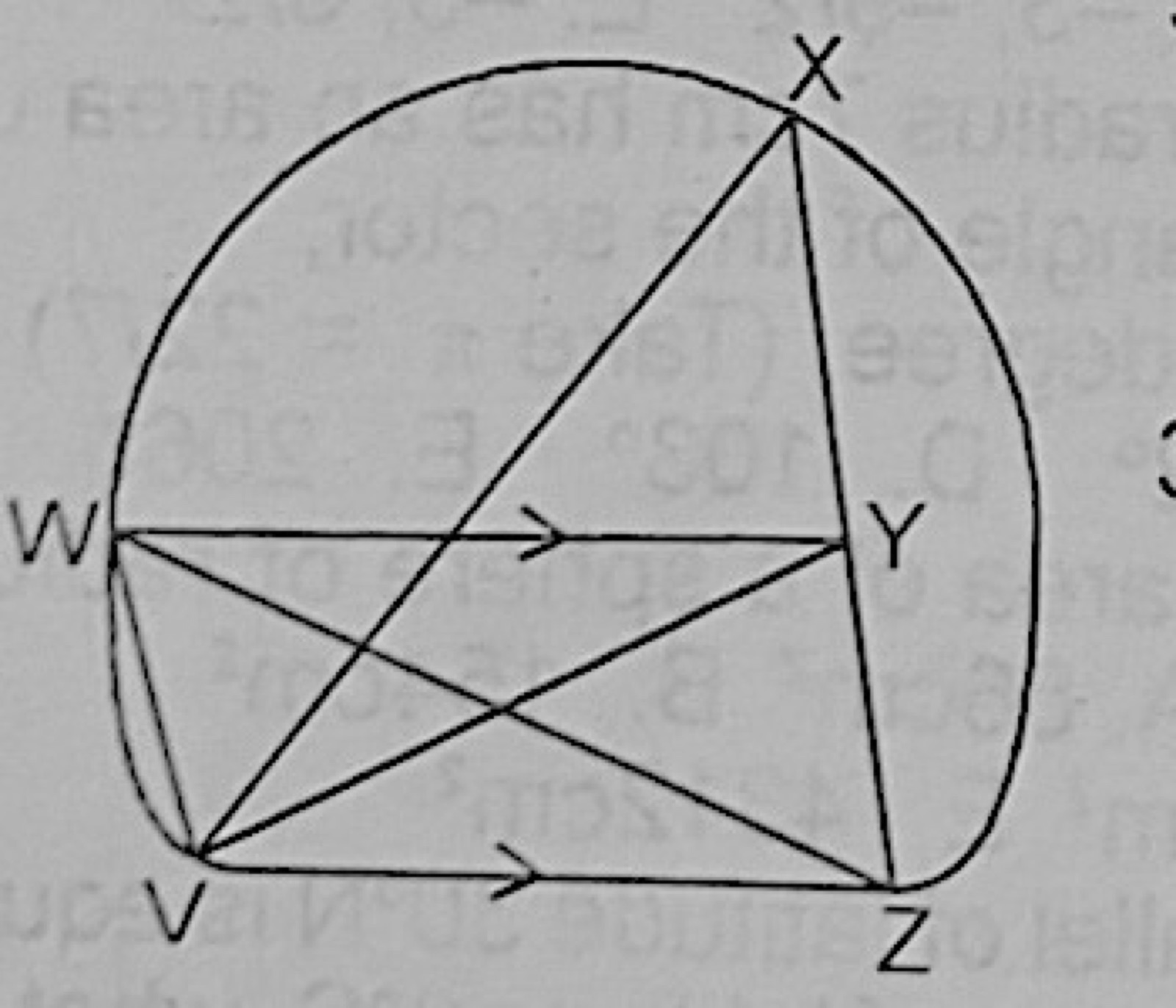
Answer: B (ΔVYZ)
WY is parallel to VZ, so triangles VWZ and VYZ have the same base VZ and lie between the same parallels; their areas are equal.
In the diagram below, PQRS is a cyclic quadrilateral, ∠PSR = 86° and ∠QPR = 38°. Calculate ∠PRQ.
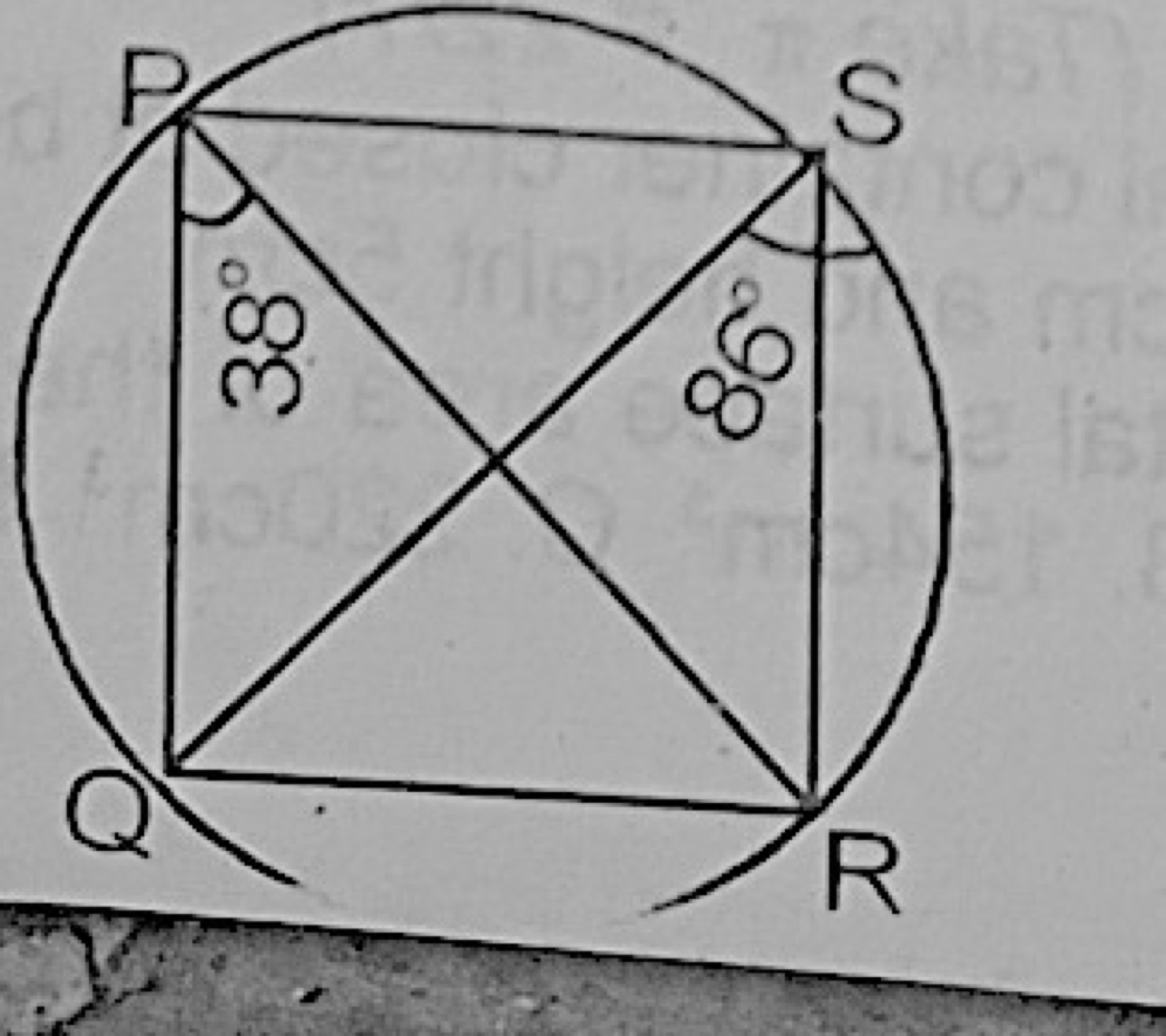
Answer: C (48°)
Opposite angles of a cyclic quadrilateral add to 180°, so ∠PQR = 94°. In triangle PQR, ∠PRQ = 180° − 94° − 38° = 48°.
In the diagram below, O is the centre of the circle. If ∠QOR = 290°, find the size of ∠QPR.
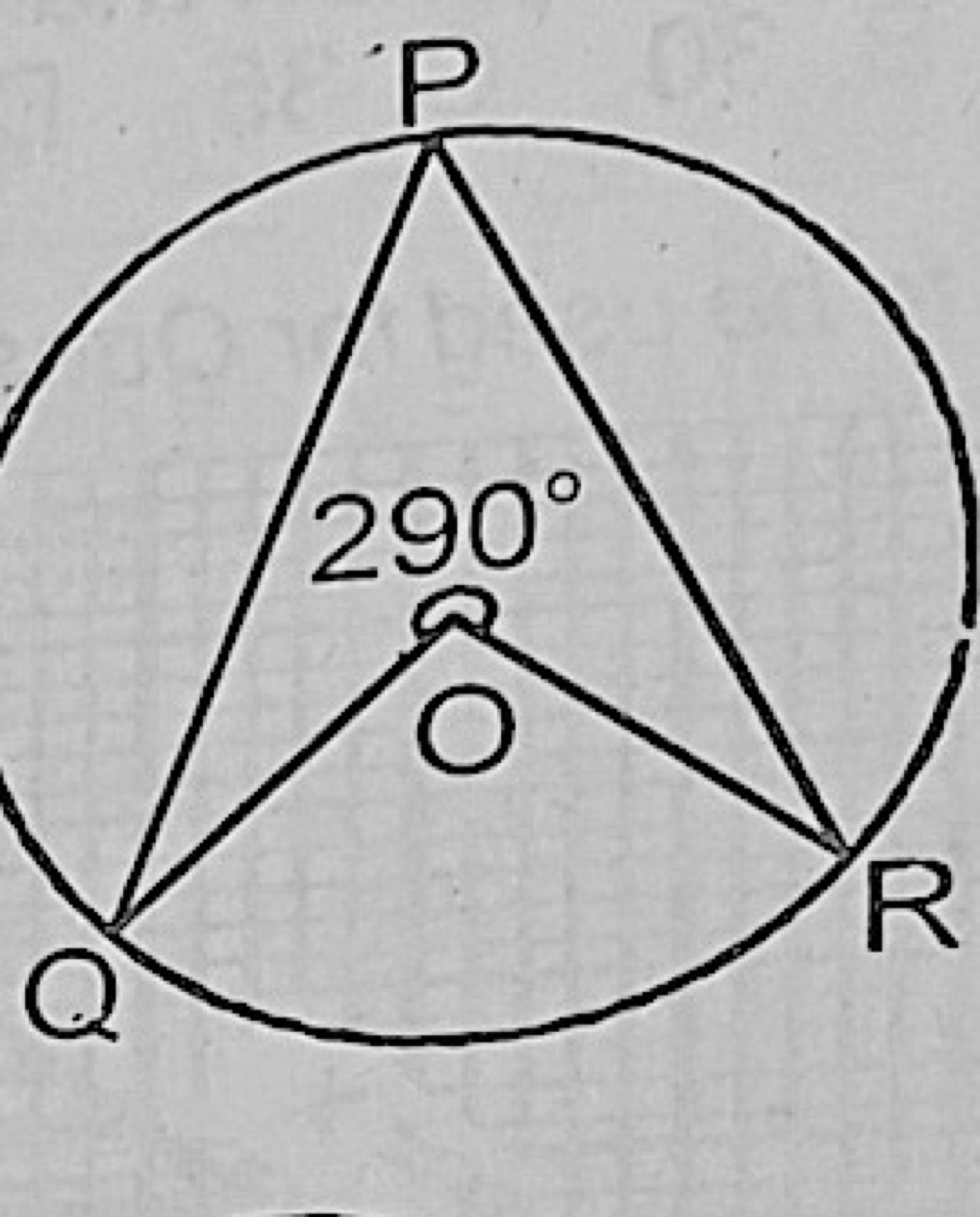
Answer: D (35°)
The 290° is the reflex angle on P's side, so the angle at O facing arc QR is 360° − 290° = 70°. The angle at the circumference is half of it: 35°.
In the diagram, PQ is a tangent at T to the circle ABT. ABC is a straight line and TC bisects ∠BTQ. Find x.
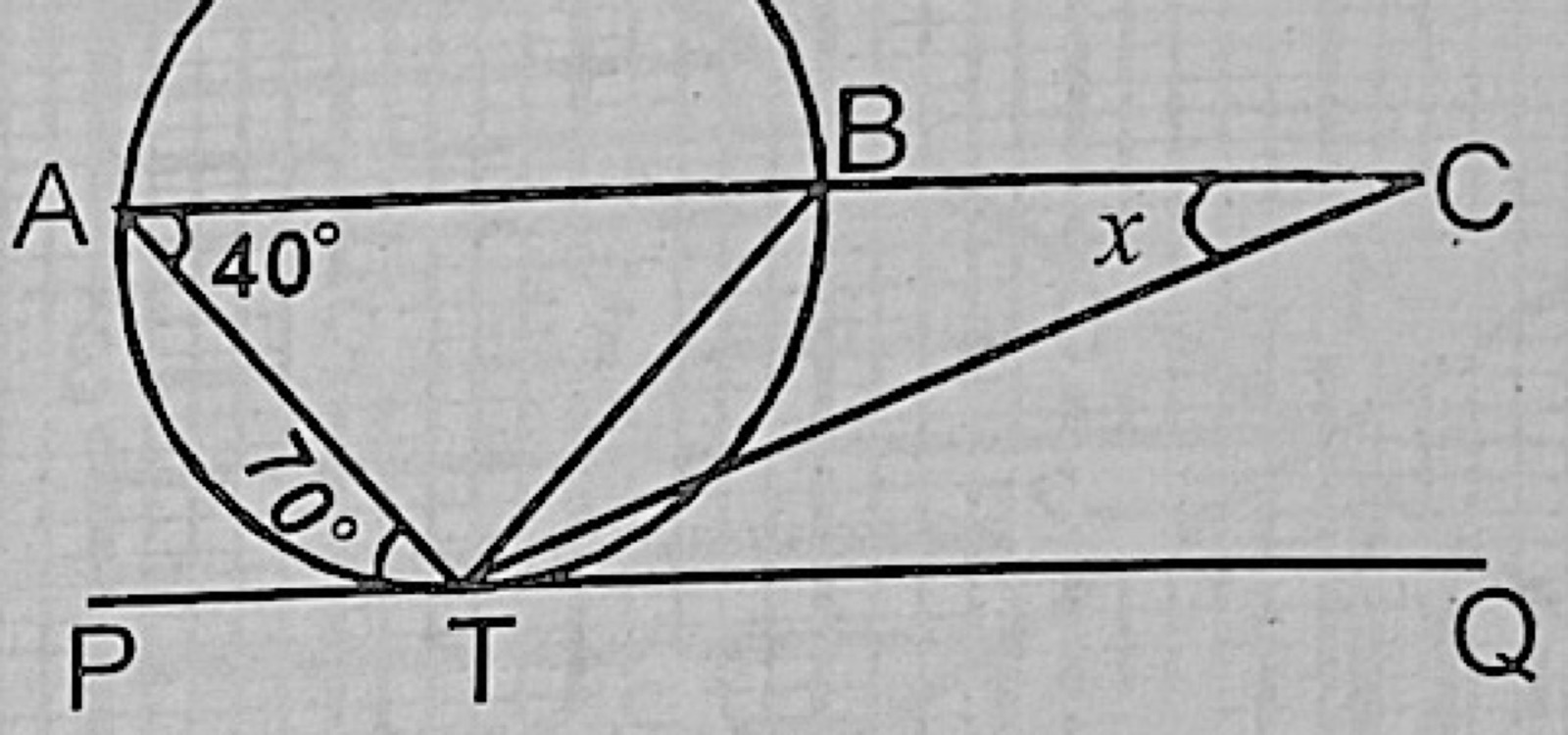
Answer: E (50°)
By the alternate segment theorem, ∠BTQ = ∠BAT = 40° and ∠ABT = ∠ATP = 70°. TC bisects ∠BTQ, so ∠BTC = 20°. In triangle BTC the exterior angle ∠ABT = ∠BTC + x, so x = 70° − 20° = 50°.
Use Mathematical tables to evaluate (cos 40° − sin 30°).
Answer: D (0.2660)
cos 40° = 0.7660 and sin 30° = 0.5000, so the difference is 0.2660.
If the shadow of a pole 7m high is ½ its length, what is the angle of elevation of the sun, correct to the nearest degree?
Answer: B (63°)
The shadow is 3.5m, so tan θ = 7/3.5 = 2 and θ = 63.4° ≈ 63°.
From the top of a building 10m high, the angle of depression of a stone lying on the horizontal ground is 69°. Calculate, correct to 1 decimal place, the distance of the stone from the foot of the building.
Answer: B (3.8m)
The angle of elevation of the top from the stone is 69°, so distance = 10/tan 69° = 10/2.605 = 3.84 ≈ 3.8m.
The bearing of a point X from a point Y is 074°. What is the bearing of Y from X?
Answer: D (254°)
The back bearing differs by 180°: 074° + 180° = 254°.
Using the graph above, find the value of sin 270° + 2 cos 270°.
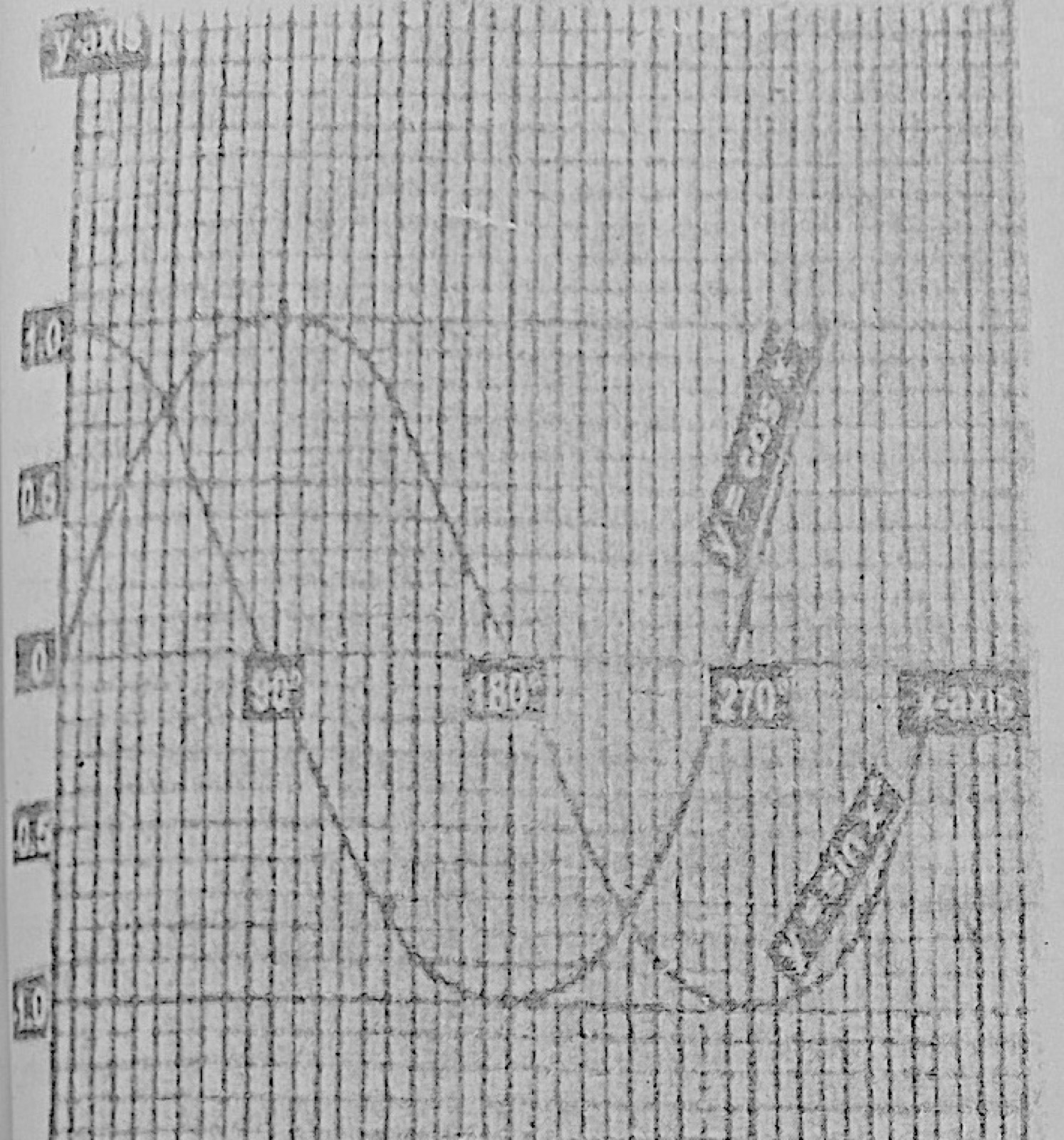
Answer: B (−1)
From the graphs, sin 270° = −1 and cos 270° = 0, so the value is −1 + 0 = −1.
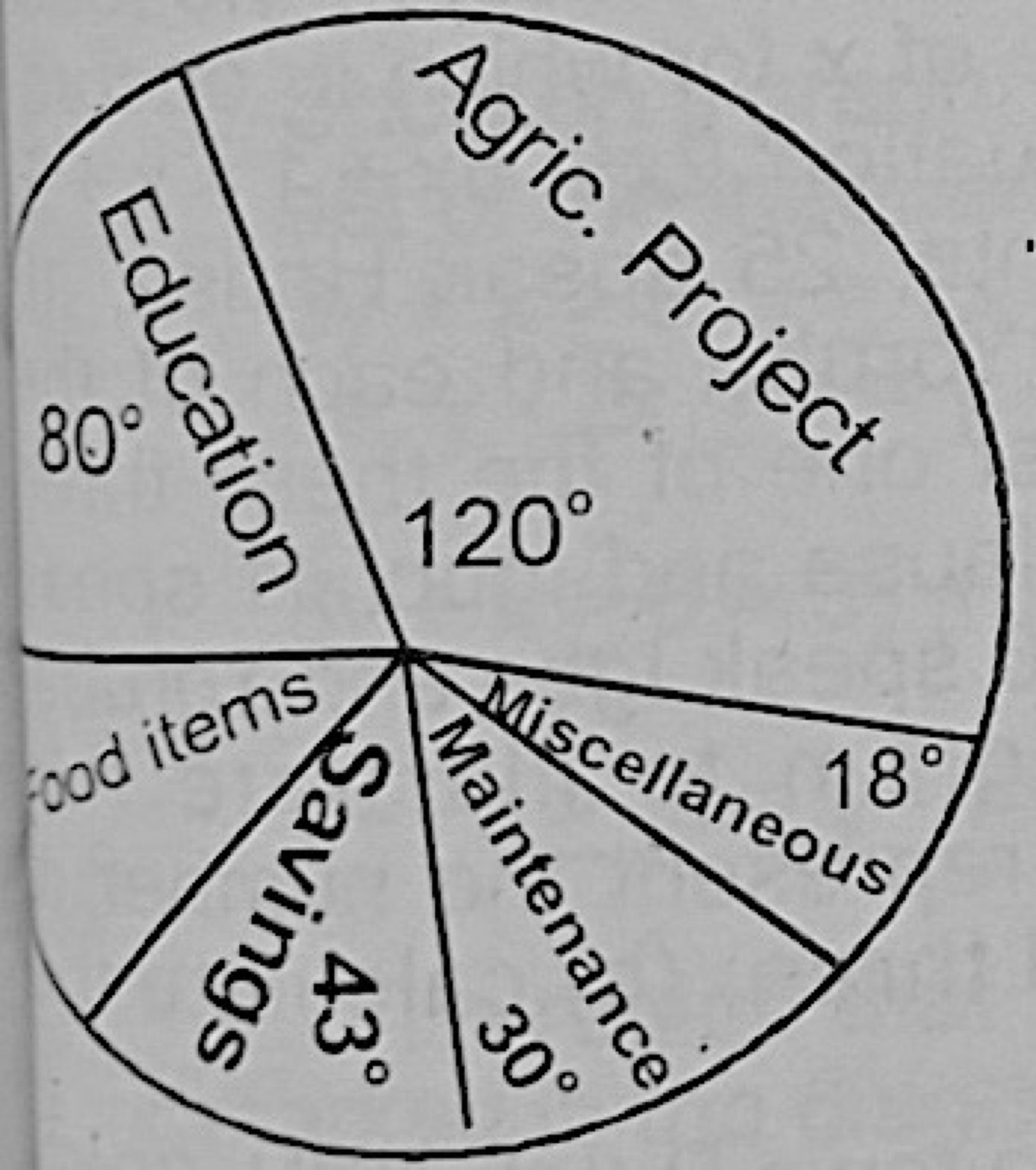
The annual salary of Mr. Johnson Mohammed for 1989 was N12,000.00. He spent this on agricultural projects, education of his children, food items, savings, maintenance and miscellaneous items as shown in the pie chart.
How much did he spend on food items?
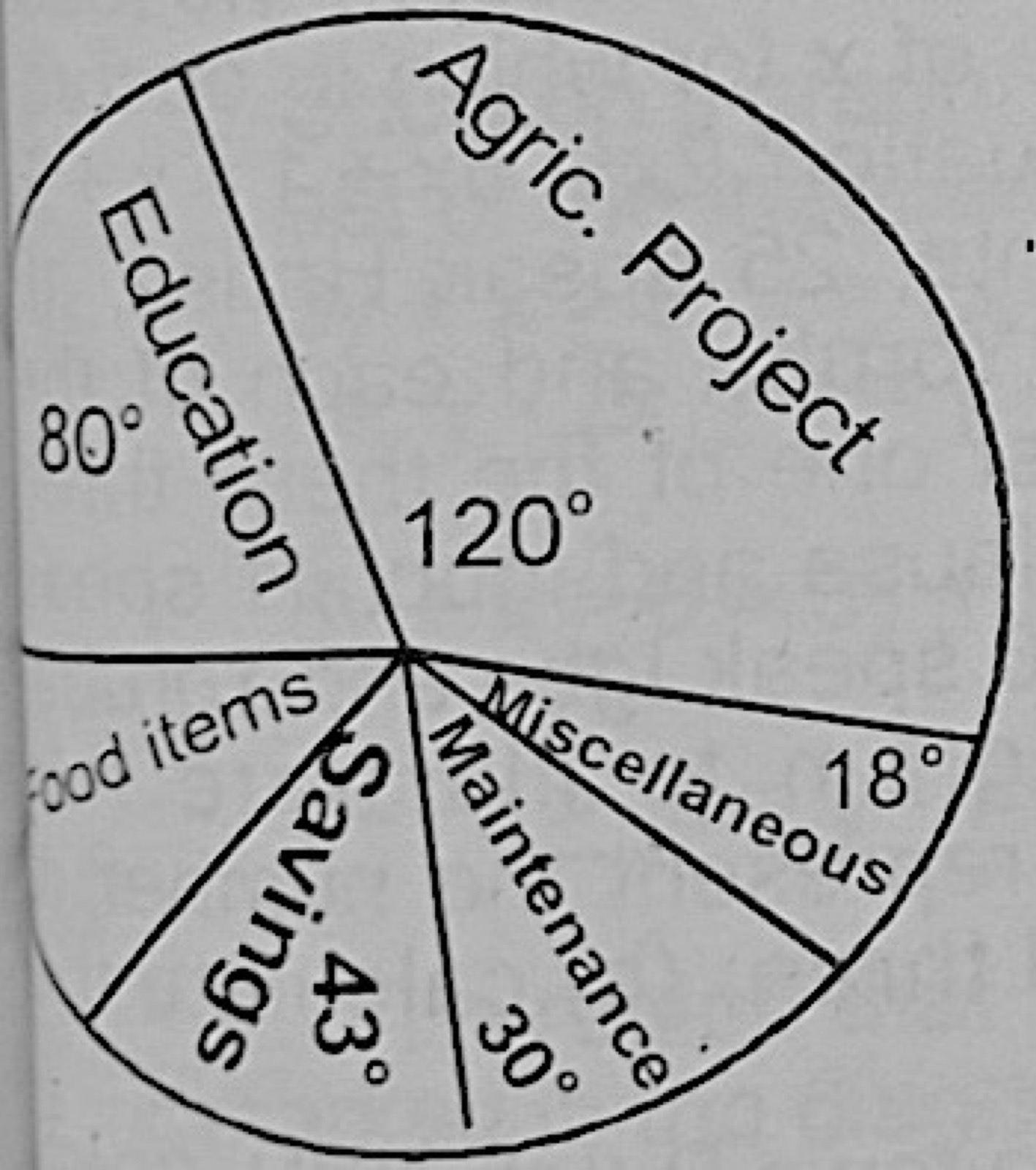
Answer: E (2,300.00)
Food angle = 360° − (120° + 80° + 18° + 30° + 43°) = 69°. Amount = 69/360 × N12,000 = N2,300.
The annual salary of Mr. Johnson Mohammed for 1989 was N12,000.00. He spent this on agricultural projects, education of his children, food items, savings, maintenance and miscellaneous items as shown in the pie chart.
How much money did he invest in agriculture.
Answer: E (N4,000.00)
Agric. project has 120°: 120/360 × N12,000 = N4,000.
The table shows the amount of money (in naira) collected through voluntary donations in a secondary school.
Amount (in naira): 3, 6, 9, 12, 15, 18
No. of Students: 3, 9, 6, 15, 3, 12
What is the mode?
Answer: D (N12)
The amount given by the most students (15 students) is N12.
The table shows the amount of money (in naira) collected through voluntary donations in a secondary school.
Amount (in naira): 3, 6, 9, 12, 15, 18
No. of Students: 3, 9, 6, 15, 3, 12
Find the median of distribution
Answer: C (N12.00)
There are 48 students, so the median is between the 24th and 25th. Cumulative frequencies are 3, 12, 18, 33, … so both lie in the N12 group.
Two groups of male students cast their vote on a particular proposal. The results are as follows:
Group A: In favour 128, Against 32
Group B: In favour 96, Against 48
If a student in favour of the proposal is selected for a post, what is the probability that he is from group A?
Answer: D (4/7)
224 students are in favour and 128 of them are in group A: 128/224 = 4/7.
Two groups of male students cast their vote on a particular proposal. The results are as follows:
Group A: In favour 128, Against 32
Group B: In favour 96, Against 48
If a student is chosen at random, what is probability that he is against the proposal?
Answer: C (5/19)
80 of the 304 students are against: 80/304 = 5/19.
(a) Simplify (0.016 × 0.084)/0.48 leaving your answer in standard form.
(b) Eight wooden poles are to be used for pillars and the lengths of the poles form an Arithmetic Progression (A.P). If the second pole is 2m and the sixth is 5m, give the lengths of the poles, in order.
(a) 0.016 × 0.084 = 0.001344; 0.001344 ÷ 0.48 = 0.0028 = 2.8 × 10⁻³
(b) a + d = 2 and a + 5d = 5, so 4d = 3, d = 0.75m and a = 1.25m
Lengths: 1.25m, 2m, 2.75m, 3.5m, 4.25m, 5m, 5.75m, 6.5m
In (b), subtract the two term equations to find d first.
Show on a graph, the area which gives the solution set of the inequalities:
y − 2x ≤ 4, 3y + x ≥ 6, y ≥ 7x − 9.
Draw the boundary lines y = 2x + 4 (through (0, 4) and (−2, 0)), x + 3y = 6 (through (0, 2) and (6, 0)) and y = 7x − 9 (through (1, −2) and (2, 5)).
Shade the unwanted side of each line: above y = 2x + 4, below x + 3y = 6, below y = 7x − 9 (or shade the wanted region, stating which).
The solution set is the triangle with vertices about (−0.86, 2.29), (1.5, 1.5) and (2.6, 9.2).
Check with a point inside, e.g. (1, 4): 4 − 2 ≤ 4, 12 + 1 ≥ 6, 4 ≥ −2, all true.
Test a point such as (1, 4) in each inequality to know which side to keep.
(a) Prove that the sum of the angles of a triangle is two right angles
(b) The side AB of a triangle ABC is produced to a point D. The bisector of ACB cuts AB at E. Prove that ∠CAE + ∠CBD = 2∠CEB.
(a) Given triangle ABC. Draw a line through A parallel to BC, making angles p (beside B) and q (beside C) at A.
p = ∠B and q = ∠C (alternate angles). p + ∠A + q = 180° (angles on a straight line). So ∠A + ∠B + ∠C = 180° = two right angles.
(b) Let ∠ACE = ∠ECB = c (CE bisects ∠ACB) and ∠CAE = a.
∠CBD is an exterior angle of triangle ABC: ∠CBD = a + 2c.
∠CEB is an exterior angle of triangle AEC: ∠CEB = a + c.
So ∠CAE + ∠CBD = a + a + 2c = 2(a + c) = 2∠CEB.
An exterior angle of a triangle equals the sum of the two interior opposite angles.
A carpenter was told to make a rectangular desk with top, of dimension 50cm by 40cm. The carpenter actually made the desk 60cm by 35cm.
(a) Calculate the percentage error in the: (i) length and the breadth; (ii) area of the table top.
(b) Find the product of the two errors in (a)(i).
(a)(i) Length: error = 10cm, 10/50 × 100 = 20%. Breadth: error = 5cm, 5/40 × 100 = 12.5%
(ii) Intended area = 2000cm2, actual = 2100cm2; error = 100cm2; 100/2000 × 100 = 5%
(b) 20 × 12.5 = 250 (as fractions 0.2 × 0.125 = 0.025)
Percentage error = error ÷ the correct (intended) value × 100.
The feet of two vertical poles of height 3m and 7m are in line with a point P on the ground, the smaller pole being between the taller pole and P and at a distance of 20m from P. The angle of elevation of the top (T) of the taller pole from the top (R) of the smaller pole is 30°. Calculate the: (i) distance RT; (ii) distance of the foot of the taller pole from P, correct to three significant figures; (iii) angle of elevation of T from P, correct to one decimal place.
Height of T above R = 7 − 3 = 4m
(i) sin 30° = 4/RT, so RT = 4/0.5 = 8m
(ii) Distance between the poles = 4/tan 30° = 6.928m; distance from P = 20 + 6.928 = 26.9m
(iii) tan θ = 7/26.93 = 0.2600, θ = 14.6°
Draw the horizontal through R; the right-angled triangle above it has height 4m.
(a) Find the volume of a right solid cone of base radius 4cm and perpendicular height 6cm. (Take π = 3.142)
(b) A hemispherical tank of diameter 10m is filled by water issuing from a pipe of radius 20cm at 2m per second. Calculate, correct to three significant figures, the time, in minutes, it takes to fill the tank.
(a) V = ⅓πr2h = ⅓ × 3.142 × 16 × 6 = 100.5cm3 (≈ 101cm3)
(b) Tank volume = ⅔πr3 = ⅔ × 3.142 × 53 = 261.8m3
Water per second = π(0.2)2 × 2 = 0.2514m3
Time = 261.8 ÷ 0.2514 = 1041.7s = 17.4 minutes
Change 20cm to 0.2m before working out the flow.
The weights to the nearest kilogram of a group of 50 students in a College of Technology are given below:
65, 70, 60, 46, 51, 55, 59, 63, 68, 53
47, 53, 72, 53, 67, 62, 64, 70, 57, 56
73, 56, 48, 51, 58, 63, 65, 62, 49, 64
53, 59, 63, 50, 48, 72, 67, 56, 61, 64
66, 52, 49, 62, 71, 58, 53, 69, 63, 59
(a) Prepare a grouped frequency table with class intervals 45 − 49, 50 − 54, 55 − 59, etc.
(b) Using an assumed mean of 62 or otherwise, calculate the mean and the standard deviation of the grouped data, correct to one decimal place.
(a) 45−49: 6; 50−54: 9; 55−59: 10; 60−64: 12; 65−69: 7; 70−74: 6 (total 50)
(b) Class marks 47, 52, 57, 62, 67, 72; d = x − 62: −15, −10, −5, 0, 5, 10
Σfd = −90 − 90 − 50 + 0 + 35 + 60 = −135; mean = 62 − 135/50 = 59.3kg
Σfd2 = 1350 + 900 + 250 + 0 + 175 + 600 = 3275
SD = √(3275/50 − (−2.7)2) = √(65.5 − 7.29) = √58.21 = 7.6kg
Use tally marks so that no weight is missed or counted twice.
ABCD is a trapezium in which AB||DC, |AB| = 8cm, ∠ABC = 60°, |BC| = 5.5cm and |BD| = 8.3cm.
(a) Using a ruler and a pair of compasses only, construct (i) the trapezium ABCD; (ii) a rectangle PQCD, where P, Q are two points on AB.
(b) Measure |AC| and |QB|
(a)(i) Draw AB = 8cm; construct 60° at B and mark C with BC = 5.5cm; construct a line through C parallel to AB; with centre B and radius 8.3cm cut this line at D; join AD. Construction arcs must be shown.
(ii) Drop perpendiculars from D and C to AB, meeting AB at P and Q; PQCD is the rectangle.
(b) |AC| ≈ 7.1cm; |QB| ≈ 2.75cm (accept 2.7−2.8cm)
To draw the parallel through C, copy the angle at B or construct two perpendiculars.
(a) If a number is chosen at random from the integers 5 to 25 inclusive, find the probability that the number is a multiple of 5 or 3.
(b) A bag contains 10 balls that differ only in colour; 4 are blue and the others are red. Two balls are picked, one after the other with replacement. What is the probability that (i) both are red? (ii) both are the same colour?
(a) 21 integers. Multiples of 5: 5, 10, 15, 20, 25. Multiples of 3: 6, 9, 12, 15, 18, 21, 24. 15 is in both, so 11 numbers. P = 11/21
(b) P(red) = 6/10, P(blue) = 4/10
(i) 6/10 × 6/10 = 9/25
(ii) 9/25 + (4/10 × 4/10) = 9/25 + 4/25 = 13/25
Count a number like 15 that is a multiple of both only once.
The following is an incomplete table for the relation y = 2x2 − 5x + 1
x: −3, −2, −1, 0, 1, 2, 3, 4, 5
y: _, _, 8, 1, −2, _, _, _, 26
(a) Copy and complete the table.
(b) Using a scale of 2cm to 1 unit on the x axis and 2cm to 10 units on the y axis, draw a graph of the relation y = 2x2 − 5x + 1 for −3 ≤ x ≤ 5.
(c) Using the same scale and axes, draw the graph of y = x + 6.
(d) Estimate from your graphs, correct to one decimal place: (i) the least value of y and the value of x for which it occurs; (ii) the solution of the equation 2x2 − 5x + 1 = x + 6.
(a) y = 34, 19, 8, 1, −2, −1, 4, 13, 26
(b) Smooth U-shaped curve through the plotted points with the given scales
(c) Straight line through e.g. (−3, 3), (0, 6), (5, 11)
(d)(i) Least value of y ≈ −2.1 at x ≈ 1.3 (exact: −2.125 at x = 1.25)
(ii) Read x at the intersections: x ≈ −0.7 or x ≈ 3.7 (since 2x2 − 6x − 5 = 0)
The solutions of the equation are the x-values where the curve and the line cross.
In a class of 40 students, 25 speak Hausa, 16 speak Igbo, 21 speak Yoruba and each of the students speaks at least one of these three languages. If 8 speak Hausa and Igbo, 11 speak Hausa and Yoruba and 6 speak Igbo and Yoruba
(a) Draw a Venn diagram to illustrate this information, using x to represent the number of students that speak all three;
(b) calculate the value of x.
(a) Three overlapping circles H, I, Y in a rectangle of 40. Regions: H∩I only = 8 − x; H∩Y only = 11 − x; I∩Y only = 6 − x; centre = x; H only = 25 − (8 − x) − (11 − x) − x = 6 + x; I only = 2 + x; Y only = 4 + x
(b) Sum of regions = 40: (6 + x) + (2 + x) + (4 + x) + (8 − x) + (11 − x) + (6 − x) + x = 37 + x = 40
x = 3
Fill the centre first, then the pairs, then the 'only' regions.
An aeroplane flies from a town P (lat. 40°N, 38°E) to another town Q (lat. 40°N, 22°W). It later flies to a third town T (28°N, 22°W). Calculate the: (a) distance between P and Q along their parallel of latitude; (b) distance between Q and T along the line of longitudes. (c) average speed at which the aeroplane will fly from P to T via Q, if the journey takes 12 hours, correct to three significant figures. (Take the radius of the earth to be 6400km and π = 3.142)
(a) Difference in longitude = 38° + 22° = 60°
PQ = 60/360 × 2 × 3.142 × 6400 × cos 40° = 5135km ≈ 5130km
(b) Difference in latitude = 40° − 28° = 12°
QT = 12/360 × 2 × 3.142 × 6400 = 1341km ≈ 1340km
(c) Total distance ≈ 6475km; speed = 6475 ÷ 12 ≈ 540km/h
Along a parallel of latitude use the radius R cos(latitude); along a meridian use R.